360 Assessment for Leadership: Implementation Guide
By Synopsix · August 2, 2026 · 15 min read
Most advice about a 360 assessment for leadership starts in the wrong place. It treats survey design as the main event, then acts surprised when leaders stare at a polished report and change almost nothing. The harder work starts after the last rater clicks submit, when someone has to turn anonymous feedback into a narrow, credible, behavior-change plan that a busy leader will use.
That post-feedback gap is where most programs leak value. Teams spend real effort getting clean data, good participation, and tidy dashboards, then hand the leader a long list of strengths and gaps with no clear sequence. In practice, broad feedback can overwhelm managers, generic action plans fade fast, and the organization ends up praising the process without improving leadership behavior.
Why Most 360 Programs Fail After the Survey Closes
The easiest part of a 360 program is making the survey look professional. A true failure point is what happens when the report lands in a leader's inbox and nobody has designed the next three moves. A beautiful data set doesn't matter if the leader is left alone with twenty insights, most of them too broad to act on.
The common mistake is treating feedback as the outcome
A lot of organizations stop at “identify gaps.” That sounds reasonable, but it's where momentum dies. If the feedback doesn't become a short list of business-relevant behaviors, the leader reads it once, nods politely, and goes back to firefighting.
A multi-rater process is supposed to change behavior, not just generate commentary. Qualtrics describes 360 feedback as a development tool, and TechClass is explicit that it becomes effective when it's paired with coaching and action plans. Without that bridge, the organization gets a scorecard instead of development.
> Practical rule: If the next step after the report is another meeting to “reflect on the data,” the program is probably too vague.
Broad feedback creates decision paralysis
Complex leaders usually have more than one gap. That's the problem. When the report highlights several weaknesses across peers, direct reports, and managers, the leader often can't tell which issue is the constraint on performance.
The better move is to focus on one high-stakes skill where the self-view and others' views diverge most. That approach keeps the development plan tied to actual work, not to a generic wish list. It also protects managers from the trap of trying to fix every low score at once, which usually means fixing nothing well.
A useful 360 process should end with a sequence, not a summary. First, identify the behavioral pattern that matters most. Then connect it to a business outcome the leader owns. Then define the smallest practice set that can shift it.
> A report that creates urgency without direction often does more harm than good.
The overlooked gap is not data quality, it's post-feedback action design. That's why the most effective practitioners don't ask, “What does the report say?” They ask, “What will the leader do differently next week, and who will hold that change together?” For a practical sample of how this can be framed, the [360 assessment sample](https://synopsix.ai/blog/360-assessment-sample) is useful as a reference point.
The Mechanics of Multi-Rater Leadership Feedback
A strong 360 assessment for leadership works because it compares the leader's self-perception with how different parts of the work network experience that leader. The University of Minnesota describes 360-degree assessment as feedback from a professional network that includes managers, peers, and direct reports, and Psychometrics likewise frames it as anonymous input from supervisors, co-workers, direct reports, and others. That multi-rater design is the core mechanic, not a cosmetic feature.
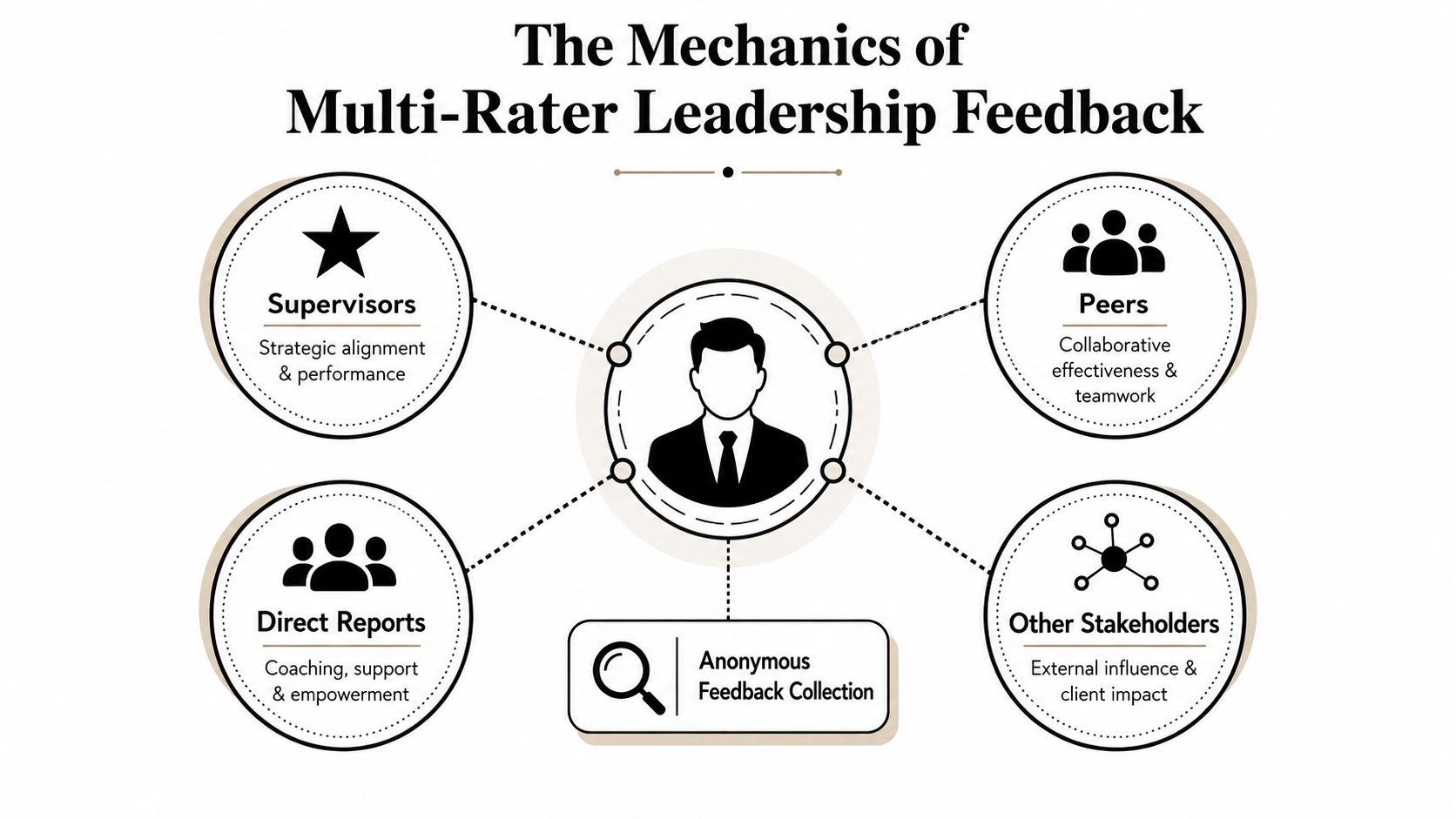
Why multiple raters outperform manager-only reviews
Single-manager reviews only capture one vantage point. That's fine for some performance conversations, but it misses how a leader behaves across meetings, cross-functional work, and day-to-day coaching moments. Multi-rater feedback catches the friction points that a manager may never see directly.
The value is not just volume. It's contrast. A leader may believe they are clear and collaborative, while peers and direct reports experience them differently. That comparison is where blind spots surface, and it's why lower 360 ratings on task and interpersonal leadership are associated with greater derailment risk, according to the CCL validation paper referenced in the trade press summary.
A major validation study of the Extraordinary Leader 360-degree survey analyzed 1,596,938 multi-rater assessments covering 26,314 leaders and 237,123 survey responses, which makes it one of the largest published evidence bases for leadership 360 feedback ([validation study](https://zengerfolkman.com/wp-content/uploads/2019/04/Extraordinary-Leader-360-Survey-Validation_2023.pdf)). The study reported a Pearson correlation of 0.561 between the survey's two leadership indices, significant at the 0.000 level, which the authors used to support validity and reliability.
The model matters more than the format
A technically defensible 360 isn't built around vague personality language. DDI's guidance is clear that the assessment should use a validated, role-relevant competency model and raters who interact regularly with the leader to reduce noise. That's the difference between a score that feels random and a score that describes behavior.
This is also why adoption is so widespread. A Talent Development survey found that 77% of responding organizations used 360-degree assessments, and 40% considered them highly or very highly effective for assessing executive potential (TD Magazine summary). The method has become mainstream because teams need more than top-down judgment.
A structured competency model makes the data usable
The U.S. federal Leadership 360 is a strong example of operationalization. OPM maps feedback to 28 governmentwide leadership competencies across the five Executive Core Qualifications, including Leading Change, Leading People, Results Driven, Business Acumen, and Building Coalitions & Communication (OPM Leadership 360). That structure turns feedback into a signal leaders can act on, not just a satisfaction survey.
Designing a Technically Sound Assessment
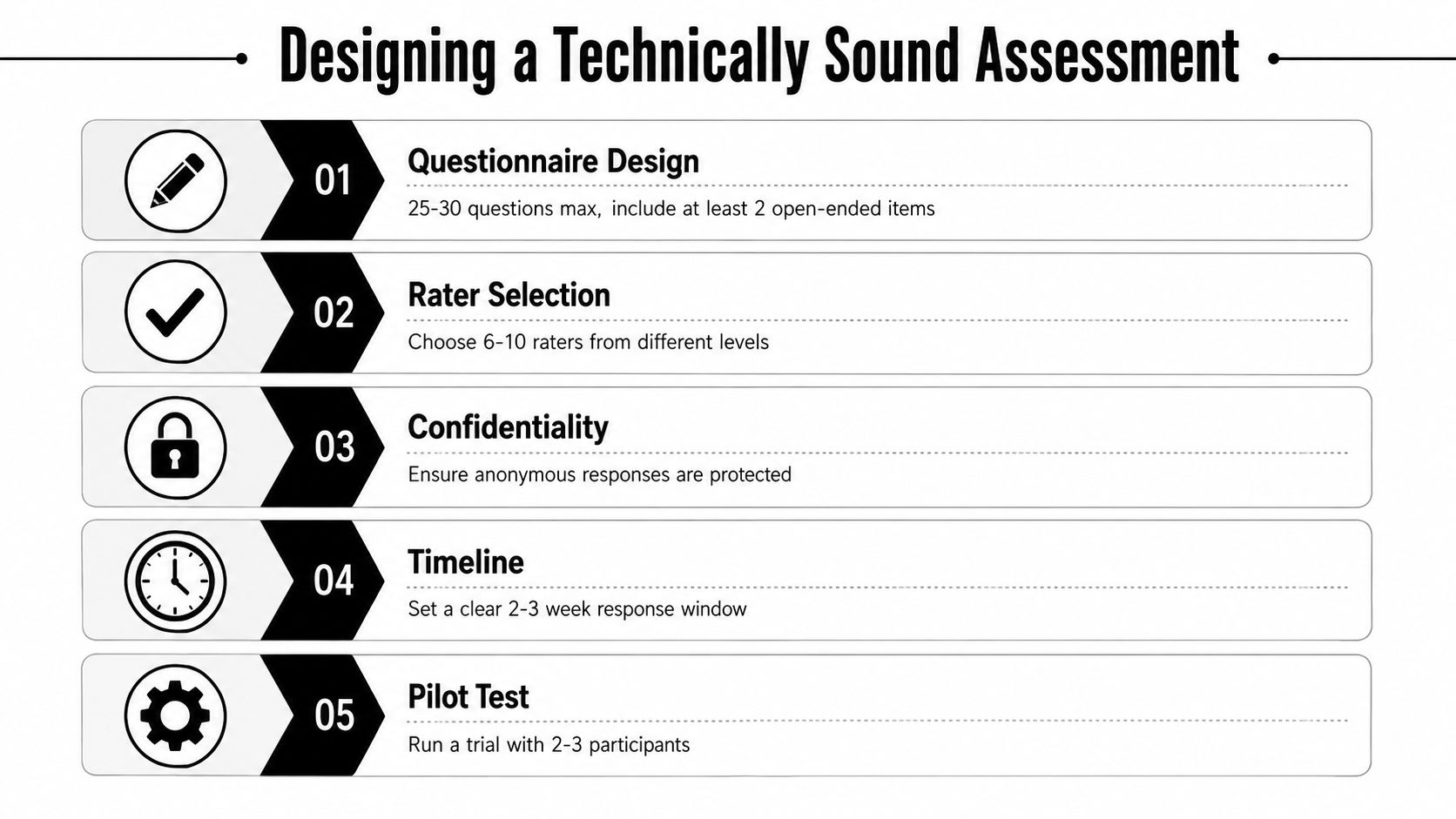
Good 360 design is mostly about discipline. Keep the instrument tight, make the raters relevant, and protect anonymity in a way people can trust. If any of those pieces are sloppy, the feedback won't feel credible enough to drive change.
Build for speed and clarity
A practitioner guide on YouTube recommends keeping the questionnaire to 25 to 30 questions or fewer, with at least 2 open-ended questions, so people can finish without losing focus and the debrief stays manageable ([practitioner guide](https://www.youtube.com/watch?v=nAIAb4lnT5g)). That's a sensible ceiling. Once the survey gets bloated, raters start clicking faster and the feedback gets thinner.
Tell participants the survey usually takes 5 to 10 minutes. That simple expectation-setting can improve participation because people know they're not being asked to sit through a long evaluation. The same guide also recommends giving raters at least 2 weeks to respond so holidays and busy periods don't wipe out completion rates.
Pick raters who actually observe the behavior
The best rater pool is small enough to manage and broad enough to show real patterns. DDI's guidance emphasizes selecting enough raters who interact regularly with the leader to reduce noise. A random audience won't help. Neither will a group that only knows the leader from occasional updates.
> Practical rule: Choose raters who have seen the leader under pressure, in meetings, and in day-to-day collaboration, not just in polished presentations.
Keep anonymity real, not rhetorical
A 360 only works when people believe their comments won't be traced back to them. The practitioner guidance above recommends averaging responses so no individual can be identified, and that's the standard leaders usually trust most. If the group is too small or the process feels exposed, the ratings get softer and the comments get less honest.
Tying questions to specific behaviors also matters. Vague traits invite fuzzy ratings. Behavior-based items create cleaner comparisons across self, peers, direct reports, and managers, which makes the report easier to discuss and harder to dismiss.
For a deeper look at how measurement quality affects interpretation, the [validity in psychology](https://synopsix.ai/blog/validity-in-psychology) discussion is a useful companion read.
Using 360 Data for Future Leadership Capability
Most organizations still use 360s as a mirror for current blind spots. That's useful, but incomplete. The stronger move is to treat the same data as a forecast signal for what the business will need from leaders in the next few years.
Link the competency model to the strategy, not the org chart
CCL's guidance points organizations toward a sharper question, which leadership skills will matter more in the next 3 to 5 years. That question changes how you use the data. Instead of only asking whether a manager is strong today, you also ask whether the current competency model still reflects where the business is going.
That matters in environments shaped by digital transformation and AI. Microsoft's 2024 Work Trend Index found that 75% of knowledge workers already use AI at work, 59% of leaders say they need to increase productivity, and 60% say they lack a clear vision and plan for AI adoption. Those conditions create new leadership demands faster than legacy models usually adapt.
The point isn't to stuff the assessment with trendy language. It's to rewrite the competency model so it captures the behaviors the business will reward next. Cross-functional execution, judgment in AI-supported workflows, and the ability to align teams across changing priorities are becoming more relevant than some older management habits that still dominate annual review forms.
Forecast capability gaps before they become succession gaps
360 data becomes strategic here. If repeated feedback shows that emerging managers struggle with influence, alignment, or coaching across functions, that's not just a development issue. It's a succession risk. The organization may have strong individual performers but a weak future bench.
CCL explicitly recommends linking leadership strategy to business strategy, and that's the right operating principle here. If the company is heading into a more matrixed, digital, or client-facing operating model, the competency framework should change before the promotion slate does.
For teams looking at adjacent planning tools, [AI career tools 2024](https://writingmate.ai/blog/best-ai-tools-for-career-development-in-2024) is a helpful resource for thinking about how AI literacy is showing up in development ecosystems. That kind of context helps HR leaders decide whether a 360 should emphasize today's gaps, tomorrow's capabilities, or both.
Use future-focused 360s to reshape development priorities
A future-oriented 360 doesn't just ask, “What did people notice?” It asks, “Which leadership behaviors will become more important as the operating model changes?” That shift makes the assessment more useful for succession planning, capability mapping, and targeted leadership investments.
Converting Feedback into Focused Development Plans
The most useful 360 reports don't try to fix the whole leader. They pick one meaningful behavior and build around it. That feels narrower than many executives expect, but it's usually what creates actual change.
Start by narrowing the signal
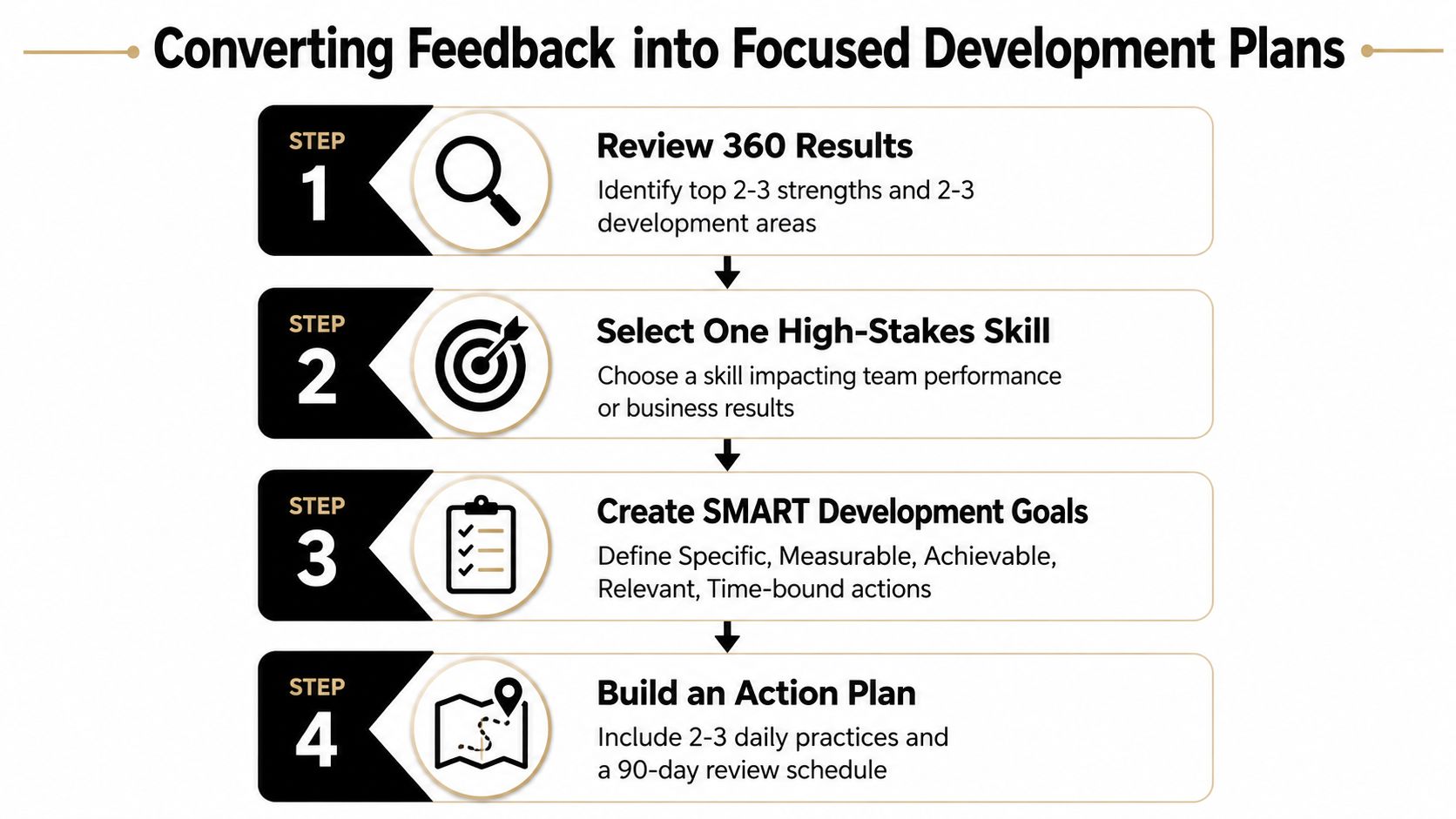
Review the report for the top strengths and the top development areas, then look for the biggest divergence between self-view and others' views. That gap usually tells you where the leader's behavior is affecting the team most. It's the clearest place to start because it's specific enough to act on and visible enough to measure.
A practical development plan should be tied to the leader's actual role. If the person runs a cross-functional team, the issue might be clarity in decision-making. If the role is people-heavy, the issue might be coaching consistency. Broad labels like “be more strategic” rarely change behavior because they don't tell the leader what to do differently on Tuesday morning.
Build the plan around one high-stakes skill
Once the skill is chosen, define what better looks like in observable terms. Then pair the 360 data with a small set of recurring practices, not a long wish list. TechClass is right to stress follow-up activities such as coaching and action plans, because feedback without practice rarely sticks.
The structure in [leadership development planning](https://synopsix.ai/blog/leadership-development-planning) is useful here because it forces discipline around priorities and follow-through. A 90-day plan should be short, behavior-based, and reviewed on a fixed schedule so the leader doesn't drift back into old habits.
> The best action plans are boring in the right way. They are small, visible, and repeated often enough to become habits.
Make the plan business-relevant
Translate the 360 result into an impact statement. If the issue is inconsistent delegation, the business effect might be bottlenecks. If it's weak coaching, the cost might be slower team growth. That translation helps senior stakeholders see the plan as operational, not therapeutic.
Synopsix is one option that can help turn assessment results into comparable behavioral profiles, business-language intelligence reports, and development plans that are easier to act on. Used well, that kind of platform can reduce the gap between psychometric data and day-to-day leadership decisions.
Common Implementation Pitfalls and How to Avoid Them
One director I worked with had a clean-looking 360 process on paper. The survey was polished, the questions were aligned to the competency model, and the results came back on time. The problem was participation. Raters were given too little time, the launch happened during a holiday-heavy period, and the comments that did come in were cautious enough to be useless.
Timing mistakes kill participation first
When rater response windows are too short, the process excludes the people whose input matters most. The practitioner guidance above recommends at least 2 weeks, and that's not bureaucratic caution, it's operational realism. Busy periods and holidays matter more than leaders like to admit.
I've also seen managers undermine the process by treating it like an HR exercise instead of a leadership tool. When sponsors don't explain why the assessment matters, raters assume their time won't change anything. Participation drops, and the report ends up over-weighting the easiest responders instead of the most relevant ones.
Anonymity breaches destroy trust fast
The second common failure is any hint that comments can be traced back to a person or small subgroup. Once that suspicion spreads, the next cycle gets softer ratings and blander comments. At that point, the organization is managing fear, not feedback.
The fix is simple but essential. Average responses, protect rater anonymity, and don't over-segment the data in small populations. If the audience is too tiny to keep identities safe, the report should be aggregated more tightly or delayed.
Misusing the tool breaks the whole program
A 360 is built for development, not compensation. Qualtrics is explicit about that, and I agree with the distinction. The moment leaders think the ratings will affect pay or promotion directly, they edit themselves and the honest signal disappears.
Vague competency models cause a different kind of damage. If the items are too abstract, leaders can't tell what to change, and raters can't tell what they're evaluating. The result looks professional but feels hollow, which is usually how programs lose credibility after one cycle.
Measuring Success and Demonstrating ROI
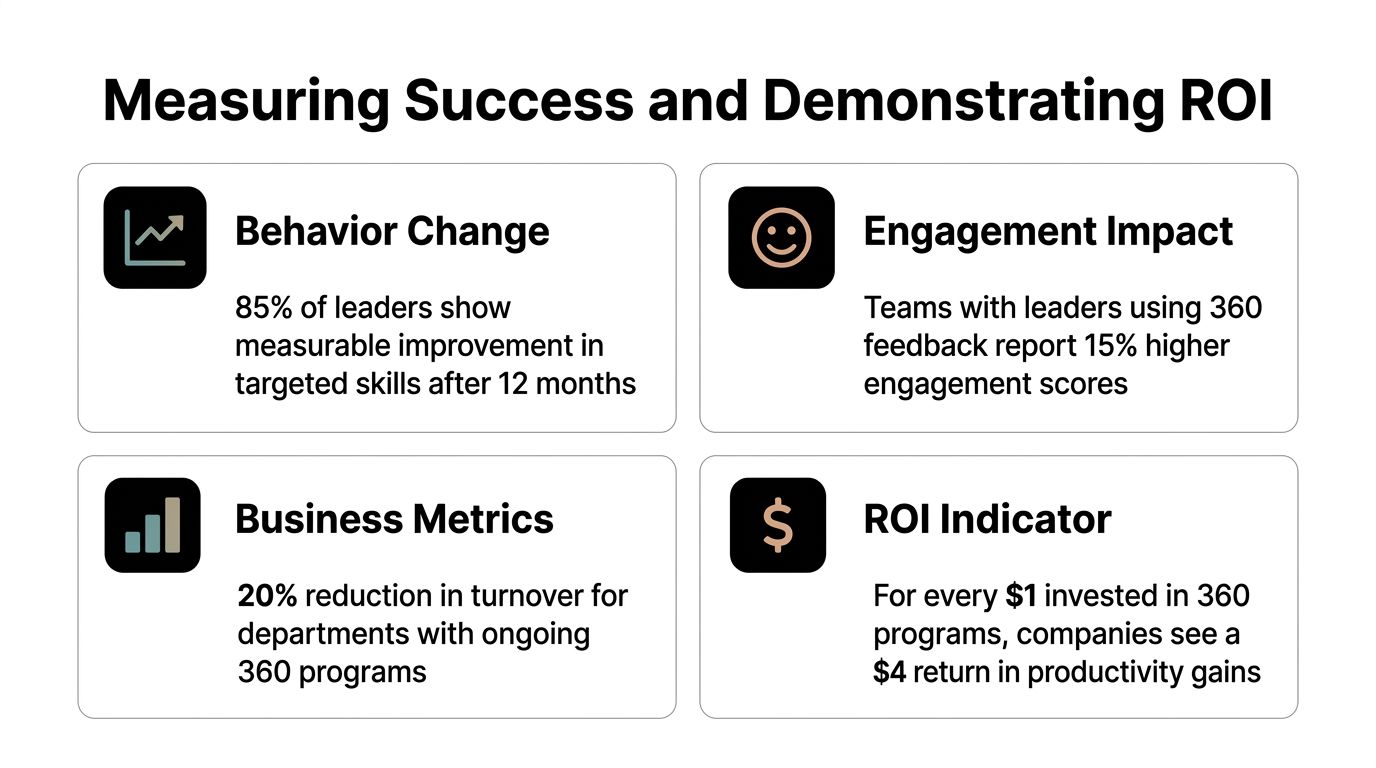
A successful 360 program doesn't promise dramatic transformation overnight. It shows steady behavior change over time, then connects that change to leadership quality and business performance. That's the standard stakeholders should expect if they want the process to be more than a one-time diagnostic.
Set realistic expectations for change
A follow-up study summarized by Lumus360 reports measurable improvement over a 12-month period between the first and second survey cycles, and says a minimum improvement of 5% over 12 months is a realistic expectation when the process is used well ([Lumus360 summary](https://lumus360.co.uk/resources/does-360-feedback-actually-work.html)). The same source points to specific lifts such as 6.9% in “Being an inspirational leader,” 4.9% in “Acting as a role model,” and 4.4% in “Driving an ethical workplace.”
Those numbers matter because they're modest and believable. A 360 is not a magic wand. It is a behavior-change mechanism, and behavior change takes repetition, coaching, and time.
Measure what changes, not just who participated
Participation rate tells you whether the process ran. It doesn't tell you whether leadership improved. Track whether the targeted behavior moved, whether the leader followed the action plan, and whether the next survey cycle shows tighter alignment between self-view and others' ratings.
If stakeholders need a broader way to frame training outcomes, [prove employee training value](https://learnstream.io/blog/roi-on-training/) offers a useful lens for translating development effort into business language. That same logic applies to 360s, because the goal is not activity, it's capability.
Use the business case carefully
Don't oversell ROI with fantasy numbers. Instead, show the chain of impact. Better feedback leads to more focused development. Focused development changes a specific leadership behavior. That behavior improves how the team works together, decides, and executes.
The strongest case for continued investment is consistency. When leaders get clear feedback, choose one behavior to improve, and review progress on a schedule, the organization builds a more reliable leadership pipeline. That is the return.
---
Synopsix helps organizations turn assessment data into business-ready behavioral profiles, leadership signals, and development plans that are easier to act on. If you're building or tightening a 360 assessment for leadership, visit [Synopsix](https://synopsix.ai) to see how its people-intelligence platform can support better decisions from feedback to follow-through.