AI-Powered Recruitment Tools: Transform Hiring in 2026
By Synopsix · August 10, 2026 · 11 min read
AI-powered recruitment tools are no longer a niche experiment. A 2025 SHRM survey found that 43% of organizations were already using AI for HR tasks, up from 26% in 2024, and recruiting was the leading use case at 27% of organizations. In the same reporting, 69% of companies said they use AI somewhere in talent acquisition, which tells CHROs something important, hiring has become one of the first places where AI moves from pilot to operational habit, not because it sounds modern, but because the market is forcing the issue. [SHRM-reported adoption data](https://sqmagazine.co.uk/ai-recruitment-statistics/)
That shift matters because the conversation is changing. The old question was whether AI could help recruiters work faster. The better question now is whether AI can help leaders make smarter people decisions, the kind that improve role fit, team design, and hiring quality, not just throughput. For organizations that still treat AI as a résumé sorter, the gap between automation and intelligence is widening fast. For leaders who want a practical roadmap, [data-driven recruitment guidance](https://synopsix.ai/blog/guide-to-data-driven-recruitment) helps connect hiring activity to better decisions.
Why AI in Recruiting Is Now Table Stakes
Hiring teams don't have to debate whether AI belongs in recruiting anymore. The market has already answered that. What matters now is whether the tools are being used as simple labor-saving devices or as part of a broader talent strategy that improves judgment, not just speed.
The adoption pattern is revealing. Recruiting is often the first HR workflow where AI shows up because the pain is immediate, candidate volume is high, and managers want faster decisions. That makes sense, but it also creates a risk. When companies stop at automation, they get quicker processing without necessarily getting better hires.
From operational convenience to strategic pressure
For CHROs, the central issue is competitive. If your peer companies are using AI to screen, communicate, and assess candidates, your recruiters are competing against faster workflows and more consistent candidate handling. That doesn't automatically mean those teams are making better decisions, but it does mean the baseline has changed.
> Practical rule: If AI only saves recruiter time, it's a productivity tool. If it improves who gets advanced and why, it becomes a decision system.
The most important shift is mental. AI in recruiting is no longer best understood as a gadget layered onto an ATS. It's becoming part of the operating model for talent acquisition, especially where leaders want to connect hiring data to future workforce needs. That's why the strategic conversation has to move from task automation to predictive intelligence, and from faster processing to stronger evidence.
What AI-Powered Recruitment Tools Actually Do
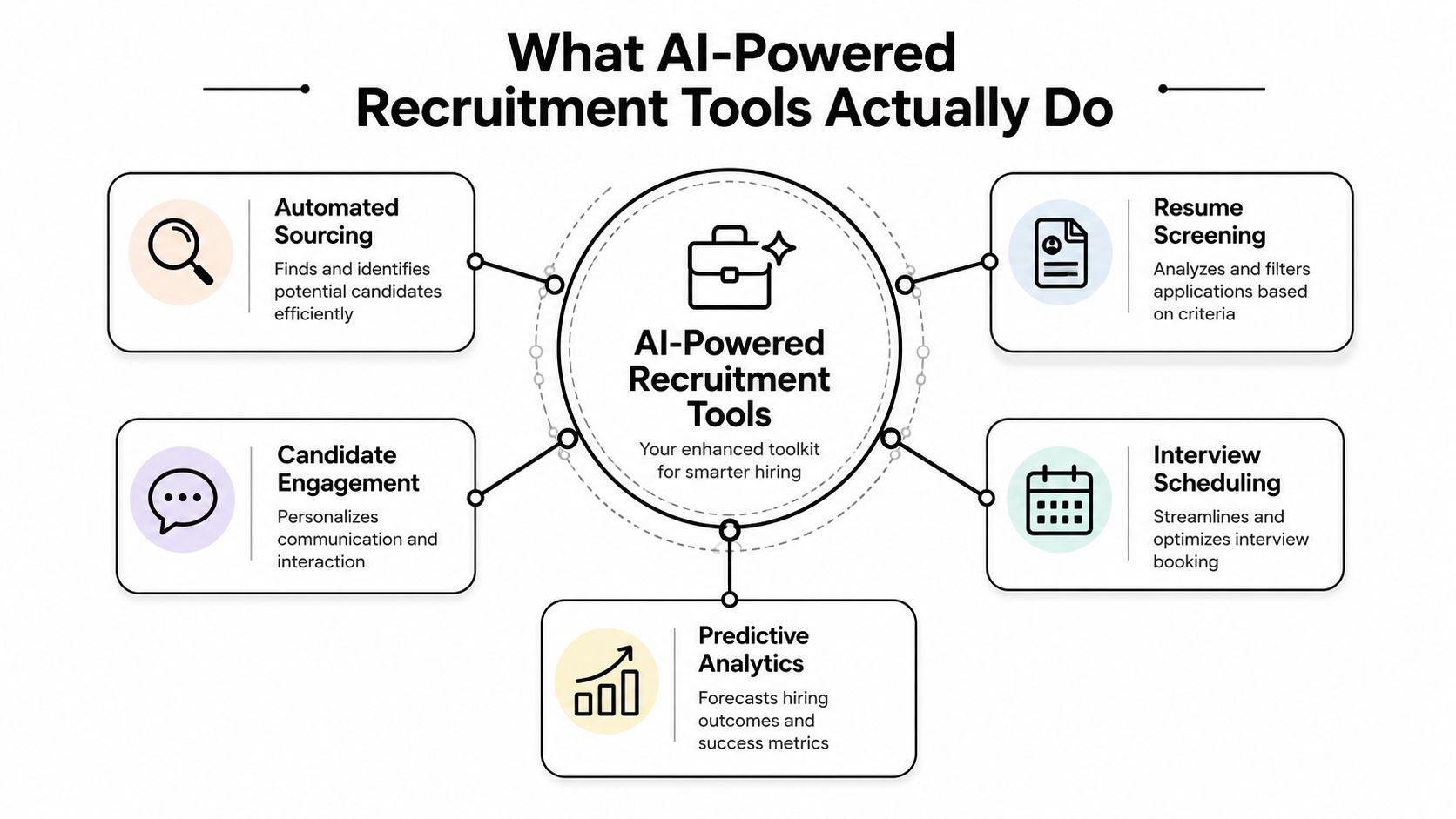
The easiest way to understand ai-powered recruitment tools is to stop thinking about them as software that “does recruiting.” A better analogy is an intelligent research assistant. A traditional ATS mostly stores and sorts. AI adds interpretation, pattern recognition, and prioritization.
In practice, that means the system can read resumes more like a human reviewer, but at machine scale. It can understand context, not just keywords, and it can help recruiters search for meaning rather than title overlap alone. That's a big difference when job histories are messy, titles vary across industries, and the strongest candidate isn't always the one with the most obvious résumé match.
The technical stack behind the scenes
Modern recruiting platforms usually combine three layers. Large language models interpret text and candidate signals, agentic workflows handle actions like outreach and scheduling, and machine-learning analytics estimate outcomes from historical hiring data. The result is a workflow that can move beyond static filters into semantic matching and decision support. [Juicebox's recruiting tool overview](https://juicebox.ai/blog/ai-recruiting-tools) describes this stack clearly.
What changes for the recruiter
The recruiter's job shifts from manually combing through every application to managing higher-quality inputs. Instead of asking, “Who used the right keyword?” the team can ask, “Who shows the strongest evidence of performing this role?” That's where AI becomes useful.
The most mature systems also create a more coherent candidate journey. They can connect sourcing, screening, engagement, and analytics so the process feels less fragmented for both recruiters and applicants. That said, not every product marketed as AI accomplishes this. Some tools are just legacy systems with a thin AI layer on top, which is why buyers need to look past the label and ask where the model changes outcomes. [Greenhouse's industry analysis](https://www.greenhouse.com/blog/best-ai-recruiting-software) makes that distinction explicit.
Core Features and Common Use Cases
AI recruiting shows up across the hiring lifecycle, not in one neat place. Academic review literature groups recruitment AI into job advertisement, job search, application, selection, assessment, and coordination [PMC review](https://pmc.ncbi.nlm.nih.gov/articles/PMC9516509/), which is a useful map for leaders trying to understand where value appears.
A practical way to read the market is to divide it into four capability buckets. The first is candidate sourcing, where AI identifies passive talent and broadens the pool. The second is screening and assessment, where it parses applications, scores skills, and surfaces candidates most likely to fit. The third is engagement and experience, where chatbots, automated updates, and personalized messaging keep candidates moving. The fourth is analytics and reporting, where leaders get insight into what sources, stages, and roles are producing results.
Where the use cases are strongest
For specialist hiring, the technology is moving beyond parsing. In technical roles, market guides now emphasize hands-on validation, system-design assessment, and interview intelligence, because those signals often matter more than title history. That's especially relevant when a hiring team wants to validate what someone can do, not just what their resume implies. [Alex's guide to AI recruiting tools](https://www.alex.com/blog/best-ai-recruiting-tools) highlights that shift well.
If you're trying to understand how this maps to broader talent strategy, [talent intelligence platform thinking](https://synopsix.ai/blog/talent-intelligence-platform) is useful because it connects candidate data to workforce planning instead of treating recruitment as a standalone queue.
The candidate experience side matters too. If your team is looking at employer reputation and online footprint screening, the [employer social media screening guide](https://www.digitalfootprintcheck.com/employer-social-media-screening) is a practical reference for how careful review should be handled without turning hiring into surveillance theater.
<iframe width="100%" style="aspect-ratio: 16 / 9;" src="https://www.youtube.com/embed/N5SgJJYf2ac" frameborder="0" allow="autoplay; encrypted-media" allowfullscreen></iframe>
Measuring Decision Quality, Not Just Hiring Speed
Speed gets attention because it is easy to measure. But speed alone does not tell you whether a hiring process is better. The stronger case for AI is that it can improve the quality of who advances, which is much closer to business value.
A randomized field experiment found that 54% of candidates from an AI-assisted pipeline passed the final human interview, compared with 34% from the traditional process, a 20 percentage point improvement [arXiv field experiment](https://arxiv.org/html/2507.08029v1). That result matters more than a generic time-saving claim because it points to decision quality, not just administrative efficiency.
Why decision quality matters more than speed
A faster process that keeps advancing the wrong people is still a bad process. A slower process that surfaces stronger candidates is at least moving in the right direction. CHROs should care about whether AI is improving the quality of shortlists, the consistency of evaluations, and the signal strength of assessments.
That is where predicting human behavior becomes practical. AI cannot read minds, but it can help identify patterns in candidate data that correlate with better outcomes in a specific role context. Used carefully, that means better screening, stronger assessment design, and more consistent decision support for hiring managers.
> AI is most valuable when it helps managers compare candidates on work-relevant evidence, not when it simply removes resume pileup.
The difference between automation and intelligence matters here. Automation clears work out of the queue. Intelligence helps choose the better next step. For talent leaders trying to build a healthier hiring pipeline, that distinction is the whole game.
How to Evaluate and Choose the Right Tools
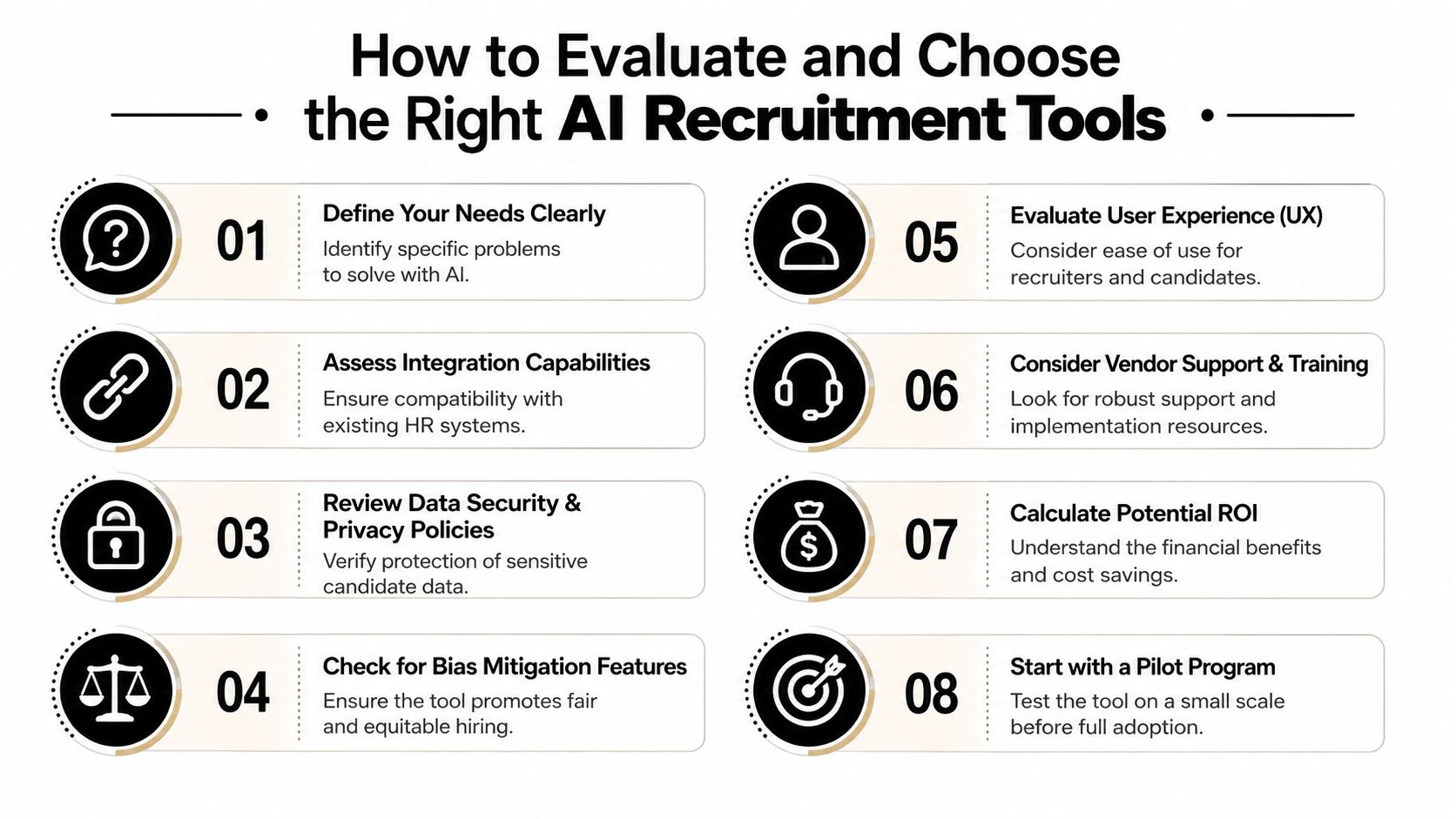
Vendor demos usually make every platform sound smart. The due diligence process should be less polite and more demanding. The right evaluation framework focuses on integration, candidate experience, predictive validity, and governance, because those are the areas where AI recruiting either earns trust or creates problems.
Start with the integration question. If the tool doesn't connect cleanly to your ATS, HRIS, or scheduling stack, recruiters end up double-entering data and the workflow slows down instead of improving. Then check how the product affects candidates. A sleek recruiter dashboard means very little if applicants get confusing messages, repeated requests, or opaque screening.
Questions a CHRO should ask vendors
The performance claims also need scrutiny. Industry statistics say AI-enabled hiring can reduce time-to-hire by up to 70%, with average time falling from 42 days to 14 days and cost-per-hire dropping from $4,200 to $1,600 [industry hiring statistics](https://hiregen.com/blog/ai-recruitment-statistics-2026-50-data-points-every-hr-leader-needs). Those figures are useful as targets, not guarantees, so vendors should be able to show comparable case evidence in similar hiring environments.
If you want a broader lens on measurement, [recruitment analytics tools](https://synopsix.ai/blog/recruitment-analytics-tools) can help frame what should be tracked after purchase, not just before it.
Your Implementation Roadmap From Pilot to Scale
Implementation fails when teams buy software and expect behavior to change on its own. A working rollout needs clear ownership, staged adoption, and governance from the start. The most effective programs treat AI as a process change, not a software install.
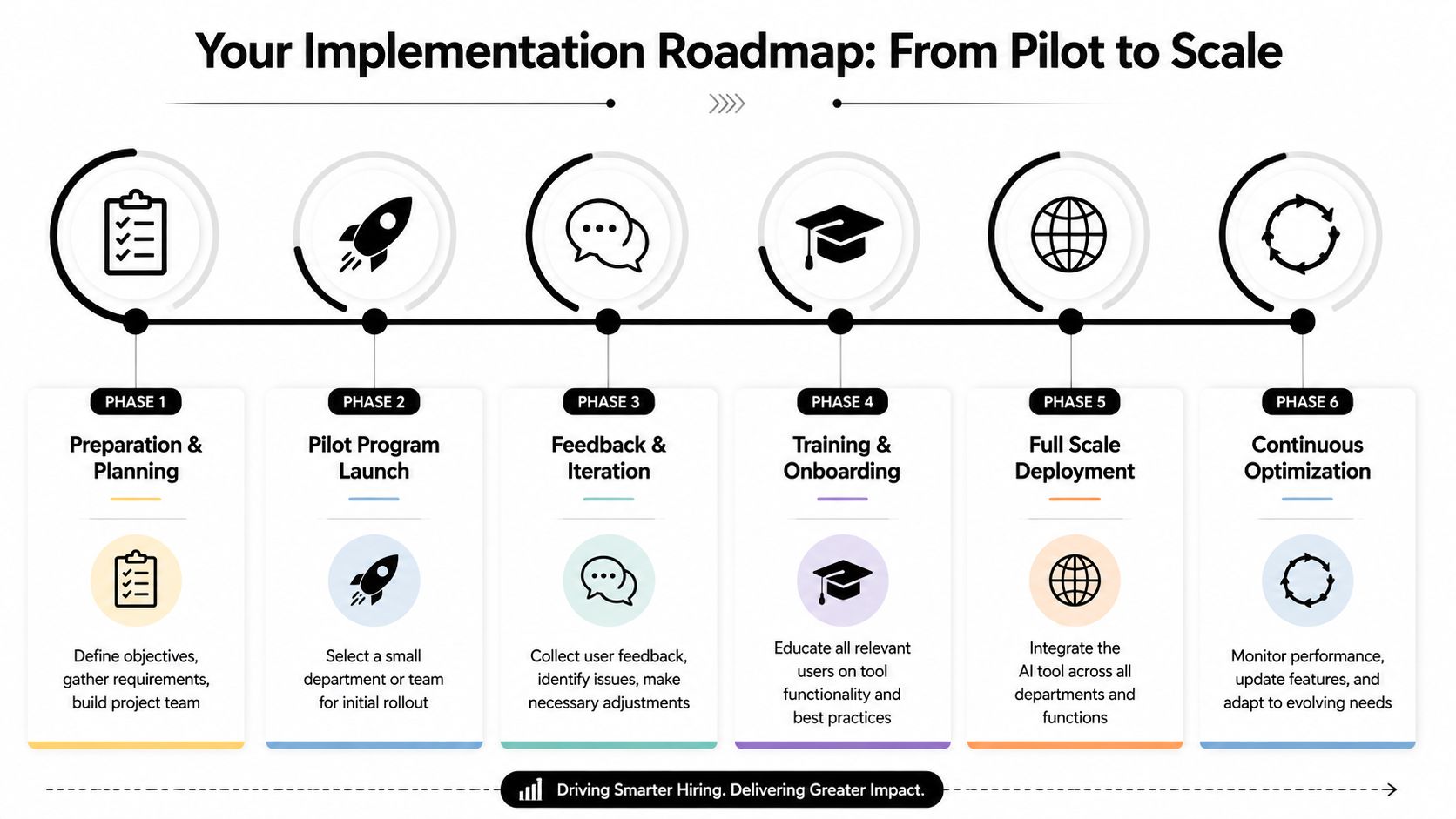
First, define the business problem. If the goal is faster screening, say that. If the goal is stronger shortlist quality or better interview consistency, make that explicit too. Then choose a contained pilot where the team has enough hiring volume to produce signal without exposing the entire organization to change risk on day one.
A rollout that usually holds up
1. Preparation and planning. Assign owners, define success metrics, and map the data the system will use. 2. Pilot launch. Run the tool in one business unit or hiring lane. 3. Feedback and iteration. Collect recruiter and hiring manager feedback quickly. 4. Training and onboarding. Teach people how to read outputs and where human review still matters. 5. Full deployment. Expand only after the pilot proves stable. 6. Continuous optimization. Review performance, usage, and exceptions on an ongoing basis.
Ethics can't sit at the end of the rollout plan. Research warns that AI recruitment tools can replicate historical bias when they learn from past hiring data, which is why independent bias reviews and transparent governance matter from the beginning [Forbes on AI hiring bias](https://www.forbes.com/sites/madelinehalpert/2022/10/09/ai-powered-job-recruitment-tools-may-not-improve-hiring-diversity-experts-argue/). That means candidate privacy, vendor transparency, and auditability need to be part of the operating model, not optional extras.
> If your team can't explain why the model advanced one candidate and not another, the implementation isn't mature enough.
Conclusion Making Smarter People Decisions a Reality
The best ai-powered recruitment tools don't replace human judgment. They give it better inputs. That difference matters because hiring is not just a throughput problem, it's a people decision problem, and people decisions shape performance, culture, and long-term workforce health.
The market has already moved past curiosity. AI is now embedded in recruiting workflows because organizations want faster action, but the primary opportunity is sharper decision-making. When leaders use AI only for automation, they get convenience. When they use it for intelligence, they get a better view of fit, risk, and potential.
The future of hiring is less about scanning more resumes and more about identifying the signals that matter. That means choosing tools that can support comparison, consistency, and accountability across the hiring process. It also means keeping human oversight in place where context, fairness, and judgment still matter most.
For CHROs, the priority is clear. Don't ask whether AI can replace recruiters. Ask whether it can help your team make smarter, more evidence-based people decisions at scale.
---
Synopsix helps teams turn behavioral assessments into actionable hiring intelligence, so candidate fit, team complementarity, and role risk can be reviewed in business language instead of technical jargon. If you're building a more predictive hiring process and want to connect assessment to action, visit [Synopsix](https://synopsix.ai) and see how its people intelligence platform supports better hiring decisions.