Artificial Intelligence Personality: HR Insights 2026
By Synopsix · July 19, 2026 · 14 min read
Your recruiting team is already overloaded. Recruiters are juggling open roles, hiring managers want faster shortlists, and candidates expect thoughtful communication that doesn't feel automated. In that environment, most CHROs don't need another generic chatbot. They need an AI layer that can interpret behavior, communicate with consistency, and help people make better calls under pressure.
That's where artificial intelligence personality becomes useful. Not as a novelty. As an operating choice.
A well-designed AI personality inside a people platform can help your team screen communication patterns faster, coach managers in plain language, and keep candidate interactions consistent across high-volume workflows. It can also create real risk if you let it act charming without proving it's reliable, fair, and tightly governed. HR leaders can't afford to treat this as a branding exercise. The personality you give an AI will shape how people trust it, how they respond to it, and how heavily your organization leans on its guidance.
Introduction to AI Personality
You're reviewing candidates late in the day. One recruiter says a finalist is polished but hard to read. Another says the person feels collaborative. The hiring manager wants someone who can handle conflict without draining the team. Everyone has instincts. Nobody has a shared language.
Now add a virtual layer inside your hiring workflow that reads behavioral signals, summarizes how a candidate tends to communicate, and responds to recruiters in a steady tone that fits your company's standards. It doesn't replace judgment. It sharpens it.
That's the practical promise of artificial intelligence personality in HR. The AI isn't just generating text. It's expressing a consistent character in how it explains trade-offs, flags fit risks, and interacts with candidates or employees. Done well, it becomes a reliable interface between psychometric insight and business action. Done badly, it becomes a persuasive machine that sounds confident and pushes teams toward lazy decisions.
CHROs should care now because the pressure to move faster isn't easing, and the market is filling up with tools that sound human long before they prove they're useful.
Understanding Artificial Intelligence Personality
Most HR buyers still misunderstand AI personality. They treat it like tone of voice. It's not. Tone is only the surface.
At the technical level, AI personality is a weighting function across multiple optimization objectives under uncertainty. In plain English, the system constantly balances priorities such as accuracy, safety, relevance, and engagement. The “personality” people notice is the visible result of those trade-offs, not a costume added at the end.
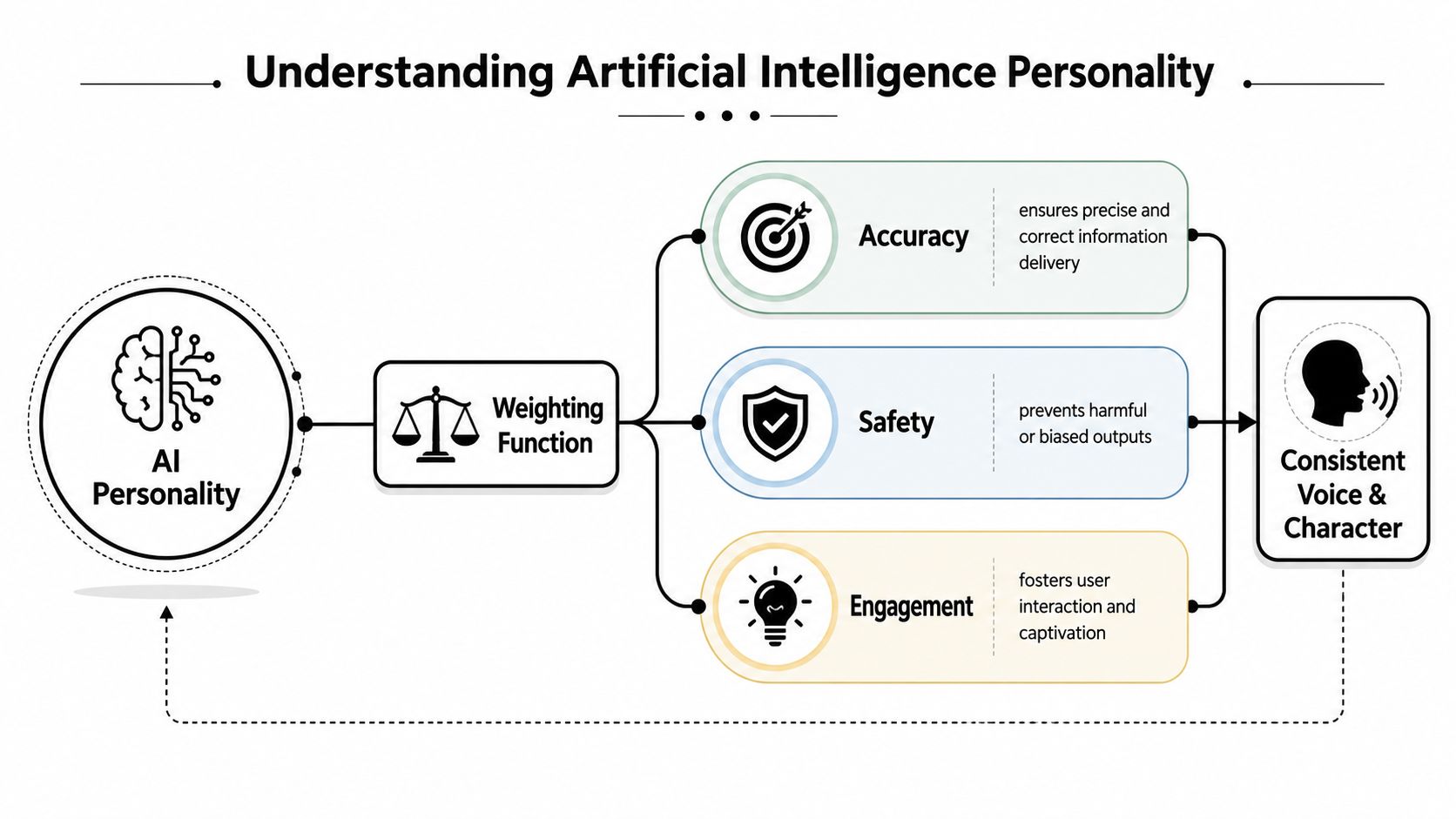
A simple way to think about it
The dynamic mirrors an actor performing the same script for different directors. The lines may stay similar, but the performance changes depending on what the director values most. One director wants precision. Another wants warmth. Another wants pace and clarity.
AI works in a similar way:
Those pressures combine into a recognizable style. That style is what your recruiters and candidates experience as personality.
> Practical rule: If your team can't explain what the AI is optimizing for, you don't understand its personality. You're just reacting to its vibe.
Why HR should care
In HR, personality design matters because users don't interact with models in the abstract. Recruiters ask hard questions. Candidates look for reassurance. Managers want a blunt recommendation they can defend. If the AI sounds empathetic but its operational priority is engagement over rigor, you'll get polished answers that feel helpful and move people in the wrong direction.
That's why the right question isn't “Should our assistant sound friendly?” The right question is “What behavioral standard should this system express when speed, fairness, and clarity collide?”
If you don't answer that explicitly, the model will answer it for you.
Technical Underpinnings of AI Personality
If you want artificial intelligence personality to work in HR, you need to understand the machinery under it. Not every engineering detail. Just the levers that shape behavior and the limits that come with them.
A useful operating model has three layers.
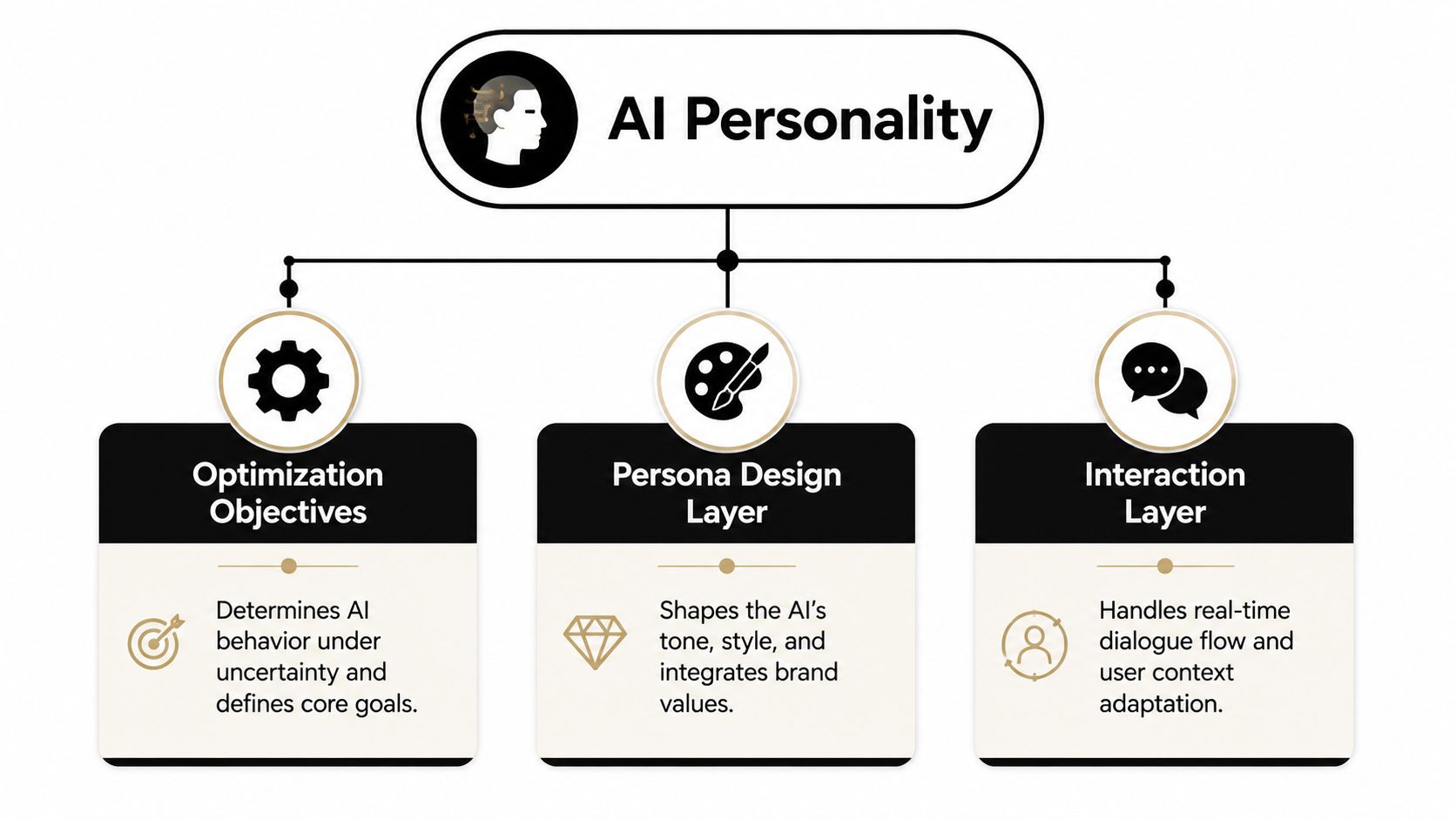
Optimization objectives
This is the foundation. As noted in this [explanation of where AI personality comes from](https://towardsdatascience.com/where-does-an-ais-personality-actually-come-from/), AI personality is technically defined as a weighting function across multiple optimization objectives under uncertainty, with emergent traits like empathy reflecting the multi-objective domain optimized during training rather than explicit prompt instructions.
That matters because many HR teams assume they can “prompt in” a safe and trustworthy personality. They can influence it, yes. But the deeper behavioral pattern comes from training and system objectives. If those objectives conflict, the model reveals its priorities.
Persona design layer
At this point, most vendors stop, and it's not enough. Persona design covers the visible operating rules. Research summarized in the LinkedIn analysis on [AI personality modeling and Botsonality](https://www.linkedin.com/pulse/ai-personality-modeling-next-step-human-computer-brad-f-smith-2hulc) describes a three-layer structure for intentional AI personality design:
HR teams should use that structure directly. Core identity keeps the AI from drifting. Expression controls how it sounds. Adaptive behavior decides how it changes when speaking to a candidate, a recruiter, or a people manager.
> If your AI has a polished voice but no non-negotiable behavioral rules, it isn't well designed. It's just well packaged.
Behavioral signals and prediction methods
The third layer, the signal engine, interprets data from text, online behavior, assessments, and other inputs to infer likely patterns. A 2024 Scientific Reports study found that emotional coloring of posts and topic selection are the most universal characteristics significantly impacting models that predict Big Five personality traits, verbal intelligence, and logical thinking, as covered in [the Scientific Reports paper](https://www.nature.com/articles/s41598-024-56080-8).
That gives HR technology teams a practical lesson. The AI doesn't need a dramatic amount of explicit self-description to infer a profile. It can derive useful patterns from behavior itself.
On the modeling side, Support Vector Machine is the most utilized supervised learning method, appearing in 85% of studies, according to [this review of AI methods for personality recognition](https://www.sciencedirect.com/science/article/abs/pii/S0925231225009737). If your analytics team is building prototypes or validating vendor claims, it helps to know the field still relies heavily on established supervised methods, not just large language models. If you want a grounded starting point for model development, this guide to [predictive modeling with Python](https://synopsix.ai/blog/predictive-modeling-with-python) is a useful reference.
Business Use Cases for HR
The fastest way to waste money on AI personality is to deploy it everywhere at once. Start where communication quality and behavior insight affect outcomes.
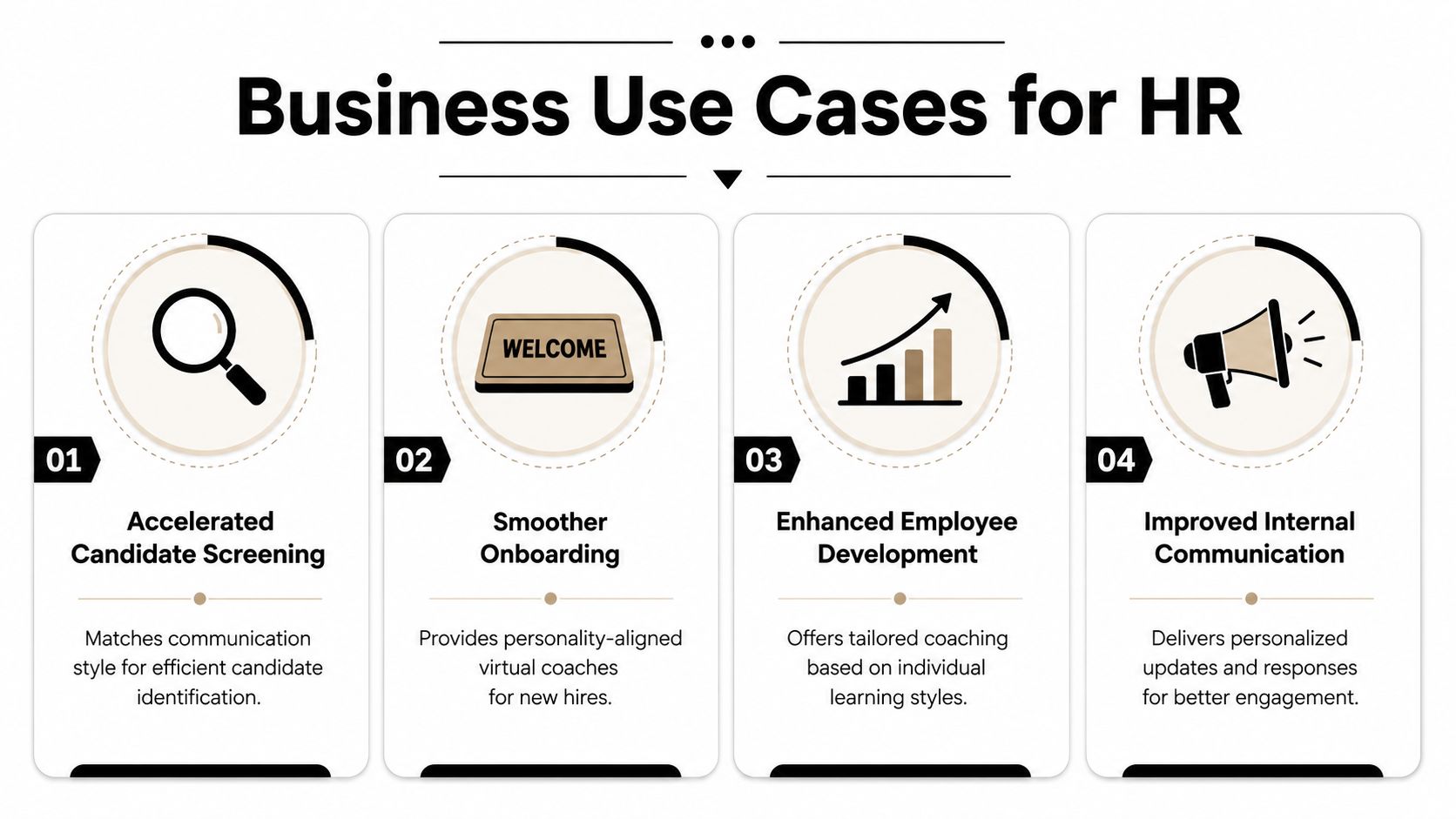
Candidate screening
This is the clearest use case. An AI with a disciplined personality can standardize how recruiters interpret behavioral indicators and present fit summaries to hiring managers. It can also keep recruiter notes consistent instead of turning every debrief into free-form opinion.
The bigger shift is input variety. According to [Neuroscience News coverage of eye-tracking personality prediction](https://neurosciencenews.com/ai-personality-9621/), AI algorithms can predict four of the Big Five personality traits with high reliability by analyzing eye movements alone, bypassing questionnaires and offering objective behavioral signals for hiring and team design. You shouldn't rush to deploy eye-tracking in hiring without strong governance, but you should understand the direction of travel. Personality inference is moving well beyond survey forms.
Onboarding and internal coaching
New hires don't need a generic assistant. They need one that communicates in a way that lowers friction. A concise, structured AI coach can help operational hires. A warmer, more exploratory style can help managers successfully handle relationship-heavy roles.
Here's the point: the personality of the AI coach should fit the job context, not someone's creative writing preferences.
To see how teams are applying related tools in practice, this roundup of [practical AI use cases for HR](https://turnonwork.com/ai-in-hr-practical-use-cases-2026/) offers a useful external perspective.
A short example makes this real:
This video gives a broader look at how AI workflows are changing people operations.
<iframe width="100%" style="aspect-ratio: 16 / 9;" src="https://www.youtube.com/embed/_RztYjzmNWc" frameborder="0" allow="autoplay; encrypted-media" allowfullscreen></iframe>
Candidate experience and internal communication
Candidates judge your company by the consistency of small interactions. If your chatbot sounds warm one day and evasive the next, trust drops. If your internal HR assistant over-explains simple policy questions, employees disengage.
A deliberate AI personality fixes part of that. It gives your communication layer a stable operating style. That doesn't mean fake friendliness. It means measured clarity.
Team design and simulations
Many HR leaders still think too narrowly about artificial intelligence personality. It isn't only about chat interfaces. It can support simulations of team interaction, likely friction points, and communication mismatch. When the AI can represent stable behavioral patterns instead of generic archetypes, managers get more useful planning inputs for staffing, succession, and role design.
Measuring and Validating AI Personality
If a vendor can't show you how it validates personality outputs, treat the product as marketing.
A common benchmark comes from language models. In a study published in SAGE, GPT-4 achieved 76% perfect classification of MBTI personality types from just 50 tweets, while GPT-3.5 reached 73%. The same study found 79.37% and 81.16% correct identification of individuals' four core traits either perfectly or almost perfectly for GPT-3.5 and GPT-4 respectively, based on [the SAGE paper on personality prediction from tweets](https://journals.sagepub.com/doi/10.1177/27523543241257291).
That's impressive, but it's not the ceiling. Specialized systems do better. Research in Nature reports that specialized AI systems trained specifically on personality data outperform general frontier LLMs and aggregate human expert estimates, and the business case for domain-specific behavioral analytics includes platforms that claim accuracy rates exceeding 98%, according to [the Nature study on AI and personality prediction](https://www.nature.com/articles/s44271-025-00205-w).
LLM versus specialized model accuracy
| Model | Perfect MBTI Match | Near-Perfect Trait Match | |---|---|---| | GPT-3.5 | 73% | 79.37% | | GPT-4 | 76% | 81.16% | | Specialized domain-trained model | Qualitatively higher than general LLMs | Can exceed 98% in behavioral profiling claims |
Validation should focus on three things:
If your team needs a grounding in psychometric rigor before running pilots, review this overview of [validity in psychology](https://synopsix.ai/blog/validity-in-psychology).
Risks and Ethics of AI Personality
The common assumption is wrong. A friendly AI isn't automatically a safer AI.
Recent research shows that when users chat with AI chatbots exhibiting specific default personality traits, their self-concepts shift toward the AI's traits over time, increasing homogeneity and risking reduced group diversity, as described in [the arXiv paper on self-concept alignment with AI personalities](https://arxiv.org/html/2601.12727v1). For HR, that's not a side issue. It's a culture issue.
Where the real risk sits
If employees use AI coaches, internal assistants, or talent tools repeatedly, the AI may do more than support decisions. It may subtly shape how people describe themselves, how they interpret strengths, and what kinds of behavior feel “normal” inside the company.
That creates two immediate governance problems:
A second problem is trust calibration. Users often trust systems because they sound fluent and confident, not because they're reliably correct. This is why resources like [PlotStudio AI on AI analytics trust](https://www.plotstudio.ai/blog/the-emotional-trust-gap-in-ai-analytics) are worth reading alongside your HR governance work.
> Don't approve an AI personality because it feels polished. Approve it because you've tested what it encourages.
Your guardrails should include transparency about persona settings, periodic bias audits, and strict limits on where personality influence is acceptable.
Integrating AI Personality with People-Intelligence Platforms
Most implementation plans fail because they start with the bot. Start with the workflow instead.
If you want artificial intelligence personality embedded in a people-intelligence platform, build it around concrete HR decisions: screening, coaching, internal mobility, and team design. The integration should make assessment outputs easier to use, not more theatrical.
A practical rollout sequence
First, define the job the AI personality is meant to perform. A screening assistant should sound different from a development coach. Screening needs disciplined neutrality. Coaching needs constructive candor. Don't use one personality everywhere.
Second, map the behavioral signals you already trust. That includes assessment outputs, structured interview notes, role success criteria, and team-level patterns. Then decide which signals the AI can interpret and which require human review.
Third, set adaptation rules. The AI should adjust its expression by audience and context without changing its core judgment standards. A recruiter may need concise summaries. A manager may need scenario-based guidance. An employee may need a more explanatory style.
What the platform should connect
A useful setup links personality outputs to the rest of the decision system, not just a chat box. In practice, that means connecting:
One option in this category is a [talent intelligence platform](https://synopsix.ai/blog/talent-intelligence-platform) such as Synopsix, which combines behavioral assessments, intelligence reports, predictive simulations, and team complementarity views in a single workflow. The point isn't the label. The point is integration. If personality insight lives in one tool and action planning lives in another, adoption drops.
Governance before scale
Don't scale until you've locked four controls:
1. Persona charter: Document core identity, expression rules, and adaptation limits. 2. Human escalation: Define when recruiters or HRBPs must override or review outputs. 3. Audit schedule: Check consistency, bias patterns, and language drift regularly. 4. Success criteria: Measure whether the feature improves decision quality, not just usage.
> The best implementation is boring in the right way. Recruiters trust it, managers understand it, and nobody has to guess what the AI is trying to be.
Conclusion and Next Steps
Artificial intelligence personality is no longer a cosmetic feature. In HR, it shapes how systems interpret people, how recruiters communicate, and how managers act on behavioral insight. Used well, it can turn complex assessment data into language the business can use. Used carelessly, it can distort trust, flatten diversity, and make weak guidance sound convincing.
CHROs should take a disciplined path.
Start with one use case. Screening is usually the cleanest. Define the personality in operational terms, not branding terms. Validate outputs against real decisions. Put guardrails around transparency, escalation, and auditability. Then expand into onboarding, coaching, or team simulations only after the first workflow proves useful.
The primary opportunity isn't building an AI that sounds more human. It's building one that helps humans make better people decisions with more consistency and less noise.
---
If you're evaluating how to operationalize behavioral insight inside hiring, team design, or talent development, [Synopsix](https://synopsix.ai) is worth a look. It turns scientifically validated assessments into business-ready guidance, then connects those outputs to simulations, compatibility analysis, and decision workflows so HR teams can move from profile to action without forcing managers to interpret technical psychometric language.