Asking Right Questions in Hiring and Reviews
By Synopsix · November 5, 2026 · 14 min read
You're twenty minutes from a final interview, and the scorecard still has blank lines. Last week's review ran long, everyone nodded, and you left without a decision. The candidate sounded ready. You still don't know who did the work.
Asking the right questions is less about charm than about whether the answer can change a hire, a rating, or a promotion. A prompt that feels harmless between peers can carry career risk when the other person controls workload or the next review, and that risk decides how honest the answer will be. So the habit is to predict from evidence, then decide. Write the decision on one line before you write a single question. If you cannot say which answer would change your mind, the conversation has no decision attached to it yet.
Question Sets for Each Hiring, Review and Team Decision
Read each row left to right. The core question opens the meeting. The follow-up probe tests the first answer. The evidence column tells you when you can stop.
| Decision | Core question | Follow-up probe | Evidence to listen for | | --- | --- | --- | --- | | Final-round candidate fit | Tell me about a time you had to change a plan mid-project | What did you change first, and who objected? | Specific actions and personal ownership, not a team summary | | Performance review | Which goal did you hit, and which one slipped? | What got in the way, and what would you do differently? | Concrete behavior and a named cause | | Promotion readiness | What decisions have you made that your manager would not have made? | How did you know it was the right call? | Judgment exercised beyond the current scope | | Team diagnostic | Where does work stall between teams? | Who would confirm that, and what happened last time? | The same example from several people, not one anecdote | | Reorg or role change | Which tasks will stop when this change lands? | Who owns each one after the change? | A named owner for every task | | Stay interview | What would make you consider leaving in the next six months? | What have you already raised, and what happened? | Specific triggers, dates and unresolved requests |
Why the wording has to change
A final-round fit check, a performance review, a promotion conversation, a team diagnostic, a reorg, and a stay interview can involve the same person and still need different questions. Fit asks for a past change under pressure. A review asks which goal moved and which slipped. Promotion asks for judgment outside the current job. A team diagnostic only counts when several people describe the same stall. A reorg fails if tasks stop and nobody owns them. A stay interview fails if the answer is "I'm fine" with no date and no request still open.
Tying the question to the role is the research point, not a style preference. A [meta-analysis of 494 studies](https://onlinelibrary.wiley.com/doi/abs/10.1111/j.1744-6570.1991.tb00696.x), covering 97 independent samples and 13,521 people, found personality measures predicted job performance far better when job analysis selected them (corrected mean validity .38) than when researchers used exploratory, generic choices (.12). Confirmatory studies landed at .29, more than twice the exploratory figure. Across the Big Five, corrected validity ran from .16 for Extraversion to .33 for Agreeableness. One universal trait score will not serve six different meetings.
If the role is finance, borrow the discipline those firms already use when they [Hire Accountants](https://hireaccountants.com/): define the work first, then ask only what that work requires. Pick the row that matches your next meeting and write the core question on paper before you walk in.
How to Build a Question Before You Ask It
A useful question is a three-part exchange: tie it to the decision, hear the answer without steering it, then paraphrase until both of you share one meaning. Guidance on [interdisciplinary inquiry](https://par.nsf.gov/servlets/purl/10333522) puts the same sequence in practical terms. Name what must be learned, classify the inquiry, and state purpose before you ask for a recommendation.
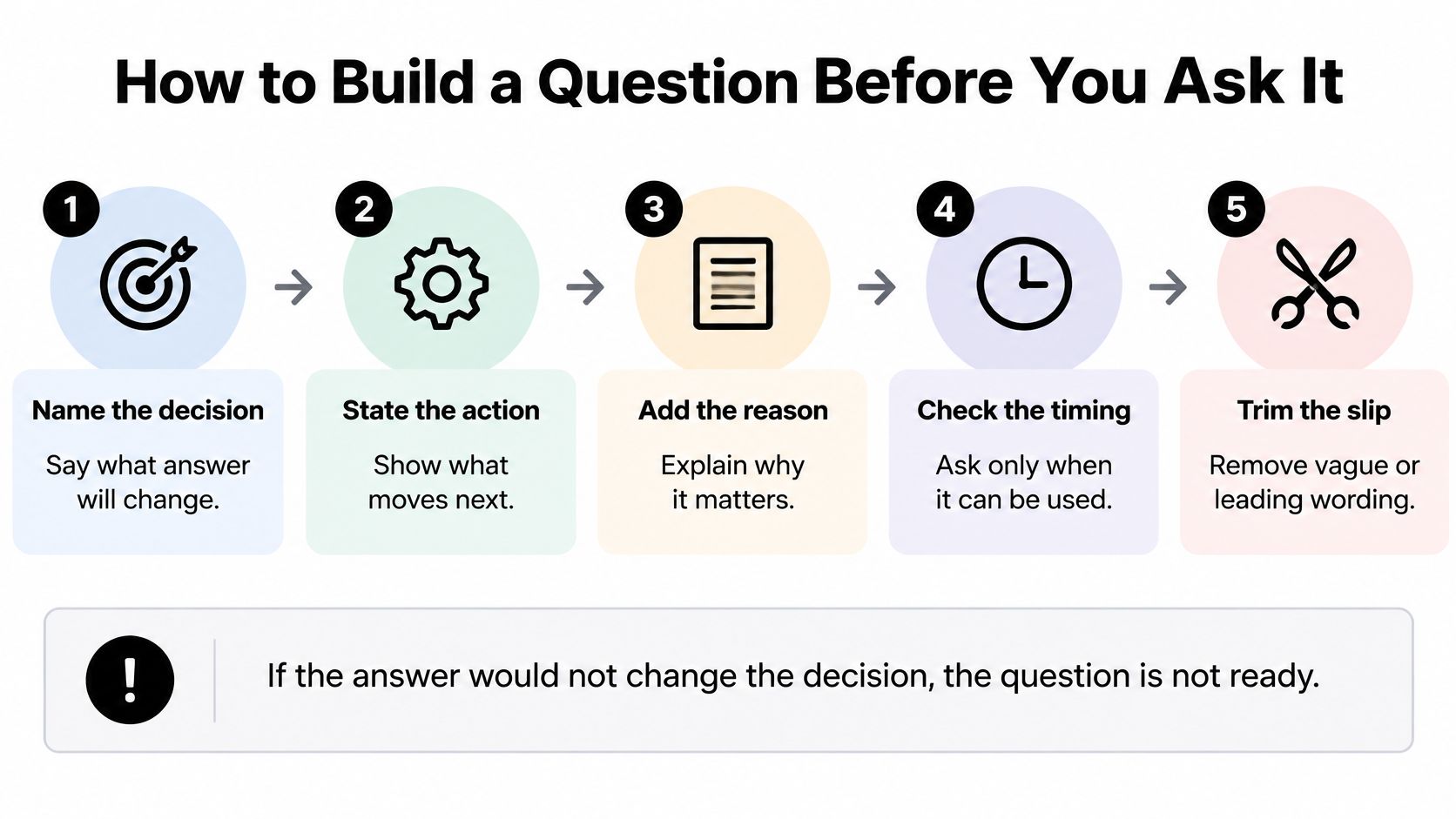
Five steps, and the slip in each
1. Name the decision in one sentence. "This answer will decide whether we advance Maya" is enough. If the answer would not change anything, drop the question. The usual slip is asking because the agenda has a blank line. 2. Classify the question. Discovery asks what happened. Challenge tests a conclusion you already like. Calibration asks how confident the other person is. Decision-rights asks who owns the outcome. Each type needs a different follow-up, and mixing them in one breath produces a speech, not an answer. For worked examples of each type, use this [interview question design](https://synopsix.ai/blog/interview-question-design) note before the meeting. 3. State the purpose out loud. "I need the first action you took, because that is what we score" tells the person which gap you are trying to close. Skipping the purpose leaves them guessing which story you want. 4. Ask it, then wait. Do not nod them toward the ending you expected. A leading question returns the answer you brought into the room. Silence after the question is part of the method, not a social failure. 5. Paraphrase in one sentence. "You changed the timeline first, and the client objected." Then ask whether you got it right. A technically complete answer can still be misread, and the paraphrase is what makes the chain auditable.
> Prep rule: Choose one or two priority questions, rehearse each once, and after the meeting write what changed in the decision.
If you cannot name the decision the question affects, you are still on step one. Prefacing with purpose cuts ambiguity. Paraphrasing turns talk into a testable understanding. That chain matters most in hiring and team design, where the signal you want and the conclusion you prefer are easy to confuse.
Follow-Up Questions That Separate Insight from Polite Answers
The first answer is rarely the useful one. It is often the safe one.
A [2017 study in the Journal of Personality and Social Psychology](https://dash.harvard.edu/server/api/core/bitstreams/7312037e-a4f8-6bd4-e053-0100007fdf3b/content) looked at more than 300 online and in-person interactions, including 15-minute talks between strangers and heterosexual speed-dating encounters. People whose partners asked more questions, especially follow-ups, were liked more. The answerer disclosed more and credited that good feeling to the person who asked. In the speed-dating field study, more questions also lined up with a greater chance of a second date.
In an interview or a review, a relevant next question does the same job. It shows you heard the last sentence.
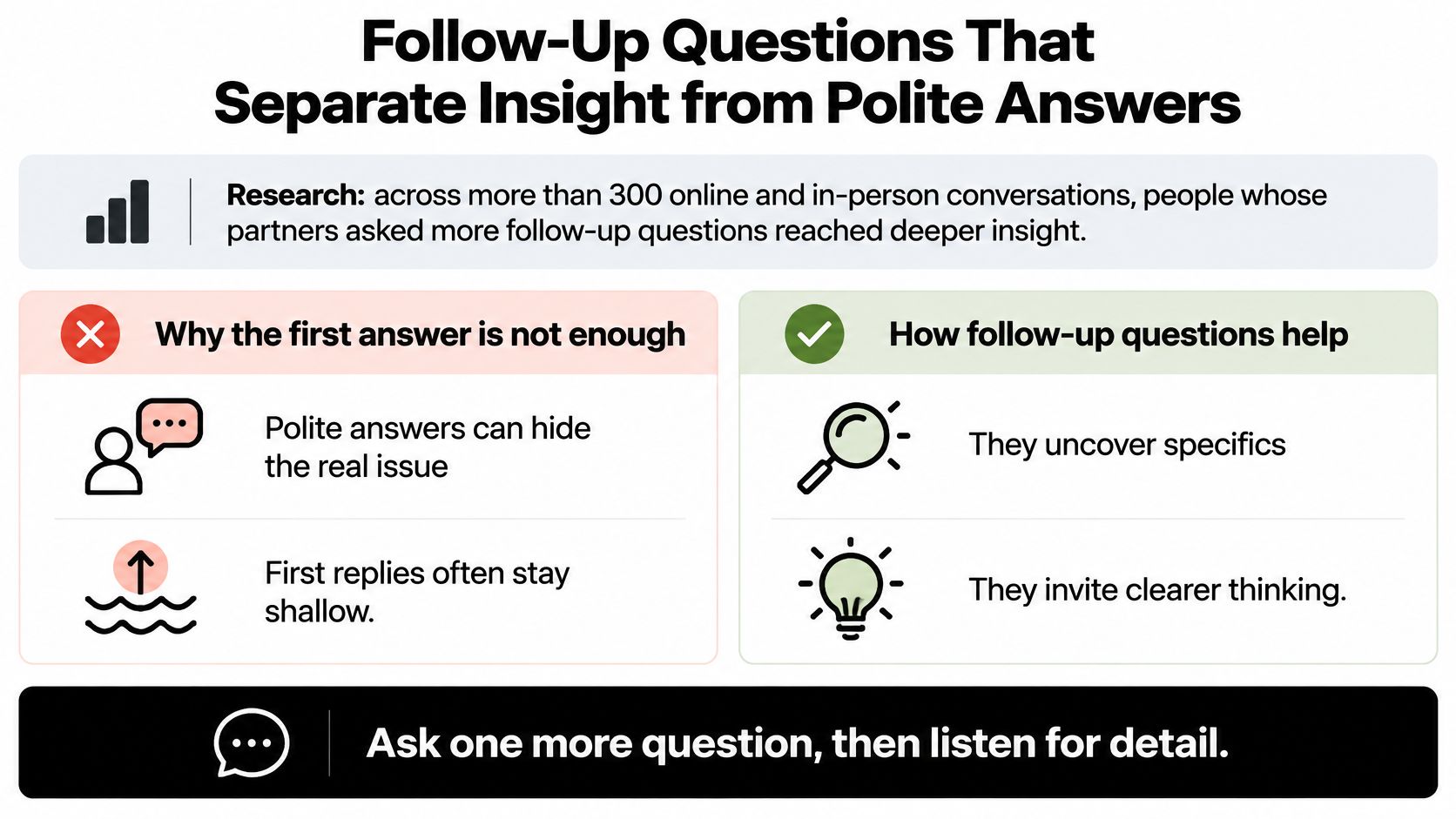
A probe ladder when a project slipped
Say the candidate says, "The launch slipped, but the team recovered."
Stop when you have a personal action, a constraint, and a result you could score. Polished recovery stories often hide whether the person owned the slip or narrated it. [Filta on AI and candidate authenticity](https://filtaglobal.com/blogs/are-you-interviewing-a-candidate-or-their-ai-the-hiring-risk-companies-face-in-2026/) is a useful check when the wording is fluent and the dates are missing.
What fails, and what holds
Switching topics before the evidence is clear wastes the disclosure you just earned. Asking for agreement ("That was the right call, wasn't it?") hands them your conclusion. Stacking a second question before the first is finished trains them to answer the easiest half.
Follow-up quality can be observed and scored. Treat it as a signal of listening and curiosity in the hiring loop, not as personal style. Responsiveness is the point: the next question should prove you processed the answer, not that you had a longer list.
Structured Interview Questions and a Scoring Rubric
Structure is the part of the interview that moves validity. A [meta-analysis of 31 employment-interview studies](https://onlinelibrary.wiley.com/doi/abs/10.1111/j.1468-2389.1993.tb00080.x) found an observed average validity of .27 and an estimated true validity of .38. Across six study characteristics, interview structure was the only one that moderated validity. Same job-relevant questions, same order, fixed criteria. An open chat shaped by whoever is in the room does not match that.
A fixed rubric shifts a little power back to the candidate: the standard is visible, and the interviewer has less room to improvise a case against them. The trade-off is preparation time. Anchors and probes take work before the first interview, and that work buys comparability across candidates.
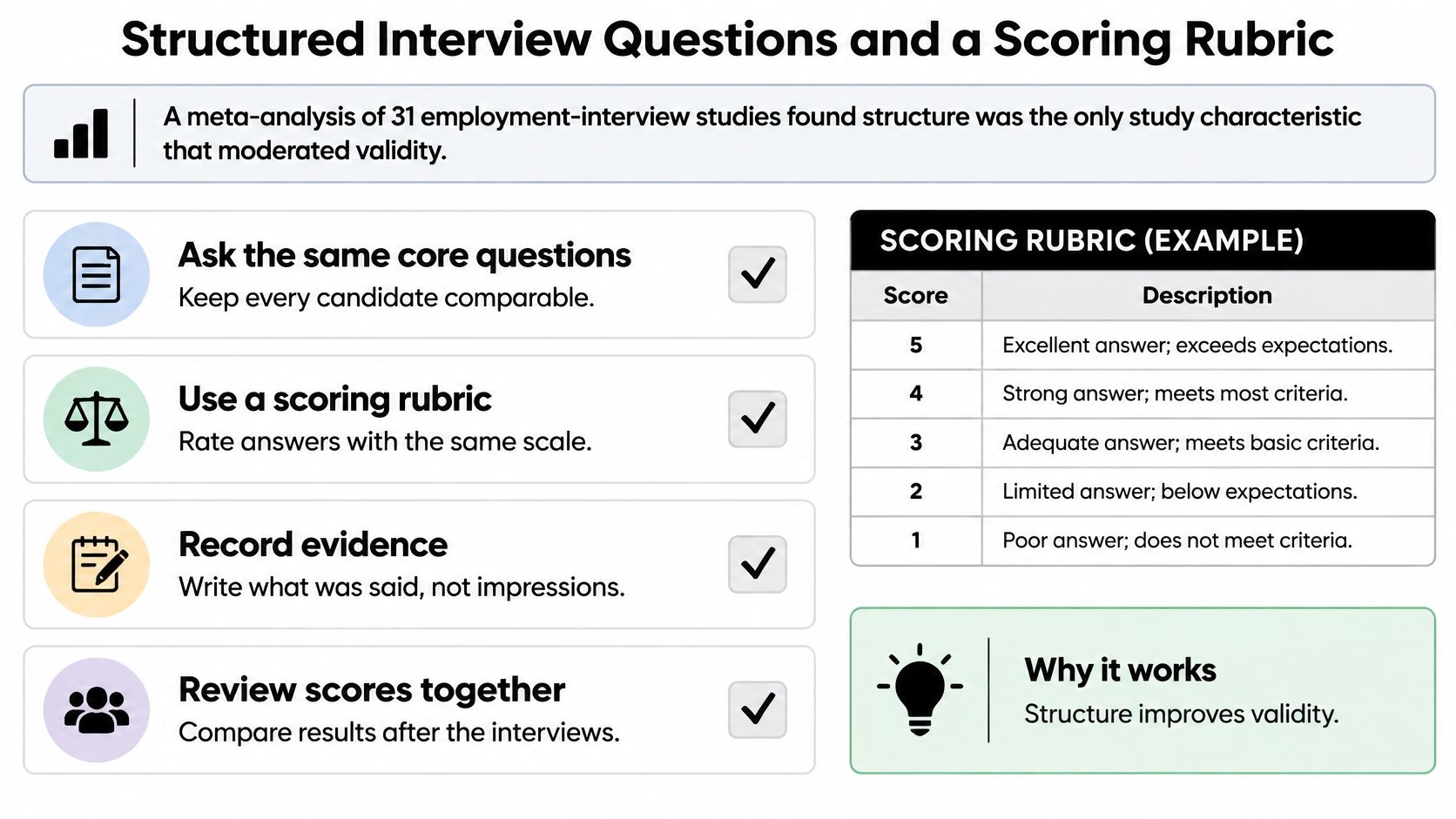
Use three question types, and do not treat them as interchangeable.
| Score | Evidence the interviewer hears | | --- | --- | | 1 | No example given, or only a hypothetical answer | | 3 | A real example with a clear action and outcome | | 5 | A specific action, a trade-off the candidate weighed, and a measurable result |
A sales manager script
1. "Tell me about a quarter when a target looked missed by week six. What did you change first?" Probe: "Who objected, and what number moved?" 2. "A peer says your discounting is hurting their region. What would you do in the first meeting?" Probe: "What would you refuse to trade?" 3. "Walk me through how you would rebuild this pipeline note into a forecast." Probe: "Which assumption would you test before you present it?"
For a performance review, ask "Which goal did you hit, and which one slipped?" Then, "What got in the way, and what would you do differently?" Score a concrete behavior and a named cause. For a team diagnostic, ask "Where does work stall between teams?" Then, "Who would confirm that, and what happened last time?" Collect each person's answer alone before you compare them, so the first voice does not write the rest.
Where the score should stop
A review drawing on hundreds of studies reported an overall corrected association of about r = .31 between a general personality factor and job performance, and that factor explained 10.2% of performance variance, in this [personnel-selection analysis](https://research.vu.nl/ws/files/278187338/Personality_Personnel_Selection_and_Job_Performance.pdf). Profile traits should shape the probes. They should not decide the hire. Predictive values stay moderate. Candidates can ask how a score was produced, and Synopsix makes explanations of the key factors behind a user's results available on request.
Before any interview, confirm five things: same questions, same order, scoring anchors ready, probes listed, and each decision owner named. Cross-border hiring adds one more test of consistency. Teams can [find resources for nearshore hiring](https://www.latojobs.com/resources/employers) before they localize a kit, then keep the same scoring anchors for the role instead of one office's habits.
Asking Hard Questions When Someone Else Holds the Power

Question quality is not only a skill problem. It is a power problem. A manager who controls ratings, promotion, workload and information can make a fair question expensive for a junior employee, even when the meeting invite says "open floor."
In a study of more than 27,000 healthcare workers, a one-standard-deviation rise in psychological safety was linked to a 0.72-point drop in burnout and a 0.63-point rise in willingness to stay, as covered in this [Harvard Business School Working Knowledge piece](https://www.library.hbs.edu/working-knowledge/psychological-safety-is-an-asset-not-a-luxury). That is the evidence to use when a leader asks why questions need protection. The cost of speaking up changes behavior before anyone admits it, which is why protection has to be designed in.
Four practices you can install this month:
The same design problem shows up in selection. A late-stage candidate can ask about manager style, workload, fairness, and what happened to the last person in the role, as curiosity rather than suspicion. Pair that with a [way to reduce hiring bias](https://synopsix.ai/blog/how-to-reduce-hiring-bias) so the hard question is allowed and scored the same way for everyone.
A question nobody acts on teaches people to stop asking. Play this short briefing before your next staff meeting if you want the room to hear that norm out loud.
<iframe width="100%" style="aspect-ratio: 16 / 9;" src="https://www.youtube.com/embed/Bhn71mwOjsA" frameborder="0" allow="autoplay; encrypted-media" allowfullscreen></iframe>
Why Good Questions Still Lead to Poor Decisions
The failure I see most often is a rehearsed answer to an opinion question. You asked how they lead. They gave you a speech. You still cannot score it.
| Symptom in the conversation | Likely cause | Fix for next time | | --- | --- | --- | | Candidate gives rehearsed, polished answers | Question asks for an opinion, not evidence | Ask for a specific recent example with a date | | Interviewer does most of the talking | Several questions stacked into one turn | Ask one question, then wait for the full answer | | Review ends without a decision | No decision owner or stopping rule | Name the decision and its owner before the meeting | | Same question asked three times in one hour | No record of the answers given | Write each answer in notes before moving on | | Team answers agree too quickly | Leading question or manager speaks first | Collect individual answers first, then compare | | Long question list, thin answers | Checklist used as a script | Keep two priority questions and drop the rest |
Start with the symptom from your last two reviews. Change only that one thing before the next meeting.
More questions are not automatically better. Poorly timed, leading, or unowned questions add noise and delay the call. Use a stopping rule instead of a count. Stop when the answer supports the decision, the main uncertainty is bounded rather than wished away, and the next action has a named owner.
For every question that informs a hire or a promotion, record three things: the behavioral evidence that supports the conclusion, the evidence that would prove it wrong, and the person accountable if the prediction fails. That is the practical core of [evidence-based practice](https://synopsix.ai/blog/what-is-evidence-based-practice). After each loop, mark which symptom appeared so the next conversation changes one habit, not the whole script.
Run One Question Review This Week
Pick one decision on your calendar in the next seven days: a final interview, a performance review, or a team check.
Build the minimum set before you walk in.
Write the core question on paper. Afterward, log what you learned and which evidence changed your view. If you use a validated assessment, treat the profile as a hypothesis to test in the conversation, not a verdict. The free assessment shows your traits, leadership style and professional fit, which is a starting picture, not the hire. Then run the next decision the same way.
> The right question is the one that changes the decision, and you can only check that after the conversation.
---
Synopsix turns validated behavioral assessments into practical guidance for hiring, reviews, and team design, including questions shaped to the person and the role rather than a generic script. If your next people decision needs a clearer question and a score you can defend, visit [Synopsix](https://synopsix.ai) and state the decision you are about to make.