Assessment Interpretation for Smarter People Decisions
By Synopsix · July 10, 2026 · 16 min read
You already have the assessment report. It's sitting in your inbox with score bands, norm references, trait labels, and a polished PDF layout that looks authoritative enough to settle the decision.
But your hiring manager still asks the only question that matters: Should we hire this person for this role, on this team, under these conditions?
That's where assessment interpretation breaks down in most companies. The data exists. The decision logic doesn't. Strong people leaders don't need to become psychometricians. They need a way to translate behavioral evidence into business judgment that executives can use quickly and defend publicly. That's the difference between a report that decorates a hiring process and one that improves it.
predict-human-behavior-synopsix-smarter-people-decisions
Why Most Assessment Interpretation Fails
Teams often don't struggle because they lack data. They struggle because the report stops at description instead of decision. A candidate gets labeled as high drive, moderate sociability, lower structure, or above-average learning agility, and everyone around the table nods as if insight has occurred.
It hasn't. Not yet.

The real problem is translation
Most content on assessment interpretation fails to show how to convert technical psychometric output into business action. One cited source says 72% of HR professionals feel overwhelmed by complex assessment data and lack confidence in interpreting results, and that companies using uninterpreted data experienced 40% higher mis-hire rates ([supporting reference](https://www.youtube.com/watch?v=akHcbn2CB-s)).
That finding matches what happens in practice. Leaders receive a sophisticated profile but still make the final call based on intuition, résumé prestige, or interview chemistry. The assessment becomes background noise because nobody has translated the result into role-specific upside, downside, and next-step questions.
> Practical rule: If a report can't tell a manager what to probe, where a candidate may thrive, and what could go wrong under pressure, it isn't finished.
A similar issue shows up in adjacent people systems. Teams building a better [customer feedback loop with AI](https://www.agentstack.build/blog/customer-experience-survey) don't stop at raw sentiment data. They convert signals into operational decisions. Assessment interpretation should work the same way. The point isn't to admire the dashboard. The point is to act.
What does not work
A few habits consistently derail good interpretation:
What does work
The strongest practitioners use a narrower, sharper lens:
| Interpretation habit | Weak practice | Strong practice | | --- | --- | --- | | Starting point | Read the score labels | Start with role demands | | Unit of analysis | Individual trait | Pattern across traits | | Audience | HR or IO specialists | Hiring managers and executives | | Output | Description | Recommendation |
The standard to aim for is simple. Your assessment interpretation should help a business leader answer three questions fast:
1. Fit. Does this person's likely behavior match the role's real demands? 2. Risk. What failure modes are most plausible if we hire or promote them? 3. Action. What should we test, support, or mitigate next?
If you can do that consistently, you don't need more data. You need better interpretation discipline.
Decoding the Data Foundation
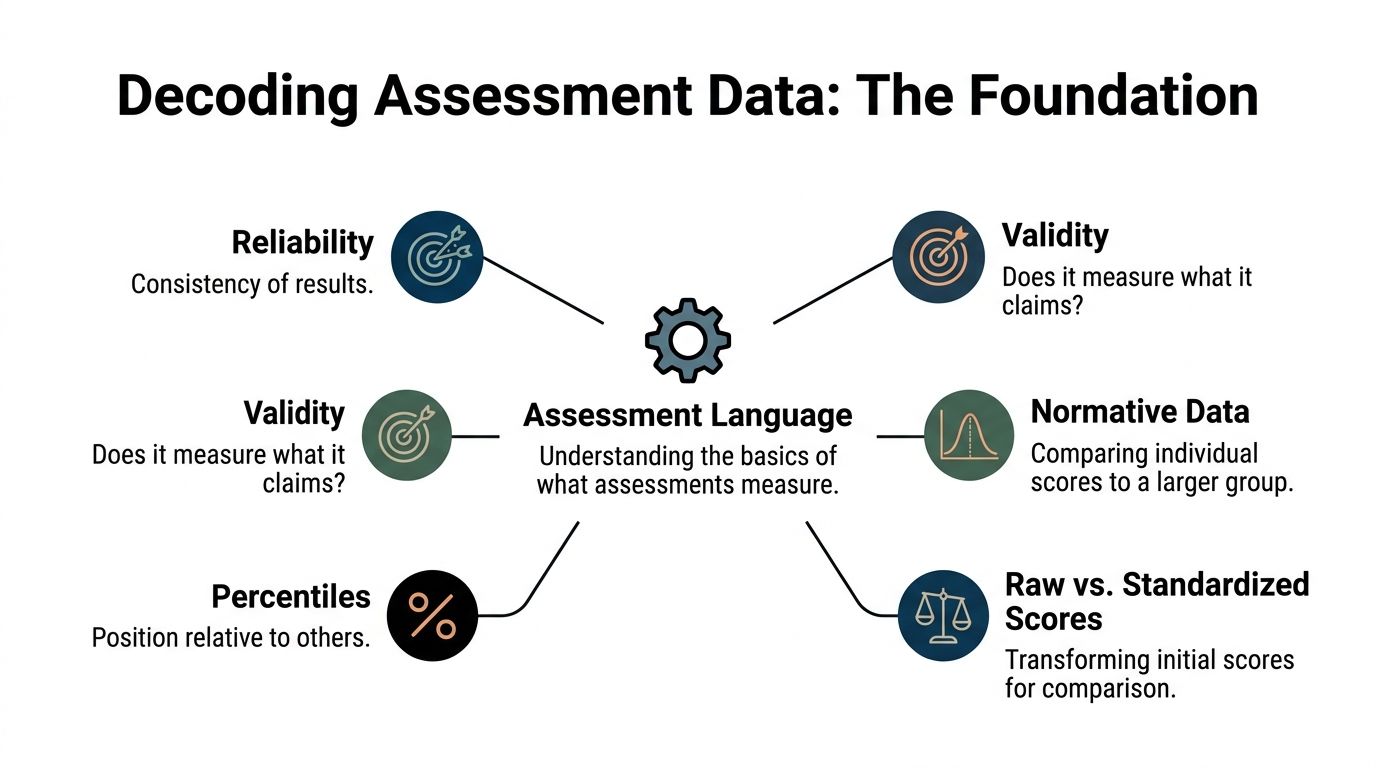
Assessment interpretation gets easier once you stop treating the report as a mystery document and start treating it as a measurement system. The executive audience doesn't need a statistics lecture. They do need enough fluency to ask intelligent questions about what a score means, what it doesn't mean, and what comparison group sits behind it.
Start with compared to whom
A score without context is just a number. The first question behind any percentile, standard score, or benchmark is compared to whom.
A comparison against a broad general population tells you one thing. A comparison against successful enterprise sellers, plant managers, or first-line people leaders tells you something more decision-ready. This is why the same candidate can look merely average in one benchmark and highly differentiated in another.
Three foundational terms matter most:
Reliability and validity aren't academic extras
Leaders often skip past these terms because they sound technical. That's a mistake. Reliability asks whether the result is consistent. Validity asks whether the assessment measures what it claims to measure and supports the interpretation you're about to make.
The psychometric discipline behind item analysis shows why this matters. In one example, only 40% of examinees may choose the correct answer while 50% pick a distractor, which can indicate a flawed item or an overly effective distractor. Metrics such as the Pearson point-biserial correlation (r-pbis) range from -1 to 1, and the eta coefficient ranges from 0 to 1, helping developers judge whether items differentiate effectively and support valid score interpretation ([item analysis overview](https://assess.com/item-analysis/)).
For a business user, the takeaway is direct: if the underlying instrument isn't measuring cleanly, the downstream recommendation won't be trustworthy either. If you want a deeper grounding in this concept, this explainer on [validity in psychology](https://synopsix.ai/blog/validity-in-psychology) is a useful companion.
> Reliable scores reduce noise. Valid interpretations reduce bad decisions.
Human behavior is context-bound
A rigorous methodology for assessment interpretation requires a multisource, multi-method, and multisetting approach, because human functioning is domain-specific and context-dependent. The APA also states that psychologists must understand the conceptual meaning of scores before synthesis ([APA guidance](https://www.apa.org/about/policy/guidelines-psychological-assessment-evaluation.pdf)).
That matters more in talent decisions than many teams admit. A candidate may show strong problem-solving tendencies in structured tasks and far less strength in ambiguous, political, cross-functional environments. If the role lives in the second environment, you can't synthesize results as if context were irrelevant.
A simple executive check
Before you trust any assessment output, ask these four questions:
1. What exactly is being measured? 2. Who is the person being compared against? 3. How should this score be used in this role context? 4. What other evidence should sit beside it?
That last question is the one many teams forget. Good assessment interpretation doesn't isolate scores from interviews, work history, structured references, or on-the-job evidence. It organizes them.
From Numbers to Narratives Reading a Profile
A useful profile reads less like a spreadsheet and more like a behavioral forecast. Not a prediction in absolute terms. A structured view of how someone is likely to operate when the work gets real.
Read patterns, not traits
One of the most practical rules in assessment interpretation is to stop reacting to isolated dimensions. A single trait score rarely tells you enough. What matters is the pattern.
When interpreting assessment data, comparisons usually fall into three categories: performance against a standard, self-comparison over time, and comparison with peer groups. That same source notes that Pearson correlation values are traditionally interpreted as low below 0.4, moderate from 0.4 to 0.8, and high above 0.80, which reinforces the need to look at the magnitude of association rather than making too much of weak links ([CAL evaluation toolkit](https://www.cal.org/twi/EvalToolkit/6how2analyze.htm)).
In practice, that means you're looking for combinations that create a coherent work style. High urgency means something different when paired with high conscientiousness than it does when paired with low detail orientation. Strong social confidence means something different when paired with low resilience than when paired with emotional steadiness.
A project manager example
Take a project manager profile. Suppose the narrative across the report suggests these tendencies:
That pattern tells a more useful story than any single score. In an early-stage environment with shifting requirements, this could be a strong fit. In a highly regulated delivery environment with strict documentation standards, the same pattern could create execution risk.
A manager reading a [personality profile sample](https://synopsix.ai/blog/personality-profile-sample) should be able to move from trait labels to role implications quickly. The right question isn't “Is this score good?” It's “How will this pattern show up in the work?”
> Ask what behavior a score combination is likely to produce on a stressful Tuesday, not in a quiet testing session.
Turn profile patterns into interview probes
Once you've built the narrative, use it to sharpen the final-stage interview. For the project manager example, I'd probe in very specific areas:
| Profile signal | Business implication | Interview question | | --- | --- | --- | | High urgency plus lower detail focus | Risk of speed outrunning control | Tell me about a project where speed created rework. What did you change? | | Strong ownership | Potential for initiative and boundary overrun | When have you moved ahead without full alignment, and what happened? | | Moderate influence | Solid stakeholder management, possible difficulty in escalation moments | Describe a time you had to push back on a senior stakeholder. |
That's where numbers become decisions. Not in the report itself, but in the quality of the narrative and the evidence you gather around it.
Matching Profiles to Roles and Identifying Risk Flags
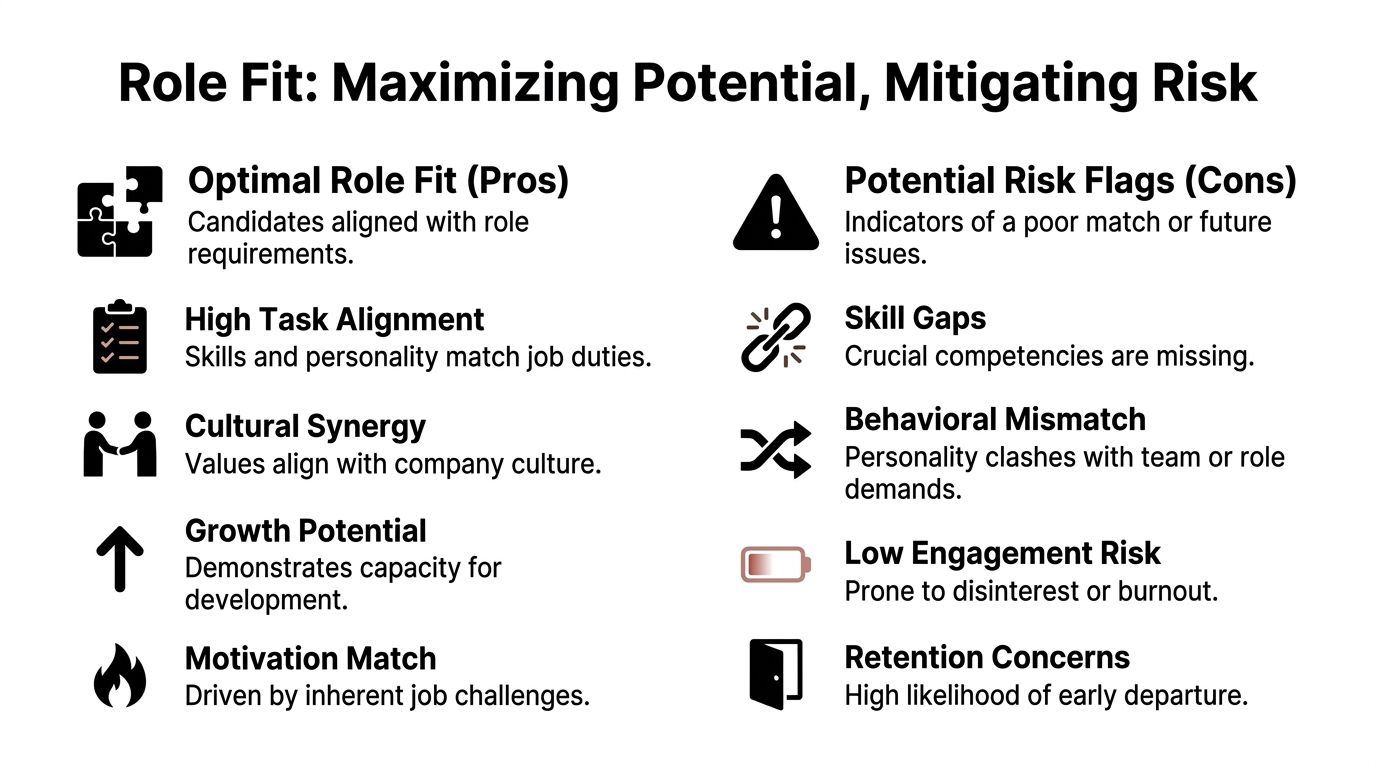
Role fit isn't about finding the best person in the abstract. It's about finding the best trade-off for a defined job, on a specific team, with known constraints. That requires discipline. Otherwise teams drift into vague language about culture, instinct, and executive presence.
Build the role before you judge the person
I start with the work, not the candidate. A role-fit review should define the few demands that separate success from failure. Usually that includes pace, ambiguity, decision latitude, collaboration load, precision requirements, and the type of influence the role needs.
Once that's clear, map the profile to the role in two lanes:
This next resource is useful if you want another perspective on fit-versus-risk thinking in practice.
<iframe width="100%" style="aspect-ratio: 16 / 9;" src="https://www.youtube.com/embed/V1CSKCStvZU" frameborder="0" allow="autoplay; encrypted-media" allowfullscreen></iframe>
A practical fit and risk grid
The cleanest version is a short decision grid.
| Area | Strong sign | Risk flag | What to decide | | --- | --- | --- | --- | | Pace | Thrives in fast cycles | Acts before enough information | Can the role tolerate quick but imperfect calls? | | Collaboration | Engages others well | Avoids hard challenge | Does the role require direct confrontation? | | Execution | Builds momentum | Drops detail follow-through | Is there process support around the role? | | Leadership | Takes charge naturally | May overpower peers | Is the team built for forceful leadership? |
Experienced people leaders separate signal from panic. A risk flag isn't an automatic no. It's a conditional judgment. Some risks are manageable with structure, coaching, and team design. Others sit right in the role's failure path and shouldn't be rationalized away.
Weigh trade-offs like an operator
The best hiring discussions sound less like personality debates and more like business scenario planning.
For example:
> Don't ask whether the person is impressive. Ask whether their likely strengths and failure modes match the operating conditions of the job.
This is also where assessment interpretation becomes credible with executives. You're not selling certainty. You're presenting a structured judgment: where the candidate fits, what could go wrong, and whether the business is willing to absorb that risk.
Crafting Actionable Reports and Recommendations
A strong interpretation can still fail if the report reads like a technical archive. Busy executives don't need every subscale, every benchmark note, or every psychometric footnote. They need a recommendation they can use in a meeting.
The one-page report that gets read
The most effective format is a one-page decision brief. It should answer four things in order:
1. Overall fit recommendation 2. Strengths most relevant to role success 3. Risk factors and likely conditions that trigger them 4. Specific next actions
That structure forces discipline. It stops the writer from hiding behind jargon and forces each insight to earn its place.
A clean summary might use headings like these:
Don't interpret alone
One of the biggest mistakes in assessment interpretation is treating it as a solo analytical exercise. A better protocol uses structured conversation. Guidance from the University of Hawaiʻi notes a critical pitfall is failing to collaboratively analyze results with diverse perspectives, and recommends structured conversations using rubrics to align findings with intended outcomes and surface differences across groups that aggregate views can miss ([assessment use guidance](https://manoa.hawaii.edu/assessment/resources/interpret-and-use-assessment-results/)).
In talent settings, that means involving the right mix of participants. Recruiters see market patterns. Hiring managers know the work. HR business partners understand organizational context. Sometimes a skip-level leader sees risk tolerance more clearly than either group.
A report language upgrade
Compare these two examples.
Weak phrasing The candidate demonstrates high dominance and below-average conformity, suggesting a potentially independent and assertive interpersonal style.
Better phrasing The candidate is likely to challenge slow decision processes and may work around unclear authority lines. That can help in turnaround conditions. It can create friction in matrixed teams unless expectations are explicit.
The second version gives the business reader something to do.
> A report earns trust when every observation is tied to a business implication, not when every business implication is tied back to a trait label.
Include mitigation, not just diagnosis
Assessment interpretation is most valuable when it helps the organization act after the decision, not only before it.
For each notable risk, include one mitigation move:
| Risk signal | Likely consequence | Practical mitigation | | --- | --- | --- | | Low structure tolerance | Inconsistent follow-through | Add milestone reviews and visible operating cadence | | Conflict avoidance | Slow issue escalation | Coach on decision rights and escalation triggers | | High control orientation | Delegation bottlenecks | Set explicit ownership boundaries early |
This turns the report from a screening artifact into a management tool. That's when hiring managers start asking for it proactively.
Advanced Interpretation for Predictive Team Design
The most strategic use of assessment interpretation starts after the individual hire decision. Teams don't succeed because every person scores well in isolation. They succeed when work styles combine in ways that improve execution, challenge, adaptation, and trust.
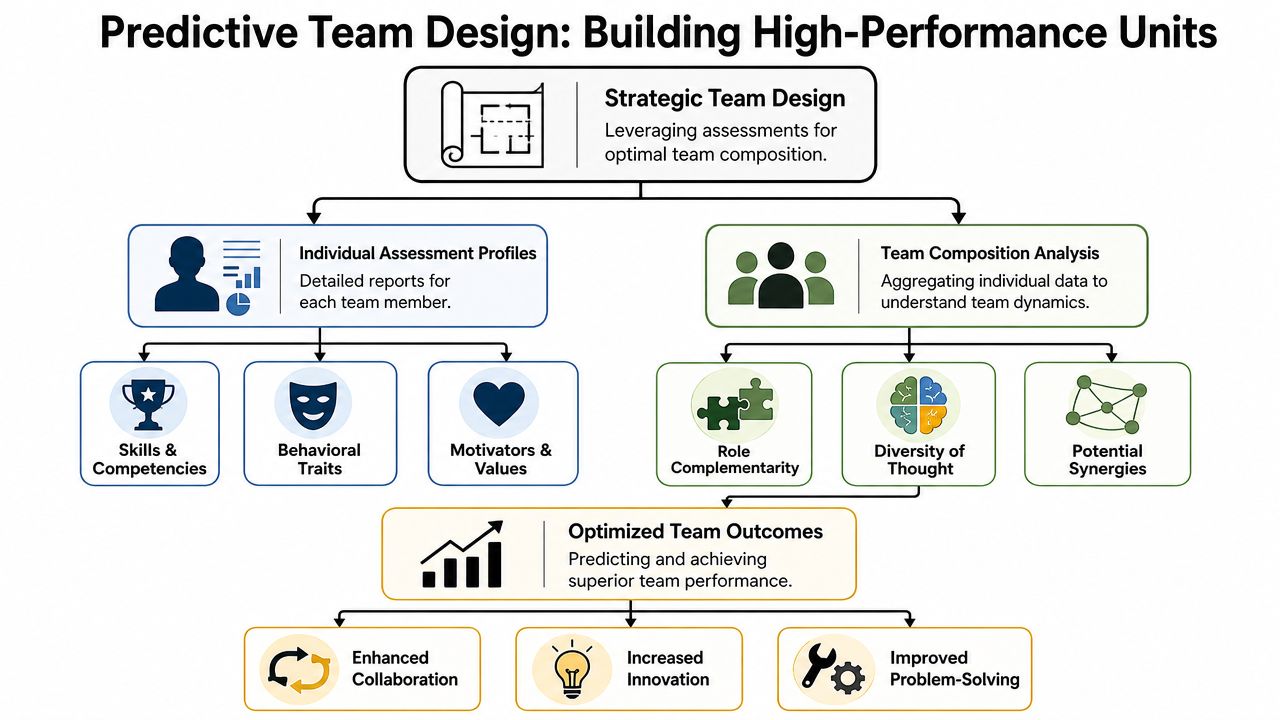
Move from person fit to interaction fit
Many organizations are lagging in this area. One source states that 68% of organizations use behavioral assessments for team design, but only 12% have tools that translate psychometric profiles into predictive simulations of team compatibility. The same source says a 2025 study found 58% of talent leaders cannot interpret assessment data to anticipate team friction, contributing to more project delays and lower performance ([team design reference](https://pmc.ncbi.nlm.nih.gov/articles/PMC7605764/)).
The key shift is simple. Don't ask only whether each person fits their role. Ask how their profiles will interact under pressure.
Examples include:
Use team interpretation like scenario planning
When I review a team slate, I look for concentration risk. Too much similarity in pace, confrontation style, detail orientation, or ambiguity tolerance can become a structural problem. The profile mix should match the work mix.
That's where a data environment matters. If your people data sits across fragmented systems, it helps to [find expert Databricks consultancies](https://dataengineeringcompanies.com/databricks-consulting/) that can support a cleaner analytics foundation before you attempt more advanced workforce modeling.
A useful next step is connecting profile interpretation with [predictive modeling](https://synopsix.ai/blog/what-is-predictive-modeling). Not to automate judgment away, but to support better staffing decisions with a clearer view of likely friction, complementarity, and development needs.
What executives should ask
For team design, I'd push leadership teams to ask:
1. Where will this group likely align quickly? 2. Where will disagreement stall or sharpen execution? 3. Which pairings create an advantage, and which pairings create drag? 4. What support structure will this team need to perform at speed?
That's the mature form of assessment interpretation. Not just reading a person. Reading the system that forms when several people work together.
---
Synopsix helps teams turn assessment data into decision-ready guidance for hiring, team design, and talent development. If you want business-language reports, clearer fit recommendations, and practical signals for risk and complementarity, explore [Synopsix](https://synopsix.ai).