Assessment Validity and Reliability: A Practical Guide
By Synopsix · August 22, 2026 · 15 min read
A candidate arrives with an impressive résumé, polished interview answers, and an assessment score that suggests an ideal fit. Months later, the same person struggles with the role's actual demands. The hiring team starts questioning its judgment, but the deeper problem may sit in the measurement itself. If the assessment produces noisy or misleading data, even experienced managers can make confident decisions on a weak foundation.
Assessment validity and reliability turn that foundation into something more useful. Reliability asks whether a tool produces consistent results. Validity asks whether those results support the conclusion you want to draw, such as whether a candidate is likely to perform well in a particular job. Together, they help people teams move from attractive impressions to evidence that supports faster decisions, lower hiring risk, and better performance predictions.
Why Most Hiring Decisions Feel Like Guesswork
A sales leader needs to hire a manager quickly. One finalist has a strong record, communicates with confidence, and scores highly on a behavioral questionnaire. The hiring panel agrees that the candidate looks decisive, persuasive, and commercially minded. After joining, however, the new manager avoids difficult coaching conversations, misses warning signs in the pipeline, and creates friction with experienced representatives.
The failure doesn't automatically mean the hiring manager was careless. The team may have relied on an assessment that measured confidence rather than coaching skill, or on interview ratings that changed according to which manager conducted the conversation. A polished score can create an illusion of precision without proving that the score relates to the work.

Signal versus noise in hiring
Every selection process contains information and error. A structured work sample may reveal how someone handles a real task. A vague interview question may reveal more about the interviewer's preferences than the candidate's capability. A personality profile may describe a useful tendency, but only if the instrument measures that tendency consistently and connects it to the role.
Reliability helps control random variation. Validity helps establish whether the remaining signal supports a meaningful interpretation. Without both, hiring teams can mistake familiarity, charisma, résumé polish, or an appealing assessment report for evidence of future performance.
Managers also need practical support during live conversations. Tools that help interviewers capture comparable evidence can complement, rather than replace, a validated assessment process. Teams can [explore real-time interview support](https://www.parakeet-ai.com/hiring) when they need help keeping interviews focused and evidence-based.
> Practical rule: A score deserves influence in a hiring decision only when the organization understands how consistently it is produced and what outcome it can reasonably predict.
The central question isn't whether an assessment looks advanced. It's whether the data helps the organization choose someone who can do the work, in the conditions that matter, with less dependence on guesswork.
What Assessment Validity and Reliability Mean
A hiring manager reviews two candidates who received similar assessment scores. Before using those scores to rank them, the team needs to know whether the assessment produces stable results and whether the results mean what the organization assumes.
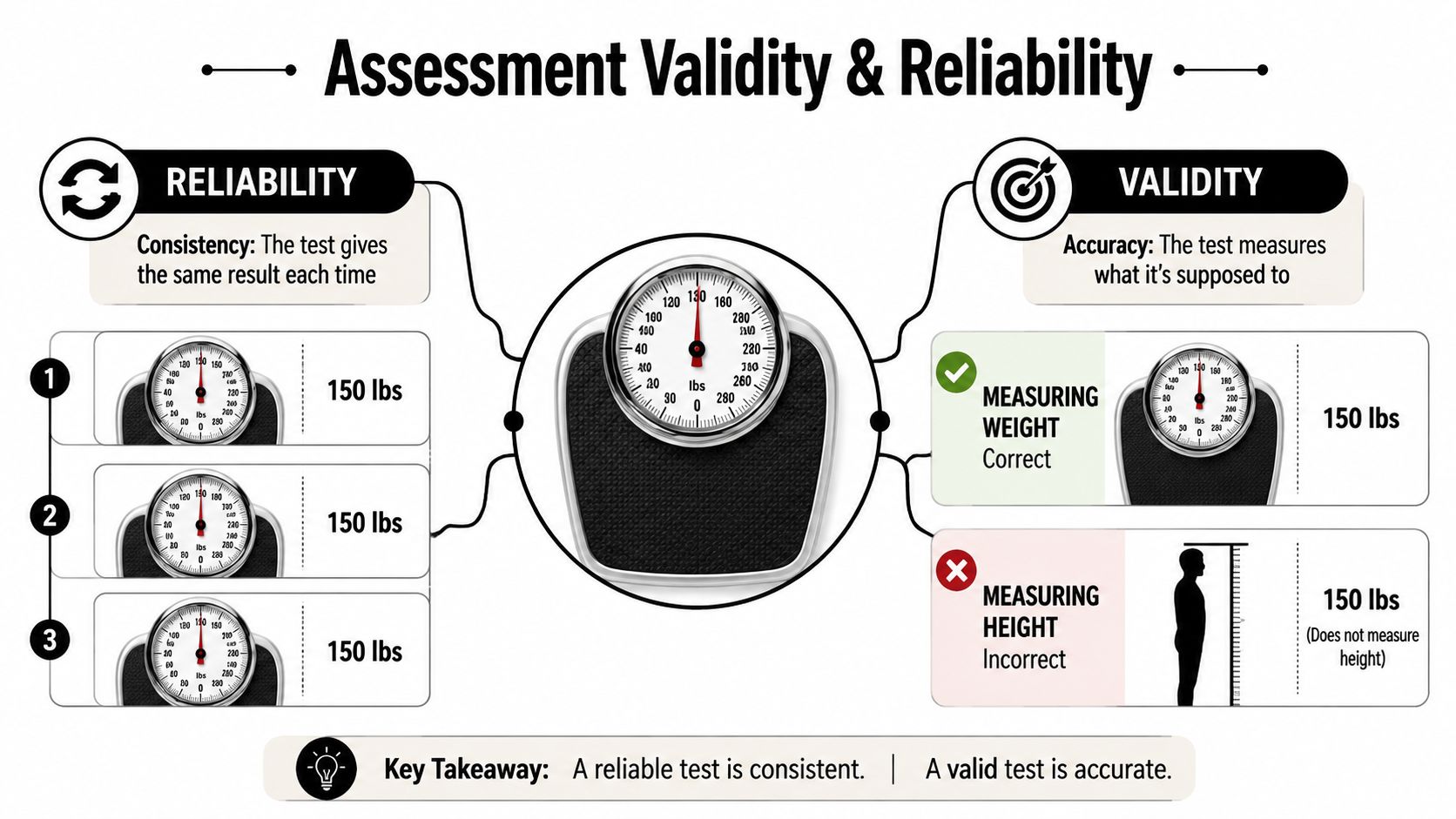
A bathroom scale makes the distinction clear. If it shows the same reading each time you step on it, it demonstrates reliability, or consistency across repeated measurements. That consistency does not establish accuracy. A scale can be calibrated incorrectly and display the same wrong reading every time.
Validity concerns accuracy and meaning. If the scale is intended to measure weight, does it measure weight rather than height, balance, or another feature? In hiring, the parallel question is whether a score supports the interpretation being made. A reasoning assessment might produce similar scores repeatedly, while offering little evidence about future customer-service performance.
Why reliability comes first
Reliability reflects consistency across time, items, or raters. Common reliability statistics typically range from 0 to 1, with higher values indicating less measurement error, as described in the [psychometric overview of validity and reliability](https://static1.squarespace.com/static/61155ee1e0b08d7164c81982/t/68dad0f4bb54c92cf0e0be4a/1759170804074/validitiy+and+reliability.pdf). If two managers score the same response very differently, the organization cannot confidently interpret the result. The variation may arise from scoring rather than from the candidate.
Reliability provides the measurement foundation for validity. A tool may consistently measure the wrong attribute, and unstable results leave too much uncertainty for a defensible interpretation. In practice, dependable scoring helps hiring teams compare candidates, reduce rework, and make decisions with less delay, but consistency alone says little about job performance.
Validity is an evidence argument
Modern psychometrics treats validity as an evidence-based argument rather than a permanent label attached to a test. Relevant evidence can include:
For HR leaders, “valid” is an incomplete description. The useful questions are valid for what use, in which role, and under which conditions? An assessment may support development conversations while lacking evidence for high-stakes selection. That distinction affects hiring speed, risk, and the confidence of predictions about actual work performance.
The Three Types of Validity That Matter for Hiring
Hiring teams can organize validity evidence around three practical questions. Each question examines a different part of the decision, and none should be treated as a substitute for the others. The [overview of validity in psychology](https://synopsix.ai/blog/validity-in-psychology) provides a useful companion for teams building this vocabulary.
Does the content match the job
Content validity asks whether an assessment covers the capabilities the role requires. A technical support assessment should include tasks related to diagnosing customer problems, communicating clearly, and following through. If it focuses mainly on abstract vocabulary, it may omit central parts of the job.
Start with a role analysis. Identify the behaviors that distinguish effective performance, then check whether the assessment gives candidates a meaningful opportunity to demonstrate them. A panel of knowledgeable job experts can review the items, scenarios, or work samples for relevance and coverage.
Does the score relate to performance
Criterion-related validity asks whether assessment results correspond with an external criterion. In selection, the most useful criterion is often later job performance, measured through a defensible performance process rather than a manager's general impression.
Predictive validity is the forward-looking version. It examines the relationship between a selection method and later performance. In employment contexts, coefficients above 0.30 are considered useful, above 0.40 strong, and above 0.50 exceptional, according to this [guide to predictive validity in assessments](https://scovai.com/blog/predictive-validity-assessments/). These thresholds provide orientation, not permission to ignore the role, sample, design, or consequences of use.
Is the tool measuring the claimed trait
Construct validity asks whether the assessment measures the psychological construct it names. If a tool claims to measure adaptability, its items and score patterns should behave in ways consistent with adaptability, rather than reflecting verbal fluency or social confidence.
For employers, criterion-related evidence often feels most actionable because it connects scores to outcomes. Still, content and construct evidence explain what the score means and why the relationship might exist. A useful hiring decision needs the three forms working together.
How to Evaluate Reliability Evidence in Assessments
A vendor's reliability evidence should answer a simple operational question: will this score remain dependable when real people use the tool in real hiring conditions? Different reliability measures test different sources of inconsistency.
| Metric | What It Measures | Acceptable Range | |---|---|---| | Internal consistency | Whether items intended to measure the same trait produce coherent results | Often near or above 0.80 for strong consistency | | Test-retest reliability | Whether scores remain stable when the same person completes the measure again under comparable conditions | Review the coefficient, time interval, and expected stability of the trait | | Inter-rater reliability | Whether different assessors score the same response or performance similarly | Review agreement evidence and the clarity of scoring rules |
Internal consistency looks inside the assessment. If several questions are supposed to measure conscientiousness, their responses should show enough coherence to support a common interpretation. Test-retest reliability examines stability over time, while inter-rater reliability matters whenever managers evaluate interviews, simulations, writing samples, or role plays.
A 2020 meta-analysis of curriculum-based measures illustrates why teams shouldn't assume quality from an assessment label alone. Its reported overall mean criterion-validity correlation was .59, while alternate-form reliability ranged from .21 to .89, showing that measurement quality can vary substantially by format and content area ([meta-analysis of curriculum-based measures](https://journals.sagepub.com/doi/10.1177/1534508420978457)).
Human judgment changes the reliability equation
A tool may have impressive validity documentation but lose consistency during administration. A 2025 review of rubric-based assessment found that ambiguous wording reduced agreement among raters, even when validity criteria were met. Explicit rating rules helped assessors apply the rubric more consistently ([review of rubric-based assessment](https://ejournal.papanda.org/index.php/jmrd/article/view/1253)).
That finding applies directly to hiring. Two managers may agree that a candidate is “strategic,” yet mean different things by the word. One may reward long-term planning, while another rewards decisiveness under uncertainty. A scoring guide should define observable behaviors, distinguish levels of performance, and give raters practice applying the rules.
Teams evaluating technical roles can also use a structured [senior developer evaluation guide](https://hire-a.dev/blog/coding-skills-assessment) to clarify what a coding assessment should observe. The point isn't to outsource judgment. It's to make the criteria visible enough that different assessors can reach comparable conclusions.
For a deeper explanation of consistency within testing, teams can review [what test reliability means](https://synopsix.ai/blog/what-is-test-reliability). Then ask the provider for coefficients, samples, administration conditions, and evidence from the population where the assessment will be used.
The Gap Between Strong Reliability and Real Validity
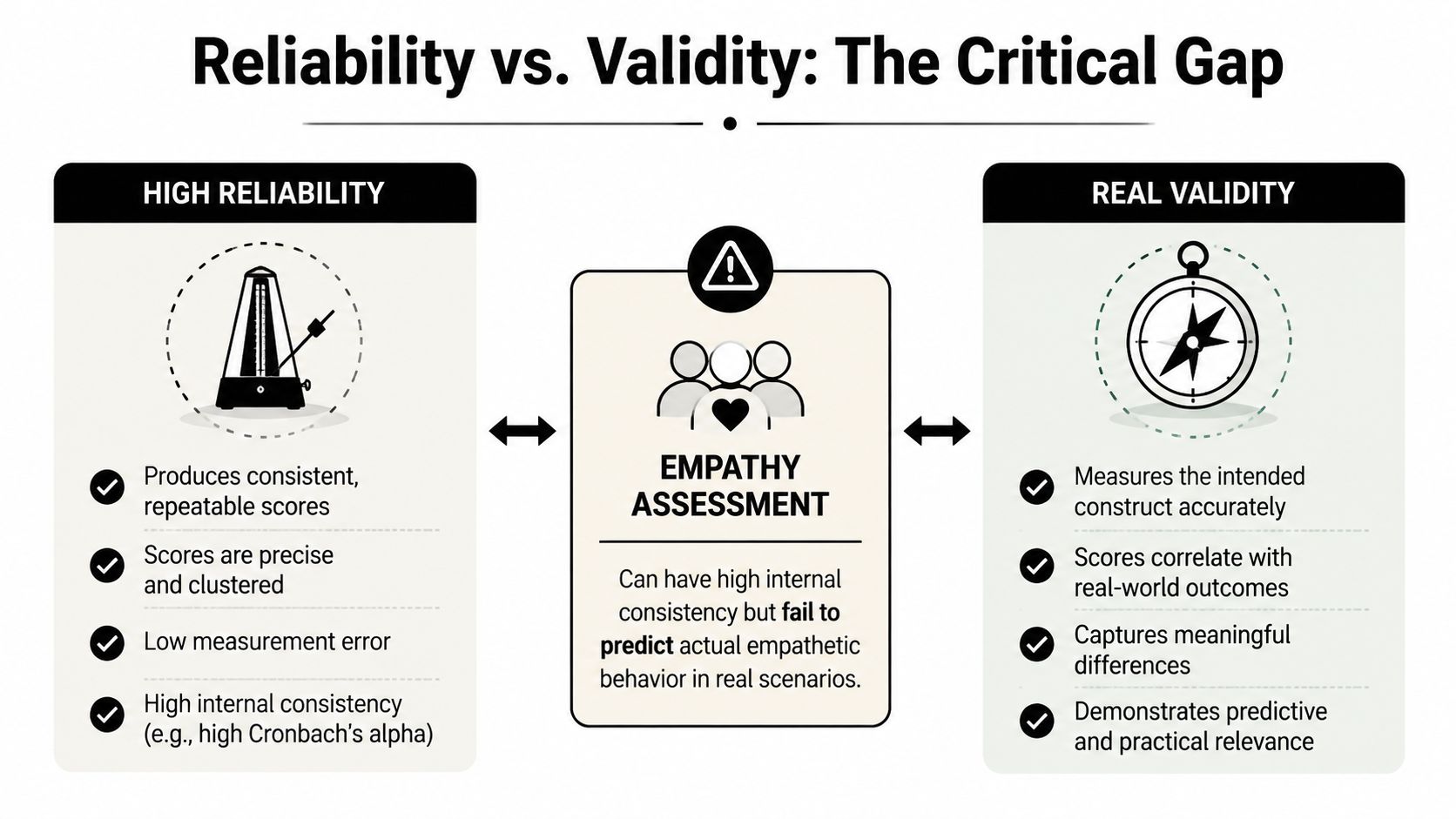
A consistent score can still describe the wrong capability. That's the uncomfortable gap many assessment buyers miss when they focus on a single reliability coefficient.
Empathy instruments provide a clear example. A systematic review and meta-analysis found internal-consistency reliability values in the moderate-to-good range, with Cronbach's alpha from about 0.61 to 0.86. Yet construct-validity evidence was weaker, including convergent-validity relationships around 0.27 to 0.45 and weak structural validity ([systematic review of empathy instruments](https://www.frontiersin.org/journals/psychology/articles/10.3389/fpsyg.2021.781346/full)).
What the gap means for talent decisions
Suppose an empathy questionnaire contains carefully worded items that all ask about similar self-perceptions. Candidates may answer in a stable pattern, producing a repeatable score. That score may still fail to represent how they listen to an upset customer, respond to disagreement, or notice another person's perspective during pressure.
For high-stakes hiring, the standard should therefore be dual evidence:
One established example is the PI Behavioral Assessment. Its validity summary reports approximately 400 validity studies since 1992, with significant performance relationships in 94% of studies and an average criterion-validity coefficient of r=0.30 in the significant tests ([PI Behavioral Assessment reliability and validity summary](https://www.predictiveindex.com/learn/support/reliability-and-validity-of-the-pi-behavioral-assessment/)). Those figures don't make every use automatically appropriate, but they give buyers a body of evidence to examine.
A measurement program earns trust when it shows both consistency and meaningful relationships to work outcomes. Either one alone leaves a material blind spot.
The following video offers additional context for understanding the distinction between repeatable measurement and meaningful prediction.
<iframe width="100%" style="aspect-ratio: 16 / 9;" src="https://www.youtube.com/embed/6pOHGjsDd8g" frameborder="0" allow="autoplay; encrypted-media" allowfullscreen></iframe>
Automation can improve process consistency, but it can't create validity evidence where none exists. Teams comparing automated quality controls may find this [test automation guide](https://yellow.ai/platform/automated-testing/) useful as a general reference for thinking about repeatable evaluation processes.
How Context and Methodology Impact Predictive Power
The same construct can predict performance differently depending on how the assessment presents it. A general question such as “Are you organized?” invites self-description with little connection to a specific job. A contextualized question asks how the candidate prioritizes competing customer requests, manages deadlines, or responds when a plan changes.
Meta-analytic evidence found that contextualized personality measures were more predictive of performance than noncontextualized measures. Noncontextualized measures ranged from .02 to .22, with a mean validity of .11, while contextualized measures ranged from .14 to .30, with a mean validity of .24 ([meta-analysis of contextualized personality measures](https://jobcannon.io/methodology/disc/validity)).
Scoring is part of the measurement
Scoring methodology also changes the signal. Rational scoring relies on a theory-based decision about which responses should count and how strongly. Empirical scoring uses observed relationships between response patterns and relevant outcomes to construct the composite.
A meta-analysis of biodata in employment settings found higher criterion-related validity for empirically scored composite scales, with ρ = .44, than for rationally scored composite scales, with ρ = .24. The analysis also identified conscientiousness and leadership as the most predictive narrow domains ([technical summary of biodata validity](https://clearrock.com/wp-content/uploads/2022/03/Science-Behind-the-PI-Technical-Summary-1.pdf)).
Context and scoring don't eliminate the need for judgment. They make the assessment more closely resemble the decision it supports and provide a stronger basis for interpreting results.
Can the relationship travel
A result from one organization may reflect local hiring practices, a narrow applicant pool, or a particular performance measure. Validity generalization uses meta-analysis to estimate the mean population validity and variation across settings. A test is typically considered to show validity generalization when 90% or more of its observed validity estimates with the target criterion are above zero ([validity generalization framework](https://econtent.hogrefe.com/doi/10.1027/1015-5759/a000835)).
For HR leaders, that evidence matters when applying an assessment across departments, locations, or job families. A portable signal can reduce dependence on one study, but teams should still examine moderators, role differences, and local consequences before expanding use.
How Synopsix Applies Psychometric Science to Hiring
A people intelligence platform can make psychometric evidence easier for operating teams to use, provided the underlying assessment and interpretation are documented. Synopsix describes a four-step workflow that moves from measurement to action.
Start with a consistent assessment
Candidates and employees complete an assessment in under 30 minutes, according to the platform description. The first business benefit is comparability. Each person responds to a defined process rather than receiving an entirely different evaluation based on interviewer style.
Create a shared behavioral language
The platform generates comparable behavioral profiles. This gives recruiters, hiring managers, and people leaders a common way to discuss likely work patterns without relying entirely on labels such as “culture fit,” which can hide personal preference.
Translate psychometrics into decisions
The next step turns assessment results into business signals. Reports can present role-specific insights, risk indicators, and fit recommendations in language intended for decision-makers rather than psychometric specialists. That translation helps managers ask better follow-up questions, but it shouldn't replace job analysis, structured interviews, or outcome tracking.
Test the decision before acting
Simulations and compatibility analysis help teams examine potential friction, complementary behaviors, and development needs. The product suite includes assessments and profiles, intelligence reports for roles such as leadership and sales, predictive simulations, and Human Interlink for visualizing team complementarity and tension points.
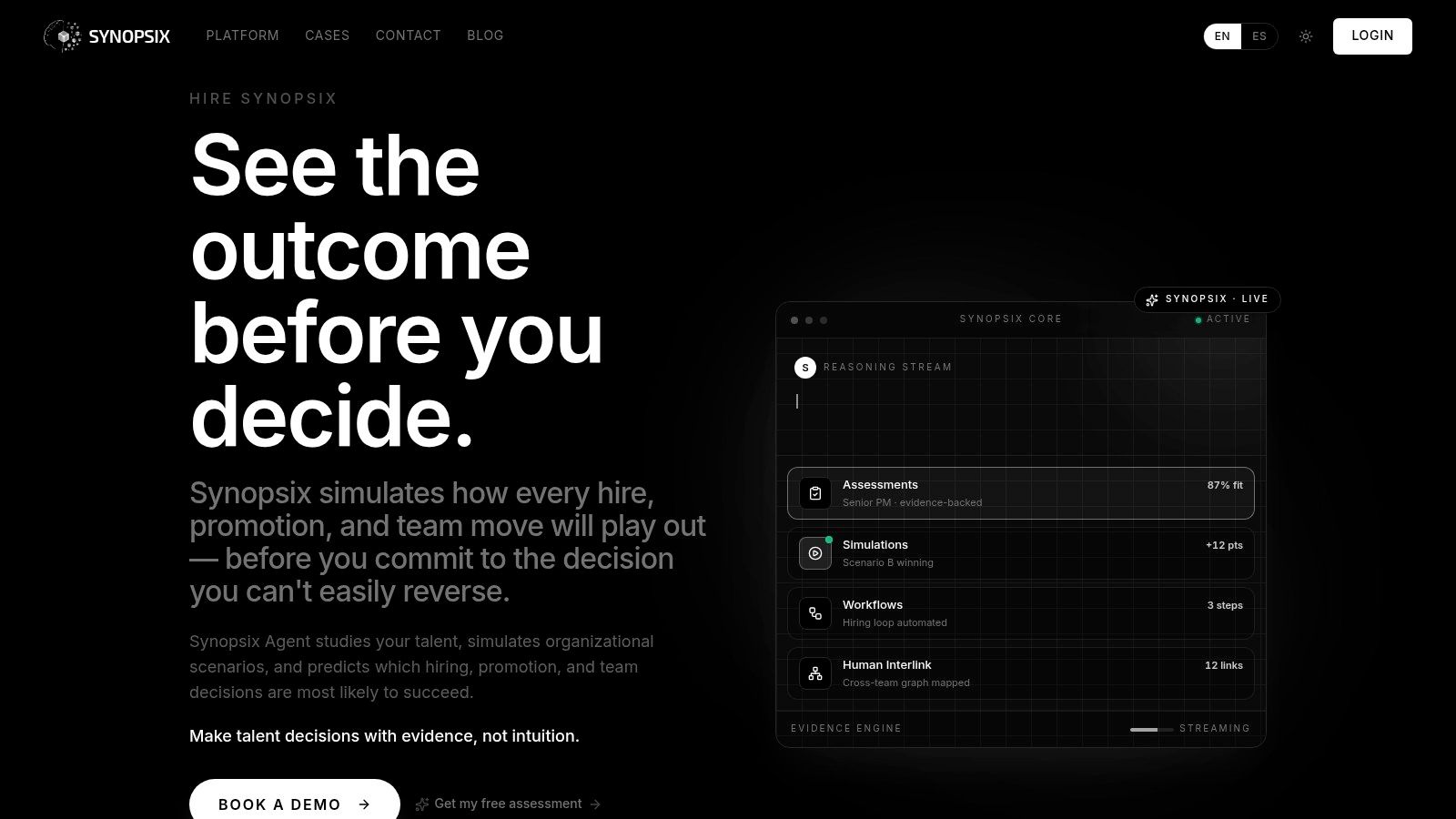
Backed by AI and proprietary IP, Synopsix reports 40% faster hiring decisions, 60% fewer mis-hires, over 50K profiles generated, and claimed 98% assessment accuracy. These are reported platform outcomes, so HR leaders should ask how each result was defined, measured, and validated before using it in an internal business case.
The practical evaluation standard remains unchanged. Ask what the assessment measures, how consistently it measures it, which outcomes it predicts, and whether the reports help managers make decisions that can be reviewed later.
Making Smarter Decisions With Validated Assessment Data
Responsible assessment use starts before a vendor demonstration. It begins with a clear definition of the job, the decision, and the evidence required to support that decision. A tool that produces attractive profiles but lacks reliability or criterion-validity research shouldn't carry decisive weight in hiring.
Use this due-diligence checklist:
Newer digital methods deserve the same scrutiny as traditional tools. A 2024 systematic review of social-media-based personnel assessment found that single-rater reliability was mostly poor, convergent validity was only adequate, and criterion-related validity for job outcomes was small or near zero ([review of social-media-based personnel assessment](https://www.cogn-iq.org/blog/what-predicts-job-performance/)). The review also noted limited criterion-related validity research for asynchronous video interviews and concerns that AI-generated or simulated interview responses may change validity and outcomes.
AI can accelerate administration and interpretation, but it doesn't turn an unvalidated signal into a dependable prediction. HR leaders should preserve human accountability, document how scores influence decisions, and validate outcomes after deployment. Sound assessment validity and reliability practice is less about finding one perfect coefficient and more about building an evidence trail that connects the tool, the role, the decision, and the result.
For help translating psychometric reports into defensible talent decisions, review this guide to [assessment interpretation](https://synopsix.ai/blog/assessment-interpretation).
---
Synopsix turns scientifically validated behavioral assessments into practical guidance for hiring, team design, and talent development, with comparable profiles, role-specific reports, simulations, and compatibility analysis. Visit [Synopsix](https://synopsix.ai) to see how your team can connect reliable measurement with more informed people decisions.