Behavioral Assessments for Hiring: A Practical Guide
By Synopsix · August 20, 2026 · 15 min read
A hiring manager championed a candidate because the person was articulate, confident, and familiar with the company's market. Four months later, the hire was missing commitments, avoiding difficult feedback, and creating friction across the team. The manager's question was simple: What did we miss?
That question is driving more HR leaders toward behavioral assessments for hiring. These tools won't replace judgment, and they shouldn't. Used correctly, they add structured evidence about how candidates tend to decide, collaborate, handle ambiguity, and respond to pressure. Used badly, they create false precision, invite candidate faking, and can automate bias at scale.
The right approach is practical. Match each assessment to the hiring decision, combine behavioral data with job-relevant evidence, and monitor whether the signal predicts outcomes in your own workforce.
Why Behavioral Signal Matters in Modern Hiring
Resumes tell you where someone has worked and what they claim to have done. They rarely show how that person behaves when priorities conflict, a customer escalates, or a manager challenges their assumptions. Culture-fit interviews often add little because interviewers reward polish, shared background, and communication styles that resemble their own.
Reference checks have the same weakness when they're unstructured. A former manager may confirm that a candidate was “great,” but that description doesn't tell you whether the person seeks feedback, follows through under ambiguity, or handles disagreement without withdrawing.
Behavioral assessments address a different question: what patterns is this person likely to bring into the role? Depending on the instrument, they can surface default collaboration style, decision-making tendencies, response to feedback, composure under pressure, and risk posture. The value isn't psychological curiosity. It's the connection between a measurable construct, a job competency, and an observable outcome.
Where traditional evidence breaks down
Remote work makes observation harder. Cross-functional roles distribute accountability across people who may never share an office. Frontline hiring often moves quickly, leaving little time for deep vetting. In each environment, interview charisma can mask weak execution, while quiet candidates can be screened out before they demonstrate capability.
That's why behavioral signal matters. It gives hiring teams a common language and a repeatable observation layer. Structured behavioral interviews, for example, use the same questions, anchored scoring, and consistent rubrics, reducing interviewer noise and making candidate comparisons more reliable across applicants and geographies. Meta-analytic summaries frequently cite operational validity around 0.42 for structured behavioral interviews, as described in this [overview of personality testing for hiring](https://www.poll-maker.com/personality-test-for-hiring).
> Practical rule: Use behavioral evidence to sharpen human judgment, not to disguise an instinctive decision with a score.
The rest of the program depends on design. You need to know what each assessment measures, how much predictive value it earns, where the signal weakens, and which controls protect candidates and the organization. The financial case follows from that discipline, because a valid signal only creates value when it changes a decision and improves the quality of the resulting hire.
What Behavioral Assessments Measure in Practice
A behavioral assessment is a standardized instrument for estimating how candidates tend to act, decide, and relate to others at work. It captures behavioral preferences or likely responses. It does not measure technical knowledge, reasoning speed, or a candidate's ability to deliver a compelling career narrative.
The distinction determines where the tool belongs in the hiring workflow. Cognitive ability tests examine reasoning, information processing, or working memory. Personality questionnaires without a clear connection to workplace competencies may describe broad traits while offering little decision value. Unstructured interviews often reward confidence and verbal fluency. Behavioral assessments add a structured view of work-related tendencies, provided the design connects each measure to job demands.
Four assessment families
| Family | What It Measures | Typical Length | Best Stage | |---|---|---|---| | Situational judgment tests | Responses to realistic workplace scenarios and competing priorities | Short | Early screening | | Trait-based inventories tied to competencies | Tendencies such as conscientiousness, sociability, adaptability, or composure | Moderate | Screening and interview preparation | | Simulation exercises | Observable behavior in an inbox task, role play, written case, or work sample | Longer | Mid- to late-stage evaluation | | Integrity and honesty scales | Reliability, rule adherence, responsibility, and attitudes toward workplace conduct | Short to moderate | Screening and risk review |
Situational judgment tests, or SJTs, ask candidates to choose or rank responses to realistic job situations. A customer-service SJT can examine empathy and de-escalation. A project-management scenario can test prioritization when stakeholders impose incompatible demands. Use SJTs early, where they can narrow the pool without replacing later evidence.
Trait-based inventories earn a place only when traits map to defined competencies. Conscientiousness has hiring value when the role requires dependable follow-through. Openness may matter in work that demands experimentation, but it should not become a vague preference for “creative” people. Weak trait-to-job mapping creates noise and can reinforce bias.
Simulations provide more direct behavioral evidence because candidates perform rather than describe themselves. A sales candidate can respond to a difficult objection. A prospective leader can conduct a feedback conversation. A written case can show how a candidate structures an ambiguous decision. Use these exercises later in the funnel when the organization can invest time in observation and scoring.
The report label matters less than the measurement logic. Define the success profile, specify observable behaviors, and select an instrument that produces relevant evidence at the right hiring stage. This [explanation of behavioral assessment](https://synopsix.ai/blog/what-is-behavioral-assessment) provides context for making that distinction.
The Predictive Validity You Can Bank On
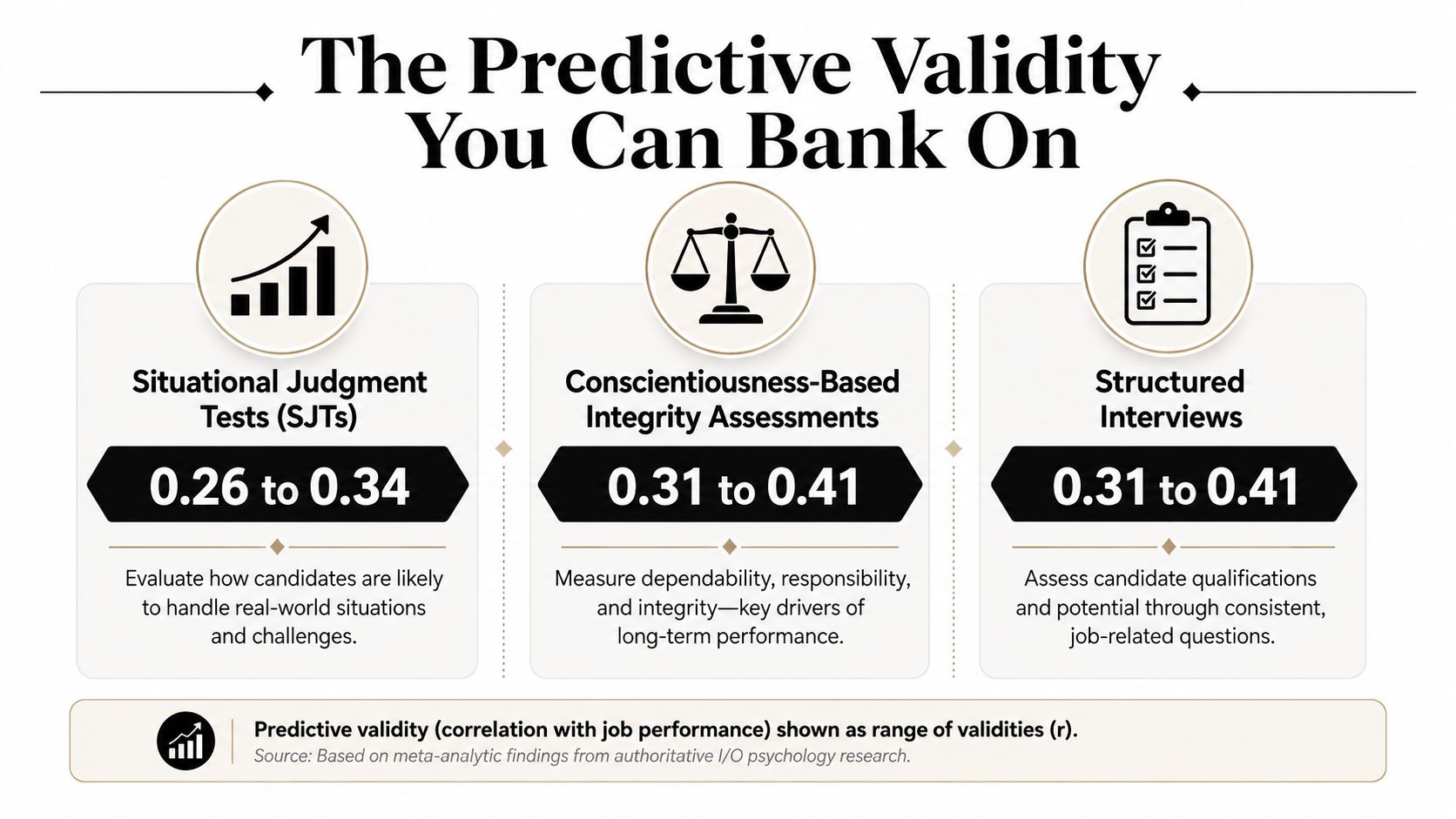
A structured interview can improve a hiring decision, but its coefficient is not a promise about any individual candidate. Treat validity coefficients as decision guidance. They show whether a method has a defensible relationship with job performance. For a deeper look, see [a deeper look at validity in psychological measurement](https://synopsix.ai/blog/validity-in-psychology).
The evidence favors standardized behavioral questioning. Classic personnel-selection research reported operational validity of about r = .51 for structured interviews, compared with about r = .38 for unstructured interviews, showing a predictive advantage for structured methods in the [summary of behavioral interview research](https://www.pin.com/blog/behavioral-interview-questions/). A later synthesis found corrected validity around r = .42, with results varying widely across studies, approximately .42 ± .24. Design quality materially changes the result. The [research synthesis on structured interviews](https://www.cambridge.org/core/services/aop-cambridge-core/content/view/7CB1F7C86CB0D15328B3F07AD5F964E2/S1754942623000421a.pdf/structured_interviews_moving_beyond_mean_validity.pdf) supports treating structure as a quality requirement, not a cosmetic format.
Work samples add another useful signal because candidates must demonstrate job-relevant behavior. A meta-analysis reported an observed mean correlation of .26, rising to .33 after correcting for criterion unreliability, for simulations and tasks. The [work-sample validity meta-analysis](https://home.ubalt.edu/tmitch/645/articles/a%20meta-analysis%20of%20work%20sample%20test.pdf) supports using these exercises where the role permits direct observation.
When the signal weakens
Validity drops when the construct is vague, items lack a job link, or leaders treat the assessment as a standalone gate. High-stakes conditions create another weakness. A 2025 analysis reported lower validity in high-stakes settings, r = .13, than in low-stakes settings, r = .17. A 2025 review also identified validity and impression management as central issues in personality recruitment research. The [recent review and analysis](https://pubmed.ncbi.nlm.nih.gov/40773956/) supports treating applicant faking as a practical design risk.
Use four controls:
> Decision standard: A behavioral assessment earns a place in hiring only when it predicts something your organization can observe and improve.
AI-derived signals require the same discipline. Research on chatbots in hiring found reduced social-desirability bias compared with self-reports, but weaker prediction of real-world outcomes for traits including Neuroticism, Agreeableness, and Openness. The [research on chatbots and hiring assessments](https://www.frontiersin.org/journals/psychology/articles/10.3389/fpsyg.2025.1564979/full) reinforces job-relevant validation and subgroup error analysis.
Wiring Behavioral Assessments Into Your Hiring Workflow
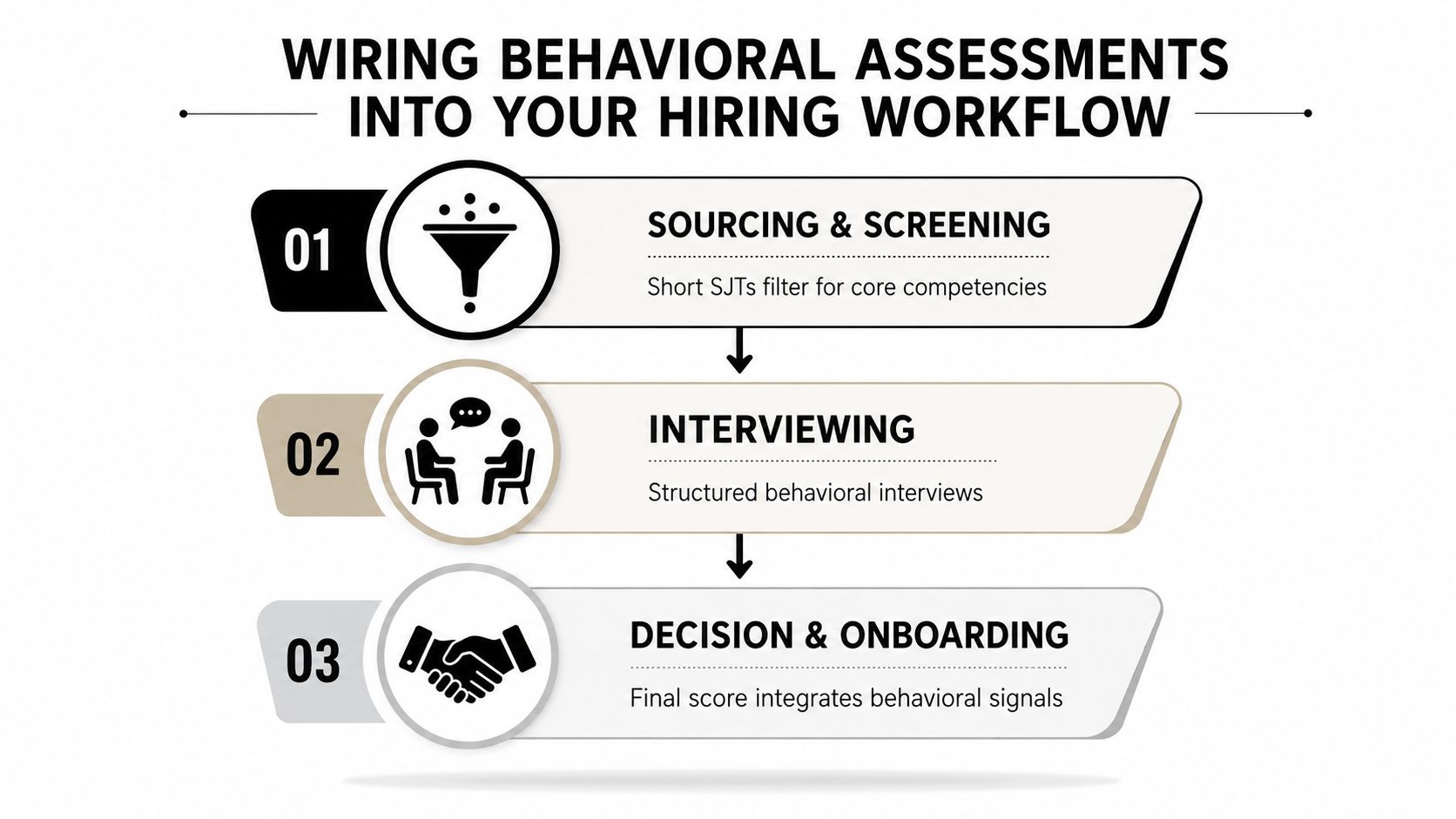
The assessment should match the decision at each gate. Don't make every candidate complete the same battery, and don't ask a late-stage simulation to repeat what an early screen already established.
Start with a narrow screen
At the top of the funnel, use a short SJT when you need to evaluate a small set of job-relevant behaviors before investing interview time. A scenario can test teamwork, conscientious follow-through, customer empathy, or prioritization more directly than a resume keyword.
Keep the screen proportionate and explain its purpose. The output should be a structured signal for progression, not a permanent label. Candidates who fail because of an irrelevant or poorly designed screen are not “low potential.” Your process has measured the wrong thing.
Use richer evidence in the middle
Mid-funnel evaluation should combine a role-specific work sample with a structured behavioral interview. Give interviewers the same competency map, the same core questions, and anchored scoring criteria based on observable actions.
A sales candidate might complete a discovery simulation and then answer a question about recovering from a lost deal. A people leader might handle a feedback role play and explain how they responded when a team member resisted coaching. The point is not to reward the most polished narrative. It's to compare evidence against the success profile.
Reference checks should use the same dimensions. Ask about follow-through, feedback-seeking, collaboration, or decision quality rather than inviting general praise. This validates or challenges the signal instead of restating the candidate's interview performance.
Close the loop after the offer
Onboarding assessments can establish a baseline for communication preferences, decision style, and likely friction points. Managers can then compare expected behavior with actual performance during the first 90 days, using the gap to improve coaching and future selection design.
The process creates a different artifact at each stage:
1. Screening: A comparable scenario-based signal. 2. Evaluation: Observable performance from a simulation and structured interview scores. 3. Decision: An integrated evidence record with documented rationale. 4. Onboarding: A baseline for manager support and later validation.
Teams that need a broader framework can [build a culture assessment with The OKR](https://www.theokrhub.com/insights/cultural-fit-assessment), particularly when they're separating shared working norms from vague culture-fit preferences. For a wider view of available platforms, review these [psychometric assessment tools](https://synopsix.ai/blog/psychometric-assessment-tools).
<iframe width="100%" style="aspect-ratio: 16 / 9;" src="https://www.youtube.com/embed/dY-B0JAvJFE" frameborder="0" allow="autoplay; encrypted-media" allowfullscreen></iframe>
Legal, Ethical, and Bias Risks You Must Manage
Behavioral assessments aren't automatically fair. They can reduce interviewer subjectivity, but they can also turn weak assumptions into repeatable barriers. A defensible program starts with job analysis, documented competencies, and a clear explanation of how scores affect decisions.
Faking is the immediate threat to score integrity. Candidates know selection assessments are high stakes, and many can infer which answers appear desirable. A personality or competency questionnaire can therefore measure impression management instead of ordinary workplace tendencies. Treating the resulting score as a clean behavioral fact is a serious analytical mistake.
Use controls that make distortion harder and easier to detect:
Audit the algorithm, not just the candidate
Video, voice, and text-based scoring introduce additional risks. An AI system may infer behavioral characteristics from language, delivery, or other proxies that vary across disability, culture, language background, or communication style. The responsible position is to treat AI recommendations as advisory until the system demonstrates job-relevant prediction and subgroup error analysis.
Organizations should document consent, restrict retention, protect access, and explain how candidate data is used. They should also maintain human-scored benchmarks so automated outputs can be challenged rather than accepted as objective truth.
| Risk | What Goes Wrong | Required Control | |---|---|---| | Impression management | Candidates optimize responses for the desired profile | Use response-consistency controls and multiple evidence sources | | Construct irrelevance | The assessment measures preferences unrelated to job performance | Conduct job analysis and document competency links | | Adverse impact | A selection rule disadvantages a protected group | Run group-level selection and error analyses, then document decisions | | AI proxy bias | Video, voice, or text signals encode irrelevant differences | Compare algorithmic outputs with human-scored benchmarks | | Privacy failure | Candidate data remains accessible or is reused without clear consent | Define consent, access, retention, and deletion rules |
The four-fifths rule may be part of an organization's adverse-impact review, but compliance isn't achieved by checking one ratio and moving on. Legal teams, assessment specialists, and people analytics leaders should review cut scores, validation evidence, accommodations, and the complete decision workflow. This [guide to inclusive tech recruiting](https://talantrix.com/resources/blog/unconscious-bias-in-hiring/) is a useful reference for broadening that review beyond the assessment vendor's claims.
Role-Specific Examples and Synopsix in Action
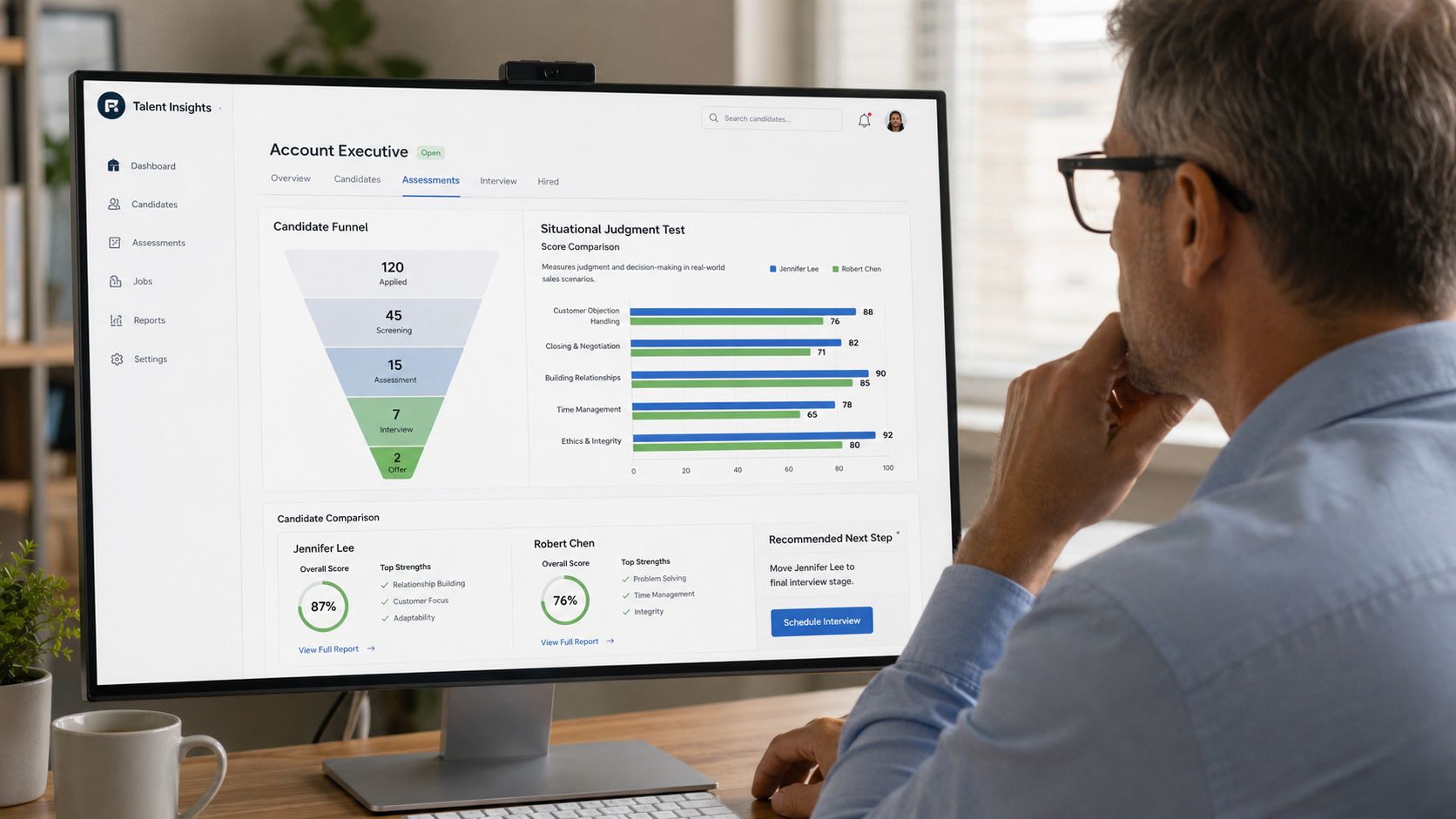
An account executive search illustrates why behavioral data should enter the conversation before the final panel vote. The external candidate had recognizable competitor experience and a polished resume, so several interviewers initially preferred that profile. A situational judgment exercise and a work sample instead highlighted another candidate's stronger coachability and resilience, which were more relevant to the role's ramp demands.
The panel didn't use the assessment as an automatic override. It reviewed the scores alongside structured interview answers and the candidate's performance in the sales exercise. The result was a more disciplined decision: tenure on a competitor's payroll carried less weight than evidence of learning from setbacks, adapting a pitch, and responding constructively to coaching.
Leadership hiring exposes hidden risk
A director-level search produced a different result. A leadership simulation flagged an experienced finalist for weak feedback-seeking behavior. That finding mattered because the role required the leader to learn quickly from peers, direct reports, and business partners.
Structured reference probes tested the same issue and confirmed the concern. The panel redirected attention toward another finalist with stronger learning agility, even though the first candidate had deeper experience in the company's sector.
These examples support three operating principles:
A platform such as Synopsix can assess candidates and employees, generate comparable behavioral profiles, translate psychometric results into business signals, and support simulations, compatibility analysis, and development planning. That kind of workflow is useful only when the organization defines the role outcomes first and validates whether the resulting signals improve decisions.
Measuring ROI and Rolling Out With Confidence
Start the business case with the cost of a bad hire. A mis-hire typically costs 1.5 to 3 times annual salary when recruiting expense, ramp time, lost productivity, and team disruption are included, as outlined in the supplied hiring assessment research. That cost isn't limited to the person who leaves. Managers lose time, teammates absorb unfinished work, and customers experience inconsistent execution.
A behavioral program should be compared with that exposure, not with the price of a questionnaire. Include assessment administration, candidate support, validation work, manager training, legal review, ATS integration, and the operational cost of adding a step to the funnel.
| Cost Component | Unstructured Hiring | Behavioral Assessment Program | |---|---|---| | Candidate evaluation | Resume, conversational interview, informal references | Job-linked assessment, work sample, structured interview | | Decision quality | Heavily dependent on interviewer judgment | Combines standardized signals with human review | | Mis-hire exposure | Difficult to diagnose because evidence is inconsistent | Easier to audit and connect with later outcomes | | Manager effort | Repeated interpretation and unstructured debate | Training required, followed by shared rubrics and reports | | Post-hire learning | Limited baseline for comparison | Assessment indicators can inform onboarding and validation |
Roll out in controlled phases
Pilot with one role family in one location for 60 to 90 days, then review the evidence before expanding. Benchmark the assessment against incumbent high performers, but don't confuse correlation with proof. Examine performance quality, retention, manager ratings, candidate completion, and subgroup outcomes.
Before broad deployment, ask legal and assessment specialists to review validation evidence, accommodations, cut scores, and adverse-impact results. Train managers to interpret signals without turning them into personality verdicts. Integrate the final decision record into the ATS, and connect onboarding observations to the original competency framework.
A mature operating cycle looks like this:
1. Pilot narrowly: Test one job family and one workflow. 2. Benchmark locally: Compare scores with observable performance patterns. 3. Review risk: Examine subgroup outcomes and decision rules. 4. Train managers: Provide interpretation guides and office hours. 5. Integrate systems: Connect assessment, decision, and onboarding data. 6. Recalibrate regularly: Revisit the model annually and after material role changes.
> Operating principle: If a score never changes a hiring conversation, it's an expensive decoration.
Use manager office hours to review difficult profiles and prevent a return to gut calls. Track where panels override the assessment, whether those overrides predict better outcomes, and which competencies fail to forecast performance. The strongest ROI comes from a learning system, not a one-time purchase.
---
Synopsix turns scientifically validated behavioral assessments into comparable profiles, role-specific reports, simulations, and practical hiring guidance for people teams. Visit [Synopsix](https://synopsix.ai) to see how your organization can connect behavioral signal to more disciplined hiring, onboarding, and talent decisions.