Mastering Behavioral Competencies for Team Performance
By Synopsix · July 1, 2026 · 19 min read
Organizations still hire for the engine and ignore the driver. That's expensive.
Behavioral indicators account for up to 85% of long-term career success, while technical skills explain 15% of variance in performance outcomes over time, according to [AIHR's overview of behavioral competencies](https://www.aihr.com/hr-glossary/behavioral-competencies/). If your hiring, promotion, and succession decisions still lean mostly on resumes, domain expertise, and manager instinct, you're evaluating only part of performance.
The result is familiar. A technically strong hire stalls because they can't handle conflict. A high-output individual contributor gets promoted into leadership and loses the room. A graduate interviews well, sounds confident, and then struggles when ambiguity, pressure, or cross-functional friction show up. The issue usually isn't effort. It's that the organization never defined, measured, or acted on the behaviors that shape outcomes.
That's where behavioral competencies matter. They turn vague ideas like “good communicator” or “strong leader” into observable, discussable, assessable patterns. Beyond this, they give the C-suite a funding case. Once behavior is translated into a common framework, a measurement system, and operating decisions, it stops being soft HR language and starts looking like risk reduction, quality of hire, promotion accuracy, and stronger leadership pipelines.
Why Behavior Trumps Technical Skills in 2026
Eighty-five percent versus fifteen percent is the split noted earlier. That gap explains why so many technically impressive hires still underperform once the actual work begins.

What technical strength misses
Technical skills still matter. They get someone into consideration and, in many roles, they set the minimum bar for credibility. A finance analyst has to model accurately. A recruiter has to run a disciplined process. A manager has to understand the commercial and operational reality of the function.
The problem shows up after entry.
Once someone is operating inside a team, performance depends on judgment under pressure, response to feedback, willingness to collaborate, and the ability to adjust when priorities change. A strong engineer can still create drag if they resist input or struggle with cross-functional conflict. A sales leader can hit quota personally and still fail as a people leader if they cannot coach, stay composed, or make balanced decisions with partial information. A senior operator can know the business cold and still stall execution if peers do not trust them.
Technical skill tells you what a person is capable of doing. Behavioral competency shows how reliably that capability will translate into results in actual conditions of work.
Why executives should care
For the C-suite, this is not a soft-skills conversation. It is a decision-quality conversation.
Organizations that overweight technical credentials usually create the same three costs. They promote high-output individual contributors into leadership roles they are not behaviorally prepared to handle. They let managers substitute vague ideas like "culture fit" for defined selection criteria. They produce development plans full of broad advice and very little measurable behavior change.
That combination drives expensive mistakes. Mis-hires take longer to diagnose. Promotions fail later and more publicly. Succession slates look stronger on paper than they do in practice.
A competency model fixes part of that problem by turning subjective language into observable standards. A people intelligence platform such as Synopsix closes the remaining gap. It connects those standards to hiring signals, development data, internal mobility decisions, and outcome tracking, which is how a framework becomes fundable instead of theoretical.
Why 2026 raises the stakes
The operating environment is less forgiving than it was a few years ago. Roles change faster. Managers lead across functions, locations, and reporting lines. AI is reshaping task-level work, which increases the value of the human behaviors technology does not handle well: judgment, influence, learning speed, self-management, and trust-building.
That changes the trade-off.
Technical expertise can become outdated quickly. Behavioral range tends to transfer across changing tools, shifting structures, and new business conditions. Companies that understand that distinction are already hiring and promoting differently. Companies that do not are still relying on resumes, pedigree, and manager instinct, then acting surprised when execution quality is inconsistent.
In practice, behavior wins because it predicts whether skill will hold up under pressure, in ambiguity, and at scale.
Decoding Behavioral Competencies
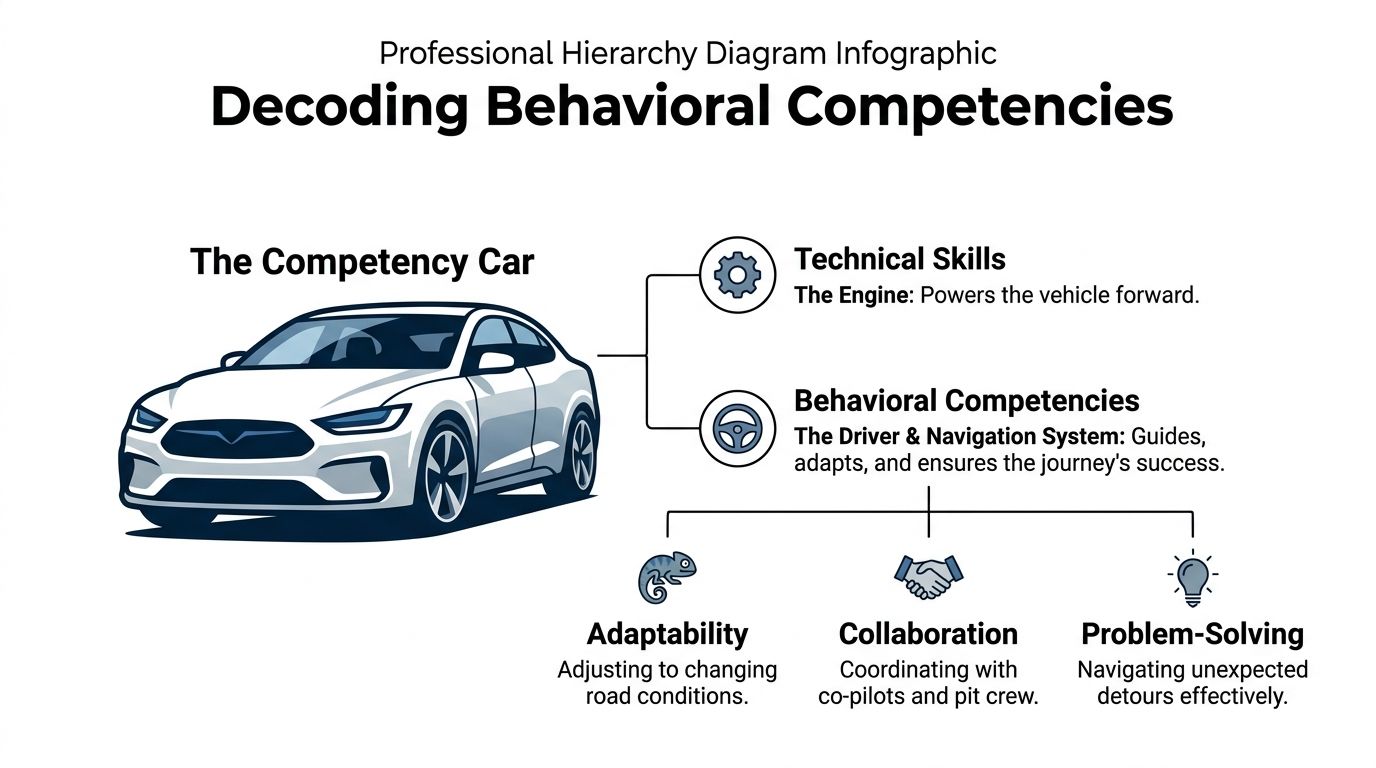
Think of technical skills as the engine of a car. They provide raw capability. Behavioral competencies are the driver and navigation system. They determine whether the vehicle handles traffic, changing weather, detours, and bad decisions without crashing the trip.
That distinction matters because performance at work is rarely a straight road. People need to interpret signals, manage themselves, read others, and make trade-offs in motion. Behavioral competencies describe that visible “how” of performance.
The five clusters that make behavior easier to read
Research groups behavioral competencies into five distinct clusters: self-awareness, self-management, social awareness, relationship management, and cognitive capabilities, as outlined in this [peer-reviewed competency framework](https://pmc.ncbi.nlm.nih.gov/articles/PMC7296078/).
That's useful because behavior is often made too fuzzy. These clusters make it easier to categorize what you're observing.
Here's a quick explainer for teams that need a simpler visual model before building their own language:
<iframe width="100%" style="aspect-ratio: 16 / 9;" src="https://www.youtube.com/embed/TpGL3qe9k5w" frameborder="0" allow="autoplay; encrypted-media" allowfullscreen></iframe>
What observable behavior actually looks like
Many competency models go off track specifically by using labels with no evidence behind them.
“Adaptable” isn't a competency unless you can describe what it looks like in action. Does the person recover quickly from changes in scope? Do they update their approach without becoming defensive? Do they help others stabilize during change?
The same is true for “communication.” Are they concise? Do they tailor messages to different audiences? Do they surface risks early, or only after something breaks?
> Good competency design turns abstract labels into observable patterns that managers can recognize, discuss, and score consistently.
A cleaner mental model for operators
Use this test when deciding whether something belongs in your behavioral competency model:
| Question | If yes | If no | |---|---|---| | Can a manager observe it in real work? | Keep it | It's too abstract | | Can two interviewers discuss evidence for it? | Keep it | It's too subjective | | Can it be developed over time? | Keep it | It may be a trait label, not a competency | | Does it affect role performance? | Keep it | It doesn't belong in the framework |
This is the discipline that separates a useful model from a values poster. Behavioral competencies aren't personality fluff. They're a practical way to predict how someone will respond when work gets messy.
Building Your Core Competency Framework
Most organizations delay competency work because they think they need to invent a perfect model from scratch. They don't. Start with the competencies that show up repeatedly across high-performance roles, then tailor by level and function.
A strong baseline already exists. Seven core behavioral competencies, communication, teamwork, problem-solving, adaptability, leadership, decision-making, and customer focus, are present in nearly 90% of high-performance organizational roles globally, according to [TalentGuard's competency benchmarking](https://www.talentguard.com/competency-and-skill-types).
Start with the universal seven
These seven are a practical starting point because they travel well across functions. They aren't role-exclusive, but they do need different standards by level.
| Core Competency | Positive Behavioral Indicator Example | |---|---| | Communication | Explains complex issues clearly and adjusts the message to the audience | | Teamwork | Shares context, supports peers, and works toward collective outcomes | | Problem-solving | Breaks down ambiguous issues and proposes workable options | | Adaptability | Adjusts approach when conditions change without losing momentum | | Leadership | Creates clarity, influences others, and takes ownership for direction | | Decision-making | Weighs trade-offs and makes timely, defensible choices | | Customer focus | Considers end-user or stakeholder needs when setting priorities |
These aren't enough on their own. The actual work starts when you define what each competency means inside your business.
Translate competencies by role level
Communication for an analyst isn't communication for a VP.
An entry-level employee may need to write clearly, listen well, and ask clarifying questions. A department head may need to align competing stakeholders, present trade-offs to executives, and communicate hard decisions without creating confusion. Same competency. Different standard.
That's why every framework needs proficiency levels. At minimum, define what “emerging,” “effective,” and “advanced” look like for each competency in each job family.
A useful design pattern looks like this:
Build for decisions, not posters
If the model won't change a decision, it's too vague.
Use the framework to answer operational questions such as:
For teams doing this work for the first time, a strong primer on [competency mapping](https://synopsix.ai/blog/what-is-competency-mapping) helps clarify how to connect job requirements, proficiency levels, and talent decisions.
> The best frameworks are boring in the right way. They use plain language, clear indicators, and standards managers can actually apply.
What doesn't work is the opposite. Competency dictionaries with dozens of overlapping terms. Definitions written by committee. Leadership models nobody can remember. If the framework feels academic, managers won't use it and executives won't fund it.
How to Reliably Measure Human Behavior
Most competency programs fail at measurement, not intent.
The framework is sensible. The launch deck looks polished. Then managers revert to intuition, interviews become free-form conversations, and ratings reflect confidence, similarity, or presentation style more than real behavior. If you want behavioral competencies to influence hiring or promotion, the measurement model has to be stronger than “I liked them.”
What each method actually tells you
A behavioral interview can be useful. It gives you examples, context, and judgment calls from prior situations. But it also has limits. People rehearse. Some candidates are reflective and articulate. Others are capable but less polished. A strong story isn't the same as a stable behavioral pattern.
That's why measurement works better when methods are combined.
360-degree assessments offer a picture of how the world perceives an individual, while other methods primarily show how the individual sees the world, as explained in [Questionmark's overview of behavioral competency assessment](https://www.questionmark.com/resources/blog/behavioural-competencies/). That contrast matters because self-perception and external impact often diverge.
Here's a practical comparison:
| Method | What it reveals | Where it helps | Where it falls short | |---|---|---|---| | Behavioral interview | Past examples and self-narrative | Hiring and promotion conversations | Vulnerable to rehearsal and interviewer bias | | Situational judgment test | Choice patterns in work scenarios | Early screening and role-fit signals | Doesn't show live team impact | | Psychometric assessment | Stable tendencies and likely behavior patterns | Scalable comparison across candidates or employees | Needs careful interpretation and job relevance | | 360-degree feedback | External perception from colleagues | Development, leadership calibration, promotion checks | Can be influenced by culture and rater quality |
Why triangulation beats gut feel
No single method should carry the full weight of a people decision.
A better approach is triangulation. Use a structured interview to test evidence, a psychometric or assessment layer to identify likely patterns, and multi-rater feedback when the decision affects leadership scope or internal mobility. The point isn't to remove judgment. It's to improve judgment with better inputs.
For teams exploring how to [unlock talent with behavioral assessments](https://www.myculture.ai/blog/pre-employment-behavioral-assessment), the useful takeaway is that assessments work best when they complement structured evaluation rather than replace it.
Reliability matters more than novelty
HR teams often get distracted by flashy tools with weak measurement discipline. Fancy dashboards don't fix noisy inputs.
The standard to apply is simple. Can the method produce comparable, repeatable signals across candidates or employees? If not, don't build high-stakes decisions on top of it. A practical guide to [test reliability in talent assessment](https://synopsix.ai/blog/what-is-test-reliability) is worth reviewing before any rollout, especially if vendors make bold claims but can't explain consistency.
> If your measurement approach changes drastically depending on which manager runs the interview, you don't have a competency system. You have localized opinion with better branding.
What works is boring and rigorous. Standard prompts. Anchored rubrics. Comparable assessments. Evidence from more than one angle. That's how behavioral competencies move from soft discussion to dependable signal.
Operationalizing Competencies with a People Intelligence Platform
The hard part isn't defining competencies. It's running them at scale without creating admin drag, manager confusion, or reporting that nobody trusts.
Many organizations struggle with a common problem. They possess a framework, perhaps even a solid interview guide, yet they cannot translate behavioral data into clear, repeatable decisions. The gap usually sits between psychometric complexity and business usability. Leaders don't want raw scores. They want to know whether a person is likely to lead effectively, struggle in ambiguity, create friction on a team, or fit a role's demands.
That translation layer is where a people intelligence platform earns its place.
The four-step operating model
A practical system usually follows four moves. Assess. Profile. Translate. Act.
Assess Start with scientifically validated inputs that can be completed quickly enough to fit real hiring and development workflows. If assessment takes too long or feels opaque, adoption drops fast.
Profile Raw responses need to become comparable behavioral profiles. This is what lets a recruiter, people partner, and hiring manager discuss the same person using the same evidence base.
Translate This is the step many vendors miss. The output has to convert psychometrics into business language. Hiring risk. Leadership readiness. Sales orientation. Team compatibility. Friction indicators. Development priorities.
Act Insights are only useful if they drive next steps. That might mean interview focus areas, onboarding plans, internal mobility decisions, manager coaching, or team design choices.
Closing the perception gap
This operating model matters because self-report and actual capability often diverge.
The gap between perception of new graduates' proficiency in career-readiness competencies and actual demonstrated ability can exceed 50% for leadership skills, according to [NACE's analysis of graduate competency perception gaps](https://www.naceweb.org/career-readiness/competencies/the-gap-in-perceptions-of-new-grads-competency-proficiency-and-resources-to-shrink-it). That's exactly why resumes, self-confidence, and polished interviews can produce false positives.
A modern platform helps close that gap by replacing broad claims with structured evidence. Instead of “seems leadership-ready,” you get a profile that distinguishes confidence from influence, energy from judgment, and ambition from role fit.
What this looks like in practice
In hiring, the workflow often starts before the interview. Assessment data highlights likely strengths, possible derailers, and question areas that deserve deeper probing. If interviewers need a refresher on how to [Ace Behavioral Questions STAR](https://intonetic.com/behavioral-questions-star/), that structure helps them test the signals already surfaced rather than improvise from scratch.
In development, the same profile can shape coaching. A manager doesn't need another generic note telling an employee to “be more strategic.” They need specificity. Does the person struggle with self-management under pressure? Are they strong in cognitive analysis but weaker in relationship management? Are they likely to create tension in highly collaborative environments?
For leaders evaluating platform options, a good overview of what a [talent intelligence platform](https://synopsix.ai/blog/talent-intelligence-platform) should do is useful shorthand. The right system shouldn't just store assessment outputs. It should connect assessment to role fit, team dynamics, and action plans that operating leaders can understand.
> Executives fund systems that reduce ambiguity in expensive decisions. They don't fund frameworks that add terminology without improving outcomes.
That's the practical case for operationalizing behavioral competencies with technology. It makes the model usable, comparable, and decision-ready.
Integrating Competencies into Your Talent Lifecycle
A competency model only matters when it changes live decisions. If it sits in HR documentation, managers will ignore it and employees will never see the value.
The two places to embed behavioral competencies first are hiring and development. They create the fastest shift from subjective judgment to a more disciplined talent operating system.
Use competencies to tighten hiring decisions
Start with the role, not the generic company model.
For each open role, choose the few behavioral competencies that drive success. A frontline support role may require composure, communication, and customer focus. A head of product role may require decision-making, influence, adaptability, and cross-functional leadership. The list should be short enough that interviewers can evaluate it well.
Then rewrite the job description. Replace filler like “must be a self-starter” with observable expectations. Say what the person will need to do behaviorally. Influence without authority. Handle changing priorities. Deliver difficult messages clearly. Build trust across technical and non-technical stakeholders.
A practical hiring flow looks like this:
Build development around behavioral evidence
Development gets sharper when it uses the same language as hiring.
Instead of annual feedback full of broad advice, managers can coach against visible gaps. If someone is strong in analytical thinking but weak in relationship management, their plan should include stakeholder-heavy projects, feedback loops, and coaching on influence. If a manager struggles with self-management, the plan should address response patterns under pressure, not just “executive presence.”
Three practices work well here:
1. Use profiles in manager one-to-ones Review strengths, likely blind spots, and situations where the employee performs well or struggles.
2. Tie growth plans to role progression Don't coach in the abstract. Show which competencies matter at the next level and what evidence will indicate readiness.
3. Calibrate succession with behavioral data High output alone shouldn't decide who enters the leadership pipeline. Look for repeatable behaviors that scale through others.
> A promotion case gets stronger when leaders can point to evidence of judgment, influence, and adaptability, not just current results.
What to avoid
A few patterns almost always undermine adoption:
The organizations that do this well keep it simple, role-linked, and visible in day-to-day talent processes.
Validating Your Model and Proving Business Impact
Sooner or later, the CFO asks the right question. Is this improving decisions, or did HR just add a new layer of process?
That's a fair challenge. Behavioral competencies shouldn't survive on philosophy alone. They need validation. Not because people leaders owe finance a spreadsheet for every judgment call, but because better talent decisions should leave operational evidence behind.
What to measure first
The cleanest proof starts with metrics your business already respects.
Track whether competency-based hiring improves quality of hire, reduces obvious mismatch in role placement, and increases confidence in promotion decisions. Review performance discussions, early ramp feedback, regretted attrition patterns, and manager satisfaction with slate quality. You don't need invented precision to see whether decisions are getting cleaner.
A useful validation stack includes:
How to make the CFO case
Executives rarely fund “better language for talent.” They fund lower risk and better allocation of people investment.
So frame the case accordingly. Competency-based systems improve decision consistency. They reduce dependence on individual manager instinct. They create a common standard for hiring, coaching, and succession. And they make expensive judgments easier to audit after the fact.
This is especially important when your organization is scaling. The larger the company gets, the less it can afford hidden criteria, inconsistent promotion logic, or role-fit decisions based on charisma.
Validation is an ongoing discipline
Don't treat the first competency framework as finished.
Review it against actual outcomes. Which competencies really predict success in your environment? Which indicators are too vague? Which roles need different standards than you originally assumed? The model should mature as your evidence improves.
> If a competency model can't explain who succeeds, who struggles, and why decisions were made, it won't hold executive support for long.
The payoff is bigger than HR credibility. A validated behavioral model gives the business a repeatable way to predict human behavior more accurately, with less noise and more accountability. That's the true value.
---
Synopsix helps teams turn behavioral data into practical hiring, development, and team decisions. If you're ready to replace subjective talent calls with a system that assesses, translates, and acts on behavioral evidence, explore [Synopsix](https://synopsix.ai).