Behavioral Data Analysis for People Decisions
By Synopsix · October 12, 2026 · 16 min read
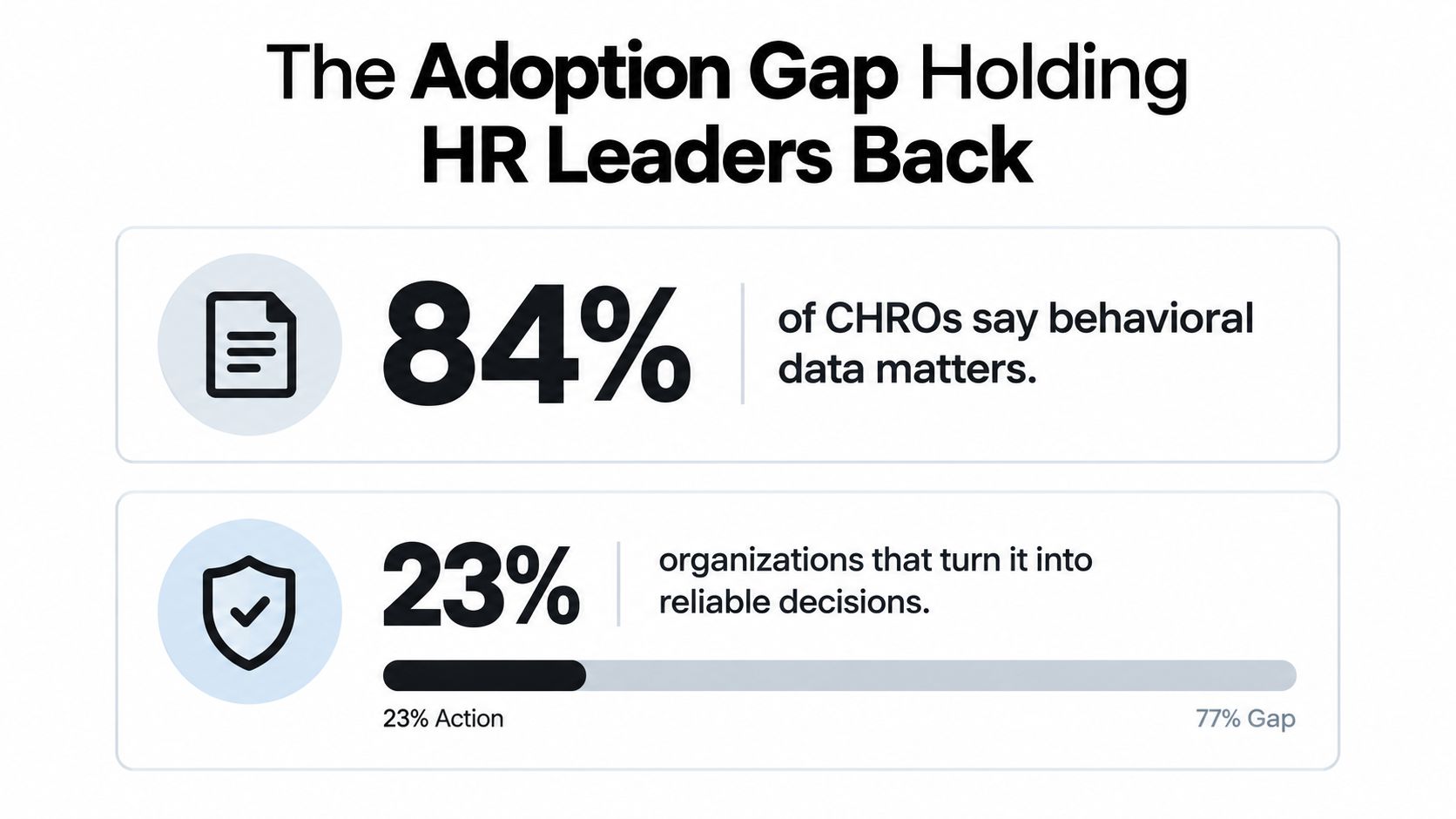
84% of organizations considered people analytics important or very important, yet only 39% reported good data quality and just 2% had integrated real-time, AI-assisted tools into business decisions, according to a 2018 global human-capital survey/2.03:_People_Analytics/2.3.03:_Adoption_Trends). That gap changes the question for every CHRO. The problem isn't whether behavioral data matters. It's whether your organization knows which signals deserve trust, which should be ignored, and how measurement is changing the behavior you're trying to predict.
Behavioral data analysis can improve hiring, team design, and development, but it can't turn weak constructs into reliable decisions. The disciplined approach starts with the decision, chooses the least intrusive job-relevant signal, validates it against outcomes, and gives people a meaningful way to understand or challenge the result.
The Adoption Gap Holding HR Leaders Back
HR leaders face a decision-quality problem: behavioral data exists, but it rarely changes a consequential decision. The priority is therefore not collecting every available signal. It is deciding which measures deserve trust, which should be ignored, and where analysis belongs in the workflow.
The survey evidence shows the gap clearly. 84% of respondents considered people analytics important or very important, while only 39% reported good or very good data quality for people-related decisions. Among large organizations, 69% had formed a people-analytics team and were building an associated database. Only about 2% had reached the highest maturity level, integrating real-time, AI-assisted tools into business and management decisions.
The same adoption gap appears beyond one market. A German study cited in the adoption review found that 74% of companies had digitized at least their most important business processes, yet fewer than 40% regularly used data-driven digital approaches such as people analytics. Digital access supplies information. It does not establish construct validity, clean outcome data, analytical judgment, or employee trust.
Diagnose the maturity gap
A CHRO can assess readiness through three practical indicators:
A weak data-quality result makes advanced modeling premature. Without accountable analysts, the organization may collect signals without knowing how to interpret them. Poor workflow integration leaves analysis with no operational consequence.
> Practical rule: Ask which consequential decision would change if the behavioral data disappeared tomorrow.
The cost extends beyond wasted software spend. Weak signals can produce confident but irrelevant rankings. Disconnected analytics can encourage managers to replace judgment with a score instead of improving judgment. The operating principle is clear: collect less, validate more, and connect every measure to a decision someone is authorized to make.
What Behavioral Data Analysis Means
Behavioral data analysis is the disciplined use of observable actions, self-reports, and digital traces to estimate meaningful constructs, compare patterns, and test whether those patterns relate to defined outcomes. The purpose is better decisions, not fuller surveillance. A signal earns attention only when it has a clear meaning, a relevant outcome, and evidence that it works under the conditions where leaders plan to use it.
The field has deep roots. Mid-19th-century positivist researchers treated social and psychological observations as measurable social facts, while Wilhelm Wundt established an early laboratory model for controlled psychological experiments. During the 1930s, researchers developed statistical techniques suited to behavioral measurements and experimental designs. ANOVA helped compare average outcomes across groups while separating treatment effects from random variation. Least-squares linear regression helped estimate relationships and forecast outcomes from observed variables. The historical account of behavioral data analysis describes how these foundations moved behavioral research beyond description toward hypothesis testing and explicit evaluation of uncertainty.
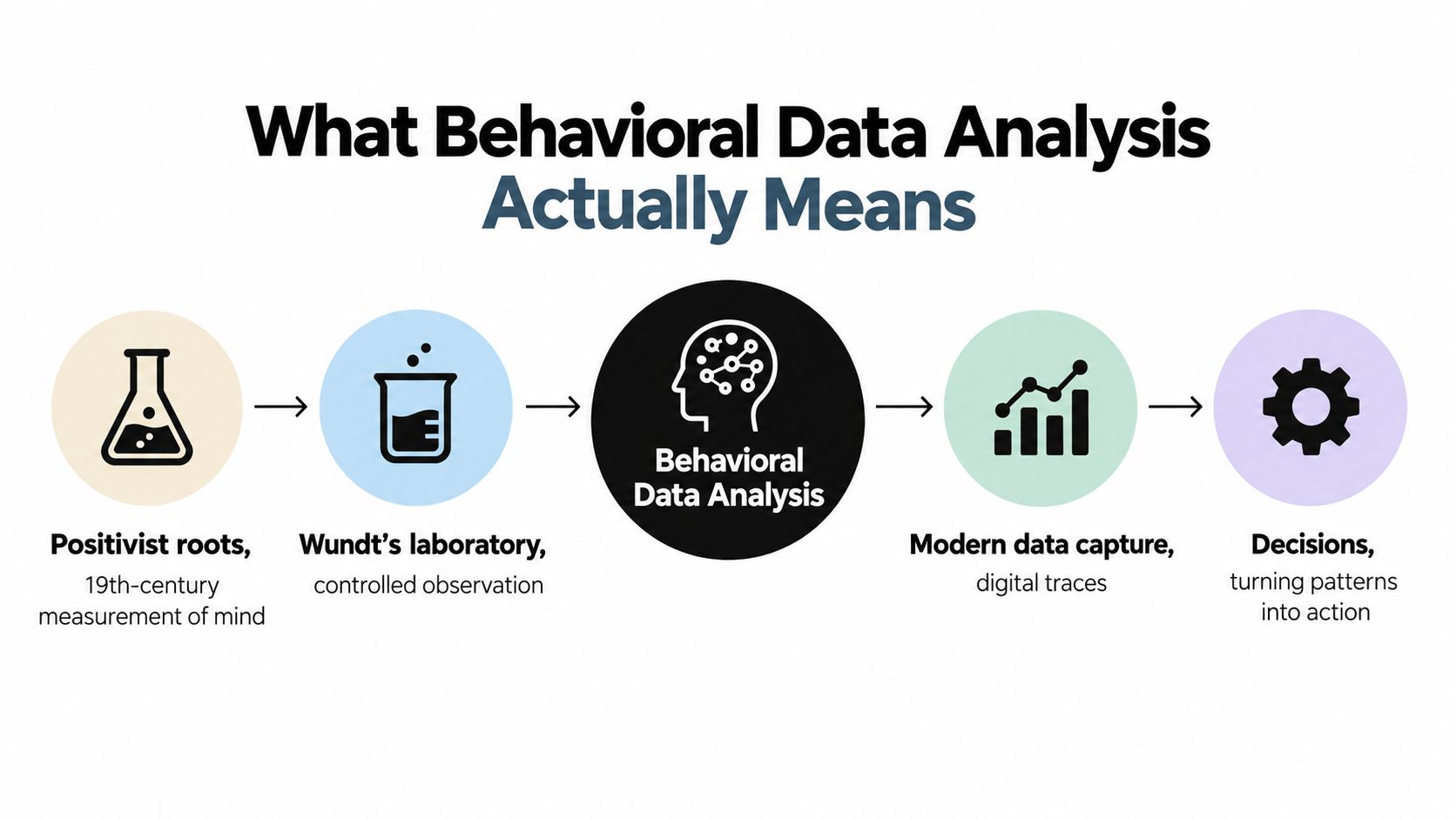
The distinction between data and analysis determines whether a people metric deserves influence. Behavioral data is raw material: a candidate's response to a structured work scenario, an employee's self-report, observable collaboration behavior, or a digital trace generated during work. Behavioral data analysis starts when analysts define what the signal represents, check how consistently it was measured, and test whether it predicts the outcome that matters.
A platform can capture thousands of events without showing that those events measure collaboration, judgment, leadership, or role fit. More observations cannot repair a vague construct.
Before accepting a behavioral claim, require three answers:
1. What construct is being measured? “Culture fit” is too broad unless the organization defines the specific behaviors and conditions it means. 2. Which outcome validates the signal? A score validated for training performance should not automatically determine promotion or retention decisions. 3. What would falsify the claim? A credible method specifies error, uncertainty, subgroup performance, and the conditions under which the signal stops working.
Predictive value depends less on data volume than on consistent measurement and rigorous evidence evaluation. Apply that standard to every assessment, dashboard, and AI-generated recommendation. The decision question comes first: which signal deserves weight, and which should be ignored?
Methods That Turn Behavioral Signals Into Decisions
The right method depends on the question, not on the vendor's preferred algorithm. A descriptive view answers what happened. Clustering identifies groups with similar patterns. Predictive modeling estimates what may happen next. None of these methods decides whether the underlying signal is fair, job-relevant, or acceptable to use.
Match the method to the decision
Suppose a business wants to improve team composition and reduce avoidable hiring mistakes. Descriptive analytics can show how current teams differ in observed behaviors and outcomes. Clustering can identify recurring behavioral profiles that help HR examine segments, but it doesn't prove that a cluster is desirable or causal. Predictive modeling can estimate role performance or retention risk, provided the organization has suitable outcome data and tests error carefully.
| HR Decision | Best-Fit Method | What It Answers | Interpretability vs Accuracy Trade-Off | |---|---|---|---| | Understand current behavior and outcomes | Descriptive analytics | What happened, and where do patterns differ? | Highest interpretability, limited forecasting | | Identify behavioral segments | Clustering | Which people or teams show similar patterns? | Useful for exploration, but clusters require human interpretation | | Estimate a future outcome | Predictive modeling | Which signals are associated with performance, retention, or role fit? | Greater forecasting potential, with stronger demands for validation and governance | | Compare candidates consistently | Regularized classification or structured scoring | How do candidates rank against predefined criteria? | Interpretable baselines should come before complex models |
A benchmark covering 11 classification models across 41 fine-grained behavioral datasets found that well-regularized logistic regression achieved the strongest area under the ROC curve, or AUC, while also requiring the longest training time. The [classification benchmark](https://link.springer.com/article/10.1007/s41060-019-00185-1) supports a practical position: start with an interpretable baseline, then adopt complexity only when its incremental value justifies lower transparency and greater operational cost.
Use a decision-to-method map
For workforce planning, begin descriptively. Establish what the organization currently observes and whether data quality varies by role, manager, location, or collection channel. For team design, use clustering as an exploratory aid, then test whether identified groups relate to actual collaboration outcomes. For hiring, use predictive models only after structured measurement and outcome validation are in place.
Candidate behavior is also shaped by the experience of the process itself. HR teams evaluating journey signals should pair their assessment design with a practical [candidate experience data guide](https://ghostedby.xyz/blog/candidate-experience-data) so they don't interpret a drop-off or response pattern without understanding the context in which it was produced.
A complex model isn't automatically a better model. It becomes better only when the additional complexity produces a decision benefit that leaders can explain, monitor, and defend. For a related perspective on moving from prediction to action, see [predictive behavior modeling](https://synopsix.ai/blog/predictive-behavior-modeling).
From Individual Profiles to Team Dynamics
A strong individual profile does not predict team performance on its own. It can indicate how someone may approach ambiguity, conflict, or influence, but the surrounding team determines whether those tendencies help or hinder the work.
Google's Project Aristotle examined more than 180 teams over roughly two years. Reported comparisons linked higher psychological safety with 19% higher productivity, 31% more innovation, and 27% lower turnover. Psychological safety also appeared as the strongest predictor of team effectiveness in the study summaries. The [Project Aristotle summary](https://www.linkedin.com/posts/pedro-pinto-5463b614_in-2012-google-launched-project-aristotle-activity-7476625536564432896-LoMv) points to a practical correction: individual assessment should inform team design, not replace it.
Psychological safety gives people room to speak up, admit mistakes, ask questions, and challenge ideas without fear of humiliation or punishment. A team may include highly capable individuals while a dominant manager, unclear decision rights, or retaliation for dissent suppresses those behaviors.
Assess the interaction conditions directly:
Compatibility analysis should compare a person with a specific manager, role, and team environment. The same behavioral tendency can support performance in one setting and obstruct it in another. Treat the result as a working hypothesis, not a ranking.
A Human Interlink-style team view should therefore prompt structured discussion, observed collaboration, and explicit working agreements. If a model flags tension between two profiles, test that prediction in practice. Do not label one person as the problem before examining the conditions around the interaction.
Hire for relevant capability, then design the conditions that let people use it. Individual signals show potential. Team-level evidence shows whether the environment can convert that potential into effective collaboration.
Here is a practical visual explanation of how individual signals can connect to team dynamics:
<iframe width="100%" style="aspect-ratio: 16 / 9;" src="https://www.youtube.com/embed/iXHCCw762PU" frameborder="0" allow="autoplay; encrypted-media" allowfullscreen></iframe>
Why More Behavioral Data Can Make Decisions Worse
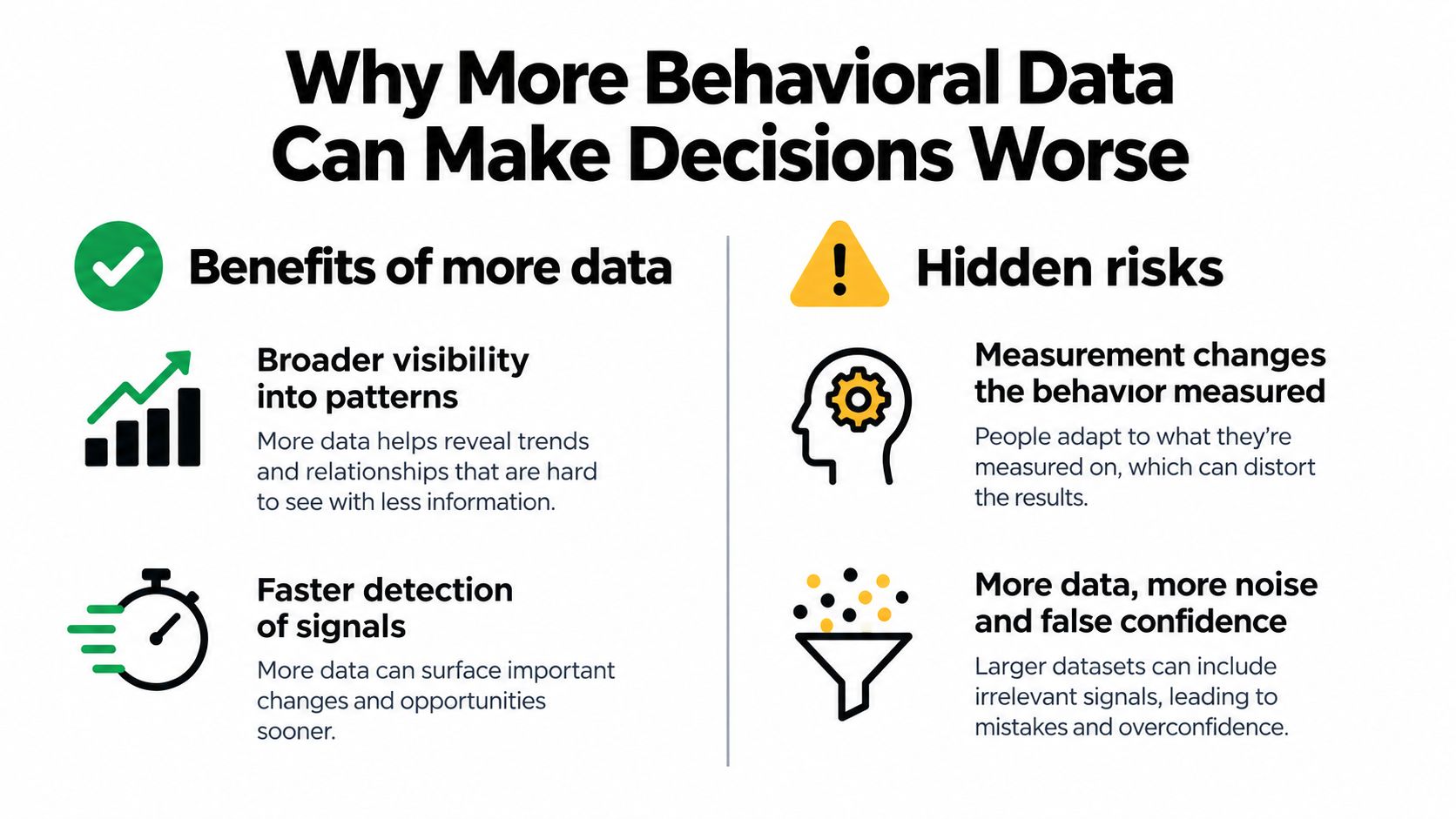
More data can widen visibility while reducing validity. People change their behavior when they know an organization is watching, scoring, or predicting them. The measurement process can become part of the behavior being measured.
An [Information Systems Research case study on trace-data production](https://pubsonline.informs.org/doi/10.1287/isre.2019.0357) found that knowledge workers changed their own actions and influenced colleagues after learning that activity was recorded and analyzed. Those traces could therefore capture strategic adaptation to anticipated evaluation, rather than only the underlying behavior analysts intended to measure.
Treat disclosure as a measurement event
The disclosure date belongs in the analysis. Separate the baseline period from the period after employees learn how their data is used. Then monitor changes in missingness, activity patterns, and score distributions. A sudden rise in visible activity may signal adaptation, not stronger performance.
AI assessments create another distortion. Across 12 studies involving 13,342 participants, people described themselves as more analytical and minimized emotional or intuitive qualities when they believed AI was evaluating them. The [PNAS evidence on the AI assessment effect](https://www.pnas.org/doi/10.1073/pnas.2425439122) found that human involvement reduced this effect without removing it.
HR should read candidate profiles accordingly. A profile may show the traits a person believes an algorithm rewards, rather than a stable tendency that will appear at work. Automation does not remove impression management. It redirects that effort toward the perceived preferences of the machine.
> Measurement warning: A behavioral trace is not neutral evidence when the subject adapts to the measurement process.
Before approving a rollout, require answers to three questions:
1. What changed after disclosure? Compare pre-disclosure and post-disclosure behavior, missingness, and score distributions. 2. How does scoring depend on self-report? Separate claimed preferences from observed behavior, and state how each affects the result. 3. How do conditions differ? Compare human-led, AI-led, and hybrid assessment settings. Test whether effects vary by culture, role, seniority, or technical literacy.
Vendor confidence should fall when the assessment setting strongly shapes responses. The output should be a contextual decision aid, not a definitive label. It should show uncertainty and warn leaders when the data may represent performance for the algorithm rather than behavior at work. Measure less when a smaller, better-understood signal answers the decision question.
Implementing Behavioral Analysis Without Breaking Trust
Trust isn't a communications layer added after deployment. It is a property of the entire data pipeline, from collection through governance.
Build the pipeline in four stages
Collection starts with restraint. Define the job-relevant construct and choose the least intrusive measure that can capture it. Don't default to facial expression, vocal characteristics, social-media activity, or broad digital surveillance when a structured work sample or validated assessment can answer the decision question more directly.
Validation tests whether the measure works for its intended purpose. Compare scores with relevant outcomes, inspect missingness, evaluate error across subgroups, and document when the data was collected. A measure validated for one role or outcome can't be treated as universally valid.
Integration connects the behavioral signal to the systems that contain decision context, including the applicant-tracking system, HRIS, and performance systems. Profiles should update when new evidence arrives, but updates need traceability so leaders can see what changed and why.
Governance determines who can use the result, for which decision, with what oversight, and how a person can challenge it. For a practical treatment of [defining decision authority and risk controls](https://blog.aletheionagi.com/blog/guardrails-meaning-in-business), focus on ownership rather than vague principles.
Put the governance gate before the decision
U.S. federal employment-selection guidance uses the four-fifths rule as an initial adverse-impact indicator. If a protected group's selection rate falls below 80% of the rate for the group with the highest selection rate, the organization should investigate job-relatedness and business necessity, as described in the [Uniform Guidelines reference](https://assets.kolbe.com/wp-content/uploads/20190916202346/Kolbe-Corp-EEOC-1.pdf).
The rule isn't an automatic finding of unlawful discrimination. It is a screening threshold that tells the employer to investigate. Responsibility stays with the organization, not the vendor.
A defensible governance checklist includes:
Research concentration creates a serious global risk. Reviews identify much more work from India, Germany, the United Kingdom, and the United States than from Latin America and Africa. A global rollout should therefore treat local revalidation as a requirement, not a courtesy. For a deeper framework on ethical assessment practice, see [ethics in assessment](https://synopsix.ai/blog/ethics-in-assessment).
How to Read Validated Selection Methods
HR teams often compare assessment products by interface, automation, or vendor confidence. Start with predictive validity instead.
Meta-analytic estimates place structured interviews at approximately 0.51, unstructured interviews at about 0.38, work-sample tests near 0.48, and a combination of general mental ability testing with a structured interview around 0.65 for predicting job performance, according to this [selection-method validity summary](https://www.hiretruffle.com/blog/structured-vs-unstructured-interviews).
| Selection Method | Validity Coefficient | What Drives the Score | Best Used For | |---|---:|---|---| | Structured interview | ~0.51 | Consistent questions, standardized scoring, comparable evaluation | Competency-based hiring | | Unstructured interview | ~0.38 | Interviewer intuition, improvisation, first impressions | Should not carry the main decision | | Work-sample test | ~0.48 | Direct demonstration of job-relevant behavior | Roles with observable work outputs | | General mental ability plus structured interview | ~0.65 | Combined cognitive signal and consistent behavioral evaluation | Decisions requiring broad reasoning and role assessment |
The lesson isn't that one coefficient settles every hiring decision. It's that how information is elicited and scored matters. A structured process reduces improvisation and makes comparisons more defensible.
Academic performance offers the same principle. A recent meta-analysis found a mean corrected correlation of 0.21 with job performance across 114 studies, 0.34 with training performance across eight studies, and -0.02 with turnover across 20 studies. Its [analysis of academic performance and work outcomes](https://pubmed.ncbi.nlm.nih.gov/39190439/) found stronger validity when measures reflected job-relevant courses or behaviors rather than general grades or class rank.
Before approving a behavioral assessment, ask:
1. What construct does it measure? 2. Which outcome was used for validation? 3. Does the assessment resemble the work? 4. Can the organization monitor error and subgroup differences after launch?
For a fuller treatment of measurement quality, review [assessment validity and reliability](https://synopsix.ai/blog/assessment-validity-and-reliability). A vendor that can't answer these questions in plain business language hasn't earned a role in a consequential people decision.
Choosing a People-Intelligence Platform That Earns Trust
A CHRO doesn't need another feature catalogue. The buying decision should test whether a platform helps the organization predict job-relevant performance, reduce mis-hire risk, accelerate decisions without sacrificing rigor, and preserve candidate trust.
Look for four capabilities:
Synopsix is one example of this operating model. It combines behavioral assessments and comparable profiles with Intelligence Reports, Predictive Simulations for friction and risk, and Human Interlink for team complementarity and tension points. The point isn't to replace judgment. It is to give authorized decision-makers a consistent evidence layer they can question and apply.
When evaluating any provider, ask whether it supports the full path from assessment to action, whether it exposes uncertainty, and whether governance controls are built into the workflow. Organizations also need an integration plan that fits their broader analytics environment, so a practical [Microsoft data analytics partner guide](https://kagool.com/microsoft-partner-data-analytics/) can help frame questions about data architecture and implementation responsibilities.
The right platform won't promise certainty. It will make the decision process more consistent, the evidence easier to inspect, and the limits harder to ignore.
---
Synopsix turns validated behavioral assessments into comparable profiles, role-specific Intelligence Reports, Predictive Simulations, and Human Interlink views for team dynamics. Visit [Synopsix](https://synopsix.ai) to evaluate how a decision-led behavioral data analysis workflow can support hiring, team design, and talent development without treating people as collections of opaque scores.