8 Behavioral Profiling Techniques for Smarter Hiring
By Synopsix · July 6, 2026 · 19 min read
From Guesswork to Science: A New Era of People Decisions
Many teams still make hiring and promotion calls as if instinct were enough. It isn't. The wider analytics market behind modern behavioral profiling reached [USD 905.6 million in 2023 and is projected to grow at a 27.5% CAGR through 2034, potentially reaching USD 13.1 billion](https://www.futuremarketinsights.com/reports/behavioral-analytics-market). That level of investment tells you something important. Organizations are trying to replace opinion with signal.
Behavioral profiling techniques aren't new. Their roots go back to the 1880s, when George Phillips and Thomas Bond analyzed the Jack the Ripper crimes around the idea that behavior reflects personality, a line of thinking that later evolved through the FBI's Behavioral Science Unit into more formal methods ([history of criminal profiling from the American Psychological Association](https://www.apa.org/monitor/julaug04/criminal)). In business, the context is different, but the lesson is the same. Patterns matter. Interpretation has to be disciplined.
In HR, that means moving past unstructured interviews, charisma bias, and résumé theater. The best behavioral profiling techniques help leaders compare candidates more consistently, identify likely derailers earlier, and design teams with fewer blind spots. The worst implementations turn into labeling exercises that feel scientific but don't improve decisions.
What works is a layered approach. Use validated assessments where they fit, use simulations when you need behavior under pressure, and use structured interpretation instead of mythology. These eight techniques are the ones I see most often in hiring, leadership assessment, and team design, along with the trade-offs that senior HR leaders need to manage.
1. Big Five OCEAN Model
The Big Five remains the cleanest starting point for most organizations because it measures broad trait dimensions instead of trying to squeeze people into rigid categories. Openness, Conscientiousness, Extraversion, Agreeableness, and Neuroticism give HR teams a shared language for discussing work style, stress response, and interpersonal tendencies without pretending personality is destiny.

In practice, this model is strongest when roles have clear behavioral demands. A sales leadership role usually needs a different balance of sociability, follow-through, and emotional steadiness than a compliance role. That doesn't mean you hire only one personality pattern. It means you define what range tends to work in the job and test your assumptions against outcomes.
Where It Works Best
Google's Project Oxygen is often cited in leadership discussions because it pushed managers to translate behavioral insights into clearer leadership expectations. That's the right spirit for Big Five use. It works best in manager selection, leadership development, succession planning, and role calibration.
A practical implementation looks like this:
> Practical rule: Big Five data should sharpen a hiring conversation, not end it.
I'd also insist that HR teams understand [validity in psychology](https://synopsix.ai/blog/validity-in-psychology) before they build any workflow around personality testing. If they can't explain what a score means, what it doesn't mean, and how it will be used, they aren't ready to operationalize it.
The main pitfall is overconfidence. Big Five is useful because it's broad. That's also its limitation. It won't tell you how someone behaves in your specific culture unless you connect the profile to job demands, manager expectations, and observed behavior over time.
2. DiSC Behavioral Assessment
DiSC survives in organizations for a simple reason. Managers can use it. The Dominance, Influence, Steadiness, and Conscientiousness framework is easy to explain, easy to remember, and often easier to turn into practical coaching than more technical models.
That accessibility is its strength and its risk. Teams understand it quickly, but they also tend to oversimplify it. People start saying “she's a high D” or “he's an S” as if that settles the matter. It doesn't.
Best Use in the CHRO Playbook
I've seen DiSC work best in onboarding, manager training, team resets after reorganization, and cross-functional collaboration programs. Zappos is frequently associated with culture-forward onboarding practices, and that's the type of environment where DiSC can be useful. It gives people a language for communication preferences and friction patterns early.
Use it in a way that stays grounded:
DiSC also fits organizations that aren't yet mature enough for heavier psychometric programs. If you're trying to build manager capability quickly, a simpler model often gets adopted faster than a more rigorous one that no one understands.
> Teams don't need another label. They need clearer agreements on how to work together.
The compliance point is straightforward. Don't use DiSC as a hard screen for employment decisions unless your legal and assessment governance standards are very disciplined. It's better treated as a team effectiveness and communication tool than as a primary hiring gate. For CHROs, that distinction matters. Development tools can create value even when they aren't appropriate as selection instruments.
3. Myers-Briggs Type Indicator MBTI
MBTI is one of the most recognized names in behavioral profiling techniques, and it's also one of the most misused. The appeal is obvious. Sixteen types are memorable. People like seeing a type code that feels descriptive. It gives teams a shared language for discussing preference, attention, and interaction style.
That's useful for self-awareness. It's weak for high-stakes hiring.
What MBTI Is Good For
IBM and many university career centers have used MBTI-style workshops for self-exploration and communication development. That's the right lane. MBTI can help individuals reflect on how they approach information, decisions, planning, and social energy. It can also improve conversation quality in teams that struggle with misunderstanding each other's styles.
Where I'd use it:
What I would not do is use MBTI type as a hiring filter. Type frameworks create false certainty too easily. In selection, you need more than a preference code. You need evidence tied to job outcomes, situational behavior, and performance requirements.
Common Pitfalls
The biggest mistake is letting type language harden into identity. People start treating preferences as permanent constraints. A manager says someone “isn't a natural fit” because they're the wrong type. That's lazy interpretation.
Another issue is reification. Teams start talking as if the model discovered something immutable rather than offering a structured way to discuss tendencies. Keep the framing light. Use MBTI to open dialogue, not to settle it.
If your HR team wants to include MBTI in a broader talent strategy, keep it explicitly developmental. Pair it with role expectations, manager observations, and objective outcomes. Used that way, it can still be helpful. Used as a selection shortcut, it usually creates more noise than insight.
4. Hogan Personality Inventory HPI
If Big Five is broad and MBTI is conversational, Hogan is operational. This family of assessments is built for business settings and is especially useful when leadership risk matters as much as leadership potential. The combination of normal personality, derailers, and values gives HR leaders a more complete picture of how someone performs, where they may break down, and what environments they're likely to prefer.
That makes Hogan especially relevant in succession planning and executive hiring, where the cost of getting personality wrong is high even when experience looks strong.
Why Senior HR Teams Use It
General Electric has used Hogan in executive succession contexts, which fits the assessment well. It's designed for questions such as these: How does this leader show up when things are stable? What behaviors surface under pressure? What motives shape culture fit and engagement?
That three-part structure matters because many leadership failures aren't failures of competence. They're failures of judgment under strain, overused strengths, or values misalignment. Hogan helps make those risks discussable before they become expensive.
A disciplined rollout usually includes:
> A polished interview often hides derailment risk. Pressure exposes it faster than charm does.
For teams building this capability, it helps to anchor leaders on what a [behavioral assessment](https://synopsix.ai/blog/what-is-behavioral-assessment) contributes. It's not a crystal ball. It's a structured way to surface patterns that interviews often miss.
The watch-out is interpretive inflation. Hogan reports can feel rich enough that leaders assume they're definitive. They aren't. Use them to identify hypotheses, targeted interview probes, coaching priorities, and placement risks. That's where they create business value.
5. Predictive Index Behavioral Assessment
Predictive Index is popular because it moves quickly from profile to job fit. The framework focuses on four drives, Dominance, Extraversion, Patience, and Formality, and many companies like it because managers can connect those dimensions directly to role demands without wading through dense psychometric language.
That simplicity can be a major advantage in fast-moving hiring environments. It gives hiring managers a clearer structure than instinct, while staying practical enough to use in weekly recruiting meetings.
Strongest Use Cases
I've seen Predictive Index work best in sales hiring, frontline management, customer success, and growth-stage companies where role design is changing fast. Its usefulness rises when the team has already done the hard work of defining what the job requires. If the target profile is sloppy, the tool just scales sloppy thinking.
A sound implementation usually includes three disciplines:
This is also where many organizations run into the broader analytics adoption problem. Across major industries, BI and analytics adoption remains in the [20% range, with barriers including lack of proper training at 50%, insufficient data quality at 41%, and budget constraints at 36%](https://barc.com/infographic-bi-analytics-adoption-strategies/). The same pattern shows up in talent assessment. The issue usually isn't the tool. It's weak enablement.
What Doesn't Work
Predictive Index fails when companies turn it into a traffic-light system. Green means hire. Red means reject. That's not assessment. That's outsourcing judgment.
It also fails when HR owns the model but line leaders don't understand the output. If managers can't connect the drives to observable behavior, they'll either ignore the data or misuse it. The fix is simple. Train managers on behavioral interpretation, then audit whether profile-informed decisions do improve hiring quality.
6. CliftonStrengths StrengthsFinder
CliftonStrengths takes a different route from most behavioral profiling techniques. It doesn't focus first on risk, personality pathology, or selection. It focuses on talent themes and how people can turn recurring patterns into strengths. That orientation makes it useful in cultures that want a common development language without pushing employees into deficit-heavy conversations.
Marriott International and many professional services firms have used strengths-based approaches in development contexts because they support engagement, coaching, and role alignment. That's where the tool tends to earn its keep.
How to Use It Well
CliftonStrengths works best after hiring, not before it. It helps managers understand how people naturally contribute, where they may gain energy, and how to compose teams with complementary styles.
For HR leaders, the practical applications are straightforward:
A strengths-based system can also balance more risk-oriented assessments. If your talent process only tells leaders where someone may derail, teams start viewing profiling as a threat. CliftonStrengths can make the conversation more constructive by showing where people are likely to contribute at a high level.
The Trade-Off
The limitation is obvious. Strengths language can become too affirming. Leaders sometimes avoid hard feedback because they don't want to “misalign” with a strengths-based philosophy. That's a mistake.
Use CliftonStrengths to improve role fit, coaching quality, and team dialogue. Don't use it to dodge accountability. Strong systems can hold both ideas at once. People should work from their strengths, and they still need to meet the job's actual requirements. When that balance is missing, the tool becomes motivational wallpaper instead of a decision aid.
7. Situational Judgment Tests SJTs
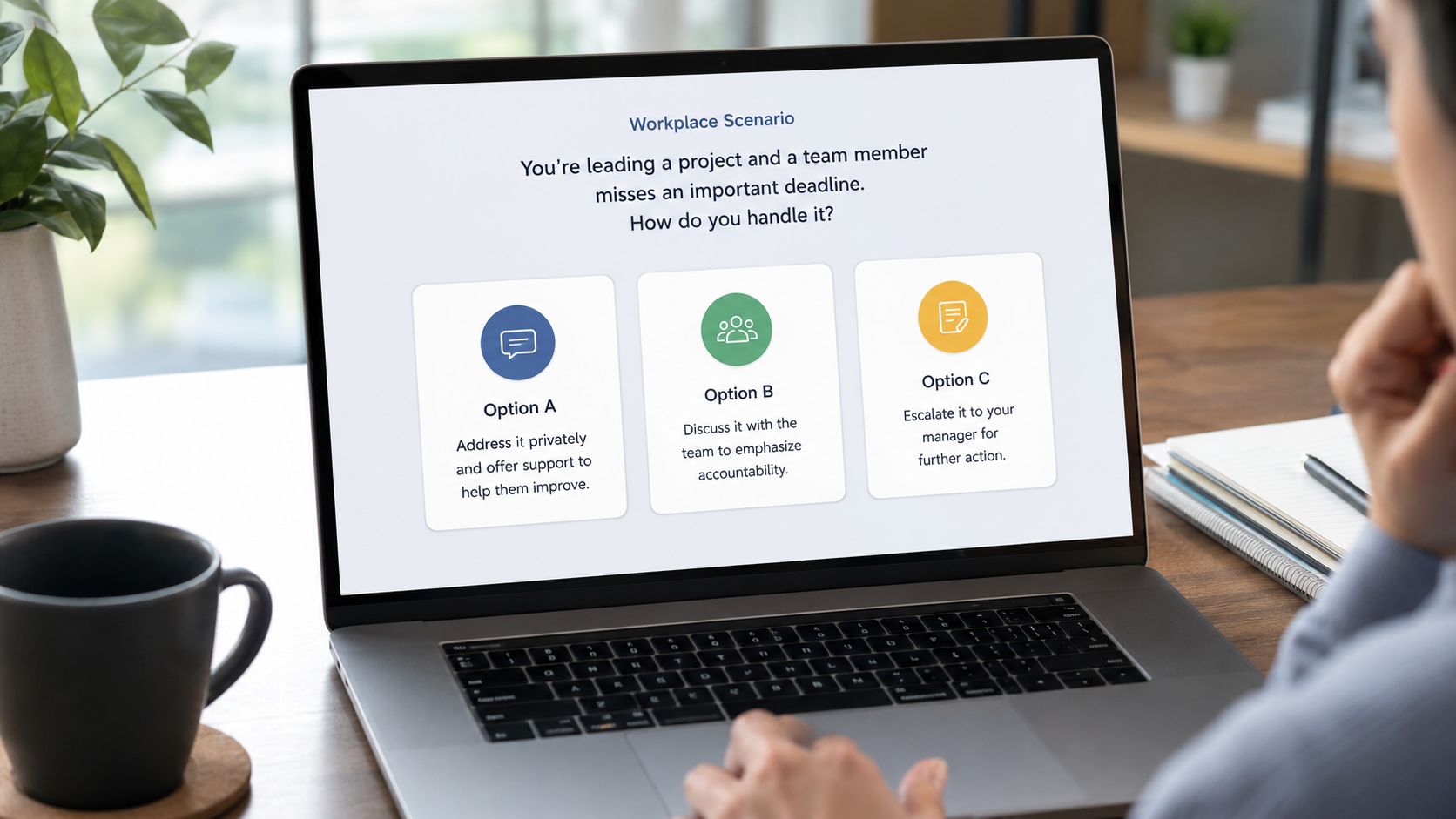
Situational Judgment Tests are where behavioral profiling starts getting closer to actual work. Instead of asking people how they see themselves, SJTs present realistic scenarios and ask them to choose or rank responses. That gives employers a better read on judgment, prioritization, and applied decision-making.
For hiring, this is often more credible than personality data alone. Candidates can fake self-description more easily than they can consistently handle job-relevant trade-offs.
Why They Matter
Deloitte and IBM have both used scenario-based digital assessment approaches in hiring, which makes sense for roles where client interaction, technical judgment, or leadership under ambiguity matters. A good SJT forces candidates to reveal how they think when there isn't a perfect answer.
The strongest design principle is realism. Your scenarios should come from actual incidents, not generic HR fiction. If your top performers routinely face conflict between speed and accuracy, stakeholder pressure and policy, or client expectations and internal capacity, those tensions should show up in the test.
A practical rollout should include:
Behavioral profiling research reports a [success rate between 50% and 85%, with accuracy varying by methodology and with profiles treated as investigative aids rather than proof](https://www.ebsco.com/research-starters/health-and-medicine/profiling). That's a useful reminder for SJTs too. They can materially improve decision quality, but they don't eliminate the need for corroborating evidence.
> Don't score candidates on whether they think like your current managers. Score them on whether they handle the role's real tensions well.
The biggest mistake is making SJTs too obvious. If the “right” answer is easy to spot, you aren't measuring judgment. You're measuring test-taking.
8. AI-Powered Predictive Simulations
The field is shifting towards more dynamic approaches. Static assessments tell you about tendencies. Simulations show you behavior in motion. AI-powered predictive simulations place people inside job-relevant challenges, then analyze the choices, pacing, trade-offs, and interaction patterns that unfold over time.
That matters because real work is dynamic. A candidate can look ideal on a static assessment and still struggle when priorities shift, pressure rises, or interpersonal friction appears. Behavioral profiling in machine learning contexts already relies on algorithms that classify, cluster, and predict behavior based on historical patterns ([overview of behavioral profiling and machine learning](https://www.hipeople.io/glossary/behavioral-profiling)). Simulations extend that logic into more lifelike decision environments.
Here's a closer look at the format in action.
<iframe width="100%" style="aspect-ratio: 16 / 9;" src="https://www.youtube.com/embed/fXizBc03D7E" frameborder="0" allow="autoplay; encrypted-media" allowfullscreen></iframe>
The Emerging CHRO Use Case
This approach is especially relevant for leadership hiring, team design, and internal mobility. It's one of the few methods that can help HR teams evaluate adaptability in context instead of inferring it from static scores. That gap matters because [90% of current organizational hiring tools use static, one-time assessments, while 68% of mis-hires result from candidates who can't adapt to real-time situational demands](https://www.mcafeeinstitute.com/blog/profiling-people).
For senior HR leaders, the playbook is clear:
This is also where more advanced people analytics starts to matter. [Predictive analytics in HR](https://synopsix.ai/blog/predictive-analytics-in-hr) becomes far more useful when the inputs include not only psychometrics, but also observed choices under realistic conditions.
One adjacent example is [AI powered candidate screening](https://worksignal.com/ai-interviewer), which reflects the broader shift toward automated evaluation layers in talent workflows. The caution is that automation only helps if the criteria are job-relevant, explainable, and regularly audited.
The ethical line is important. Real-time insight should not become invasive surveillance. Keep simulations bounded, role-relevant, and transparent. That's how you gain better signal without eroding trust.
Behavioral Profiling Techniques, 8-Point Comparison
| Tool / Model | Implementation Complexity 🔄 | Resource Requirements ⚡ | Expected Outcomes ⭐ | Ideal Use Cases 💡 | Key Advantages 📊 | |---|---:|---:|---|---|---| | Big Five (OCEAN) Model | Moderate, straightforward administration; advanced analysis needs stats skills | Low–Medium, short self-report, highly scalable, AI integration possible | High, strong predictive validity for performance and retention | Talent assessment at scale, leadership calibration, research | Robust psychometrics, cross-cultural norms, transparent trait definitions | | DiSC Behavioral Assessment | Low, simple four-quadrant approach and reports | Low, 10–15 min, minimal training, visual outputs | Moderate, improves communication and team dynamics; limited long-term prediction | Team-building, onboarding, communication training | Intuitive, fast adoption, highlights interpersonal blind spots | | Myers-Briggs Type Indicator (MBTI) | Low, easy to administer; dichotomies reduce nuance | Low, short instrument; facilitator recommended for interpretation | Low–Moderate, raises self-awareness and discussion; limited predictive power | Self-awareness workshops, career exploration, team discussions | Highly recognizable, fosters dialogue, development-oriented | | Hogan Personality Inventory (HPI) | Medium–High, multiple surveys (HPI/HDS/MVPI); certified interpretation advised | Medium–High, 20–30 min, practitioner training, higher cost | High, predicts managerial success, identifies derailers and cultural fit | Executive selection, succession planning, leadership development | Strong track record for leadership prediction, actionable derailer insights | | Predictive Index Behavioral Assessment | Low, structured job-target approach; easy deployment | Low, 5–10 min, integrated software; proprietary ecosystem | Moderate, rapid job-fit recommendations for volume hiring | High-volume hiring, sales/service roles, quick screening pipelines | Fast turnaround, built-in job libraries, automated fit scores | | CliftonStrengths (StrengthsFinder) | Low, focused on top themes; development orientation | Low–Medium, online survey; workshops and coaching add resources | Moderate, boosts engagement and development (not for selection) | Employee development, engagement programs, team role alignment | Positive strengths focus, actionable development plans, engagement lift | | Situational Judgment Tests (SJTs) | High, scenario design, validation and updating required | Medium–High, time/cost to develop custom scenarios; automated scoring possible | High, directly measures job-relevant judgment; resistant to faking | Role-specific selection, measuring practical decision-making | High face validity, job-relevant measurement, candidate engagement | | AI-Powered Predictive Simulations | Very High, AI modeling, adaptive branching, bias management required | High, significant data, design, training, and longer candidate time | Very High, deep behavioral footprints and nuanced performance forecasts | Senior/complex roles, leadership simulation, talent forecasting | Rich, real-time behavioral data, adaptive realism, latent risk identification |
The Synopsix Way Integrating Insights into Action
Most HR teams don't suffer from a lack of tools. They suffer from fragmentation. One platform houses personality data, another stores interview notes, another runs assessments, and managers still make final calls based on whichever candidate “felt right” in the debrief. That's where behavioral profiling techniques lose value. Not because the methods are useless, but because the operating system around them is weak.
A better model treats behavioral data as part of a decision architecture. Big Five or Hogan can help you understand stable tendencies. DiSC, MBTI, and CliftonStrengths can improve communication and development when used in the right lane. Predictive Index can speed up role-fit discussions. SJTs and simulations can reveal how someone handles real trade-offs. The value comes from synthesis, not from any single instrument.
This is also where senior HR leadership has to act like an operating executive, not just a program owner. Selection standards need governance. Managers need interpretation training. Legal and compliance partners need to understand where each technique belongs and where it doesn't. Teams also need outcome tracking. If you can't connect your profiling approach to quality of hire, internal mobility decisions, leadership performance, or team friction patterns, you're collecting data without building capability.
The market expansion around behavioral analytics shows how much appetite exists for more predictive, evidence-based decisions. But adoption challenges in analytics also show what derails implementation. Training gaps, weak data quality, and poor usability aren't side issues. They are usually the reason promising assessment programs stall.
For CHROs, the practical takeaway is simple. Start with role clarity. Choose methods that fit the decision. Use development tools for development, selection tools for selection, and simulations when you need to observe behavior under realistic pressure. Then build a process that turns outputs into action plans managers can implement.
Platforms like Synopsix fit naturally into that model when the goal is to connect assessment signals to hiring, team design, and development decisions in one workflow. The attraction isn't that a platform replaces judgment. It's that it can reduce interpretive drift, make profiles comparable, and translate technical outputs into business language that line leaders can use.
The future of people decisions won't come from one perfect test. It will come from combining validated inputs, role-relevant observation, and disciplined interpretation. That's how you predict human behavior more responsibly. It's also how you make smarter people decisions without pretending certainty where none exists.
---
If you're building a more evidence-based hiring and talent strategy, [Synopsix](https://synopsix.ai) is worth evaluating as a way to turn behavioral assessments, profiles, and simulations into practical guidance your leaders can use in real decisions.