Behavioral Risk Factors Explained for Smarter Hiring
By Synopsix · September 22, 2026 · 14 min read
A technically excellent employee misses a safety check, reacts defensively to coaching, and starts arriving late. A new manager delivers strong individual results but creates friction across the team. A sales hire has the energy to win customers, yet makes impulsive promises that operations can't fulfill.
These outcomes rarely come from a missing skill on a résumé. They often emerge from behavioral risk factors, recurring tendencies that shape how a person responds to pressure, routine, ambiguity, feedback, and responsibility. HR teams already evaluate skills and experience. The harder question is whether a candidate's likely behavior fits the demands of the role and the team around it.
Introduction Why Behavioral Risk Matters Now
A hiring manager may notice the problem only after the offer is signed. The employee knows the tools, understands the industry, and interviews confidently. Within weeks, colleagues are compensating for missed handoffs, a supervisor is managing avoidable conflict, or a safety-sensitive process is receiving inconsistent attention.
That doesn't mean the person is “bad,” and it doesn't prove that one behavior caused every downstream problem. It means the selection process measured capability more clearly than it measured behavior under real working conditions. Skills tell you what someone can do. Behavioral risk indicators help you estimate how consistently, safely, and collaboratively they may do it.
Public health has treated behavior as a serious source of risk for decades. The same logic can help organizations make better talent decisions, provided HR leaders avoid turning people into labels. A behavioral signal is a probability, not a verdict. It should inform structured decisions alongside job analysis, interviews, work samples, references, and performance evidence.
This distinction matters for hiring, promotion, and team design. A tendency toward rapid action may help in sales while creating quality risk in regulated work. Strong independence may support specialist work but become a problem in a manager who must coordinate decisions. Context changes the meaning of a signal.
A practical approach to [talent risk management](https://synopsix.ai/blog/talent-risk-management) starts with a simple sequence: define the behaviors the role requires, measure them consistently, translate results into business language, and test the implications against observable outcomes. The purpose isn't to predict a person perfectly. No assessment can do that. The purpose is to reduce avoidable surprises and give managers a clearer basis for support, selection, and team composition.
What Behavioral Risk Factors Really Mean
Think of a workplace as a garden. Skills are the plants you intentionally grow. Processes are the irrigation system. Behavioral risk factors are conditions that can act like unchecked weeds. One small weed may not change the garden, but several competing for water, sunlight, and attention can affect everything nearby.
That analogy makes the concept easier to separate from personality. Personality traits describe relatively broad patterns, such as conscientiousness or extraversion. Behavioral risk factors translate patterns into possible work consequences, such as inconsistent follow-through, unsafe shortcuts, avoidable conflict, or likely attendance problems. Skills describe learned capability. Culture describes shared expectations and norms. These ideas overlap, but they aren't interchangeable.
The roots of behavioral risk measurement sit strongly in public health. In the Global Burden of Disease 2017 analysis32225-6/fulltext), behavioral risk factors accounted for 43.6% of all disability-adjusted life years in 1990. By 2017, all GBD risk factors combined were linked to 34.1 million deaths and 1.21 billion DALYs worldwide. The categories included exposures such as tobacco use, diet, alcohol, and physical activity.
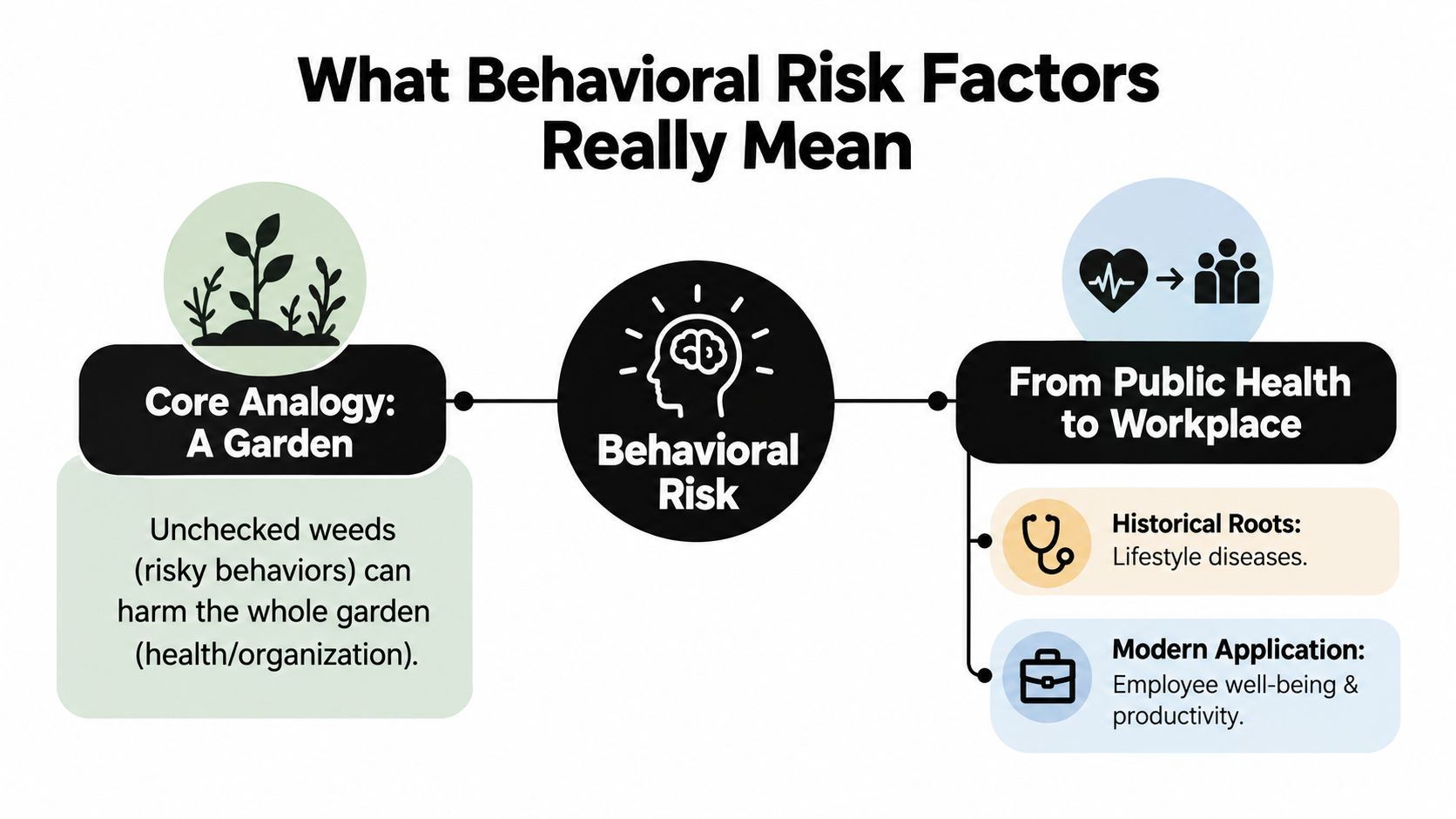
From health exposure to workplace signal
The workplace application is narrower and more practical. HR isn't diagnosing disease through a hiring assessment. It's asking whether observable tendencies may affect safety, quality, dependability, judgment, learning, or collaboration in a specific role.
A behavioral risk factor also isn't a moral judgment. Someone who prefers speed isn't automatically careless. Someone who dislikes routine isn't automatically unreliable. The signal becomes useful only when the role creates a meaningful consequence for that tendency and the organization can test it fairly.
Behavior also compounds. A person who avoids feedback may miss early correction. Missed correction can create quality problems, which can increase stress, which can make defensiveness more likely. The organization should treat that chain as a hypothesis to examine, not as a guaranteed outcome.
For readers building an early-stage team, a practical [guide to early-stage hiring traits](https://underdog.io/blog/attributes-to-look-for-in-early-stage-employees) can help connect broad qualities to the realities of changing priorities, limited structure, and shared ownership. The central principle is simple: define the working conditions first, then ask which behaviors will help or hinder performance in those conditions.
How Behavioral Risk Is Identified and Measured
Measurement works best when each method answers a different question. A psychometric assessment can reveal stable preferences and tendencies. A structured interview can show how a candidate describes past choices. A simulation can expose behavior while the person handles competing demands. Performance data can test whether the signals relate to outcomes after hiring.
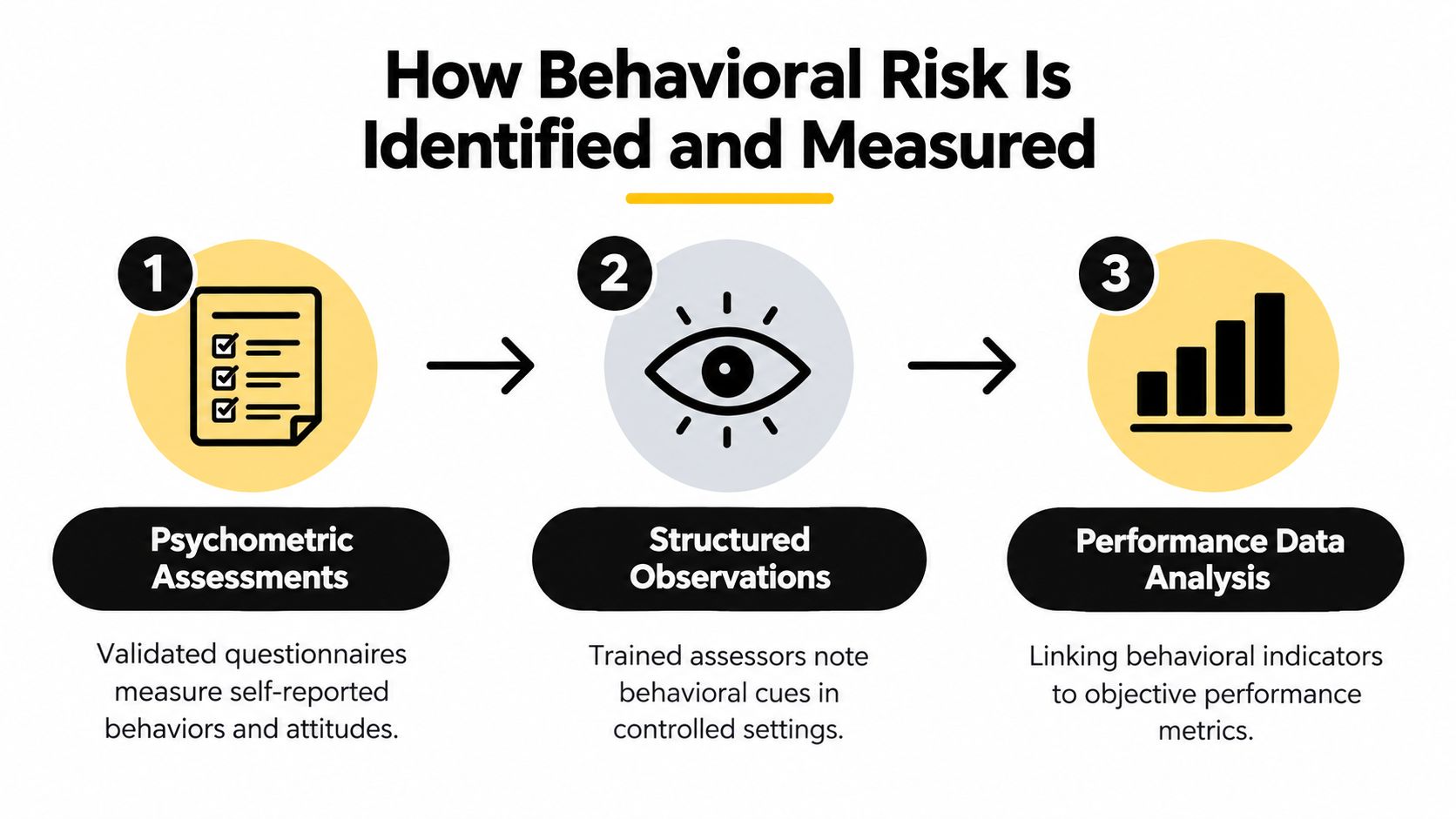
Start with the job, not the questionnaire
Job analysis should identify the situations that matter. Does the employee need to follow strict procedures, recover from rejection, coordinate across functions, make rapid judgments, or persist through repetitive work? Those demands determine which behavioral indicators deserve attention.
A meta-analysis of 494 studies, covering 97 independent samples and 13,521 people, found a corrected mean validity of .29 for confirmatory research strategies versus .12 for exploratory strategies. When job analysis explicitly guided measure selection, validity rose to .38. The meta-analysis supports a practical lesson: don't select a personality measure because it sounds interesting. Select it because the role gives that measure a meaningful job to predict.
A useful [talent assessment guide for HR teams](https://gentyrecruitment.io/insights/what-is-talent-assessment-a-guide-for-hr-teams) can provide broader context on how assessments fit alongside interviews, work samples, and other selection tools. No single instrument should carry the full decision.
Combine evidence without confusing it
Structured behavioral interviews improve comparability when every candidate receives the same job-related questions and a consistent scoring rubric. References may reveal patterns of dependability or collaboration, but they can also be incomplete or overly generous. Background checks address defined concerns, not personality.
Predictive simulations are especially useful for translating abstract tendencies into decisions. A customer-facing simulation might test how a candidate handles an angry client and an unrealistic deadline. A safety simulation might present a production target alongside a procedure that cannot be skipped. The evaluator should score the behavior against predefined criteria, not personal impressions.
Reports should use business language. “Low emotional stability” is less actionable than “may need a clear escalation process when priorities change.” A reliable workflow also separates risk indication, role relevance, and mitigation plan. For more detail on interpreting assessment quality, see [assessment validity and reliability](https://synopsix.ai/blog/assessment-validity-and-reliability).
Business Impact and Concrete Examples Across Talent Decisions
Behavioral risk matters because the same tendency can produce different consequences in different talent decisions. A hiring screen asks whether a person is likely to meet the role's baseline demands. A promotion decision asks whether the person's current strengths will transfer to a broader scope. Team design asks whether one person's tendencies complement or intensify those of colleagues.
One published hiring framework identifies seven operational categories: Safety, Quality, Impulsivity, Dependability, Attitude, Absenteeism/Tardiness, and Turnover. It describes high absenteeism or tardiness risk in practical terms, such as being more likely to arrive late, miss work, or skip work. The framework is useful because it converts vague personality language into workplace questions.
| Risk Category | Hiring Signal | Promotion Signal | Team Design Signal | |---|---|---|---| | Safety | May bypass procedures under pressure | May model or tolerate unsafe shortcuts | Pair urgency with strong process discipline | | Quality | May trade accuracy for speed | May fail to build review habits | Add detail-oriented checking capacity | | Impulsivity | May decide before gathering facts | May overreact to ambiguous events | Balance fast action with deliberate challenge | | Dependability | May struggle with follow-through | May need stronger planning routines | Clarify ownership and handoff rules | | Attitude | May respond poorly to coaching | May damage trust through defensiveness | Establish feedback norms and escalation paths | | Absenteeism/Tardiness | May create coverage problems | May weaken team reliability | Build redundancy for critical responsibilities | | Turnover | May leave when work becomes difficult | May disengage after expanded scope | Match role design with motivators and support |
Hiring and promotion don't ask the same question
Consider impulsivity. In a sales role, quick responses and comfort with uncertainty can support customer engagement. In quality assurance, the same pattern may create rework if the employee acts before checking evidence. The hiring decision should therefore ask, “What does this tendency mean in this role?” rather than, “Is this trait good or bad?”
Promotion introduces a different risk. An individual contributor may succeed through personal speed and independence. A manager must slow down enough to coach, consult, document, and distribute responsibility. A promotion assessment should test the expanded behavior set instead of assuming past performance proves readiness.
Team design adds another layer. A highly independent employee may thrive beside a strong coordinator, while several independent decision-makers may leave ownership unclear. Behavioral profiles can help managers discuss complementarity without reducing people to fixed types.
Organizations also need humane responses when stress or health concerns affect work. Resources such as [evidence-based workplace stress treatment](https://uptownpsychologyny.com/work-related-stress-therapy/) can provide context for support, but HR decisions should remain focused on job requirements, fair process, reasonable support, and observable behavior. For a broader business lens, the discussion of [the cost of a bad hire](https://synopsix.ai/blog/cost-of-a-bad-hire) helps frame why prevention and onboarding support belong in the same operating conversation.
Why Behavioral Risks Cluster and Multiply
People rarely bring one isolated behavior into a role. A worker may combine low activity, poor diet, alcohol misuse, and smoking. A workplace employee may combine weak planning, avoidance of feedback, rushed decisions, and inconsistent attendance. Treating each signal separately can make the total pattern look smaller than it is.
A systematic review of 37 studies found that unhealthy diet, physical inactivity, alcohol misuse, and smoking commonly co-occur. [The review](https://eprints.whiterose.ac.uk/id/eprint/102810/1/s12889_016_3373_6.pdf) also cautioned that its evidence base was largely cross-sectional, so the findings don't establish every causal pathway. They do support a practical modeling choice: screen for combinations, not only individual variables.
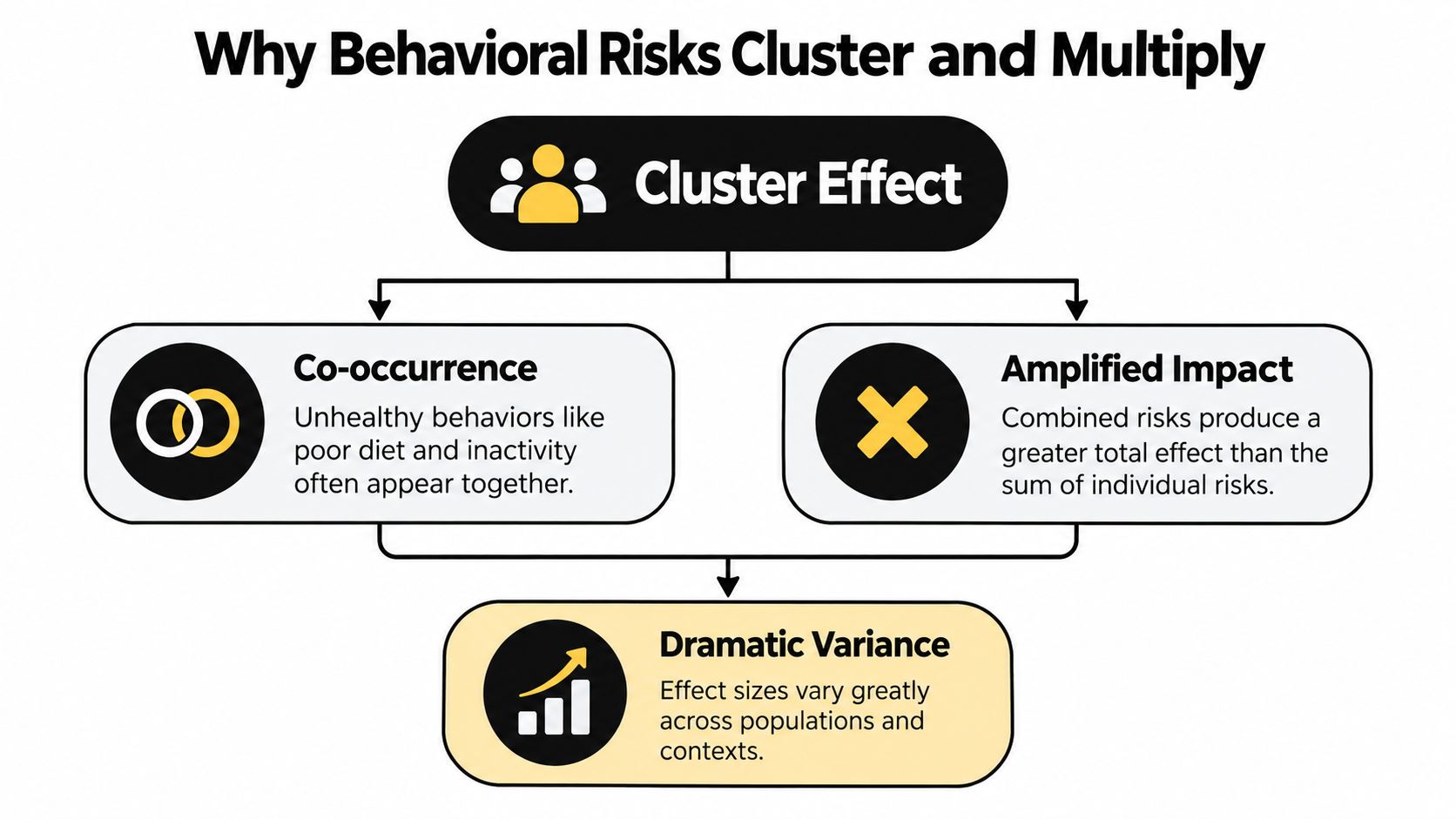
Co-occurrence changes the decision
Suppose a candidate shows a mild signal for rushing, a mild signal for resisting oversight, and a mild signal for inconsistent planning. Each result alone may deserve a development question. Together, they may suggest a role-specific risk in an environment where compliance, documentation, and escalation are essential.
That doesn't mean an organization should just add scores together. Composite scoring needs validated rules, relevant outcomes, and careful governance. The useful question is whether a pattern changes the probability of a defined result, such as missed handoffs, safety incidents, early disengagement, or avoidable conflict.
Effect size should also influence attention. A systematic review of reviews on communicable diseases reported that 50 of 53 reviews, or 94%, concluded that at least one behavioral risk factor increased infection risk or severity, with reported effect sizes ranging from 0.83 to 8.22. [That evidence](https://pure.bangor.ac.uk/ws/portalfiles/portal/39690668/2021_Impact_of_behavioural_risk_factors.pdf) doesn't transfer automatically to workplace outcomes, but it demonstrates why equal weighting can be misleading. Some indicators deserve more scrutiny because their relationship with a particular outcome is stronger.
> Modeling principle: A risk score should reflect the role, the outcome, and the interaction among signals. It shouldn't treat every behavior as equally important.
A dose-dependent pattern can matter too. Repeated exposure to several related risks may indicate a different intervention need than one occasional concern. In organizational terms, HR should distinguish a single coaching opportunity from a recurring pattern that affects resilience, attendance, judgment, or team load.
<iframe width="100%" style="aspect-ratio: 16 / 9;" src="https://www.youtube.com/embed/y6ScjdTJ8is" frameborder="0" allow="autoplay; encrypted-media" allowfullscreen></iframe>
Mitigation Strategies and Integration Best Practices for HR Leaders
Behavioral risk becomes useful only when it changes what the organization does. The strongest process connects role design, assessment, decision review, onboarding, and development rather than leaving a report in a candidate file.
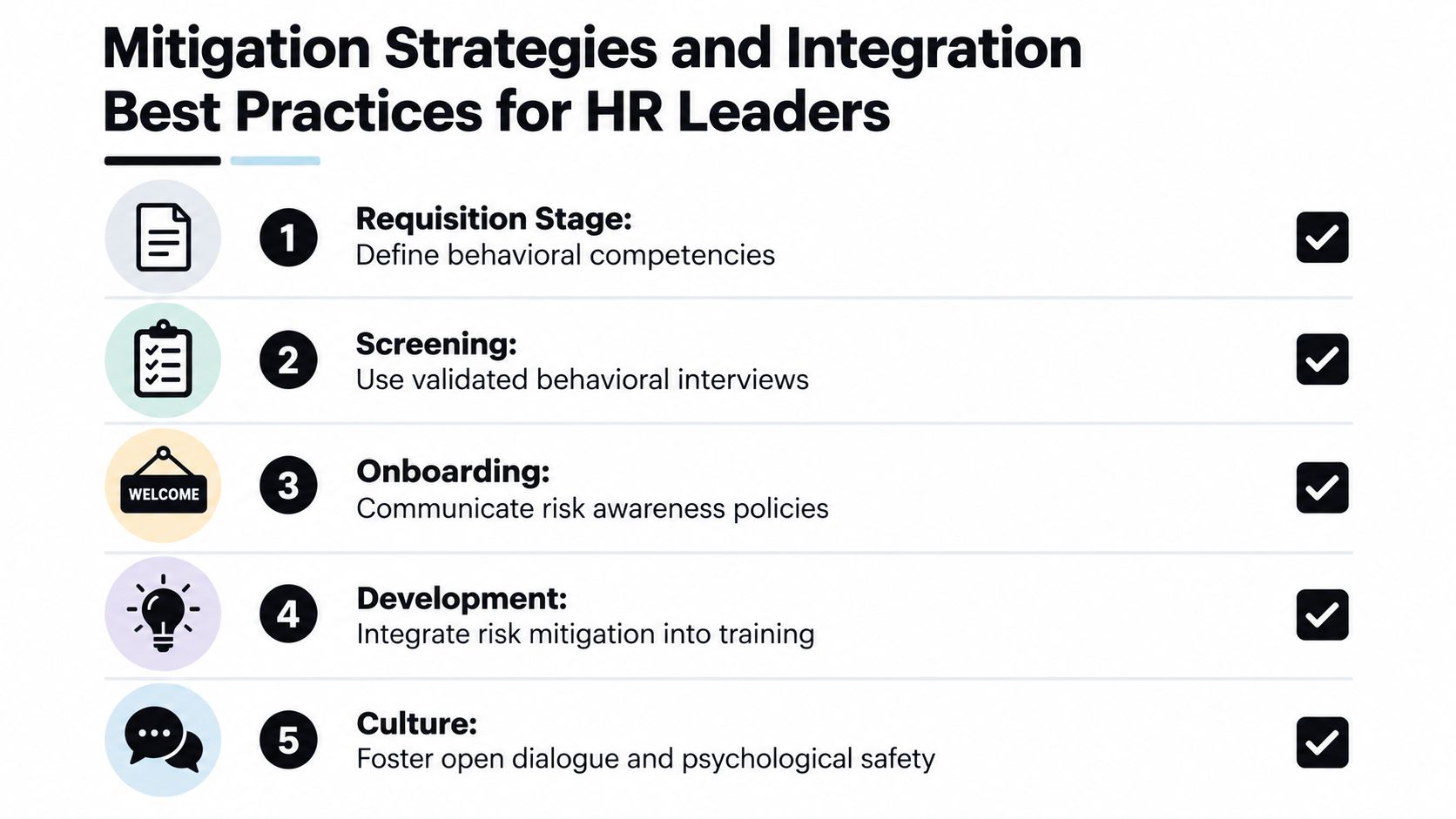
Build the workflow around decision checkpoints
At the requisition stage, define the behavioral competencies that matter. “Good communicator” is too broad. “Raises delivery risks early, documents decisions, and stays constructive during disagreement” gives assessors something observable.
During screening, use validated behavioral interviews and job-relevant simulations. Ask candidates for evidence from past work, then score the response against the same rubric. Avoid questions that invite disclosure of protected health information or personal circumstances unrelated to the job.
Onboarding should turn known risks into support. A new employee who may rush under pressure might receive explicit quality gates, escalation rules, and early feedback. A manager who struggles with delegation might use scheduled one-to-one reviews and decision-rights documentation.
Measure whether the system improves decisions
Track operational indicators such as time-to-decision, mis-hire rate, early turnover, assessment completion, manager agreement, and team complementarity. These measures aren't proof of causation by themselves. They create a feedback loop that shows whether the process is becoming more consistent and whether the selected signals relate to role outcomes.
The Big Five evidence reinforces why role context matters. In a classic meta-analysis covering professionals, police, managers, sales, and skilled or semi-skilled workers, Conscientiousness was the only dimension with consistent relations across all job performance criteria and occupations. Extraversion was particularly valid for managers and sales roles, while some other effects were small, often ρ < .10. The occupational meta-analysis supports targeted interpretation rather than universal trait rankings.
A platform such as Synopsix can fit into this workflow by generating comparable behavioral profiles, translating psychometrics into business signals, and using simulations, compatibility analysis, and development plans to connect assessment with action. It should complement human judgment and governance, not replace them.
Key Takeaways and Next Steps for Building Resilient Teams
Behavioral risk factors are most valuable when HR treats them as decision signals, not labels. They help leaders ask better questions about how people may respond to the actual demands of a role, especially when pressure, ambiguity, routine, or interpersonal tension exposes patterns that a résumé won't show.
Three actions can make the work practical:
Cross-cultural evidence also supports careful use of behavioral signals. A meta-analysis of 33 studies involving 6,782 people found that Big Five traits retained similar validity for job performance in South Africa as in other contexts, with Conscientiousness emerging as the strongest predictor across performance criteria. The cross-cultural analysis supports portability, but it doesn't remove the need to validate tools for each role and workforce.
Resilient teams aren't built by eliminating every risk. They're built by matching people to work, making tradeoffs visible, designing complementary teams, and giving employees practical support where a risk can be managed.
---
Synopsix turns validated behavioral assessments into comparable profiles, role-specific business signals, predictive simulations, and team-complementarity guidance for hiring, team design, and development. Visit [Synopsix](https://synopsix.ai) to see how your HR team can move from behavioral risk awareness to more consistent people decisions.