Behaviour Based Assessment: What It Is and How It Works
By Synopsix · September 29, 2026 · 16 min read
A behavioural assessment isn't automatically useful because it looks scientific. In hiring, structured interviews show a validity coefficient of about 0.51, while work-sample tests reach about 0.54, according to a large evidence review of selection methods ([evidence review of selection methods](https://kanbanforhiring.com/audits/samples/pbh-evidence-base-review.html)). The buying question, then, isn't whether your vendor uses the word “behaviour.” It's whether the assessment captures job-relevant conduct, scores it consistently, and adds evidence beyond a polished conversation.
Most HR teams treat behaviour based assessment as a binary purchase decision. That's too crude. The right choice depends on what you need to predict, whether performance is observable, how much candidates can prepare or game the process, and whether the same construct holds across countries and job families.
This guide gives you a practical filter for four decisions: what the tool measures, how strong the evidence is, where the design fails, and how to deploy it without turning a questionable score into a high-stakes verdict.
What Behaviour Based Assessment Actually Measures
Behaviour based assessment should capture what a person does under defined conditions. It shouldn't merely ask candidates to describe themselves as resilient, collaborative, decisive, or empathetic. Those self-descriptions may provide context, but they're not direct observations of conduct.
A useful analogy is a flight recorder. A situational judgment test, or SJT, presents a defined work scenario and records the candidate's chosen response. A simulation gives the person a task, interaction, or problem and captures actions against a scoring framework. The output is comparable behavioural data, not a personality label.
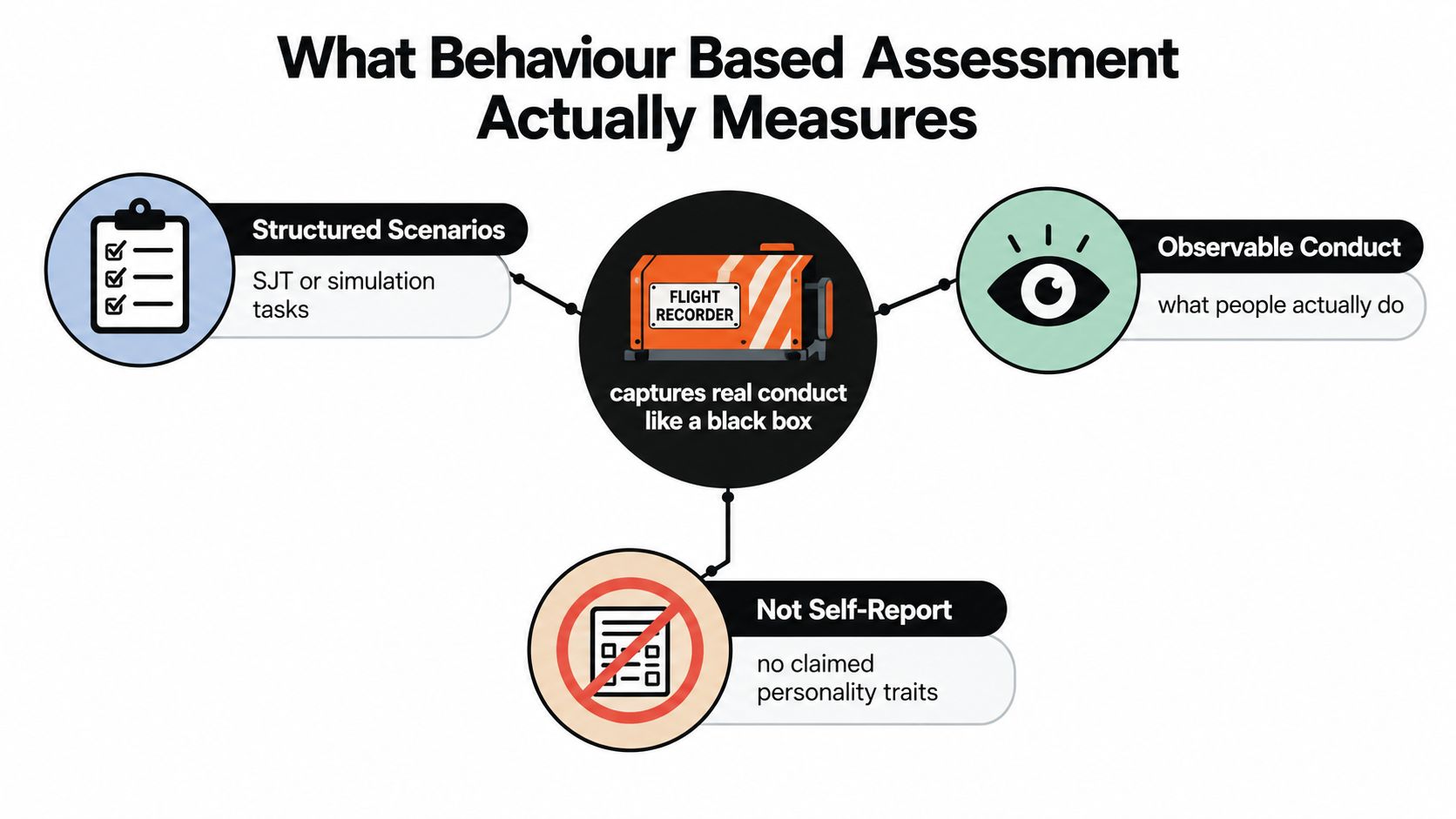
Separate the three measurement layers
HR buyers should ask which layer a vendor delivers:
These methods answer different questions. A self-report inventory may indicate how someone sees their working style. An SJT tests the quality of their choices in a standardised context. A simulation can reveal how they listen, allocate attention, handle resistance, or execute a task when another person is watching.
Treat the score as decision support
The assessment's purpose is not to describe a candidate elegantly. It's to support a decision about selection, promotion, development, or intervention. That requires an interpretable signal tied to a role and an outcome.
The field's technical standard is clear: assessments need sufficient evidence of reliability and validity before widespread use. The discipline evolved from clinical and educational observation systems into job analysis, performance appraisal, pre-employment assessment, talent management, and employee development ([overview of behavioural assessments and their evolution](https://www.thomas.co/resources/type/hr-guides/behavioral-assessments-guide)).
> Practical rule: If a vendor can't show what behaviour it measures, how raters score it, and which job outcome it predicts, you're buying a report, not a decision system.
The Science Behind Validated Behavioral Measurement
Good measurement starts with the job, not the questionnaire. A role analysis identifies the behaviours that matter, such as diagnosing customer needs, escalating risk, coaching a struggling employee, or coordinating work under pressure. Researchers then translate those requirements into items or scenarios that represent credible job situations.
The scoring model must connect observable actions to a defined construct. A sales simulation might score discovery questions, evidence use, listening, and next-step discipline. A leadership exercise might score how the candidate handles conflicting priorities and gives corrective feedback. The rubric should describe behavioural anchors, so raters judge the action rather than charisma, confidence, or personal similarity.
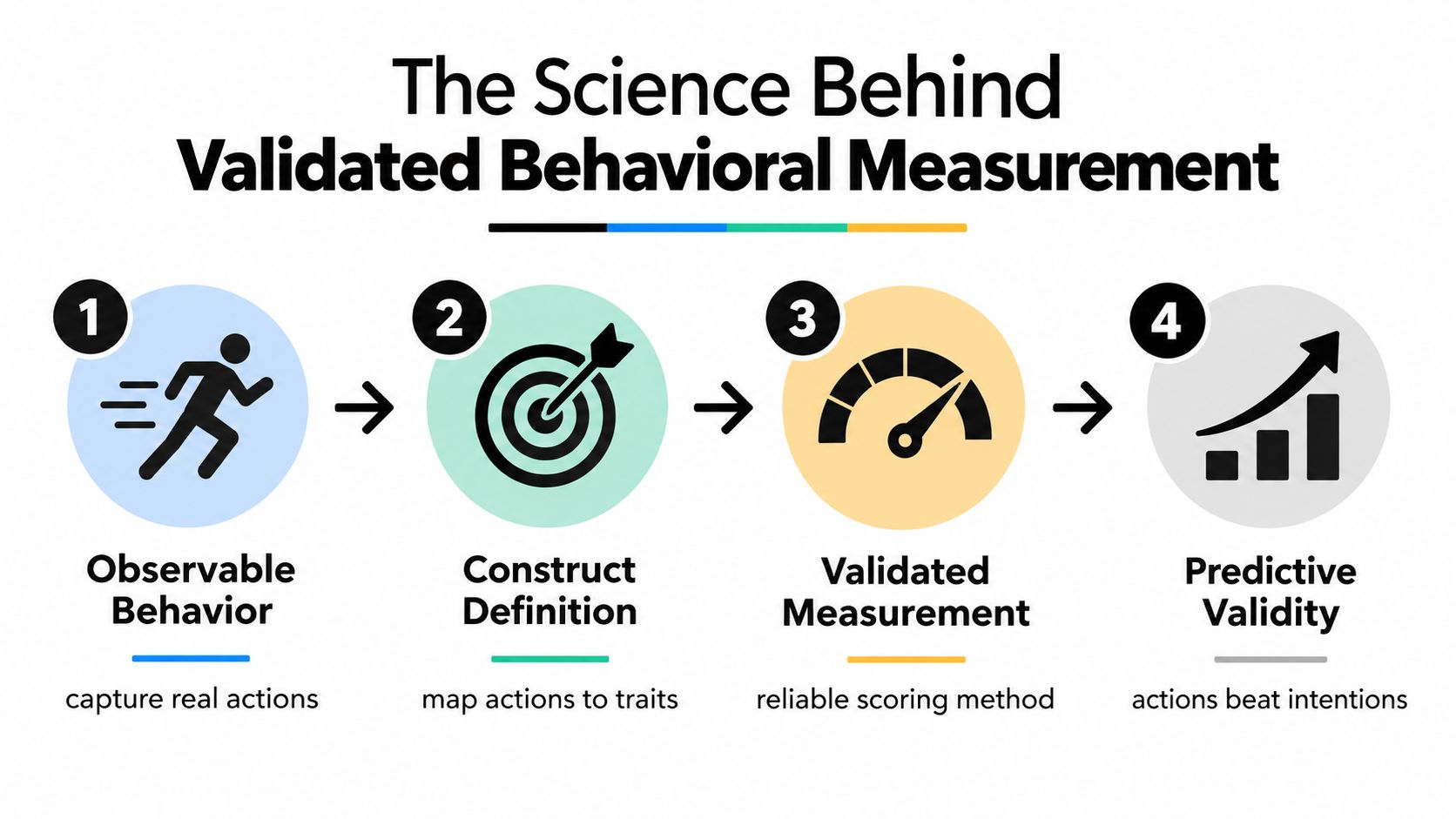
Read a vendor datasheet like an analyst
A credible validation file should answer four questions:
1. What construct is being measured? “Leadership potential” is too broad unless the vendor defines its component behaviours. 2. How was the role analysed? Item selection should reflect actual job requirements and critical incidents. 3. How reliable is the score? Look for agreement between trained observers or internal consistency evidence, not just a polished dashboard. 4. What outcome does the score predict? Criterion-related validity should connect results to job performance, training outcomes, retention, or another defined criterion.
A review of 494 studies, identifying 97 independent samples and 13,521 individuals, found corrected mean validity of .29 when researchers used confirmatory strategies, compared with .12 for exploratory strategies. When job analysis explicitly informed item selection, validity rose to .38. The same review found conscientiousness was the personality trait most consistently associated with job performance, while other traits were more context-dependent ([meta-analysis of personality and job performance](https://onlinelibrary.wiley.com/doi/abs/10.1111/j.1744-6570.1991.tb00696.x)).
That result gives CHROs a useful standard. A vendor shouldn't present one universal accuracy claim. It should explain the role architecture, target criterion, research design, sample, and limits of generalisation.
The evidence also shows why observation quality matters. A 2023 Wiley study reported interobserver agreement ranging from 90% to 100% for classroom behaviour observation tools, alongside strong kappa coefficients (Wiley study of interobserver agreement in behaviour observation). Other tools have been less technically complete. A 2024 study of functional behaviour assessment products found technical adequacy scores ranging from 40% to 50% of total components, showing that labels alone don't guarantee sound measurement (study of functional behaviour assessment products).
The lesson is simple. Validation is a chain, from job analysis to behavioural design, reliable scoring, relevant outcomes, and adverse-impact monitoring. Break one link and the score becomes harder to defend.
<iframe width="100%" style="aspect-ratio: 16 / 9;" src="https://www.youtube.com/embed/gLPQUlmI6So" frameborder="0" allow="autoplay; encrypted-media" allowfullscreen></iframe>
For a practical explanation of the distinction between consistency and accuracy, see [assessment validity and reliability](https://synopsix.ai/blog/assessment-validity-and-reliability).
How Behaviour Based Assessment Compares to Other Methods
Behaviour based assessment earns its place when it standardises evidence that interviews often capture inconsistently. It does not automatically outperform a practical work sample, and a generic personality screen should not be treated as equivalent to either.
For HR leaders choosing between methods, consistency is the practical decision point. Structured interviews and work samples provide stronger evidence than unstructured conversations, while broad personality measures usually work best as supplementary input. A large evidence review reports validity coefficients of about 0.51 for structured interviews, about 0.54 for work-sample tests, and about 0.51 for general mental ability tests. Unstructured interviews are lower, at about 0.38 ([selection-method evidence review](https://kanbanforhiring.com/audits/samples/pbh-evidence-base-review.html)). Use these figures to compare methods, not to promise identical accuracy across roles.
| Method | Predictive Validity | Best-Fit Use Case | Key Limitation | |---|---:|---|---| | Structured behavioural interview | About 0.51 | Roles where past actions and judgment can be probed consistently | Candidates can rehearse answers, and interviewer quality still matters | | Work-sample test | About 0.54 | Narrowly defined roles with observable outputs | Can require more time, equipment, or assessor capacity | | Generic personality assessment | About 0.30 in significant validity tests | Supplemental context and carefully bounded development use | Broad constructs may not map tightly to the role | | Unstructured interview | About 0.38 | Exploratory conversation only, never as the sole decision tool | Gut feel, inconsistency, and similarity bias | | Combined methods | About 0.63 for general mental ability plus work samples | High-stakes decisions needing complementary evidence | More operational complexity and governance work |
Buy a multi-method system for high-stakes decisions. A structured behavioural interview examines how a candidate handled a real situation. A work sample tests whether the person can perform the relevant task. Combining them reduces reliance on rehearsed storytelling and abstract self-description.
Personality data can add context, but it should not determine a hiring decision. In the validity research program for a behavioural assessment used in hiring, 94% of studies found statistically significant associations between scores and job-performance measures, with an average criterion-validity coefficient of r=0.30 in significant tests ([reliability and validity evidence for a behavioural assessment](https://www.predictiveindex.com/learn/support/reliability-and-validity-of-the-pi-behavioral-assessment/)). That evidence supports bounded use. It does not justify removing job samples or structured interviews, especially where candidates can tailor self-reported answers.
> Buyer test: Ask the vendor for the validity coefficient for your target role, criterion, population, and method. A universal coefficient is a marketing claim, not a validation strategy.
Where Behaviour Based Assessment Breaks Down
The label “behaviour based” doesn't make an assessment bias-free. Design determines whether the tool captures useful conduct or merely gives old judgments a technical appearance.
The first failure mode is self-report distortion. Candidates know that employers may prefer collaboration, emotional control, initiative, and conscientiousness. They can shape answers toward the profile they think the employer wants. AI-assisted preparation increases the candidate's ability to anticipate common scenarios and rehearse socially desirable responses, especially when the assessment relies on transparent question formats.
The second failure mode is observer inconsistency. Two managers may watch the same interaction and reward different behaviours if they haven't practised the rubric together. A score can then reflect rater preference, communication style, or cultural familiarity rather than job performance.
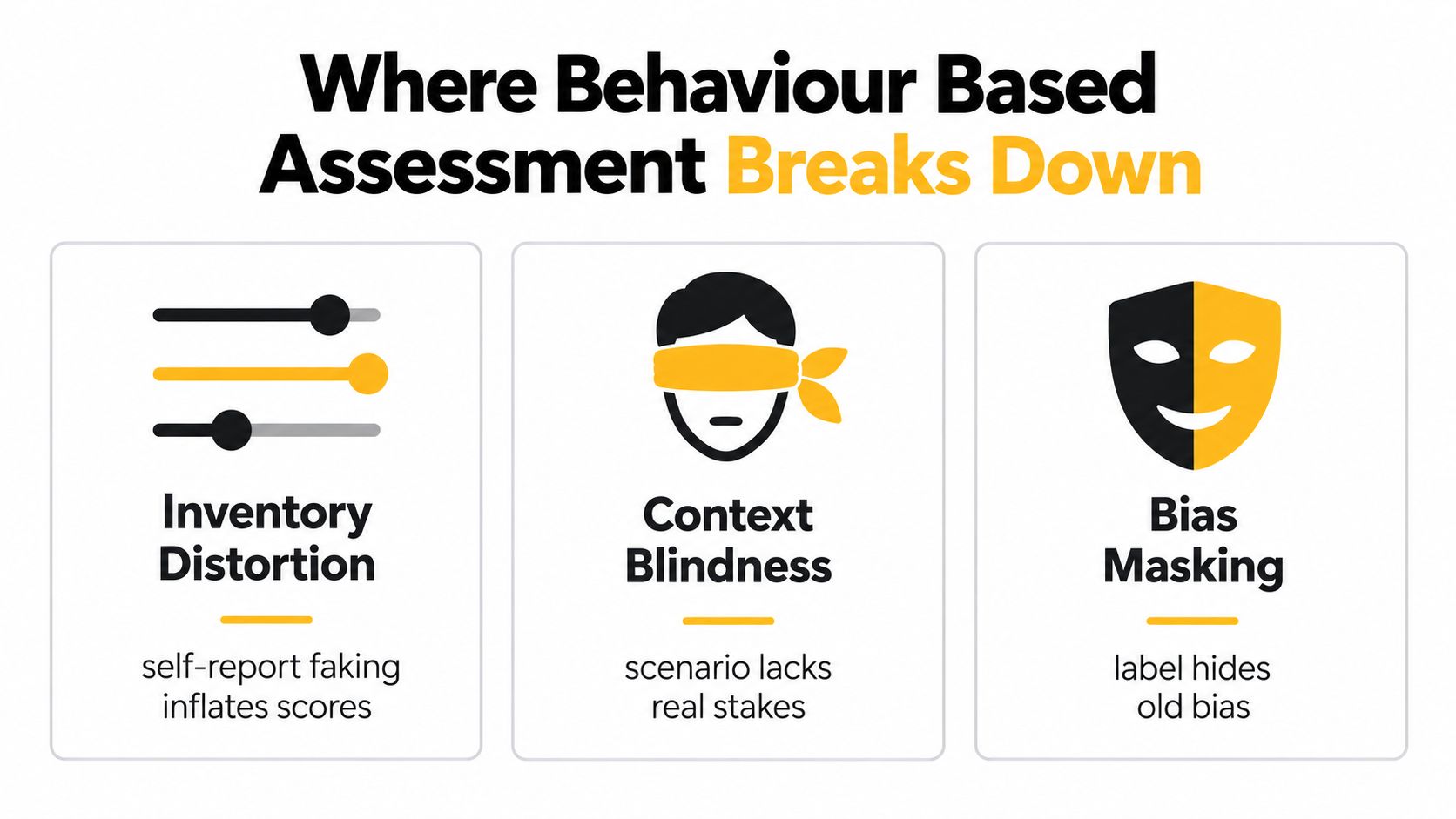
Cross-cultural validity is a design issue
A behaviour that looks positive in one labour market may carry a different meaning elsewhere. Assertiveness, eye contact, disagreement, self-promotion, and speed of response can be interpreted differently across cultures. Many assessments were developed in Western, English-speaking, middle-class contexts, so local validation matters before a global HR team treats a score as portable ([discussion of cross-cultural risks in behavioural testing](https://www.linkedin.com/pulse/5-major-issues-companies-face-when-using-behavioral-tests-fuller-ljeve)).
Cross-cultural evidence is encouraging when the construct is stable and the criterion is job performance. A meta-analysis of South African research pooled 33 studies and 6,782 individuals and found that the Big Five retained similar criterion-related validity to findings from other regions, with conscientiousness emerging as the strongest predictor across performance criteria ([cross-cultural meta-analysis of the Big Five and job performance](https://scholarworks.gvsu.edu/cgi/viewcontent.cgi?article=1006&context=lib_seniorprojects)). That supports transportability, not blind translation.
Team research adds another warning. Self-assessments didn't correlate with overall team performance, while observer-based workload ratings were more consistent with performance-linked findings about workload and team functioning ([research on self-assessment, observer ratings, and team performance](https://link.springer.com/article/10.1007/s10111-017-0428-0)).
The practical response is to test measurement invariance, monitor group-level score differences, revalidate by country and job family, and document how the employer investigated adverse impact. A generic screen with a validity near .30 shouldn't displace a structured behavioural interview near .51 when the decision is high stakes.
For a focused treatment of behavioural risk signals and their responsible interpretation, see [behavioural risk factors](https://synopsix.ai/blog/behavioral-risk-factors).
Implementing Behaviour Based Assessment in HR Workflows
Deploy the assessment as a controlled decision process, not as an isolated vendor step. The sequence should be assess, profile, interpret, and act, with a human review point before any consequential decision.
1. Assess the role
Start with job analysis. For an enterprise account executive, define the behaviours that matter in the actual role: diagnosing buying needs, handling procurement resistance, managing a complex stakeholder group, documenting next steps, and protecting forecast integrity. Don't buy a generic “sales personality” profile and retrofit it to the job.
Document the job link before launch. Record who identified each competency, which performance criterion it supports, and why the assessment format can observe or measure it. This file becomes the foundation for validation, candidate communication, and later audit work.
2. Profile the candidate pool
Use the same instructions, time conditions, scenarios, and scoring rules for comparable candidates. If you use an SJT, make scenarios realistic without exposing confidential customer information. If you use a simulation, define what observers should record, such as question quality, evidence use, prioritisation, and response to challenge.
Candidate consent must be explicit. Set data-retention limits that align with GDPR obligations and review requirements under the Illinois AI Video Interview Act where applicable. Don't collect behavioural data indefinitely just because the platform makes storage easy.
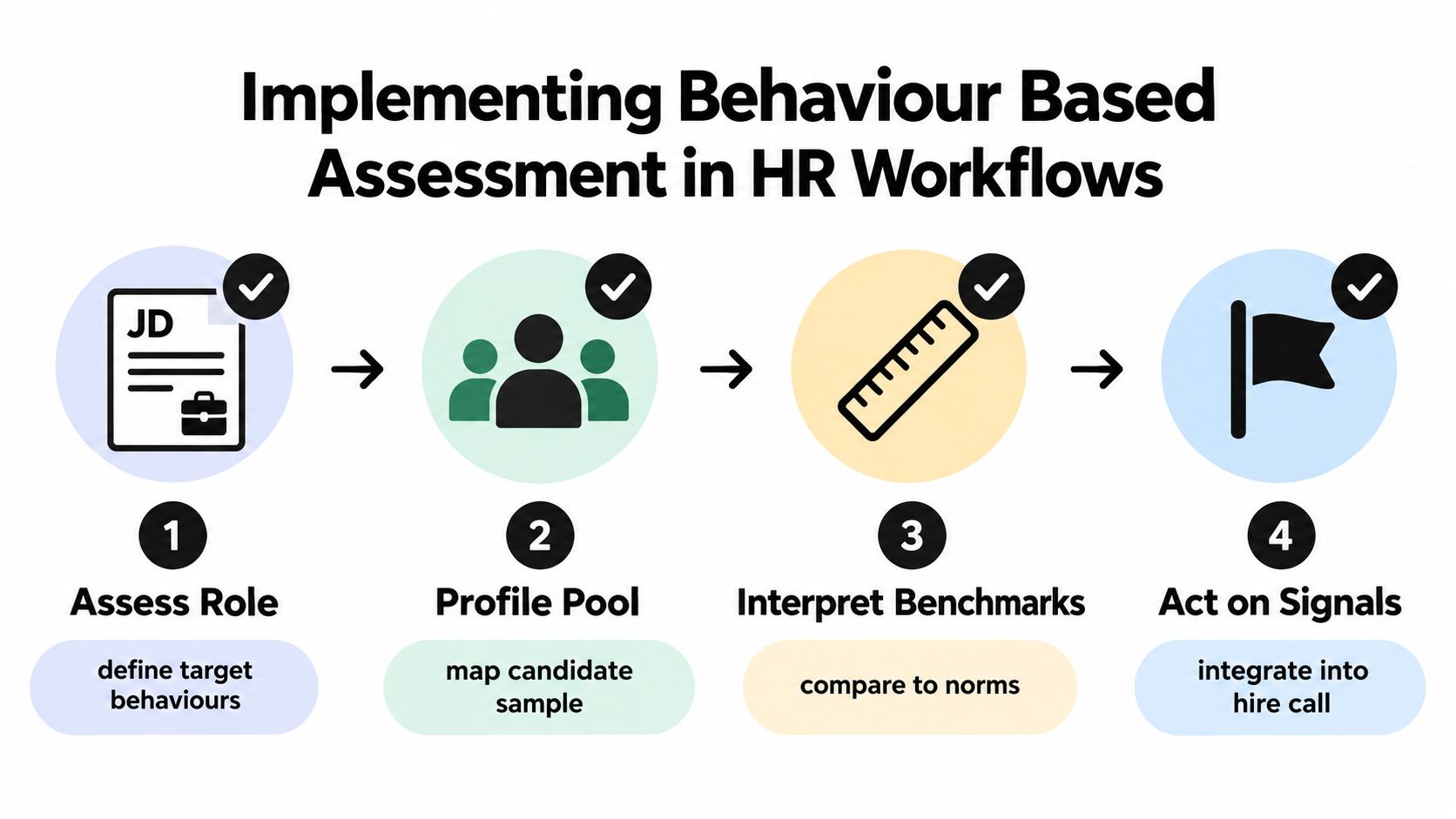
3. Interpret against benchmarks
A benchmark is useful only when it reflects the job and the relevant comparison group. For development, a low score on conflict navigation might trigger coaching rather than exclusion. For selection, the team should define how the result combines with interview evidence and work output before seeing candidate scores.
Train raters on behavioural anchors. Run calibration exercises using the same examples, discuss disagreements, and check whether ratings differ systematically across managers, locations, languages, or demographic groups.
When managers need help describing observed conduct without inflaming a conversation, resources such as Spark's [esempi di feedback non professionale](https://tryspark.co/come-dare-feedback-su-comportamento-non-professionale/) can support more concrete feedback language.
4. Act on integrated signals
The mandatory control point is simple: every high-stakes decision must combine behavioural data with a structured interview. Never let an assessment score alone determine hiring, promotion, or termination.
Before launch, require:
For a more detailed workflow for turning behavioural evidence into a decision, see [how to assess behavior](https://synopsix.ai/blog/how-to-assess-behavior). Documented process doesn't eliminate legal risk, but it gives HR a stronger basis for explaining why a tool was selected, how it was scored, and how the organisation monitored disparate impact.
Behaviour Based Assessment for Hiring, Promotion, and Development
The same assessment can't serve three talent decisions equally well. Hiring asks whether the evidence predicts performance before the person joins. Promotion asks whether past behaviour transfers to a larger scope. Development asks whether the output creates useful self-awareness and action.
Hiring requires the strongest evidence
For frontline hiring, use structured behavioural questions and a job-relevant work sample where the output is observable. A 2024 SHRM talent benchmark reports a 40% reduction in time-to-hire associated with behaviour based assessment use (SHRM talent benchmarks). The number matters only if the organisation preserves quality, documents the role link, and avoids treating speed as proof of validity.
Promotion needs multiple perspectives
For internal promotion, assessment output should be one input among 360 reviews, a structured panel, and the assessment itself. Compare the combined evidence with the organisation's nine-box process, then audit whether people identified as high potential progress at the expected rate. A promotion tool should expose readiness gaps, not merely confirm the sponsor's preferred candidate.
Development can tolerate lower stakes
Development is the right place for a self-report diagnostic, provided the organisation presents it as a reflection prompt rather than a ranking mechanism. A coach can use the result to explore how someone reacts under pressure, receives feedback, or approaches ambiguity. The person should be able to challenge the interpretation and translate it into a behavioural experiment.
A review of employment assessments reports an overall validity around .22, with high-stakes applicant testing around .12 to .13 across 215 studies and 68,372 participants in a recent meta-analytic summary ([review of behavioural assessment validity in employment](https://www.myculture.ai/blog/behavioral-assessment-for-employment)). That's why prediction-oriented hiring tolerates fewer compromises than reflection-oriented development.
| Use Case | Typical Validity | Primary Outcome Metric | Key Risk | |---|---:|---|---| | Frontline hiring | About 0.51 for structured interviews | Job performance and quality of hire | Gaming, weak role linkage, and overreliance on one score | | Internal promotion | Use a multi-method design | Promotion outcomes and performance in expanded scope | Sponsor bias and false confidence in potential labels | | Development | Lower-stakes diagnostic use | Behaviour change, coaching progress, and feedback quality | Turning a reflection tool into a ranking system |
A 2023 Gartner Talent Analytics survey reports that talent pools using multi-method behavioural data outperformed single-method pools by 18% on twelve-month retention (Gartner Talent Analytics survey). Treat that figure as a budget justification for integration, not as a promise from any one assessment vendor. Track whether the added method improves the outcome your organisation cares about.
A Decision Framework for HR Leaders
Use this rule next quarter: deploy structured behavioural interviews and observer-rated simulations for high-stakes hiring and promotion, reserve self-report tools for low-stakes development, and require job analysis plus adverse-impact auditing in every case.
The decision becomes clearer when mapped to the use case:
| Use Case | Recommended Method | Min Validity Target | Key Safeguard | |---|---|---:|---| | Entry-level hiring | Structured SJT or behavioural interview, paired with a work sample where practical | Above 0.30 | Standardised administration and group-level monitoring | | Internal promotion | Observer-rated simulation, structured panel, and 360 input | Above 0.30 for the defined criterion | Audit progression against promotion outcomes | | Leadership development | Self-report diagnostic with coaching and observed practice | No high-stakes cutoff | Consent, confidentiality, and no ranking | | Customer-facing role | Role-specific simulation and structured interview | About 0.51 for the structured interview component | Validate the construct in each relevant market |
When a vendor presents a dashboard, ask three questions:
1. Is job performance observable? If not, explain exactly what the assessment can and can't infer. 2. Are raters trained? If observers score conduct, require calibration evidence and monitoring. 3. Does the tool have a documented validity coefficient above 0.30? If it doesn't, treat the result as exploratory and don't use it as a standalone gate.
For CHROs, the most important distinction is between measurement that predicts and measurement that stimulates reflection. A self-report profile may be useful in coaching. It shouldn't decide who gets hired. A simulation may demand more operational effort, but it gives the organisation direct evidence about behaviour in a role-relevant situation.
Synopsix is one platform option that combines behavioural assessments and profiles with role-oriented intelligence reports, predictive simulations, compatibility analysis, and development planning. Use any platform only after checking its validation evidence, local applicability, data governance, and fit with your decision design.
Track quality of hire, not assessment completion or dashboard engagement. Define the performance criterion before launch, compare outcomes for people selected with the new process against the prior process, and review results by role and group. That's the metric that tells you whether behaviour based assessment improves decisions or merely makes them look more rigorous.
---
Synopsix helps HR teams turn validated behavioural assessment data into role-specific hiring, team, and development guidance. Visit [Synopsix](https://synopsix.ai) to review its assessment profiles, predictive simulations, and people-intelligence workflows, then test whether the evidence fits your next talent decision.