Building Leadership Pipeline: A Step-by-Step Guide
By Synopsix · August 21, 2026 · 16 min read
Only about 20% of organizations worldwide have high confidence in their leadership succession pipelines, leaving roughly 80% unprepared for leadership transitions. The practical way to beat that average is to build a deeper, evidence-based system that connects strategy, assessment, development, promotion, and quarterly governance.
That distinction matters because succession planning often looks healthier on paper than it is in practice. A spreadsheet can show names beside roles while managers still lack reliable evidence of who can lead through change, make difficult decisions, influence across functions, or develop other people. A leadership pipeline earns credibility only when it produces observable readiness and gives the business better choices before a vacancy becomes urgent.
Why Most Leadership Pipelines Stall Before They Start
The global benchmark is uncomfortable. A later analysis found that only about 20% of organizations report high confidence in their succession pipelines, while roughly 80% remain unprepared for transitions ([Global Leadership Succession Readiness analysis](https://img1.wsimg.com/blobby/go/8591b807-61d5-4c8e-bad9-f848af845897/Global%20Leadership%20Succession%20Readiness%20-%20An%20In.pdf)). Earlier research was even more severe. A 2020 survey covering more than 15,000 leaders and 2,000 HR professionals across 1,740 organizations in 24 industries found that only about 11% reported a strong leadership bench, although 85% rated leadership an urgent or important issue and only 14% said they did an excellent job developing global leaders ([Forbes coverage of the leadership-bench study](https://www.forbes.com/sites/edwardsegal/2021/05/19/only-11-of-companies-have-a-strong-leadership-bench-according-to-new-study/)).
Those findings challenge the default definition of a pipeline. A chart of names mapped to senior roles is useful inventory, but it isn't a pipeline by itself. Building a leadership pipeline means operating a repeatable decision system that connects future business requirements to evidence about people, targeted experiences, promotion choices, and measurable readiness.
The failure patterns senior teams recognize
Several breakdowns appear repeatedly in succession reviews:
A useful external reference is this [practical guide from Underdog.io](https://underdog.io/blog/how-to-build-talent-pipeline), particularly for teams connecting talent sourcing with longer-term workforce needs. The leadership pipeline itself must go further, reaching beyond the top team and linking talent decisions to the work people perform.
> Practical rule: If a successor's readiness can't be supported by recent evidence, the person is a hypothesis, not a plan.
The blueprint that follows addresses seven operating questions: where the business needs leadership depth, how potential gets assessed, how readiness gets built, how successor lists stay fluid, how executives govern the system, which metrics matter, and what to do in the first 90 days. The sequence works for an immature program, but mature organizations can start with the section that exposes their largest current gap.
Anchor the Pipeline to Strategy and Critical Roles
A leadership pipeline should begin with the business direction and its exposure, not with a familiar list of names. Ask where the organization expects value to be created, disrupted, or reduced over the next 18 to 36 months, then identify the capabilities required to deliver that direction. The horizon may vary by business, but the principle holds: a role is critical because of its strategic impact, not its position in the hierarchy.
Convert strategic risk into a role inventory
Review the chief executive team, the two layers below it, and roles exposed to digital transformation, AI, regulatory change, customer concentration, or emerging-market growth. Include positions where failure could interrupt a product, customer relationship, operating capability, or transformation program. Keep the inventory selective enough to support serious development, while broad enough to move beyond a top-team succession chart.
For each role, establish an internal coverage target. A practical model calls for 80% to 100% identified successors, with an immediate review when coverage falls below 70% ([leadership-pipeline KPI guidance](https://skillpanel.com/blog/leadership-pipeline-kpis/)). For roles with especially high exposure, set a working ambition of at least three ready-now successors and five ready-in-two-years candidates. These are operating targets, not universal laws. Compare them with the organization's starting point and review two to three years of trend data before resetting expectations.
Use a one-page critical-role profile
The profile should keep the discussion focused on business risk, capability requirements, and readiness evidence rather than name collecting.
| Field | What to Capture | Example | |---|---|---| | Role | Scope, decisions, and outcomes | Regional operations leader | | Strategic driver | Why the role matters now | Expansion into a new market | | Current incumbent risk | Retirement, mobility, performance, or concentration risk | Deep customer knowledge held by one person | | Internal bench depth | Readiness by candidate and time horizon | One ready now, two developing | | External market scarcity | Difficulty of replacing the capability | Specialized regulatory expertise | | Sponsor | Executive accountable for bench health | Business-unit president |
A role with weak depth and high business risk belongs in executive governance, not only an HR dashboard. Escalate it to the executive committee for active sponsorship within 30 days, then assign a development action, external market scan, or interim-continuity plan. Use this [strategic workforce planning framework](https://synopsix.ai/blog/strategic-workforce-planning) to connect role criticality with broader capacity and capability decisions. That connection keeps assessment, development, and promotion decisions tied to the work the business must deliver.
Identify Potential with Evidence, Not Gut Feel
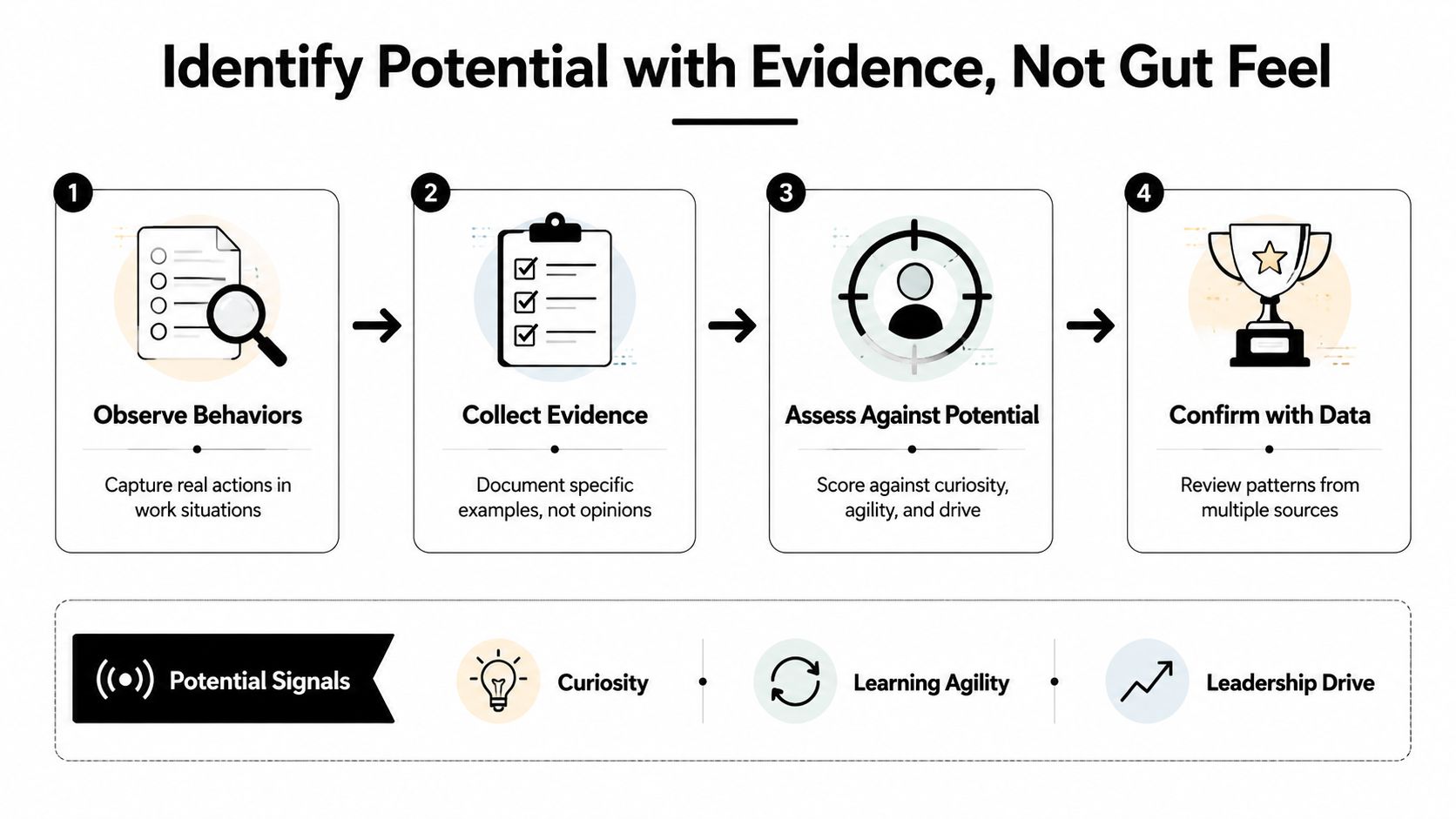
Potential isn't charisma, confidence, or similarity to the current leadership team. A more useful definition treats it as a learnable combination of curiosity, learning agility, leadership presence, and results-through-others. Each signal should appear in work artifacts, decisions, feedback, and observed behavior. Personality data can add context, but it shouldn't carry the decision alone.
The evidence standard is important because practical skills are about five times more predictive of actual job performance than many other common selection inputs, according to a Harvard behavioral-science review ([Harvard behavioral-science review](https://www.hks.harvard.edu/sites/default/files/centers/wappp/921046-PDF-ENG.pdf)). That supports structured, role-specific assessment rather than informal impressions. Teams designing a broader attraction and selection system may also find this [attract top talent guide for 2026](https://benely.com/how-to-attract-top-talent/) useful as a companion resource.
Build a three-input assessment
Use three distinct evidence streams, each scored against a shared rubric.
1. Structured behavioral interview: Ask for STAR examples tied to the four markers. Probe what the person did, what changed because of their actions, how they handled resistance, and what they learned. 2. Multisource feedback: Gather perspectives from the manager, peers, and at least one cross-functional stakeholder. Look for patterns across contexts, not a single favorable or unfavorable comment. 3. Business case or simulation: Give the candidate a live organizational problem. Score the quality of diagnosis, prioritization, decision logic, stakeholder management, and follow-through.
A calibration panel should debate evidence, surface inconsistent standards, and force-rank candidates using a 9-box that maps performance against readiness. It shouldn't map potential against likability. Structured processes also work best when final decisions use aggregated scores or data, with decision-makers included who weren't involved in the original assessment, as recommended by [CIPD guidance on structured recruitment and selection](https://www.cipd.org/globalassets/media/knowledge/knowledge-hub/reports/a-head-for-hiring_2015-behavioural-science-of-recruitment-and-selection_tcm18-9557.pdf).
| Signal | Ready now | Ready in 1 to 2 years | |---|---|---| | Curiosity | Reframes unfamiliar problems and seeks relevant evidence | Consistently explores beyond assigned work | | Learning agility | Applies feedback quickly in a high-stakes context | Turns feedback into visible behavior change | | Leadership presence | Creates clarity and commitment across stakeholders | Influences effectively without formal authority | | Results through others | Delivers outcomes through delegation and coaching | Begins scaling impact beyond personal execution |
Run anti-bias checks before finalizing the slate. Ask whether access to visible assignments distorted the evidence, whether the panel used the same threshold for different candidates, and whether a manager's advocacy replaced proof. No one should enter a succession slate without two independent evidence inputs. Teams looking for a more detailed process can pair this model with [how to identify high-potential employees](https://synopsix.ai/blog/how-to-identify-high-potential-employees).
Design a Development Pathway That Builds Real Readiness
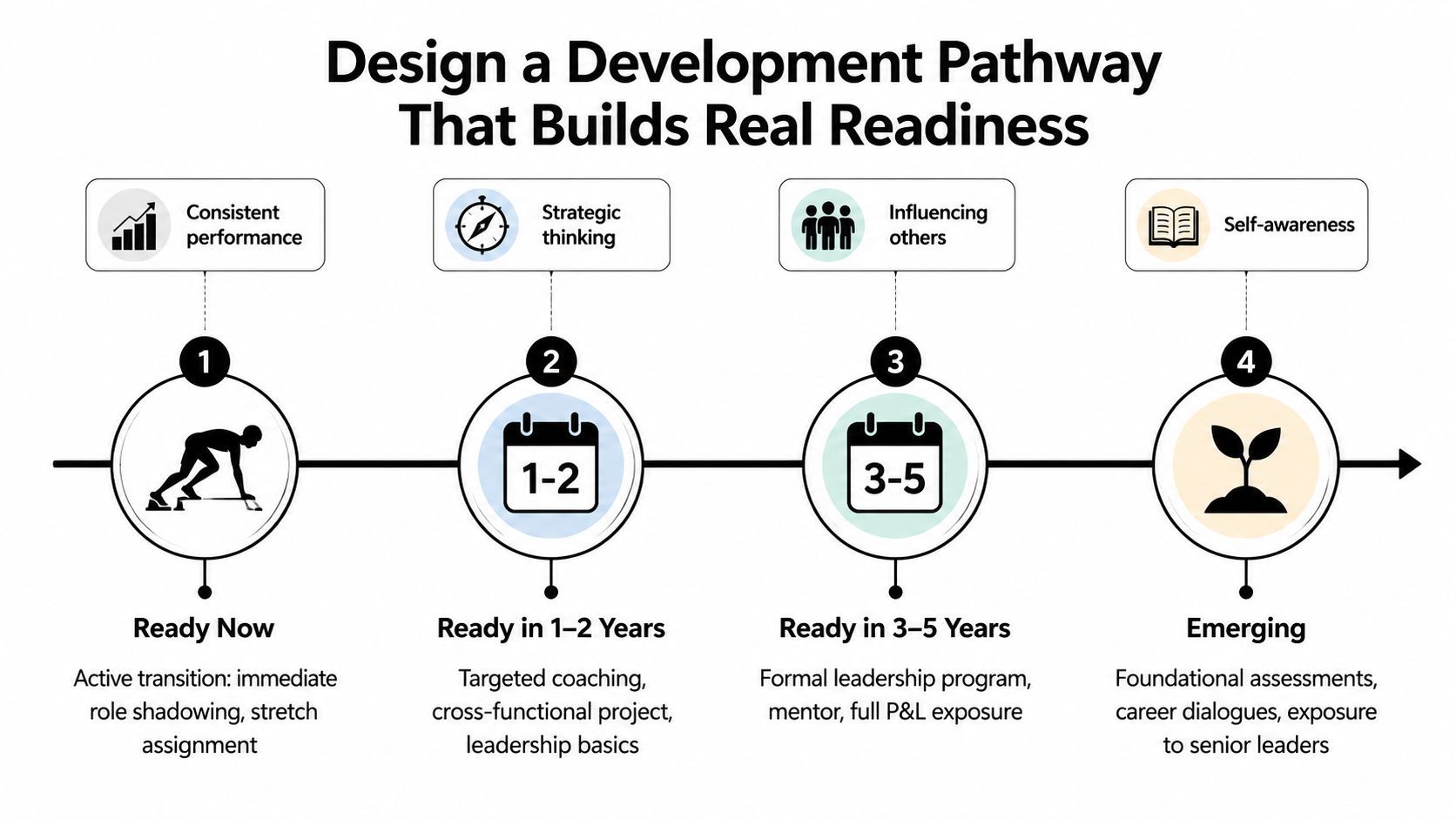
A course catalog doesn't create readiness. Development should place people in situations that resemble the target role's hardest work, then capture evidence about how they respond. The pathway should distinguish four stages: Ready Now, Ready in 1 to 2 Years, Ready in 3 to 5 Years, and Emerging.
Each stage needs a different intensity of exposure. A Ready Now candidate may need role shadowing, transition planning, and immediate decision practice. An Emerging candidate may need foundational assessment, career dialogue, and exposure to senior leaders before receiving broader accountability.
Make the 12-month pathway concrete
Every participant should receive a written plan containing four components:
The timing should create momentum without turning the plan into administration. Diagnose gaps in month one, launch the assignment by month three, run a midpoint simulation in month six, and certify readiness at month twelve through a competency evidence file. That file should contain decisions, outcomes, feedback, simulation scores, and the candidate's reflection on what changed.
The most useful curricula connect learning to work rather than treating training as a separate event. For ideas on structuring that experience, see this resource on [curricula design from Pauline Vuyelwa Muswere-Enagbonma](https://paulinevmuswere.com/workforce-training-and-development/).
<iframe width="100%" style="aspect-ratio: 16 / 9;" src="https://www.youtube.com/embed/BTWyKKWZul4" frameborder="0" allow="autoplay; encrypted-media" allowfullscreen></iframe>
A development review should ask one direct question: What new evidence would justify moving this person to the next readiness stage? If the answer is another course, the pathway is probably too weak. Additional planning guidance is available in [leadership development planning](https://synopsix.ai/blog/leadership-development-planning), but the operating principle remains simple. Development and promotion decisions must rely on the same behavioral evidence.
Keep the Pipeline Fluid and Tied to Promotion
The heir-apparent model feels decisive because it gives senior leaders a name. It also creates avoidable risk. One favored successor can narrow the slate, discourage other talent, and make managers interpret development as confirmation rather than investigation. A fluid pipeline preserves choice while making readiness visible.
Every critical role should have at least three ready or developing successors, with at least one candidate from a different function, geography, or demographic segment. This isn't a quota for promotion. It's a design check against homogeneity and groupthink. If a slate falls below three after a promotion, departure, or reorganization, the business owner should provide a written explanation and recovery plan.
Separate readiness from promotion
Readiness is one input into a promotion decision. Business need, sustained performance, role availability, team capacity, and the candidate's willingness to move also matter. A person can be ready for a role without receiving it immediately, while another person may be promoted because the business need is urgent and the evidence supports a calculated decision.
Refresh lists every 12 months, then update them after any material event. A candidate's status should change when new project evidence changes the assessment, not only when the annual talent cycle arrives. Best-practice succession systems emphasize development opportunities, linchpin positions, transparency, regular measurement, and flexibility rather than rigid slates ([classic succession-management synthesis](https://citeseerx.ist.psu.edu/document?repid=rep1&type=pdf&doi=f60b00f8966561a3bde84ac20cb068f42f486189)).
| Practice | Heir-Apparent Model | Fluid Pipeline Model | |---|---|---| | Slate design | One favored name | Multiple successors across readiness stages | | Evidence | Manager advocacy and reputation | Recent work, feedback, and simulations | | Refresh cycle | Annual or informal | Annual plus event-driven updates | | Diversity of options | Often narrow | Includes cross-functional and underrepresented talent | | Promotion link | Label implies entitlement | Readiness informs a broader business decision | | Override | Rarely documented | Business case and executive sign-off required |
Watch for stagnant pipelines where the same names appear for more than three cycles, candidates receive no meaningful assignments, cross-functional talent never enters discussion, or managers can't explain why readiness ratings changed. Those are signs that the process is preserving comfort, not building supply.
Governance, Reviews, and the KPIs That Matter
Without governance, a leadership pipeline becomes a slide deck that HR updates before a meeting. Establish a Talent Council with the CEO, CHRO, and top business leaders. The council should meet quarterly and review one standardized page for every critical role, with explicit owners and escalation decisions.
The review should focus on exceptions, not recite every name. Escalate a critical role with a Ready Now bench below two, a slate with zero cross-functional successors, or any involuntary departure in a critical role. Those triggers turn succession from a reporting exercise into a continuity mechanism.
Use a small, decision-ready scorecard
Five core KPIs provide a practical starting point:
Track leading indicators such as stretch-assignment completion and assessment-center pass rates alongside lagging indicators such as regrettable turnover in critical roles. A high completion rate means little if candidates don't become more capable. Conversely, a disappointing internal fill rate may reflect a sensible external hire rather than a failed program, so the council must examine role context.
| KPI | What It Tracks | Target Benchmark | Review Cadence | |---|---|---|---| | Bench strength index | Readiness across critical roles | Set against the organization's baseline and role risk | Quarterly | | Successor diversity ratio | Breadth of the slate | No critical slate with zero cross-functional successors | Quarterly | | Time to fill | Continuity response | Improve relative to the organization's baseline | Quarterly and after vacancies | | Internal fill rate | Internal mobility into critical roles | Set by role family and business strategy | Quarterly | | 18-month post-promotion success rate | Quality of promotion decisions | Establish a baseline before setting a target | At promotion milestones |
Review the scorecard alongside business planning. Heidrick & Struggles has argued that organizations need to extend succession planning deeper into the organization and connect leadership development with promotion and succession decisions ([CEO and Board Confidence Monitor 2025](https://www.heidrick.com/en/insights/leadership-succession-planning/ceo-and-board-confidence-monitor-2025_persistent-concerns-pockets-of-increased-confidence)). That connection is what keeps the pipeline relevant to operating leaders rather than leaving it as an HR sidebar.
Your First 90 Days and What to Measure Next
A useful launch doesn't require a perfect enterprise-wide system. It requires a disciplined starting population, clear evidence standards, and leaders who agree to act on what the data shows.
Days 1 to 30 focus on diagnosis
Inventory critical roles, pull current bench depth by level, and identify where a vacancy would create the greatest strategic exposure. Run two to three strategy-risk workshops with executives, then select an assessment method that matches your talent density and operating context. A small organization may use structured interviews, feedback, and simulations. A complex enterprise may add assessment centers, talent analytics, and role-specific behavioral profiles.
Days 31 to 60 focus on design
Define readiness in observable terms. Build the first calibrated successor slate, document evidence gaps, assign sponsors, and agree on the rules for promotion conversations. Stand up the Talent Council with named owners, review dates, escalation paths, and a standard role profile. Don't wait for every business unit to reach the same maturity. Start with the roles where continuity risk is highest.
Days 61 to 90 focus on activation
Launch development for the top tier, brief managers on how to use readiness ratings without turning them into promises, and publish the first KPI dashboard. For teams evaluating behavioral tools, Synopsix offers assessments and profiles, role-focused intelligence reports, predictive simulations, compatibility analysis, and development guidance that can support a consistent assessment-to-action workflow. Treat it as one option in a broader operating model, not a replacement for manager observation and business judgment.
| Metric | Definition | Day-90 Target | |---|---|---| | Bench strength | Readiness coverage across selected critical roles | Baseline established with named gaps | | Internal fill rate | Critical roles currently filled internally | Baseline established by role family | | Time to readiness | Expected time for each successor to reach the next stage | Readiness dates recorded for every listed successor | | Promotion equity | Distribution of development access and promotion outcomes across relevant talent groups | Review process documented and first disparity check completed |
Use this failure-mode checklist at the end of the first quarter:
A leadership pipeline becomes durable when leaders can answer three questions without opening a presentation: which roles matter most, who could step in, and what evidence would make that decision safer. Start with the highest-risk roles, make the next 90 days visible, and let each review improve the quality of the choices.
---
Synopsix helps organizations turn behavioral assessment into comparable profiles, role-specific intelligence, predictive simulations, and practical development plans for evidence-based leadership pipeline decisions. Visit [Synopsix](https://synopsix.ai) to explore how its people intelligence platform can connect assessment, development, and promotion decisions in one workflow.