Business Acumen Assessment: How to Read and Use Results
By Synopsix · November 9, 2026 · 14 min read
A resume can claim strong business sense in three words. It can't show whether someone protects margin when a customer demands a discount, spots a cash problem before it bites, or chooses well when two good options compete for the same budget. That's the gap a well built assessment fills, and it's also where weak tools mislead. A vocabulary quiz feels rigorous, yet it mostly proves someone has heard the terms.
What a Business Acumen Assessment Measures
Only 30% of individual contributors had achieved mastery across the measured professional skill domains in the [American Management Association Total Professional survey](https://www.amanet.org/assets/1/6/striving-for-excellence.pdf). That survey covered more than 2,000 professionals across over 20 industries and all organizational levels, using a 35-item self-assessment covering business acumen, analytical intelligence, relationship management, and professional effectiveness.
The more useful finding sits next to it. Many leaders rated their capabilities as very good or excellent while still identifying notable weaknesses in specific business acumen and analytical skills. Confidence and seniority, in other words, don't reliably signal mastery.

A plain definition
A business acumen assessment measures how well a person reads a commercial situation and makes sound decisions about money, customers, operations, and strategy. It's not a test of whether someone sounds businesslike in an interview. It's evidence about judgment you can observe and score.
A structured business acumen assessment should examine several capabilities separately, because a person can be strong in one and exposed in another.
That separation matters when you later [evaluate decision making in a specific role](https://synopsix.ai/blog/decision-making-evaluation), rather than rating general sharpness.
> Practical rule: Before you look at any tool, write down the three capabilities that matter most in the role you're filling.
If you can't name them, you can't judge whether a score means anything. Start there, in plain business language, and let the tool earn its place against your list.
Assessment Types and When Each Fits
Different formats answer different questions, and mixing them up is the commonest buying mistake.
| Format | What It Measures | Best Use | Main Strength | Main Limit | |---|---|---|---|---| | Knowledge quiz | Financial and market terminology, calculations | Early screening | Quick to score and compare | Rewards memorization, weak predictor of judgment | | Self-report survey | Perceived skill and confidence | Development conversations | Fast and inexpensive | Tends to overstate ability | | Scenario judgment test | Decisions under ambiguity and trade-offs | Hiring and promotion shortlists | Tests application, not vocabulary | Needs a clear scoring rubric to be consistent | | Work sample or simulation | Performance on realistic business tasks | Final-stage selection and leadership roles | Closest to the actual job | Costly to design and run | | Behavioral profile | Tendencies such as risk appetite and stakeholder style | Team design and coaching | Adds context to other results | Shows likely behavior, not a verdict on performance |
Why one format is not enough
The [OECD/INFE framework described in a South African competency study](https://open.uct.ac.za/items/a9de491f-94cf-493f-8c94-2440c2ce8012/full) separates financial literacy into knowledge, behavior, and attitudes, and applies those dimensions to business owners and managers. That study built its framework and survey instrument with expert input and pilot testing, then used empirical data from 123 entrepreneurs to evaluate reliability and validity.
The logic is practical. Knowledge lets someone recognize financial drivers. Behavior shows whether they apply that knowledge. Attitudes shape risk, planning, and control decisions.
So a sound business acumen assessment mixes formats on purpose. Quizzes check whether someone can interpret contribution margin, cash flow, working-capital effects, and investment trade-offs. Scenarios show how they act under uncertainty. Behavioral profiles capture attitudes such as risk tolerance and planning discipline.
Score those dimensions separately. A candidate who can define gross margin but can't explain how discounting changes contribution, cash conversion, or capacity economics shouldn't receive a high overall score. Defining a term and using it under pressure are different skills, and collapsing them into one number hides exactly what you need to see.
Match the format to the decision you're making. Screening needs speed and comparability. Promotion needs evidence of judgment at the next level. Development needs specific gaps a coach can work on.
How Psychometric Scores Are Built and Checked
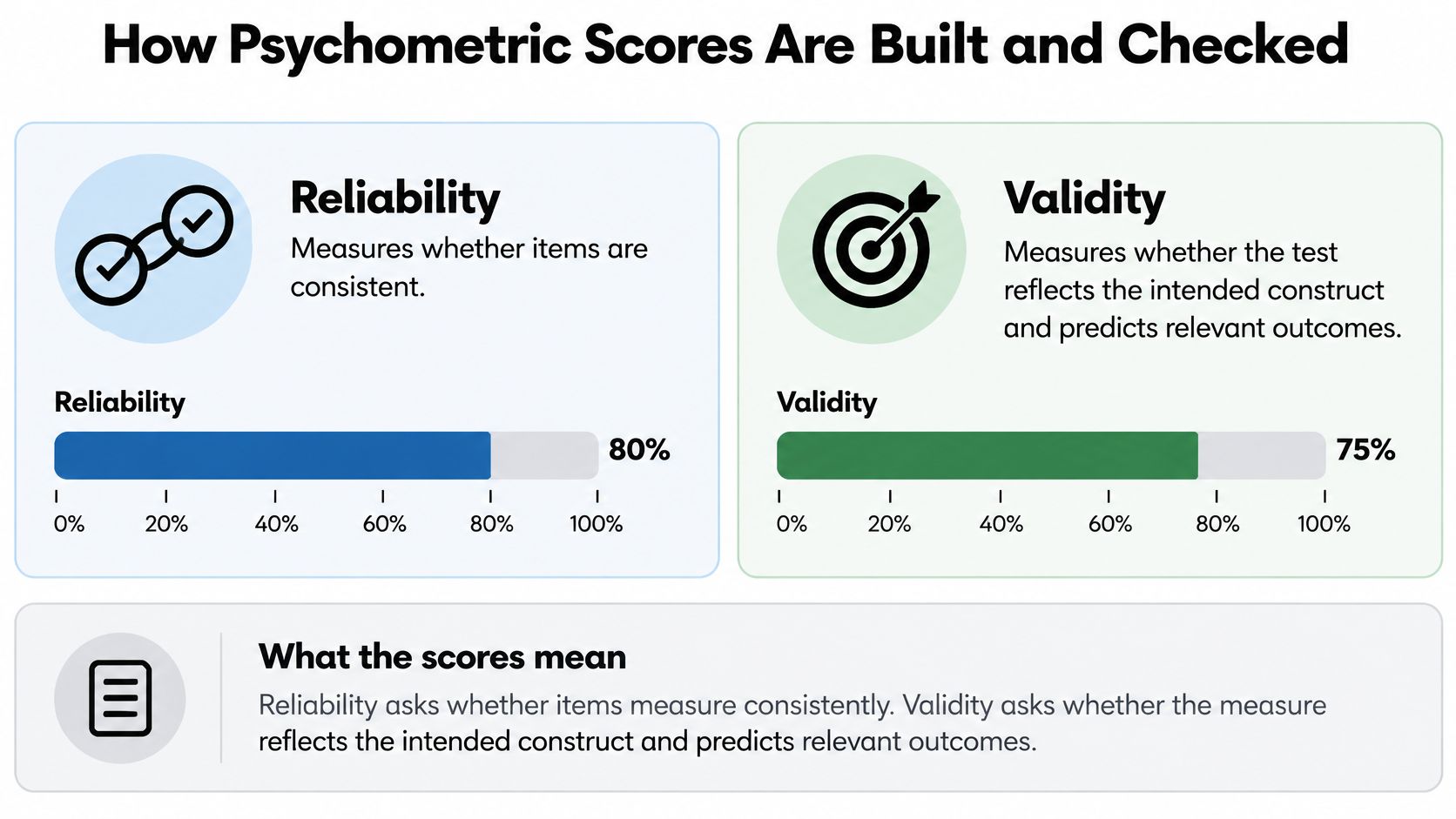
Two properties decide whether a score deserves your trust.
A test can be reliable and still measure the wrong thing. It can also aim at the right thing and measure it so loosely that scores wobble. You need both, which is why [assessment validity and reliability](https://synopsix.ai/blog/assessment-validity-and-reliability) should be checked together.
What the checks look like
A [2025 study of business acumen and financial performance](https://www.mdpi.com/1911-8074/18/9/492) modeled acumen across strategy, organization, information, process, and culture, then used confirmatory factor analysis to test unidimensionality, reliability, convergent validity, and discriminant validity. Its reported values cleared the commonly used thresholds of 0.70 for composite reliability and 0.50 for average variance extracted.
| Construct | Composite reliability | AVE | Result against thresholds | |---|---|---|---| | Acumen awareness | 0.922 | 0.708 | Meets 0.70 and 0.50 | | Accounting knowledge | 0.949 | 0.639 | Meets 0.70 and 0.50 | | Financial performance | 0.710 | 0.561 | Meets 0.70 and 0.50, narrowly on reliability |
Read that last row carefully. Passing narrowly is still passing, but it tells you where measurement is thinnest.
The build sequence behind numbers like these is unglamorous. Link each item to one competency in a blueprint. Pilot items across relevant roles and markets. Estimate internal consistency. Then check results against outcomes such as forecast accuracy, margin decisions, project performance, or promotion success.
Benchmarks need the same care. That study discusses a PMI global benchmark of 2,841 project professionals, including 2,254 project managers and 587 senior leaders, measured across eight skills. A sample that separates levels lets you calibrate by role and decision context instead of applying one universal cutoff.
Ask any provider for its reliability and validity evidence in writing before you rely on a score.
How Well Results Predict Job Performance
Validity here means the strength of the relationship between an assessment result and a later job outcome, expressed on a scale where higher means stronger prediction.
| Method | Reported Validity | Condition | |---|---|---| | Structured interviews | 0.59 | Informal or intuition-based job analysis | | Structured interviews | 0.87 | Formal job analysis | | Situational-judgment tests | 0.29 | Without job analysis | | Situational-judgment tests | 0.38 | Grounded in job analysis | | Assessment centers | 0.37 | Average for overall job performance | | Personality tests | 0.22 | Average across 38 years of research |
A [review of personnel selection research](https://www.sciencedirect.com/topics/social-sciences/personnel-selection) reports that assessment centers have an average validity of 0.37 for predicting overall job performance, and that structured interviews tied to a formal job analysis produced a reported validity of 0.87, compared with 0.59 when the job analysis was informal or based mainly on intuition. Situational-judgment tests showed 0.38 when grounded in job analysis versus 0.29 without that foundation, and a meta-analysis covering 38 years of research found an overall validity of 0.22 for personality tests.
The lesson in the gap
The job analysis drives accuracy more than the test label does. The same interview method performs very differently depending on whether someone first defined the commercial and strategic behaviors the role requires.
Treat these numbers carefully. A validity of 0.37 is useful and incomplete. Most variation in performance still comes from elsewhere, so no single score should decide a hire.
Measuring return without inventing it
1. Define the outcome first: sales performance, promotion success, retention, or quality of strategic decisions. 2. Record a baseline: capture current results before rollout. 3. Compare fairly: assessed versus non-assessed hires or promotions over a full review cycle. 4. Count total cost: assessment fees, manager time, and interview hours. 5. Calculate the return: value of improved decisions minus program cost, divided by program cost.
Name one outcome you'll track before the first business acumen assessment is run. If you choose it afterward, you'll find a flattering one.
Reading a Profile Without Overstating Readiness
In [PMI's 2025 global research](https://www.pmi.org/-/media/pmi/documents/public/pdf/learning/thought-leadership/pulse/pulse_of_the_profession_2025-1.pdf), 66% of project professionals fell into a moderate-acumen category, only 18% demonstrated both high skill proficiency and strong strategic application, and 16% were classified as low-acumen.
That spread is the warning. Knowing business concepts and applying them to a live trade-off are not the same achievement, so quiz scores and self-confidence can overstate job readiness.

What a useful profile contains
Look for strengths, blind spots, decision risks by role, and a note on the quality of evidence behind each claim. A single overall score gives you none of that.
Say a candidate scores high on financial vocabulary and low on prioritization under constraints. A good report says she can read a P&L, but may struggle when two stakeholders want incompatible outcomes. It then recommends a conflict scenario in the final interview, so you test the risk instead of debating it.
Benchmark carefully across functions. Compare each person with role-level benchmarks inside their own function, not with one company-wide average. A supply chain specialist and a key account manager face different commercial contexts, and a shared average penalizes both unfairly.
Careful [assessment interpretation](https://synopsix.ai/blog/assessment-interpretation) also means asking what would change your mind. This short video walks through the reasoning behind that discipline.
<iframe width="100%" style="aspect-ratio: 16 / 9;" src="https://www.youtube.com/embed/zfUdwNXpG1o" frameborder="0" allow="autoplay; encrypted-media" allowfullscreen></iframe>
Ask three questions of any profile. What decision does this predict? What evidence supports it? What result would change my view?
Then write a one-line interpretation for each candidate naming a strength, a risk, and a follow-up question. If you can't write that line, the report hasn't helped you decide.
Role-Specific Uses for HR Leaders
The same business acumen assessment serves different decisions depending on who is holding it.
| Role | Decision | Assessment Focus | Evidence to Check | |---|---|---|---| | CHRO | Leadership pipeline and succession | Strategic judgment and trade-off reasoning | Results linked to promotion and retention outcomes | | Recruiting lead | Shortlisting for a defined role | Role-specific scenarios and knowledge baseline | Score bands calibrated to the role level | | Hiring manager | Final choice between finalists | Team fit and decision style | Profile compared with existing team complementarity | | Commercial head | Account and pipeline roles | Commercial trade-offs and prioritization | Post-hire commercial results | | L&D or OD professional | Development planning | Blind spots and skill gaps | Follow-up assessment after training |
Why one threshold fails
A [meta-analytic study of conscientiousness](https://onlinelibrary.wiley.com/doi/full/10.1111/ijsa.12028) found that conscientiousness was a stronger predictor of performance in highly routinized jobs and a weaker predictor in jobs with high cognitive-ability requirements. The trait didn't change. The job did.
That is a concrete warning against one-size thresholds. The same score carries different decision value for a warehouse supervisor, whose work rewards dependable repetition, than for a strategy director, whose work rewards complex reasoning under ambiguity.
So set bands by role. Test a CFO candidate on capital allocation scenarios, where the cost of a weak trade-off is large and slow to reverse. Test a frontline team manager on daily trade-offs, such as staffing against service targets when someone calls in sick. Test a promotion candidate against the defined next role, not the one she already performs well.
We assess people from C-suite roles such as CEO, CFO, and CHRO and directors through to team managers and frontline roles, and the decision context changes at every level. That's the point. Readiness is always readiness for something specific.
Do not skip the team
Individually strong hires can still create friction. Before deciding, compare a finalist's profile with the existing team's tendencies, especially where two people will share decisions or cover for each other.
> A profile tells you how a person is likely to decide. Only the team context tells you whether that helps or hurts.
Recruiting leads scanning the market can also review current [hiring opportunities for talent leaders](https://wearedistributed.org/jobs/talent-acquisition) to see how employers are framing these decision skills in live role descriptions.
Keep one rule per role. CHROs ask whether scores predict promotion success. Recruiters ask whether bands match the level. Hiring managers ask how this person changes the team. Commercial heads ask whether results show up in accounts. L&D asks what changed after training.
How to Run an Assessment Program Step by Step
Programs fail on sequencing more often than on tool choice. Get the order right.
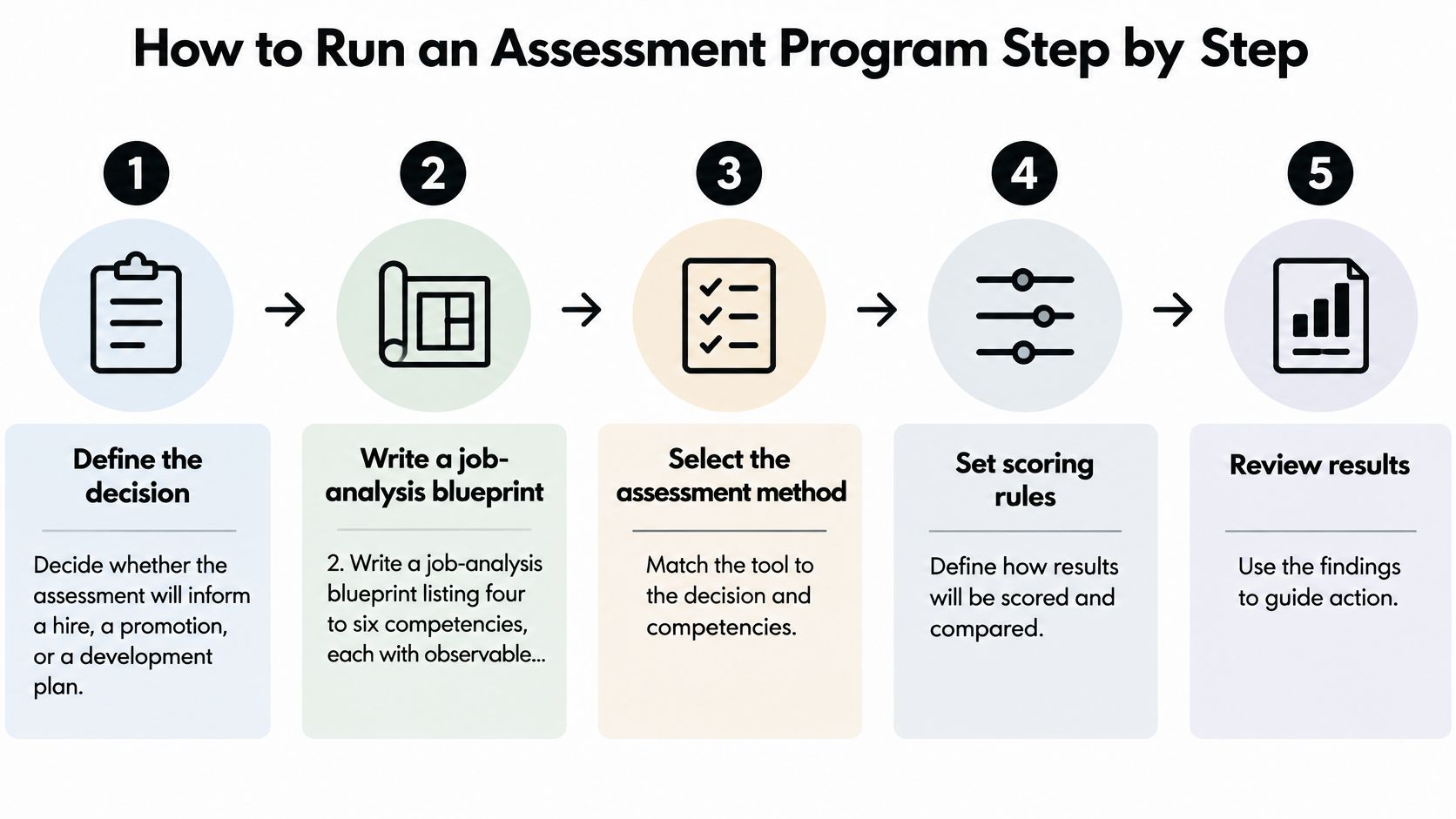
1. Define the decision: a hire, a promotion, or a development plan. Every later choice follows from this one. 2. Write a job-analysis blueprint: list four to six competencies, each with observable behaviors. Vague competencies produce vague items. 3. Match formats to competencies: quizzes for knowledge, scenarios for judgment, simulations for final-stage selection. 4. Pilot the items: run them with a sample across roles and markets, then check internal consistency before anyone's career depends on them. 5. Set benchmarks by role level: one universal cutoff will misclassify specialists and senior hires alike. 6. Train interviewers: teach them to use the report to generate questions, not as a verdict. A profile should start a better conversation. 7. Keep scoring consistent: use the same rubrics for every candidate and offer transparent accommodations, so differences reflect judgment rather than access. 8. Track outcomes and revalidate: follow decision quality, promotion success, and retention, then refresh benchmarks each year.
Three pitfalls to plan for
None of these pitfalls argues against assessing. They argue for designing the program so genuine reasoning is the easiest thing to show.
Choose the Right Assessment Before Your Next Decision
Make three choices before you use any score. Pick the format, name the outcome you'll track, and decide what evidence you'll require. If a provider can't support all three, you're buying a number rather than a decision aid.
Start with a low-risk trial. Our personal professional assessment is free and takes about 10 minutes, and it includes a full downloadable PDF report that is private and confidential. Use it to see how a profile reads, where it feels specific, and where it feels generic, before you let any profile influence a hiring decision.
Be clear about the boundary. A personal result is for self-insight. It isn't a hiring verdict, and treating it as one would repeat the mistake this article has been warning against.
Then put three questions to any provider.
Write that checklist into your next vendor evaluation before any demo. Demos are persuasive. Checklists are harder to charm.
---
Synopsix turns behavioral assessment into role-specific profiles written in plain business language, so you can see likely strengths, blind spots, and decision risks before you commit to a hire or promotion. Try the free personal assessment first, read your own profile critically, and then judge whether that quality of evidence would improve your next people decision. Visit [Synopsix](https://synopsix.ai) to start.