Business Impact Assessment: A Repeatable Framework
By Synopsix · August 14, 2026 · 14 min read
Most advice on business impact assessment still treats it like an IT recovery exercise. That framing is too narrow. A serious BIA doesn't just ask which server or application fails first, it asks which business processes stop, which people hold the knowledge, where the handoffs break, and how long leadership can tolerate the disruption before the loss becomes unacceptable.
That broader view matters because official guidance already frames BIA around critical processes, interdependencies, and recovery targets such as RTO and acceptable downtime, not just infrastructure inventories [MetricStream guidance on business impact assessment](https://www.metricstream.com/learn/business-impact-assessment.html). In other words, a BIA is supposed to connect operational fragility to business consequences. If it leaves out people risk, it leaves out a major part of the business.
Why Most Business Impact Assessments Miss the People Factor
The most common mistake is assuming the BIA belongs to IT, operations, or continuity teams alone. That's convenient, but it misses how often disruption starts with a person, not a system. A key manager leaves, a specialist is absent, onboarding drags, or one team holds too much process knowledge, and the whole workflow slows before anyone touches the recovery plan.
People dependency is a business continuity issue
A technically sound business impact assessment is supposed to identify acceptable versus unacceptable downtime for each function and resource, then turn that tolerance into recovery priorities CMS BIA process and template. That's where the people factor belongs. If only one analyst knows how to reconcile a revenue-critical process, the dependency isn't the spreadsheet, it's the person.
Traditional BIAs go stale. They map a process as if the team behind it is static, but organizations aren't static. Roles shift, leaders change, teams merge, and specialized work gets concentrated into fewer hands. A strong assessment has to capture that reality instead of pretending the org chart is fixed.
A useful test is simple. If you replaced the named owner of a process with a capable new hire tomorrow, would the process still move at the same speed? If the answer is no, the BIA has a people-risk gap. For teams working on morale and retention as part of continuity, [improve workplace morale](https://www.virtustant.com/blog/employee-morale) is worth reading because sentiment, trust, and friction often show up before hard attrition does.
> Practical rule: if a process depends on one person's memory, judgment, or informal workaround, that process has a hidden resilience cost.
The broader point is that BIA is not a document about equipment. It's a decision tool about fragility. Once leadership sees that, talent planning, succession, and cross-training stop looking like separate HR topics and start looking like continuity controls.
Core Components of a Rigorous Business Impact Assessment
A rigorous BIA starts by naming what the business cannot afford to lose, then tracing what breaks when those functions are interrupted. The strongest assessments look at interdependencies across people, applications, infrastructure, suppliers, and recovery resources, because one weak link can slow or stop the end-to-end process. That is what separates a useful assessment from a simple risk list.
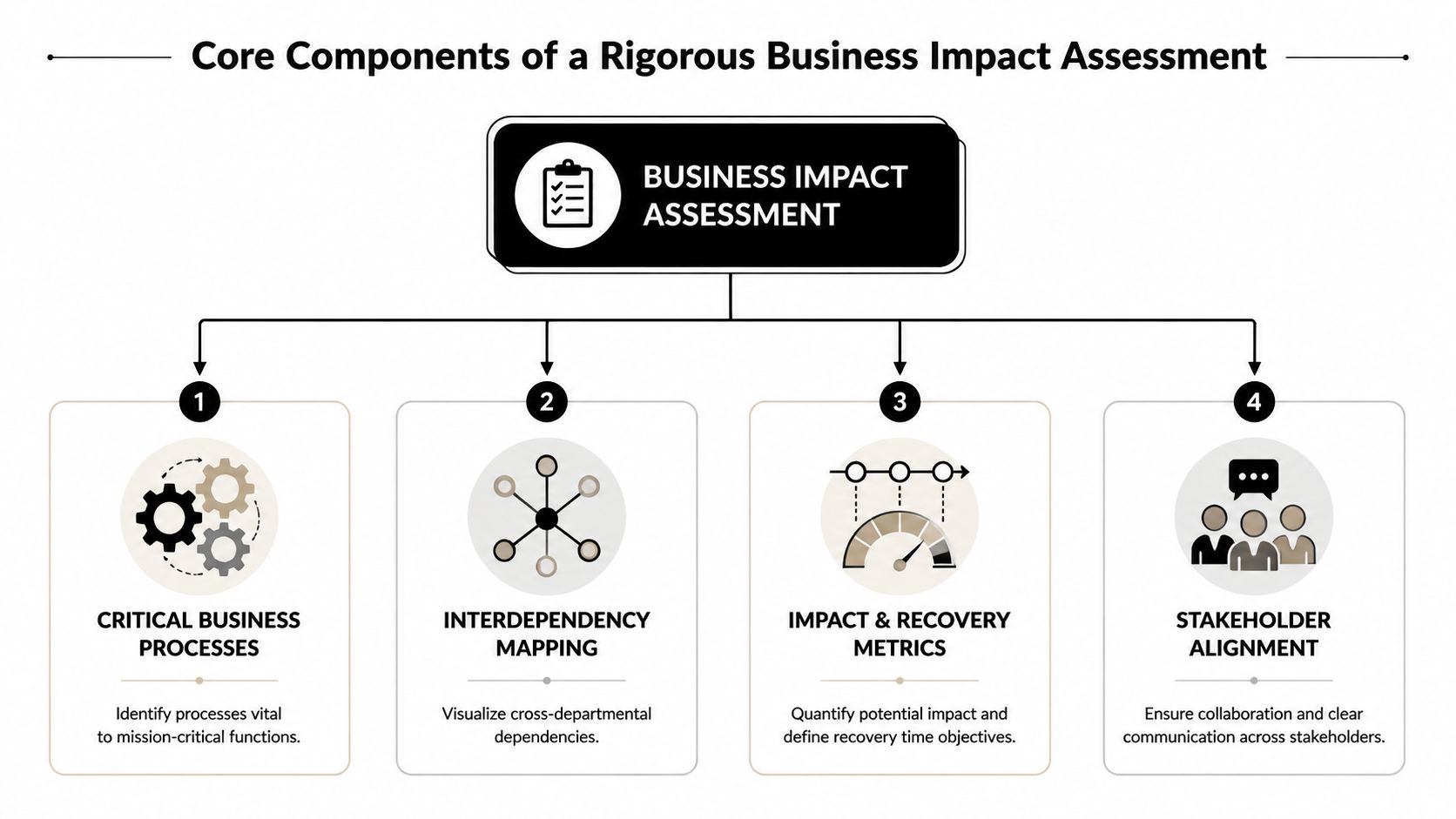
What each core component does
The first component is critical business processes. These are the activities the organization must keep running, or restore first, because they sustain mission-critical work. A sales operation, for example, may not fail because the CRM is down. It may fail because the quoting owner, legal reviewer, and finance approver are no longer moving together.
The second component is interdependency mapping. This component traces people, systems, vendors, and recovery resources together instead of assessing them in isolation. NIST's risk prioritization guidance treats BIA as a way to connect threats to mission and business consequences, which means the analysis is about consequences, not just hazards [NIST IR 8286D](https://nvlpubs.nist.gov/nistpubs/ir/2025/NIST.IR.8286D-upd1.pdf).
The third component is impact and recovery metrics. A business impact assessment should quantify downtime tolerance, then use that threshold to set recovery objectives and prioritize restoration CMS BIA template. That turns operational judgment into decisions teams can act on, especially when leaders are weighing process risk against people risk.
The fourth component is stakeholder alignment. A BIA only works when leaders can read the findings and make trade-offs. If the report cannot tell them which function needs attention first, it is not useful in practice.
> The best BIA outputs are boring in the right way. They show priority, dependency, and tolerance without making managers decode jargon.
For teams comparing process risk with talent risk, [avoid costly AI mistakes](https://www.cyndra.ai/blog/ai-readiness-assessment) is a useful adjacent read because it reinforces a point many organizations miss, bad inputs produce confident but useless outputs. A BIA has the same problem when people data is guessed instead of measured.
A Repeatable Workflow for Running Your Assessment
A workable BIA process doesn't start with a template, it starts with scope. Practical guidance consistently follows the same sequence, scope the assessment, identify critical business processes, assess impact across time frames, define continuity metrics like tolerable downtime and recovery needs, then report and validate the findings with decision-makers BOC Group workflow. That sequence is simple enough to repeat and strict enough to keep the work from sprawling.
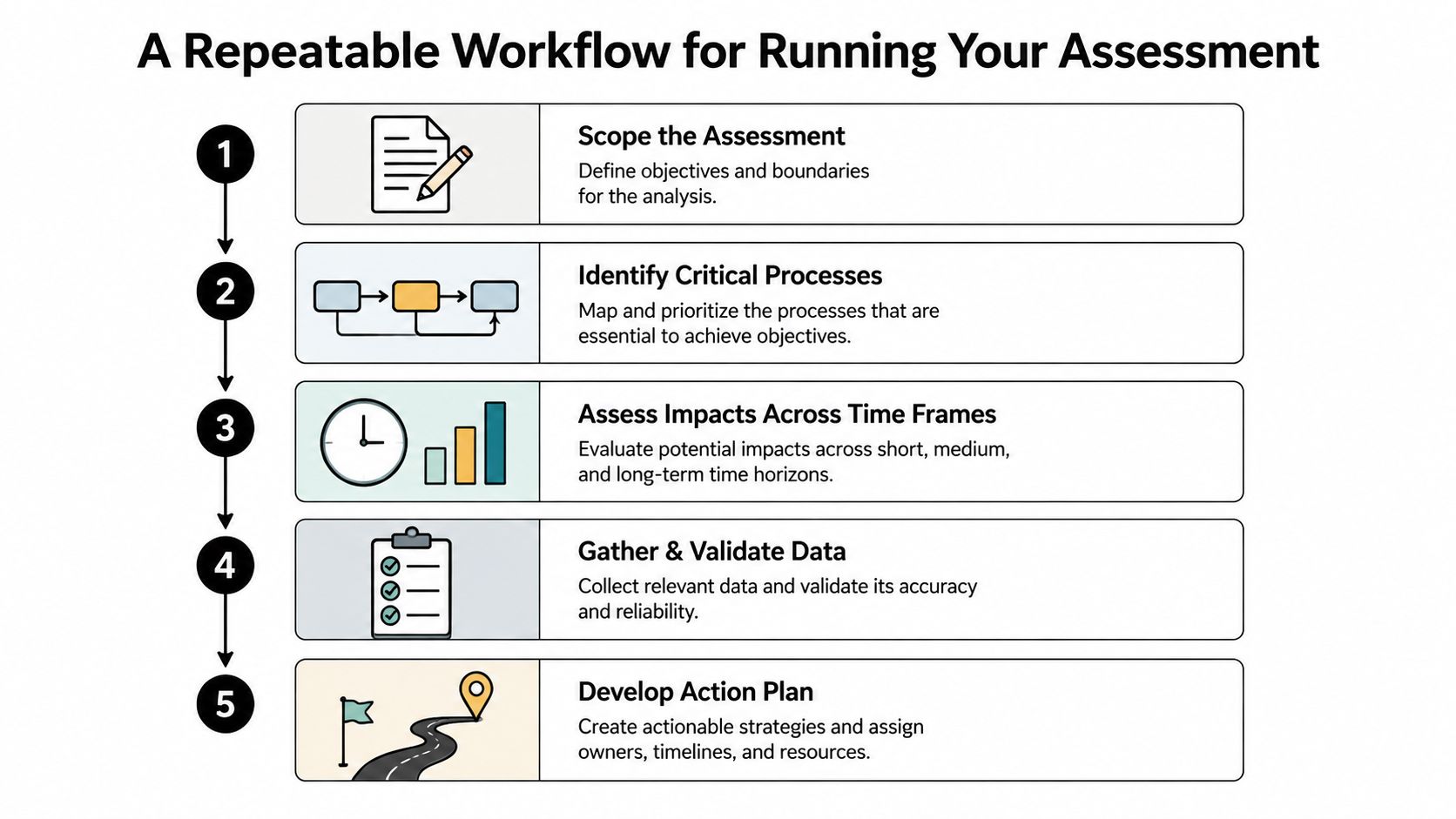
Step 1 define the boundary
Start by choosing the functions, teams, locations, or service lines you're assessing. Don't boil the ocean. A narrow scope produces sharper answers, especially when the organization is changing quickly.
Step 2 identify the critical processes
Then list the processes that sustain the business. Keep the focus on what the business cannot afford to lose for long, not on every task people happen to perform. The goal is priority, not completeness for its own sake.
Step 3 assess impact across time frames
Now ask what happens after short, medium, and longer interruptions. A process might survive a short outage but become unworkable later when people, suppliers, or customers start compounding the delay. That's where downtime tolerance becomes visible.
Step 4 validate with the people who own the work
The findings need review from the managers and specialists who run the process. They know the informal handoffs, the hidden dependencies, and the workarounds that don't show up in system diagrams. If you skip this, the BIA becomes tidy but inaccurate.
Step 5 refresh when the business changes
Re-run the assessment after restructures, new systems, or growth events. Public guidance still tends to frame BIA as periodic planning, but business change doesn't wait for annual cycles [Ready.gov planning and impact analysis](https://www.ready.gov/business/planning/impact-analysis). A BIA that sits unchanged through a merger, platform rollout, or team redesign stops reflecting reality very quickly.
<iframe width="100%" style="aspect-ratio: 16 / 9;" src="https://www.youtube.com/embed/s7XUgYxVpaM" frameborder="0" allow="autoplay; encrypted-media" allowfullscreen></iframe>
The practical habit that helps most is versioning the assessment like a living operating document. When a process owner changes, a key supplier changes, or a team loses a specialized role, that's not a footnote. It's a trigger to reassess recovery priorities.
Quantifying People Risk with Behavioral Intelligence
People risk becomes manageable when it's measured in the same language as operational risk. That means translating key-person dependency, role concentration, absenteeism, onboarding friction, and knowledge drain into comparable inputs a leadership team can use. Without that translation, HR sees the issue, but the BIA can't rank it against other business impacts.
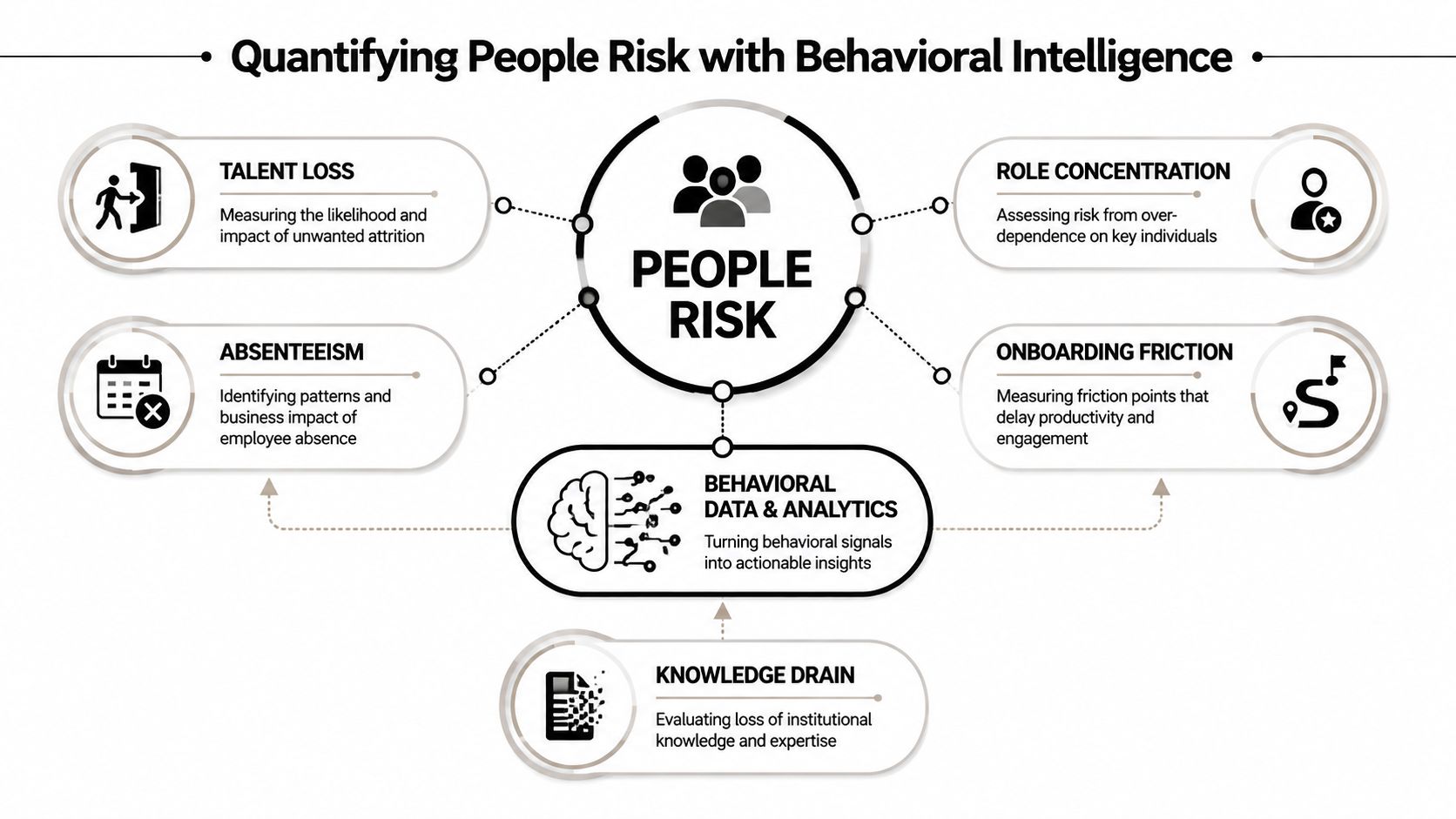
What behavioral data adds
Behavioral intelligence helps distinguish between a role that looks filled and a role that's resilient. Two people may both hold the same title, but one may carry the customer relationship, one may hold the informal process memory, and one may have the influence needed to keep the workflow moving. Those differences matter in a BIA because they change the recovery order.
The strongest use case is not abstract psychometrics. It's decision support. When behavioral profiles are comparable, leadership can see which roles need deeper succession coverage, where team tension could slow recovery, and where onboarding friction could extend downtime after a departure. That's the missing layer in many BIAs, because they count headcount without measuring how the team works.
Synopsix reports 40% faster hiring decisions, 60% fewer mis-hires, and over 50,000 behavioral profiles generated with claimed 98% assessment accuracy. Those figures matter here because they point to a faster way to build the people inputs a BIA needs, not just the process map [Synopsix talent intelligence overview](https://synopsix.ai/blog/what-is-talent-intelligence). Used well, that kind of people intelligence gives CHROs a sharper way to compare roles with different continuity profiles.
The right integration point is the impact register, not a separate HR appendix. For example, role-fit scores can inform replacement speed, team complementarity can show where one departure creates a coordination gap, and predictive simulations can flag where handoff friction is likely to slow restoration. That makes people risk measurable instead of anecdotal.
> If the leadership team can't compare people risk across functions, it will overfund the loudest problem and underfund the riskiest one.
A BIA that includes behavioral data doesn't replace judgment. It gives judgment better inputs. That's the difference between saying a role is important and showing why its disruption would be materially harder to absorb than another role with the same job title.
Real-World Scenarios Where BIA Drives Talent Decisions
A BIA becomes useful the moment it changes a talent decision. In one scenario, a leadership team reviews the assessment and sees that a finance process can survive a short outage, but only if one senior approver is available. Succession planning then shifts toward that role first, because the operational impact is higher than anyone expected from the org chart alone.
Another scenario shows up in team design. A customer operations group looks healthy on paper, yet the BIA reveals a single point of failure in the escalation path. The fix isn't just another hire, it's redistributing ownership so that no one team member holds the only workable route through the process. That's where [succession planning process guidance](https://synopsix.ai/blog/succession-planning-process) becomes relevant, because continuity improves when replacement paths are visible before the disruption hits.
When the BIA changes the hiring plan
A third case is faster hiring. A commercial role has downtime tolerance measured in hours rather than weeks, so the recruiting team adjusts the pipeline, the interview loop, and the onboarding path. The point isn't speed for its own sake, it's matching talent operations to the business's actual tolerance for interruption.
Another use case is development investment. If the BIA shows that several critical functions depend on one manager's judgment, leadership may decide to build bench strength there before opening a new growth initiative. That's a better use of budget than waiting for a vacancy to expose the gap.
The common thread is that BIA findings become useful when they inform priority, not just description. They tell leaders where to put succession depth, where to redesign team handoffs, and where to accelerate readiness. They also give HR a common language with finance, operations, and risk teams.
A BIA used this way stops being a compliance exercise. It becomes an operating model for workforce continuity. And once that shift happens, talent decisions are no longer separate from resilience decisions.
Common Pitfalls That Undermine Assessment Quality
The weakest BIAs fail in familiar ways. Teams treat them as a one-time project, limit the analysis to financial loss, leave out cross-functional dependencies, or hand over a report that leaders cannot use. Each failure is avoidable, but only if the team replaces habit with sharper criteria and makes people risk visible alongside process risk.
The mistakes versus the better move
| Common pitfall | Better approach | | --- | --- | | Treating BIA as a one-time project | Build it into continuous strategic planning, especially after restructures or new systems | | Relying only on process maps | Layer in people, technology, and supplier dependencies | | Using vague impact categories | Apply quantified operational and recovery metrics |
The one-time-project trap creates stale output. If a restructuring shifts ownership or a new platform changes how work moves, the old assessment stops being useful for recovery priorities. Refresh triggers matter more than calendar dates, because the business changes faster than the paperwork.
The map-without-people gap hides fragility. A process map without people, supplier, and recovery-resource context can look complete while missing the critical bottleneck. Technically rigorous disaster recovery guidance stresses interdependence because one broken link can affect the whole chain disaster recovery guidance.pdf).
The vague-category problem makes leadership shrug. If the report only says something is “high impact,” executives still have to guess what that means relative to everything else competing for attention. Clear downtime thresholds and recovery expectations give them something concrete to act on.
A better assessment also catches the people signals that traditional BIAs miss. Key-person dependency, role concentration, and onboarding friction all change recovery speed, yet they are often left out because they are harder to quantify. That is where people-intelligence platforms help, because behavioral data can turn soft concerns into decision-grade inputs instead of afterthoughts.
A good diagnostic question is simple. If a manager reads the BIA and still cannot tell which process gets restored first, the assessment is not finished. It may look polished, but it is not decision-grade.
Templates and Checklists to Launch Your Assessment
Start with four documents, not one. You need a scoping checklist, a stakeholder interview guide, a dependency and recovery template, and a validation checklist for decision-makers. That set keeps the work focused and makes it easier to rerun the assessment later without rebuilding it from scratch.
What to capture in each artifact
For the scope checklist, list the business units, functions, and time horizon you're covering, plus the trigger that justifies the review. For the interview guide, ask process owners which activities stop first, which people are indispensable, which vendors are hard to replace, and what workarounds exist. For the dependency template, record people, applications, suppliers, and recovery resources in the same place so the chain is visible.
The validation checklist should force sign-off on two things, the accuracy of the dependencies and the accuracy of the recovery priorities. If leadership can't challenge or confirm the ranking, the report is too soft to guide action. That's also where people-intelligence inputs fit cleanly, because behavioral profiles, complementarity maps, and simulations belong alongside process and resource data, not off to the side.
For teams that want a structured starting point for the people side, [gap analysis for dental teams](https://www.learniverse.app/blog/gap-analysis-template) is a useful example of how a template can surface capability gaps without making the exercise feel abstract. The same logic applies here, define the gap, document it clearly, and connect it to an operational consequence.
If you need a sample format for development and assessment evidence, the [360 assessment sample](https://synopsix.ai/blog/360-assessment-sample) is a practical reference for how to structure input so leaders can use it. The same principle helps a BIA stay readable instead of turning into a file cabinet.
A good template doesn't create strategy by itself. It makes strategy visible. Once the people risk, process dependency, and recovery threshold are on one page, leadership can make better calls about where resilience investment should go.
---
Synopsix helps CHROs and HR leaders turn behavioral assessments into practical inputs for hiring, team design, and talent development, which makes people risk easier to quantify inside a business impact assessment. If you want to move beyond process maps and see how behavioral data can sharpen continuity planning, visit [Synopsix](https://synopsix.ai) and explore how their platform turns talent signals into decision-ready insight.