Business Strategy Execution: A Step-by-Step Playbook
By Synopsix · October 28, 2026 · 16 min read
Communicate the strategy more clearly is popular advice. It's also incomplete. People can understand the ambition perfectly and still make incompatible decisions because their roles, incentives, capabilities, and handoffs haven't changed.
Business strategy execution means making those operating choices before committing the organization to delivery. A launch meeting won't resolve a pricing dispute, create an absent capability, or tell a manager which work to stop. Leaders have to design those conditions deliberately.
The Six-Phase Execution Playbook at a Glance
In the five-year study described in [Why Strategy Execution Unravels](https://www.prisim.com/wp-content/uploads/2016/08/CLEAN-Why-Strategy-Execution-Unravels.pdf), covering nearly 8,000 managers across more than 250 companies, 40% identified failure to align the organization vertically as the leading execution challenge, while 30% identified poor cross-functional coordination.
That distinction matters. Vertical alignment connects corporate priorities to departmental goals and individual actions. Cross-functional coordination determines whether people can deliver when another department controls something they need.
Treat execution as a sequence of operating decisions, not a communication campaign.
Six execution phases, owners and outputs
| Phase | Question it answers | Accountable owner | Output | Closing checkpoint | |---|---|---|---|---| | Translate | What must be true for the strategy to work? | CEO with strategy lead | Three to five measurable priorities | Priority sign-off | | Assign | Who owns each outcome? | Executive sponsors | Owner and outcome card per priority | Owner acceptance | | Align | Do roles, structure and processes support the priorities? | CHRO with functional heads | Role and decision-rights map | Structure review | | Equip | Do the people involved have the capabilities required? | CHRO and talent team | Capability gap list | Assessment readout | | Measure | Are leading indicators moving as expected? | Strategy office or PMO | Scorecard mixing leading and lagging measures | Monthly review | | Adapt | Should the initiative continue, change or stop? | Executive committee | Decision log with recorded revisions | Quarterly decision gate |
The closing checkpoint is a real approval, not confirmation that somebody uploaded a document. At owner acceptance, the executive should identify the resources and authority they need. At assessment readout, the CHRO should distinguish capabilities already available from those requiring development, hiring, or a different team configuration.
For commercial priorities, Grou's guide to [a unified approach to B2B pipeline](https://grouglobal.com/blog/a-go-to-market-strategy-guide) offers useful context for connecting functions around a shared commercial outcome. Apply that same discipline beyond sales: agree on the result before departments optimize their separate contributions.
> Launch rule: Don't approve a priority solely because its business case is attractive. Approve it when the organization can explain how it will deliver.
The coordination findings point particularly to Assign, Align, and Equip as places to investigate execution breakdowns. For a mid-size organization, those phases deserve explicit attention, not an assumption that existing reporting lines will suffice. Owned priorities, pre-launch people tests, and role-specific actions turn them into practical work.
How to Cascade Strategy into Owned Priorities
A cascade isn't a longer task list. It's a set of commitments connecting an enterprise outcome to the people who can change it.
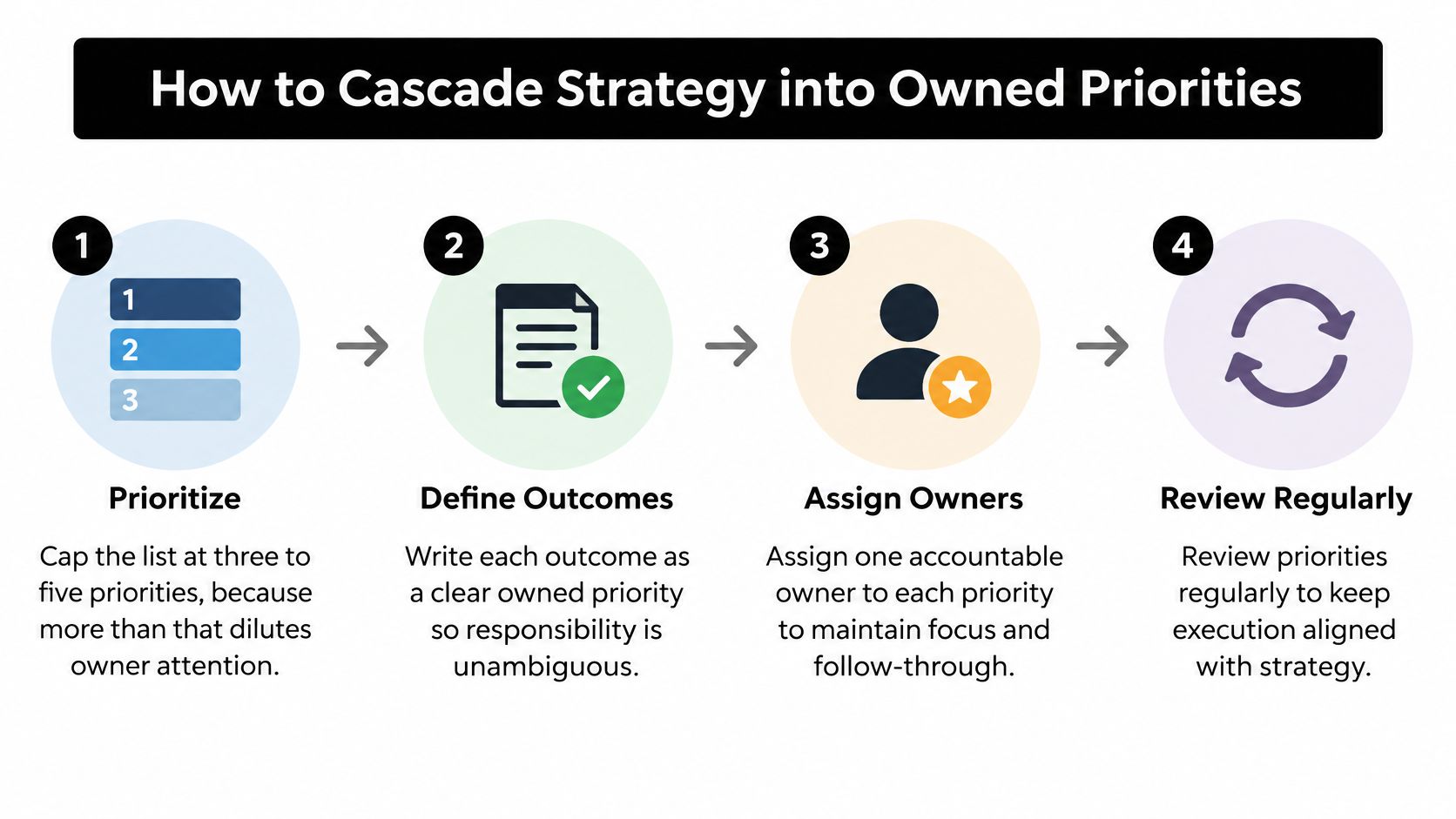
The visual below summarizes the ownership flow before the detailed operating steps.
Build the outcome card
1. Cap the list at three to five priorities. Executive attention is finite, so choose the outcomes that deserve protected capacity. Move worthwhile but secondary projects into the operating backlog rather than calling everything strategic.
2. Write a measurable outcome with a baseline and target date. People need to distinguish progress from motion. Record the current position, desired result, measurement method, and actual calendar deadline before approving the work.
3. Name one accountable executive. A committee can advise, but it can't provide an unambiguous answer when a trade-off needs an owner. Have the executive explicitly accept the outcome rather than merely attend the kickoff.
4. List cross-functional dependencies. Delivery requires other teams to make specific commitments, not express general support. A pricing change, for example, may require finance to validate margin assumptions, sales to change quoting behavior, and legal to approve contract language.
5. Define the required capabilities. Staffing by availability leaves critical work exposed. A partnership push may need negotiation skill; a system migration may need change leadership, process design, and managers who can handle resistance without dismissing it.
6. Pair lagging and leading measures. Revenue, margin, and retention confirm results; qualified pipeline, cycle time, adoption, and decision turnaround help owners intervene earlier. Specify who maintains each measure and what evidence qualifies for inclusion.
7. Set an escalation rule. Agreeing on intervention conditions before results arrive reduces arguments about whether a miss matters. For example, intervene after two consecutive review periods below the agreed leading-indicator threshold.
Keep outcomes stable and tactics adjustable
A [2025 study in Africa's Public Service Delivery and Performance Review](https://apsdpr.org/index.php/apsdpr/article/download/891/1785), based on 153 valid employee responses, found that organizational capability and internal processes significantly improved performance, while rational implementation alone did not. A detailed plan therefore needs operational support, not just approval.
Use [organizational alignment](https://synopsix.ai/blog/organizational-alignment) as a practical test: can each affected team explain what it must do differently, what it needs from others, and which work it will deprioritize? Preserve the outcome definition while allowing controlled changes to staffing, sequencing, and workflow.
For a complementary walkthrough of execution, use the video below.
<iframe width="100%" style="aspect-ratio: 16 / 9;" src="https://www.youtube.com/embed/UhWQFOWDa0E" frameborder="0" allow="autoplay; encrypted-media" allowfullscreen></iframe>
Say a regional retailer launches a supply-chain priority, but store managers never receive ownership of inventory corrections. The warehouse team improves replenishment while stores keep submitting unreliable stock records. In week one, the dependency review would expose the missing store-level owner, allowing the operations executive to assign responsibility before the replenishment work stalls.
Testing People Risk Before the Strategy Launches
Workforce planning often gets attention after a strategy stalls. That is too late to discover that the people assigned to deliver it cannot make the required agreements, handle unfamiliar work, or challenge a flawed assumption. In a [2025 strategic workforce-planning study of 50 U.S. business leaders](https://assets.ctfassets.net/lbgy40h4xfb7/7whPwOEbC5GSB7SluPHQ2x/c23869d90d223346fa9de45046cbd038/resource-research-StrategicWorkforcePlanningInAIEra.pdf), 87% viewed aligning workforce and business strategy, including AI initiatives, as a top need, yet only 29% believed their organizations were good at this type of workforce planning.
Test capability before prescribing training
Start with the capabilities each outcome requires. Assess the leaders and teams against observable demands, such as resolving ambiguity, influencing peers, learning new processes, and making disciplined commercial judgments.
Then identify what is driving any gap. A manager who can implement change but receives conflicting instructions needs clearer direction, not primarily training. An employee who loses compensation by supporting a priority faces an incentive problem. A team without sufficient capacity has a workload problem. Those distinctions matter because each calls for a different intervention.
Use work samples, structured interviews, delivery evidence, and behavioral assessments together. No single profile should decide whether someone is suitable for an execution-critical role.
Test compatibility at the handoff
Examine the working relationship wherever progress depends on collaboration. A fast-moving sales lead and a cautious finance partner can complement each other if they agree on what evidence a pricing exception requires.
Compatibility does not mean similarity. The goal is useful disagreement: differences that improve judgment without preventing a timely handoff. Identify both sides before launch. Where might contrasting approaches catch a weak assumption, and where might they leave a decision unresolved?
> Assess the demands of the work before labeling the person as the problem.
Rehearse the disagreement
Run a scenario in which sales wants a discount and finance rejects the margin exposure. Ask each participant what they would do, what information they need, and who resolves the disagreement if neither changes position.
Watch how they respond, not just what they say. Does someone conceal uncertainty, defer automatically to hierarchy, or escalate before attempting resolution? Set the required change before launch: clarify a boundary, change a pairing, target development, or redesign a role.
People intelligence platforms such as Synopsix offer assessments, team compatibility views, and simulations for these tests. Treat the outputs as inputs to leadership judgment, alongside direct evidence and employee context, rather than as automatic verdicts. Keep sensitive assessment material access-controlled, and use [talent risk management](https://synopsix.ai/blog/talent-risk-management) to connect findings to proportionate actions rather than permanent labels.
Role-Specific Actions for Leaders and Managers
CEO, publish the priorities and owners together. Put the three to five priorities on one page, with the accountable executive beside each outcome. For an insurer moving claims to digital, name the claims director as the owner of cycle time rather than presenting digitization as a shared aspiration.
The CEO also needs to state what won't receive the same attention. If every existing initiative retains its staffing and urgency, functional leaders will make hidden trade-offs that contradict the published plan.
Translate executive intent into working arrangements
CHRO, build the role and decision-rights map. Identify the adjuster, claims-supervisor, IT, and specialist roles the digital claims priority requires. Flag decisions that competing teams both claim, such as authority to change the automated routing rules.
Functional heads, write down the handoffs. Convert the priority into team objectives and obtain agreement from the receiving function. The operations head should confirm the handoff to fraud review before launch, including what constitutes a complete case and who handles exceptions.
Hiring managers, revise the job profile. Add the priority's capabilities to selection criteria instead of copying a generic competency list. For the insurer, a claims-supervisor profile should test coaching through workflow change, not merely familiarity with claims procedures.
> Capacity check: Ask every functional head which existing commitment will move when strategic work starts. An answer of none needs scrutiny.
Make frontline constraints visible
Team leads, hold a 30-minute blocker session. Ask adjusters what would prevent them from using the digital process on a difficult claim, then log the answers without turning the discussion into a defense of the design. Separate missing knowledge from missing access, contradictory instructions, and workflow defects.
Follow up with the person who raised the issue. Otherwise, employees learn that surfacing problems creates discussion but no resolution, and managers lose access to useful operating evidence.
PMO or strategy office, establish the scorecard and decision log. Give the claims director a consistent view of cycle time, adoption, and exceptions, with clear definitions and named metric owners. Record approved changes, their reasons, and the person responsible for implementation.
Keep these first-month actions connected through the same priority identifier. The hiring profile, handoff agreement, blocker log, and scorecard should all identify the digital claims outcome they support. That makes it possible to trace a stalled result to an operating decision rather than request another round of general updates.
Governance Checkpoints and Decision Gates
| Checkpoint | Cadence | Question | Evidence to bring | Decision it triggers | |---|---|---|---|---| | Priority kickoff | Once per priority | Are owners, baselines and capabilities confirmed? | Outcome cards and capability gap list | Launch or hold | | Delivery pulse | Weekly | Are dependencies and blocked decisions moving? | Dependency log and blocked-decision count | Escalate blockers within the week | | Leading-indicator review | Monthly | Are leading measures on threshold? | Pipeline, cycle time, adoption and decision latency | Intervene after two consecutive misses against the agreed threshold, per the escalation rule | | Strategy gate | Quarterly | Does the priority still fit market conditions? | Lagging results and scenario updates | Continue, revise or stop | | Trigger review | When a people signal appears | Is this a capability, motivation or design problem? | Assessment and team data | Targeted development, role change or redesign |
A checkpoint earns its place when it resolves a decision or removes a constraint. If a meeting ends with another request for presentation slides, the team may have added reporting without reducing execution risk.
Apply the agreed escalation rule consistently. Two consecutive misses against the threshold trigger intervention; don't reset the count because the review discussion is uncomfortable. A key leader's departure or conflict blocking a critical dependency may also warrant action before the next scheduled review.
Avoid the speed trap
A global 2025 benchmark of 800 strategy and planning decision-makers found that only 28% said their organizations could adapt quickly to change, according to the [strategy-execution survey findings](https://www.pwc.com/us/en/about-us/newsroom/press-releases/whats-next-for-business-2025.html). The answer is not to speed up every decision. Faster decisions help only when the right people have clear authority and the consequences are understood.
Separate reversible operating choices from decisions with significant financial, customer, or people consequences. Teams can adjust an internal workflow with less scrutiny than a change to customer commitments or specialist oversight. The trade-off is straightforward: tighter controls can slow action, while vague authority can send teams in conflicting directions.
Before accelerating, name the decision-maker, evidence required, consultation boundary, and escalation route. For commercial teams, [designing a GTM operating system](https://h2.studio/blog/gtm-operating-system) connects decision forums to day-to-day execution. Enterprise leaders also need [executive team alignment](https://synopsix.ai/blog/executive-team-alignment) to resolve competing commitments instead of passing unresolved conflicts down to delivery teams. Workforce design and role fit belong in these decisions: a plan can meet its milestones on paper and still stall if key roles or team relationships cannot support the work.
Make the quarterly gate conclusive
At the quarterly gate, the executive committee should record one explicit disposition:
Record the evidence, rejected alternatives, decision owner, and condition for the next review. When revising an initiative, preserve the previous assumptions so the committee can later assess whether the change worked.
Stopping requires operational closure. Release capacity, notify affected teams, and remove obsolete measures from active reporting. Otherwise, employees may keep servicing an initiative leaders consider finished, while the next priority competes for the same people.
Common Pitfalls and How to Fix Them
Introduced by Robert Kaplan and David Norton in 1992, the Balanced Scorecard reportedly reached adoption by 53% of companies in the late 2000s before declining to 29% by the late 2010s, according to Bain & Company surveys discussed in the [academic review of the Balanced Scorecard](https://link.springer.com/article/10.1007/s11846-023-00700-6).
That history doesn't prove why individual organizations stopped using it. It does warn against equating framework adoption with sustained value: a scorecard still needs a connection to actual decisions.
Execution pitfalls, early signals and fixes
| Pitfall | Early signal | Likely cause | Fix | |---|---|---|---| | Scorecard tracks activity | Many green metrics, no change in results | Measures chosen for ease of reporting | Replace two activity measures with one outcome and one leading indicator on the scorecard | | Owner without decision rights | Owner waits for approvals every week | Decision rights never mapped | Complete the role and decision-rights map in the Align phase | | Priorities changed monthly | Teams restart plans every review | No gate or threshold for change | Limit routine changes to the quarterly strategy gate; log exceptional changes | | Plan kept past the evidence | Two or more quarters below threshold, no decision | Escalation rule missing or ignored | Trigger intervention after the agreed miss count and record the disposition | | Unowned dependency | Work stalls between two functions | Cross-functional handoff not in the cascade | Assign one owner to each handoff on the outcome card | | Speed without decision quality | Fast decisions, frequent reversals | Missing data and unclear escalation | Set decision rights and data requirements before accelerating; examine reversals at the trigger review |
Repair the mechanism, not the presentation
For an activity-heavy scorecard, ask what decision each metric enables. Training attendance may be useful administrative information, but it doesn't establish that employees can perform the new workflow. A work sample or exception trend may provide a more actionable signal.
For an unowned handoff, inspect acceptance criteria. Naming somebody doesn't solve the problem if the sending team considers work complete before the receiving team can use it.
Technology programs deserve the same scrutiny. Stimulead's guidance to [fix stalled AI roadmap execution](https://stimulead.com/ai-roadmap/) provides a relevant resource when an AI initiative needs an execution reset rather than another statement of ambition.
Don't respond to every symptom by replacing the owner. First inspect the relevant artifact and checkpoint. A role change may be justified, but it won't repair a process that would obstruct the next person too.
Run Your First Execution Review This Quarter
Set a 90-minute meeting with the CEO, CHRO, owners of the top two priorities, and strategy office. This is a decision meeting, not a presentation of everything currently underway.
Bring four artifacts:
Use the meeting to close open commitments
1. Confirm owners and baselines. Resolve any disagreement about accountability or the starting position before discussing progress. 2. Review the largest unowned handoffs. Ask the receiving function what it needs and record who will provide it. 3. Test one people risk. Use a compatibility check or simulation to examine a likely disagreement, not a comfortable scenario everyone already knows how to handle. 4. Set the trigger rule and gate date. Put the actual quarterly review date in the calendar and confirm who can call an earlier intervention. 5. Record decisions before leaving. Read back the actions, responsible people, and deadlines so nobody leaves with a different interpretation.
If internal assessment capacity is limited, a people intelligence platform such as Synopsix can help produce profiles and team compatibility views quickly. The leadership team still owns the interpretation and decision.
Don't wait for perfect coverage across the portfolio. This week, choose the single priority with the highest people dependency and run the Equip phase on it first. Decide whether to develop capability, change the team arrangement, or hold launch until a critical gap is addressed.
---
Synopsix offers short assessments, team compatibility views, and simulations to inform people decisions before execution problems become delivery failures. Visit [Synopsix](https://synopsix.ai) to explore these inputs for your next priority, while keeping accountability with the leaders responsible for the outcome.