Candidate Assessment Tests for Better Hiring Decisions
By Synopsix · October 22, 2026 · 18 min read
The most popular advice about candidate assessment tests is to replace gut instinct with data. That's incomplete. Replacing an interviewer's hunch with an unexplained score doesn't make hiring evidence-based, it changes where the assumptions hide. Choose an assessment because you can inspect what it measures, how its scores support a particular decision, and what happens when the measurement is wrong.
Why Candidate Assessment Tests Deserve Scrutiny
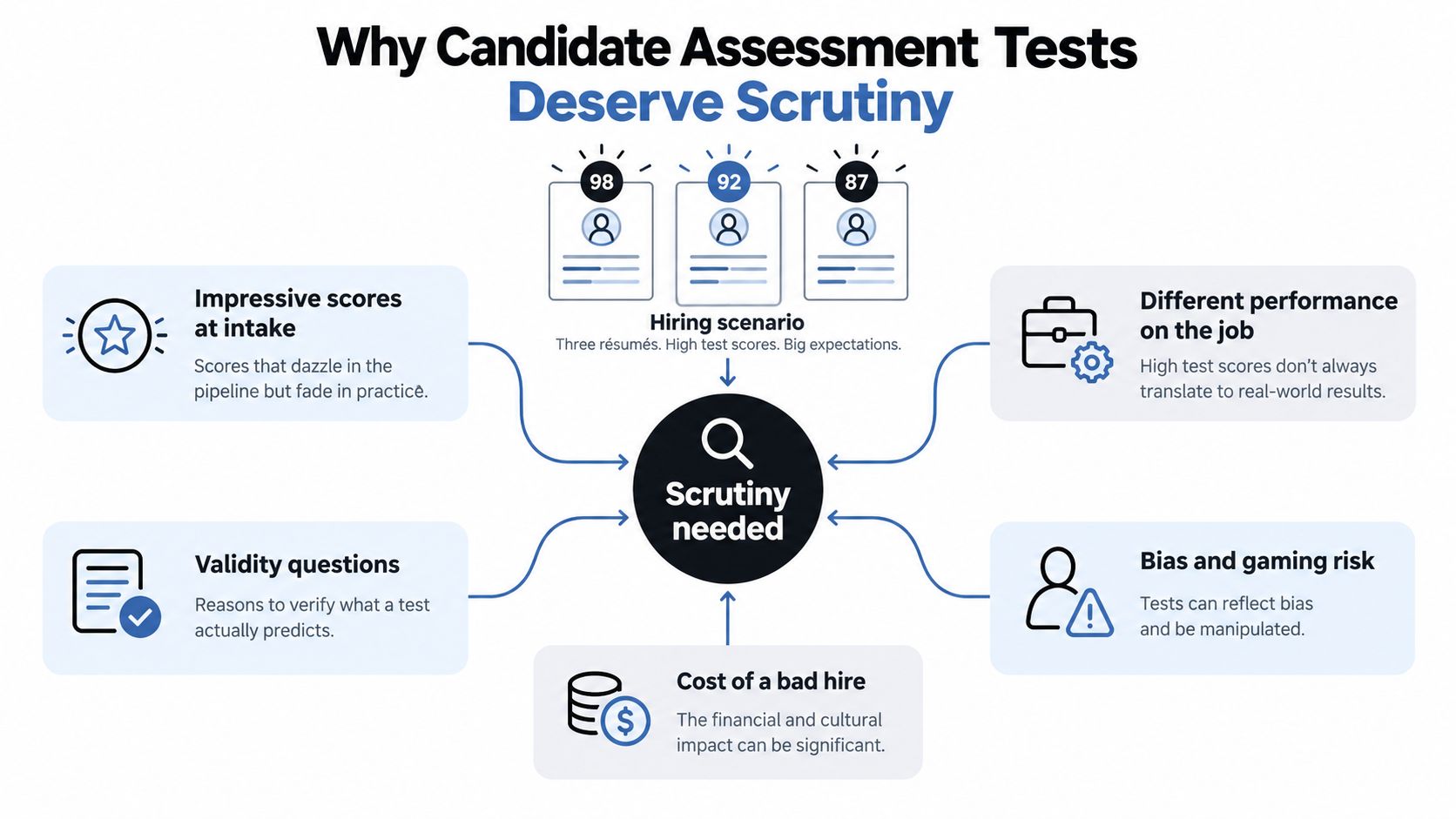
Consider a familiar hiring scenario: applicants arrive with impressive assessment reports, yet perform differently after joining. One handles routine tasks well but struggles with unfamiliar problems. Another needs support initially, then becomes dependable. The intake scores looked comparable, but the hiring team never established what those scores actually meant.
That's an illustrative scenario, not a case study. It exposes the question leaders should ask before procurement: What evidence connects this result to the work we need someone to do?
The diagram highlights why scrutiny belongs before deployment.
Precision isn't proof
A polished report can display precise scores without establishing that the underlying interpretation is justified. Claimed accuracy is especially unhelpful when a provider doesn't identify the outcome, comparison population, or decision being evaluated. An AI label answers none of those questions.
The legal history makes the distinction concrete. After Title VII of the Civil Rights Act of 1964 prohibited employment discrimination based on race, color, religion, sex, and national origin, the EEOC issued testing guidelines in 1966; subsequent developments included Griggs v. Duke Power Co. in 1971 and the 1978 Uniform Guidelines on Employee Selection Procedures, establishing job-relatedness and scrutiny of apparently neutral selection practices as central concerns ([EEOC employment-testing history](https://www.eeoc.gov/history/eeoc-history-1964-1969)).
The assessment decision stack
| Layer | Question | Evidence to request | |---|---|---| | Job relevance | Why measure this? | Essential-function mapping | | Measurement | Can we trust the score? | Reliability and validation documentation | | Fairness | Who encounters barriers? | Subgroup and accessibility reviews | | Interpretation | What decision does it support? | Scoring and decision rules | | Accountability | Who can challenge its use? | Named reviewer and escalation process |
My recommendation is straightforward: evaluate the entire decision stack, not the dashboard. Include evaluator time, candidate support, accommodation administration, and recordkeeping in the purchase decision.
> Practical rule: If the supplier can explain the score more clearly than the employer can explain its hiring use, implementation isn't ready.
What a Candidate Assessment Test Measures
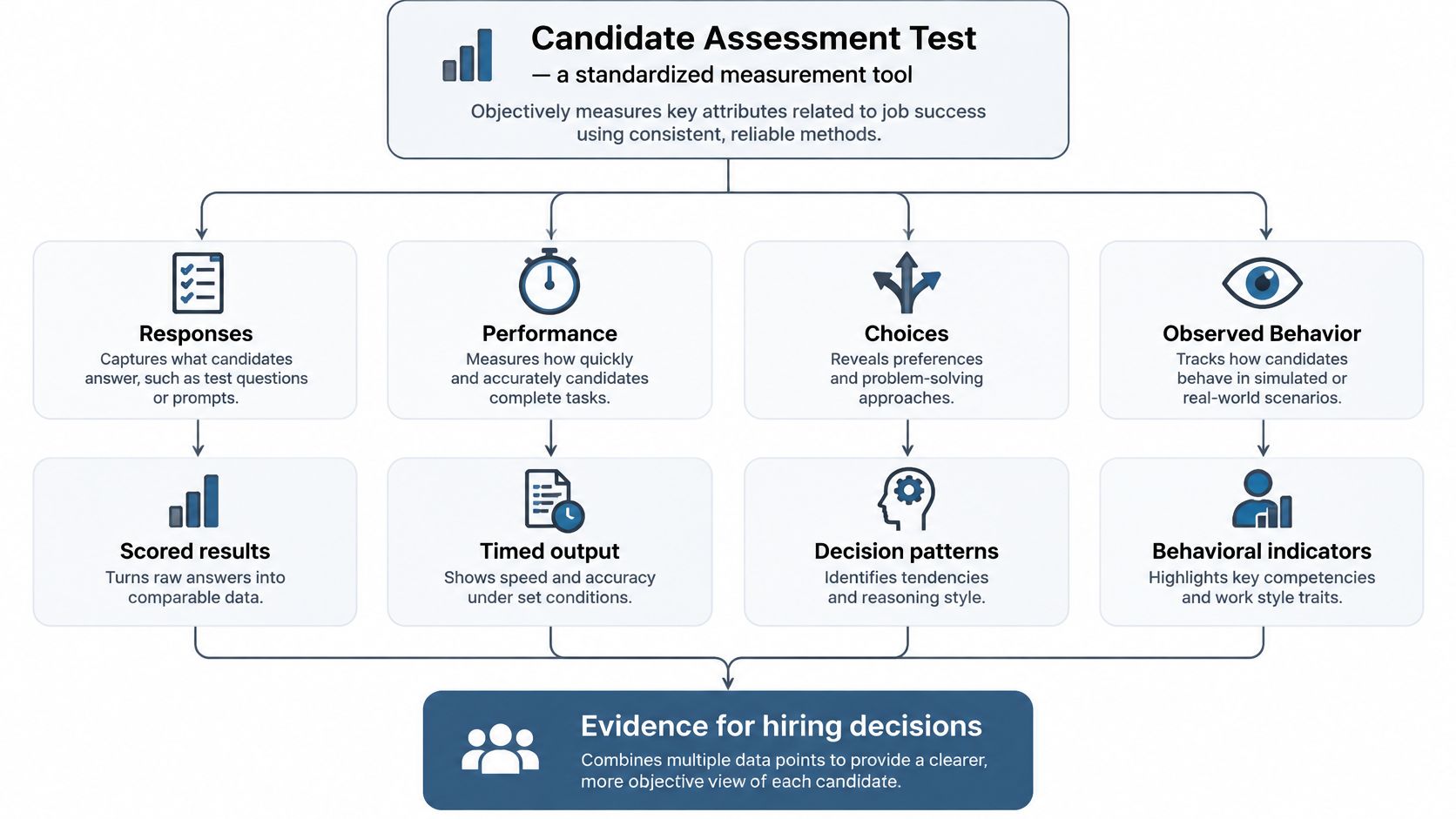
A candidate assessment test is a standardized measurement tool that converts responses, task performance, choices, or observed behavior into evidence about a defined attribute. That attribute might involve reasoning, a technical skill, or a tendency in how someone approaches work.
The score isn't the person. It's an estimate produced under particular conditions, using a particular scoring method, for a particular purpose.
Think of an airport luggage scale. It can help establish whether a bag meets a weight requirement, but it doesn't describe the contents, predict the journey, or guarantee careful handling. A hiring score deserves equally disciplined interpretation.
The measurement chain should remain visible from input to decision.
Separate the construct from its use
The construct is the attribute the assessment intends to measure. The purpose explains why the employer needs that information. Confusing these creates overclaims: measuring a preference for planning doesn't automatically establish someone's ability to manage an operational function.
Score interpretation requires another decision. Are you comparing candidates, checking an essential capability, or organizing follow-up questions? Those uses aren't interchangeable, and hiring managers shouldn't switch between them after seeing who scored well.
Assessment vocabulary at a glance
| Term | What it means | Common overclaim | |---|---|---| | Construct | Attribute being measured | A complete account of personality | | Score | Scored evidence under defined conditions | An exact measure of future performance | | Reference group | Population used for comparison | A universal standard | | Threshold | Boundary used for a decision | A naturally correct dividing line | | Ranking | Ordering candidates by a score | Meaningful differences between every candidate | | Decision support | Evidence informing judgment | An automated hiring verdict |
A threshold needs a reason tied to the decision. Don't select a convenient dashboard cutoff and then search for an explanation. Likewise, don't assume a small score difference deserves a different hiring outcome without evidence supporting that distinction.
Before buying, ask the provider to complete this sentence in plain language: this score represents this attribute, under these conditions, and supports this use. Then ask what the score doesn't establish.
That final question matters. A provider willing to define interpretation limits gives the hiring team something useful to manage. An unlimited promise gives the team nothing it can responsibly defend.
Comparing Behavioral Cognitive and Skills Tests
Choose formats by the evidence you need, not by the category a vendor markets most confidently. A behavioral profile, a reasoning assessment, and a coding exercise address different questions. None deserves automatic priority.
The comparison below separates the main measurement families.
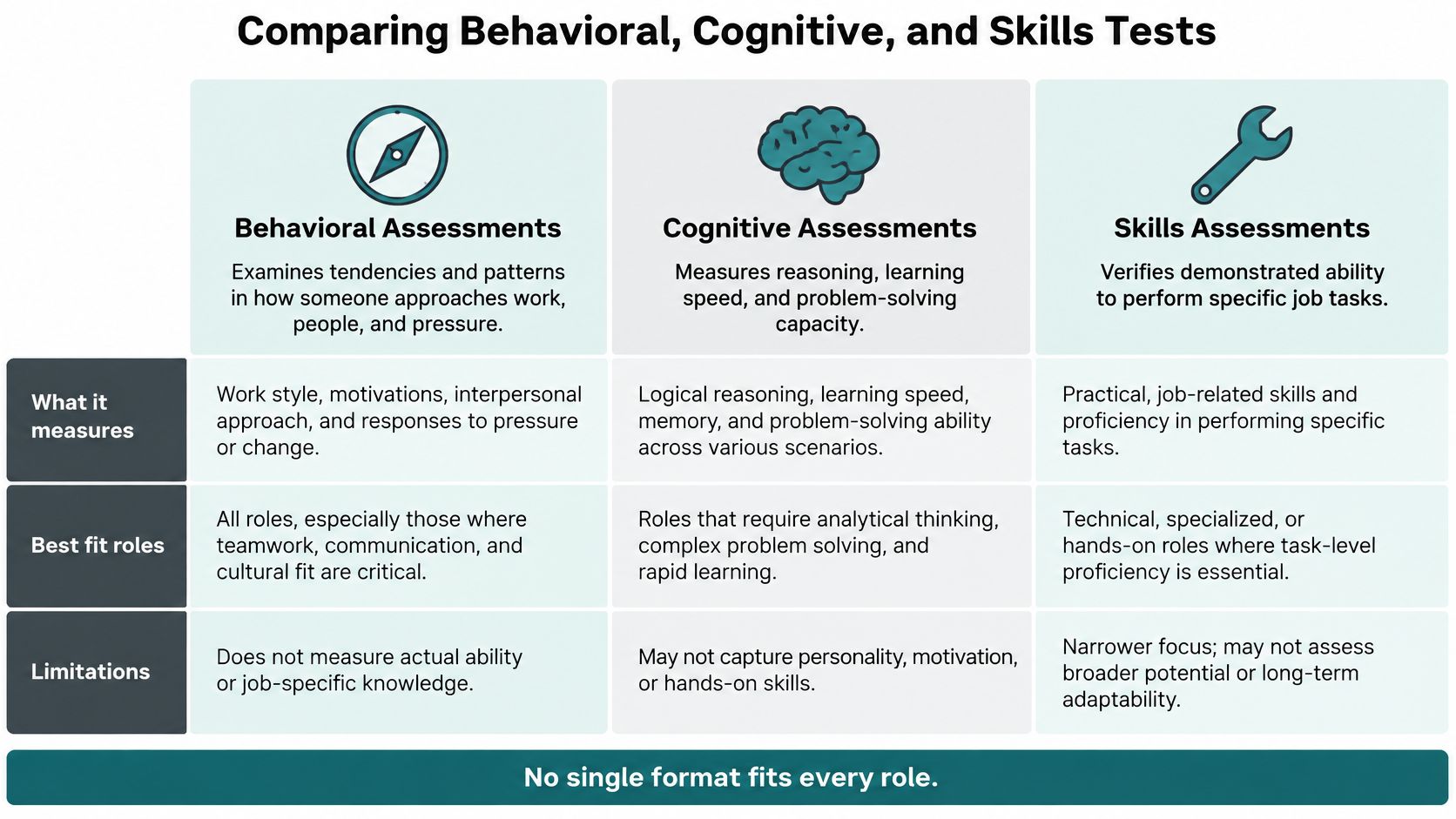
Behavioral assessments examine tendencies in how someone approaches work, relationships, or pressure. Use them to develop focused questions about relevant behavior, not to label applicants as desirable or undesirable personality types.
Cognitive assessments examine reasoning, learning, or problem-solving capacity. Their role in a hiring process should depend on the actual reasoning demands of the position, with careful attention to administration conditions and group outcomes.
Direct performance and standardized observation
Skills tests ask candidates to demonstrate a defined capability. Work samples situate that demonstration within representative work, while simulations let evaluators observe applied behavior in a controlled scenario. These categories can overlap, so inspect the task rather than relying on its label.
Structured interviews offer standardized questioning and scoring. A widely cited estimate reported validity correlations of approximately .51 for structured interviews versus .38 for unstructured interviews, but later reanalysis indicated that the difference may be smaller after methodological corrections, a reason not to treat either coefficient as universal ([review of employment-interview evidence](https://onlinelibrary.wiley.com/doi/10.1002/9781118851715.ch10)).
Assessment format comparison
| Format | Evidence offered | Best use | Main caution | |---|---|---|---| | Behavioral | Work-related tendencies | Targeted behavioral exploration | Don't confuse preference with capability | | Cognitive | Reasoning and problem-solving | Roles with relevant cognitive demands | Examine fairness and testing conditions | | Skills | Demonstrated capability | Essential technical or functional requirements | Avoid irrelevant trivia | | Work sample | Performance on representative tasks | Applied execution | Bound the task and score consistently | | Structured interview | Comparable job-related responses | Exploring experience and judgment | Train evaluators | | Simulation | Behavior in a controlled situation | Interaction, prioritization, or leadership | Check scenario realism and rating quality |
Treat any overview as a starting point for your own format comparison.
<iframe width="100%" style="aspect-ratio: 16 / 9;" src="https://www.youtube.com/embed/j2jT1O0rlsI" frameborder="0" allow="autoplay; encrypted-media" allowfullscreen></iframe>
My preference is to begin with the most direct evidence of essential work, then add another method only when it answers a distinct unresolved question. A writing exercise might establish whether an applicant can produce a clear customer response; an interview can examine how they handle disagreement about that response.
Don't assemble a test battery merely because the platform makes it easy. If several instruments all explore similar tendencies, you may be asking candidates to repeat themselves rather than improving the decision. Require the hiring manager to explain the contribution of every assessment before approving it.
Judging Validity and Reliability
Reliability concerns measurement consistency. Validity concerns whether the interpretation and use of scores are supported by evidence. A test can consistently measure something that has little relevance to the job.
The Society for Industrial and Organizational Psychology recommends documenting both predictor and criterion reliability because measurement error can weaken observed score-performance relationships; its principles also call for evidence connecting AI assessment scores to relevant future outcomes and validation samples representative of applicants ([SIOP personnel-selection principles](https://www.houstontx.gov/hr/hrfiles/classified_testing/siop_principles.pdf)).
That means scrutinizing the performance measure as well as the assessment. An imprecise manager rating isn't automatically a sound basis for declaring a test predictive.
Request the evidence behind the interpretation
Reliability and validity evidence
| Evidence type | What it demonstrates | Question for the provider | |---|---|---| | Internal consistency | Coherence among relevant test items | Which scales were evaluated? | | Test–retest | Stability across repeated measurement | Under what conditions and interval? | | Criterion-related validity | Relationship to relevant outcomes | Which outcomes and population? | | Content validity | Representation of job requirements | How were tasks mapped to work? | | Construct validity | Support for the intended attribute | What supports this interpretation? | | Cross-validation | Performance beyond the development sample | Was independent evidence examined? |
For a deeper technical vocabulary, use this guide to [assessment validity and reliability](https://synopsix.ai/blog/assessment-validity-and-reliability) when reviewing provider documentation. Keep the procurement conversation anchored to your intended use, rather than accepting a general statement that the product is validated.
AI scoring requires the same discipline. Producing the same output from the same input establishes neither relevance nor predictive usefulness. Ask for the scoring version, development population, validation sample, and limits on generalization.
Treat adverse-impact screening correctly
The EEOC's 80-percent, or four-fifths, rule flags potential adverse impact when a protected group's selection rate falls below 80% of the highest-selected group's rate; if the latter is 60%, a rate below 48% warrants concern and further analysis, rather than automatically proving unlawful discrimination ([EEOC guidance on employment tests and selection procedures](https://www.eeoc.gov/laws/guidance/employment-tests-and-selection-procedures)).
Interpret that indicator alongside sample size, statistical significance, job relevance, and the overall process. Passing the screening benchmark isn't a declaration that an assessment is fair, either.
Before approving a tool, require answers to these questions:
> A consistent score can still support the wrong decision. Reliability is necessary evidence, not permission to stop asking questions.
Deploying Assessments in the Hiring Workflow
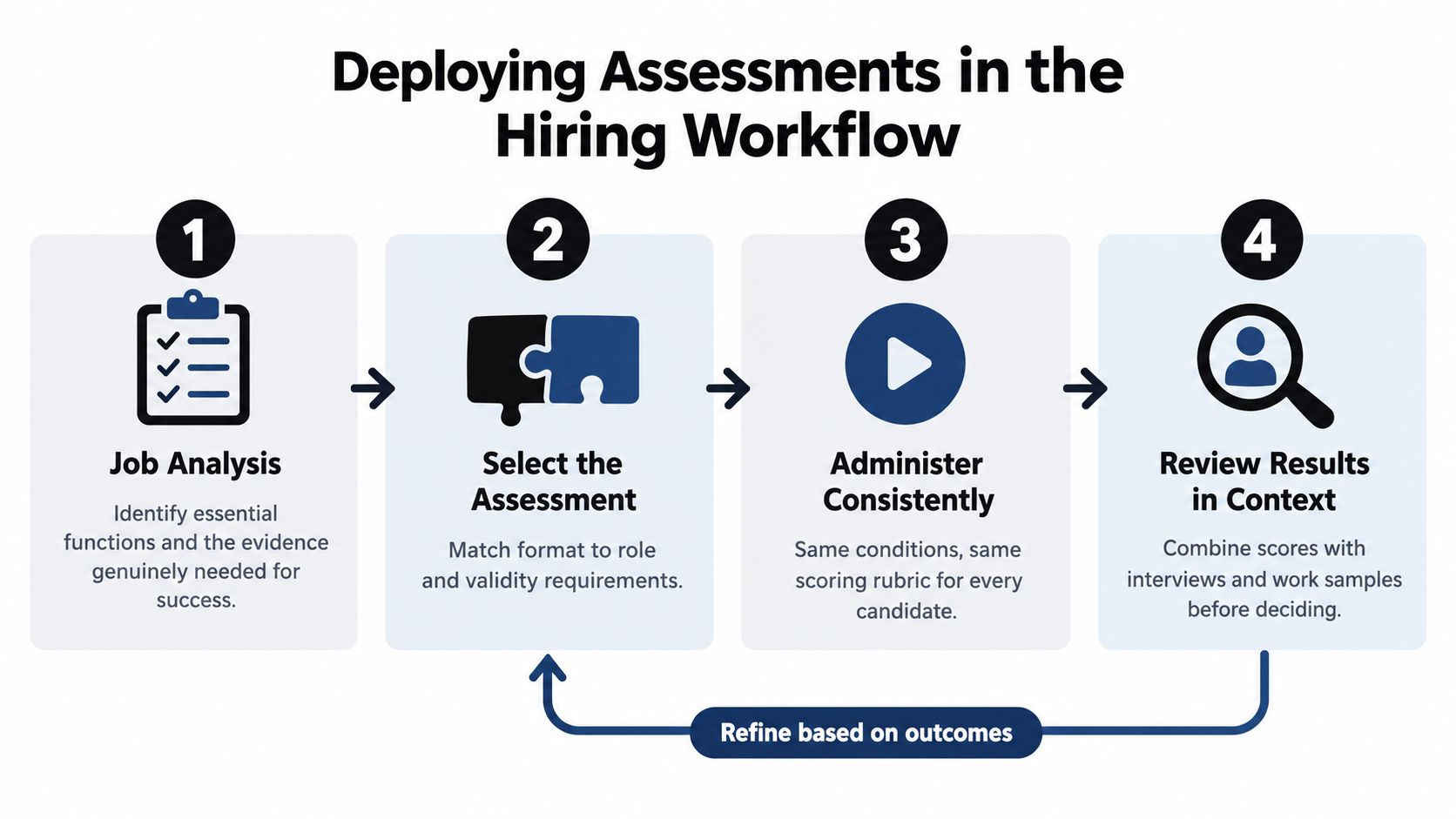
Start with the job, not the product demonstration. Ask the hiring manager to identify essential functions, describe acceptable performance, and distinguish capabilities needed on entry from capabilities the organization will teach.
Turn those requirements into an evidence plan. For each requirement, specify the assessment method, scoring criteria, decision use, and person accountable for review.
The workflow should preserve that connection through administration and selection.
Define controls before applicants begin
Select measures deliberately. Remove duplicated coverage and place each assessment where its evidence is needed. Early screening should address justified entry requirements; later exercises should resolve questions that remain after initial review.
Set prompts, timing policies, permitted resources, rating anchors, and evaluator training before examining applicant results. Document how accommodations will be arranged so that consistency doesn't become an excuse for rigid administration.
Keep capability assessment distinct from other screening activities. When mapping those handoffs, Digital Footprint Check's [pre employment screening process guide](https://www.digitalfootprintcheck.com/pre-employment-screening-process) can serve as a companion resource for organizing the broader process, without treating background information as a substitute for demonstrated capability.
Hiring workflow controls
| Workflow stage | Control | Evidence retained | |---|---|---| | Role definition | Agree essential requirements | Approved job analysis | | Method selection | Map each method to a requirement | Role-to-assessment map | | Pilot | Check instructions and scoring | Pilot findings and revisions | | Administration | Apply defined conditions | Version and administration record | | Accommodation | Provide an accessible request route | Restricted support record | | Evaluation | Apply anchored scoring | Completed scorecards | | Selection | Record job-related reasons | Decision rationale | | Follow-up | Review outcomes and incidents | Monitoring and action log |
Budget for the work outside the test
The purchase price isn't the operating cost. Assign resources for candidate queries, alternative administration, evaluator calibration, technical incidents, secure storage, and evidence reviews. If nobody owns those activities, the deployment plan is incomplete.
A pilot should test the workflow, not merely whether the software launches. Ask participants to interpret instructions, complete representative tasks, request support, and move through the reporting process. Have evaluators score the same material independently, then examine where their reasoning differs.
Define what happens when something goes wrong. An interrupted session, inaccessible interface, or scoring-version change needs a documented response, not an improvised decision from the recruiter managing the vacancy.
Finally, decide how assessment results will enter the selection meeting. Keep requirement-level evidence visible rather than collapsing everything into a universal fit score. Hiring teams need to know which capability is established, which remains uncertain, and which concern requires investigation before they make an offer.
Matching Tests to Real Hiring Decisions
A sales role and a technical role shouldn't inherit the same assessment bundle because they sit in the same applicant-tracking system. Start with the decision risk: what would you most regret failing to establish before hiring?
The following scenarios are proposed assessment designs, not reported employer outcomes. Each combines primary evidence with a supporting method that serves a different purpose.
Role scenario selection matrix
| Scenario | Primary evidence | Supporting evidence | Decision risk | |---|---|---|---| | Sales | Discovery-call simulation | Structured interview on qualification decisions | Mistaking confidence for listening | | Operations | Prioritization and exception-handling task | Interview on escalation judgment | Rewarding speed over accuracy | | Leadership | Resource-allocation simulation | Structured behavioral interview | Confusing charisma with judgment | | Technical | Representative debugging work sample | Structured discussion of trade-offs | Rewarding puzzle familiarity |
Design around the unresolved question
For sales, I'd observe whether the applicant asks useful discovery questions, recognizes uncertainty, and explains a relevant next step. A behavioral profile could add context, but it shouldn't replace evidence of listening and judgment.
For operations, use a bounded task involving competing priorities and incomplete information. Score the rationale for sequencing and escalation, not just whether the candidate reaches the answer an evaluator expected.
For leadership, create a scenario involving limited resources and conflicting responsibilities. Ask candidates to explain what they would decide, what information they still need, and how they would communicate the consequences.
Technical hiring needs similar discipline. Teams using external sourcing resources such as [Hire Developers](https://hiredevelopers.com/) should still define their own role-specific evaluation criteria rather than assuming sourcing and assessment answer the same question.
A debugging task might be more representative than an abstract puzzle when maintenance is central to the role. This guide to [work-sample testing](https://synopsix.ai/blog/work-sample-testing) can help frame the task around observable work rather than test-taking performance.
Before adding a supporting instrument, write down the uncertainty it will resolve. If the team can't name that uncertainty, remove the instrument.
Also compare the burden of alternative designs. Consider preparation requirements, accessibility, evaluator availability, and time-to-decision, not the volume of information produced. A narrower process with interpretable evidence is preferable to an elaborate process nobody can explain.
Interpreting Results Without Overclaiming
An assessment profile should prompt a disciplined review, not end one. Separate observed performance, test-derived estimates, interpretation, and decision rationale in the hiring record.
For example, a candidate may omit an escalation step during a simulation. That's an observation. Concluding that they're generally careless is an interpretation that goes beyond the task evidence.
Calibrate the reasoning
Have evaluators score independently before discussing their conclusions where appropriate. In calibration meetings, ask each reviewer to point to the relevant response or behavior and explain its relationship to the rubric.
Contradictory evidence deserves investigation. Don't let an automated result override a strong work sample without examining whether the tools addressed different requirements or whether administration affected the result.
Result interpretation guardrails
| Evidence status | Responsible action | Avoid | |---|---|---| | Clear task observation | Record behavior and criterion | Turning behavior into a global label | | Model-derived estimate | Examine supporting evidence | Treating the estimate as certainty | | Contradictory results | Investigate the disagreement | Averaging away the issue | | Administration concern | Review conditions and remedy | Assuming the score remains comparable | | Missing evidence | Obtain relevant information | Filling gaps with intuition |
A defensible rationale might explain that the candidate identified the problem, proposed a workable response, but didn't demonstrate an essential escalation requirement. It shouldn't claim that the candidate will fail.
> Decision discipline: Record what the evidence supports, what remains uncertain, and why the remaining uncertainty is acceptable or unacceptable for this role.
Explain the process to candidates
Research summarized in the literature indicates that applicants can view fully algorithmic selection as less fair than human or combined processes, while struggling to identify which tools are more discriminatory ([review of candidate perceptions of digitized selection](https://repository.mu.edu.ua/jspui/bitstream/123456789/10690/1/tolp_devel_v_ekon_2025_30_35.pdf)). Don't mistake an objective-sounding label for meaningful transparency.
Provide a candidate notice that addresses practical questions:
Transparency doesn't require exposing proprietary questions or scoring keys. Explain the decision logic and candidate rights without publishing material that compromises the assessment.
When results seem weak or inconsistent, ask whether the task was completed under suitable conditions, whether an accommodation issue remains unresolved, and whether the interpretation exceeds the evidence. Escalate those questions before finalizing the decision, not after a complaint arrives.
Build a Defensible Assessment System
A defensible assessment system needs an owner after the hiring campaign ends. Maintain a current role-to-test map, evidence file, subgroup review record, accommodation log, version history, and incident process.
Employer responsibility doesn't disappear when a provider supplies the technology. U.S. guidance emphasizes obtaining evidence of job-relatedness, bias testing, and accessibility rather than relying on a supplier's general assurances ([Department of Labor guidance on AI and equal employment opportunity](https://data.aclum.org/storage/2025/01/DOL_www_dol_gov_agencies_ofccp_ai_ai-eeo-guide.pdf)).
Assign responsibility for review
Assessment governance review
| Review area | Evidence to retain | Owner | |---|---|---| | Role alignment | Current requirements and assessment mapping | Hiring manager and HR | | Measurement quality | Technical evidence and local findings | People analytics | | Group outcomes | Selection-pattern reviews and investigations | Analytics and legal | | Accessibility | Interface findings and accommodation records | HR accessibility owner | | Data governance | Access rules, retention schedule, vendor terms | Privacy and security | | Scoring changes | Version history and impact review | Provider and assessment owner | | Decision accountability | Rationales, overrides, and appeals | Hiring leader | | Incidents | Complaint, investigation, and corrective action | HR operations |
Set review dates before launch, then add event-triggered reviews. Revisit the system when job requirements change, a provider updates scoring, applicant populations shift, candidates report barriers, or evaluators identify unexplained inconsistencies.
Review relevant post-hire outcomes against the intended decision use, while checking the quality of those outcome measures. Don't claim local validation from a convenient collection of ratings that doesn't support the conclusion.
Keep evidence organized under stable, searchable names. If a project uses the identifier predict-human-behavior-synopsix-smarter-people-decisions, attach it to the evidence register rather than treating the phrase as a prediction claim.
Make procurement conditional on inspectable evidence
Before approval, require a compact evidence pack:
Use an [ethics-in-assessment framework](https://synopsix.ai/blog/ethics-in-assessment) to connect those operational controls to the decisions people experience. Ethical intent matters, but named responsibilities and retained evidence make that intent inspectable.
Be prepared to limit or pause a tool when its use exceeds the available evidence. Procurement approval shouldn't become permanent permission.
The strongest candidate assessment test isn't the one with the most impressive-looking score. It's the one whose purpose, evidence, limitations, and human decision process are explicit enough for someone else to examine. Buy that standard, and fund the work required to maintain it.
---
[Synopsix](https://synopsix.ai) offers behavioral assessments and AI-powered guidance for hiring, team design, and talent development. Visit the platform to explore its profiles and role-focused reports, then ask how the supporting evidence, interpretation limits, and human-review process would apply to your next hiring decision.