Climate and Culture for Better People Decisions
By Synopsix · October 30, 2026 · 15 min read
The most popular advice about workplace culture is often the least useful: refresh the values, communicate them harder, and expect people to behave differently. A values poster won't tell you whether employees can challenge their manager, and a personality report won't tell you whether a team lets someone use their strengths. Before changing people or rewriting roles, leaders need to separate climate and culture, then measure the layer they intend to change.
Why Climate and Culture Get Mixed Up
Say a leadership team sees rising attrition and launches a culture refresh. Managers host workshops, employees rewrite values, and the company updates its onboarding materials. Nobody checks whether staff can question an unrealistic deadline without damaging their prospects.
The intervention addresses organizational identity while leaving daily working conditions untouched. A values poster, an engagement pulse, and a personality report aren't three views of the same thing. They answer different questions.
Culture is the learned system of assumptions, stories, selection habits, and rewards that people absorb over time. Climate is their shared reading of current conditions: manager behavior, workload, recognition, voice, and interpersonal risk.
> Culture is the climate system of the place; organizational climate is this season's weather. A heat wave can damage retention before the underlying system changes.
Separate the decision before choosing the instrument
For CHROs, talent leaders, hiring managers, and people-analytics teams, the distinction matters whenever someone proposes a hiring, promotion, or team-design decision. An employee may have the capabilities a role requires but work in a unit where disagreement is treated as disloyalty. Replacing that employee won't resolve the unit's problem.
Keep these questions separate:
A useful leadership discussion needs a comparison people can apply, performance evidence, role-matched measures, and a diagnosis that identifies what to change first. Team composition alone won't explain why a capable group is struggling.
Climate Versus Culture Side by Side
| Dimension | Organizational climate | Organizational culture | |---|---|---| | Time horizon | Shared read of current conditions; can shift in weeks to a few months | Learned assumptions and rewards; typically shifts over years | | What you observe | Manager behavior, workload, recognition, voice, interpersonal risk | Stories, rituals, language, unwritten rules, who becomes a hero | | Typical measures | Pulses, safety and engagement items, observed meeting behavior | Values assessments, selection patterns, promotion criteria over time | | Link to retention | Near-term stay or leave and willingness to speak up | Who thrives long term and who self-selects out | | Primary HR lever | Manager habits, role design, team norms | Hiring profile, promotion standards, leadership pipeline |
Use climate when the problem is current working behavior, and culture when the problem is who the organization keeps selecting and promoting.
Read the rows as decision rules
Start with time horizon. Treat the timing in the table as a planning distinction, not a guaranteed intervention schedule. A manager can change how they handle questions immediately; employees need repeated evidence before trusting the change. Altering who advances through a leadership pipeline requires a longer sequence of consequential decisions.
Next, look at observable evidence. A policy promising openness tells you what leaders intend. A meeting in which someone raises a delivery risk and gets excluded from the next discussion tells you what employees experience. Culture becomes visible through the broader pattern: perhaps the organization repeatedly celebrates leaders who rescue projects after suppressing warnings.
Measurement should follow that distinction. A short pulse can ask whether employees can raise concerns with their manager. It can't, by itself, establish which unwritten assumptions govern promotion across the organization. For that, examine promotion criteria, appointment decisions, onboarding messages, and the explanations leaders give for choosing one candidate over another.
For practical context on how those expectations enter the employee experience, [developing workplace culture with Benely](https://benely.com/onboarding-and-developing-organizational-culture/) connects culture development with onboarding. Use that perspective to examine what new hires learn, then compare it with what established employees see rewarded.
Match the lever to the retention problem
Retention requires both lenses. Someone considering an immediate exit may be reacting to an unmanageable workload or a dismissive supervisor. Someone evaluating a long-term career may be asking whether people like them ever receive meaningful authority.
Those are different management problems. The first calls for changes to work allocation, recognition, and manager conduct. The second calls for scrutiny of hiring profiles, advancement standards, and leadership succession.
> Practical rule: If employees are already leaving or withholding concerns, inspect their current conditions before commissioning a culture refresh.
The difficult edge case is a strong stated culture with a cold daily climate. Employees may identify with the mission and still decide they can't work safely or sustainably in their unit. An engagement score that captures pride in the organization can conceal that contradiction.
Don't average it away. Compare responses by manager and work setting, protect confidentiality, and investigate where favorable sentiment coexists with exits or silence.
How Team Climate Decides Whether Composition Pays
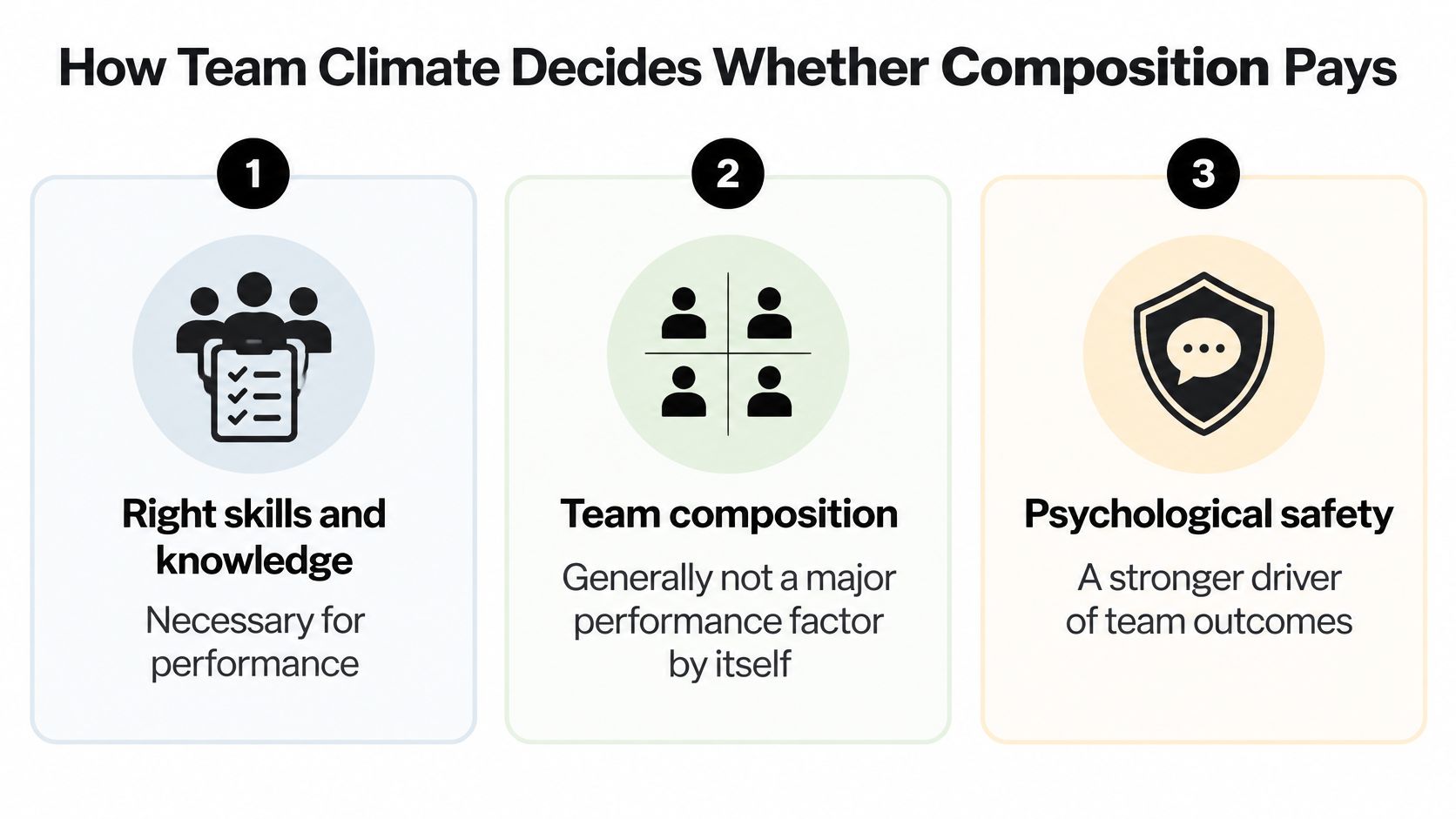
The [Chartered Institute of Personnel and Development's evidence review](https://www.cipd.org/globalassets/media/knowledge/knowledge-hub/evidence-reviews/2023-pdfs/8388-high-performing-teams-practice-summary.pdf) finds that the right skills and knowledge are necessary, but team composition is generally not a major performance factor by itself, while psychological safety has a moderate-to-large positive relationship with team performance.
That distinction changes the hiring conversation. Before asking which profile a team lacks, ask whether existing members can contribute what they already know. A collection of strong individual assessments doesn't establish that people will exchange information when the stakes rise.
Watch what happens when the plan is challenged
Consider a product squad with complementary engineering, commercial, and design capabilities. The senior product leader presents a launch date as settled. A junior engineer spots an unresolved dependency but stays quiet because previous questions have been treated as evidence of poor commitment.
The squad misses the launch. Adding another technically accomplished person wouldn't necessarily address the reason the warning never reached the decision-maker. The immediate intervention is to change how the team tests assumptions and escalates risks.
Listen for behavior rather than declarations:
A learning-culture claim has little practical value when the weekly meeting penalizes the first dissenting voice. Leaders need to inspect the response to disagreement, not merely count invitations to contribute.
Why diversity needs a receptive setting
A [Harvard Business School research model on psychological safety in diverse teams](https://www.hbs.edu/ris/Publication%20Files/Psychological%20Safety%20in%20Diverse%20Teams_V3_8d2783c5-113b-4184-95b9-d180f63452f7.pdf) found a slightly negative average relationship between diversity and performance, but diversity was positively associated with innovation performance when psychological safety was one standard deviation above average, and more negatively associated with performance when safety was one standard deviation below average.
That's a conditional finding, not a verdict against diversity or proof that safety alone causes innovation. It shows why leaders shouldn't expect different backgrounds to produce useful disagreement automatically. Adding a contrasting profile to a team that suppresses differences can leave the new member isolated rather than influential.
Before changing team design, check:
For a sector-specific application, American Cardiology Group's guidance on how to [develop sustainable cardiac care teams](https://www.americancardiologygroup.com/post/how-to-build-a-resilient-cardiology-team-strategies-for-healthcare-leaders) offers a useful setting for discussing team resilience. The same diagnostic question applies: can colleagues surface a concern when professional hierarchy makes that uncomfortable?
Safety doesn't replace skill. A supportive group still needs the knowledge and capacity to deliver. Evaluate both, using [team dynamics and performance](https://synopsix.ai/blog/team-dynamics-and-performance) as connected questions rather than treating a compatibility chart as a forecast of results.
Measures That Predict the Role
| Measure choice | Corrected validity | What HR should do with it | |---|---|---| | Exploratory studies | .12 | Don't hire or promote from traits discovered after the fact | | Confirmatory studies | .29 | Accept modest prediction only when traits were specified in advance | | Job analysis used to select measures | .38 | Prefer this bar for role-relevant hiring and development | | Extraversion | .16 | Don't treat it as a general performance trait | | Agreeableness | .33 | Use only where the role's outcomes actually require it |
These corrected validity figures come from a [personality and job-performance meta-analysis covering 494 studies, 97 independent samples, and 13,521 participants](https://onlinelibrary.wiley.com/doi/abs/10.1111/j.1744-6570.1991.tb00696.x).
The practical lesson isn't that personality guarantees performance. It's that how you choose and validate a measure matters. A coefficient describes a relationship, not the percentage of employees who will succeed.
Set the criterion before inspecting the profile
Exploratory analysis searches for relationships after examining the results. That can generate hypotheses, but it's a weak foundation for a consequential decision about a candidate. Don't search through a personality report until you find a trait that appears to explain a favored hire.
Confirmatory use starts with a stated expectation. Job analysis goes further by connecting the assessment to the work: the decisions a person must make, the pressures they'll face, and the outcomes they're accountable for.
For example, a sales role may require persistence after rejection, careful qualification, and disciplined follow-through. A leadership role may require judgment under ambiguity and the ability to handle conflict. Don't assume that the same profile, weighting, or assessment battery serves both.
> Assessment boundary: A personality label isn't a hiring criterion until you can explain its connection to the job and evaluate that connection against relevant outcomes.
Trait popularity is no substitute for that explanation. An outgoing candidate may interview persuasively without demonstrating the behaviors the role demands. An agreeable candidate may collaborate effectively, but the decision still requires evidence about the specific responsibilities.
Keep experience measures separate from behavioral tendencies
Climate instruments ask what people experience now. Use short, concrete items such as whether employees can raise a concern, whether managers explain recognition decisions, whether workloads are manageable, and whether decisions feel fair.
Pair those responses with observed interaction. Record who contributes to decisions, who gets interrupted, and whether a manager acknowledges a dissenting view before closing discussion. Don't turn observation into covert surveillance; explain the purpose, protect individual privacy, and report patterns responsibly.
Culture assessment asks about shared expectations and repeated organizational choices. Role assessment asks which behavioral tendencies support defined work. Don't merge those into a single fit score that obscures whether someone differs from colleagues or lacks a job-relevant capability.
Build an evidence sheet for each role with the outcome, required behavior, assessment method, and review criterion. Include structured interviews or work samples where appropriate, rather than expecting a personality instrument to answer every question.
Once those measures exist, a people gap becomes a testable problem: a mismatch between required work, available capability, and the conditions under which people must perform.
How to Diagnose a People Gap
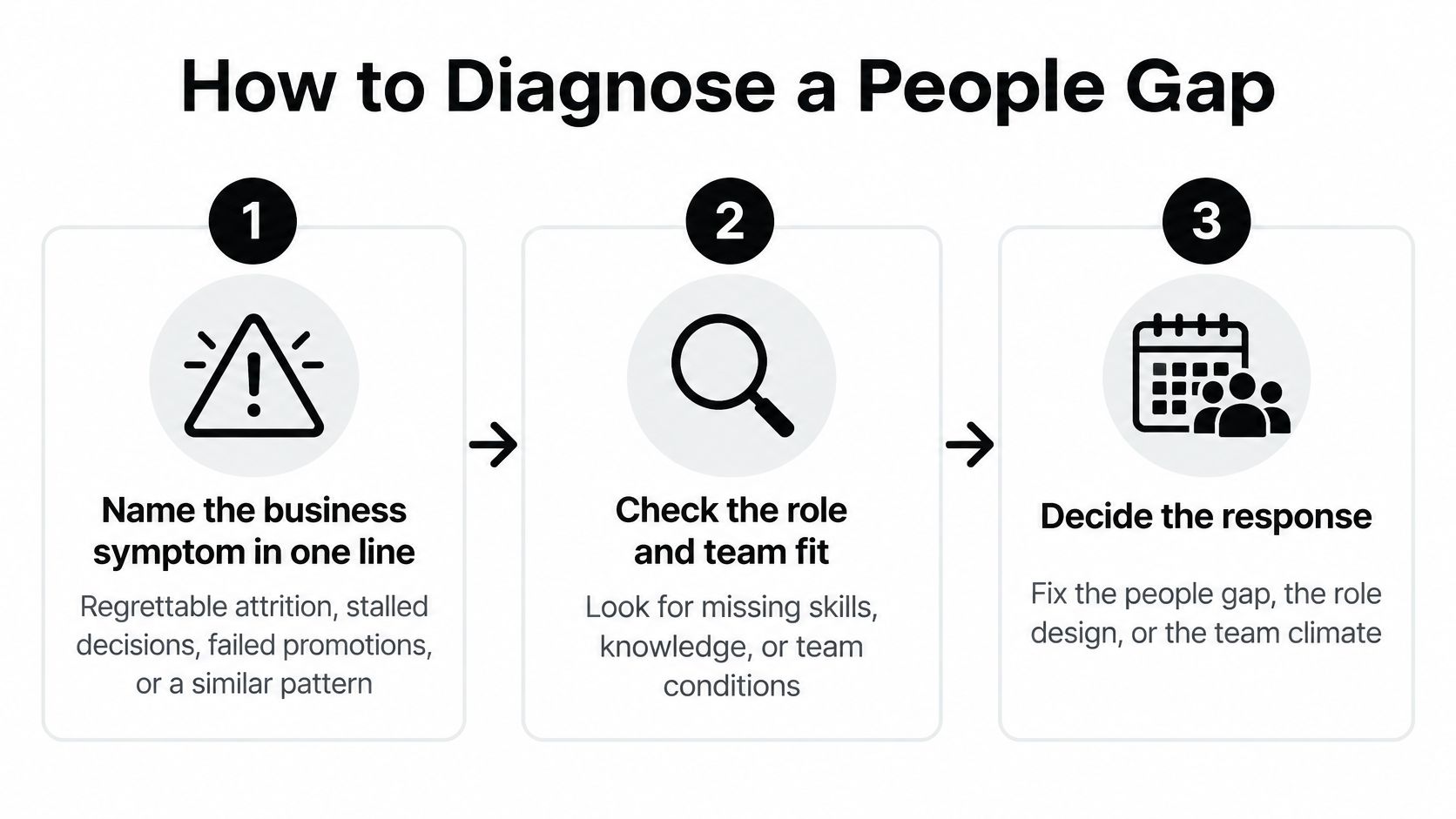
Start with a business symptom, not a label such as poor culture or bad fit. Those labels compress several possible explanations into a judgment about people. A defensible diagnosis keeps the alternatives open until you've checked them.
Follow a diagnostic path
1. Name the symptom. Write a sentence describing regrettable attrition, stalled decisions, failed promotions, or weak innovation. Specify the work affected without assigning blame.
2. Separate the layer. Current silence, overload, or manager conduct calls for a climate investigation. Repeated selection of an unsuccessful profile calls for scrutiny of culture and role criteria.
3. Pull role-relevant evidence. Compare behavioral information with the outcome that matters for the job. Don't substitute a generic trait inventory for evidence of judgment, persistence, or another defined requirement.
4. Map interaction. Observe participation, interruptions, disagreement, and handoffs. Look for where complementary capabilities become tension or remain unused.
5. Test alternatives. Check for missing skills, unclear authority, incompatible incentives, and disruption after a reorganization. Don't prescribe a culture program for a resource or accountability problem.
6. Choose a primary lever. Address climate through manager routines, role clarity, and meeting norms. Address selection patterns through hiring and promotion standards.
7. Set a review point. For climate, schedule a follow-up pulse and observation after people have experienced the changed routines. For culture, review actual hiring and promotion decisions across a meaningful decision cycle.
Use symptoms as hypotheses
| Symptom | Likely layer | First move | |---|---|---| | High engagement scores with high exits | Pulse misses climate | Add observed meeting behavior and exit-interview evidence | | Strong hire profile fails in one unit | Unit climate rejects the profile | Start with manager routines and voice norms | | Same profile keeps failing across repeated hires | Culture and role criteria | Change hiring and promotion criteria | | Same traits work in one market and fail in another | Criterion mismatch | Re-check the criterion and keep the behavioral data | | Diverse team flat on innovation | Low psychological safety | Raise safety before adding contrasting profiles |
These are starting hypotheses, not automatic conclusions. A strong profile failing in a unit could also indicate inadequate onboarding, unsuitable responsibilities, or an assessment that didn't capture the work.
A [South African meta-analysis of 33 studies involving 6,782 individuals](https://onlinelibrary.wiley.com/doi/am-pdf/10.1111/ijsa.12175) found broadly similar personality–performance relationships to other cultural contexts, with conscientiousness the strongest overall predictor and other traits useful for particular criteria or employee groups.
That supports investigating role and criterion differences rather than immediately discarding behavioral evidence when results differ across markets. It doesn't justify assuming that every instrument or scoring rule transfers unchanged.
Use an [organizational culture assessment](https://synopsix.ai/blog/organizational-culture-assessment) to examine shared expectations alongside local evidence. Finish the diagnosis with a named owner, a proposed change, and an observable outcome that would support or challenge your explanation.
Align Roles Teams and Daily Behavior
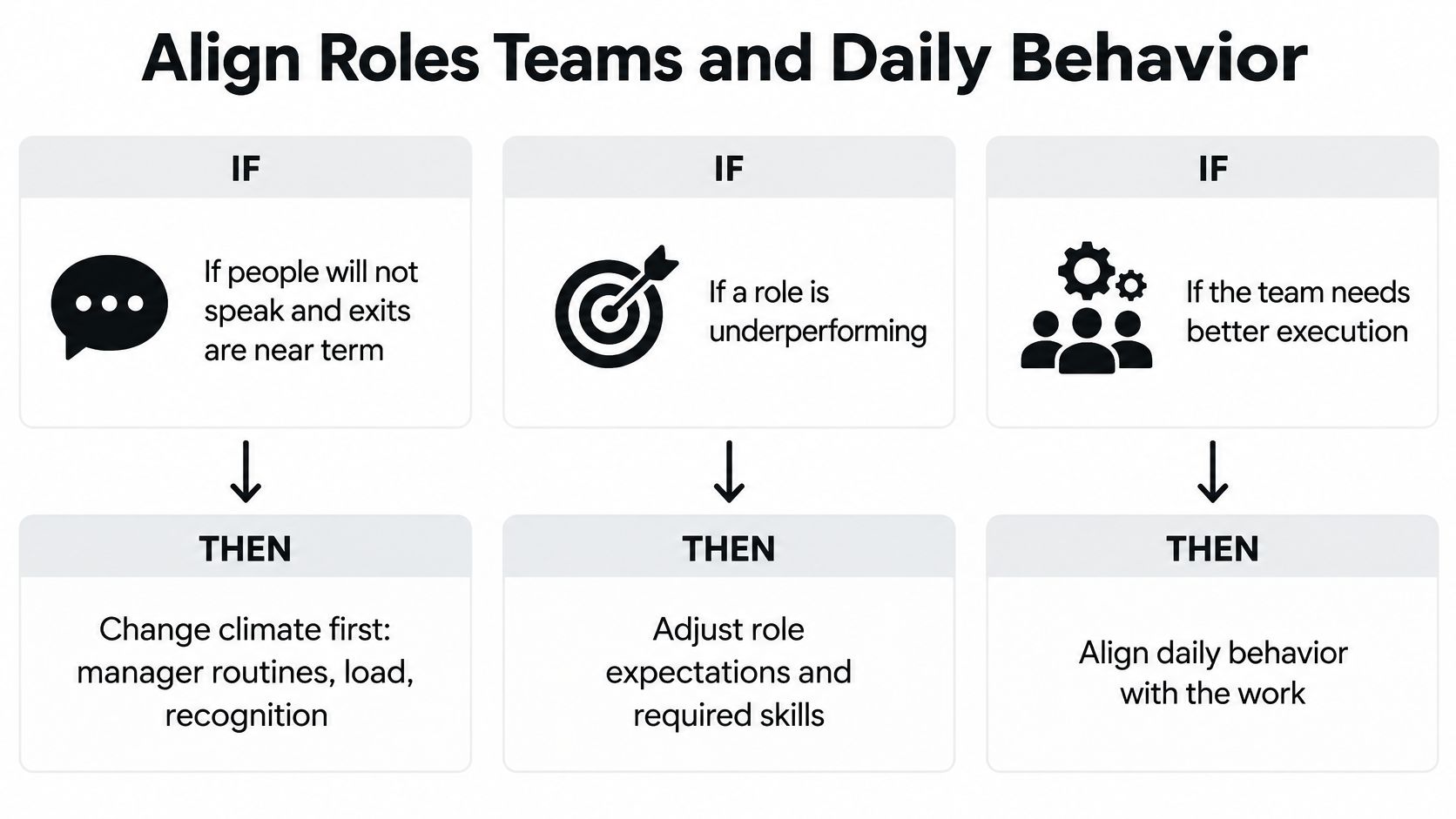
A new values workshop rarely changes how work feels on Monday. Climate is shaped by daily interactions: who can question a forecast, how managers respond to missed commitments, and whether people can raise concerns without penalty. Culture changes more slowly, through the expectations and habits those interactions reinforce.
If employees stay silent while departures loom, adjust manager routines, workload, recognition, and responses to challenge. If the wrong profiles keep advancing, revisit leadership criteria. If a role repeatedly produces mis-hires, return to the job analysis before adding traits to an assessment.
Apply the decision to actual work
Consider a capable sales team whose forecast meetings rely on public criticism. The manager needs to change how uncertainty and missed commitments are discussed. The role assessment should separately examine how sellers handle rejection and maintain follow-through, not whether they resemble the manager.
A leadership pipeline presents a different problem. If decision-makers repeatedly promote agreeable coordinators into conflict-heavy positions, examine how readiness is defined and whether the promotion process tests those responsibilities. Development can build skills, but it cannot compensate for criteria that never assess the demands of the role.
> Keep role design distinct from team conditions: a clear job description will not fix a hostile climate, and a supportive team cannot make an undefined role measurable.
Move from measurement to action
Choose an assessment for the work being done. Compare behavioral profiles in business language, then examine likely friction before changing responsibilities or team membership. Structured interviews, work samples, and facilitated observation can add evidence alongside a people-intelligence platform.
Synopsix offers comparable behavioral profiles, role-focused reports, simulations, development plans, and Human Interlink views of complementarity and tension. Use [compatibility matches](https://synopsix.ai/blog/compatibility-matches) as prompts for investigation, not as verdicts about who belongs. Leaders remain responsible for defining the role and addressing the conditions employees experience.
For a focused pilot, keep the decision record alongside the assessment evidence so the reasoning can be reviewed later. Select one struggling role or team, state whether climate or culture is the working hypothesis, and choose an observable measure before making a broader change.
Synopsix provides behavioral assessments and guidance for hiring, team design, and development, connecting individual profiles with role requirements and team interactions. Explore a focused assessment of a struggling role or team at [Synopsix](https://synopsix.ai), and consider the findings alongside direct evidence of daily working conditions.