Communication for Impact: How Leaders Can Get Results
By Synopsix · October 23, 2026 · 15 min read
“Be clearer and communicate more often” is incomplete advice. A polished announcement can explain a change perfectly without giving employees a workable reason to change what they do. Communication for impact starts with a different question: what observable behavior should change, and what evidence would convince us that the message helped?
For people leaders, that means treating a rollout memo as an intervention, not a deliverable. The writing matters, but so do the decision rights, audience differences, delivery conditions, and measurement plan behind it.
Why Clear Messages Still Fail to Move Teams
Consider a hypothetical rollout email announcing a new performance process. Nearly everyone reads it, managers praise its clarity, and the town hall produces few questions. At the next review meeting, supervisors still use their old notes and postpone difficult feedback.
The communication reached people. It may even have made sense. Neither tells you whether employees changed their routines.
Exposure Is Not Action
These distinctions matter when a leadership team declares a rollout successful:
A read receipt establishes exposure, not understanding. A positive reaction can reflect agreement with the intention rather than readiness to implement it. Silence in a meeting is particularly ambiguous: employees might understand, disagree, or be unwilling to expose confusion.
> A message can be clear about the strategy and still leave people guessing about their next decision.
The manager who understands the new performance philosophy may still wonder whether documenting concerns will trigger an escalation. A recruiter may support structured hiring but assume the hiring manager can override the scorecard. These are operating questions, not copyediting problems.
Delivery Skill Is Only Part of the Job
Leaders should work on how they speak. Intonetic's resource on how to [strengthen executive presence when speaking](https://intonetic.com/strategic-communication-skills/) is relevant when preparing to explain a difficult decision. But confident delivery doesn't replace a usable process or resolve contradictory incentives.
Communication for impact is the deliberate use of messages and dialogue to support an observable change in behavior. That definition makes room for an uncomfortable conclusion: sometimes the memo isn't the problem. Employees may understand the request but lack authority, time, confidence, or a practical way to comply.
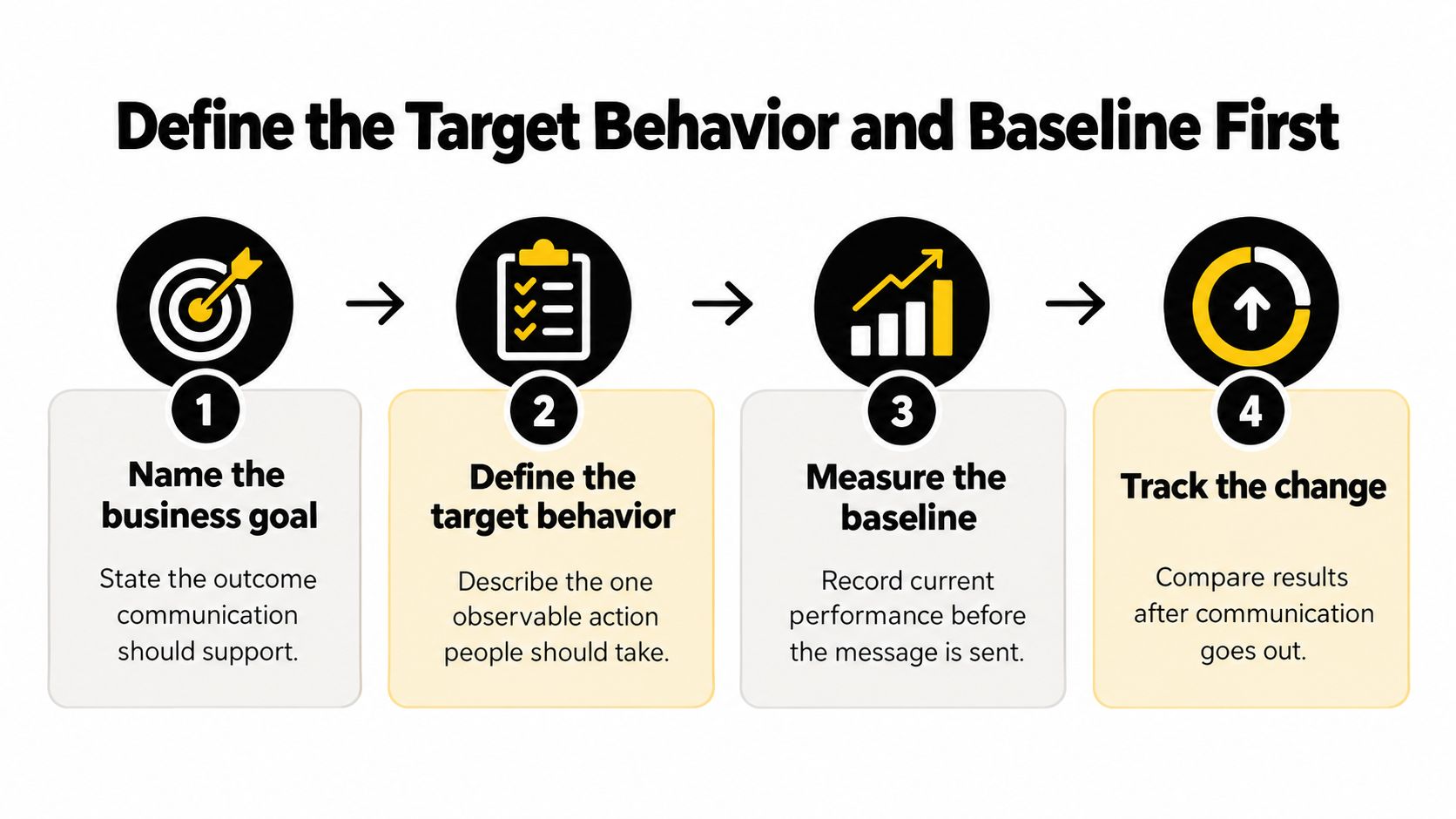
Define the Target Behavior and Baseline First
Before opening a document, finish this sentence: “We need these people to do this differently when this situation occurs.” If the answer is “understand our strategy,” you're not ready to draft.
An evidence-oriented approach connects the business problem, available data, hypothesis, proposed solution, and business impact. [Deloitte's guidance on telling a story with data](https://www.deloitte.com/us/en/insights/topics/analytics/telling-a-story-with-data.html) provides that analytical foundation. Applied to communication, it means specifying the behavior and baseline before choosing the wording.
Work Backward From a Hiring Decision
Suppose a hiring-manager team needs to adopt structured interview scoring. The business problem isn't low awareness of the scorecard. It's that interviewers arrive at debriefs with inconsistent evidence, making candidates difficult to compare.
Define the target behavior as submitting an evidence-backed scorecard before the hiring debrief. Then establish the current position by reviewing recent interviews, using the same definition of completion you'll use after the rollout.
| Planning decision | Worked example | |---|---| | Business problem | Hiring discussions rely on impressions rather than comparable evidence | | Target behavior | Interviewers submit completed scorecards before debriefs | | Baseline | Current share of eligible interviews with timely, evidence-backed scorecards | | Adoption measure | The same completion measure after the intervention | | Business outcome | More consistent decisions with less avoidable debrief rework |
Don't invent a starting figure because the project sponsor wants a complete slide. If historical records are unreliable, collect an initial observation period and label its limitations.
Segment by Responsibility, Not Mailing List
The recruiter needs to know how to request missing scorecards. The hiring manager needs to know whether a debrief can proceed without them. Interviewers need scoring examples and a clear submission point.
A regional leader may need exception patterns rather than instructions for completing each field. Segment by role, influence, and information needs, not just department.
A testable hypothesis could be: “Interviewers who receive a role-specific scoring example and an explicit pre-debrief requirement will submit more complete scorecards than those receiving the policy announcement alone.” That's a proposition to evaluate, not a promised result.
Capture immediate signals such as understanding, perceived relevance, manager confidence, and intended action. Reserve adoption, productivity, retention, or revenue for the outcome layer where they're relevant. Assign an owner to each measure so the measurement plan doesn't become an appendix nobody maintains.
Write Messages Around One Observable Action
“Please familiarize yourself with the updated framework” sounds reasonable and asks for almost nothing observable. Replace it with the action someone must complete, the reason it matters, and the authority behind it.
In [Project Management Institute research on communication and project performance](https://www.pmi.org/learning/library/en-2013-pulse-high-cost-low-performance-13512), roughly four in five projects communicating with sufficient clarity and detail in the audience's language achieved their original goals and business intent, compared with slightly more than half where communication lacked that clarity. Audience-language fit deserves the same attention as deadlines and ownership.

Draft the Request Before the Background
For each stakeholder, separate what they must know, believe, and do. Knowledge covers the changed requirement. Belief concerns why following it is worthwhile or safe. Action identifies the task that someone can verify.
A team lead introducing a performance check-in routine might say:
> “Before your next check-in, add the employee's current priority and any support they need to the shared template. We're using it to make support requests visible, not to introduce a new rating. You and the employee agree the priority; unresolved workload conflicts come to me.”
A recruiter explaining a revised scorecard might use:
> “Submit your evidence against the interview criteria before the debrief begins. This lets the panel compare observations before discussing an overall recommendation. The hiring manager owns the final decision; send scoring questions to me before submitting, rather than leaving fields blank.”
Both scripts state the action, purpose, and decision rights. Neither begins with a long account of the project team's work.
Remove Ambiguity, Not Useful Detail
Replace specialist terms with language the recipient uses. “Improve calibration fidelity” becomes “use the same criteria when comparing candidates.” Keep technical detail available for people who need it, but don't make everyone search through it for the instruction.
For assessment-based communication, the same discipline applies when deciding [how to write an intelligence report](https://synopsix.ai/blog/how-to-write-intelligence-report): findings need interpretation and a decision implication, not just terminology.
Test the draft with two or three representative users. Ask them to describe what they'd do next and who they'd approach with a problem. Don't ask only whether they like the wording.
Tailor Messages Using Assessment Insights
Personalization should change how you explain a decision, not which facts employees receive. Keep the requirement, rationale, protections, and decision rights consistent. Adjust pacing, detail, and the order in which you address concerns.
Behavioral profiles and team compatibility notes can provide hypotheses about those preferences. They shouldn't become labels that substitute for asking people what they need. Guidance on [assessment interpretation](https://synopsix.ai/blog/assessment-interpretation) belongs alongside direct conversation, not above it.
Adapt the Entry Point
Consider a hypothetical announcement introducing a shared workflow for allocating project work. The action is identical for everyone: submit resource requests through the shared process before managers commit capacity.
| Audience preference | Possible opening | |---|---| | Detail-oriented analyst | “The allocation criteria and implementation timeline are available in the workflow guide. Submit requests through the shared form before committing capacity; the department head approves exceptions.” | | Relationship-focused manager | “Your team should have a clearer way to raise competing workload demands. Submit requests through the shared form before committing capacity; the department head approves exceptions, and you remain responsible for discussing the effect on your people.” |
The analyst receives criteria first. The manager hears the people implications first. Neither receives a different policy.
Check the preference rather than assuming it. A detail-oriented employee facing a sensitive personal change may want a conversation before a document. A relationship-focused manager may need precise implementation criteria to answer their team's questions.
Keep Human Ownership Visible
AI assistance adds another personalization decision: whether the recipient expects the leader's own judgment and emotional attention.
In a 2025 study of more than 1,000 professionals, employees viewed supervisors as sincere in 83% of cases involving low AI assistance, compared with roughly 40 to 52% when supervisors relied heavily on AI, especially for personal or motivational communication, according to the [reported findings on AI-assisted supervisor messages](https://www.carriermanagement.com/news/2025/08/12/278363.htm).
That isn't a reason to ban drafting assistance. It is a reason to distinguish message types:
Don't imply that a heavily generated personal note is an intimate reflection. If assistance materially shaped the message, say so plainly and retain responsibility for every sentence. A disclosure is not a substitute for personal involvement.
Deliver Messages Through Channels People Trust
Consider a hypothetical manager explaining a revised approval policy during a team call. Before closing, she asks an employee to describe what will happen when the next request arrives. The employee says the submission deadline has moved.
It hasn't. The approval requirement changed, but the deadline stayed the same. Without that response, the manager might have left the meeting believing the announcement was understood.
Use the Response to Check the Route
The manager corrects the distinction during the call, updates the written summary, and asks supervisors to check whether the same misunderstanding appears elsewhere. She doesn't merely repeat the original slide more slowly.
This approach reflects principles in [WHO guidance on risk communication and community engagement](https://iris.who.int/bitstream/handle/10665/259807/9789241550208-eng.pdf?sequence=2): information should be transparent, timely, understandable, relevant, candid about uncertainty, linked to people's ability to act, and delivered through channels communities trust and use. WHO also summarizes evidence that preparedness improved when community members participated as planners rather than merely attending.
Workplace change isn't a public-health emergency, but those communication principles offer a useful design discipline. Involve frontline representatives while deciding how the rollout will work, not only when inviting people to its launch.
> Delivery rule: Choose the channel for the uncertainty people need to resolve, not the convenience of the sender.
Match Urgency and Complexity
A routine policy clarification may need a short written update with an accessible reference page. A complicated change affecting responsibilities deserves a live discussion and a durable written record. Urgency doesn't remove the need for clarification; it changes how quickly leaders must provide it.
Build a response route into delivery:
Don't default to the newest collaboration tool if employees don't regularly use it. Equally, don't assume a familiar channel is sufficient for a sensitive conversation. Trust depends on the messenger's willingness to answer difficult questions as well as the location of the announcement.
When something remains undecided, state what is unresolved, who owns the decision, and how employees will receive the answer.
Measuring Whether Your Message Changed Behavior
The difficult question isn't whether adoption improved after an announcement. It's whether the communication contributed to that improvement, rather than merely arriving alongside better training, stronger leadership, or a more usable system.
Among 1,148 U.S. desk workers at large companies, organizations with clearly communicated agentic-AI strategies reported 92% seeing positive productivity effects, compared with 62% where communication was unclear; AI use was 66% versus 39%, according to the [EY survey on agentic-AI adoption](https://www.ey.com/en_us/newsroom/2025/10/new-ey-survey-reveals-majority-of-workers-are-enthusiastic-about-agentic-ai-but-leadership-gaps-in-communication-and-lack-of-training-threaten-impact). These are correlational findings, not evidence that communication alone caused the differences.
Indicators for Tracking Message Impact
| Indicator Type | Examples | What It Tells You | |---|---|---| | Exposure | Delivery, attendance, document access | Whether people had an opportunity to encounter the message | | Leading indicators | Comprehension, relevance, manager confidence, intended action | Whether recipients appear ready to respond | | Behavioral indicators | Workflow use, scorecard completion, time-to-proficiency | Whether work practices changed | | Business outcomes | Productivity, retention, avoidable rework | Whether relevant organizational results changed | | Trust safeguards | Perceived sincerity, psychological safety, willingness to raise concerns | Whether implementation carried relationship costs |
A satisfaction score can complement these measures, but it can't replace them. Employees may enjoy a presentation without adopting its recommendation, or dislike a necessary change while implementing it correctly.
Build a Credible Comparison
Where practical, randomly assign comparable teams to message variants while keeping the underlying policy, training, access, and implementation support consistent. Compare changes from each group's baseline, not just their final results.
If random assignment isn't feasible, use a phased rollout or matched groups. Record differences in leadership involvement, prior experience, technology readiness, and existing trust. Be explicit that these designs may leave alternative explanations unresolved.
Connect the experiment to the broader practice of [measuring team performance](https://synopsix.ai/blog/how-to-measure-team-performance), while keeping the communication-specific question narrow. Report what the comparison supports, what remains uncertain, and what you'll change next.
Choosing Tools and Taking Your Next Step
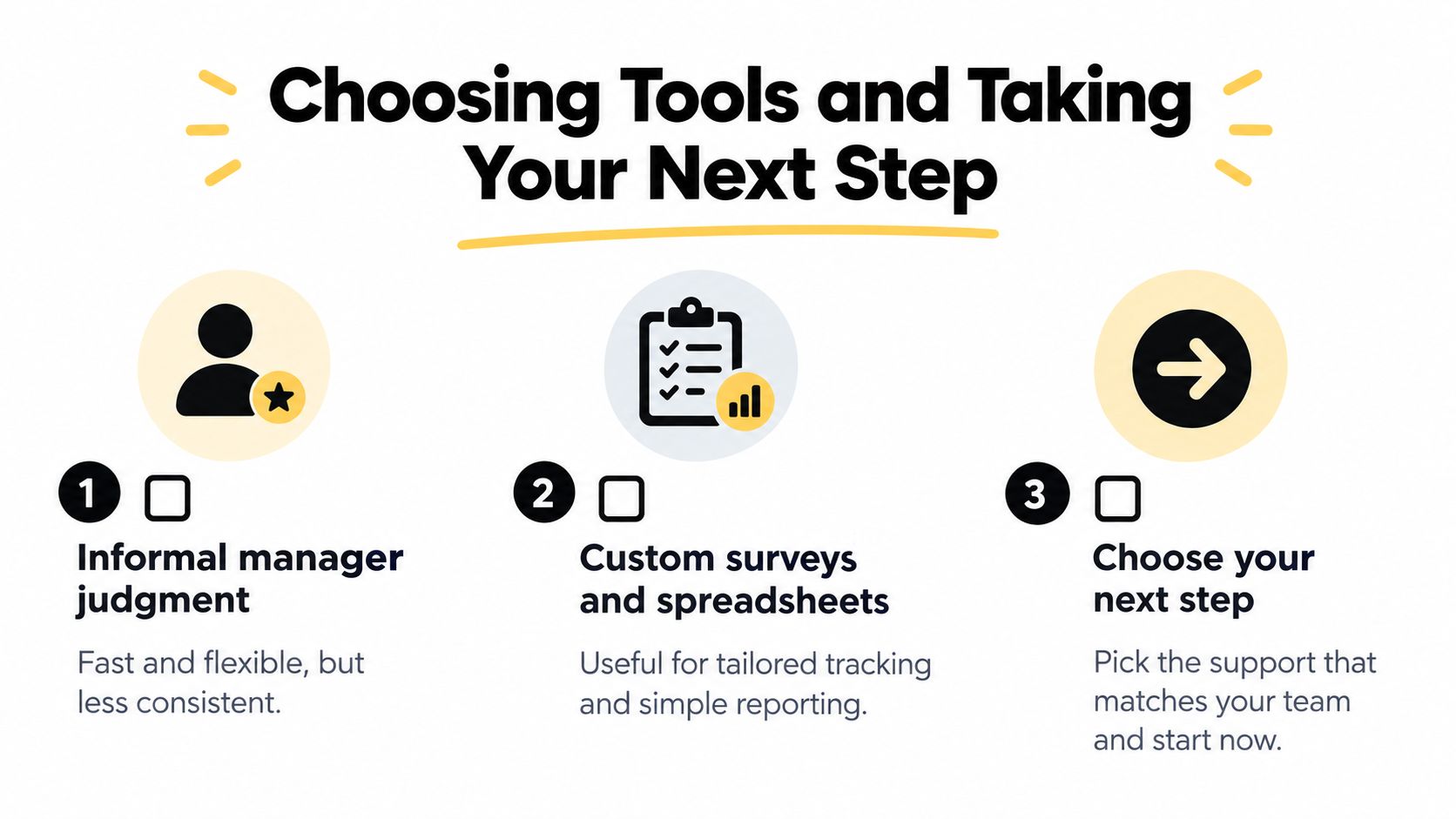
Choose support according to the decision you need to make. A manager preparing a routine update doesn't need the same infrastructure as a people-analytics team comparing rollouts across functions.
Informal manager judgment is fast and sensitive to local context. Its limitation is consistency: another manager may interpret the same employee differently, and the reasoning may never be recorded.
Compare Support Against the Work
| Approach | Personalization | Measurement and consistency | |---|---|---| | Manager judgment | Based on direct relationships and observation | Requires deliberate documentation to compare decisions | | Custom surveys and spreadsheets | Can capture specific preferences and questions | Flexible, but definitions and follow-up need active maintenance | | Integrated people-intelligence platforms | Use comparable profiles and structured interpretation | Can support shared practices across hiring, team design, and development |
Synopsix is an option in the platform category. It describes its approach as turning scientifically validated behavioral assessments into AI-powered guidance through comparable profiles, business-language Intelligence Reports, risk indicators, and fit recommendations. Predictive Simulations address potential friction and risk, while Human Interlink examines team complementarity and tension points.
Treat those outputs as decision support, not proof that a particular message will work. Ask how assessment validity is established, who can access profiles, and whether employees can challenge interpretations. Don't use communication preferences to infer competence or justify withholding information.
Start With a Bounded Pilot
Choose an upcoming message this week and document its target behavior and baseline. Prepare a standard version and an adjusted version informed by profile insights, then compare responses without changing the underlying requirement or support.
Keep a simple experiment record. A working identifier such as `predict-human-behavior-synopsix-smarter-people-decisions` can connect the draft, audience assumptions, and outcome notes. Judge the pilot by the behavior observed and the trust retained, not by which version sounds more polished.
---
[Synopsix](https://synopsix.ai) offers behavioral assessments completed in under 30 minutes and AI-powered guidance for people decisions; the company reports 40% faster hiring decisions and 60% fewer mis-hires, which are company-reported claims rather than predicted results for your rollout. Visit the platform to explore its profiles and team-analysis tools, then test whether those insights help you adapt an upcoming message without weakening clarity, consistency, or trust.