Compatibility Matches in Hiring and Team Design
By Synopsix · October 1, 2026 · 14 min read
You can have two candidates with nearly identical qualifications, yet one seems to strengthen the team while the other creates unease. Is that instinct a useful signal, hidden bias, or both?
Hiring managers often call this feeling compatibility, but they rarely define what they mean. A candidate may fit the work yet clash with the manager, share the company's values yet struggle with the team, or bring a productive difference that a broad “culture fit” score would wrongly penalize.
Compatibility matches deserve more rigor than a single number. The useful question is not just whether two people match. It's whether they're compatible for retention, collaboration, execution, or another specific outcome. Organizational research offers several ways to measure that distinction, while people-intelligence platforms such as Synopsix show how behavioral data can become practical hiring and team-design guidance.
Why Two Equally Qualified Candidates Feel So Different
A hiring manager has narrowed the search to two finalists. Both have the required experience, comparable achievements, and strong technical answers. One interview feels easy. The candidate explains decisions clearly, responds thoughtfully to disagreement, and seems likely to work well with the people already on the team. The other is equally capable, but the conversation feels strained.
The manager's reaction may be based on useful information. It may also reflect familiarity bias, such as preferring someone with a similar communication style or background. That tension explains why compatibility shouldn't remain a vague feeling, but shouldn't become an unquestioned score either.
Separate the signal from the story
A useful assessment asks what produced the reaction.
These questions convert “I liked them” into observable hypotheses. For example, a manager might record that one candidate asks clarifying questions before committing, while another moves quickly with incomplete information. Neither behavior is automatically better. The right choice depends on the work, the team's current weaknesses, and the cost of errors or delay.
> Practical rule: Treat compatibility as a set of testable fit questions, not as permission to hire people who feel familiar.
The research tradition behind this idea is older and more formal than modern culture-fit language suggests. Relationship science examined compatibility as a pattern of similarity, complementarity, and matching. Organizational psychologists then developed related concepts for jobs, companies, groups, and supervisors.
That history gives decision-makers a stronger starting point. Compatibility is measurable, but it's multi-dimensional and purpose-dependent. The rest of the decision depends on identifying which dimensions matter, testing them consistently, and preserving differences that help the team think better.
What Compatibility Matches Actually Mean
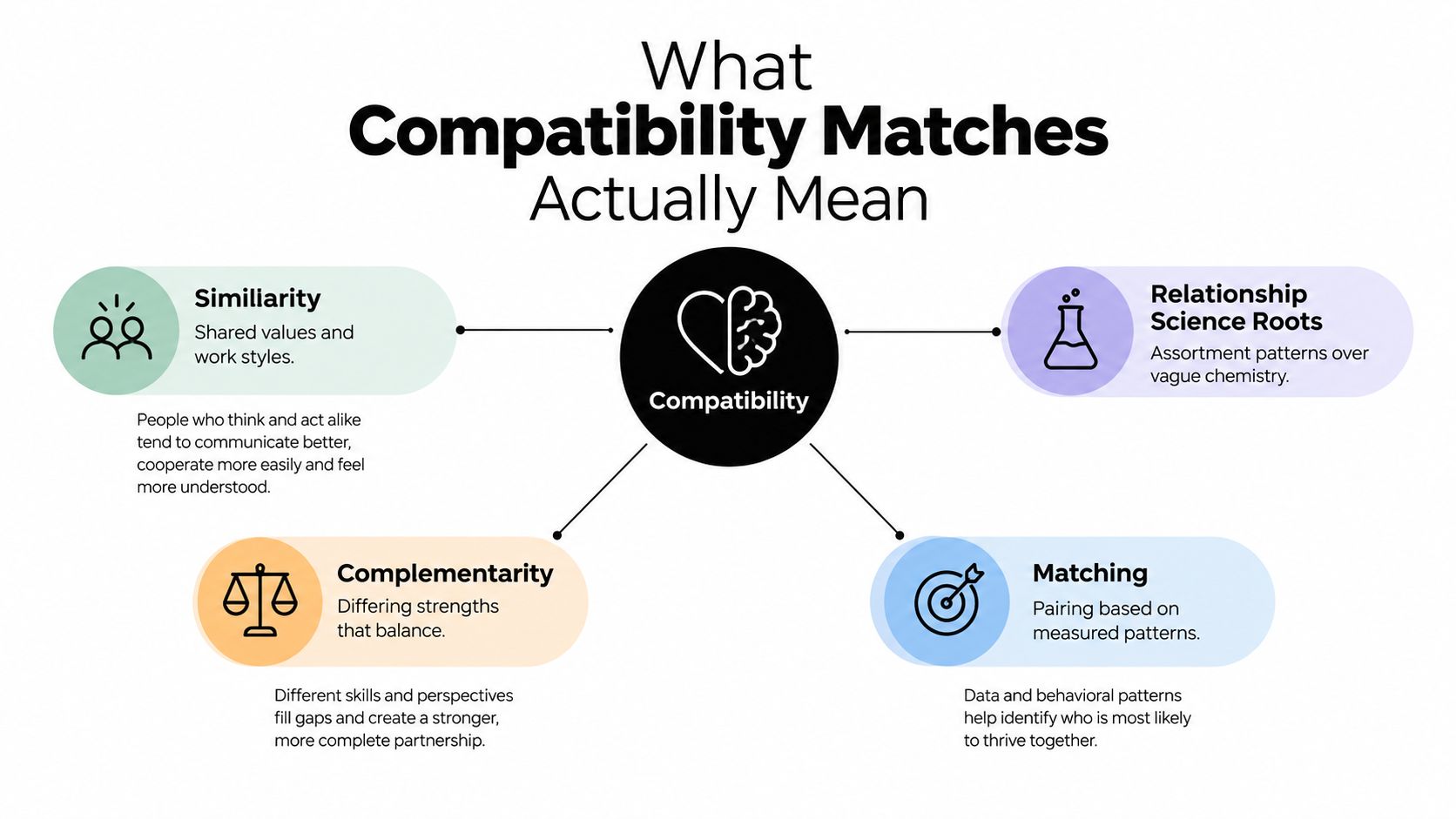
What does a compatibility match measure? In relationship science, it describes a measurable pattern in how people or environments fit together, rather than an impression of chemistry. A [2011 review of compatibility in close relationships](https://www.scielo.org.mx/scielo.php?script=sci_arttext&pid=S2007-48322011000200002) describes compatibility primarily through similarity, while also recognizing complementarity and alignment on socially desirable characteristics.
The matching principle focuses on level alignment. A highly structured person may coordinate more smoothly with someone who also values planning, deadlines, and follow-through. The relevant question is whether their levels on a trait support the demands of the interaction, not whether they share every preference.
Compatibility can also come from different strengths serving one outcome. A visionary strategist may work well with a careful operator when the work requires both direction and disciplined execution. The fit depends on the task: the same difference could help a launch team and create friction in work that requires identical procedures.
How the idea entered hiring
Organizational research applies related ideas through person–job fit and person–organization fit. Person–job fit concerns the relationship between a person's abilities and preferences and a job's demands and supplies. Selection research has treated these fit judgments as part of hiring systems for more than twenty years, as described in the [organizational fit review chapter](https://academic.oup.com/edited-volume/34488/chapter/292598682?searchresult=1).
The connection between relationship research and hiring is useful, though the questions differ. A relationship match examines whether two people can form a workable connection. A hiring match examines whether a person, role, organization, manager, and team support a defined outcome, such as retention, collaboration, or execution.
That distinction keeps compatibility matches from becoming a vague culture test. They provide a way to study people and environments, provided decision-makers define the outcome and keep each fit layer separate.
A practical definition is:
> Compatibility matching pairs people and environments according to measured patterns of similarity, complementary strengths, and relevant demands.
The [Hire Sense hiring blog](https://hire-sense.io/blog-post?id=6aaf9dbd212a3e3186e783b0) offers further hiring-focused context on structured decisions. A person may fit a job's demands while clashing with a supervisor's working style, or fit a team's social rhythm while struggling with its execution requirements. A useful match therefore explains compatible for what, and leaves room for productive disagreement where difference improves the work.
Similarity, Complementarity, and Matching Explained
What makes a candidate compatible with a team: shared habits, different strengths, or the right level of a job-related trait? These are separate hiring hypotheses, and each points to a different outcome.
Consider a product group preparing a complex launch.
Similarity describes shared patterns. Two colleagues may both prefer written briefs, careful preparation, and explicit decision rights. Their communication may feel easier because they interpret pace and structure in similar ways. This lens helps when the work depends on common standards, such as compliance, operational handoffs, or detailed project coordination.
Complementarity describes differences that serve the same task. A product lead may move quickly from a broad market idea, while an implementation lead tests assumptions, identifies dependencies, and slows a decision at the right moment. Their mismatch in pace can improve execution if both people respect the other's contribution. Difference becomes useful when it fills a capability gap rather than creating avoidable friction.
Matching asks whether a person's level on a relevant characteristic aligns with the role or environment. A position requiring sustained follow-through may suit a candidate whose conscientiousness matches those demands. Matching does not mean selecting a clone. It means comparing the level required with the level a person is likely to bring.

One person, three different readings
A single candidate can look different through each lens. Suppose a sales leader is energetic, persuasive, and comfortable improvising.
The practical question is not whether the person is a broad “culture fit.” It is which pattern supports the intended outcome, such as retention, collaboration, or execution.
Use the three lenses to label the hiring hypothesis explicitly: are you seeking shared standards, complementary strengths, or level alignment with role demands? For a practical view of how individual patterns affect group interaction, see [understanding team dynamics](https://synopsix.ai/blog/understanding-team-dynamics). A fit score should support that conversation, not replace it.
Why One Compatibility Score Is Never Enough
A single score hides the question that matters most: compatible for what outcome?
A candidate may be highly suited to the work itself but poorly matched with the person who will manage them. Another may fit the organization's values yet duplicate the team's existing strengths, leaving an important capability uncovered.
Research distinguishes four fit layers. A meta-analysis covering 172 studies and 836 effect sizes found that person–job, person–organization, person–group, and person–supervisor fit relate differently to pre-entry and post-entry outcomes, including attraction, hire intent, performance, withdrawal, strain, and tenure. The same analysis shows that a strong match on role demands doesn't necessarily mean a strong match with the manager or team. Read the meta-analysis on multiple fit dimensions.
| Fit Layer | Question It Answers | Strongest Predicted Outcomes | |---|---|---| | Person–job fit | Can this person's abilities and desires meet the role's demands and supplies? | Role attraction, performance, and task alignment | | Person–organization fit | Do the person and organization align in values, norms, and expectations? | Commitment, retention, and organizational attachment | | Person–group fit | Will the person work effectively with peers and the wider team? | Collaboration, comfort, cooperation, and group functioning | | Person–supervisor fit | Can this person and manager coordinate, communicate, and develop trust? | Manager relationship, strain, withdrawal, and day-to-day effectiveness |
The high-role-fit, low-manager-fit candidate
Imagine a technical specialist whose capabilities align perfectly with a demanding role. They enjoy autonomy, challenge assumptions, and prefer direct feedback. Their future manager, however, expects frequent status updates, values consensus, and interprets disagreement as resistance.
A blended score might label the candidate a strong match. A layered model would flag a supervisor-fit risk and prompt a practical intervention, such as clarifying decision rights, agreeing on communication routines, or involving the manager in a structured simulation.
This distinction also prevents overclaiming. Person–organization fit may support commitment and retention without automatically improving task performance. Person–group fit may make daily work more comfortable while leaving execution unchanged.
> Decision question: Are you optimizing for retention, collaboration, execution, or a combination that has been explicitly weighted?
Before adopting a tool, review how it handles [assessment validity and reliability](https://synopsix.ai/blog/assessment-validity-and-reliability). A credible system should show which evidence supports each signal, keep fit layers visible, and avoid turning different outcomes into one opaque verdict.
When Balanced Teams Beat Similar Ones
What outcome must the team produce? The answer determines whether similarity or balance is the better form of compatibility.
A team is more than a collection of person-to-role matches. Its members must cover the behaviors the work demands, such as initiative, caution, persistence, analysis, and coordination. A group with one dominant behavioral pattern may communicate easily yet leave important responsibilities uncovered. A balanced group works more like a well-equipped toolkit: different tools create more options, provided people know when to use them.
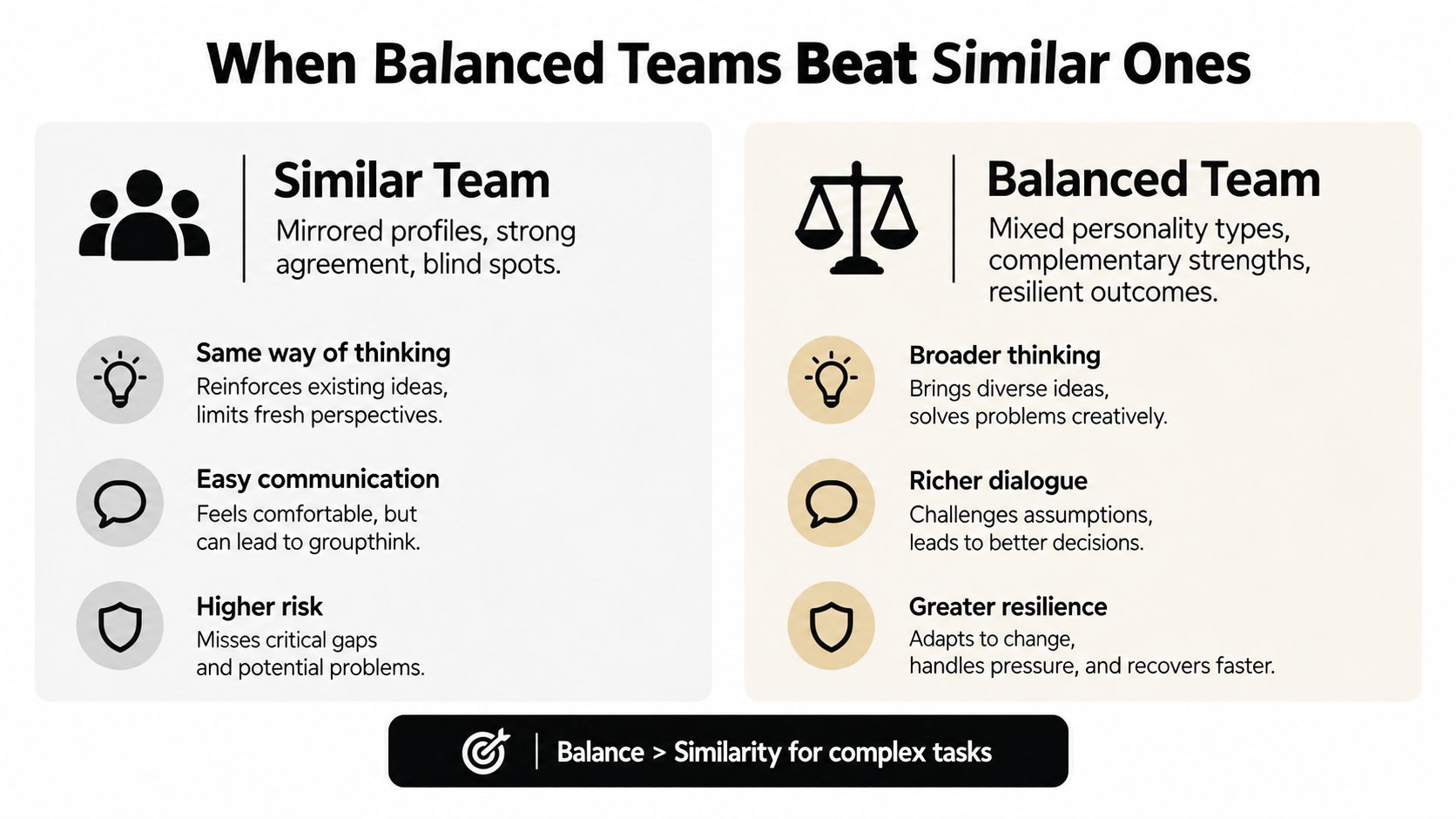
Research supports this distinction. An experimental study using DISC profiles formed 14 five-person teams, with N=70, and found that balanced teams performed significantly better on a collaborative task, with lower conflict and higher satisfaction. A separate study of 20 two-person construction crews found that compatibility explained more than half of the predictable variance in productivity. These findings are summarized in the [team personality and balance research](https://research-portal.uu.nl/en/publications/personality-matters-balancing-for-personality-types-leads-to-bett/).
Similarity still has a useful role. Shared procedures, comparable risk tolerance, and familiar communication habits can support repeatable work where consistency matters most.
Balance becomes more valuable when the task contains competing demands. One member spots an opportunity, another tests its risks, a third keeps stakeholders aligned, and a fourth protects quality under pressure. Their differences may create productive friction, especially when the team has enough trust to challenge ideas without turning disagreement into personal conflict.
Use the team's desired outcome to guide the choice:
A practical review starts with the work, not the score. List the behaviors required for retention, collaboration, or execution. Then map which members reliably provide each behavior. Crowded columns reveal duplicated strengths. Empty columns show gaps that may require hiring, role changes, or clearer ownership.
<iframe width="100%" style="aspect-ratio: 16 / 9;" src="https://www.youtube.com/embed/Qy7gthZ1XZY" frameborder="0" allow="autoplay; encrypted-media" allowfullscreen></iframe>
The useful question is not whether a team is generally compatible. Ask compatible for which outcome, and whether its composition supports that outcome.
The Bias Risk Hiding Inside Compatibility Matches
Could a compatibility match reward familiarity more than capability?
A high score can reflect smooth coordination, yet it can also favor candidates who resemble the people already making decisions. A 2025 study on AI bias in recruitment describes how similar-to-me and stereotype bias can enter AI-assisted hiring through flawed data and feedback loops. A 2024 sociology study also linked organizational fit judgments with gender, ethnicity, and cultural similarity in matching processes. [Review the research on bias in AI-assisted recruitment and organizational fit](https://www.tandfonline.com/doi/full/10.1080/09585192.2025.2480617).
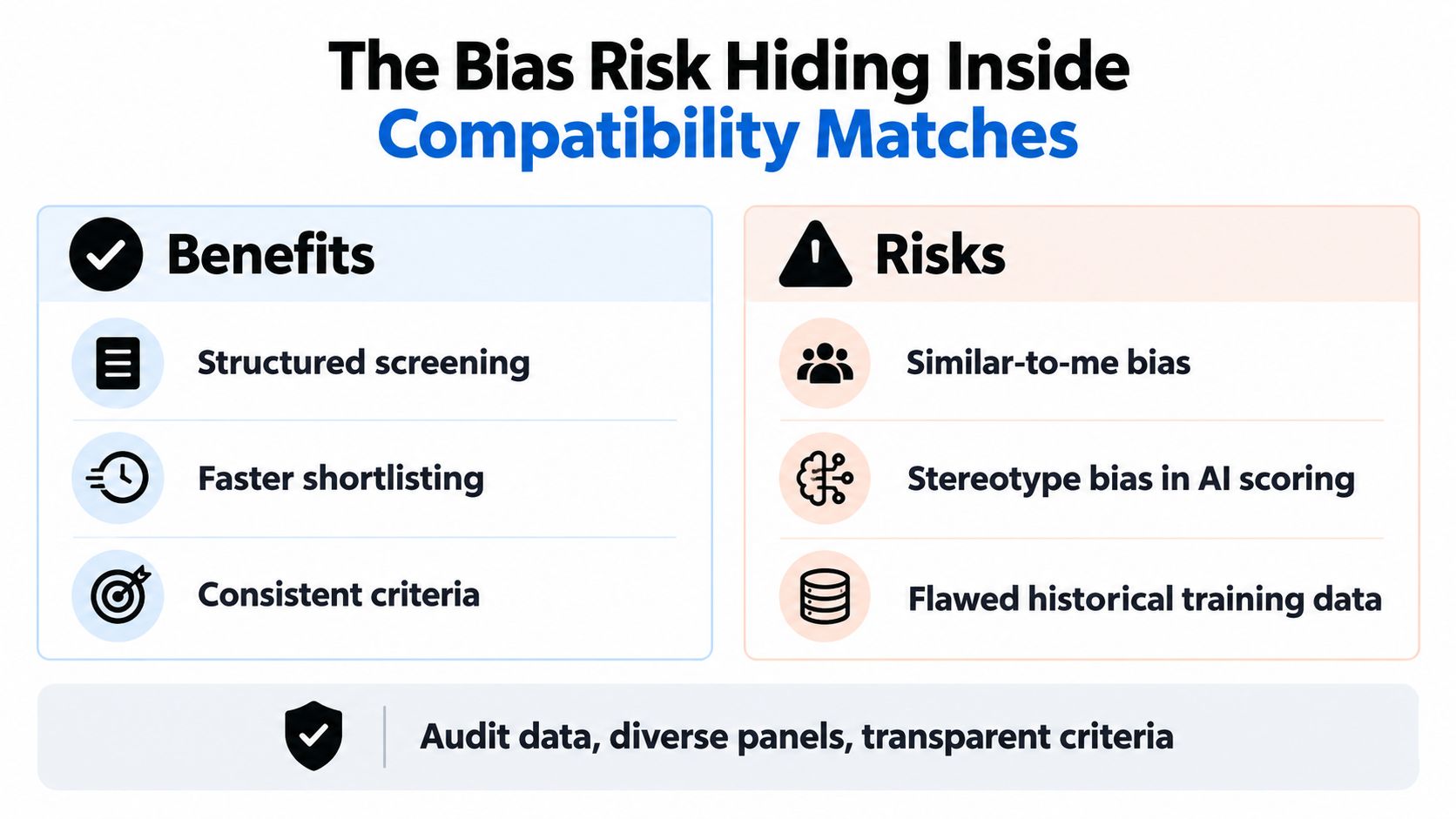
The pattern often begins with a plausible observation. Previous high performers may have communicated in a certain way, attended similar schools, or shared cultural references. A model trained on those outcomes can mistake these features for evidence of capability. Recruiters then select similar candidates, and their performance data reinforces the original pattern.
The system has learned familiarity, not necessarily job fit.
Audit the workflow for these warning signs:
Mismatch can be useful. Someone who questions a popular assumption may slow a meeting while improving the final decision. A manager and employee with different communication habits may need explicit operating agreements, then develop a strong working relationship. The right question is what outcome the difference affects, and whether the team can handle the friction it creates.
> Keep the mismatch that improves thinking. Remove the mismatch that blocks trust, safety, or execution.
Responsible compatibility analysis audits its data, defines fit layers separately, and uses structured criteria. It also invites multiple perspectives, separating a genuine role risk from a decision-maker's preference for familiar people. A score should support that judgment, not replace it.
How Synopsix Turns Compatibility Into Decisions
Operational compatibility analysis starts before a score appears. Candidates or employees complete a behavioral assessment, receive comparable profiles, and get psychometric findings translated into plain business language. Decision-makers can then connect those signals to simulations, compatibility analysis, and development plans.
Synopsix is one example of this workflow. Its product suite includes Assessments & Profiles, role-oriented Intelligence Reports, Predictive Simulations, and Human Interlink, which visualizes team complementarity and tension points. The sequence matters because each stage answers a different question:
1. Assess the person: Gather behavioral information consistently rather than relying only on conversational impressions. 2. Create a comparable profile: Represent candidates and employees in a common format. 3. Translate the profile: Explain likely work behaviors in terms that hiring managers and team leaders can use. 4. Test the relationship: Simulate friction, coordination, or role demands before making a high-consequence decision. 5. Act on the signal: Use fit recommendations and development plans to shape onboarding, management, or team design.
A buyer's checklist
Any compatibility tool should make its logic inspectable. Ask the vendor:
People leaders can also compare these requirements with roles listed in [talent acquisition jobs](https://wearedistributed.org/jobs/talent-acquisition) to understand the operational context in which hiring teams apply structured decision methods. For a broader view of the platform category, Synopsix's overview of [functionalities that transform talent management](https://synopsix.ai/blog/top-functionalities-synopsix-transform-talent-management) connects assessment, analysis, and action.
Compatibility matches work best when they sharpen judgment rather than replace it. Use them to identify questions, test assumptions, and design better working conditions. Don't use them to certify that one person is universally right for a role or team.
---
Synopsix turns behavioral assessments into comparable profiles, business-language insights, simulations, compatibility analysis, and development plans for hiring and team design. Visit [Synopsix](https://synopsix.ai) to evaluate fit layers separately, visualize complementarity and tension points, and make people decisions with clearer evidence.