Competency of Manager: A Practical Guide for HR Leaders
By Synopsix · September 10, 2026 · 17 min read
Most manager competency guides begin with the wrong premise. They present a polished list of skills, assume it applies equally to every management level, and then treat a promotion decision as if it were a simple matching exercise. That approach produces confident hiring panels, attractive competency libraries, and too many managers who perform well individually but weaken execution through others.
The better question is harder: which behaviors, in which role and under which pressure, reliably predict effective management? A manager's competence isn't a personality label or a permanent checklist. It's a role-specific combination of judgment, execution, people leadership, and the capacity to create conditions in which other people can perform.
That distinction matters because self-ratings often conceal the gaps employees experience most sharply. It also matters because managers increasingly carry operational pressure while being expected to coach, resolve conflict, support wellbeing, and build capability. HR leaders need a system that measures what managers do, not what they believe they do.
Why Manager Competency Is Harder to Define Than Most HR Teams Think
A typical competency library lists traits such as strategic mindset and people first, then applies the same list to every management level. That approach looks efficient, but it hides the conditions that determine whether a manager will succeed. A competency framework earns its place only when it distinguishes role demands, operating pressure, and observable evidence.
A front-line supervisor making shift-level decisions works in a different decision environment from a senior director allocating resources across functions. The supervisor needs fast operational judgment, reliable coaching, and clear communication at close range. The senior director needs strategic thinking, organizational design judgment, political awareness, and the discipline to decide with incomplete information. One list can name all these qualities. It cannot make them equally predictive in every role.
Time pressure exposes the weakness of generic frameworks. Managers with little time often prioritize urgent delivery over coaching, feedback, and capability building. Employees then experience the gap between the manager's self-rating and the behaviors they receive. That gap is not a side issue. It shows which competencies a framework rates highly in theory but underweights in daily work.
A [comparative study of managerial competencies](https://pmc.ncbi.nlm.nih.gov/articles/PMC11918287/) reached a similar conclusion. Strategic thinking, goal orientation, and performance management mattered especially for top managers, while team building and networking mattered for middle managers. Analytical thinking, problem solving, innovation, and creative thinking remained important across levels. Manager competency is therefore a layered capability set, not one universal trait.
The prediction problem
Stop asking whether a candidate “has leadership potential” in the abstract. Ask whether the person can demonstrate the behaviors required by a defined management role, at a defined level, under realistic constraints.
Separate three variables:
Managerial competency affects organizational performance and productivity, but it is not a single personality characteristic. The research describes it as a combination of ability, authority, skill, knowledge, and competence, making the construct multidimensional.
> Practical rule: Build manager standards around decisions and observable behaviors, not attractive adjectives.
<iframe width="100%" style="aspect-ratio: 16 / 9;" src="https://www.youtube.com/embed/f4CF-qBDu5o" frameborder="0" allow="autoplay; encrypted-media" allowfullscreen></iframe>
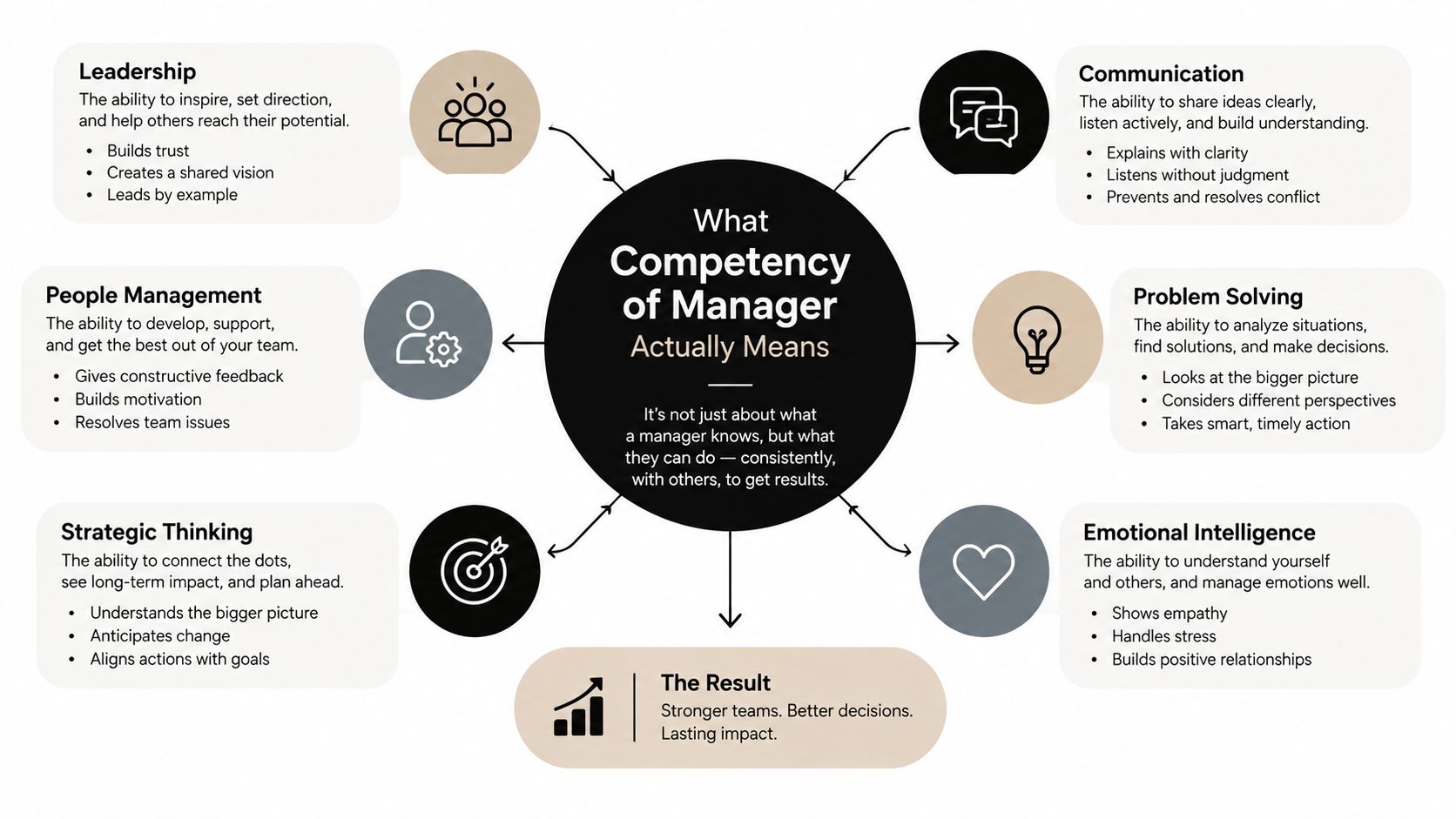
What Competency of Manager Actually Means
A useful working definition is simple: manager competency is the demonstrable combination of knowledge, skills, abilities, and behavioral patterns that enables someone to set direction, develop people, deliver results through others, and manage organizational complexity.
The word “demonstrable” does the important work. A person may understand coaching theory without holding a productive development conversation. They may describe strategic thinking without making a coherent trade-off. They may value accountability while avoiding a difficult performance discussion. Competency exists in behavior under real conditions, not in intention or self-description.
Five dimensions of effective management
A practical model should include several dimensions without turning into an encyclopedia.
1. Technical and functional depth Managers need enough subject knowledge to set credible standards, challenge weak assumptions, and make sound role-specific decisions. They don't need to be the strongest individual contributor forever, but they must understand the work they're accountable for.
2. People leadership This includes setting expectations, coaching, giving feedback, handling performance issues, developing successors, and creating psychological conditions for honest communication. Communication matters, but communication alone isn't people leadership.
3. Cognitive and strategic judgment Managers interpret information, identify priorities, solve problems, and make trade-offs. At more senior levels, they must connect operational choices to organizational direction.
4. Emotional and social capability Resilience, emotional regulation, empathy, conflict navigation, and relationship management determine whether a manager can remain useful when pressure rises. These capabilities are often less visible during interviews than verbal confidence.
5. Execution and delivery Competent managers convert goals into clear plans, allocate attention, follow through, remove obstacles, and inspect progress. They create accountability without turning every problem into surveillance.
Competency isn't the same as potential
Think of a manager as an orchestra conductor. Coordination is central, but the behavior changes with the size of the orchestra, the complexity of the score, and the consequences of a missed cue. A new supervisor may coordinate a small team through clear routines. A middle manager coordinates across teams with competing priorities. A senior leader coordinates systems, incentives, and decisions that no single team can see in full.
Performance describes what someone has delivered in a particular context. Potential describes the likelihood that they can handle broader or more complex work. Personality describes enduring preferences and tendencies. Competency overlaps with all three, but it isn't identical to any of them.
That distinction protects HR from a common error: promoting the highest-performing individual contributor and assuming their current performance proves readiness to lead through others. It doesn't. The organization must assess whether the person can create clarity, make decisions, coach effectively, and sustain execution after personal ownership of every task ends.
Core Manager Competency Frameworks Worth Knowing
Established frameworks are useful starting points, but none should be adopted as a complete answer. Each was designed for a particular purpose, and each emphasizes some manager behaviors while leaving others underdeveloped.
| Framework | Core Competency Clusters | Best Used For | Common Blind Spot | |---|---|---|---| | Katz three-skill model | Technical, human, and conceptual skills | Explaining how management demands change by level | It offers limited behavioral detail for assessment | | Lominger and Korn Ferry competencies | Leadership behaviors, learning agility, relationships, execution, and career derailers | Selection, development, succession, and leadership language | Broad catalogs can encourage checklist scoring | | Hay and McClelland job competency approach | Role outputs, motives, behaviors, knowledge, and job requirements | Job analysis, role architecture, and talent decisions | Quality depends heavily on disciplined role analysis | | Gallup manager domains and Google Project Oxygen | Manager behaviors connected to engagement, coaching, support, and team effectiveness | Manager development and behavior change | Visible behaviors can overshadow resilience and pressure judgment |
What each framework gets right
Katz's model remains valuable because it rejects the idea that all managers need the same balance of skills. Technical skill generally matters close to the work, human skill matters at every level, and conceptual skill becomes more consequential as managers handle broader systems.
Lominger and Korn Ferry provide a practical language for leadership behaviors, including potential derailers. Their value is greatest when organizations use the model to structure interview questions, development plans, and succession discussions rather than treating competency names as scores.
The Hay and McClelland tradition is stronger on job-linked competency analysis. It asks what successful performance requires in a role, including motives and behavioral patterns, rather than listing popular leadership traits.
People-leader systems such as Gallup's manager engagement domains and Google's Project Oxygen translate management into observable practices. They're useful for coaching, but HR teams should test whether their chosen behaviors capture difficult decisions, conflict, resilience, and follow-through.
A [leadership competency model](https://synopsix.ai/blog/leadership-competency-model) becomes more useful when each competency includes behavioral evidence, level-specific expectations, and a clear connection to decisions the manager owns. HR leaders who need a practical process can also [build a competency framework with LearnStream](https://learnstream.io/blog/competency-based-training-framework/), especially when converting broad expectations into structured development.
> Choose a framework for the decision it must support. Don't ask one model to perform selection, development, succession, and culture work equally well.
The strongest approach is usually hybrid. Use Katz to differentiate levels, a job-competency method to define role requirements, and a people-leader model to specify observable behaviors. Then add explicit measures for decision quality under pressure, employee experience, and follow-through.
How to Measure Manager Competency in Practice
No assessment method can reveal the full competency of manager on its own. Interviews capture judgment through language. Psychometrics describe behavioral tendencies. Simulations show behavior under designed pressure. On-the-job outcomes reveal consequences, but they're contaminated by team composition, resources, market conditions, and the quality of the manager's own manager.
| Method | Predictive strength | Cost and time | Key limitation at manager level | |---|---|---|---| | Structured behavioral and situational interviews | Useful when questions are role-specific and scored consistently | Moderate | Candidates can rehearse polished answers and overstate reflection | | Validated psychometric instruments, such as Hogan and CPI | Adds insight into tendencies, derailers, and interpersonal style | Moderate | A profile isn't proof of effective behavior in a particular culture | | Simulations, including in-basket exercises and role plays | Strong evidence of applied judgment, prioritization, and communication | High | Designed scenarios may not reproduce political or operational complexity | | On-the-job metrics, including 9-box data, engagement scores, and attrition | Shows consequences over time | Low assessment cost, high observation time | Outcomes may reflect context rather than manager capability |
Use triangulation, not a single score
Structured interviews should begin with incident-based prompts. Ask what the candidate did, what they noticed, what trade-offs they made, and what happened next. Situational questions can test judgment in unfamiliar conditions, but they shouldn't replace evidence from past behavior.
A validated personality measure adds a different lens. It can highlight tendencies related to pressure response, sociability, skepticism, ambition, or risk, but HR must interpret results in relation to the role. A high-energy profile may help in one environment and create listening problems in another.
Simulations expose gaps that interviews conceal. Give candidates a realistic in-basket, a prioritization problem, or a role play involving a struggling direct report. Score the exercise against a rubric that covers diagnosis, clarity, empathy, accountability, and decision quality.
The strongest process blends a situational interview, one validated personality measure, and at least one simulation. Then HR should compare those signals with outcomes over a meaningful observation period before locking in a promotion decision. For a detailed assessment design, see this guide to [assessing leadership competencies](https://synopsix.ai/blog/how-to-assess-leadership-competencies).
The literature supports using competency systems primarily as manager-level capability interventions. Competencies were positively related to individual manager performance, and mentoring managers on a competency system improved individual managerial performance, while the relationship with unit-level performance was weaker ([managerial competency and performance research](https://journals.sagepub.com/doi/10.1177/0149206305280789)). That means HR shouldn't promise that a competency score will directly guarantee team output.
Competency Expectations Across Front-Line, Middle, and Senior Managers
A healthcare network makes the level differences obvious. A front-line supervisor in a hospital, a middle manager coordinating several departments, and a senior executive shaping the network may all be described as “leaders,” but their competency demands are not interchangeable.
Front-line supervisors
The front-line supervisor lives close to operations. Their effectiveness shows up in staffing decisions, handoffs, service consistency, and the quality of daily coaching.
The strongest supervisors usually demonstrate:
Evidence should come from observed huddles, documented coaching conversations, schedule and handoff quality, and upward feedback from direct reports. A workshop exercise can't show whether the supervisor follows through during a difficult shift.
Middle managers
The middle manager translates network priorities into workable plans for departments that depend on one another. Their job is less about personally solving every operational issue and more about building coordination that survives competing demands.
Their disproportionate competencies include cross-functional influence, hiring judgment, and translation of strategy into team plans. HR should examine the quality of hiring decisions, the clarity of department objectives, peer feedback from partner functions, and examples of how the manager resolved resource conflicts.
A middle manager who communicates warmly but can't align departments will create friction. A manager who hits local targets by shifting problems to another department isn't demonstrating enterprise competence.
Senior leaders
Senior healthcare leaders carry broader consequences. They shape the talent bench, organizational structure, investment priorities, and ethical boundaries around resource allocation.
Assess them on talent bench depth, organization design judgment, and capital allocation ethics. Evidence includes succession readiness, the logic behind restructuring choices, how they balance service quality with financial constraints, and whether they create decision clarity for the layers below them.
The competency model should therefore change by level. Shared values can remain constant, but the behavioral evidence must reflect the manager's actual decision rights, span of influence, and operating horizon.
The Hidden Gap Between Manager Self-Rating and Employee Experience
A manager who can explain good leadership may still fail to practise it under pressure. Self-assessment is therefore weak evidence for promotion. Managers know the vocabulary of listening, openness, coaching, and resilience. Employees judge those qualities through repeated events: whether the manager notices strain, invites disagreement, follows up, and addresses conflict before it becomes personal.
A 2024 study found that managers systematically underestimated several competencies, especially psychological resilience, decision-making under pressure, and crisis management, while managers and employees showed greater agreement about communication and career experience ([study of manager and employee competency perceptions](https://jssidoi.org/jesi/article/1326)). HR frameworks often over-rate visible, easy-to-describe behaviors and under-examine what employees experience during demanding work.
What perception gaps reveal
Ask what the manager's communication feels like to the people who depend on it. That question produces better evidence than asking whether the manager communicates well.
Three patterns require close review:
Time poverty makes this gap harder to detect. Managers under constant pressure tend to rate competencies through intention and isolated examples. Employees experience the accumulated effect of short interactions, missed follow-ups, and decisions made when attention is limited. Frameworks that assess planned behavior without examining those moments will systematically over-rate communication and resilience.
Research on manager and employee perceptions also found disagreement about who initiates day-to-day conversations. 50% of managers said they initiate conversations, while only 21% of employees agreed ([manager and employee perception research](https://jssidoi.org/jesi/article/1326)). That difference shows why self-report cannot carry a promotion decision.
> Measurement rule: Require employee and peer evidence alongside manager self-rating, especially for resilience, pressure handling, and developmental behavior.
HR should use upward feedback in performance reviews and promotion gates. Protect respondents, examine recurring patterns, and ask about observable actions rather than broad judgments. A [360 assessment for leadership](https://synopsix.ai/blog/360-assessment-for-leadership) works best when its questions focus on specific behavior, not whether someone “is inspirational.”
I recommend giving employee and peer evidence at least 50% of the competency score before it affects a promotion decision. Adjust the weighting for the role and data quality, but never let self-assessment dominate evidence about behaviors employees experience directly.
Building a Hiring and Development System Around Real Manager Competency
Manager competency work should begin with the role, not an off-the-shelf leadership model. Define the decisions, relationships, pressures, and outcomes that distinguish the role at its level. Then build hiring, onboarding, development, and promotion around the same evidence.
Three hiring moves that improve signal
Replace generic leadership screens. Use structured behavioral interviews built around incident-based prompts. Ask candidates to describe a time they confronted weak performance, changed course after new information, handled disagreement with a peer, or developed someone who wasn't meeting expectations. Score the response against defined behavioral indicators rather than interviewer intuition.
Add a work-sample simulation. Give finalists a realistic case involving a struggling direct report. The candidate should diagnose the situation, prepare the conversation, set expectations, and explain follow-up actions. Score the exercise for judgment, clarity, empathy, accountability, and execution. A person who sounds strategic but can't conduct this conversation isn't ready for the role.
Require two upward references per finalist. Former direct reports can reveal whether the candidate created clarity, developed people, and handled pressure without transferring unnecessary anxiety to the team. Ask references for specific examples and recurring patterns, not general praise.
Development must address capacity, not just skill
Current manager expectations often exceed the time and support available. Deloitte-related 2025 coverage reported that managers spend about 40% of their time solving daily problems and administrative tasks, but only 13% developing people, while 36% said they were insufficiently prepared to manage people and 40% reported a decline in mental health after becoming managers ([Deloitte-related manager support coverage](https://www.hrdive.com/news/workers-need-skill-development-managers-still-lack-support-deloitte/743968/)). A competency model that adds coaching expectations without removing low-value work is a wish list, not an operating system.
Use a 90-day onboarding plan tied to the two weakest competencies for the manager's level. Create manager circles where participants compare self-ratings with upward feedback and practice difficult conversations. Set promotion gates that require multi-rater evidence, a simulation or work sample, and demonstrated improvement over time.
| Stage | Recommended Action | What It Measures | Success Metric | |---|---|---|---| | Hiring | Structured interview, role simulation, and upward references | Applied judgment, people leadership, and behavioral consistency | Quality of hiring decision and early manager effectiveness | | Onboarding | 90-day plan focused on two level-specific gaps | Transfer of learning into daily management | Time-to-productive and early retention | | Development | Manager circles, coaching, and targeted practice | Capability growth and perception-gap reduction | Direct-report engagement and observable behavior change | | Promotion | Multi-rater evidence plus performance context | Readiness for broader decision rights | Sustained performance in the new role | | Review loop | Quarterly HR review of evidence and outcomes | Whether the model predicts useful manager behavior | Retention, engagement, time-to-productive, and regrettable attrition |
Competency development should remain a manager-level intervention first, not a promise of automatic unit performance. HR should review direct-report engagement, retention of new hires, time-to-productive, and regrettable attrition alongside manager-level evidence. When a framework repeatedly fails to predict those outcomes, revise the framework instead of blaming managers for failing to match it.
Synopsix is one option for this evidence layer. Its platform uses behavioral assessments to create comparable profiles, translate psychometric signals into business language, and support leadership development, simulations, compatibility analysis, and team design. Used alongside structured interviews, upward references, and outcome data, it can help HR teams make manager decisions with more behavioral evidence and less reliance on self-description.
---
If your organization is promoting managers based mainly on individual performance and confident interviews, Synopsix can help you add structured behavioral evidence before the decision is final. Visit [Synopsix](https://synopsix.ai) to explore assessments, leadership intelligence reports, predictive simulations, and development guidance for manager hiring and talent pipelines.