Competing at Work: A Guide for CHROs and Hiring Managers
By Synopsix · August 11, 2026 · 13 min read
78.3% of U.S. workers say healthy competition at work is beneficial, which tells you this is not a fringe culture issue, it's a management system issue. The problem isn't whether people compete. The problem is whether leaders shape that competition into useful effort or let it turn into hidden rivalry, churn, and bad promotion decisions.
CHROs and hiring managers need to stop treating workplace competition like a personality trait and start treating it like a design choice. The same workforce can produce stronger output, worse collaboration, or outright attrition depending on how rewards, visibility, and feedback are built. That's why behavioral assessment data matters, because it lets you see competitive style before the attrition report forces the conversation.
For leaders who want to reduce guesswork, [conflict risk assessment](https://synopsix.ai/blog/conflict-risk-assessment) belongs in the same conversation as performance management. If you wait until people are already frustrated, you're managing a symptom, not a system.
Why Competing at Work Demands a Leader's Attention
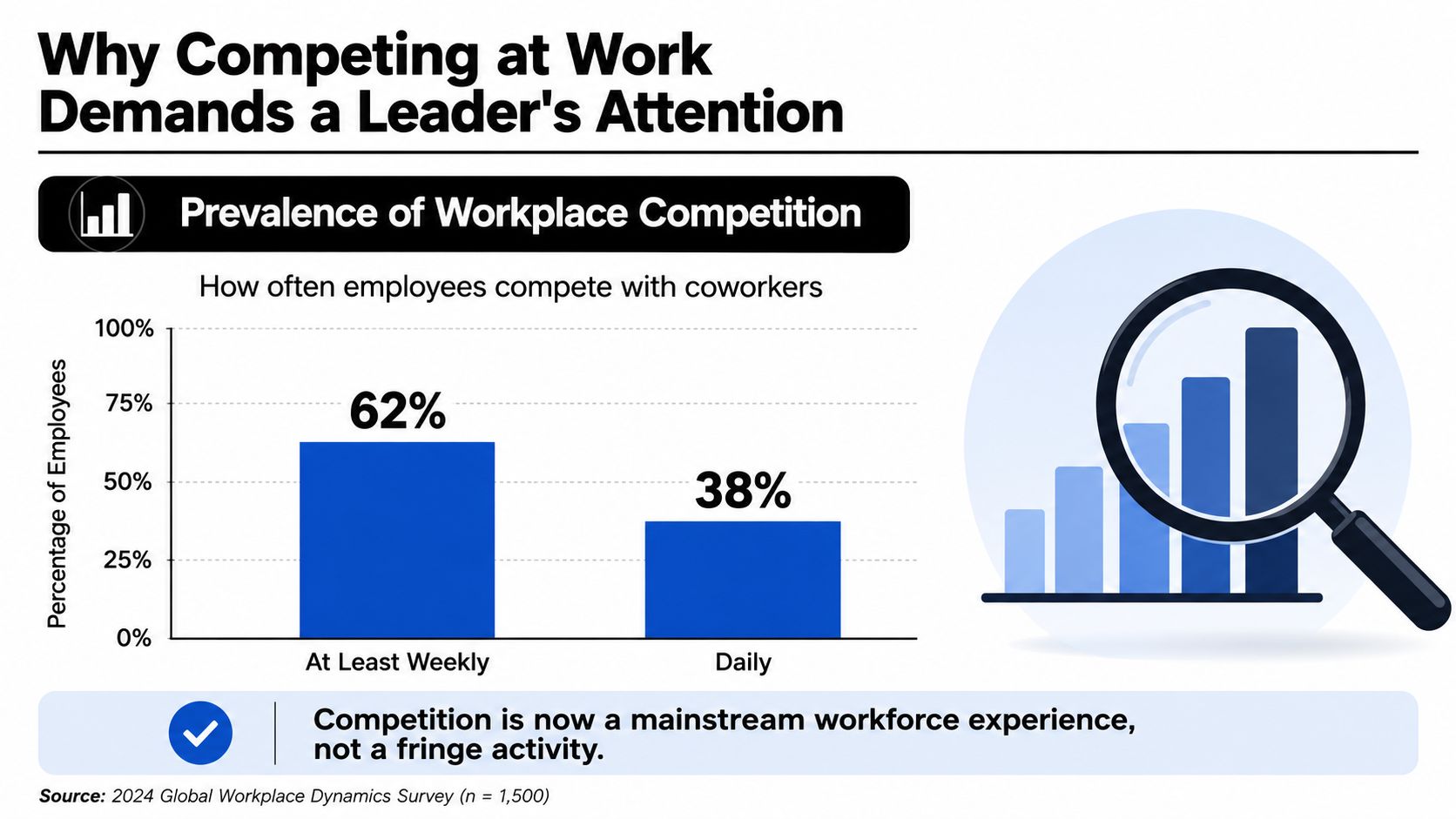
Competition is already part of the ordinary work week. A Robert Half survey found 28% of professionals said competition among employees at their company was higher than a year earlier, while 61% said it was unchanged and 11% reported a decline. That's not a niche dynamic, it's a mainstream operating condition, and leaders who ignore it end up reacting to the downstream effects, turnover, mis-promotion, guarded behavior, and silent disengagement. [Healthy competition boosts productivity survey](https://www.hrreporter.com/focus-areas/compensation-and-benefits/healthy-competition-boosts-productivity-survey/331518)
The pattern is uneven, which is exactly why broad-brush culture slogans fail. In that same survey, workers aged 18–24 and 25–40 were more likely than older cohorts to say rivalry had increased, and several U.S. cities, including Austin, Houston, and Miami, showed especially high shares reporting heightened competition. The practical message is blunt, competition doesn't land the same way across age groups, labor markets, or teams.
> Practical rule: if competitive pressure is rising in one part of the business, assume the effect is local first, not universal.
That's why CHROs should treat competition as a design variable across hiring, team composition, and performance management. If you're hiring for a role with direct output metrics, you can use competition differently than you would in an interdependent team that needs knowledge sharing. If you're redesigning rewards, you need to know whether the system is pushing people to win together or to protect their own standing.
The core business question is not whether competition exists. It's whether you can see it early enough to steer it.
What Competing at Work Actually Means
Competing at work is not one thing. An employee can have a competitive attitude and still behave cooperatively, while another can create tension through competitive behavior even if they claim they're “just driven.” Organizational research separates the mindset from the conduct, and that distinction matters because leaders often reward visible hustle while missing the interpersonal damage. [Organizational psychology research on competitive attitude and behavior](https://pmc.ncbi.nlm.nih.gov/articles/PMC6258773/)
Attitude is not behavior
Think about sports leagues versus a zero-sum poker table. In a league, players can want to win and still respect the rules, the referees, and the team structure. In a poker game, one person's gain comes directly from another person's loss, and when companies design internal contests badly, they recreate that second model inside a business that depends on cooperation.
> Plain truth: if your system rewards only rank, people will manage rank, not performance.
That's why “I like healthy competition” is a weak hiring signal by itself. You need to know whether the person competes by sharpening their own work or by undercutting others, hoarding information, or making everything public theater. The first can lift standards. The second burns trust.
A fast test for any performance system
Ask one question of every incentive you run. Does it reward shared wins, or only individual standing?
Use that test before you launch a contest, a calibration process, or a promotion cycle. If the answer pushes people toward guarding credit, you've built a rivalry machine, not a performance system.
The Three Faces of Workplace Competition
The easiest way to mismanage competition is to lump every competitive dynamic together. Leaders need a sharper vocabulary. In practice, workplace competition usually shows up as collaborative rivalry, zero-sum rivalry, or hidden rivalry, and each has a different footprint in meetings, feedback, and credit allocation.
Collaborative rivalry
This is the healthiest version. People know they're being compared, but the comparison is bounded by clear rules, shared goals, and transparent evaluation criteria. You see people push each other harder without undermining one another, and the team still shares information because the rules make it safe to do so. That aligns with the HBR view that competition can raise effort when rewards and evaluation are designed carefully. [The pros and cons of competition among employees](https://hbr.org/2017/03/the-pros-and-cons-of-competition-among-employees)
Zero-sum rivalry
Competition begins to erode the team when individual advancement feels like another's loss, prompting employees to withhold help, inflate their own visibility, and protect scarce opportunities. The Wharton paper on cooperation and competition demonstrates that subtle environmental cues can shift both mindset and action, meaning the system itself can push a team toward more combative behavior. [Wharton paper on cooperation and competition](https://faculty.wharton.upenn.edu/wp-content/uploads/2013/11/2013_08_31_SCPaper_SSRN.pdf)
Hidden rivalry
This is the hardest form to spot. People look friendly, but they're privately competing for attention, influence, or promotion credit, and managers only see the fallout when collaboration dries up. The World Economic Forum summary of rivalry research makes the point clearly, employees are often poor judges of who is competing against them, because rivals may hide behind friendly behavior. [Workplace rivals are often misread](https://www.weforum.org/stories/2017/03/if-you-think-you-know-who-your-rivals-are-at-work-youre-probably-wrong/)
| Rivalry Type | Behavioral Signature | Likely Outcome | Leader Response | |---|---|---|---| | Collaborative rivalry | Clear effort, visible respect, no credit theft | Higher drive without widespread distrust | Keep rules transparent, keep coaching private | | Zero-sum rivalry | Hoarding, posturing, selective help | Lower knowledge sharing, more tension | Redesign rewards and remove rank-only cues | | Hidden rivalry | Friendly surface, private scorekeeping | Surprise attrition, unclear ownership, resentment | Use behavioral data and stronger credit norms |
The business task is simple. Name the pattern early, then change the incentives before the pattern hardens.
When Competition Helps and When It Hurts
The biggest mistake leaders make is assuming competition is either good or toxic. It's neither. It's a tool, and like any tool, it depends on where you apply it, who you apply it to, and what problem you're trying to solve. The same competitive mechanism can sharpen output in one team and exclude people in another.
A useful warning comes from gender and inclusion conversations. A 2024 Conversation piece argues that competitive workplaces do not work well for gender equality, which is exactly why CHROs need to ask who gets pulled into the contest and who gets pushed out of it. [Competitive workplaces don't work for gender equality](https://theconversation.com/competitive-workplaces-dont-work-for-gender-equality-222689)
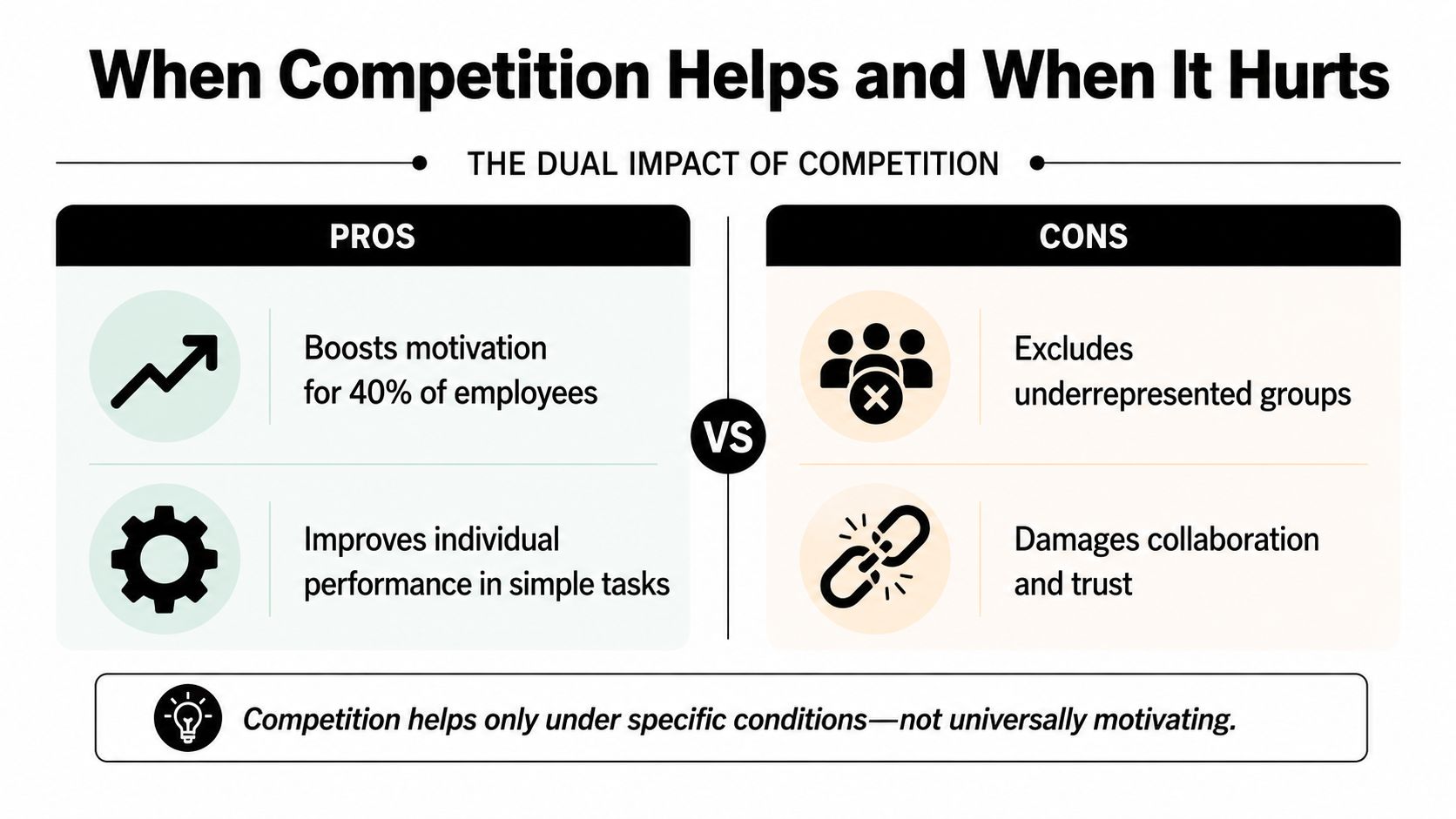
The warning signs are practical, not theoretical. If a contest makes lower performers disappear from meetings, if women or other underrepresented employees stop volunteering for visible work, or if the process starts rewarding aggressiveness over judgment, the mechanism is broken. The Core Values survey is a good reminder of what that kind of friction can produce, with 55% saying rivalry reduced job performance by creating undue stress or lower productivity, and only 6% saying it inspired them to do some of their best work. [When internal competition goes too far](https://corevalues.com/competition/when-internal-competition-goes-too-far-employees-quit/)
The key is not to ban competition. It's to use it where the work is measurable and the rules are fair, then avoid it where the work depends on trust, information flow, and joint problem solving. That means your fairness checklist should be short and brutal. Who can realistically win? What behavior does the system reward? Who gets visibility? What happens to people who don't rank near the top? If you can't answer those questions cleanly, don't launch the contest.
Detecting Rivalry Signals Through Behavioral Assessments
Behavioral assessments help leaders see competition before it becomes visible in turnover or team friction. That matters because rivalry is rarely the first symptom. The first symptom is usually a shift in how people handle feedback, credit, and proximity to status. [Behavioral assessment basics](https://synopsix.ai/blog/what-is-behavioral-assessment)
Read the signals, not the slogans
The useful signals are not “likes competition” or “wants to win.” You want to know whether a candidate shows dominance, status sensitivity, a preference for collaboration, and a stable response to correction. Someone high in competitive drive but low in status fixation can be a strong hire in a role with direct performance metrics. Someone highly status-sensitive may do well in structured environments, then become a friction source when recognition is ambiguous.
That's where tools like Synopsix can help leaders convert assessment data into business-language signals for hiring and team design. Its value isn't abstract psychometrics, it's the translation from behavioral profile to fit, friction, and role design. Use that kind of output to distinguish a person who competes through steady output from a person who competes by provoking comparison.
> Good hiring rule: reward evidence of disciplined striving, not just verbal comfort with competition.
How to interpret what you see
If an Intelligence Report flags low collaboration preference and high status vigilance, don't ignore it just because the person interviewed well. In a quota-driven role, that profile may be manageable. In a cross-functional role, it's a warning. Predictive simulations are even more useful because they let you test how someone may behave when recognition is scarce, feedback is ambiguous, or peers are strong.
Human Interlink-style team views are valuable after hiring too. They show where complementarity exists and where tension is likely to surface. That's the difference between building a team around balance and building one around repeated status contests. If you can see two people likely to compete for the same credit path, you can redesign ownership before they start blaming each other.
The business decision here is straightforward. Use assessments to separate productive rivalry from corrosive rivalry before either gets disguised as “high standards.”
A Manager Playbook for Productive Competition
Managers don't need a culture sermon. They need rules. If you want competition to raise effort without damaging psychological safety, design it around clarity, privacy, and task structure. Start by segmenting the work. Individual contests belong where output is measurable and owned by one person. Team incentives belong where the work is interdependent and credit is shared.
The moment you make rank public, you change behavior. That can be fine in a sales org where people know the rules and the metrics are clean. It's dangerous in a knowledge team where people need to ask for help, share drafts, and admit uncertainty. If your performance system makes people afraid to look behind, you've already damaged cooperation.
A few moves work immediately:
A practical supplement is [peer recognition leaderboards](https://asantebot.com/leaderboards/), but only if they reinforce behavior you want repeated. Use them to make contribution visible, not to create a permanent caste system. If you can't explain why someone is on the board in one sentence, your recognition model is too fuzzy.
For managers who need a clean escalation path, [team conflict resolution strategies](https://synopsix.ai/blog/team-conflict-resolution-strategies) should sit next to performance calibration, not behind it. Don't wait for a full-blown feud before you intervene. If the same two people keep competing for airtime, credit, or executive attention, change the meeting structure, the ownership model, or the feedback cadence.
Two Real-World Snapshots of Competition in Action
A sales organization used a visible leaderboard, shared quotas, and weekly recognition tied to pipeline quality. The result was healthy pressure, because everyone understood the rules and the score was tied to clear output. People compared themselves, but they didn't need to sabotage one another to improve their standing.
An engineering team in a different company had the opposite setup. Credit for ideas was ambiguous, feedback arrived asynchronously, and managers praised individual heroics without clarifying ownership. Engineers started protecting work, avoiding collaboration, and disengaging when they felt their contribution was being absorbed by others. The business problem wasn't ambition, it was a weak system for attribution.
If you want a deeper look at what strong team design looks like in technical environments, [how to build elite software teams](https://www.tekrecruiter.com/post/how-to-build-high-performing-teams-in-tech) is a useful reference point. The lesson from both cases is the same. Competitive instincts don't decide the outcome by themselves. The structure does.
That's why one team can use rivalry as fuel and another can turn the same impulse into attrition.
What CHROs and Hiring Managers Should Do Next Quarter
Start with three moves. First, run behavioral assessments where competition is part of the job, then review who shows disciplined striving versus status sensitivity. Second, audit your performance systems for public ranking, unclear credit, and reward structures that make people compete for visibility instead of results. Third, look at team design, especially where work is interdependent, and decide whether the current system helps people cooperate or forces them to guard their position.
Measure what matters. Track rivalry-related attrition drivers, review mis-promotion patterns, and watch Psychological Safety survey items closely. If a team has strong output but weak trust, you're probably paying for it somewhere else. If managers are relying on intuition instead of assessment data, they're reading the wrong signal.
If you need a more structured outbound motion around this topic, an [SDR](https://lathire.com/hire-sdr/) function can support the top of the funnel while you keep your internal talent decisions disciplined. The same applies to internal mobility. Don't let competition become the reason people leave before you've redesigned the system.
Escalate quickly if you see recurring credit disputes, rising silence in meetings, or high performers avoiding collaboration. That's when competition has stopped being productive and started becoming a management liability.
---
Synopsix helps leaders turn behavioral assessment data into clearer hiring, promotion, and team-design decisions. If you want to identify productive rivalry before it turns into friction, visit [Synopsix](https://synopsix.ai) and use assessment-driven reports, simulations, and team-fit insights to tighten your people decisions.