Achieve Competitive Advantage with People-First Strategy
By Synopsix · June 25, 2026 · 14 min read
Most advice on competitive advantage is stale. It tells leaders to cut costs, sharpen positioning, and build better products. That advice isn't wrong. It's incomplete, and in many markets it's dangerously incomplete. Competitors can match your feature set, undercut your pricing, and copy your messaging faster than most leadership teams admit.
The harder truth is this: your most durable edge comes from how you hire, combine, develop, and deploy people. If your leadership team still treats people decisions as judgment calls dressed up as strategy, you're leaving your advantage to chance.
The strongest companies don't just compete in the market. They build teams that make better decisions, adapt faster, and create a culture competitors can't clone. That's the moat. If you want a useful lens on the culture side of that equation, start with [understanding organizational culture in practical terms](https://synopsix.ai/blog/understanding-a-culture).
Beyond Products and Price The Real Competitive Advantage
Cheap wins attention. Better features win a quarter. Neither guarantees endurance.
A product edge is temporary if buyers can compare alternatives in minutes. A pricing edge is fragile if a competitor can absorb margin pressure longer than you can. Leaders who build strategy on those levers alone usually end up in a cycle of reaction. They launch, competitors respond, and the market resets.

Why the old playbook breaks down
The market now copies visible advantages quickly. Product ideas leak. Messaging gets mirrored. Tactics spread across industries within weeks. The one asset that remains difficult to replicate is the way your people think, work together, handle pressure, and execute priorities.
That is your behavioral moat. It isn't a slogan. It's the combined effect of hiring people with the right behavioral profile, placing them in the right roles, and shaping a culture that reinforces strategic execution.
> Practical rule: If a competitor can buy, copy, or imitate your advantage within a planning cycle, it isn't a durable advantage.
Serious companies already know that intelligence drives performance. According to a landmark 2023 analysis, 90% of Fortune 500 companies utilize Competitive Intelligence as a strategic tool to secure a Competitive Advantage, making it a foundational operational requirement for market leaders ([Evalueserve competitive intelligence statistics](https://www.evalueserve.com/blog/competitive-intelligence-statistics/)).
The moat competitors can't steal
Most leadership teams invest in market intelligence and still ignore people intelligence. That's a mistake. Knowing what competitors do matters. Knowing whether your own team can out-execute them matters more.
Investopedia's definition is useful because it's blunt. A competitive advantage is a unique attribute or capability that helps a business stand out from its competitors in the marketplace. That standard rules out generic talent claims. "We hire great people" isn't an advantage. A repeatable system for building teams with rare complementarity might be.
Here's the direct recommendation. Stop treating workforce decisions as HR administration. Treat them as strategy design. Your culture, team dynamics, and leadership fit are not soft factors. They determine whether your company can convert plans into outcomes when the market gets messy.
Understanding the Sources of Competitive Advantage
Leaders usually default to two classic sources of competitive advantage. Cost leadership and differentiation. Those still matter. But they don't stand on their own. They are outcomes of deeper organizational choices, not standalone strategies.
A more useful operating model has four pillars: cost leadership, differentiation, niche strategy, and people advantage.
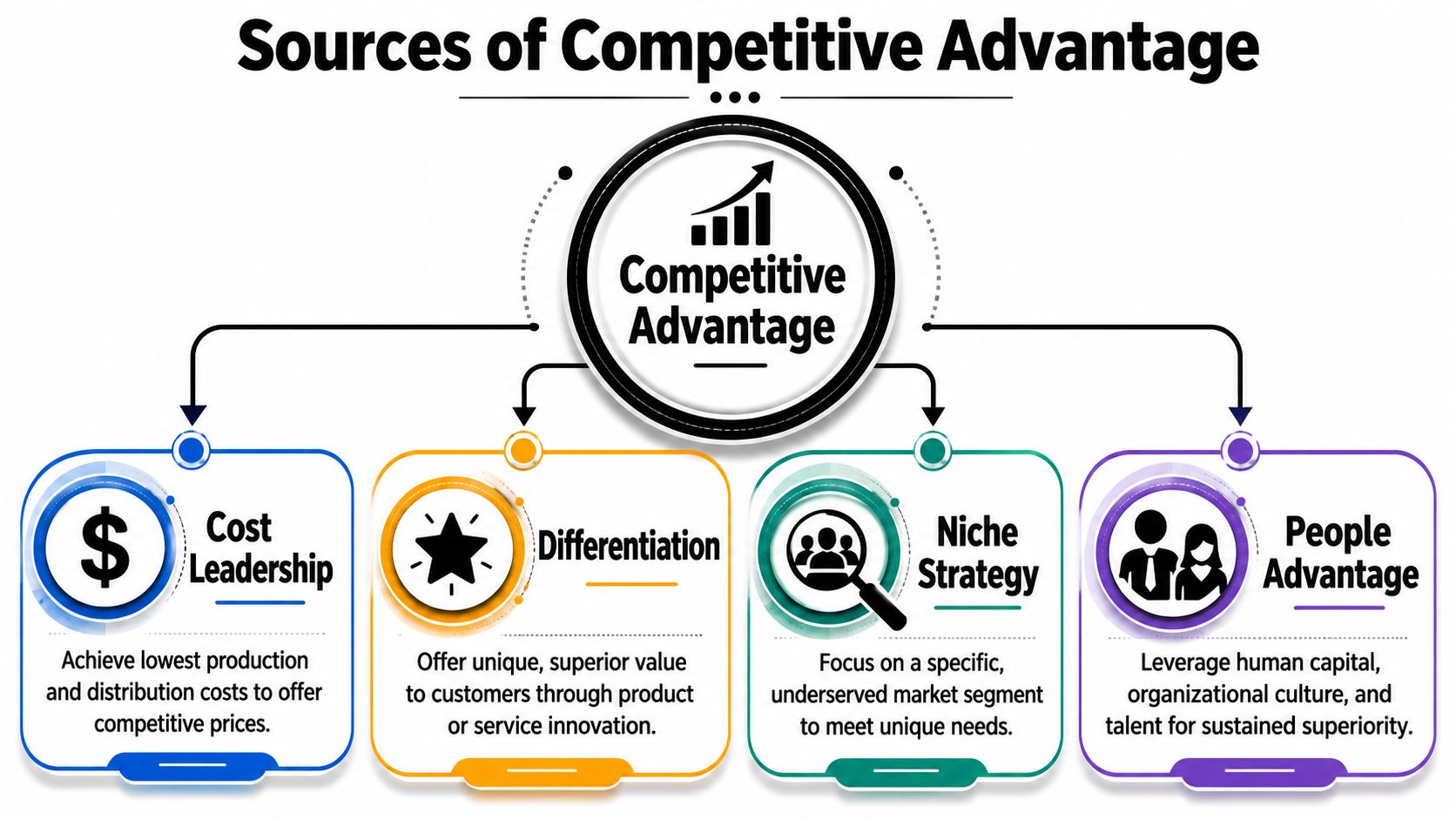
The four pillars leaders should actually use
The first three are visible in the market. The fourth is what powers them.
If you want a strong example of how market positioning and execution collide in practice, [South Africa's eCommerce battle](https://www.marketwithboost.com/insights/amazon-vs-takealot) shows why competitive advantage rarely comes from one lever alone. It comes from a mix of proposition, timing, operating discipline, and strategic fit.
Differentiation is behavioral, not just commercial
Many strategy conversations go soft at this point. Leaders talk about innovation as if it appears by declaration. It doesn't. It shows up in behavior.
Research on SMEs shows that a differentiation advantage uniquely correlates with five specific behavioral traits: ingenuity, proactiveness, risk-taking, competitive aggression, and autonomy, proving strategy is driven by specific behavioral profiles ([PMC research on competitive advantage formation in SMEs](https://pmc.ncbi.nlm.nih.gov/articles/PMC9650035/)).
That finding should change how HR and executive teams work together. If your growth strategy depends on differentiation, you can't build the company with people selected only for experience, pedigree, or interview charisma. You need people whose behavioral profile matches the strategy.
> The strategy deck says "differentiate." The hiring process still rewards caution and conformity. That's not alignment. That's self-sabotage.
A useful extension of this thinking sits inside [talent intelligence as a business tool](https://synopsix.ai/blog/what-is-talent-intelligence). The point isn't to admire data. The point is to connect workforce signals to business outcomes.
What this means for leadership teams
Ask four hard questions:
1. Where do we compete on cost, and where do we need uniqueness instead? 2. Which roles create our strategic edge, not just our headcount volume? 3. What behaviors does our strategy require under pressure? 4. Does our culture reinforce those behaviors or block them?
Most companies can answer the first question. Fewer can answer the last three. That's why people advantage remains underused. It's harder to define, but once you define it, it becomes harder for rivals to copy.
Turning People Strategy into Measurable HR Levers
Most leadership teams say people are their greatest asset, then run hiring through interviews that reward confidence, familiarity, and storytelling. That's not strategy. That's pattern bias.
If you want competitive advantage from people, you need to translate strategic intent into measurable HR levers. Otherwise "people-first" becomes a slogan with no operating value.
Start with the failure point
Traditional hiring methods create noise. They look structured from the outside, but they often rely on subjective interpretation and inconsistent standards across managers. That's why the predictive signal is so weak.
Traditional hiring methods have an accuracy correlation of only r=0.14 with future job performance, while scientifically validated psychometric assessments can exceed r=0.60, a nearly 4x improvement in predictive power.
That gap matters because every weak signal compounds downstream. Poor selection affects onboarding, manager time, team trust, promotion quality, and retention risk. The cost isn't just a bad hire. It's organizational drag.
> Gut feel isn't neutral. It favors the manager's preferences, not the business's needs.
Map strategy to specific levers
Once you stop relying on intuition, the work becomes more practical. Every source of advantage should connect to a workforce lever and a metric leadership can review.
| Source of Advantage | HR Lever | Key Metric to Track | | --- | --- | --- | | Cost leadership | Role design and productivity alignment | Time to productivity | | Differentiation | Behavioral fit for innovation and execution | Quality of hire | | Niche strategy | Segment-specific capability building | Internal mobility into critical roles | | People advantage | Team compatibility and leadership alignment | Performance and friction patterns |
The point of this table isn't the metric names. It's the discipline. HR has to stop reporting activity and start reporting decision quality.
Build a measurement system leaders can use
A workable people strategy should include:
Communication also matters. If your strategy changes and your workforce doesn't understand what matters now, alignment breaks fast. For teams rethinking how information travels internally, these [strategies for internal audio communication](https://www.podmuse.com/post/why-fortune-500-companies-are-choosing-internal-podcasts-over-email-updates) offer a practical example of how companies are changing message delivery so updates land.
The recommendation is simple. Audit every major people decision for evidence quality. Hiring, promotion, succession, and team design should all answer the same question: what proof do we have that this person will perform in this context with these people under these conditions? If you can't answer that clearly, you don't have a people strategy. You have a gamble.
A Practical Roadmap for Building Your People Advantage
Leadership teams don't need more theory. They need a process they can run.
A durable people advantage comes from four moves done in sequence: define the behavior your strategy requires, assess it with rigor, predict how it will play out in context, and act on the result. Skip any one of those and the whole model weakens.
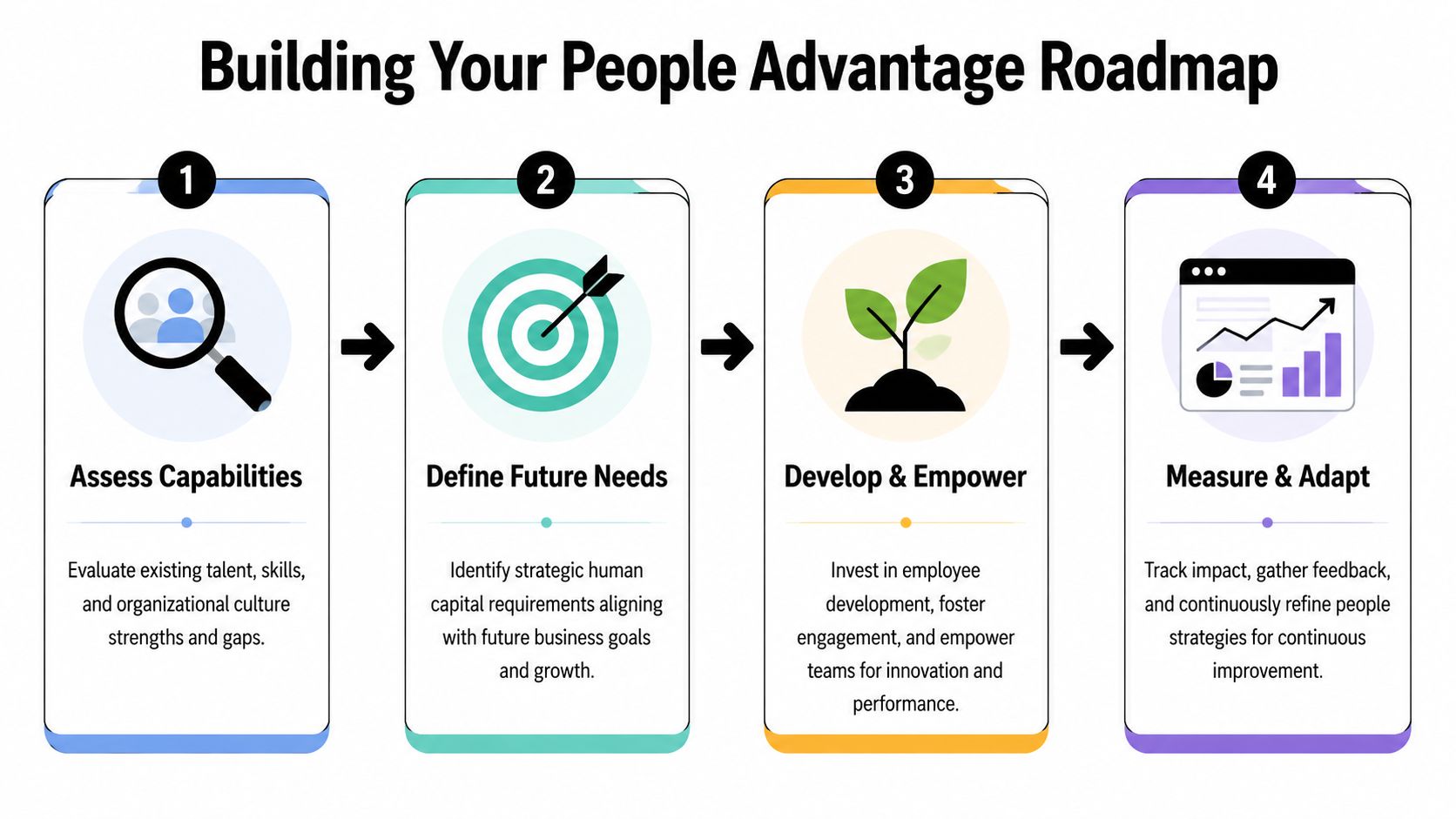
Step one define the behavior behind the strategy
Most strategy documents describe goals, not behaviors. That's why execution drifts.
If your business wants growth through differentiation, identify the behaviors that support that path. You may need people who show autonomy, competitive aggression, and comfort with ambiguity. If your model depends on operational consistency, you may need reliability, structured decision-making, and low variance in execution.
Write those requirements in business language. Don't hide them inside vague competency lists.
Step two assess with scientific discipline
Many companies frequently revert to interviews and manager preference. Don't.
Assessment should create comparable evidence across candidates and employees. It should tell leaders how a person is likely to operate, not just how well they present themselves. That means using validated methods and applying them consistently.
> Good hiring doesn't start with "Who impressed us?" It starts with "What does this role demand, and how reliably can we measure it?"
Step three predict team impact before you decide
A person can be strong and still be wrong for the team. That's the part many hiring systems miss.
A key question from leaders is "How do I differentiate my company when competitors copy my product?" Recent McKinsey data reveals 73% of high-performing firms attribute their sustained advantage to "culture and team dynamics" rather than technology or cost.
That is the practical definition of a behavioral moat. It means the decision isn't only about whether someone can do the job. It's whether they improve the system they join.
A few signals to model before making a decision:
For leaders investing in executive visibility and talent attraction, [LinkedIn personal branding](https://www.viralbrain.ai/blog/linkedin-personal-branding) is also relevant. The external brand of leaders shapes who enters your pipeline, but that signal only pays off if your internal selection process can identify who will thrive.
Step four act on the prediction
Prediction only matters if it changes decisions.
That means hiring managers need clear guidance. Recruiters need evidence they can defend. HR leaders need to use the data for promotion, succession, and team redesign, not just hiring. If the process ends with an interesting report that nobody operationalizes, you've built analysis, not advantage.
Use the output in four places:
1. Selection decisions for hiring and internal movement. 2. Onboarding plans developed to address likely risks and strengths. 3. Manager coaching so leaders know how to work with the person effectively. 4. Team composition reviews to spot complementarity and tension before performance drops.
This roadmap isn't complicated. It is disciplined. That's why it works.
How Synopsix Helps You Predict Human Behavior
Most companies understand the logic of better people decisions. They struggle with scale. The challenge isn't agreeing that team fit matters. The challenge is turning assessments, profiles, and simulations into decisions managers can use quickly.
That is where a platform approach becomes practical.
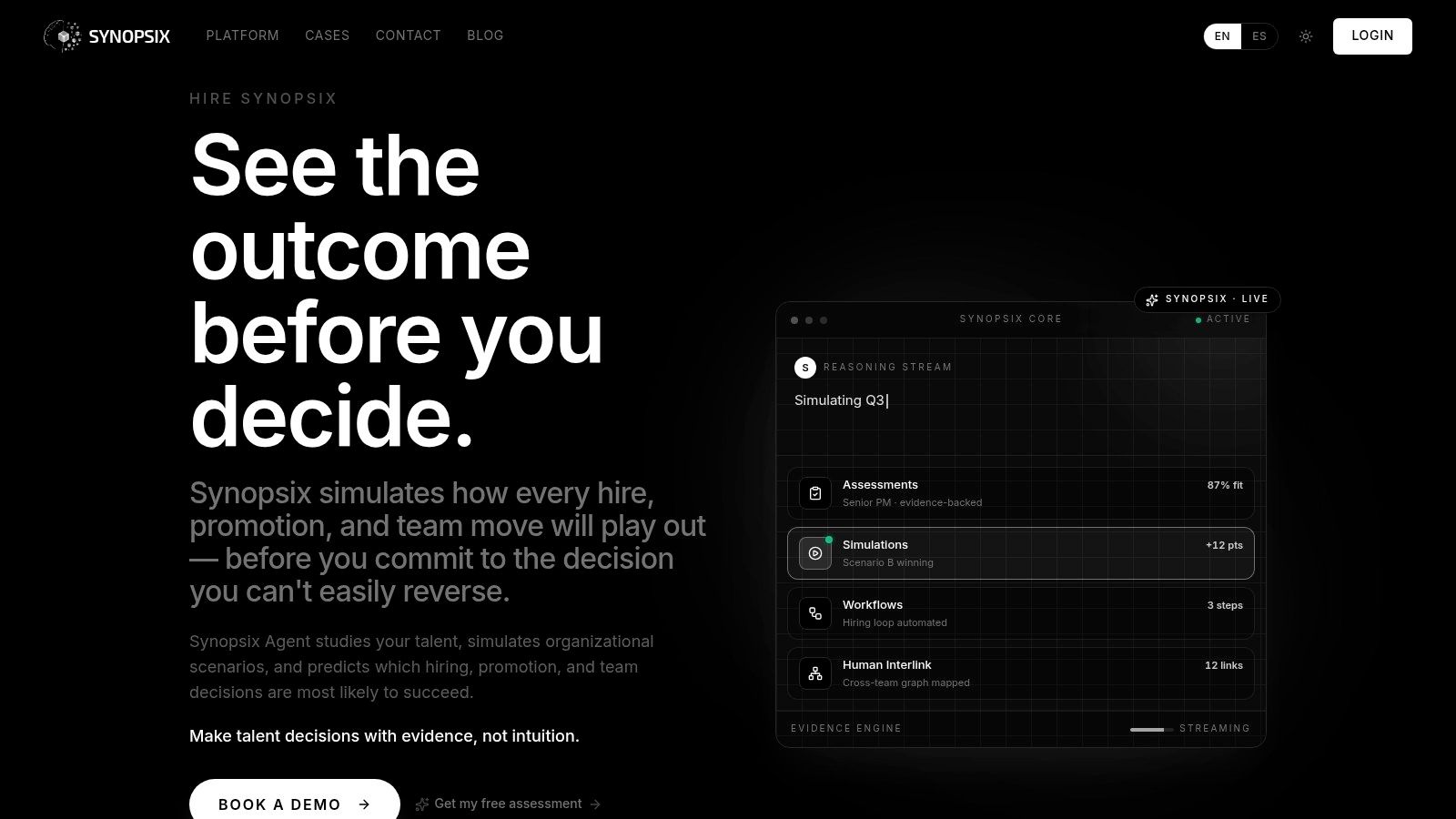
What an operational system needs to do
A useful system should handle four jobs well.
First, it should assess candidates and employees fast enough that the process doesn't stall hiring or development. Second, it should convert raw psychometric outputs into comparable profiles leaders can understand. Third, it should predict likely fit, friction, and role alignment in business language. Fourth, it should help the team act with clear recommendations.
That operating model is the difference between academic assessment and workforce execution.
Where vertical AI changes the equation
Specialized vertical AI models for recruiting, like those used by Synopsix, achieve a 94% accuracy rate in candidate-to-role matching by analyzing implicit behavioral data, far outperforming human recruiters and generic AI.
That matters because the hard part of people intelligence isn't collecting more information. It's detecting the implicit patterns that managers miss. A CV and a job description both contain non-obvious signals. Generic screening often reduces them to keywords. Vertical AI can interpret them as contextual evidence tied to role fit.
In practice, that lets leaders move from broad talent evaluation to specific decision support. Instead of asking whether a candidate looks strong, they can ask whether the person matches the behavioral demands of a given role, manager, and team setting.
If you're evaluating this category, [talent assessment and development approaches that connect data to action](https://synopsix.ai/blog/talent-assessment-and-development) are worth reviewing because the standard for usefulness is high. Leaders don't need more dashboards. They need fewer ambiguous decisions.
How it supports the roadmap in real work
A platform in this category becomes valuable when it supports concrete workflows such as:
This is also where AI-powered intelligence reports and predictive simulations become more than nice extras. They give hiring managers and HR leaders a way to compare people against a common frame. That improves consistency, especially across multiple managers who usually interpret talent differently.
The broader point is straightforward. Predicting human behavior doesn't replace leadership judgment. It improves it. Managers still decide. They just stop deciding blind.
Securing Your Long-Term Competitive Advantage
The market will keep copying what it can see. Products, pricing tactics, campaigns, and process improvements all move quickly across competitors. That's why long-term competitive advantage has to come from something less transferable.
Your workforce is that asset, but only if you manage it with evidence instead of instinct.
A people-first strategy works when leaders follow a disciplined loop. Define the behaviors your strategy depends on. Assess them with rigor. Predict likely outcomes within the specific team context. Act on those signals in hiring, promotion, development, and team design. Most companies talk about talent in broad terms. Few run that loop consistently.
What leaders should do next
If you're on an executive team, don't delegate this entirely to HR and call it support work. Treat it as a business system.
> The companies that win over time don't just hire capable people. They build teams whose behavior fits the strategy better than their competitors' teams do.
That is the behavioral moat. It doesn't come from motivational language or a revised values page. It comes from repeated, evidence-based decisions that align people, roles, and culture with the business model you're trying to build.
The leadership teams that embrace this shift will make fewer avoidable mistakes, build stronger pipelines, and execute with more consistency. The ones that don't will keep calling talent their edge while making critical people decisions on instinct.
---
If you're ready to turn people decisions into a real source of competitive advantage, explore [Synopsix](https://synopsix.ai). It gives leadership teams a practical way to assess behavior, compare talent, simulate fit, and make clearer hiring and development decisions without forcing managers to interpret technical assessment data on their own.