Contract Job Recruiters: Optimize Hiring, Avoid Mis-Hires
By Synopsix · July 26, 2026 · 18 min read
Your hiring manager just came back with the same problem in a sharper form. Eight engineers are needed fast, the internal TA team is already juggling live requisitions, and leadership still expects the same level of quality, speed, and compliance they'd demand in a normal quarter. That's exactly where contract job recruiters enter the picture, not as a generic staffing layer, but as specialists built for time-bounded, skill-specific hiring where the clock matters and the margin for error is thin.
The market around them is anything but small. The U.S. staffing, recruiting, and workforce solutions industry provided job and career opportunities for about 11 million employees in 2024, global staffing revenue was estimated at roughly $593 billion in 2023, and the broader staffing market has been projected to grow at a 5.2% CAGR from 2022 to 2028 ([American Staffing Association industry statistics](https://americanstaffing.net/research/fact-sheets-analysis-staffing-industry-trends/staffing-industry-statistics/)). Contract demand also had real momentum at the end of 2024, when APSCo's Hiring Trends analysis reported that new contract jobs increased 33% year over year and were 5% above December 2018 levels ([same source](https://americanstaffing.net/research/fact-sheets-analysis-staffing-industry-trends/staffing-industry-statistics/)). This isn't a side channel. It's a core operating model in modern hiring.
What Contract Job Recruiters Actually Do
The cleanest way to define contract recruiting is simple. It's hiring a person with specific skills to complete specific tasks for a fixed period, so the work is time-bounded and tied to a narrow need rather than open-ended employment ([U.S. Staffing, the definitive guide to contract recruitment](https://www.usstaffing.org/the-definitive-guide-to-contract-recruitment/)). A contract recruiter is the person or firm you bring in when the need is urgent, specialized, and temporary.
A typical surge looks like this. A product team needs eight engineers in six weeks, the internal recruiters are already working requisitions for permanent hires, and finance won't approve a headcount expansion that becomes permanent by accident. At that point, a contract recruiter is there to compress sourcing, screen for readiness, and move candidates through a process that's shorter than a standard search, but still disciplined enough to protect quality.
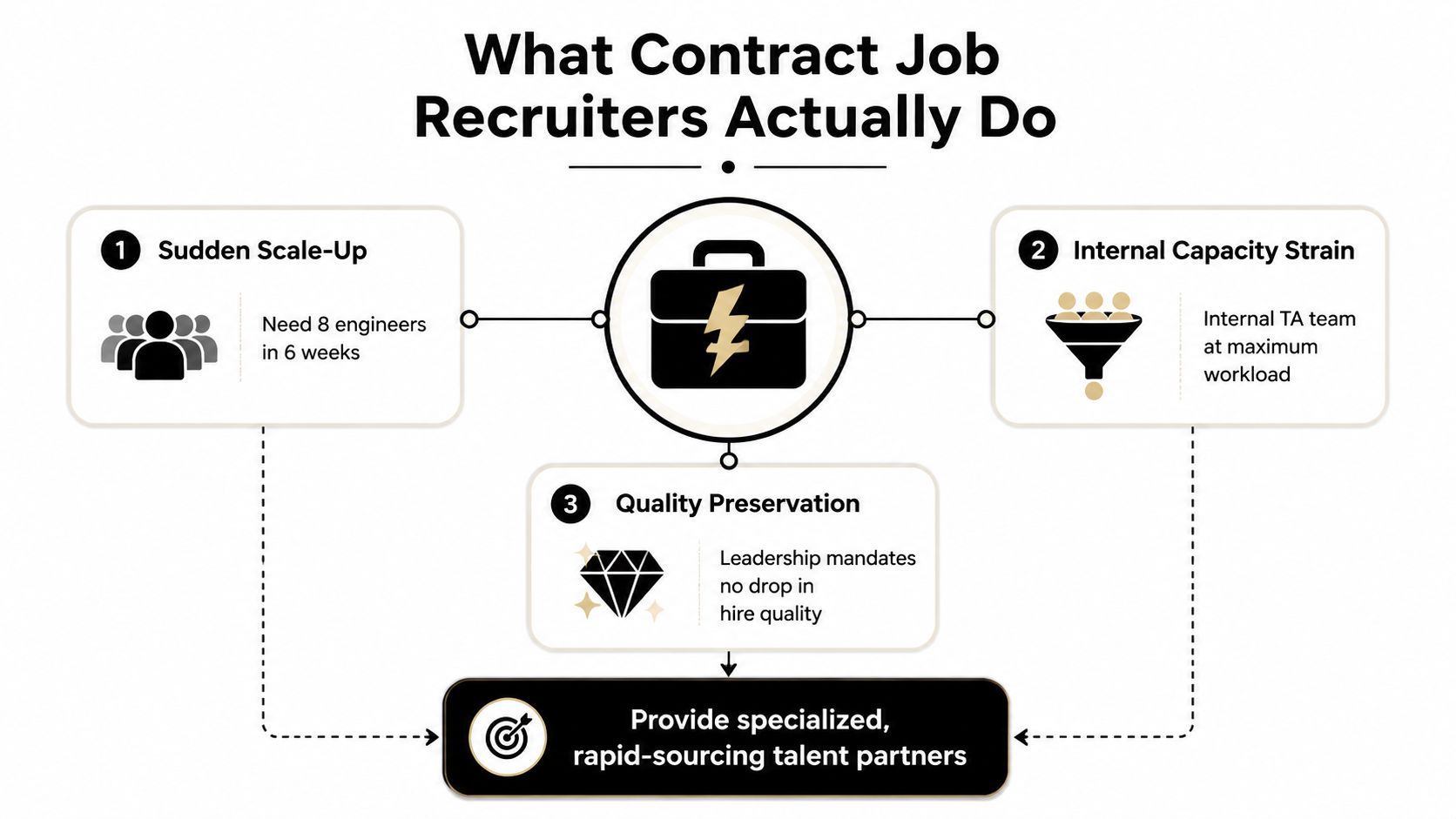
The role is narrower than most people think
Contract recruiters are not the contingent workers they place. They are the sourcing and delivery specialists on the buying side, or the external partner supporting that work, while the contractors themselves are the people hired for a fixed assignment. That distinction matters because the recruiter's job is to create a pipeline that can move quickly without skipping checks that keep the engagement legal and usable.
In practice, contract recruiters spend far less time on broad employer branding and far more time on readiness. They need to know who can start soon, who has the right clearances or work rights, who can survive a compressed process, and who won't create downstream issues after placement. The strongest firms are set up around time-to-fill SLA discipline, not vague promises of “fast placement,” with explicit targets such as 48 to 72 hours for niche roles ([Alpha Apex Group](https://www.alphaapexgroup.com/blog/top-contract-it-staffing-companies)).
The service model changes depending on who you hire
There's also a difference between hiring a contract recruiter and being one. A company hiring a contract recruiter is buying recruiting capacity for a finite business need. A recruiter working on contract is selling labor, judgment, and market access for that period. The mechanics overlap, but the incentives don't.
That's why contract recruiting often behaves more like a transaction market than a traditional employment search. The best practitioners optimize for short-cycle decision-making, candidate readiness, and compliance, not just sourcing volume. In the sections below, the actual operating models become clearer, because the market doesn't use one kind of contract recruiter. It uses several.
Four Recruiter Models Compared
The market often gets flattened into one external recruiting bucket, but the operating choices are very different. Large staffing agencies, boutique specialist firms, Recruitment Process Outsourcing providers, and freelance marketplace recruiters each solve a different hiring problem. Choose the wrong one and the result is usually friction, slower approvals, and candidates who look right on paper but do not fit the actual workflow or compliance demands.
| Model | Best For | Cost Structure | Speed to Ramp | Control Level | | --- | --- | --- | --- | --- | | Large staffing agency | High-volume, urgent fills across common skill sets | Usually mark-up on contractor pay, plus employment costs | Fast | Moderate | | Boutique specialist firm | Narrow technical, finance, or niche professional roles | Placement fee or hourly/retained hybrid | Fast once the niche is understood | Higher | | Recruitment Process Outsourcing provider | Scaling an entire hiring function or a recurring program | Embedded monthly or program-based fee | Moderate | High for the client, but with shared process ownership | | Freelance marketplace recruiter | Short bursts of sourcing support or overflow work | Hourly or project-based | Very fast to start | High, if the client manages the process tightly |
Where each model wins
Large staffing agencies usually win on volume and reach. They are built to keep a bench warm and move quickly when a client needs multiple contractors at once. The trade-off is usually in the mark-up structure, so the headline rate can look convenient while the fully loaded cost is higher than expected. That matters when you are deciding whether speed is buying real capacity or just shifting cost into the back end.
Boutique specialist firms are better when the skill set is narrow and the market is tight. If the role demands hard-to-find technical judgment, a recruiter who lives in that niche can outperform a generalist almost every time. The trade-off is depth over breadth, which often means a more selective candidate flow and less flexibility if your brief changes mid-search.
RPO is a different commercial choice. If you want a practical explanation of that model, the [HireAccountants RPO guide](https://hireaccountants.com/what-is-recruitment-process-outsourcing/) is useful because it shows how embedded hiring support differs from transactional agency work. RPO makes sense when the client wants process ownership, not just submitted candidates, and that usually includes tighter control over intake, reporting, and consistency across requisitions.
Freelance marketplace recruiters are best for overflow and short bursts of support. They can help when an internal team needs capacity fast, but the control burden stays with the client. If the brief is weak, if approval steps are messy, or if hiring managers do not respond quickly, the speed advantage disappears. Managing a contingent workforce well still requires discipline on your side, which is why teams often pair this model with a clear operating framework like [Synopsix's contingent workforce management approach](https://synopsix.ai/blog/managing-a-contingent-workforce).
> Practical rule: pick the model that matches your operating constraint, not the one with the slickest pitch deck.
The bigger mistake is treating these models as interchangeable. They are not. One is a volume engine, one is a niche instrument, one is a process wrapper, and one is a flexible capacity patch. The right choice depends on how much control you want to keep, how much process risk you can tolerate, and how much of the hiring burden you are willing to hand off.
A second mistake is ignoring contractor decision-making. A recruiter can source quickly and still create the wrong outcome if the hiring process pushes candidates toward speed-only choices, skips availability checks, or glosses over compliance requirements. The better firms surface those trade-offs early, then use people-intelligence signals to reduce mis-hires before the offer stage.
When to Use Contract Recruiters vs Internal Talent Acquisition
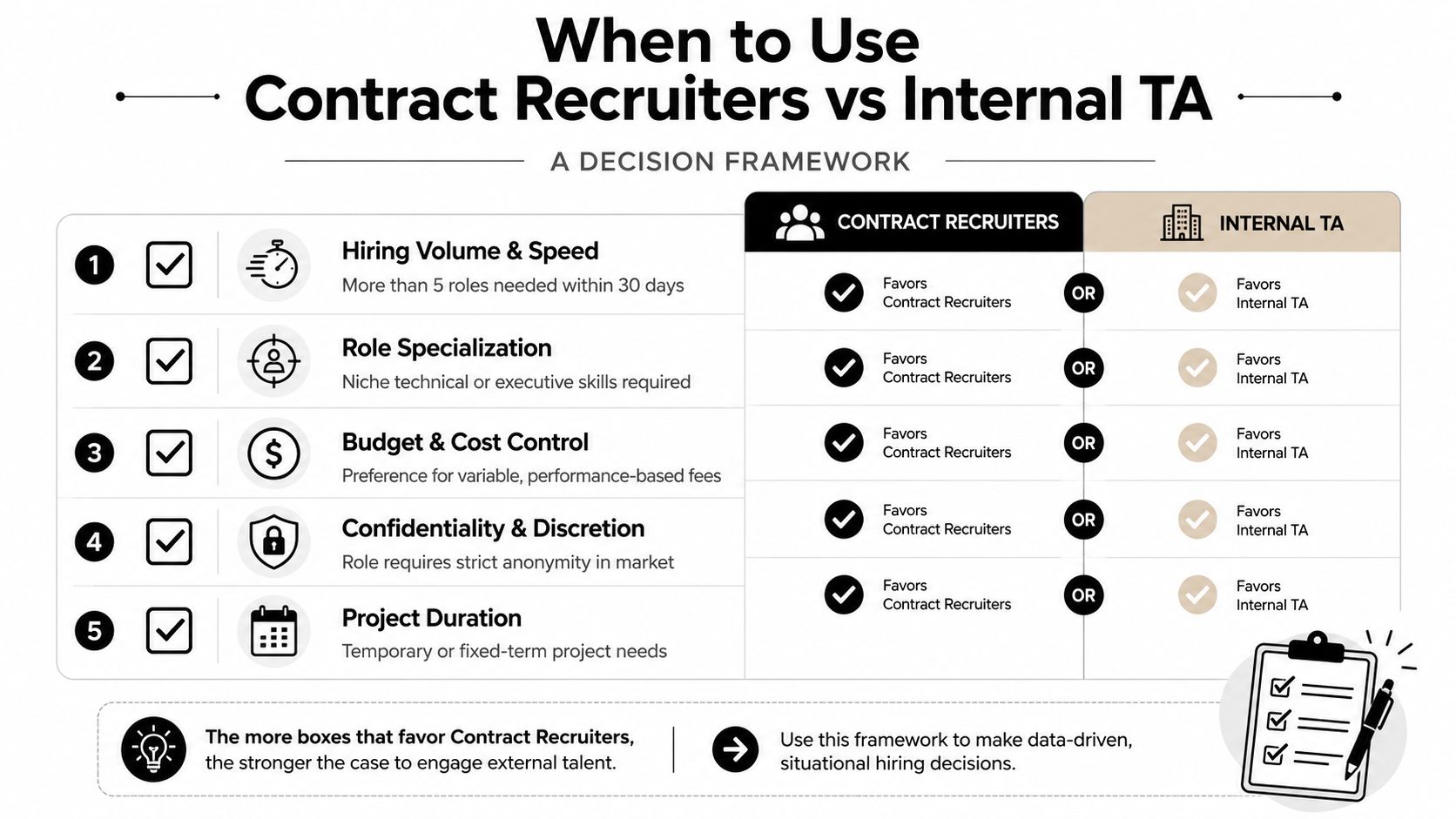
A hiring lead rarely faces a clean choice here. The decision sits between keeping work inside talent acquisition and handing part of it to contract recruiters, while still protecting compliance, candidate quality, and manager time. In practice, the right answer depends on five variables that are easy to score and hard to ignore once you write them down, hiring volume and surge duration, role specialization and scarcity, internal team bandwidth, compliance complexity, and budget flexibility. If three or more of those are under pressure, contract recruiters usually make more sense than stretching internal TA past its limit.
A simple scoring method works well. Rate each variable from low to high based on urgency and complexity, then total the pressure points. If volume is high, the role is niche, the team is saturated, and compliance is messy, the external option usually wins. If only one variable is strained, internal TA often stays the better option because context and control matter more than raw speed. That is especially true in teams that are already managing a contingent workforce and need the hiring process to fit existing controls rather than add more handoffs.
Speed is not automatic
The common myth is that contract recruiters are always faster. They aren't. Speed comes from pre-vetted talent pools and smooth compliance processing, not just from spending more hours on sourcing. A recruiter with no relevant bench is just as slow as an overloaded internal team, only more expensive.
The operating model matters. Contract recruiters who already know the market, keep active availability trackers, and have onboarding workflows in place can move quickly because they are not starting from zero. The firms that do not have those inputs end up relying on the same slow mechanics everyone else uses.
Hybrid models often work best
Many teams get the best outcome from a hybrid approach. Internal TA owns the hiring standard, the hiring manager relationship, and the final decision. Contract recruiters absorb the surge work, fill hard-to-source roles, or embed inside the team for a fixed stretch. That model protects institutional knowledge while adding capacity where the bottleneck is.
Compliance deserves special attention here. Temporary hiring does not exempt you from worker classification, onboarding, or cross-border work-rights issues. A speed-first process that ignores those risks can create more cleanup work than it saves, especially when contractors sit in multiple jurisdictions or work remotely across borders. Morgan McKinley's guidance on attracting and recruiting contractors makes that trade-off plain, and it is worth comparing with the practical detail in a [comprehensive guide for UK contractors](https://umbrellacompany.com/find-a-subcontractor/) before you decide how much risk you want outside your own team.
> A contract recruiter is valuable when they remove a constraint your internal team cannot remove fast enough, not when they simply duplicate the same process at a higher cost.
The better decision makers do not ask whether external recruiting is better in the abstract. They ask where the bottleneck lives, who owns the risk, and how much flexibility the budget really has. They also ask how contractor decision-making will be tested before the offer stage, because speed without people-intelligence checks can still produce a mis-hire.
How to Select and Interview a Contract Recruiting Agency
Choosing a contract recruiting agency should feel more like vendor due diligence than a casual chemistry check. The stakes are too high for vague promises. You want to know how they source, how they screen, how they manage compliance, and what happens when their process doesn't hold up under pressure.
Start with the pre-vetted talent pool. Ask what the pool looks like for your exact role type, not for “technical roles” in general. A credible agency can explain where the candidates come from, how often they're re-engaged, and how recently they were screened for availability or work rights.
Then move to compliance. The right question is not whether they “handle it.” The core issue is how they handle worker classification, onboarding, and any cross-border restrictions that could apply. If they're vague here, they're asking you to absorb the risk while they keep the margin.
For contractors in the UK market, a [comprehensive guide for UK contractors](https://umbrellacompany.com/find-a-subcontractor/) is a useful reference point because it makes clear how much practical detail sits behind a simple “we can source quickly” claim.
Interview questions that expose the real quality
Use direct questions, and listen for specifics.
> If an agency won't explain how it sources, you're probably buying enthusiasm, not delivery.
Red flags that usually predict problems
Watch for agencies that refuse to share SLA terms, quote rates without explaining what's included, or lean on broad claims instead of role-specific proof. Another red flag is a recruiter who talks only about “speed” and never mentions compliance or contractor decision criteria. That usually means they're optimizing for submission volume, not hire quality.
References matter, but only if they're relevant. Ask for references tied to contract work, not just permanent placements, because the cadence, risk profile, and operational pressure are completely different. A good pilot is a short, narrowly defined engagement with one or two roles, clear SLA terms, and a review point before you scale.
When the pilot goes well, expand. When it doesn't, you've learned cheaply. That's better than signing a long-term agreement based on a polished intro call and a rate card.
Integrating People Intelligence Into Contract Hiring
A contract recruiter can fill a seat quickly and still miss the assignment. That happens when the screening process stops at skills, availability, and a polished interview. In contract work, a weak fit shows up fast, because there is less time for a contractor to adjust, and less room for a hiring team to discover problems after the work starts.
People intelligence changes that decision point. Behavioral assessments can create comparable profiles in under 30 minutes, then turn psychometrics into business signals like risk indicators, role-fit recommendations, and team compatibility analysis. A [talent intelligence platform](https://synopsix.ai/blog/talent-intelligence-platform) gives hiring teams a structured way to use those signals, but the larger point is more practical. Contract hiring needs prediction, not just screening.
Where assessments fit in the workflow
The strongest placement point is after the first screen and before the final offer. By then, the recruiter has already verified the basics, including skills, availability, and logistics. The assessment then gives the hiring team a clearer read on how the candidate is likely to handle deadlines, collaboration, ambiguity, and pressure once the assignment begins.
That matters because contractor markets move fast and rely heavily on relationships, but many hiring teams still treat them like permanent searches with shorter timelines. People intelligence works better here because it gives decision-makers a structured way to compare candidates on the signals that often get missed in a résumé review.
There is also a tactical gain for specific roles. Intelligence Reports for leadership and sales roles can surface where a contractor may create friction before day one. Predictive Simulations can show how someone might respond in realistic work scenarios, which is more useful than hoping the interview captured enough context. Decision-makers get concise reports in business language, so they do not need to decode technical psychometric jargon.
Why this matters more in contractor searches
Contractor decision drivers are often practical rather than abstract. Pay volatility, notice-period risk, assignment length, and client reputation all shape whether a strong-looking candidate will accept and stay engaged. Ignore those factors, and fit gets misread even when the technical screen looks clean.
People intelligence also helps when multiple stakeholders are involved. A hiring manager may want the most experienced person. Finance may want the lowest cost. The recruiter may want the fastest yes. A structured behavioral profile gives the group something better to discuss than gut feel.
> The strongest use of assessments in contract hiring is not to replace recruiter judgment. It is to catch the kind of mismatch that only shows up after the contractor has already started billing.
When the role is critical and the timeline is short, even a small misread becomes expensive. A good behavioral signal does not remove risk, but it makes the decision more honest.
KPIs and SLAs That Protect Your Hiring Outcomes
If the recruiter only reports on submission count or response time, the process will drift toward what is easiest to defend. Those numbers can look healthy while the wrong contractor gets through, the client relationship weakens, or the assignment falls apart after start date.
The core KPIs are straightforward: time-to-fill, submittal-to-interview ratio, offer acceptance rate, first-90-day retention, and hiring manager satisfaction score. Each one catches a different failure point. Time-to-fill shows whether the recruiter can move at the pace the role needs. Submittal-to-interview ratio shows whether the shortlists are credible. Offer acceptance rate reflects whether the recruiter understands contractor decision drivers such as pay volatility, notice-period risk, assignment length, and client reputation. First-90-day retention and hiring manager satisfaction show whether the hire held up after the offer was signed.
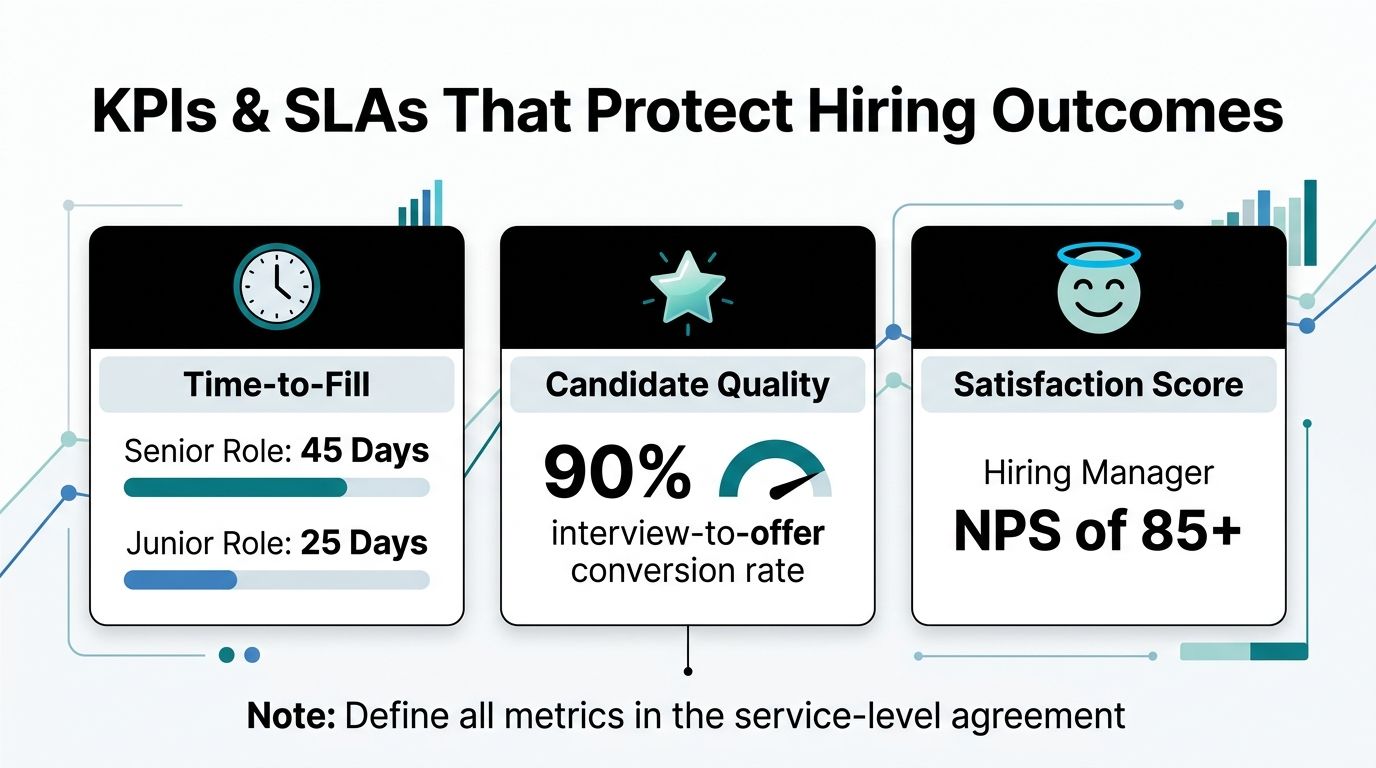
The SLA needs consequences
A target without a consequence is just a hope. If the recruiter misses an agreed deadline, the contract should state what happens, whether that means a fee reduction, a replacement obligation, or both. If a contractor leaves early, the agreement should define the replacement window and whether part of the original fee is refundable.
A practical SLA clause usually covers four things:
1. Role-specific time-to-fill targets, written by role family rather than one blanket number. 2. Submission quality standards, so a candidate counts only if they are interview-ready. 3. Retention or replacement terms, tied to early attrition. 4. Compliance obligations, especially where cross-border work rights or classification risk exists.
A clean way to write the deal
Define the role, define the target, define the proof, and define the consequence. That keeps the commercial agreement from drifting into vague “best effort” language. It also gives the hiring team something concrete to point to when delivery slips.
You can also set a service expectation around hiring manager satisfaction instead of just volume. That matters because a recruiter can flood the pipeline and still miss the brief. If the manager does not trust the shortlists, the process is failing even if the activity report looks busy.
For a practical comparison of fixed-term and conversion models, the [contract-to-hire position overview](https://synopsix.ai/blog/what-is-contract-to-hire-position) is useful because the same discipline applies when a temp assignment may later become permanent. The point is not to chase speed alone. The point is to measure whether the recruiter is helping the business choose contractors who can make the assignment work, stay compliant, and avoid a costly mis-hire.
Onboarding and Contracting Practices That Reduce Mis-Hires
A lot of contract mis-hires don't happen at sourcing. They happen after the offer is accepted, when the contractor walks into a confused environment with weak expectations and patchy access. That's where structured onboarding and tight contracting matter more than polished interviews.
Start with a contractor-specific onboarding checklist. Day-one access provisioning should be ready before start date, role expectations should be written in plain language, and the first check-in should happen within 48 hours. Those steps sound basic, but they're often the difference between a contractor ramping cleanly and one spending the first week blocked by admin.
The contract itself should protect both sides. Scope-of-work language needs to be explicit, termination clauses should tie to performance milestones where appropriate, and IP assignment terms should be unambiguous. If the contractor is remote or cross-border, the classification and tax obligations need to be settled before work begins, not after the first invoice lands.
For a deeper look at conversion and fixed-term design, the [contract-to-hire position overview](https://synopsix.ai/blog/what-is-contract-to-hire-position) is a helpful reference because the same discipline applies when a temp assignment may later become permanent.
Use a two-week performance gate
A two-week performance gate is a simple safeguard. The contractor starts, both parties observe real work, and then the client confirms whether the assignment should continue as planned. That early checkpoint catches issues that interviews miss, especially around communication style, pace, and manager fit.
It also pairs well with behavioral baselines. If you already captured a people-intelligence profile before the offer, you can compare the early signals against the profile and look for misalignment before the engagement becomes hard to unwind. That's not about over-engineering the process. It's about reducing the cost of a wrong start.
> A contractor who is technically capable but misaligned on pace or communication can create more disruption than a weaker candidate who fits the working style.
The best contract recruiters don't stop once the candidate accepts. They stay close through onboarding, early performance, and the first renewal decision. That's how you protect quality while keeping speed.
---
If you want a sharper way to evaluate contractors before they start, Synopsix helps hiring teams turn behavioral assessments into clear, practical signals that support faster, better decisions. Visit [Synopsix](https://synopsix.ai) to see how people intelligence can help you reduce mis-hires, improve contractor fit, and bring more consistency to contract hiring.