Guide to Data-Driven Recruitment: Hire Smarter in 2026
By Synopsix · July 14, 2026 · 16 min read
87% of recruitment workflows globally now use at least one AI-driven tool as of Q1 2026, according to [Fueler's AI in hiring statistics report](https://fueler.io/blog/ai-in-hiring-statistics-report). That single number changes the conversation. Data-driven recruitment is no longer an innovation story. It's an operating standard.
Most hiring teams still talk about data as if it only helps them move faster. Faster screening. Faster scheduling. Faster shortlists. Speed matters, but it's a weak definition of progress if the wrong person still gets hired, promoted, or dropped into a team they'll disrupt.
The stronger use of data is prediction. The ultimate payoff comes when hiring teams use evidence to anticipate how someone will perform, how they'll respond under pressure, how they'll complement a manager, and where friction may show up after the offer is signed. That's the difference between administrative analytics and actual people intelligence.
The New Standard for High-Performance Hiring
Bad hiring decisions rarely fail at the resume stage. They fail six months later, when a new hire struggles with feedback, clashes with a manager, or performs well alone but weakens the team around them.
That is why high-performance hiring now demands more than speed metrics and polished interviews. It requires evidence that helps teams predict how a person is likely to work, adapt, and contribute after the offer is signed.
Why intuition stopped being enough
Instinct still has a place in hiring. I use it as a prompt to probe further, not as a decision rule. The problem starts when confidence replaces evidence, especially in environments where multiple interviewers interpret the same candidate in completely different ways.
In practice, intuition breaks down in three places. It overweights charisma. It hides inconsistency across interviewers. It gives leaders very little to learn from when a hire underperforms.
The market has already shifted toward data-supported hiring, as noted earlier. The bigger change is not tool adoption by itself. It is the standard that adoption creates. Candidates are assessed across more touchpoints, hiring teams are expected to justify decisions more clearly, and leaders want a hiring process that can be reviewed, improved, and repeated.
For founders and early-stage leaders, this matters before a formal people analytics function exists. A useful complement to this shift is BAMF's [founder's playbook to attract talent](https://bamf.com/how-to-attract-top-talent), especially for teams that need stronger talent signals before they have enterprise-scale recruiting infrastructure.
What evidence-based hiring changes
A stronger hiring system replaces vague preference with observable patterns tied to business outcomes. The question is no longer whether a candidate made a strong impression. The question is whether the evidence suggests they will succeed in this role, with this manager, in this team.
That changes the hiring conversation in practical ways:
Data starts to protect quality, not just process. It reduces avoidable mis-hires. It gives managers a clearer ramp plan. It also improves team dynamics because hiring decisions are based on likely behavior in context, not personal chemistry in a one-hour interview.
A practical test helps. If the hiring team cannot explain why one finalist was selected over another in business terms such as performance, ramp risk, collaboration style, or manager fit, the process is still relying too heavily on opinion.
Teams usually build this capability in stages. They start by centralizing pipeline data, interview feedback, and post-hire outcomes. Then they connect those signals into a broader [talent intelligence framework](https://synopsix.ai/blog/what-is-talent-intelligence), so hiring decisions reflect not just who looked qualified, but who is most likely to perform and stay.
Beyond Metrics to True People Intelligence
A lot of recruiting dashboards resemble a thermometer. They tell you something is happening, but not why. They show lagging operational signals such as time-to-fill, interview volume, or drop-off rate. Useful, yes. Sufficient, no.
A mature data-driven recruitment program works more like an MRI. It helps you diagnose underlying patterns, compare hidden signals, and forecast outcomes before the damage becomes expensive.
The hierarchy of hiring data
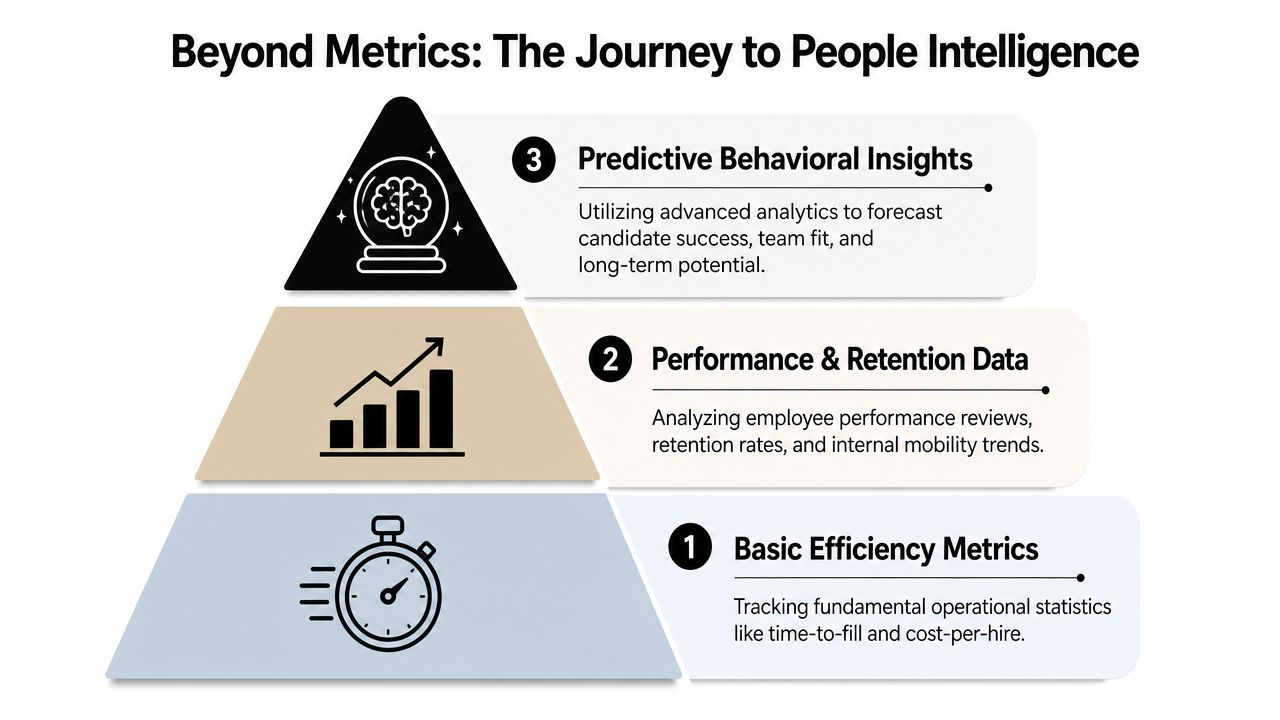
The first layer is basic operational reporting. This level is a common starting point because the metrics are easy to collect from an ATS. You can see where candidates stall, which recruiters are overloaded, and how long approvals take.
The second layer connects hiring activity to outcomes. At this stage, quality starts to matter more than throughput. You're no longer satisfied with knowing which source brought applicants. You want to know which source produced employees who stayed, ramped well, and earned manager confidence.
The third layer is where people intelligence becomes strategic. Here, behavioral and assessment data help predict not only who can do the work, but who is likely to do it well in your environment, with your leadership style, inside your current team composition.
The four pillars worth tracking
I've found that effective teams usually organize their hiring data around a small set of decision pillars instead of dozens of vanity metrics.
| Pillar | What it answers | Why it matters | |---|---|---| | Quality of hire | Did this person become a strong employee? | Prevents false wins where speed hides poor outcomes | | Source effectiveness | Which channels produce credible, durable hires? | Cuts spend on channels that generate noise | | Funnel velocity | Where does momentum slow down? | Helps remove process friction without lowering the bar | | Candidate experience | How do candidates experience your process? | Protects brand and reduces avoidable drop-off |
These pillars work together. If you only optimize one, the others can deteriorate.
For smaller teams building reporting habits from scratch, Wispra's guide to [big data analysis for small businesses](https://wispra.com/blog/how-to-analyze-big-data-a-practical-guide-for-smbs-en) is a practical reference because it frames analysis as decision-making, not dashboard theater.
The metric that separates mature teams from busy teams
The advanced metric I'd insist on once basic reporting is stable is assessment-to-performance correlation.
According to [iMocha's guide to data-driven recruitment](https://www.imocha.io/blog/data-driven-recruitment), this metric measures the statistical relationship between assessment scores and later job performance indicators such as retention, productivity, and hiring manager satisfaction. The same source notes that enterprises typically aim for r > 0.30 to validate that their assessments are predicting success rather than merely speeding up selection.
That distinction matters. A process can get faster while getting worse.
> Teams often celebrate reduced time-to-hire while ignoring whether the signals used in screening have any demonstrated link to post-hire success.
If assessment scores don't correlate with performance, then the process may be filtering efficiently but not intelligently. In practice, that leads to a common failure mode: high activity, polished dashboards, and repeated mis-hires.
The strongest recruiting leaders treat every assessment, rubric, and scorecard as a hypothesis. If the signal predicts success, keep it. If it doesn't, revise it or remove it.
Your Roadmap to Data-Driven Recruitment
Most organizations don't fail because they lack tools. They fail because they implement tools before they've defined what they're trying to improve. A workable data-driven recruitment model needs sequence, ownership, and clean data discipline.
Phase one starts with definitions
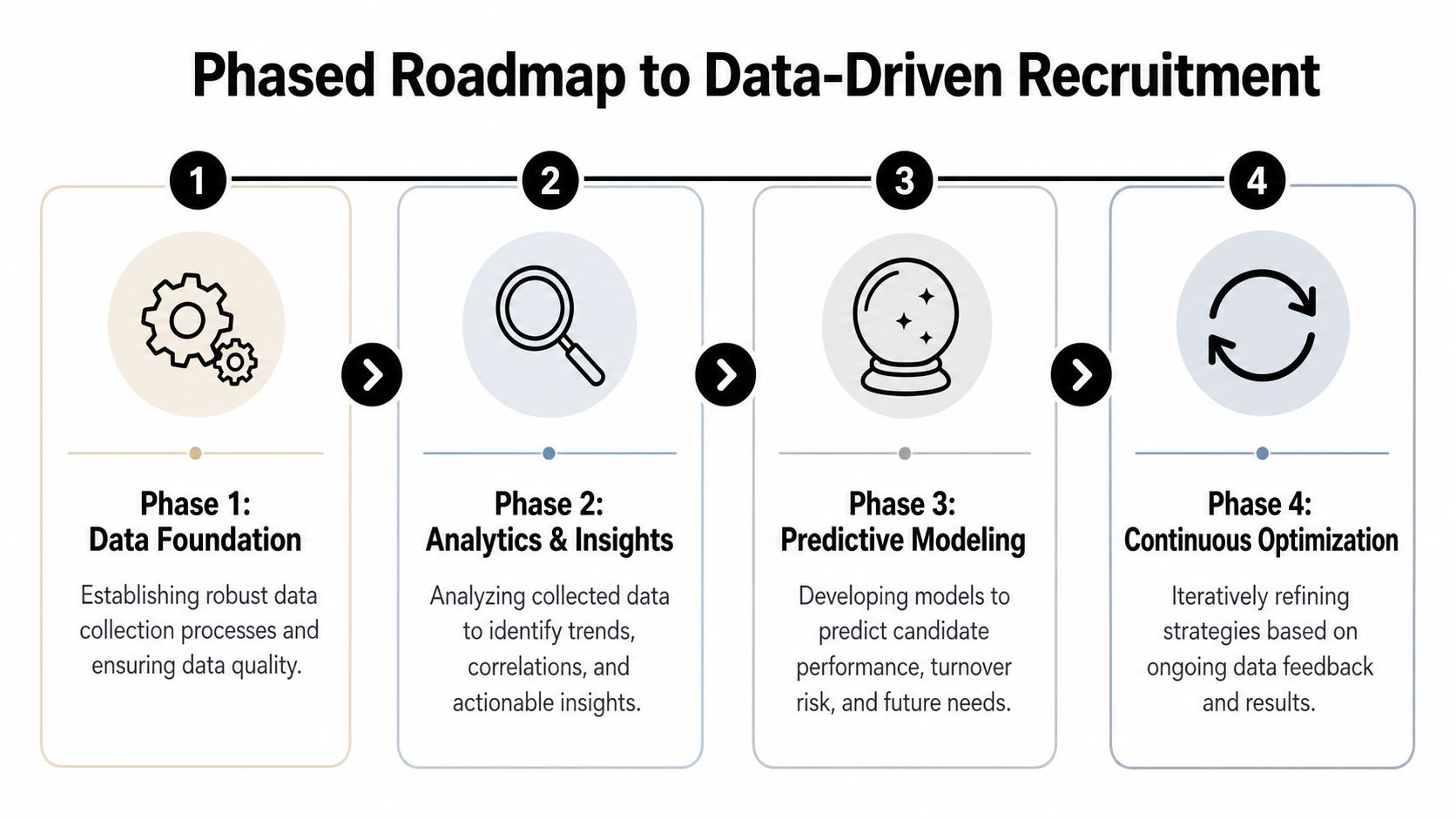
Start by tightening your data foundation. That means agreeing on consistent definitions for hiring stages, rejection reasons, scorecard fields, and outcome measures. If one recruiter marks a candidate as “not qualified” and another uses “culture mismatch” for the same issue, your reporting becomes decorative.
In this first phase, keep the work operational:
A lot of teams want predictive hiring before they've cleaned up duplicate candidate records, inconsistent tags, or incomplete interviewer feedback. That never ends well.
Phase two requires system integration
Technical architecture matters more than many talent teams want to admit. According to [Cadient Talent's guide to hiring platform architecture](https://cadienttalent.com/building-a-data-driven-hiring-platform-architecture-tools-and-best-practices/), effective implementation requires a unified stack with three core components: an Applicant Tracking System (ATS) for active pipeline data, a Candidate Relationship Management (CRM) system for passive talent pools, and a Sourcing Platform for discovery. That stack should feed a central recruitment analytics platform that visualizes real-time funnels and calculates predictive hiring score accuracy.
Here's the practical version of that architecture:
| System | Primary job | Common failure if missing | |---|---|---| | ATS | Tracks candidates through active hiring workflows | No consistent record of decision stages | | CRM | Nurtures passive and silver-medalist talent | Sourcing starts from zero every time | | Sourcing platform | Finds and refreshes external talent pools | Recruiters depend on narrow channels | | Analytics layer | Connects signals and outcomes | Teams can't see what's working |
If these systems stay siloed, every hiring review becomes an argument about whose spreadsheet is right.
A related resource on process design is Synopsix's take on [talent acquisition best practices](https://synopsix.ai/blog/talent-acquisition-best-practices), especially for teams trying to connect recruiting operations with broader business planning.
After the systems are connected, it helps to ground the strategy in a concrete workflow. This walkthrough is a good visual reference:
<iframe width="100%" style="aspect-ratio: 16 / 9;" src="https://www.youtube.com/embed/qkm5NwKVzDk" frameborder="0" allow="autoplay; encrypted-media" allowfullscreen></iframe>
Phase three turns data into diagnosis
Once the pipeline data is centralized, build dashboards that answer operational questions recruiters and hiring managers can act on this week, not abstract questions that sound strategic but go nowhere.
Good dashboards usually surface:
The essence of real recruiting leadership surfaces. Dashboards aren't for reporting activity upward. They're for making better choices in the flow of hiring.
Phase four introduces prediction carefully
Only after the first three phases are stable should you layer in behavioral assessments, predictive models, and fit simulations. The mistake I see most often is trying to run advanced models on weak operational data.
Prediction works when the inputs are governed and the outputs are reviewable. Keep human oversight in the loop. Document overrides. Compare predicted fit with actual later outcomes. That's how models improve instead of becoming another black box no one trusts.
Predicting Behavior for Smarter Hiring Decisions
The biggest weakness in most data-driven recruitment advice is that it stops too early. It teaches teams how to hire faster, track fairness, or improve funnel conversion. All useful. But it rarely helps leaders answer a more expensive question: what happens after the person joins?
That's where behavior enters the picture.
Why efficiency can still produce bad hires
A Harvard People Lab resource notes that existing content on data-driven recruitment focuses heavily on efficiency metrics and bias reduction but doesn't adequately connect behavioral assessment data to long-term team friction and performance outcomes. The same source argues that this gap leaves HR leaders unable to prevent mis-promotions or team dysfunction and points toward simulating role fit and compatibility risks before onboarding as a better path, as discussed in [this evidence-based hiring resource](https://peoplelab.hks.harvard.edu/wp-content/uploads/2022/06/evidence-based-strategies-for-hiring-a-strong-and-diverse-workforce.pdf).
That tracks with what many talent leaders see firsthand. A candidate can clear every traditional hurdle and still destabilize the team because the hiring process never examined how they make decisions, handle conflict, respond to ambiguity, or interact with the manager they'll report to.
What behavioral prediction looks like in practice
Consider a sales hire. Resume review can tell you where they worked, what they sold, and whether they hit targets. Structured interviews can help verify experience. But neither reliably tells you how that person will react after a rough quarter, a difficult territory, or a manager who coaches directly.
Behavioral data can add signals around resilience, pace, collaboration style, competitiveness, and tolerance for ambiguity. Those signals don't replace skills. They sharpen the context around skills.
For leadership hiring, the upside is even bigger. A senior operator may look outstanding in isolation and still be wrong for the team they're entering. The issue isn't competence. It's interaction. Some leaders create clarity and execution. Others create hidden tension because their decision style collides with existing peers or overwhelms a team that needs steadier coordination.
> Hire for role requirements first. Then test how that person is likely to affect the people around them.
Better inputs create better team design
This is also where recruiting starts to merge with org design. If you can estimate likely friction points before someone joins, you can make smarter choices about team composition, manager pairing, and onboarding support.
A simple comparison makes the difference clear:
| Hiring approach | What it usually captures | What it often misses | |---|---|---| | Resume-led screening | Experience, employers, credentials | Working style, adaptability, interpersonal risk | | Interview-led decisions | Communication, examples, executive presence | Consistency, hidden bias, compatibility patterns | | Behavior-informed hiring | Role fit plus likely interaction patterns | Requires disciplined interpretation and validation |
That doesn't mean scraping every possible data source and calling it intelligence. Public profile research can be useful for context, and PeopleFinder's [expert guide to find social profiles](https://peoplefinder.app/blog/find-social-media-accounts) is a practical example of how teams can gather open-web inputs carefully. But social data should stay secondary. It's context, not proof.
The strongest behavior-based hiring programs use scientifically validated assessments, structured interpretation, and post-hire feedback loops. They don't ask managers to become amateur psychologists. They translate human complexity into business-relevant signals managers can use.
Overcoming Common Hurdles and Pitfalls
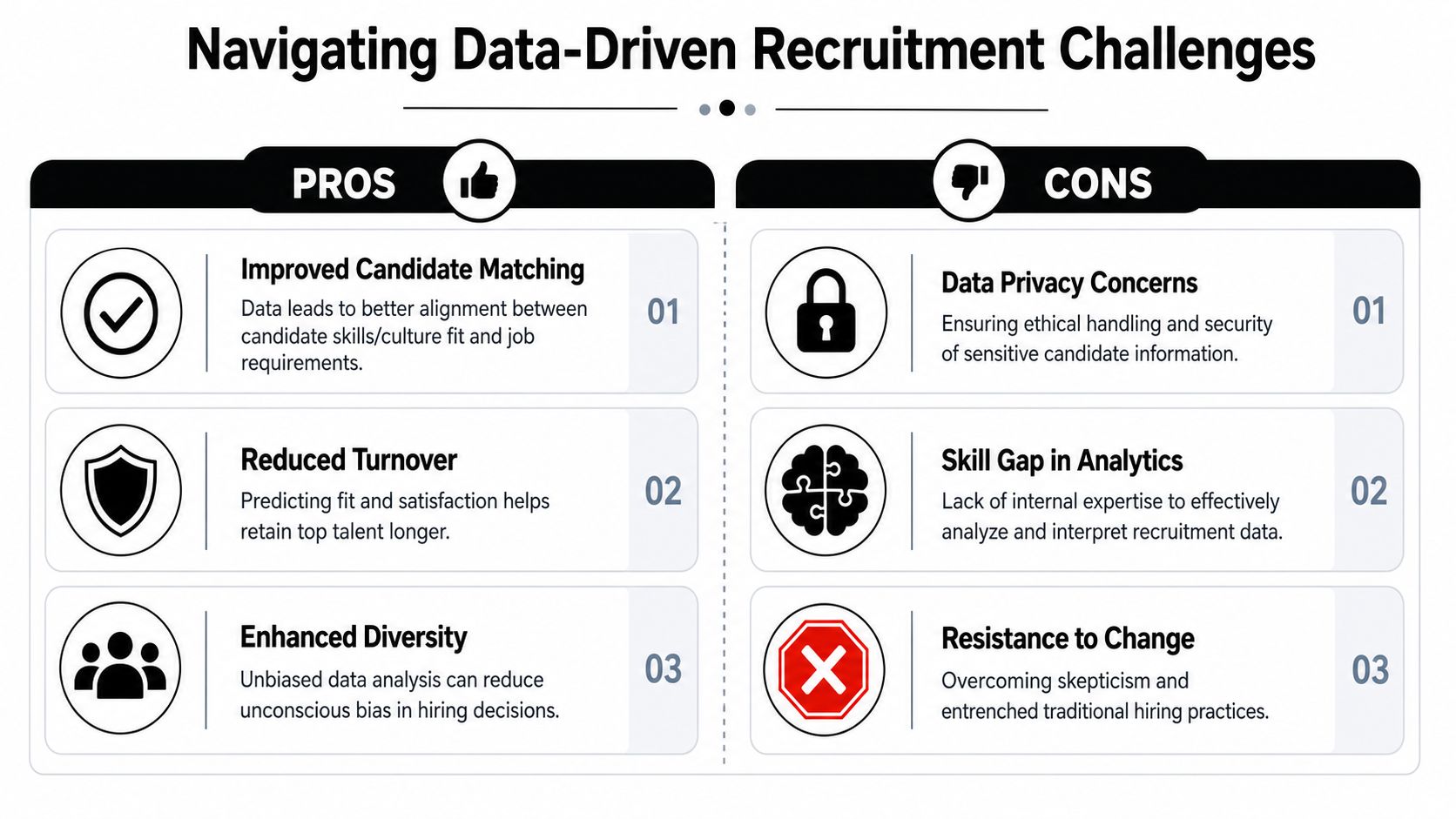
Organizations don't struggle with the idea of data-driven recruitment. They struggle with the mess that appears when theory meets workflow. The problems are usually predictable.
Bad data ruins good intentions
The first pitfall is simple. If your stage data is inconsistent, your dashboards lie. If interviewer notes are vague, comparisons collapse. If recruiters use different definitions for the same outcome, trend analysis becomes noise.
The fix isn't glamorous:
Good hiring analytics begins with boring discipline.
Gut feel doesn't disappear on its own
The second hurdle is managerial resistance. Some hiring managers hear “data-driven” and assume recruiting wants to replace judgment with software. That's the wrong frame.
The better argument is that structured evidence protects judgment from inconsistency. A strong manager should want better inputs, not fewer inputs.
> When managers resist data, the issue usually isn't analytics. It's trust in how the signals are produced and used.
Pilot programs help. Start with one role family, one business unit, or one recurrent hiring problem. Show managers where data clarified a decision, exposed a bottleneck, or prevented an avoidable mismatch.
More metrics can make decisions worse
A third trap is analysis paralysis. Teams collect everything because they can, then struggle to explain what matters. Recruiters shouldn't have to stare at a dashboard with endless charts to decide what action to take today.
Use a simple filter for every metric: does this help someone change a hiring decision, workflow step, or team design choice?
If the answer is no, remove it from the main operating dashboard.
Bias and validity need active oversight
The final hurdle is ethical and methodological. Any model, assessment, or scoring system can create harm if teams don't inspect fairness, consistency, and real-world validity over time.
That's why validity matters as much as convenience. If your hiring signal isn't grounded in evidence, the process only looks scientific. Synopsix's article on [validity in psychology](https://synopsix.ai/blog/validity-in-psychology) is a useful lens for leaders who want to evaluate whether an assessment measures what they intend it to measure.
A practical safeguard is to review data by role, recruiter, channel, and stage. That makes it easier to spot unusual patterns, inconsistent scoring behavior, or adverse outcomes before they harden into process norms.
The Future Is Evidence-Based Talent Strategy
The best hiring organizations don't treat data-driven recruitment as a reporting layer. They treat it as a decision system.
That distinction matters. Reporting tells you what happened. A decision system helps you choose better before the cost of a bad hire shows up in missed targets, failed promotions, or team conflict that nobody saw coming.
The real competitive advantage
The strongest teams move through a clear evolution. They begin with operational metrics. They connect those metrics to post-hire outcomes. Then they mature into behavior-informed decisions that improve role fit, manager alignment, and team compatibility.
That's when recruiting becomes more than delivery. It becomes a strategic capability.
A recruiting team that can explain which signals predict performance, where friction is likely to emerge, and how team composition affects execution is doing work the business can't dismiss as administrative. It is shaping workforce quality in a way leaders can feel in productivity, retention, and leadership bench strength.
What smarter hiring looks like now
Evidence-based talent strategy doesn't mean outsourcing decisions to algorithms. It means building a process where judgment has stronger inputs, weak assumptions are tested, and hiring outcomes can be improved deliberately.
The practical test is straightforward:
If the answer to those questions is still “not reliably,” there's real upside ahead.
Data-driven recruitment started as a way to make hiring more efficient. Its next stage is more important. It helps organizations predict human behavior well enough to build stronger teams on purpose.
---
If you want a more practical way to turn behavioral assessment data into hiring guidance, team compatibility insight, and clearer talent decisions, explore [Synopsix](https://synopsix.ai). It helps organizations move from raw psychometric output to business-ready signals that hiring managers, HR leaders, and executives can use.