Decision Making Evaluation for Smarter Hiring
By Synopsix · October 16, 2026 · 17 min read
You're probably in the middle of exactly the kind of hiring decision that feels familiar and risky at the same time. A finalist interviewed brilliantly, the panel feels confident, the references were fine, and someone says, “I know they'll work out.” Then six months later, the person struggles to ramp, key teammates don't trust their judgment, or a stronger but less polished candidate turns out to have been the better bet.
That's why decision making evaluation matters. In hiring, promotion, and leadership selection, the question isn't just whether a person seems impressive. It's whether your process can reliably distinguish strong judgment from confidence, style, speed, or similarity bias. The difference sounds technical, but it shows up in business terms, slower ramp-up, preventable turnover, weak team fit, and managers who stop trusting the process.
Why Great Hiring Still Gets Decisions Wrong
A hiring team can do many things right and still make poor choices. They can use experienced interviewers, align on the role, move quickly, and still end up selecting the person who “felt right” instead of the one whose patterns of judgment matched the actual job.
That happens because most hiring errors don't come from bad intentions. They come from unstructured evaluation. One interviewer rewards polish. Another overweights industry similarity. A third remembers the candidate's closing story more than the rest of the conversation. If nobody uses the same criteria or scoring rules, the final decision becomes a negotiation between impressions.
Why intuition breaks down in real hiring
In executive and manager hiring, people often confuse confidence with competence. The candidate who answers quickly can appear decisive. The candidate who mirrors the interviewer can feel like a fit. The candidate with a prestigious background can trigger assumptions before the evidence is even reviewed. A practical overview of common judgment shortcuts from [PreSales Unleashed GmbH on SE bias](https://www.serockstars.com/blog/heuristics-and-biases) is useful here because it shows how easily smart professionals slip into heuristics and bias when stakes are high and time is short.
The problem gets worse under pressure. Hiring managers are rarely evaluating in a calm laboratory setting. They're balancing open headcount, team fatigue, business deadlines, and competing opinions. Under those conditions, informal judgment can look efficient while introducing noise.
> Practical rule: If two interviewers can't explain exactly what they evaluated and how they scored it, you don't have a decision system. You have opinions with a meeting attached.
What a better lens looks like
A stronger approach treats hiring as a decision system, not a one-time interview event. That means evaluating several linked steps:
This matters for CHROs because the question isn't "Did our assessors like the candidate?" It's "Did our process help us make a decision we can defend, repeat, and improve?"
When leaders start viewing evaluation this way, hiring becomes less about instinct and more about evidence you can act on.
How Decision Making Works Under Pressure
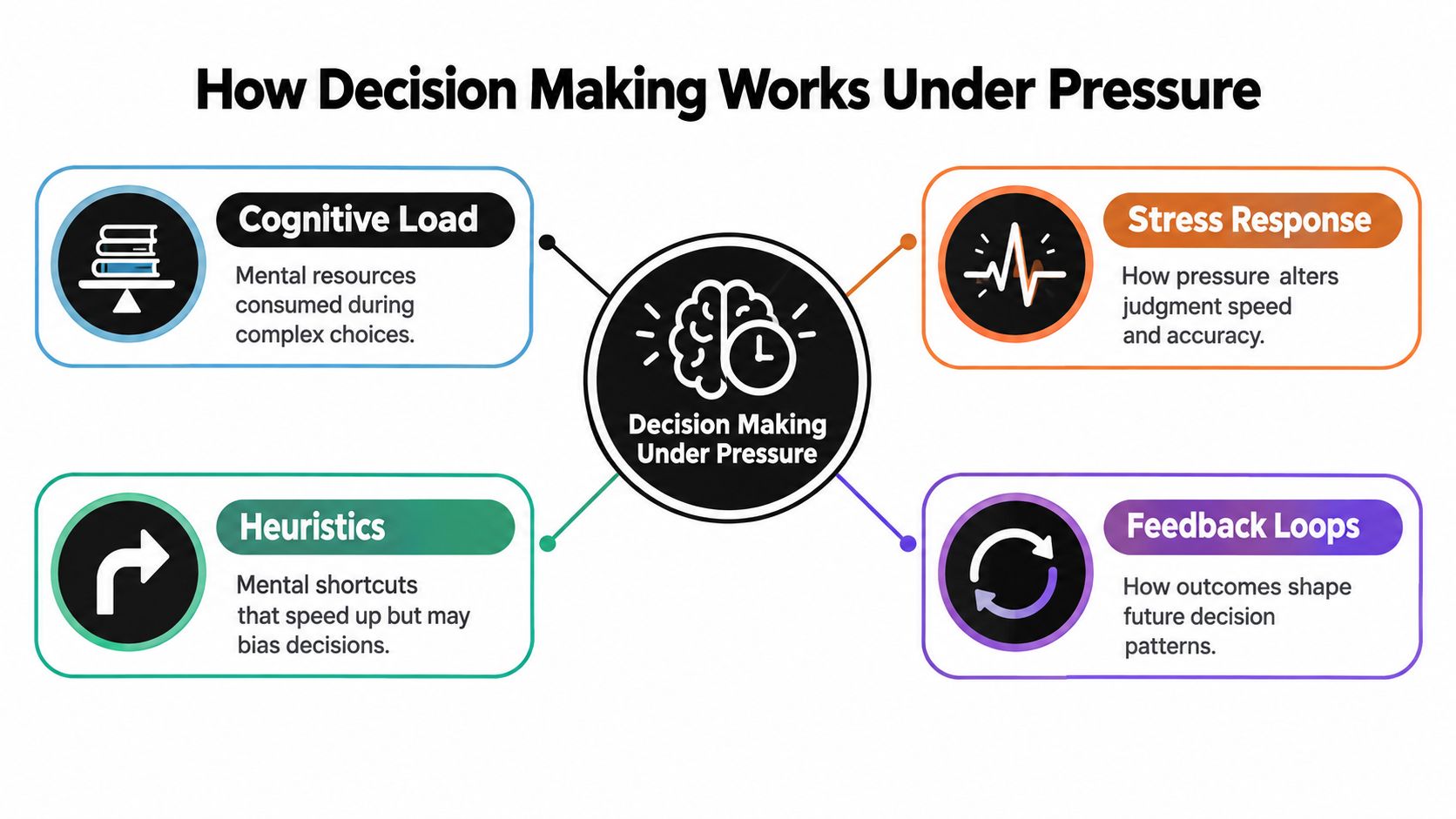
Judgment isn't a fixed trait that appears on command. It's a process. People gather clues, weigh trade-offs, react to stress, notice social cues, and sometimes change their minds when new information arrives. That's why one self-report question about “decision style” rarely tells you much about how someone will choose in a live role.
Think of it like a driving simulator
A manager making a staffing call under uncertainty is a lot like a driver in heavy rain. They're not just “good” or “bad” at driving. Their outcome depends on how they scan the road, how they prioritize threats, how much speed they carry into a turn, and whether they adjust when conditions change.
Decision making at work works the same way.
That's why assessment should look at behavior in motion, not only static preferences.
Social information changes choices
One of the clearest findings from decision research is that people don't decide in isolation the way many assessments assume. In [research on sequential social decisions](https://www.science.org/doi/10.1126/sciadv.abb0266), participants were 74% accurate when making a personal choice without the social phase. When they could wait for social information and then revise or confirm their decision, average accuracy rose to 79%. That matters in hiring and leadership because many workplace decisions are made after people see what peers think, what stakeholders want, or how a room reacts.
A thoughtful piece from [Ekipa's take on decision-making](https://ekipa.co/insights/blogs/consent-vs-consensus-to-make-progress-on-difficult-decisions/) is helpful here because it separates decision quality from group comfort. Consensus can feel clean. It doesn't always produce the best call.
> Good evaluation asks not only what choice a person makes, but also how long they wait, what evidence they seek, and when they revise.
What readers often get wrong
Many hiring teams assume that consistency means strength. Sometimes it does. Sometimes it means a person ignores new evidence. Others assume that changing your mind signals weakness. In many roles, the opposite is true. A strong operator updates when the context changes.
That's why measuring judgment requires more than asking candidates what they value. It requires observing how they process uncertainty, how they react to context, and how they integrate input from others.
Key Signals That Reveal Decision Ability
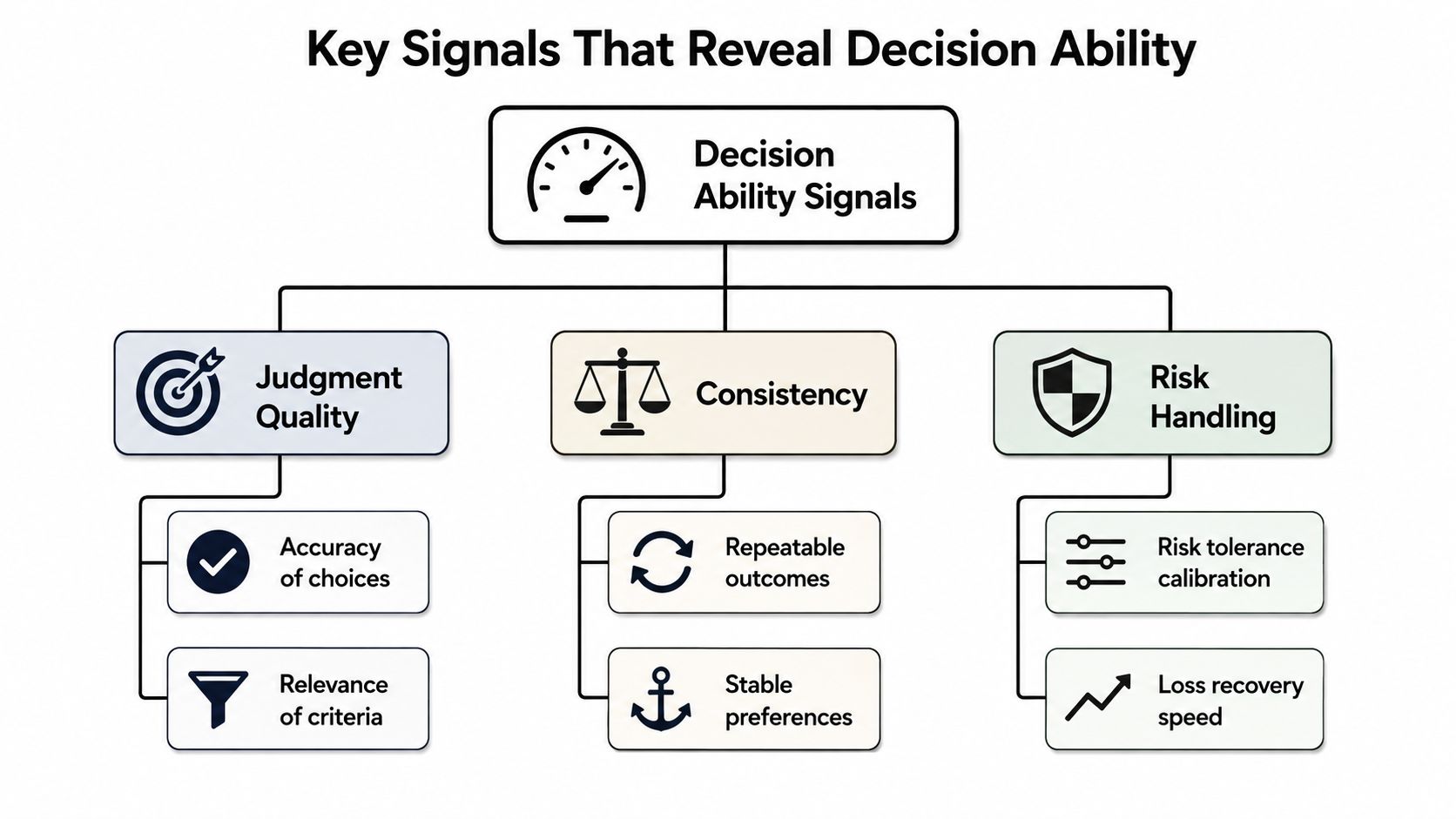
If you want better people decisions, start by measuring the right signals. Not charisma. Not interview smoothness. Not whether stakeholders “felt good” about the process. The most useful signals are the ones that show how someone evaluates options, applies criteria, and stays consistent across comparable situations.
Structure beats improvisation
Many organizations leave value on the table. In a [meta-analytic review of employment interviews](https://onlinelibrary.wiley.com/doi/abs/10.1111/j.1468-2389.1993.tb00080.x), the average observed validity was .27 and the estimated true validity was .38, and interview structure was the only examined characteristic that moderated validity. In plain language, the more consistently you define, ask, and score the interview, the more useful it becomes.
That improvement doesn't come from making interviews robotic. It comes from reducing irrelevant noise.
Three signals worth tracking
Here are the signals that usually matter most in hiring and promotion evaluation:
What strong scoring practices look like
A defensible decision process usually includes:
A useful companion topic is [behavioral data analysis](https://synopsix.ai/blog/behavioral-data-analysis), because the core challenge isn't collecting more observations. It's turning behavioral evidence into comparable signals that managers can use without overinterpreting noise.
> The best hiring signal isn't the one that sounds sophisticated. It's the one that stays meaningful when different evaluators use it on different candidates for the same role.
If your team tracks interview speed, candidate enjoyment, or panel confidence but not scoring consistency and downstream outcomes, you're measuring the comfort of the process more than the quality of the decision.
Seeing Judgment in Action Through Simulations
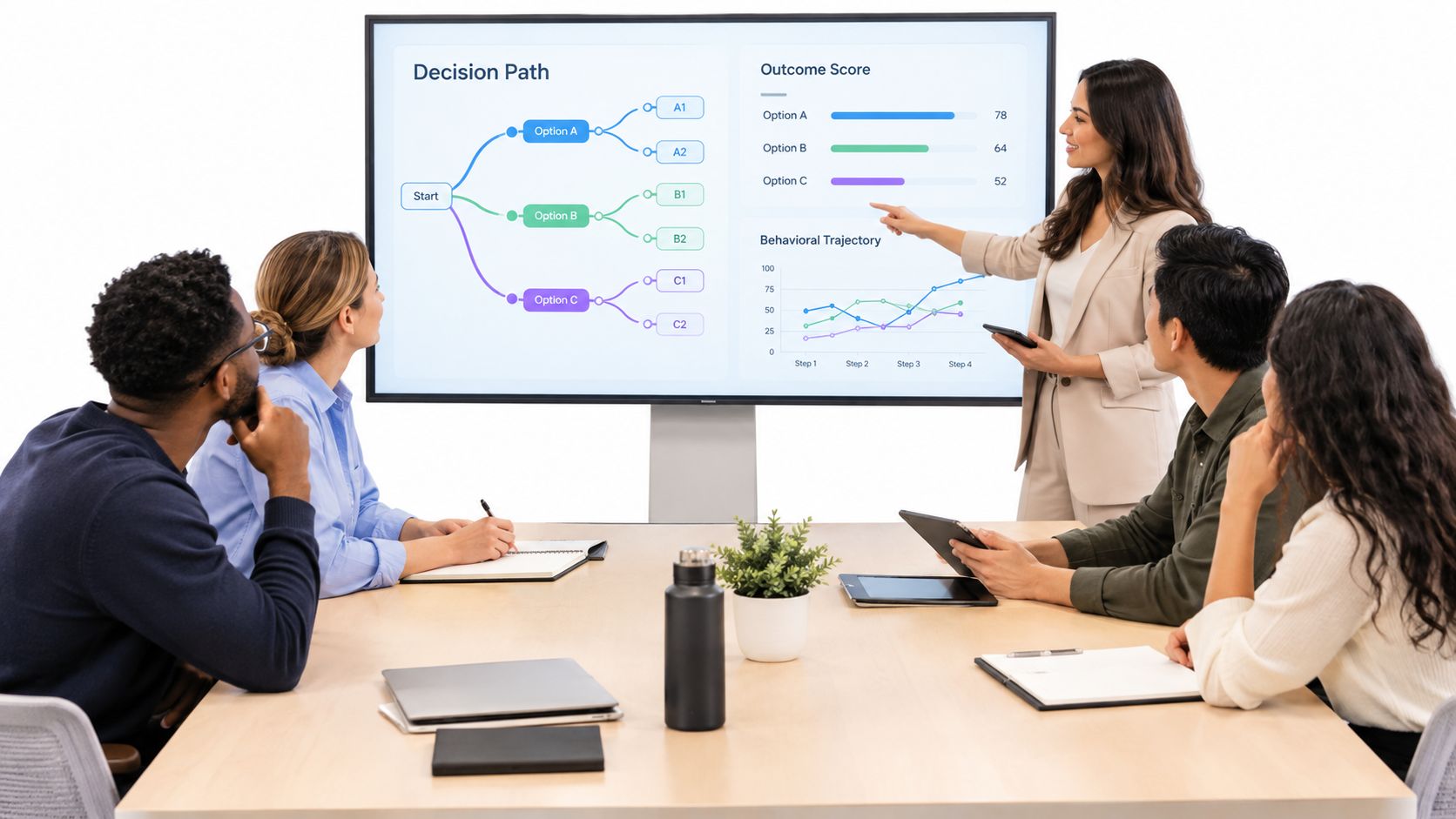
A hiring panel watches two candidates review the same business problem. Both explain their first choice clearly. Then a key constraint changes, a colleague challenges the recommendation, and new evidence arrives. Their next moves reveal more about judgment than a polished answer ever could.
Static assessments still have a useful role. They summarize preferences, flag tendencies, and give teams a shared language for discussing behavior. Their limit is that they may not show what happens when the situation changes.
Why one answer isn't enough
A candidate may describe themselves as collaborative, decisive, or data-driven. That description shows self-perception. It does not show how they respond when incentives conflict, a peer disagrees, or the surrounding options change.
Simulations expose those shifts. In a [Science study on human choice prediction](https://www.science.org/doi/10.1126/science.abe2629), computational models were tested on almost 10,000 human choice problems. A value-based model identified the preferred option in 81.41% of problems. Adding context-dependent functions raised preference accuracy to 84.81%. For hiring, the practical lesson is direct: context matters. People do not assign fixed value to every option in every setting.
A useful exercise changes one condition at a time. Urgency rises, a peer behaves differently, an incentive shifts, or another option becomes available. The evaluator can then examine whether the candidate adapts thoughtfully, changes direction too quickly, or remains attached to the original choice.
Static profiles versus dynamic observation
The comparison is straightforward:
That sequence matters when consequences unfold over time. A manager's response after resistance may reveal more than the initial recommendation, because it shows whether the person learns from feedback and adjusts their approach.
Teams exploring this method can review [simulation forecasting methods](https://synopsix.ai/blog/simulation-forecasting-method) to connect behavioral patterns with likely friction points, compatibility risks, and role-fit decisions. The value comes from observing a decision system, not treating one score as a permanent label. Repeating the exercise across roles and cohorts can also expose calibration drift and unequal impact before those problems become embedded in hiring practice.
A short explainer makes the format concrete:
<iframe width="100%" style="aspect-ratio: 16 / 9;" src="https://www.youtube.com/embed/-6qlX_ihOwQ" frameborder="0" allow="autoplay; encrypted-media" allowfullscreen></iframe>
What hiring managers can observe
When judgment unfolds in a simulation, evaluators can examine:
Tools such as Synopsix fit practically here: the platform combines behavioral assessments with simulations, compatibility views, and business-language reporting. That gives hiring teams a structured way to discuss role fit and decision patterns without asking managers to interpret psychometric terminology alone.
A static test can show what someone tends to prefer. A simulation shows what they do when constraints shift mid-task, evidence arrives late, and earlier choices create new consequences.
How to Score and Validate Decisions You Can Trust
Many hiring systems fail at the exact point where confidence should become discipline. Teams gather interviews, scenarios, and ratings, then collapse everything into a simple recommendation without checking whether the scores mean what they think they mean.
That's the moment where decision making evaluation becomes serious. A ranking can be useful. A probability you intend to act on needs stronger proof.
Start with calibration, not just accuracy
For probabilistic decision-making, [the Brier score and related evaluation framework](https://www.cambridge.org/core/journals/judgment-and-decision-making/article/an-irt-forecasting-model-linking-proper-scoring-rules-to-item-response-theory/AC002490811A4CC2A5FEB0FE43126538) offers a practical foundation. The Brier score is the mean squared difference between a predicted probability and the binary outcome, and lower values indicate better overall probabilistic accuracy. It can also be decomposed into reliability, resolution, and uncertainty. But a low Brier score alone doesn't prove good calibration, because scores can vary with outcome prevalence and population composition.
In business language, this means a model that says “this candidate has a high probability of succeeding” should be checked against what happened in similar roles and cohorts. If predicted success rates don't line up with observed success rates, the probability may sound precise without being safe to use.
> Manager check: Don't ask only, “Who ranked highest?” Ask, “Do these predicted probabilities match what usually happens after hire?”
Compare simple baselines against complex models
Complexity doesn't automatically improve decisions. A [decision-science review on simple rules and algorithms](https://onlinelibrary.wiley.com/doi/full/10.1002/aaai.12034) described a court-prediction comparison in which algorithms using 25 weighted features reached 79% accuracy on unseen cases, while simple rules using only three features reached 89%. The broader conclusion was that simple rules and complex algorithms have similar average predictive accuracy, with each doing better in different environments.
That's why every hiring model should be tested against a transparent baseline.
| Criterion | Simple Transparent Rules | Complex AI Models | |---|---|---| | Ease of explanation | High, managers can usually see the logic | Lower, depends on model transparency | | Data requirements | Modest | Often broader and more sensitive to data quality | | Adaptability to nuance | Limited in some contexts | Stronger when genuine complexity exists | | Baseline benchmarking value | Essential | Essential, but should never skip comparison | | Risk of false confidence | Lower if limits are understood | Higher if complexity is mistaken for validity |
A practical validation routine
A disciplined workflow usually includes:
1. Pre-specify the evaluation window for outcomes such as ramp-up, retention, or promotion readiness. 2. Hold out later cohorts for validation rather than testing on the same group used to build the model. 3. Report multiple indicators, including calibration-in-the-large, calibration curves, and a discrimination measure such as the c-index. 4. Monitor drift after role requirements, manager expectations, or labor-market conditions change.
If your team wants a deeper operational view of these concepts, [assessment validity and reliability](https://synopsix.ai/blog/assessment-validity-and-reliability) is the language to anchor on. Reliable scoring helps you measure consistently. Validity tells you whether the measure predicts outcomes you care about.
A single accuracy percentage sounds reassuring. It rarely tells the full truth.
Turning Evaluation Results Into Role Fit and Growth
The value of evaluation appears after the score. Leaders don't need another report that labels people. They need a way to turn findings into decisions about fit, development, team design, and future risk.
Read results as patterns, not verdicts
A good evaluation output should answer practical questions. Is this person likely to make strong trade-offs in this role? Where are the pressure points? What support would reduce risk? Which team dynamics will amplify or constrain their strengths?
Many organizations lose the plot by treating assessment results as fixed identity statements, instead of seeing them as decision patterns interacting with a role and a team.
That shift matters because behavior unfolds over time. A [2022 analysis of behavioral trajectories](https://pmc.ncbi.nlm.nih.gov/articles/PMC9154096/) assembled 168,386 individual decisions from eight published Iterated Prisoner's Dilemma studies and converted them into 8,257 behavioral trajectories, each containing nine actions for both players. It also compiled 617 trajectories of 95 actions from ten Iowa Gambling Task studies involving healthy participants. Recurrent neural-network models were then trained to predict action sequences rather than only aggregate outcomes. The practical lesson is that evaluation becomes more useful when it follows how choices evolve, not just the average score someone receives.
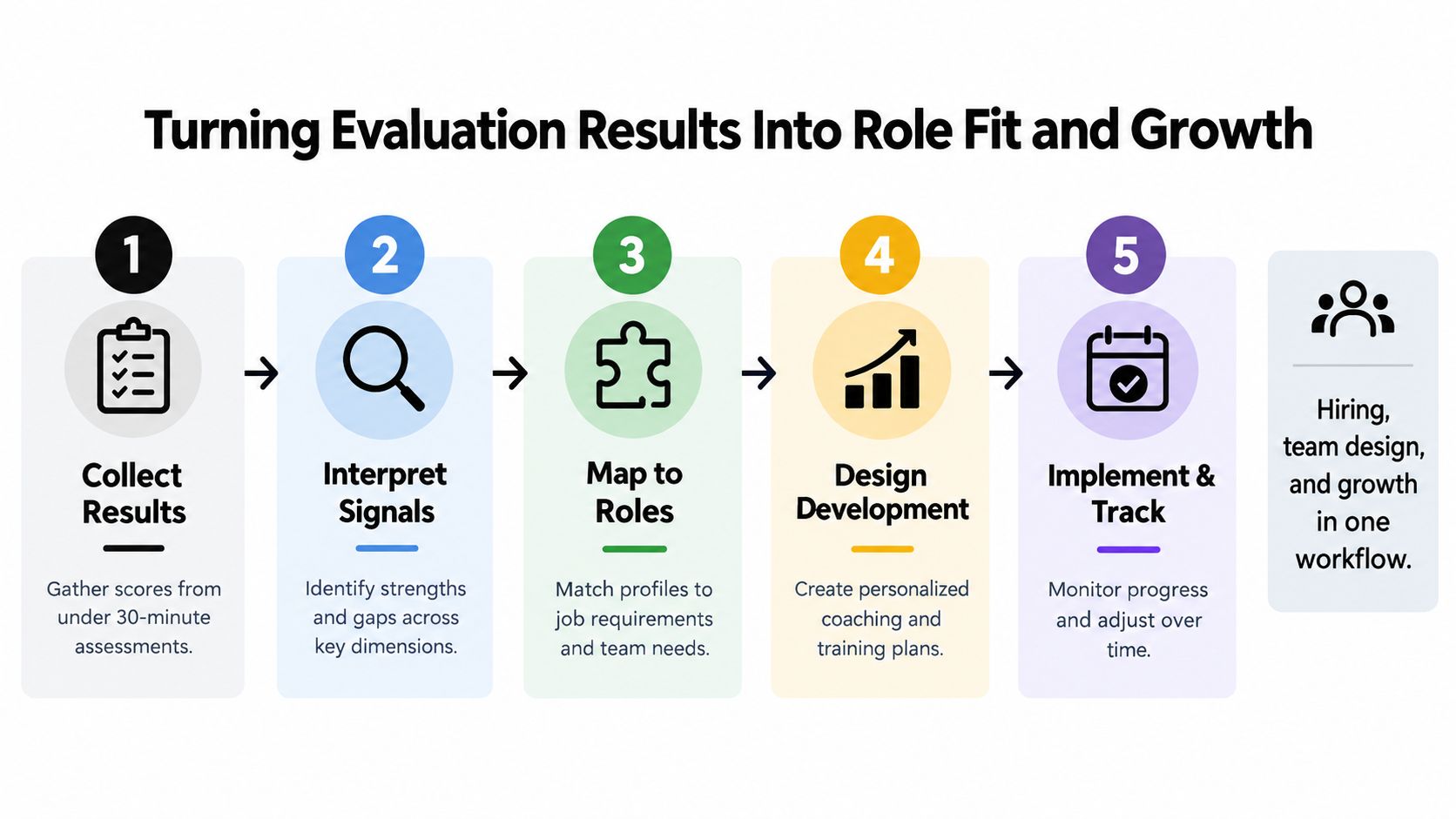
A business-friendly workflow
In practice, turning results into action often looks like this:
Hire, develop, or redesign
Sometimes the right answer is to hire. Sometimes it's to hire with support. Sometimes it's to stop forcing a person into a role shape that doesn't fit the way they decide.
> Strong evaluation doesn't freeze people in place. It helps leaders decide whether to select, coach, re-scope, or redesign.
That's what makes decision evaluation strategically useful. It moves the conversation from “Do we like this person?” to “Where will this person create value, where will they struggle, and what can we do about it now?”
Keeping Evaluations Fair and Accurate Over Time
A hiring model can look impressive on launch day and still become unreliable later. That's the part many organizations miss. Validation isn't a one-time test. It's ongoing stewardship.
A [multidisciplinary review of hiring AI](https://arxiv.org/html/2309.13933v4) warns that even systems that appear accurate and fair in one evaluation may not generalize predictably across contexts, especially when they use weakly established signals such as facial analysis or inferred personality. For HR leaders, that's a strong reminder that a polished dashboard isn't evidence by itself.
What continuous monitoring should include
A mature process watches the full decision system, not just the model output.
Fairness is broader than parity metrics
An evaluation system can look fair on paper and still discourage strong applicants or distort the funnel. Research on diversity and AI-supported decisions shows the issue is often behavioral and organizational, not purely technical. If qualified candidates opt out, if managers don't trust the guidance, or if old criteria remain embedded in the workflow, the system may produce fairer-looking scores without better real-world inclusion.
That's why the strongest test is delayed and practical. Six or twelve months later, are your decisions still helping the right people enter, succeed, stay, and grow?
The best standard is simple. If a tool affects hiring or promotion, you should be able to explain how it is performing now, for these roles, with these managers, in this labor market. If you can't, the evaluation isn't finished.
---
Synopsix helps teams turn behavioral assessments into business-ready hiring, team design, and development decisions, with comparable profiles, simulations, and role-focused guidance that's easier for managers to use in practice. If you want a more defensible approach to decision making evaluation, visit [Synopsix](https://synopsix.ai) and see how a continuous evidence-based workflow can support smarter people decisions.