Decision Making Style Assessment for Better Hires
By Synopsix · November 21, 2026 · 16 min read
41% of surveyed organizations lacked a talent-assessment strategy, even though 67% said behavioral assessments enhance employee performance, according to [Cloverleaf's 2025 survey of 155 talent leaders](https://cloverleaf.me/blog/talent-assessment-strategy/). That's the problem a decision making style assessment needs to solve: not producing more scores, but helping managers use them responsibly.
A useful result isn't a verdict that someone is analytical, indecisive, or leadership material. It's a situational hypothesis about how they might approach a decision, which you can test against the work they'll do.
What a Style Assessment Actually Measures
Assessment use is already widespread: 56% of employers reportedly used pre-employment assessments in 2025, according to SHRM figures cited by [DISC Test](https://disctest.org/disc-assessment-statistics/), while [ThriveSparrow](https://www.thrivesparrow.com/blog/behavioral-assessment-test) reported that 65% of companies used behavioral assessment tests that year. These are different measures, not interchangeable estimates of decision-style testing.
Say you're hiring a product lead. Their assessment suggests a preference for gathering information, comparing alternatives, and documenting trade-offs. That tells you something about their habitual process, but it doesn't tell you whether they'll make a sound roadmap decision before the deadline.
Think of the result as a preferred driving lane, not proof that the driver reaches the destination safely. The habits being mapped include systematic analysis, intuition, reliance on others, delay, and speed.
The assessment conversation should connect those habits to actual work.
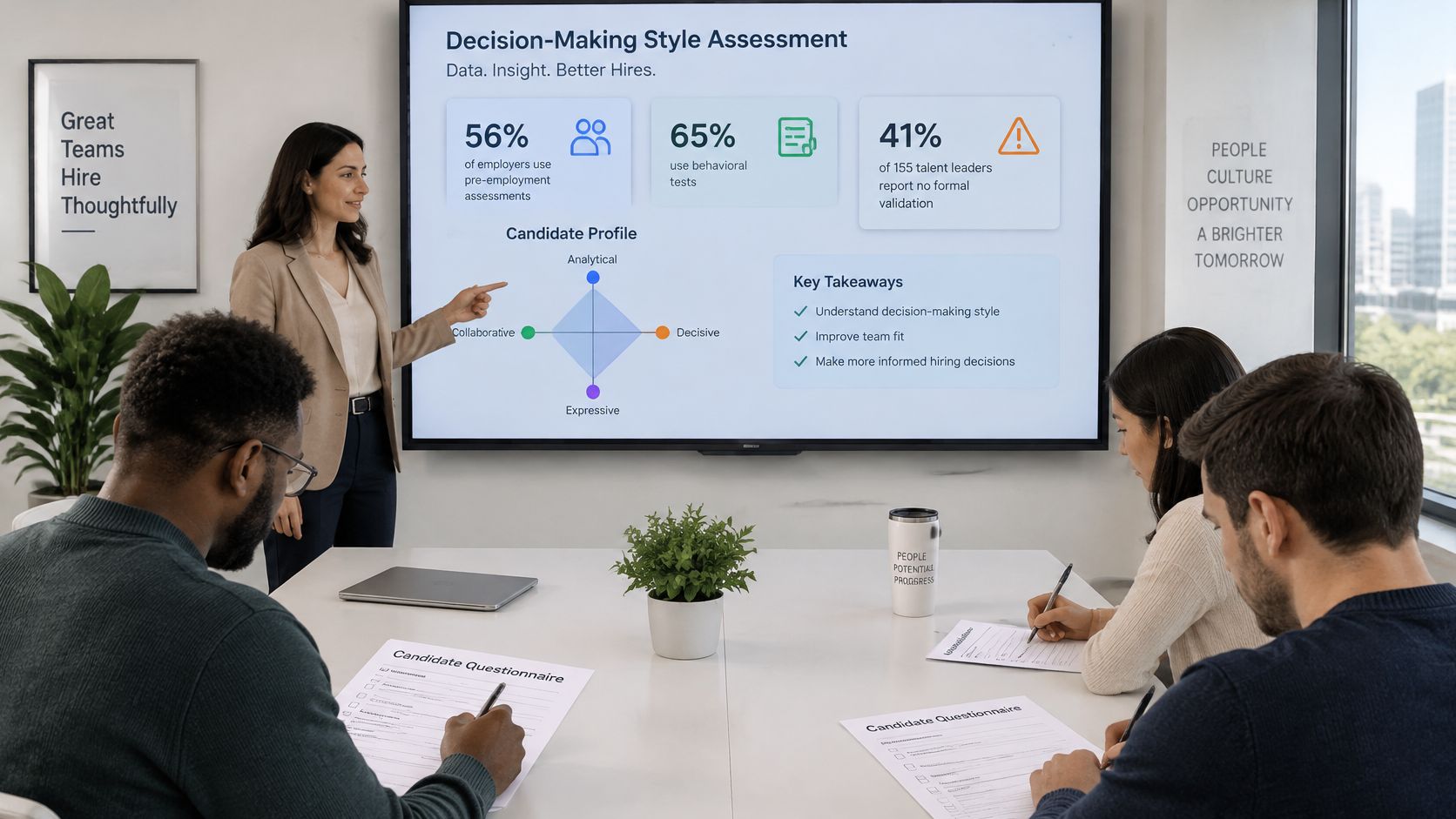
A profile rather than a verdict
Susanne Scott and Reginald Bruce developed the General Decision-Making Style framework in 1995, using four samples; spontaneous decision-making emerged during development, completing the five-style framework, with internal consistency ranging from 0.68 to 0.94, according to their [instrument-development paper](https://journals.sagepub.com/doi/10.1177/0013164495055005017). Those results support measuring distinct tendencies rather than assigning a single good-versus-bad score.
A decision-style inventory isn't an IQ test, a personality nickname, or a direct prediction of job performance. Understanding [what psychometrics measures](https://synopsix.ai/blog/what-is-psychometrics) helps separate a measured preference from the broader judgment a hiring manager must make.
> Hiring question: Which decision process does this role need under its actual working conditions?
That question is more useful than asking who looks decisive. Means, reliability warnings, situational demands, and observed behavior each contribute different evidence.
Style Means and What Each Score Signals
Decision styles, typical means, and when they help or hurt
| Style | Mean (1-5) | High score suggests | Helps when | Hurts when | |---|---:|---|---|---| | Rational | 3.8 | Systematic search and evaluation | Stakes are high and information exists | Speed matters more than completeness | | Behavioral coping | 3.8 | Adjusts through people and context | The decision needs acceptance or change | Process has no owner | | Intuitive | 3.6 | Pattern recognition | Time is short or data are incomplete | A familiar pattern is misleading | | Dependent | 3.4 | Seeks advice before committing | Buy-in from others is required | Advisors disagree or are unavailable | | Regret | 3.0 | Anticipates downside after choosing | A risk review is part of the role | Commitment is reopened after the call | | Maximizing | 2.9 | Keeps searching for the best option | The choice is rare and high value | Good-enough options are already sufficient | | Avoidant | 2.6 | Delays or dodges commitment | Almost never as a default | Deadlines and ownership are unclear | | Spontaneous | 2.6 | Acts quickly with little analysis | The call is reversible and operational | The bet is consequential and hard to undo |
The means above come from a [Judgment and Decision Making study comparing eight styles on a 1-to-5 scale](https://www.cambridge.org/core/journals/judgment-and-decision-making/article/maximizers-versus-satisficers-decisionmaking-styles-competence-and-outcomes/065A9507C3F1F1E51B6C24D274833EA1); respondents reporting less maximizing, more behavioral coping, more intuition, and less spontaneity reported significantly better outcomes, while dependence and avoidance were related to outcomes only at marginal significance. The workplace conditions in the table are practical interpretation prompts, not validated selection thresholds.
Read the row without ranking the person
Start with rational style. A high score suggests that someone favors systematic evaluation when information is available. It doesn't establish that they interpret that information correctly, identify the right alternatives, or know when to stop searching.
The mean isn't a target, either. It describes the study's respondents, not the ideal product lead, nursing manager, or finance director. Don't turn a sample average into a pass mark or a percentile without appropriate normative evidence.
The classic General Decision-Making Style framework distinguishes rational, intuitive, dependent, avoidant, and spontaneous tendencies. The broader comparison adds behavioral coping, regret, and maximizing, so the table shouldn't be mistaken for the subscales of a single interchangeable instrument.
Translate preferences into observable behavior
For a high avoidant score, investigate the process risk: does the person postpone commitment when responsibility is unclear? An explicit owner, deadline, and escalation path give you something concrete to test or improve.
For intuition, ask what experience supports the pattern recognition. Under time pressure or ambiguity, a person may need to act before complete information arrives. For a consequential decision with usable evidence, ask whether they can slow down and check their initial interpretation.
These aren't mutually exclusive capabilities. Someone can favor analysis while also using experienced judgment to identify which evidence matters.
Consider this hypothetical profile, used only to demonstrate interpretation:
Don't label this person the analytical candidate and stop there. Write a testable hypothesis instead: They may evaluate options carefully but need to demonstrate that they can commit when further information won't arrive.
That statement tells the interviewer what evidence to collect. The label doesn't.
How Precise Each Style Score Is
Subscale reliability and whether to compare candidates
| Style | Omega | Compare small gaps | Operational rule | |---|---:|---|---| | Systematic | 0.76 | Yes, for moderate gaps, with uncertainty checked | Treat as the most stable of these signals | | Intuitive | 0.58 | No | Probe with scenarios; don't rank finalists on tiny differences | | Dependent | 0.72 | Cautiously | Ask who they consult and what they do if advice conflicts | | Avoidant | 0.71 | Yes, when clearly elevated and corroborated | Add an owner, a deadline, and an escalation rule | | Spontaneous | 0.67 | Only large gaps, with corroboration | Check the call in a simulation before treating speed as fit |
These omega estimates come from an [evaluation of the 20-item General Decision-Making Style questionnaire in an Arabic-speaking adult sample](https://europepmc.org/article/MED/42663280), which reported 0.76 for systematic, 0.58 for intuitive, 0.72 for dependent, 0.71 for avoidant, and 0.67 for spontaneous styles.
Don't let a small intuition gap decide a hire. A hypothetical difference of 0.2 between finalists isn't automatically meaningful, particularly for the less reliable intuitive subscale in this evaluation. The operational rules above are cautions, not statistically established cutoffs.
Reliability belongs beside the score
Reliability concerns the consistency of a measurement. It doesn't establish that the score predicts success in your role, and it doesn't mean that a coefficient represents the percentage of correct hiring decisions.
A report should show confidence limits where justified, or a clear reliability warning where uncertainty can't be quantified responsibly. Printing equally crisp bars for every dimension can encourage managers to treat unequal signals as equally precise.
> A tidy chart isn't evidence that every difference between candidates is real.
The distinction between [assessment validity and reliability](https://synopsix.ai/blog/assessment-validity-and-reliability) matters here. A consistent inventory can still be unsuitable for a particular selection decision if its interpretation hasn't been validated for that use.
Check comparability before comparing people
Before comparing results across languages, countries, or demographic groups, require measurement invariance checks. In plain language, establish whether the questionnaire measures the same construct in a comparable way across those groups.
A translated item may carry a different meaning. Seeking advice, for example, might reflect an expected approval process rather than reluctance to decide independently. Don't assume an apparent score difference represents the same behavioral difference everywhere.
Use the inventory alongside behaviorally anchored questions and a standardized simulation. Ask candidates about a specific decision, then evaluate what they did against predefined criteria rather than how persuasive their explanation sounds.
The Arabic-language evaluation also discusses experimental evidence that greater selection structure improved recruiters' identification of competent applicants and reduced ethnic discrimination compared with impressionistic judgment. That supports a practical boundary: use style results to direct probing and development, not as an autonomous filter.
Matching the Style to the Situation
An apparently inconsistent decision-maker may be the person adapting most deliberately. Someone who analyzes a major investment carefully but acts quickly on a reversible operational problem isn't necessarily contradicting themselves.
A [2026 study of 246 employees published in the Journal of Intelligence Studies in Business](https://journal.lu.lv/JISIB/article/view/3511) identified analysis-dominant, intuition-dominant, context-adaptive, and analytical-intuitive integrative profiles. The relationship between analytical workload and negative responses to time pressure differed by profile, challenging the assumption that consistently analytical behavior is always preferable.
The comparison below separates a preferred approach from the ability to change approaches.
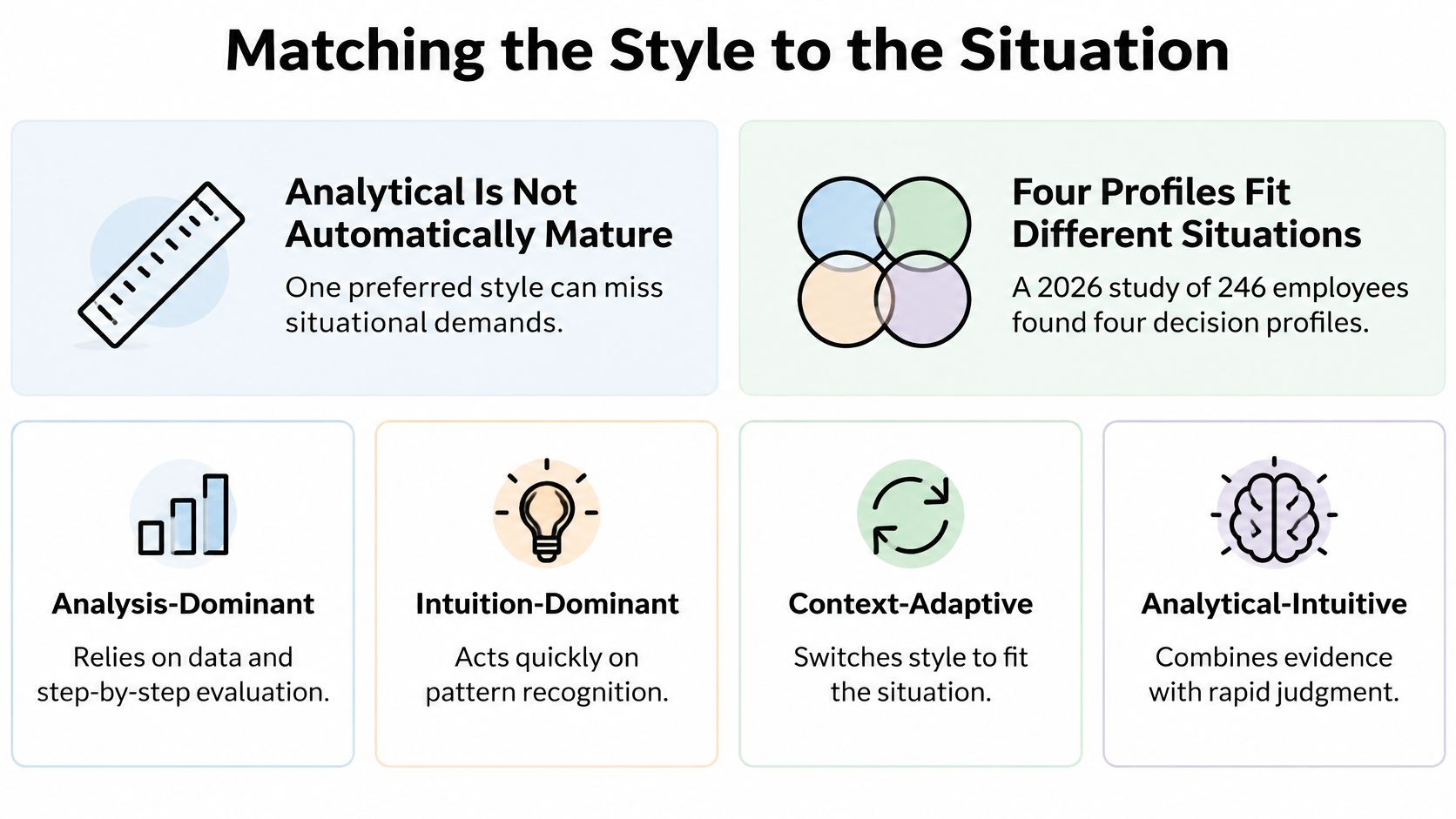
Test the transition between modes
Use the profiles as prompts for different observations:
A useful simulation changes the conditions after the candidate begins. Introduce conflicting information, an unavailable stakeholder, or a tighter deadline, then watch whether they revise the process appropriately.
The accompanying video offers another format for considering decision approaches.
<iframe width="100%" style="aspect-ratio: 16 / 9;" src="https://www.youtube.com/embed/JJt6Oj185z8" frameborder="0" allow="autoplay; encrypted-media" allowfullscreen></iframe>
Participation is a situational choice too
The Vroom-Yetton model, introduced in 1973, connects leader authority and subordinate participation to situational demands; a 1979 validation involving 96 managers and 181 real decisions supported that approach and found stronger concurrent validity than a noncontingent model, while an applied evaluation of 42 leaders found only modest support overall and none for two leader groups, as described in the [Vroom-Yetton validation evidence](https://psycnet.apa.org/fulltext/1979-02457-001.pdf).
Those leader groups included nursing, higher education, business and industry, and Greek-letter organizations. Don't assume a participation rule transfers cleanly between occupations.
An [experiment with experienced hospital and firm decision-makers](https://dl.acm.org/doi/10.1287/mnsc.26.4.371) also found that sensation-thinking participants perceived the highest risk and were more reluctant to adopt capital projects, whereas sensation-feeling participants were more risk tolerant and more likely to adopt the same proposals. These categories aren't interchangeable with General Decision-Making Style scores, but the contrast illustrates why identical proposals can prompt different reactions.
Write conditional hypotheses that specify the needed adjustment:
From Profile to Hire or Development Plan
A product-lead finalist reports high rational and low spontaneous tendencies. Don't reject them because the role requires fast roadmap choices. Ask for a concrete example of committing with incomplete information, then give them a time-boxed case and observe whether they stop gathering evidence.
Evaluate their decision against job-relevant criteria: did they identify the central trade-off, distinguish essential from optional information, and explain what would trigger a reversal? Fast delivery alone isn't enough, and neither is an elegant analysis submitted too late.
The process below connects the profile to a hiring or development action.
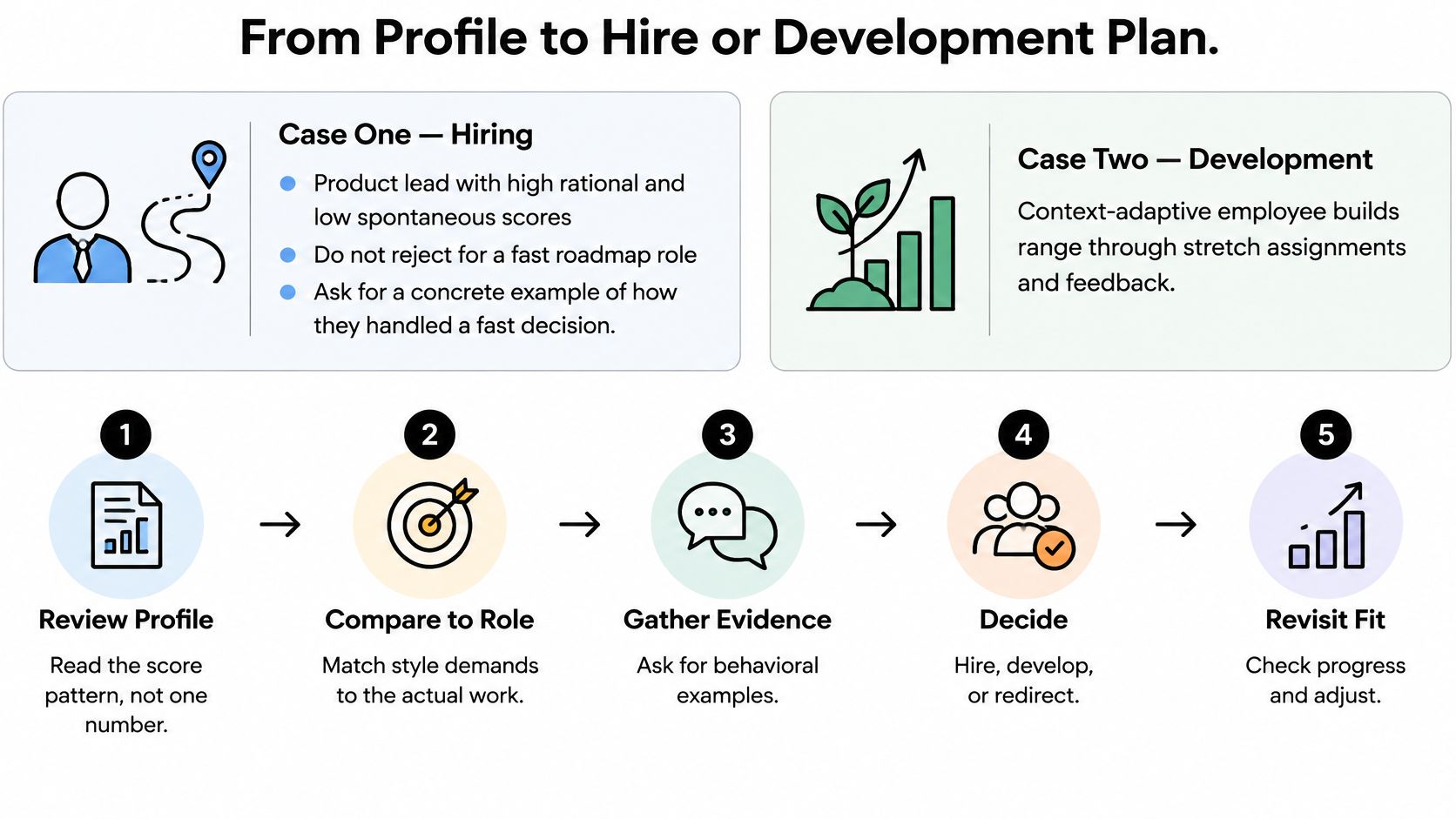
Coach the bottleneck rather than the label
Consider an operations or nursing manager with high dependent and avoidant scores. Give them a scenario where staff acceptance matters but consultation can't continue indefinitely. Observe whether they identify whose input is essential and who owns the final call.
In a [study of 102 middle-level managers](https://journals.sagepub.com/doi/10.1177/0013164412448066), rational style positively predicted rational decision-making and negatively predicted indecisiveness, while avoidant style positively predicted indecisiveness. That supports investigating a process bottleneck, not declaring the employee permanently indecisive.
A development plan might require a named decision owner, a commitment deadline, and an escalation trigger when essential advice is unavailable. A context-adaptive employee might instead benefit from stretch assignments that require unfamiliar decision modes, followed by feedback on why they switched approaches.
Bias offers another coaching target. Among 395 university students, lower cognitive-reflection scores were associated with greater susceptibility to conjunction fallacy, illusion of control, overconfidence, base-rate neglect, and conservatism; conservatism appeared in 84.5% of the low-scoring group versus 64.9% of the high-scoring group, according to the [cognitive-reflection experiment](https://www.cambridge.org/core/services/aop-cambridge-core/content/view/C70FFD62D8DA697D6FA89D8460075CF7/S1930297500007634a.pdf/cognitive-reflection-as-a-predictor-of-susceptibility-to-behavioral-anomalies.pdf).
Those student results aren't workplace selection thresholds. Use the reasoning errors to design practice, such as asking someone to check base rates before accepting a compelling story.
Keep the evidence sequence explicit
A [study of representativeness-based judgment](https://pmc.ncbi.nlm.nih.gov/articles/PMC6462158/) found biased decisions among more than half of respondents in each of six scenarios, and simple training significantly reduced the bias. Development can therefore target a specific reasoning failure rather than merely assign a style nickname.
Use this sequence:
1. Name the people decision. Specify hiring, promotion, development, or team placement. 2. List role demands. Include speed, ambiguity, information quality, and acceptance requirements. 3. Write a hypothesis. Describe the behavior you expect under a defined condition. 4. Probe with structured questions. Request concrete actions and consequences. 5. Test in a simulation. Use the same conditions and scoring criteria for comparable candidates. 6. Keep a human decision. Document the evidence supporting the final judgment.
Never convert a style mean into a pass mark.
Fairness Checks Before Scores Drive Offers
Black applicants were disadvantaged in 26% of the roles they applied to, and Asian applicants in 15%, according to a Stanford-linked analysis reported by Tech Xplore covering more than 4 million applications across roughly 1,700–2,000 positions. The findings concerned AI-assisted hiring systems and apparent adverse impact in some roles, not proof that every behavioral assessment is biased.
A well-built inventory and a fair hiring system aren't the same thing. Employers can introduce unequal outcomes when they combine assessment results with historical hiring labels, automated rankings, or recommendations whose assumptions nobody reviews.
Use the checklist as a system audit, not just a test-quality check.
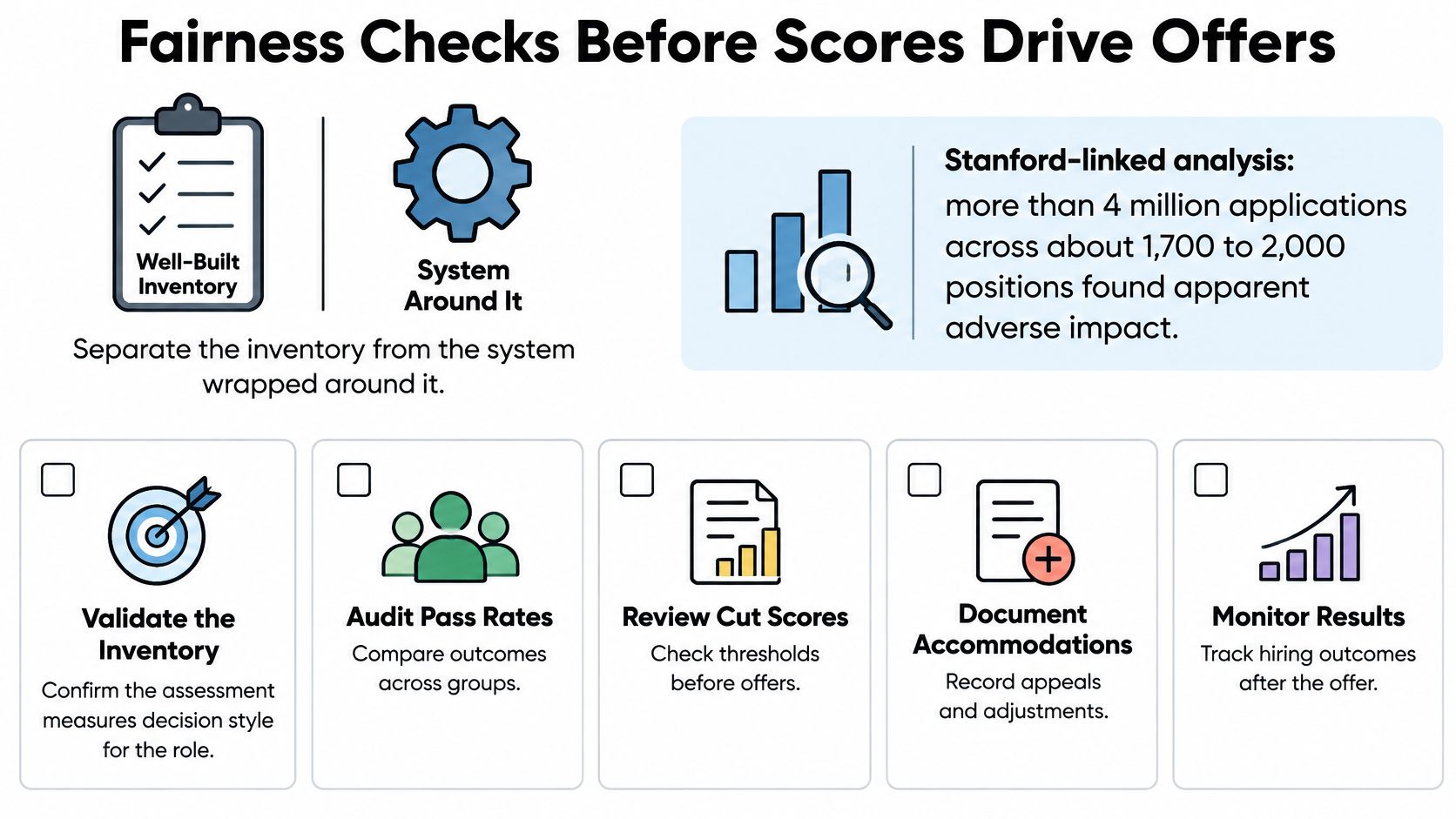
Audit the decision system
Removing demographic fields doesn't remove correlated proxies or historical patterns. Employers need to examine what happens to applicants after the score enters the workflow.
Also record accommodations, appeals, and threshold changes. Without those records, an employer may struggle to distinguish an access problem from a scoring problem or an inconsistent review process.
Separate prediction from fairness
Predictive validity asks whether a score forecasts the intended behavior. Fairness asks whether the measurement and decision process treat people appropriately and produce defensible outcomes. An employer can find predictive value and still identify an unacceptable burden on a group.
Practical methods for [reducing hiring bias](https://synopsix.ai/blog/how-to-reduce-hiring-bias) should therefore cover both the interview process and the systems around it. Don't treat an apparently objective score as permission to stop reviewing outcomes.
> Governance rule: Style results may guide interview probes and development plans. They must not be the sole basis for a hiring or promotion decision with legal or similarly significant effects.
Treat that as an organizational safeguard, not a substitute for jurisdiction-specific legal advice. For global employers, the standard should be ongoing measurement and review, not a vendor certificate filed away after implementation.
Test the Next People Decision Before You Commit
Pick a live decision this month: a finalist, a promotion, or a team change. Write the role demands in a single sentence covering speed, ambiguity, information quality, and whose acceptance matters.
Then state the behavioral hypothesis in business language. For example, the candidate may delay commitment when risk is ambiguous. Name the observation that would disprove it: in a time-boxed simulation, they identify the unresolved risk, make a defensible call, and explain when they'd reconsider. The style score matters only because it generated that hypothesis. If the situation contradicts the score, the situation wins.
Define what would change your mind
Before interviewing, record both confirming and disconfirming evidence. Otherwise, a manager can interpret every answer as support for the first impression.
Spark's guide to [riconoscere gli errori di valutazione](https://tryspark.co/errori-di-valutazione/) offers an additional resource on recognizing evaluation errors. Use that perspective to challenge your interpretation, not just the candidate's reasoning.
A short decision record should contain:
Connect the assessment to the actual choice
At Synopsix, users state the decision they're about to make in natural language. They don't choose templates or set parameters. The platform has modeled more than 10,000 people decisions, and it does not make solely automated decisions with legal or similarly significant effects.
The personal professional assessment is free, takes about 10 minutes, and includes a private, confidential, downloadable PDF report. Use it to compare the person with the role, leader, and team, while keeping the offer, promotion, or reorganization a human call.
What matters is the documented reasoning, not a prettier style badge. If the hypothesis fails in the simulation, revise it. Change the process or reconsider the shortlist when the evidence warrants it, rather than protecting the original label.
---
Synopsix connects behavioral assessment with role-specific analysis and simulations for hiring, team design, and development. Visit [Synopsix](https://synopsix.ai) and bring one live people decision this month, then use the resulting evidence to test your assumptions before you commit.