Define Impression Management for Smarter Hiring Decisions
By Synopsix · August 15, 2026 · 14 min read
Impression management is the goal-directed process of controlling how others perceive you, consciously or unconsciously. In hiring, applicants deploy ingratiation, self-promotion, excuses, and justifications that can inflate perceived fit without improving underlying competence.
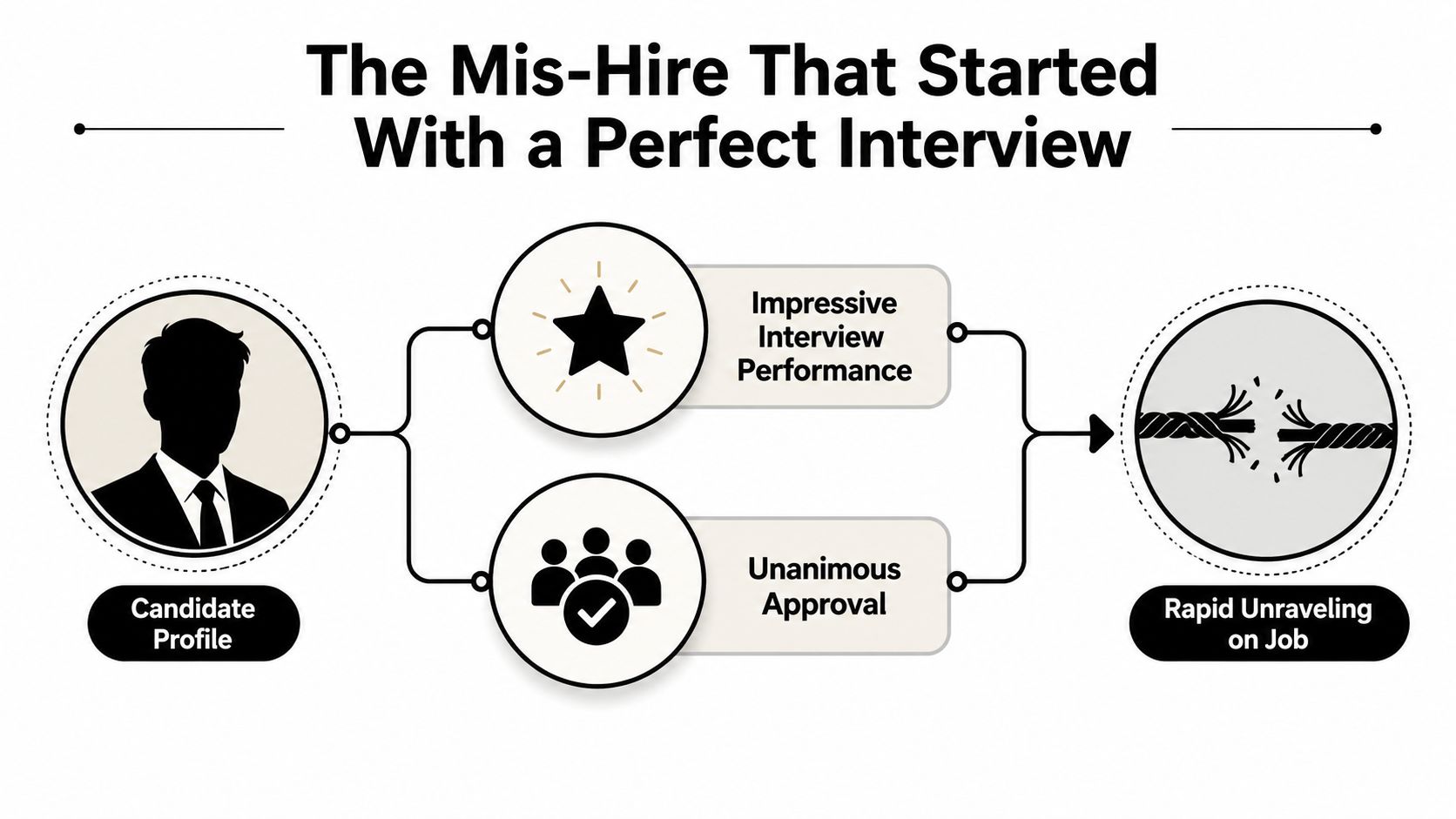
A candidate can be articulate, warm, confident, and perfectly aligned with every value discussed in the interview. The panel leaves the room unanimous. Six months later, the new hire avoids accountability, struggles with the actual work, and creates friction the interview never exposed. The problem wasn't necessarily dishonesty. The hiring system treated performance in an evaluative conversation as proof of performance on the job.
The Mis-Hire That Started With a Perfect Interview
The candidate answered every question smoothly. They had a polished story for each career move, a credible explanation for every weakness, and an example ready whenever an interviewer asked about leadership. Each panelist heard something different but equally reassuring: strategic thinking, confidence, cultural alignment, and executive presence.
The hiring team approved the candidate without meaningful disagreement. After joining, the person needed constant direction, resisted feedback, and struggled when priorities changed. The same confidence that looked like leadership in the interview became defensiveness in ordinary work. The company didn't hire a fictional person. It hired an incomplete impression.
A working definition for people decisions
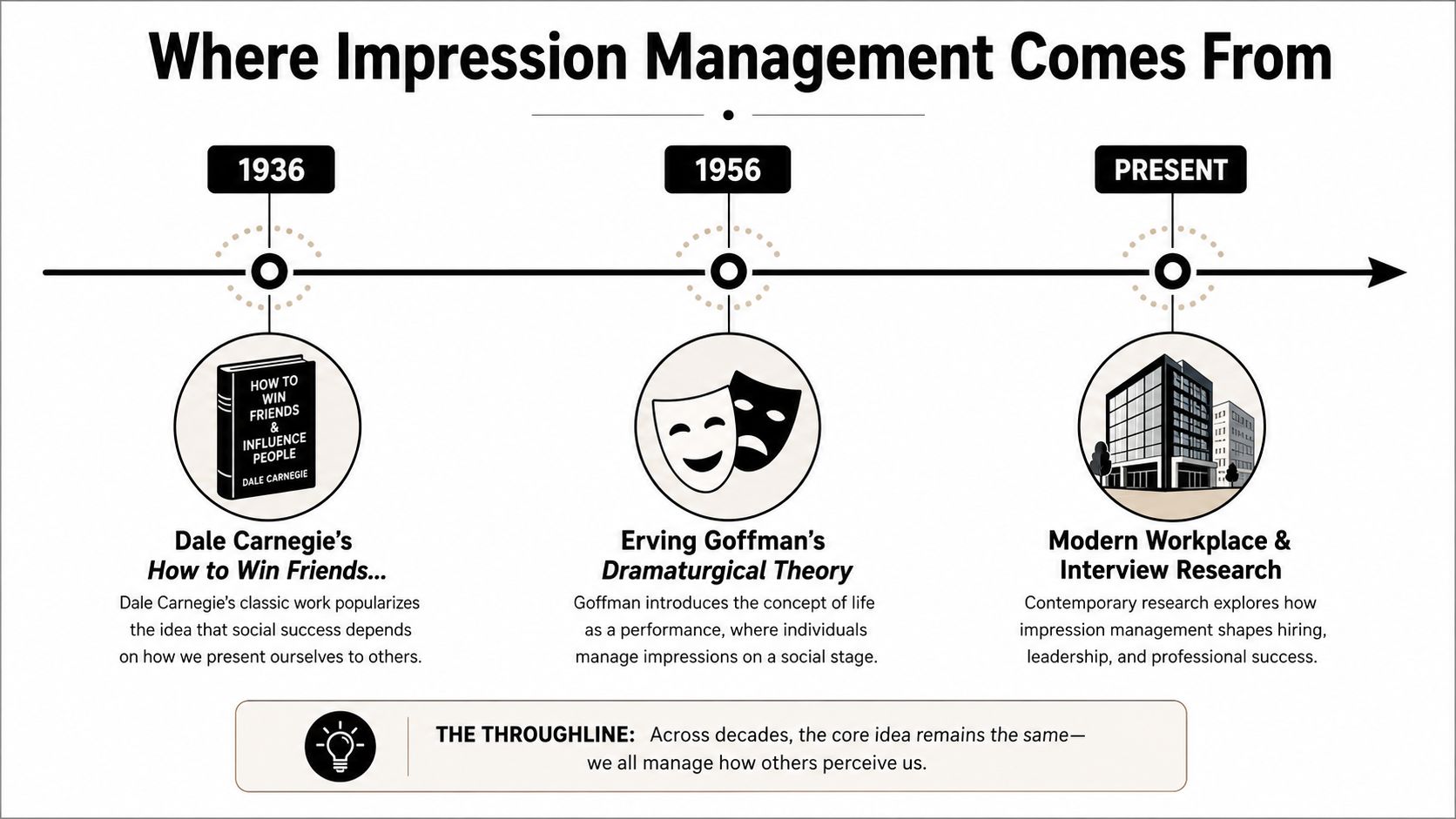
To define impression management precisely, treat it as behavior used to control, shape, or protect the impressions other people form. In workplace research, the process is goal-directed. A candidate regulates verbal and nonverbal signals to influence judgments about competence, likability, accountability, leadership potential, or fit. The behavior can be conscious or subconscious, and it isn't automatically deceptive. [EBSCO's history of impression management](https://www.ebsco.com/research-starters/history/impression-management) traces the concept's formalization to Erving Goffman's The Presentation of Self in Everyday Life, first published in Scotland in 1956 and released to a broader United States audience in 1959.
That distinction matters. A candidate who prepares carefully, listens well, and communicates clearly may be presenting themselves professionally. A candidate who exaggerates ownership, conceals limitations, or mirrors an interviewer's opinions without evidence is managing the impression in a way that can compromise decision quality.
> Practical rule: Don't ask whether a candidate is managing impressions. Everyone does. Ask whether your process can separate persuasive presentation from job-relevant capability.
Impression management becomes expensive when it enters interview inflation, mis-promotion, and leadership pipeline failure. A polished story can influence a panel before anyone tests the underlying behavior. The remedy isn't to punish confidence or demand artificial “authenticity.” It's to design assessments that make unsupported claims harder to sustain.
Where Impression Management Comes From
Impression management isn't a fashionable label attached to modern recruiting. Its intellectual lineage reaches from advice literature into social psychology and organizational behavior. The historical progression matters because each stage added a more precise explanation of how people shape social judgments.
The Oxford Research Encyclopedia review of impression management identifies roots in advice literature and sales and marketing guidance dating back at least to Dale Carnegie's 1936 work on winning friends and influencing people. That early tradition focused on practical influence. It described how people could behave in ways that encouraged approval, cooperation, and social acceptance.
From performance metaphor to workplace construct
Goffman's contribution gave the idea a durable analytical frame. His dramaturgical approach compared social interaction with theatrical performance, distinguishing the public presentation people offer from the less formal behavior they show away from an audience. That framing made self-presentation observable. Researchers could examine the signals people use to create, maintain, and protect an image instead of treating social influence as an intuition.
The concept then expanded into formal social psychology and organizational research. From the mid-1980s onward, researchers examined impression management more systematically in workplace and management contexts, including hiring, leadership evaluation, legitimacy, reputation, and organizational image. The [Oxford review](https://oxfordre.com/psychology/display/10.1093/acrefore/9780190236557.001.0001/acrefore-9780190236557-e-748) describes the scientific study as having roots that extend across nearly a century, while contemporary definitions include verbal and nonverbal behaviors used to shape how targets perceive an actor.
That evolution changed the practical question for HR. The issue is no longer whether candidates make impressions. It's which behaviors create those impressions, which judgments they influence, and whether those judgments predict performance. Hiring validity research exists because impression management can be examined as a source of response bias rather than dismissed as interpersonal chemistry.
This short video provides a useful visual introduction to the concept's development and application:
<iframe width="100%" style="aspect-ratio: 16 / 9;" src="https://www.youtube.com/embed/JDMkWZQjaE8" frameborder="0" allow="autoplay; encrypted-media" allowfullscreen></iframe>
The historical lesson is straightforward. Impression management is a serious construct with a long research lineage, not a synonym for vanity and not an accusation of fraud.
The Two Streams Every HR Leader Should Recognize
Workplace and interview research generally separates impression management into assertive tactics and defensive tactics. Assertive tactics build a desired identity. Defensive tactics repair or shield an identity when a threat appears. This classification gives interview panels a better vocabulary than “I liked them” or “something felt off.”
Assertive tactics build the preferred identity
Ingratiation seeks approval. A candidate flatters the hiring manager, agrees enthusiastically with the company's philosophy, or adopts the interviewer's language to appear naturally aligned. The behavior can reflect genuine admiration, but it becomes risky when agreement replaces independent judgment.
Self-promotion highlights competence, achievements, and qualifications. A candidate might describe a project as their accomplishment when their actual contribution was narrower, or frame exposure to a task as mastery. [Research from the University of Calgary](https://prism.ucalgary.ca/items/ffcb5556-bec3-489e-bad0-01cbec1919da) identifies ingratiation and self-promotion as distinct tactics studied in employment interviews because each can shape interviewer judgments differently.
Exemplification presents the person as unusually dedicated, principled, or hardworking. In practice, that might mean volunteering for every high-visibility initiative, emphasizing sacrifice, or describing long hours as evidence of character. It can signal commitment, but it can also reward theatrical effort rather than sustainable execution.
Defensive tactics protect a threatened identity
Excuses shift responsibility toward circumstances. A candidate may explain a missed deadline through changing priorities, unclear ownership, or another team's delay. Those factors may be real. The assessment question is whether the candidate can still identify their own decision, consequence, and corrective action.
Justifications acknowledge an unfavorable outcome but recast it as reasonable. A missed target becomes a strategic trade-off. A conflict becomes evidence of high standards. A failed initiative becomes proof that the candidate took a necessary risk.
Apologies can repair trust when they include ownership and changed behavior. They become defensive impression management when the words soften accountability without showing what the person did differently afterward.
| Stream | Common tactics | Interview signal to test | |---|---|---| | Assertive | Ingratiation, self-promotion, exemplification | Does the claimed identity appear in observable behavior? | | Defensive | Excuses, justifications, apologies | Does the candidate own the outcome and explain the correction? |
The point isn't to eliminate these tactics. Candidates need to communicate value, and professionals must sometimes repair a damaged reputation. Your panel should distinguish persuasion supported by evidence from persuasion that substitutes for evidence.
What the Numbers Actually Show in Real Interviews
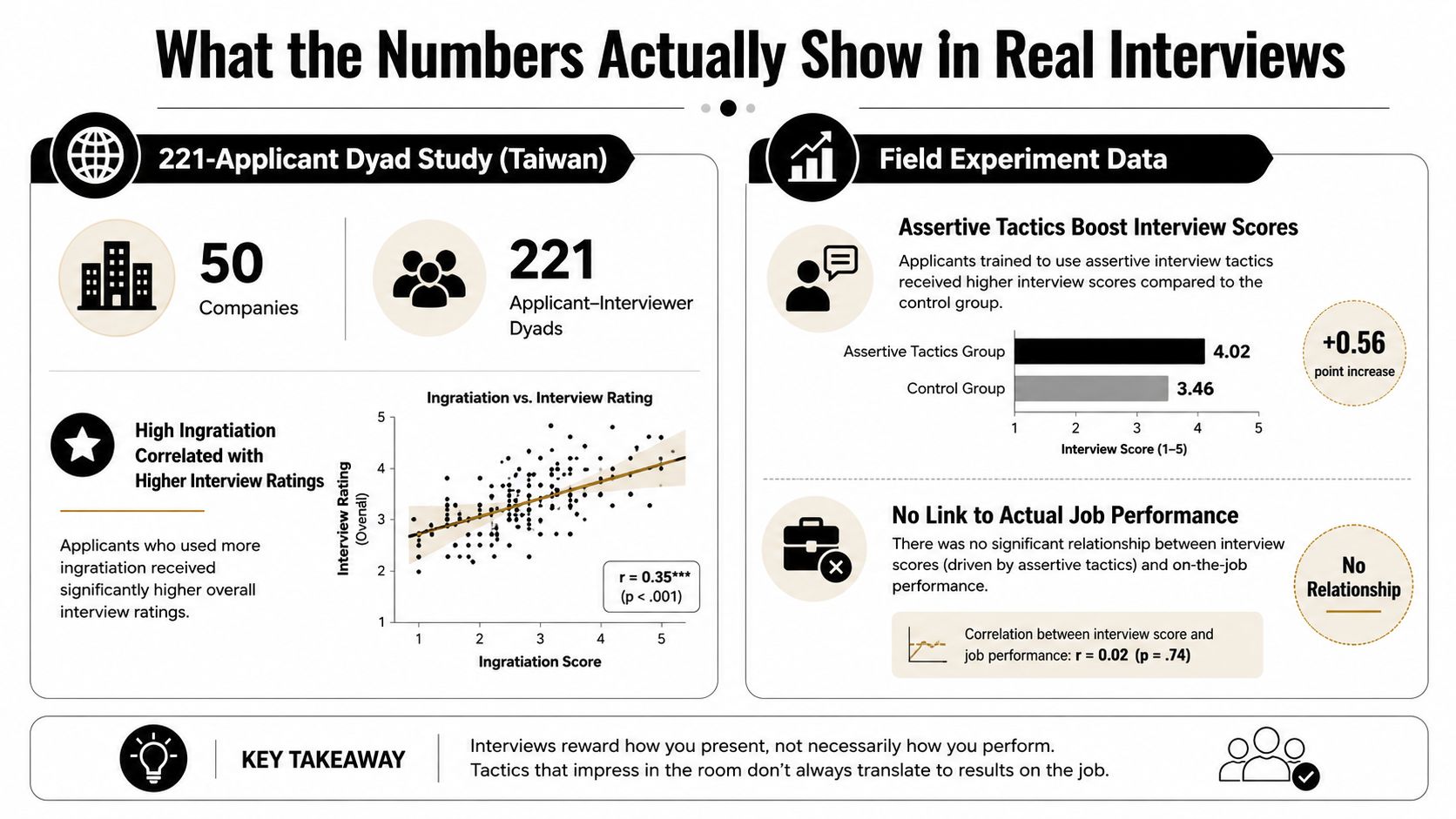
The risk becomes clearer in field research. A study of 221 applicant-recruiter dyads across 50 companies in Taiwan found that applicants' self-focused impression management was positively related to recruiters' perceptions of person-job fit. Other-focused tactics influenced hiring recommendations through perceptions of person-organization fit, while nonverbal impression management improved recruiters' positive mood, which then affected fit perceptions and hiring recommendations. [The full field study is available through the National Library of Medicine](https://pmc.ncbi.nlm.nih.gov/articles/PMC5532427/).
Fit judgments can follow the presentation
That finding should change how debriefs work. “They'd fit right in” may reflect other-focused behavior and positive mood as much as evidence of collaboration. “They clearly have the capability” may reflect self-focused presentation that has not yet been tested against work samples, references, or behavioral examples with verifiable ownership.
A separate study examined 246 professional interviewers and 270 novice interviewers. Interviewers were better at detecting honest than deceptive impression management, and interviewer experience itself didn't improve detection. [The interview detection study](https://pmc.ncbi.nlm.nih.gov/articles/PMC5309241/) directly challenges the assumption that experienced hiring managers can reliably read candidates.
The implication is uncomfortable but useful: intuition isn't a control. Experience can help an interviewer understand the job, but it doesn't guarantee accurate detection of managed impressions. A confident candidate can influence several independent observers through the same polished signals, especially when the interview format gives every applicant the same opportunity to rehearse.
> Decision standard: Treat a strong interview as a hypothesis about capability, not as capability itself.
Your process should therefore collect evidence through different channels. Ask for specific behavior, probe the candidate's personal contribution, test the relevant work, and compare the story with structured observations. A warm conversation can remain part of the candidate experience. It just shouldn't carry the validity burden alone.
Why Interview Signals Are Less Reliable Than You Think
Impression management can operate as a measurable source of response bias. Applicants adapt their behavior to an evaluative context, and the resulting signal may influence judgments without improving the underlying capability required for the role. The selection problem isn't only that some candidates are polished. It's that polished behavior can be mistaken for stable performance.
A 2023 latent profile analysis examined how applicants combine impression management tactics and linked those profiles with age, gender, HEXACO personality traits, cognitive ability, interview performance, follow-up interviews, and job offers. [The study's published record](https://ntut.elsevierpure.com/en/publications/the-effect-of-applicant-impression-management-tactics-on-hiring-r/) matters because it treats impression management as a set of tactic combinations, not a single personality trait.
Profiles matter more than labels
One applicant may rely on confident self-promotion. Another may combine agreement, warmth, and selective vulnerability. A third may use defensive explanations whenever the conversation reaches failure. These profiles can relate differently to who advances, which means a single “high or low impression management” score would oversimplify the decision.
| Tactic Profile | Dominant Behavior | Linked Outcomes | |---|---|---| | Assertive presenter | Emphasizes achievements and fit | May receive stronger perceived competence or fit | | Relational adapter | Uses agreement, warmth, and audience alignment | May influence organizational fit judgments | | Defensive repairer | Reframes setbacks and protects identity | May appear accountable or evasive, depending on evidence | | Balanced evidence-led candidate | Connects claims to specific behavior and outcomes | Offers a stronger basis for structured comparison |
These are decision profiles, not diagnoses. HR teams should never infer character from one conversational moment. They should identify where the candidate's narrative remains unsupported, then test that gap with a behavioral prompt, simulation, or work sample.
That is why [validity in psychology](https://synopsix.ai/blog/validity-in-psychology) matters to hiring design. A valid assessment aligns the evidence collected with the capability the role requires. It doesn't reward the candidate who has learned the interview script.
Candidates can also use structured preparation without becoming deceptive. Guidance on [practical AI interview tips](https://productivityradar.com/ai-interview-preparation/) can help applicants organize examples and clarify their communication. Employers should assume candidates will prepare. The responsible response is to assess performance through multiple evidence types, not to penalize preparation.
The People-Intelligence Approach to Separating Signal From Performance
The reliable answer isn't better mind-reading. It's a better assessment architecture. Structured interviews, multiple assessors, behaviorally anchored simulations, and complementary psychometric data reduce the chance that one polished interaction determines a high-stakes decision.
A structured interview gives every candidate comparable prompts and a defined scoring rubric. Multiple assessors reduce dependence on one person's rapport with the applicant. A simulation forces the candidate to make decisions, prioritize trade-offs, or respond to realistic constraints. Psychometric data adds a behavioral lens that self-presentation alone can't provide.
Healthy presentation isn't the enemy
Healthy self-presentation helps a leader communicate clearly, establish credibility, and adapt to stakeholders. A chief executive who can frame a strategy for employees, investors, and customers is managing impressions in a useful way. The presentation remains healthy when it accurately represents the person's capabilities and values.
Misleading presentation creates a different problem. It hides material limitations, claims ownership without evidence, or uses emotional fluency to bypass scrutiny. The distinction is alignment between the signal and the behavior, not whether the person appears confident.
A practical people-intelligence workflow follows four moves:
1. Assess efficiently. Gather candidate or employee data in a consistent format rather than relying on conversational memory. 2. Generate comparable profiles. Give decision-makers a common behavioral language for comparing people against the role. 3. Translate data into business signals. Explain likely strengths, risks, and working patterns without forcing executives to interpret technical jargon. 4. Test the fit under pressure. Use simulations and compatibility analysis to examine how the person may operate with the actual team and role demands.
Work-sample design deserves particular attention. A guide to [work-sample testing](https://synopsix.ai/blog/work-sample-testing) can help teams connect evaluation tasks with the work candidates will perform. That's the strongest defense against an interview process that rewards storytelling more than execution.
A Practical Playbook for HR Leaders
Start with the role, not the candidate. Write down the behaviors that distinguish strong performance, then build the assessment around those behaviors. If the role requires prioritization, test prioritization. If it requires coaching, observe coaching. Don't ask a candidate to describe a capability when you can create a situation that requires them to use it.
Build the hiring cycle in this order
1. Define behaviorally anchored questions. Ask for a specific situation, the candidate's actions, the decision logic, and the result. Score the evidence against observable criteria, not enthusiasm or polish. Use this [interview question design guide](https://synopsix.ai/blog/interview-question-design) to keep questions tied to job requirements.
2. Add a realistic simulation. Give candidates a task with incomplete information, competing priorities, or a difficult stakeholder. A rehearsed narrative has less influence when the person must demonstrate judgment in real time.
3. Compare claims with behavioral data. If a candidate claims to welcome challenge, examine how they respond to disagreement. If they claim ownership, ask what they personally changed after failure. Treat inconsistencies as prompts for investigation, not automatic rejection.
4. Use an intelligence report in the debrief. Look for role-specific risk indicators, fit recommendations, and likely friction points written in business language. The report should sharpen questions and reveal trade-offs, not replace human judgment.
5. Model team complementarity before approval. Examine how the candidate's working style may interact with existing team tendencies. A strong individual profile can still create predictable tension in a particular team configuration.
A useful external reference is [Paradigm International Inc.'s hiring framework for COOs](https://paradigmie.com/post/interviewing-best-practices), which offers a role-specific lens for evaluating senior operators. The principle applies beyond COO hiring: seniority increases the cost of confusing executive presence with operating capability.
Keep the final debrief disciplined. Require each assessor to cite observed behavior, separate evidence from inference, and identify what remains unknown. If the only argument for hiring is that the candidate “felt right,” the process hasn't finished.
Designing People Decisions That Withstand the Performance
Impression management is neither a villain nor a virtue. It's a permanent feature of social work. People present themselves, adjust to audiences, protect their reputations, and communicate identities. Strong leaders use those behaviors responsibly. Weak hiring systems mistake them for proof.
The strategic posture is simple:
A polished interview should open an inquiry, not close a decision. When HR leaders build evidence across methods, they give executives a stronger basis for hiring, promotion, and succession decisions. The result is a people system that can move faster without becoming careless, reduce avoidable mis-hires, and build leadership pipelines on demonstrated behavior rather than memorable performance.
---
Synopsix helps HR leaders turn scientifically validated behavioral assessments into practical guidance for hiring, team design, and talent development. Visit [Synopsix](https://synopsix.ai) to see how comparable profiles, intelligence reports, predictive simulations, and compatibility analysis can separate managed impressions from genuine behavioral fit.