Dependability in the Workplace: A Practical Guide
By Synopsix · October 21, 2026 · 14 min read
A deadline slips, then another. A manager is trying to decide whether a team member is unreliable, overloaded, unclear about priorities, or blocked by a process nobody has fixed. The team still needs the work done, and the next hiring or promotion decision is already on the calendar. Treating dependability as a personality label won't solve that problem.
Dependability in the workplace is both a set of observable behaviors and a property of the system those behaviors happen inside. CHROs who separate the two can make better hiring decisions, coach more precisely, and stop rewarding visible busyness over consistent contribution.
What Dependability Really Means at Work
A manager promotes a high-performing specialist because the person seems like the obvious next leader. Then deadlines start slipping. The specialist doesn't flag risks early, teammates wait on handoffs, and the manager spends time chasing status instead of moving work forward. At first, the manager calls it a personal reliability problem. A closer look reveals that the new role has conflicting priorities, no clear decision rights, and several approvals that routinely stall delivery.
That distinction matters. Dependability isn't being nice, senior, or busy. At work, it means making clear commitments, following through, communicating when a commitment is at risk, and producing consistent results as conditions change. A dependable employee doesn't have to be perfect. They do need to help others plan around what they can deliver.
Performance reviews often blur this into impressions: “always on top of things,” “a safe pair of hands,” or “not a team player.” Those descriptions may be sincere, but they don't tell a candidate what behavior to repeat or a manager what to coach. They also invite bias. One person's confidence can be mistaken for competence, while another person's early warning about a blocker can be misread as an excuse.
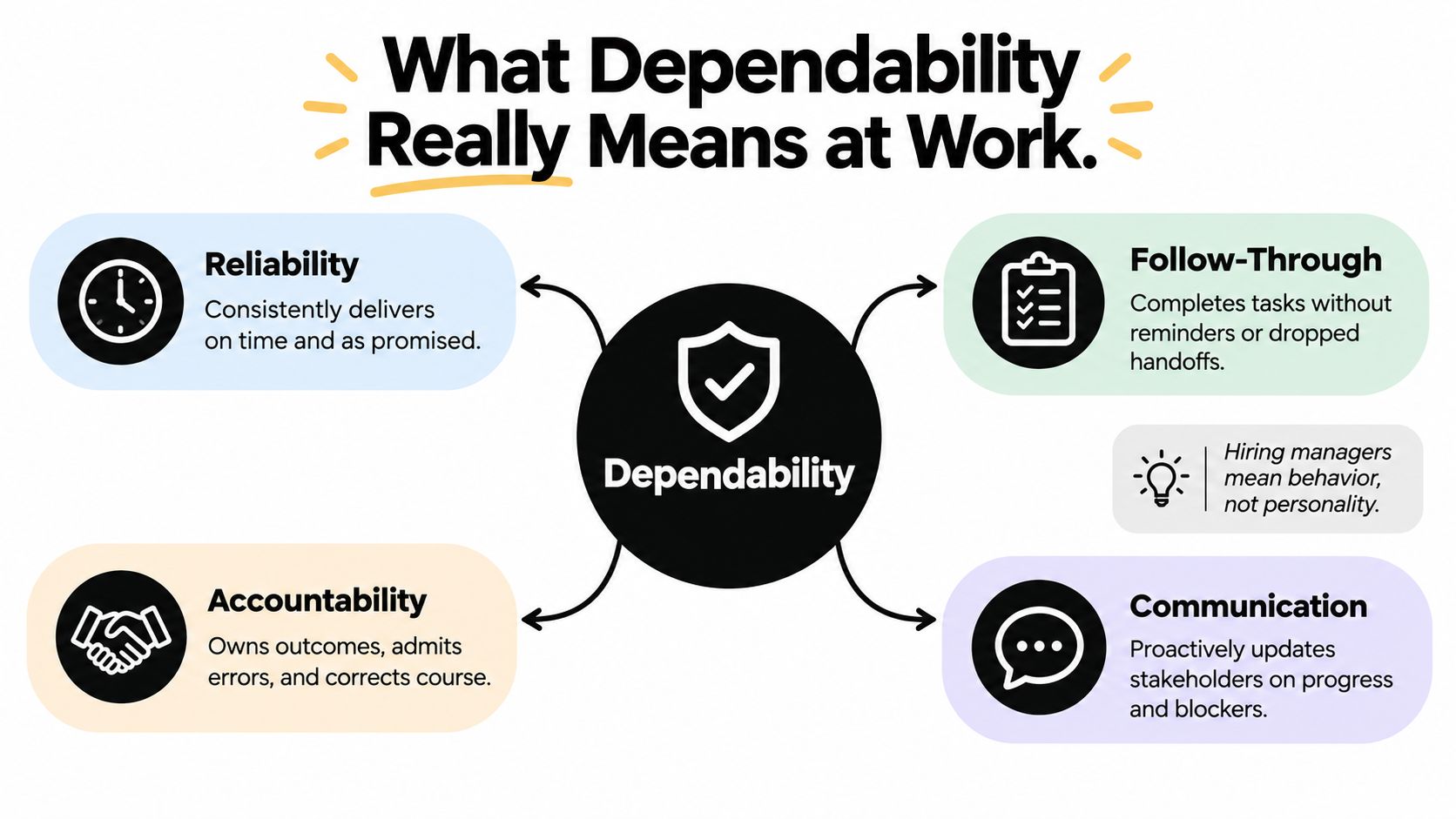
Define the behaviors before you assess the person. For most roles, start with four:
| Layer | What it covers | Example signal | Failure mode | |---|---|---|---| | Commitment | Whether expectations are understood | A clear owner and due date | Competing priorities stay unresolved | | Execution | Whether work moves as agreed | Tasks are completed or renegotiated early | Work stalls without notice | | Recovery | How someone responds to disruption | Risks are escalated with a proposed next step | Misses are hidden until they affect others |
A useful definition gives hiring managers something to observe and employees something they can act on. It also makes room for the possibility that the role, not just the person, is making dependable performance difficult.
The Trait, the Behavior, and the System
Workplace dependability has three layers, and managers should diagnose the layer that's failing before prescribing a fix.
Trait-level dependability concerns relatively stable tendencies. The organizational research connects conscientiousness, which includes reliability, persistence, planning, and attention to detail, with overall job performance. A large meta-analysis of personnel-selection research reported a corrected correlation of approximately ρ = 0.27, based on 239 studies and 48,100 participants. The relationship is meaningful, but it isn't a crystal ball: conscientiousness doesn't guarantee performance, and it doesn't tell you whether a person will succeed in a specific role. Earlier influential reviews by Barrick and Mount and by Schmidt and Hunter reached similar conclusions, with the latter reporting predictive validity of approximately ρ = 0.31 for conscientiousness. ([The meta-analysis and review of conscientiousness and job performance](https://eprints.qut.edu.au/92442/1/92442.pdf))
Behavior-level dependability is what colleagues can see: meeting commitments, attending required safety briefings, completing inspections, and escalating hazards or blockers. In one field intervention, average attendance at safety talks and toolbox meetings increased from 88% before to 94% during the intervention over equivalent 20-day periods. That's a six-percentage-point improvement, not proof that attendance alone reduces accidents. It does show why teams should track repeatable actions rather than rely on a manager's broad impression. ([The field intervention on safety-meeting attendance](https://jurnal.uns.ac.id/placentum/article/download/88869/49487))
System-level dependability asks whether the organization makes reliable work possible. Are priorities clear? Do tools work? Can employees complete handoffs without avoidable bottlenecks? A peer-reviewed analysis indexed by the U.S. National Institutes of Health estimated that health-related work losses cost U.S. employers more than $260 billion annually. In its study population, employees reported an average of 1.99 workdays missed because of illness and 9.04 additional days at work while limited in their ability to perform tasks. The analysis used an absenteeism cost multiplier of 1.61, and estimated individual annual productivity costs of $15 to $1,601 above comparable employees without those conditions or risks. ([The analysis of health-related absenteeism and presenteeism costs](https://pmc.ncbi.nlm.nih.gov/articles/PMC3128441/))
Those measures make the point: dependability includes predictable capacity and continuity, not just punctuality. In hybrid work, missed commitments may also reflect unstable infrastructure, unclear expectations, or poor handoffs. The review of hybrid-work challenges highlights how these conditions intersect with management practices, trust, wellbeing, and performance systems. ([The review of hybrid-work challenges](https://link.springer.com/article/10.1007/s43546-026-01099-4))
> Diagnostic question: Is the employee choosing not to follow through, unable to follow through, or working inside a system that makes follow-through harder than it needs to be?
For teams that struggle to define who owns decisions and deliverables, [The OKR Hub's role clarity playbook](https://www.theokrhub.com/insights/role-clarity) offers a practical way to make expectations more explicit. When a miss raises confusion about ownership, use [a framework for clarifying whose responsibility it is](https://synopsix.ai/blog/whose-responsibility-is-it) before treating the issue as a character flaw.
Why Dependability Matters for Hiring, Performance, and Team Design
Dependability should influence who you hire, who you promote, and how you distribute work. Don't leave it as an unspoken preference that managers apply differently.
Hiring
A résumé shows what a candidate says they've done. It rarely shows how they handle a shifting deadline, a blocked handoff, or a mistake that affects a colleague. Use structured behavioral interviews to ask candidates for specific examples: What commitment did they have to renegotiate? How early did they raise the risk? What did they do to restore confidence? Score answers against a shared rubric, not against whether the candidate feels polished.
Assessment data can add another perspective, especially when it's tied to the role. Personality measures can help identify patterns relevant to planning and follow-through, but they shouldn't become a pass-fail shortcut. Pair them with work samples, structured interviews, and job-relevant criteria.
Performance and promotion
Output matters, but it doesn't show the full cost of producing it. A top contributor who repeatedly leaves teammates guessing may create hidden coordination work. Add signals such as on-time delivery against agreed commitments, timeliness of escalation, and completion of required activities to performance discussions. Interpret each signal in context. A deadline miss caused by a late scope change isn't equivalent to a deadline miss that went uncommunicated.
Promotion rubrics should reward reliable judgment, not performative activity. Ask whether the candidate follows through across dependencies, surfaces risks, and helps the team recover when plans change.
Team design
Look for concentration risk. If one dependable employee routinely catches dropped handoffs or rescues late work, the team may appear stronger than it is. That person could be masking weak ownership, unclear processes, or uneven capability. Map responsibilities and dependencies, then check whether knowledge and follow-through are distributed.
Retention planning matters too. [This guide on reducing turnover friction](https://turnonwork.com/employee-engagement-and-retention-strategies/) can help leaders consider how employee experience and continuity affect the team. The aim isn't to label people as dependable or not. It's to build teams where commitments are visible, ownership is clear, and no single person has to compensate for a broken process.
Four Ways to Measure Dependability
Gut feel is quick, but it's hard to defend and even harder to coach. Use several methods because each captures a different part of the job.
| Method | What it captures | Main blind spot | Practical use | |---|---|---|---| | Personality assessment | Patterns such as planning, persistence, and conscientiousness | A trait score doesn't prove role-specific behavior | Use as one input alongside job evidence | | Structured interview | How a candidate describes past follow-through and recovery | Self-report can be selective | Ask consistent questions and score with anchors | | Operational metrics | Observable actions such as attendance or timely escalation | Context can make raw counts misleading | Define expectations and review trends fairly | | Work sample or simulation | Decisions under realistic role demands | A narrow exercise may miss longer-term consistency | Test handoffs, prioritization, and risk communication |
Use assessments as evidence, not verdicts
The personality research gives HR a reason to take structured assessment seriously, not to outsource the hiring decision to a score. A conscientiousness measure can help identify a pattern, but it can't tell you whether a candidate has the required technical skill, whether the manager sets workable priorities, or whether the job's workload is sustainable. Assessments should complement structured interviews, work samples, and job-relevant criteria.
Standardize the interview
Ask every candidate the same core questions and use a scoring rubric. Look for concrete details: the commitment, the obstacle, when the candidate communicated, what they did next, and how the outcome affected others. A strong answer isn't necessarily one where nothing went wrong. It's one that shows early communication, ownership, and a credible recovery.
For help building questions that reveal actions rather than polished generalities, use [this guide to assessing behavior](https://synopsix.ai/blog/how-to-assess-behavior).
Measure work as it happens
Operational measures work best when the behavior is within the employee's control and the expectation is clear. Attendance at required briefings, on-time completion of inspections, and escalation timeliness can reveal patterns before a customer complaint or missed deadline exposes a problem. But don't equate presence with contribution or penalize someone for reporting a legitimate blocker.
Work samples and simulations help test judgment directly. Give candidates a realistic scenario with a competing deadline or a handoff that's at risk, then observe how they prioritize, communicate, and document their decision.
My recommendation is a layered assessment: a validated personality measure, a structured interview, one role-relevant work sample, and an operational signal once the employee is in the job. Compare the methods by validity, bias risk, and what they miss. No single measure is enough, and adding interview rounds without improving the evidence won't fix that.
The Hidden Cost of Over-Monitoring
Digital surveillance can tell you who is active on a device. It can't reliably tell you who is making sound decisions, producing accurate work, or raising a risk before it spreads.
A 2025 survey cited by professional accounting media found that 74% of U.S. employers used online tracking tools, 59% monitored screens in real time, 61% used AI analytics to measure productivity, and 67% used biometric data for attendance or behavior. ([The 2025 survey on employer tracking and workplace surveillance](https://www.fm-magazine.com/issues/2025/dec/how-ai-is-changing-the-way-companies-watch-workers/))
Those figures describe adoption, not proof that monitoring creates dependable performance. Telemetry can make activity visible, but visible activity isn't the same as dependable judgment. A worker may keep a status light active while missing the important task. Another may spend time checking an AI-generated answer because accuracy matters more than speed. Dashboards can reward what's easy to count and overlook honest escalation, careful work, and recovery after disruption.
Microsoft Research's future-of-work report warns that telemetry and algorithmic management can raise short-term output while increasing stress and eroding trust unless workers have a role in governing those systems. It also cites a global survey in which two-thirds of employees trusted AI agents, while 60% skipped checking AI output for accuracy. Treat that as a warning about oversight design, not evidence that surveillance improves reliability.
> Visible compliance can be measured. Dependable judgment has to be evaluated in context.
Before adding monitoring, ask what problem the data will help a manager solve. If the issue is late handoffs, track the handoff and its ownership. If it's unclear workload, fix prioritization. If a manager responds to every blocker with blame, more tracking may teach employees to hide bad news. Review [signs of a bad manager](https://synopsix.ai/blog/signs-bad-manager) when reliability concerns seem to cluster around the same leadership practices.
A 90-Day Plan to Build Dependability Across a Team
Start with a baseline, then fix the working conditions before asking people to try harder. Choose a small set of role-relevant behaviors, explain how you'll assess them, and give the team a safe way to flag constraints.
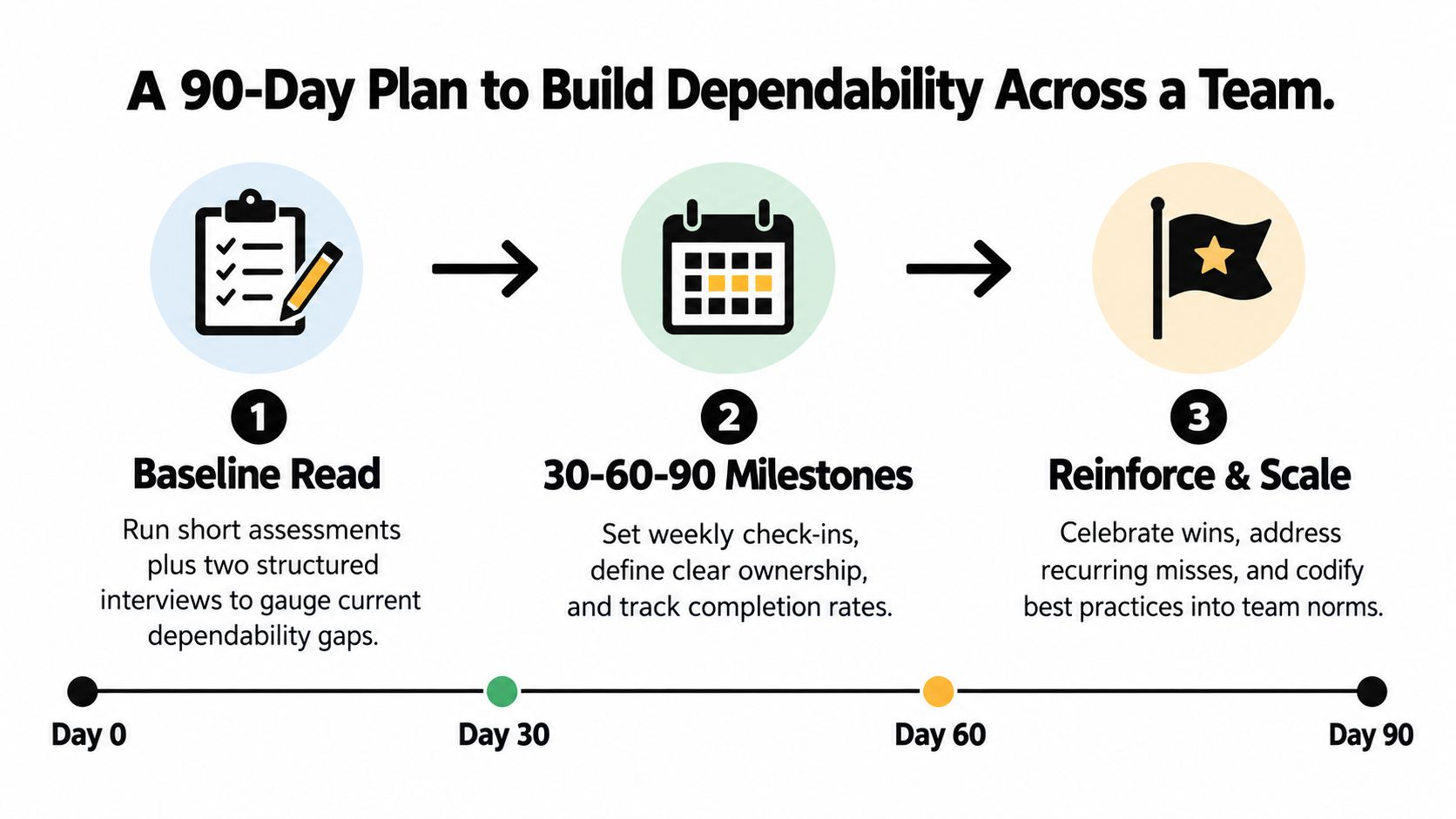
Days 0 to 30: Clarify the work
Take a baseline using short assessments, structured conversations, and two operational measures: deadline hit rate and escalation timeliness. Define what counts as a commitment, who owns each handoff, and how employees should flag a risk. Fix unclear priorities, inaccessible tools, or approval bottlenecks before launching individual coaching. The signal is whether every key deliverable has an owner, an agreed date, and a known escalation path.
Days 31 to 60: Make reliability visible
Set up a lightweight dashboard that tracks agreed commitments, completion, and early risk communication. Pair each employee with a goal tied to the actual reliability demands of their role. For one team member, that may mean closing handoffs; for another, documenting inspection results on time. Review the data with the team and let people correct records or explain constraints. The signal is whether commitments and emerging blockers are being recorded consistently.
Days 61 to 90: Reinforce and scale
Build a weekly retrospective around three questions: What slipped? What did we catch early? Which process or tool helped, or got in the way? Recognize follow-through that prevented rework or helped the team recover, not just visible late-night effort. If the same friction keeps recurring across teams, escalate the issue for organization-level redesign instead of repeating local coaching.
| Block | Focus | Key move | Measurable signal | |---|---|---|---| | Baseline | Expectations and constraints | Assign owners, dates, and escalation paths | Key work has clear ownership | | Milestones | Leading indicators | Track commitments and timely risk communication | Updates arrive before deadlines are missed | | Reinforce and scale | Habits and system fixes | Review slips, recoveries, and process friction | Recurring causes are assigned for action |
Use this checklist in team reviews:
If a recurring problem crosses teams or survives local process changes, bring it to the leaders who own staffing, tooling, priorities, and operating design.
The video below can support a team discussion about turning assessment insight into practical people decisions.
<iframe width="100%" style="aspect-ratio: 16 / 9;" src="https://www.youtube.com/embed/YTQL_0kSpRk" frameborder="0" allow="autoplay; encrypted-media" allowfullscreen></iframe>
Decisions Worth Getting Right
When a reliability concern lands on your desk, make the next decision about the work as well as the person.
Dependability isn't a fixed label attached to an employee. It's the pattern that emerges when people, roles, tools, and expectations work together. Assess behavior carefully, improve the system where it blocks follow-through, and hold individuals accountable for the commitments they can control.
---
Synopsix turns behavioral assessments into practical guidance for hiring, team design, and talent development, including role-specific profiles and team compatibility insights. If you're building a more consistent way to assess dependability and make people decisions, explore [Synopsix](https://synopsix.ai).