Digital Transformation Readiness: Assess and Act in 6 Steps
By Synopsix · August 16, 2026 · 14 min read
Digital transformation initiatives fail or underperform at rates commonly placed between 70% and 89%, while only roughly 30% to 35% are reported as fully successful in meeting objectives or value targets ([independent summaries of major consulting research](https://worldmetrics.org/digital-transformation-failure-statistics/)). That makes readiness more than a technology checklist. It's a diagnostic of whether your strategy, operating model, data, governance, and people can absorb a different way of working.
The strongest readiness programs I've seen don't ask executives whether they feel prepared. They test what teams do, how decisions move, whether data can support the intended use case, and whether leaders have created the conditions for adoption. The human side gets the same disciplined treatment as the technology stack, using behavioral assessment and people intelligence to make the people dimension measurable.
Why Most Readiness Assessments Miss the Bottleneck
A readiness score can look healthy while delivery conditions remain weak. In a 2025 global study of 1,000 senior leaders, Thoughtworks found that 60% of leaders who believed they were “ahead” were in lower readiness categories. Only 17% were true leaders, while 26% were late adopters ([Thoughtworks State of Digital and AI Readiness report](https://www.thoughtworks.com/en-us/about-us/news/2025/thoughtworks-state-of-digital-and-ai-readiness-report-)).
The gap appears when assessment answers meet operational evidence. Transformation stalls because nobody owns a cross-functional decision, data lacks an accountable steward, managers cannot translate a new process into daily work, or governance arrives after a pilot has created risk. Buying software does not resolve those conditions. It often makes them easier to see.
A cited benchmark attributes 60% of digital project failures to change-management issues ([digital transformation failure statistics](https://worldmetrics.org/digital-transformation-failure-statistics/)). That finding points to a measurement problem. Asking leaders to rate “change appetite” from one to five produces a perception score, not evidence of manager behavior, decision latency, role clarity, or adoption depth.
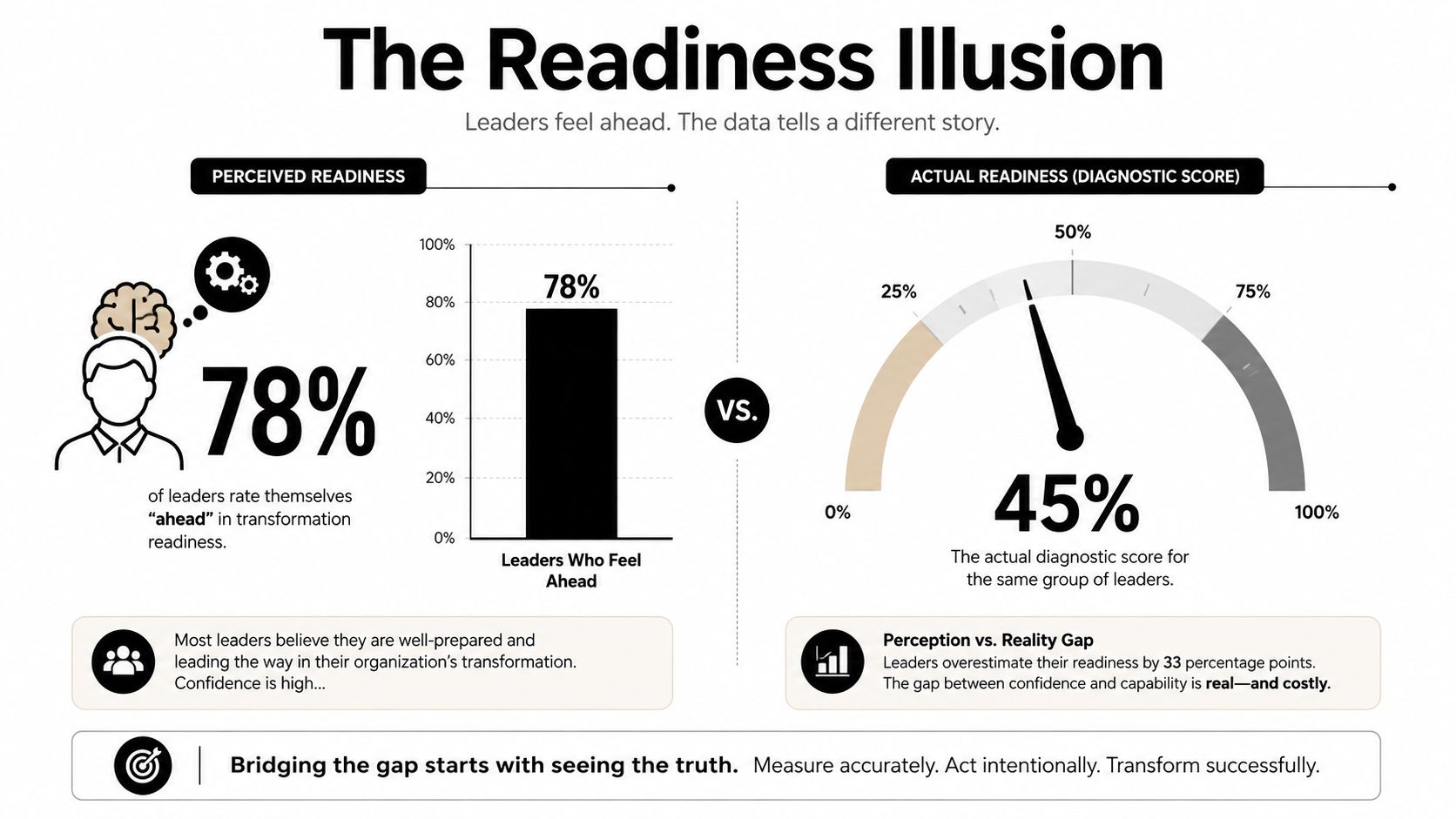
The infographic's 78% versus 45% visualization should be treated as an editorial illustration, not a verified benchmark. The verified Thoughtworks finding is the broader perception gap. The working conclusion is straightforward: confidence needs to be tested against behavior and delivery records.
What the diagnostic must expose
A useful diagnostic requires evidence for four questions:
People intelligence connects these questions to observable behavior. Assess skills, capacity, role clarity, manager reinforcement, escalation habits, and cross-functional decision patterns alongside systems and controls. That gives the human dimension a structured score rather than treating it as a soft discussion. Guidance on [sustaining adoption in change initiatives](https://textlauren.com/resources/change-management-strategies) is relevant because adoption must be built into the operating rhythm, not left to launch communications.
A practical framework uses six lenses, people, process, technology, data, governance, and culture, and scores each against defined evidence. Culture also affects execution through decision norms and manager behavior, as described in [Synopsix's perspective on culture and transformation](https://synopsix.ai/blog/culture-and-transformation). The resulting score should identify the constraint, the evidence behind it, and the corrective work required.
The Six Dimensions of Digital Transformation Readiness
A four-pillar model can be a useful starting point, but it often hides the distinctions that determine whether a program survives contact with operations. Data isn't technology, governance isn't culture, and people capability isn't the same as enthusiasm. Separate lenses give leaders a clearer view of the constraint.
People
Diagnostic question: Do the people responsible for the future state have the skills, capacity, and role clarity to deliver it?
Good looks like named owners, realistic capacity, role-specific learning, and managers who can coach the new behavior. Measure more than training completion. Check whether employees can perform the new workflow, escalate exceptions, and make decisions without reverting to the old process.
Process
Diagnostic question: Which critical workflows will change, and have we removed unnecessary complexity before digitizing them?
A ready organization maps the current process, identifies handoffs and control points, and defines the future workflow in language operators use. It doesn't automate a process just because the process already exists. Process owners can describe what gets faster, what gets safer, and what requires human judgment.
Technology
Diagnostic question: Can the current stack support the intended use case without creating avoidable integration, security, or support debt?
Good technology readiness means the organization understands its architecture, interfaces, identity controls, resilience requirements, and retirement plan. A new platform should have a clear place in the overall ecosystem. Procurement alone doesn't demonstrate readiness.
Data
Diagnostic question: Can decision-makers access trusted, appropriately governed data when the new process requires it?
A ready data environment has defined ownership, shared terms, documented quality issues, and access rules that match the use case. Teams know which data is authoritative and what limitations affect decisions. Data readiness is separate from having a data platform.
Governance
Diagnostic question: Who has the authority to approve, stop, change, and monitor the transformation?
Good governance defines decision rights, risk ownership, escalation paths, controls, and review forums. It also makes accountability visible after launch. If every material choice requires informal negotiation, the program has a governance gap regardless of how advanced the technology appears.
Culture
Diagnostic question: Do everyday incentives reward the behaviors the transformation requires?
Culture becomes measurable through behavior. Look for collaboration across functions, willingness to surface bad news, manager reinforcement, learning from incidents, and whether teams use the new process when pressure rises. A company can have positive sentiment and still protect local workarounds.
These dimensions should produce evidence, not mood. Interview notes, workflow observation, system logs, decision records, role profiles, governance artifacts, and people-analytics outputs create a stronger baseline than a single leadership workshop.
A Scoring Model You Can Run in One Workshop
A workshop score should help you decide where to investigate, not give executives a flattering label. Score each dimension from 1 to 5, assign weights based on the transformation's risk profile, and require an evidence source for every score.
| Dimension | Weight | Score 1–5 | Weighted Score | Evidence Source | |---|---:|---:|---:|---| | People | 20 | | | Skills inventory, role interviews, behavioral assessment | | Process | 15 | | | Process maps, cycle reviews, exception logs | | Technology | 15 | | | Architecture review, integration inventory, security assessment | | Data | 15 | | | Data ownership, quality review, access audit | | Governance | 20 | | | Decision-rights map, risk register, approval records | | Culture | 15 | | | Behavioral evidence, manager interviews, adoption data | | Total | 100 | | | |
Use this formula:
Composite readiness score = Σ(score ÷ 5 × weight)
The result sits on a 1 to 5 scale. Suggested interpretation bands are:
These bands are a practical editorial rubric, not an external benchmark. The score matters less than the spread beneath it. A company with a strong average and a weak governance score may be less ready than a company with a lower average but no critical dependency.
Worked example
Consider a mid-market operations team with these scores: People 3, Process 4, Technology 3, Data 3, Governance 2, and Culture 3. Applying the weights produces a composite of 3.1, which is Scalable-leaning, but the result shouldn't authorize a broad rollout.
Governance carries a high weight and scores poorly. Culture is also only moderate. The practical decision is to define decision rights, establish escalation ownership, and test manager reinforcement before scaling. The score is triage, not a trophy. Teams can use [assessment interpretation guidance](https://synopsix.ai/blog/assessment-interpretation) to distinguish a meaningful pattern from an average that conceals risk.
> Practical rule: Never accept a score without naming the evidence that would make the score higher or lower.
Why Self-Report Fails and Behavioral Evidence Wins
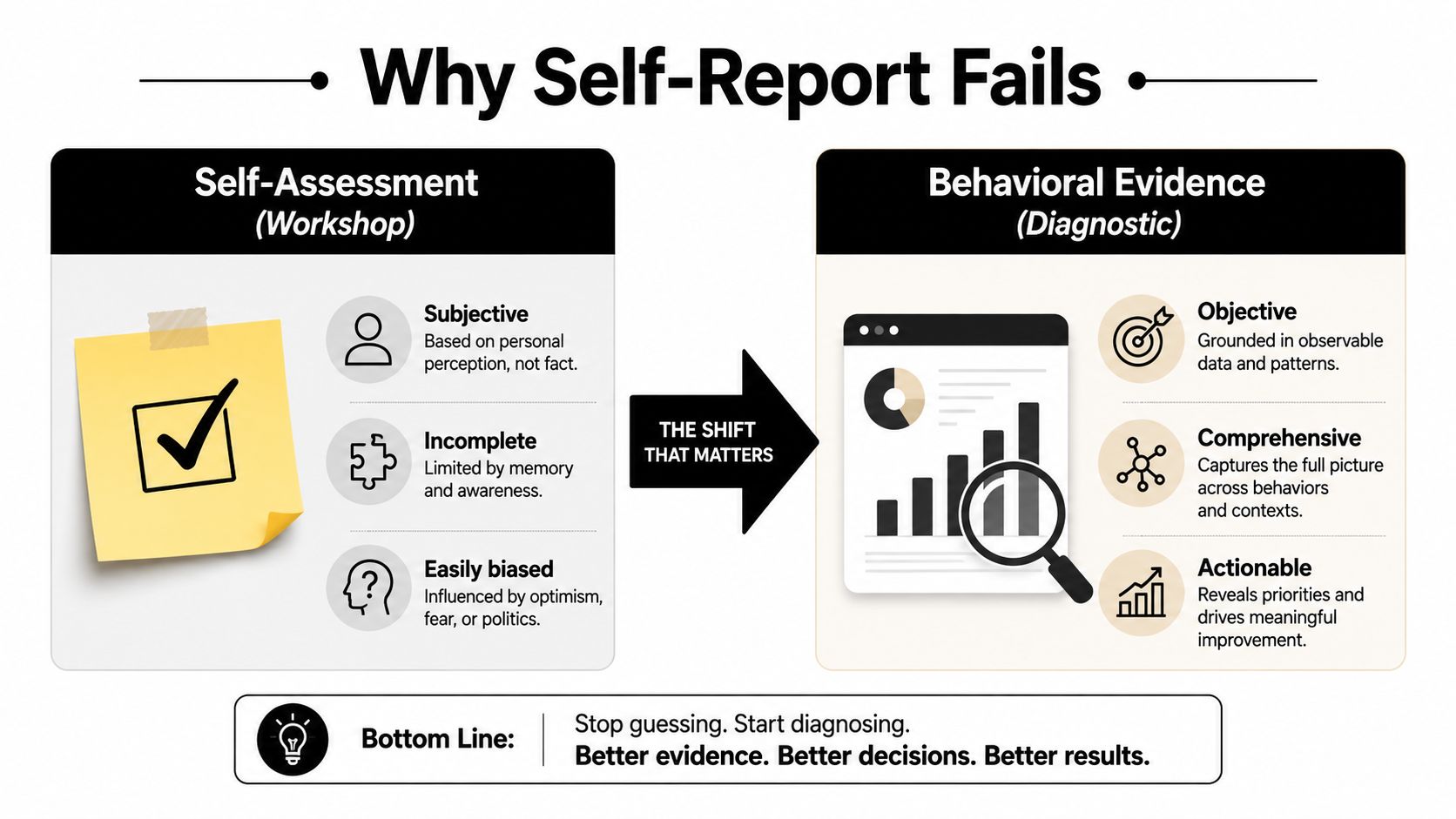
Readiness scores often reflect what executives intend to do, not how teams behave when delivery pressure rises. As noted earlier, the Thoughtworks research found that 60% of leaders who considered themselves ahead were in lower readiness categories. That gap makes an independent behavioral check necessary.
Sticky-note workshops remain useful for surfacing concerns and giving employees a shared language for change. They become weak measurement tools when statements of support stand in for evidence. An employee may endorse the program while bypassing the new workflow, withholding bad news, or waiting for a manager to decide. The diagnostic must compare stated commitment with repeated operating behavior.
Replace the single score with multiple signals
Use several evidence streams:
Behavior needs careful interpretation. Workplace research connects positive perceptions and attitudes with outcomes such as task performance and organizational citizenship behavior. It also connects negative perceptions and attitudes with counterproductive work behavior and turnover intentions. The same study found that positive perceptions can still accompany negative behavior, while negative perceptions can accompany positive behavior ([workplace behavior study](https://onlinelibrary.wiley.com/doi/pdf/10.1002/joe.22179)). A single trait or survey response therefore cannot establish transformation readiness.
The practical standard is triangulation. Use behavioral assessment to identify likely patterns, observed work to test those patterns, and operational records to confirm whether they affect execution. The principle behind [predict human behavior for smarter people decisions](https://synopsix.ai) is useful here when treated as a diagnostic discipline rather than a slogan. Leaders then receive a defensible view of whether teams can perform the future-state work, where support is needed, and which risks require action before scale.
Wiring People Intelligence Into the Diagnostic
The people dimension becomes useful when it answers operational questions. Which roles can absorb the new process? Where will decision friction appear? Which leaders can sponsor the change, and where will a team need support or redesign?
Start at the individual level. Assess role-relevant behavioral patterns, then compare them with the demands of the future state. A transformation that requires rapid iteration, cross-functional problem-solving, and disciplined escalation may expose different capability needs than a program centered on control, repeatability, and compliance. The assessment shouldn't label someone as generally “ready” or “not ready”. It should identify fit, risk, coaching needs, and the conditions under which the person is likely to perform.
At team level, examine complementarity and tension. A team can contain capable individuals yet struggle because responsibilities overlap, critical skills are absent, or conflict is handled indirectly. Map who owns decisions, who supplies expertise, who challenges assumptions, and who has the authority to resolve disagreement. People intelligence connects directly to culture and governance.
Use structured evidence, not résumé impressions
The predictive-validity evidence supports a more disciplined approach. A hiring-validity review reports r = 0.42 for structured behavioral interviews, compared with r = 0.18 for unstructured interviews, while general mental ability is reported at r = 0.51 and conscientiousness adds incremental validity of ΔR = 0.09 ([hiring-validity review](https://scovai.com/blog/predictive-validity-assessments/)). These figures don't turn assessment into certainty. They show why a structured, multi-signal process is more defensible than résumé screening and conversational impressions alone.
Biodata can add another evidence stream. Meta-analytic research reports empirically scored overall biodata composites reaching criterion validity of ρ = .44, compared with ρ = .24 for rationally scored composites, and finds that biodata adds unique variance beyond other common predictors ([meta-analysis of biodata inventories](https://pubmed.ncbi.nlm.nih.gov/34672651/)). Use past behavior carefully, with job relevance, consistency, privacy, and fairness controls.
At leadership level, measure decision rights and change capacity. People analytics can support that work, with research reporting effects of β = 0.32 to 0.41 and p < 0.001 for data-driven HR decision-making (research on predictive talent management). A platform such as Synopsix can be one implementation option, combining behavioral profiles with role insights, simulations, compatibility analysis, and development planning. For the broader operating model, [people analytics guidance](https://synopsix.ai/blog/what-is-people-analytics) can help teams connect individual evidence to workforce decisions.
The baseline should be captured before a transformation wave, then revisited after teams have used the new process. For organizations refining talent workflows, resources on how to [find better hires faster](https://hire-sense.io/blog-post?id=6a802d452c48220295f54959) can complement a readiness diagnostic, provided hiring data remains tied to role requirements rather than generic fit.
A 90-Day Roadmap to Close the Gap
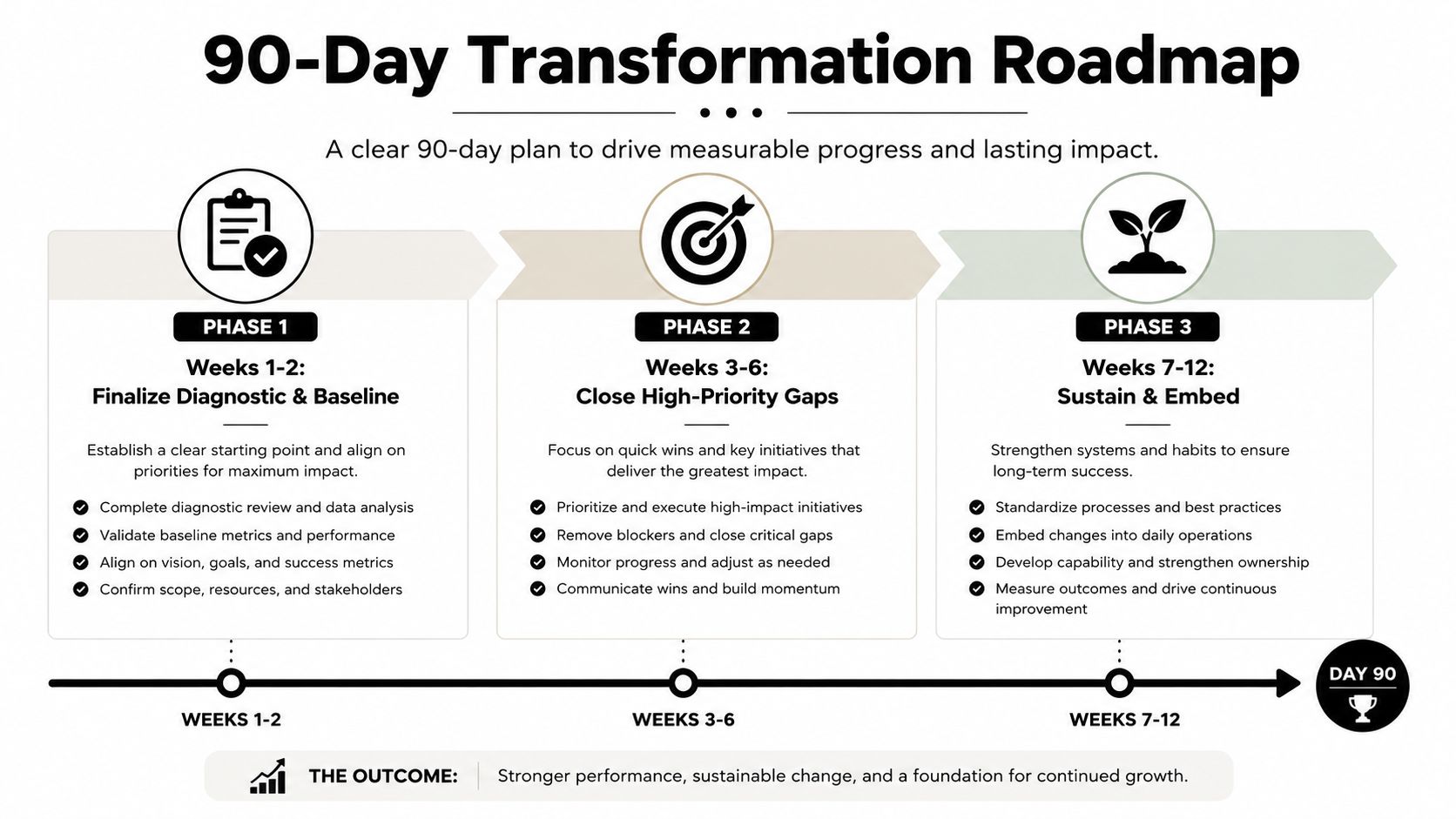
A readiness score without a remediation plan is decoration. The useful output is a short list of constraints, owners, interventions, and proof points that can be tested before the organization commits to scale.
Weeks 1 to 2
Finalize the diagnostic and baseline. Confirm the transformation outcome, validate the six scores with evidence owners, map dependencies, and identify the two or three dimensions that could block the rest. Separate symptoms from structural causes. “Low adoption” may reflect poor training, but it may also reflect unclear decision rights or a workflow that adds effort without improving the outcome.
Weeks 3 to 6
Close the highest-priority gaps with targeted interventions:
Consider the earlier example with a 3.1 composite, weak governance, and moderate culture. To improve governance end to end, the sponsor first names the decisions that are currently stuck, assigns one accountable owner for each, and records escalation conditions. The pilot then tests whether teams use those routes, whether decisions are logged, and whether managers can explain who has authority. A later re-score should rise only if the evidence changes. A target such as 3.7 within one quarter is a planning scenario, not a guaranteed outcome.
Weeks 7 to 10
Run a bounded pilot wave. Define readiness KPIs before launch, including adoption depth, decision-rights clarity, exception handling, and delivery against the intended outcome. Keep the pilot small enough to observe behavior directly. If the program involves AI agents, a practical [AI agent rollout playbook for CIOs](https://www.happyrobot.ai/blog/the-enterprise-playbook-for-implementing-ai-agents) can inform sequencing, controls, and ownership, but the organization still needs its own readiness evidence.
Weeks 11 to 12
Re-score the dimensions, review the evidence, and make a go or no-go decision for scale. A higher average shouldn't override a persistent critical weakness. Pause, remediate, and retest when teams can't explain decision ownership, managers aren't reinforcing the process, data quality undermines decisions, or the technology creates unresolved risk.
Measuring Progress and Knowing When to Pause
Readiness should be re-scored quarterly at minimum, and monthly during an active transformation wave. Use a small KPI set that distinguishes early signals from business results.
Leading indicators include adoption depth, meaning whether teams use the intended workflow in real work, and decision-rights clarity, meaning whether people can identify who decides, approves, and escalates.
Lagging indicators include outcome delivery against the roadmap and the mis-hire or mis-promotion rate. Those measures show whether improved capability and governance are producing better organizational decisions.
Pause a wave when adoption remains superficial, decision ownership is disputed, critical data cannot be trusted, or behavioral evidence shows that managers are reinforcing the old model. Don't defend the original plan against the diagnostic. Change the intervention, narrow the scope, or stop until the constraint is addressed.
---
Synopsix helps transformation and HR teams turn behavioral assessments into comparable people profiles, role-specific insights, predictive simulations, compatibility analysis, and development plans. Visit [Synopsix](https://synopsix.ai) to connect people intelligence with a more rigorous digital transformation readiness diagnostic.