10 Employee Development Strategies That Work
By Synopsix · September 14, 2026 · 20 min read
More training isn't automatically better development. Many organizations add courses while skipping the decisions that determine whether people can perform: role fit, behavioral gaps, team dynamics, leadership readiness, and the type of challenge an employee is prepared to handle. A full learning catalogue can still leave managers unsure what to do differently on Monday.
The stronger approach is to treat employee development strategies as an operating system for talent decisions, not as a schedule of classes. CHROs need to connect evidence about how people work with specific interventions, then measure whether those interventions improve readiness, mobility, retention, and business performance. That matters as development budgets become more strategic. LinkedIn's 2025 workplace learning reporting, summarized by [employee training statistics from Devlin Peck](https://www.devlinpeck.com/content/employee-training-statistics), says 88% of organizations are concerned about retention, while learning opportunities have become their number one retention strategy. The same summary reports $102.8 billion spent on training in the United States during 2024–2025, with average learning spend reaching $1,254 per employee.
The ten strategies below are prioritized by the decision they improve. Each includes practical implementation choices, trade-offs, measures, pitfalls, and a realistic organizational scenario. Synopsix is one example of how validated behavioral assessments can become business signals, development plans, simulations, and team insights. Those tools can strengthen judgment, but they don't remove the need for manager context, employee agency, or careful interpretation.
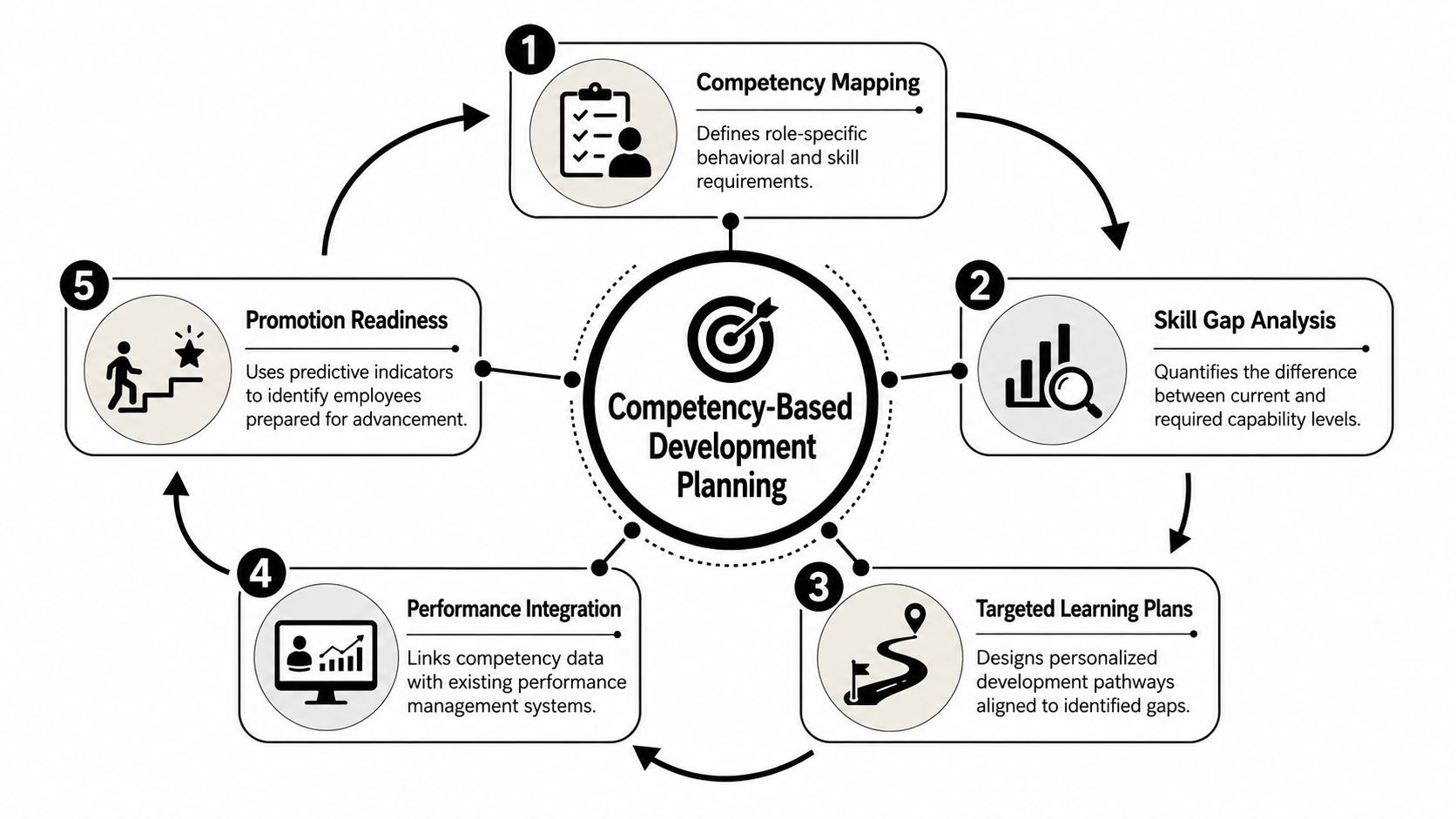
1. Competency-Based Development Planning
A development plan should begin with the work a role must produce, not with the courses an LMS already contains. Competency-based planning identifies the behaviors, technical capabilities, and judgment required for a role, then compares those requirements with an employee's current evidence. The result is a focused path for closing gaps instead of a generic promise to “improve leadership.”
This strategy is especially useful when promotion decisions carry material risk. A global financial institution might map the competencies required of relationship managers before selecting high-potential managers for broader portfolios. A manufacturer might define the leadership behaviors needed to move plant supervisors into regional roles. A technology company might create separate technical competency tracks for engineers who want advancement without becoming people managers.
Start with roles where poor fit or weak readiness has the greatest operational cost. Refresh the model as strategy, technology, and job architecture change. Pair behavioral assessments with 360-degree feedback, manager observations, and work evidence. A [competency gap analysis framework](https://synopsix.ai/blog/competency-gap-analysis) can help HR teams turn the comparison into a visible roadmap with milestones, practice opportunities, and review points.
> Practical rule: A competency model is useful only when managers can recognize the target behavior in real work.
Measure progress through observable behavior, readiness reviews, quality of promotion decisions, and movement into target roles. Course completion is a supporting signal, not the outcome. The main pitfall is false precision. Behavioral data can identify patterns and development priorities, but it shouldn't be treated as a final verdict on someone's potential.
2. Team Complementarity Analysis and Design
A technically strong group can still underperform when its members approach decisions, conflict, communication, and risk in incompatible ways. Team complementarity analysis adds behavioral fit and cognitive diversity to the composition decision. It asks whether the group has enough challenge, execution discipline, relationship strength, and perspective range to handle its actual mandate.
Use it before assembling a cross-functional product team, assigning consultants to a complex client engagement, or restructuring a sales territory. A product leader may discover that a team has abundant ideation but limited follow-through. A professional services partner may see that two consultants both prefer rapid debate, while no one naturally slows the group down to test assumptions. A sales director may redesign account coverage around interaction styles and customer relationship demands.
Assess composition before onboarding a new member, not only after friction appears. Then turn the findings into explicit working agreements. The [team dynamics assessment](https://synopsix.ai/blog/team-dynamics-assessment) approach is most valuable when it gives managers concrete questions about decision rights, escalation, feedback, and meeting behavior.
Track team health through decision-cycle quality, delivery reliability, conflict recovery, stakeholder feedback, and the team's ability to adapt after membership changes. Don't confuse difference with complementarity. Two contrasting styles may improve debate, or they may create constant friction if the team lacks shared norms and leadership.
3. Predictive Leadership Development Pipelines
Succession planning often starts too late. A vacancy appears, executives name the most visible internal candidate, and the organization discovers that strong individual performance doesn't guarantee leadership readiness. A predictive pipeline gives HR time to test readiness before a consequential transition.
The strategy combines behavioral assessment, role requirements, simulations, stretch assignments, and milestone reviews. A healthcare system can identify physician leaders before a service-line transition creates urgency. A technology company can develop technical and people leadership tracks in parallel, preserving advancement for specialists who don't want to manage large teams. A financial services organization can prepare managers for progressively broader decision environments instead of relying on one promotion interview.
Begin early enough for candidates to practice in increasingly complex settings. Use simulations to test how they respond to ambiguity, competing stakeholders, pressure, and incomplete information. Predictive modeling should support a decision, not manufacture certainty. Synopsix's explanation of [predictive modeling for talent decisions](https://synopsix.ai/blog/what-is-predictive-modeling) reflects the useful principle: connect behavioral evidence to a defined future role and a specific risk question.

Review pipeline health on a regular cadence, document selection criteria, and communicate what readiness means. Measure bench coverage qualitatively and through promotion quality, successor performance, time to effectiveness, and retention of critical talent. The trade-off is investment. Simulations and structured development take more effort than naming a successor, but they reduce the risk of treating visibility as potential.
4. Role-Specific Behavioral Coaching
Generic leadership coaching often fails because it addresses broad qualities rather than the employee's actual operating context. A new chief executive, enterprise account director, plant leader, and clinical department head face different behavioral demands. Coaching becomes more actionable when the coach understands the role, the individual's natural patterns, and the situations where those patterns help or hinder performance.
An executive search firm might give a new C-suite leader a behavioral briefing before coaching begins. An internal talent team might pair a high-potential manager with a coach who can work on delegation, challenge, and stakeholder alignment. A leadership provider might build different coaching pathways for newly promoted managers and experienced executives taking on enterprise scope.
Share the behavioral profile before the first session, but don't let it become a label. Translate findings into observable goals, such as asking more diagnostic questions in customer meetings, slowing decisions when risk is high, or giving clearer corrective feedback. Add 360-degree perspectives so the plan isn't based on self-report or assessment data alone.
Use coaching logs, manager observations, role KPIs, and follow-up feedback to judge progress. Reassessment can help identify movement, but behavioral change should also appear in work outcomes and relationships. The common pitfall is confidentiality confusion. Employees need to know what the coach shares, what remains private, and how the organization will use development evidence.
5. Stretch Assignment Planning With Risk Mitigation
Stretch work can develop capability faster than classroom instruction, but unstructured stretch assignments can also turn development into avoidable failure. The useful distinction is between giving someone a difficult job and designing a supported learning experience with clear risk controls.
A technology company might rotate a high-potential manager into a different region to build global perspective. A manufacturer could place a plant manager in supply chain operations to develop cross-functional judgment. A consulting firm might assign a rising manager to a transformation engagement before considering partnership. In each case, the employee needs challenge, sponsorship, feedback, and a credible recovery path.
Assess readiness for the type of stretch, not just current performance. Someone may have the adaptability for a fast-changing market assignment but struggle with a politically complex stakeholder environment. Another employee may learn effectively through operational ownership but need more support in ambiguous strategic work.
Measure learning gains, role readiness, stakeholder confidence, and business delivery separately. If the assignment produces a disappointing result, the organization should still be able to identify what the employee learned and whether the support model was adequate. The worst design rewards only flawless outcomes, because it teaches employees to avoid the very challenges development requires.

6. Inclusive Talent Development and Bias Mitigation
Development opportunities often follow visibility, manager advocacy, and informal access to influential networks. That creates a problem before promotion decisions are even made. Employees who aren't nominated for the right assignments may never receive the evidence needed to demonstrate readiness.
Objective behavioral assessments can add consistency to selection and development, but they aren't a substitute for equity work. Financial services firms can use structured criteria to identify broader leadership talent. Technology companies can define advancement behaviors for both technical and people leadership. Healthcare organizations can examine whether physician leadership opportunities reach employees who have historically been overlooked.
Audit the complete development process, from nomination and assessment through assignment, sponsorship, promotion, and retention. Review whether managers interpret the same behavior consistently across demographic groups. Examine practical barriers such as meeting times, networking expectations, travel, caregiving constraints, and access to senior sponsors.
> A fair assessment process can't compensate for an unfair opportunity process.
Publish internal visibility into who receives high-impact development opportunities and why. Train managers to distinguish evidence from familiarity, confidence from capability, and communication style from leadership effectiveness. Measure opportunity distribution, completion, readiness outcomes, internal mobility, and retention by relevant employee groups, while protecting privacy and avoiding simplistic causal claims.
The trade-off is transparency. Clear criteria can expose inconsistent decisions and create difficult conversations with leaders who prefer discretion. That discomfort is useful. Employee development strategies become more credible when employees can see how access is granted and when leaders are accountable for both participation and outcomes.
7. Sales and Customer-Facing Role Development Programs
Sales and customer success roles require more than general leadership capability. Employees must listen diagnostically, handle rejection, maintain deal focus, build trust, manage tension, and adapt their approach to different customer contexts. A development plan that ignores those behaviors may produce polished training activity without changing customer interactions.
An enterprise software company might use behavioral profiles to match account executives with customer segments that fit their strengths. A B2B sales organization could build coaching around consultative discovery, objection handling, and commercial discipline. A customer success team might focus on behaviors associated with renewal conversations, escalation management, and long-term relationship building.
Start by studying what effective performance looks like in your market, not by importing a generic sales competency model. Use call reviews, manager observations, customer feedback, and behavioral assessments to identify the behaviors worth practicing. Then create scenario-based coaching. A rep who struggles with diagnostic listening needs practice in realistic discovery conversations, not another broad presentation on communication.
Track development against deal quality, customer experience, retention, and manager-rated behavior change. Avoid claiming that a single behavioral factor causes revenue performance. Sales outcomes depend on territory, product, market conditions, pricing, timing, and support. Behavioral intelligence is most useful when it helps managers choose the right intervention and interpret performance evidence more carefully.
Revisit the model as customer expectations and selling motions change. Pair developing employees with strong performers for observation and feedback, but give the pairing a structured purpose. “Shadow the best rep” is weaker than “observe how the rep tests customer assumptions before proposing a solution.”
8. Peer Learning and Behavioral Modeling Groups
Employees often learn important behaviors by watching how trusted peers handle real situations. Peer learning makes that observation deliberate. It creates a setting where employees with complementary strengths or shared challenges can test ideas, compare approaches, and receive feedback without turning every development need into a manager-led intervention.
A professional partnership might establish a peer council around client leadership. A large organization could create a leadership cohort that meets monthly to work through live people challenges. An engineering function might build a community of practice where experienced engineers model structured problem solving, technical influence, and incident communication.
Keep the group small enough for candor and large enough for useful contrast. A practical design uses a mix of complementary strengths and shared development goals. Behavioral assessments can help participants understand what to observe, but the group should focus on actions, not personality judgments.
Measure changes through beginning and ending 360-degree feedback, manager observations, application of learning, and the quality of peer problem solving. The main trade-off is confidentiality versus organizational learning. Participants need enough safety to discuss real problems, while HR needs a way to identify recurring capability gaps without exposing personal disclosures.
9. Personalized Development Paths With Agile Adjustment
Annual development plans become obsolete when business priorities, career aspirations, and role requirements change faster than the planning cycle. Personalization doesn't mean creating an elaborate curriculum for every employee. It means connecting the right person to the right combination of coaching, experience, mentoring, practice, and formal learning at the right time.
A technology company may adjust development roadmaps as its product strategy changes. A professional services firm can make career tracks clearer by adding behavioral readiness checkpoints alongside technical expectations. A healthcare system might offer parallel clinical and leadership pathways for physicians who want different forms of progression.
Begin with the employee's aspirations, then test those aspirations against organizational opportunities and role evidence. Break the path into short milestones with visible behavioral indicators. Monthly conversations should ask what changed, what evidence has emerged, and whether the next intervention still fits.
> Operating principle: Personalization is not unlimited choice. It's disciplined adjustment against a clear outcome.
A plan might combine a coach, a stretch assignment, peer practice, and targeted digital learning. Transparent promotion criteria help employees understand what advancement requires, while contingency paths protect the plan when interests change. Measure progress through capability evidence, milestone completion, performance in expanded work, internal movement, and employee confidence in career direction.
The failure mode is customization without governance. If every manager defines development differently, employees receive unequal experiences and HR can't compare outcomes. Set common standards for evidence, review, and access, while allowing the intervention itself to vary by role and person.
10. Retention and Career Satisfaction Through Behavioral Fit Analysis
Retention problems don't always signal a missing skill. Sometimes a capable employee is working in a role that consistently conflicts with their behavioral strengths, preferred work patterns, or sources of motivation. More training may deepen the mismatch instead of solving it.
A financial services team might identify a high performer whose results are strong but whose role provides little opportunity for the analytical work that energizes them. A technology company could use performance conversations to explore whether a manager wants broader people responsibility or deeper technical work. A healthcare organization may detect persistent strain where role demands and working style remain misaligned.
Fit analysis should lead to a supportive conversation, not a verdict. Combine behavioral evidence with engagement feedback, workload information, manager observations, and the employee's own account. Then consider several responses:
Track regretted turnover, internal transfers, sustained performance, engagement themes, and retention after role changes. Treat successful internal movement as a retention win, not an admission that hiring failed. For senior professionals, [executive coaching for senior professionals](https://intonetic.com/professional-development-coaching/) can support the conversation when fit, identity, and career direction are tightly connected.
The critical safeguard is employee agency. Assessment data should open a discussion about options. It shouldn't determine someone's career without their participation.
10-Point Comparison of Employee Development Strategies
| Strategy | Implementation Complexity 🔄 | Resource Requirements ⚡ | Expected Outcomes ⭐📊 | Ideal Use Cases 💡 | Key Advantages | |---|---:|---:|---|---|---| | Competency-Based Development Planning | Medium–High 🔄, needs competency models & integration | Assessment tools, analytics, performance system integration ⚡ | Objective skill-gap visibility; faster ramp; fewer mis‑promotions ⭐📊 | Succession planning; role-aligned pipelines | Data-driven development; role alignment; predictive readiness | | Team Complementarity Analysis and Design | Medium 🔄, cross-member data & visualization | Team assessments, collaboration analytics, visualization tools ⚡ | Improved team performance; reduced dysfunction; faster formation ⭐📊 | Project teams, client engagements, cross‑functional squads | Predicts friction; optimizes role fit; boosts psychological safety | | Predictive Leadership Development Pipelines | High 🔄, multi-year planning & simulations | Long-term coaching, predictive analytics, validated assessments ⚡ | Stronger leadership bench; fewer executive failures; transparent paths ⭐📊 | CEO/executive succession; high-stakes leadership roles | Predictive validation; reduces promotion risk; measurable milestones | | Role-Specific Behavioral Coaching | Medium 🔄, coach training + profile interpretation | Trained coaches, behavioral reports, reassessment cadence ⚡ | Faster coaching impact; measurable behavioral change; accountability ⭐📊 | C‑suite onboarding; targeted leader interventions | Tailored coaching; addresses root behaviors; shortens time-to-impact | | Stretch Assignment Planning with Risk Mitigation | Medium–High 🔄, assignment design + supports | Mentors/sponsors, monitoring, risk assessments, checkpoints ⚡ | Rapid capability growth; higher engagement; versatile leaders ⭐📊 | High-potential rotations; cross-functional exposure | Real-world learning with support; builds adaptability; measurable risks | | Inclusive Talent Development & Bias Mitigation | Medium 🔄, audits and cultural change required | Validated assessments, demographic analytics, DEI governance ⚡ | Broader high‑potential discovery; improved leadership diversity ⭐📊 | DEI initiatives; equitable advancement programs | Reduces subjective bias; transparent opportunity distribution | | Sales & Customer-Facing Role Development Programs | Medium 🔄, role benchmarking & coaching consistency | Sales behavioral benchmarks, coaching, account-matching tools ⚡ | Better deal velocity, retention, revenue impact ⭐📊 | SaaS sales, customer success, revenue teams | Direct revenue linkage; role-specific coaching; account fit optimization | | Peer Learning & Behavioral Modeling Groups | Low–Medium 🔄, facilitation & group design | Time, facilitation skills, behavioral grouping data ⚡ | Scalable development; stronger collaboration; peer accountability ⭐📊 | Cohorts, communities of practice, leadership cohorts | Cost-effective scale; real-context learning; builds networks | | Personalized Development Paths with Agile Adjustment | Medium–High 🔄, continuous planning & manager capability | Planning & tracking systems, manager training, assessments ⚡ | Higher engagement; adaptable readiness; reduced mis‑promotions ⭐📊 | Fast-changing orgs; retention-focused talent strategies | Highly personalized; responsive to change; unified development mix | | Retention & Career Satisfaction via Behavioral Fit Analysis | Medium 🔄, ongoing fit monitoring & manager coaching | Periodic assessments, manager training, internal transfer mechanisms ⚡ | Lower turnover; increased job satisfaction; early warning signals ⭐📊 | Retention programs, performance review cycles | Early misfit detection; targeted retention actions; improves internal mobility |
Turn Development Activity Into Talent Outcomes
CHROs don't need to launch all ten strategies at once. Start with role and competency clarity, because every later decision depends on knowing what good performance and readiness look like. Then add fit and team insights to identify where coaching, team redesign, or role movement will produce more value than another course.
Use stretch assignments, peer learning, and personalized paths to create practice in real work. These interventions are more demanding than assigning content because managers must provide feedback, protect learning time, and adjust support. They also generate richer evidence about how employees behave under real conditions.
Reserve predictive simulations for consequential readiness decisions, such as succession, promotion into complex roles, or assignments with meaningful operational risk. A simulation can reveal how someone responds to ambiguity or competing priorities, but it should sit alongside work history, manager judgment, employee ambition, and stakeholder evidence. No assessment should replace a thoughtful human decision.
Equity requires its own measurement layer. Audit who receives assessments, coaching, stretch assignments, sponsorship, and promotion opportunities. Compare access with readiness outcomes and internal mobility, then investigate gaps rather than assuming the explanation. The objective isn't identical development for every employee. It's a fair process that gives people a meaningful chance to build and demonstrate capability.
A practical measurement framework spans several levels:
Learning and development budgets are under pressure to prove value. A major global HR benchmark reports a median of 8 L&D hours per full-time employee in 2026, while median L&D spending per FTE fell 28% since 2025; the benchmark is available in this [learning and development benchmark PDF](https://www.vpsc.vic.gov.au/wp-content/uploads/2017/01/PMS-Sample-Learning-Development-Benchmark-de-identified.pdf). That combination makes targeted, role-linked development more important than broad activity.
Employee demand is also clear. LinkedIn-related reporting says 94% of employees would stay longer with a company that invests in learning and development, while only 41% of U.S. employees currently receive formal training, according to the [training statistics summary from Devlin Peck](https://www.devlinpeck.com/content/employee-training-statistics). The opportunity is not merely to offer more. It's to connect access with meaningful work, evidence, and progression.
Synopsix is one relevant option for creating a consistent flow from assessment to action. Its people intelligence platform combines behavioral assessments and profiles with role-focused intelligence reports, predictive simulations, compatibility analysis, and development plans. Used responsibly, that kind of flow can help HR translate psychometric information into business language while leaving managers and employees responsible for interpretation and action.
The strongest employee development strategies answer a sequence of practical questions. Does this person fit the role? What capability is missing? How will they practice it? What support does the team need? Are they ready for the next challenge? Will the organization retain them because their work now makes sense? When development data helps leaders answer those questions, learning activity becomes a talent system rather than an administrative record.
---
Synopsix turns scientifically validated behavioral assessments into practical guidance for hiring, team design, leadership readiness, and employee development. Visit [Synopsix](https://synopsix.ai) to explore assessment-to-action workflows, behavioral profiles, simulations, compatibility insights, and development plans for more evidence-based people decisions.