Mastering Employee Retention Rates: A 2026 CHRO Guide
By Synopsix · July 11, 2026 · 17 min read
A retention problem doesn't begin when someone resigns. It begins much earlier, in the data. The median global employee turnover rate settled around 16% in 2025, while only 21% of employees globally are engaged, a gap associated with an estimated $438 billion in lost productivity according to [global employee retention data compiled by StribeHQ](https://stribehq.com/resources/employee-retention-statistics-uk/). For boards, that changes the conversation. Employee retention rates aren't a lagging HR KPI. They're an early warning signal for productivity loss, execution risk, and leadership failure.
That risk is also unevenly distributed. Younger cohorts carry a disproportionate share of flight risk, which means many organizations are losing capability exactly where future leadership and critical digital skills should be building. The companies that outperform won't be the ones that react fastest to resignations. They'll be the ones that identify behavioral risk patterns before those resignations happen.
The High Stakes of Employee Retention in 2026
Passive talent management is now a direct liability on the balance sheet.
Gallup estimates that low employee engagement costs the global economy $438 billion in lost productivity, while only 21% of employees are engaged and thriving at work, according to [Gallup's State of the Global Workplace findings](https://www.gallup.com/workplace/349484/state-of-the-global-workplace.aspx). For boards, the implication is straightforward. Retention is not an isolated HR metric. It is a leading indicator of execution quality, manager effectiveness, and workforce stability.
The financial exposure goes well beyond replacement hiring costs. When avoidable attrition rises, companies lose role-specific knowledge, weaken customer continuity, disrupt internal decision networks, and slow delivery across teams that depend on trust and context. Those losses rarely appear as a single line item, but they show up quickly in missed deadlines, longer ramp times, lower service consistency, and weaker management capacity.
Why retention belongs in the board pack
A high-turnover environment creates three business problems at once:
Boards should therefore review retention alongside productivity, margin, and customer outcomes. The relationship is operational, not symbolic.
> Strong retention is not about keeping everyone. It is about protecting the people, teams, and relationships that sustain performance.
Retention also reflects workplace conditions that standard attrition reports often miss. Stress, weak manager relationships, low trust, and persistent team friction usually register in behavior before they appear in exit data. That is why retention analysis should sit alongside broader workplace indicators, including the factors covered in [Synopsix's analysis of a healthy workplace](https://synopsix.ai/blog/the-healthy-workplace).
The strategic mistake most companies still make
Many executive teams still treat retention as a downstream output of pay reviews and annual engagement surveys. That approach is too slow for a labor market where behavioral signals appear months before a resignation. By the time regrettable attrition reaches a board dashboard, the highest-value employees at risk have often already disengaged, explored alternatives, or reduced discretionary effort.
The more effective question is not how many people left. It is which people are becoming vulnerable, what signals predict that shift, and where intervention will protect the most enterprise value.
That shift matters because retention in 2026 is becoming a predictive discipline. The companies that outperform will not rely only on historical turnover rates. They will use behavioral science, manager data, and AI-driven risk models to identify likely flight risk early, prioritize high-value populations, and intervene before performance loss becomes visible in financial results.
How to Accurately Calculate Employee Retention Rate
Before leaders can improve employee retention rates, they need a clean definition. Too many executive teams compare incompatible numbers. One business uses annual retention, another uses quarterly retention, and a third mixes voluntary exits with internal transfers. The result is false benchmarking and bad decisions.
The standard formula is simple:
Employee retention rate = (Number of employees who stayed for the full period ÷ Number of employees at the start of the period) × 100
Here's the calculation visually:
The four inputs that matter
Use this sequence consistently:
1. Choose the time period Annual is most common for board reporting. Quarterly is more useful for diagnosing fast-moving problems in specific functions or locations.
2. Count the starting headcount This is the number of employees employed on day one of the measurement period.
3. Count retained employees Include only employees from that original starting group who remained employed through the full period.
4. Apply the formula Divide retained employees by starting headcount, then multiply by 100.
A simple example
If a company starts the year with 100 employees and 88 of those same employees are still employed at year-end, the retention rate is:
88 ÷ 100 × 100 = 88%
That's the retention rate for that specific starting population.
A quick explainer helps teams align on the math before they benchmark it:
<iframe width="100%" style="aspect-ratio: 16 / 9;" src="https://www.youtube.com/embed/JZhyxEgPwUg" frameborder="0" allow="autoplay; encrypted-media" allowfullscreen></iframe>
Where teams get the metric wrong
The biggest errors usually come from inconsistent scope.
> Practical rule: A retention metric is only useful if the population definition stays stable over time.
This is also why retention rate and turnover rate aren't interchangeable. Retention asks who stayed from the starting group. Turnover asks who left during the period. Both matter, but they answer different business questions.
For teams building a more mature measurement model, [this overview of people analytics](https://synopsix.ai/blog/what-is-people-analytics) is a useful foundation because it places retention within a broader decision system rather than treating it as a standalone HR percentage.
What Is a Good Employee Retention Rate
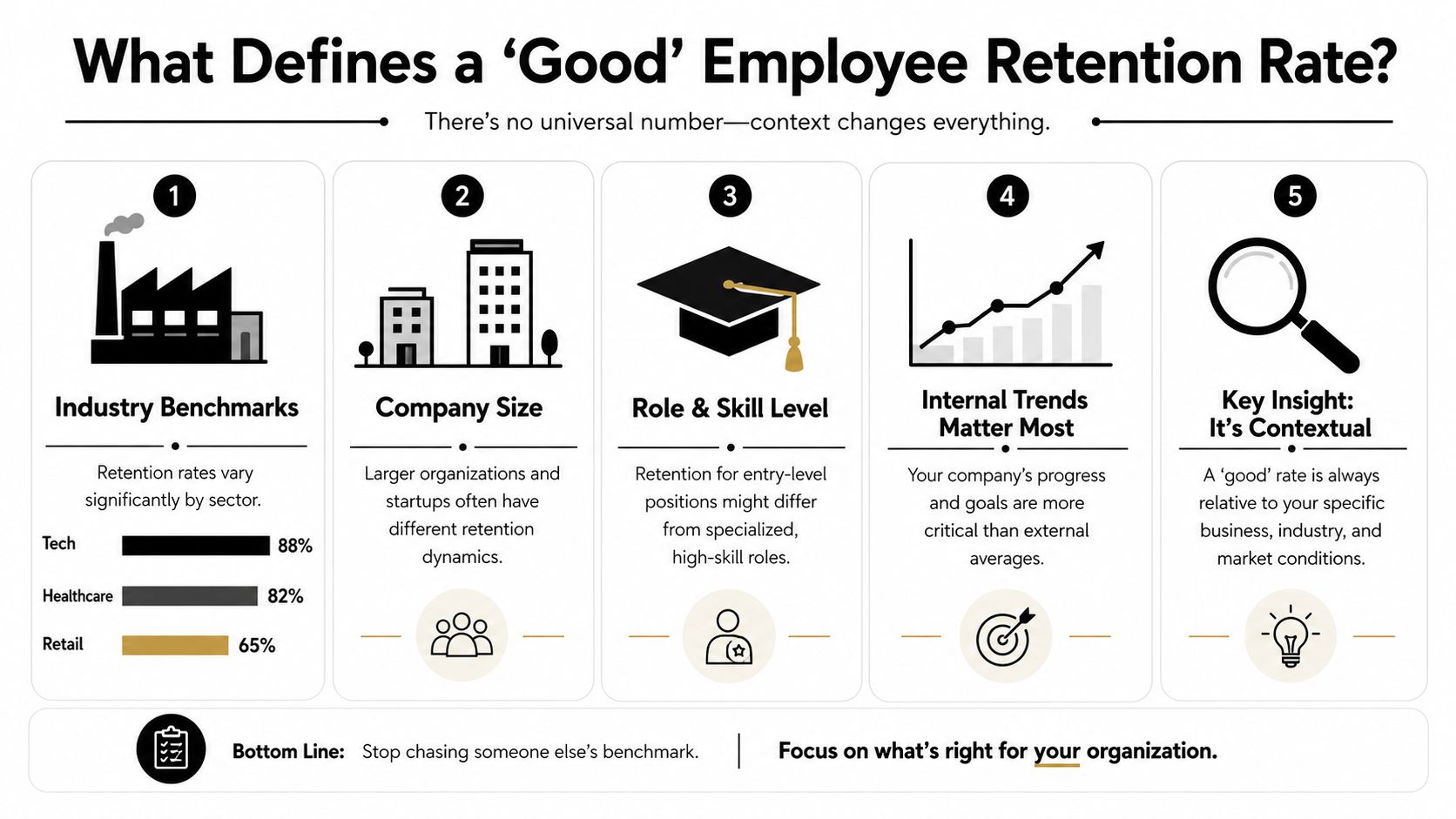
A 90% retention rate can signal strength in one workforce and underperformance in another. The benchmark only becomes useful when leaders compare it against industry structure, role criticality, and the parts of the workforce that drive revenue, service continuity, or institutional knowledge.
A practical reference point comes from the U.S. Bureau of Labor Statistics, which reports sharply different quit and separation patterns across industries in its [Job Openings and Labor Turnover Survey](https://www.bls.gov/jlt/). That matters because retention is shaped in part by labor-market conditions and operating models, not only by internal policy. A frontline employer in a high-churn sector should not read the same target the way a public agency or regulated utility would.
Context changes the benchmark
The most useful retention target is segmented, not universal.
An enterprise-level number can look healthy while masking concentrated risk in customer-facing teams, hard-to-fill technical roles, or manager populations with persistently weak retention. Boards should care less about whether the company clears a generic threshold and more about whether high-value talent stays long enough to protect execution, productivity, and succession depth.
Work arrangement can also influence outcomes, but leaders should treat that as a diagnostic signal rather than a rule. If remote, hybrid, and in-office populations retain at different rates, the underlying cause often sits in manager quality, schedule control, commute burden, or job design. The strategic question is not which model wins in the abstract. It is which conditions reduce regrettable attrition in the roles that matter most.
Industry averages set the floor, not the goal
Broad labor benchmarks help organizations avoid unrealistic comparisons. They do not set strategy.
For example, sectors with historically high quit activity will often tolerate lower retention than sectors built around long tenure and specialized knowledge. That does not excuse turnover. It changes the economics of what "good" looks like. Replacing hourly staff in a volume hiring model creates one cost profile. Losing experienced engineers, nurses, or top-performing account executives creates another, with larger downstream effects on output, quality, and customer relationships.
The board-level interpretation
Leaders should evaluate employee retention rates through three lenses:
> A good retention rate is one that preserves business-critical talent at a cost lower than replacing it.
That is why mature organizations do not stop at a headline percentage. They segment retention by role family, geography, tenure band, manager, and performance level, then use those patterns to predict where preventable loss is building. The result is better than a benchmark check. It is an early warning system for workforce risk.
Uncovering the Root Causes of High Turnover
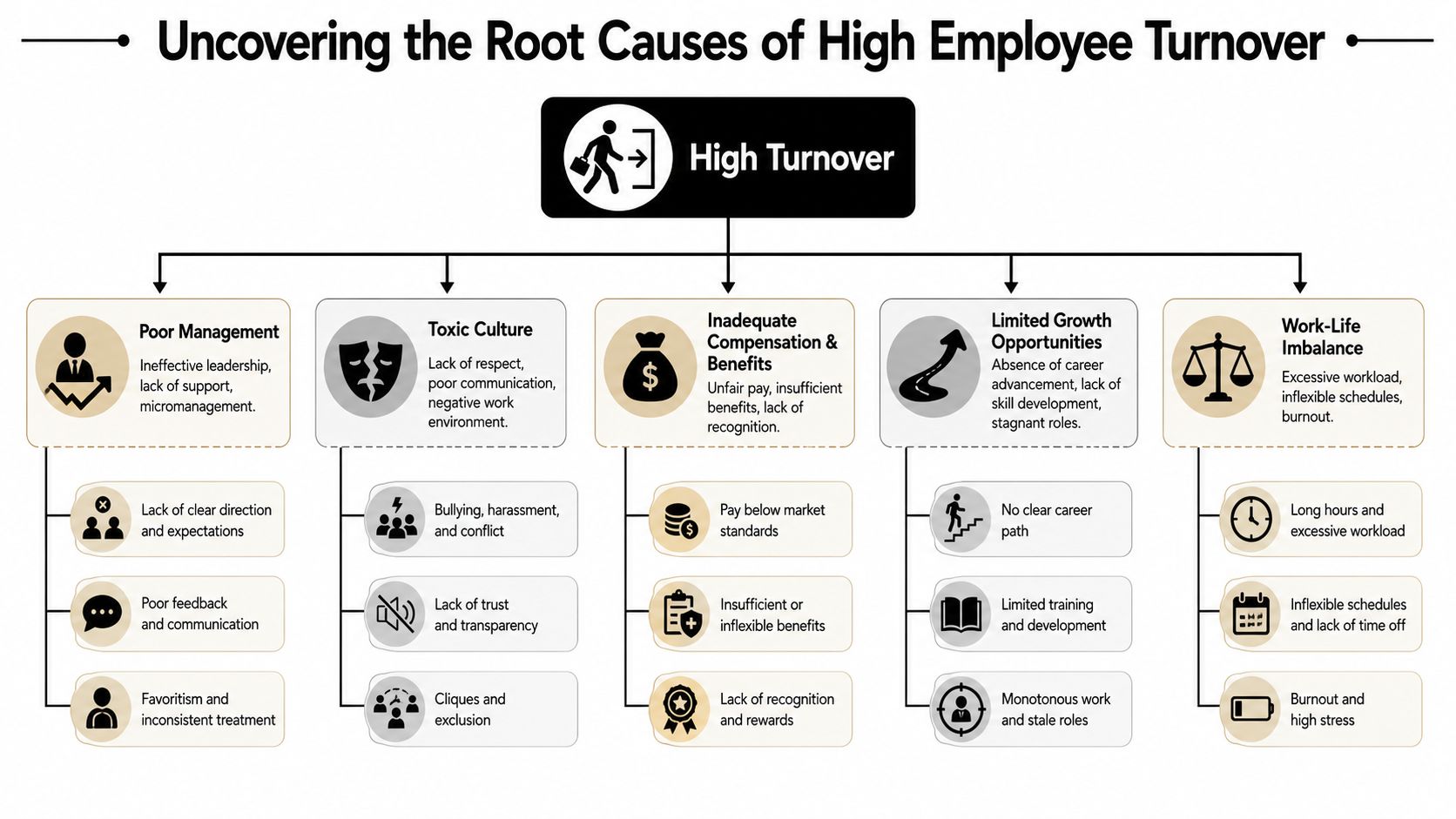
Analysis of preventable turnover indicates that internal factors, rather than external market dynamics, are often the primary drivers.
Gallup reports that employees who strongly agree they trust their manager are far more likely to be engaged and less likely to be looking for another job, while MIT Sloan Management Review's analysis of the Great Resignation found that toxic culture was a stronger predictor of attrition than compensation. For executives, that changes the diagnosis. High turnover usually reflects operating conditions inside the firm, not just recruiting pressure outside it.
The dominant drivers sit in the day-to-day employee experience
MIT Sloan researchers found that toxic corporate culture was the strongest predictor of industry-adjusted attrition during the Great Resignation, ahead of pay and schedule-related factors, in their [analysis of more than 1.4 million Glassdoor reviews](https://mitsmr.com/3f4M3vM). That finding is strategically important because culture is not an abstract sentiment measure. It shows up in workload fairness, psychological safety, inclusion, and whether employees believe leaders act consistently with stated values.
Manager quality sits close behind. Gallup has repeatedly found that the manager accounts for a large share of team engagement variance, which helps explain why attrition often clusters by leader rather than by function or geography. If one manager loses high performers at twice the enterprise average, the problem is usually local management practice before it is enterprise compensation design.
> Poor retention often starts as a management system failure before it appears as a staffing problem.
This distinction affects capital allocation. If the root cause is weak supervision, opaque decisions, or chronic overload, adding compensation spend alone may slow exits temporarily but will not reliably improve retention among high-value talent.
Development and mobility change the risk profile
Career stagnation is a structural retention risk because it changes how employees assess their future earnings, skill growth, and internal opportunity. LinkedIn's 2024 Workplace Learning Report found that organizations with strong learning cultures are more likely to retain talent, particularly when employees can see a clear path to growth and internal movement. That makes development a business control, not a perk.
Internal mobility matters for another reason. It generates behavioral signals that are useful for prediction. Employees who apply for internal roles, complete new skill pathways, or increase cross-functional collaboration often show either rising commitment or rising frustration, depending on whether the organization responds. That is where a predictive model becomes more valuable than a quarterly exit review. [Benely's employee retention insights](https://benely.com/how-to-improve-employee-retention/) highlight the practical side of that shift, especially for teams trying to move from reactive retention programs to earlier intervention.
What executives should diagnose first
Before approving broad retention spending, leaders should test three questions:
Resignations rarely have a single cause. In practice, the strongest explanations usually come from the interaction of manager quality, culture consistency, and access to growth. Those are also the variables that can feed an AI-based flight risk model, which gives leadership a chance to intervene before regrettable turnover reaches the exit interview stage.
Evidence-Based Strategies for Boosting Retention
Companies with strong internal mobility keep employees materially longer. [Genesys reporting on LinkedIn retention data](https://www.genesys.com/blog/post/the-great-rethink-its-time-to-invest-in-employee-retention) found that organizations that excel at internal mobility retain employees for an average of 5.4 years, versus 2.9 years for those that struggle. For a board, that gap matters because longer tenure protects customer continuity, lowers replacement cost, and preserves hard-to-document institutional knowledge.
Internal mobility works because it changes the employee value proposition before resignation becomes likely. A pay increase can solve an immediate market mismatch, but it rarely fixes stalled growth, weak opportunity signals, or a manager who blocks progression. A visible path to a better role inside the company addresses all three.
That makes career pathing a capital allocation decision, not a culture initiative.
Three mechanisms explain why internal mobility produces stronger retention outcomes:
Practical retention guidance still matters at the manager level. Resources such as [Benely's employee retention insights](https://benely.com/how-to-improve-employee-retention/) are useful because they translate broad retention principles into specific management practices around support, recognition, and employee experience.
Retention improves fastest when mobility sits inside a system with disciplined entry, development, and manager incentives. Structured onboarding is part of that system. Research from the Society for Human Resource Management shows that effective onboarding improves early productivity, role clarity, and social integration, which are the conditions that reduce preventable first-year exits. The point is not onboarding as an orientation event. The point is onboarding as an early-retention control.
A stronger operating model usually includes four elements:
1. Structured onboarding Define role expectations, success metrics, key relationships, and learning milestones in the first months, not just the first week.
2. Visible internal pathways Show employees adjacent roles, progression criteria, and realistic movement routes across functions.
3. Development tied to future roles Train for the jobs the business will need next. That approach improves retention and strengthens internal fill rates.
4. Manager incentives aligned to talent outcomes Reward leaders for developing successors, supporting internal moves, and improving retention quality within high-value populations.
Organizations that want better results should also connect these interventions to [predictive analytics in HR](https://synopsix.ai/blog/predictive-analytics-in-hr). That link allows leaders to test which experiences, transitions, and manager behaviors reduce flight risk, then direct retention spending toward the employees and teams where the financial return is highest.
Predict Turnover Risk with Behavioral AI
Most organizations still manage retention by looking backward. They study exits, summarize themes, and hope the next quarter looks better. That's one reason only 23% of organizations describe their retention approach as advanced, according to [Skedulo's analysis of employee retention strategy maturity](https://www.skedulo.com/blog/employee-retention-what-it-means-and-how-to-improve-it/). The consequence is poor retention quality. Companies may preserve headcount while losing the exact people they can least afford to lose.
That distinction matters more than many dashboards suggest. A stable overall retention rate can conceal regrettable loss among high-potential talent, cross-functional connectors, and specialist roles.
A more useful question than who left
Consider a CHRO facing a familiar pattern. Overall retention appears manageable, but the exits that hurt most keep coming from the same population: future managers, scarce specialists, and employees who hold informal influence across teams. Exit interviews identify culture, manager quality, and growth frustration, but they don't arrive early enough to prevent loss.
That CHRO doesn't need another generic engagement average. They need a way to identify risk before it hardens into intent.
Behavioral AI offers a different operating model. Instead of treating turnover as a purely demographic or historical pattern, it evaluates the human conditions that tend to precede attrition. Those can include fit with role demands, likely friction with a manager's style, team complementarity, tolerance for ambiguity, and development alignment.
What predictive retention actually looks like
A predictive model for retention quality usually works through a sequence like this:
> The strongest retention strategy is not persuasion after disengagement. It's prevention before disengagement becomes visible.
This is also where the phrase predict-human-behavior-synopsix-smarter-people-decisions captures a broader shift in talent strategy. Organizations increasingly need systems that don't just record outcomes. They need systems that help leaders anticipate human behavior and act on it.
For HR leaders exploring that shift, [predictive analytics in HR](https://synopsix.ai/blog/predictive-analytics-in-hr) offers a useful frame for moving from descriptive reporting to forward-looking intervention.
Why this changes the economics of retention
Predictive retention does more than stop exits. It improves the quality of decisions upstream.
When organizations understand behavioral fit more clearly, they can reduce mis-hires, make better promotion decisions, and design teams with fewer friction points. Those improvements matter because turnover often starts with the wrong role match, the wrong manager pairing, or the wrong development path. Behavioral AI doesn't replace managerial judgment. It sharpens it.
That's the key advantage. Leaders stop managing retention as a cleanup function and start managing it as a precision talent system.
From Measurement to Mastery An Action Plan
The companies that improve employee retention rates consistently don't rely on a single initiative. They build a management discipline.
The first discipline is benchmarking accurately. Calculate retention cleanly, segment it by workforce reality, and avoid generic comparisons that hide role-specific or manager-specific risk. A single enterprise number belongs in reporting, but strategic decisions require segmentation.
The second is diagnosing causes at their source. In most organizations, regrettable turnover points back to manager quality, culture conditions, and blocked growth. If leaders treat retention as a compensation-only problem, they'll spend heavily and solve little.
The third is acting before resignation risk becomes visible. That means moving beyond descriptive dashboards toward a predictive model that identifies who is vulnerable, where friction is forming, and which interventions are likely to work for high-value talent.
A practical board-level framework looks like this:
> The best retention outcome is not a lower number on a dashboard. It's a stronger organization that keeps the people who drive execution, culture, and future growth.
Retention mastery is less about persuading people to stay and more about designing an environment, a leadership system, and a set of talent decisions that make staying the rational choice.
---
Synopsix helps organizations turn behavioral insight into practical action across hiring, team design, and talent development. If you want a more predictive approach to retention quality, not just a better headline metric, explore [Synopsix](https://synopsix.ai).