Ethics in Assessment for Modern Hiring
By Synopsix · September 23, 2026 · 17 min read
A retail chain rolls out a personality screen across every store, confident that standardization will make hiring faster and more consistent. Two years later, an internal review shows that the tool has systematically downscored candidates who speak English as a second language. The company faces a class action, a brand crisis, and uncomfortable questions from the board about why nobody owned the assessment after launch.
That scenario is easy to recognize because assessment failures rarely begin with bad intent. They begin with a vendor promise, a rushed procurement process, an unexamined scoring model, or a consent notice that nobody reads. Ethics in assessment isn't a compliance paragraph. It's an operating discipline for making consequential people decisions.
Why Ethics in Assessment Is Now an Operating Concern
The retail example becomes a board issue because an assessment sits inside several business systems at once. It influences who enters the organization, which candidates disappear from the funnel, how recruiters spend their time, and whether hiring managers trust the pipeline. Once an assessment produces unequal outcomes, the organization doesn't face one isolated HR problem. It faces legal exposure, reputational damage, weakened workforce planning, and a credibility problem with candidates and employees.
The regulatory environment reinforces that shift. HR leaders now have to track requirements and expectations associated with the EEOC, New York City's Local Law 144, the EU AI Act, privacy rules, and existing employment discrimination frameworks. The specific duties vary by jurisdiction and tool, but the direction is clear. Organizations need evidence that their assessments are appropriate for their purpose, monitored in use, and governed by accountable people.
The cost appears before litigation
A weak assessment can create a bad hire, but its damage starts earlier. Recruiters may reject capable applicants, hiring managers may receive a distorted shortlist, and people analytics teams may spend months explaining unexplained representation gaps. If leaders then compensate by adding interviews or manual reviews, the organization loses the speed and consistency that justified buying the assessment.
The United Kingdom's 2020 A-level grading controversy shows why technical sophistication can't settle an ethical question. Teacher estimates were adjusted using an algorithm based on historical school performance, and the system was abandoned after public backlash because standardization had produced outcomes widely judged unfair. The episode demonstrates that predictive or statistical optimization doesn't automatically equal fairness. [Research on the controversy](https://www.tandfonline.com/doi/full/10.1080/0969594X.2022.2067834) connects ethical legitimacy with understandable processes, proportionate decisions, and socially defensible consequences.
> Board-level test: If nobody can explain who reviews an assessment, what evidence supports it, and what happens when it fails, the organization doesn't have an ethics control. It has a purchase order.
Assessment ethics belongs in governance, audit trails, and quarterly business reviews alongside financial and security controls. Leaders who approve a tool once and never revisit it are treating a changing decision system as if it were static software.
The Core Principles That Define Ethical Assessment
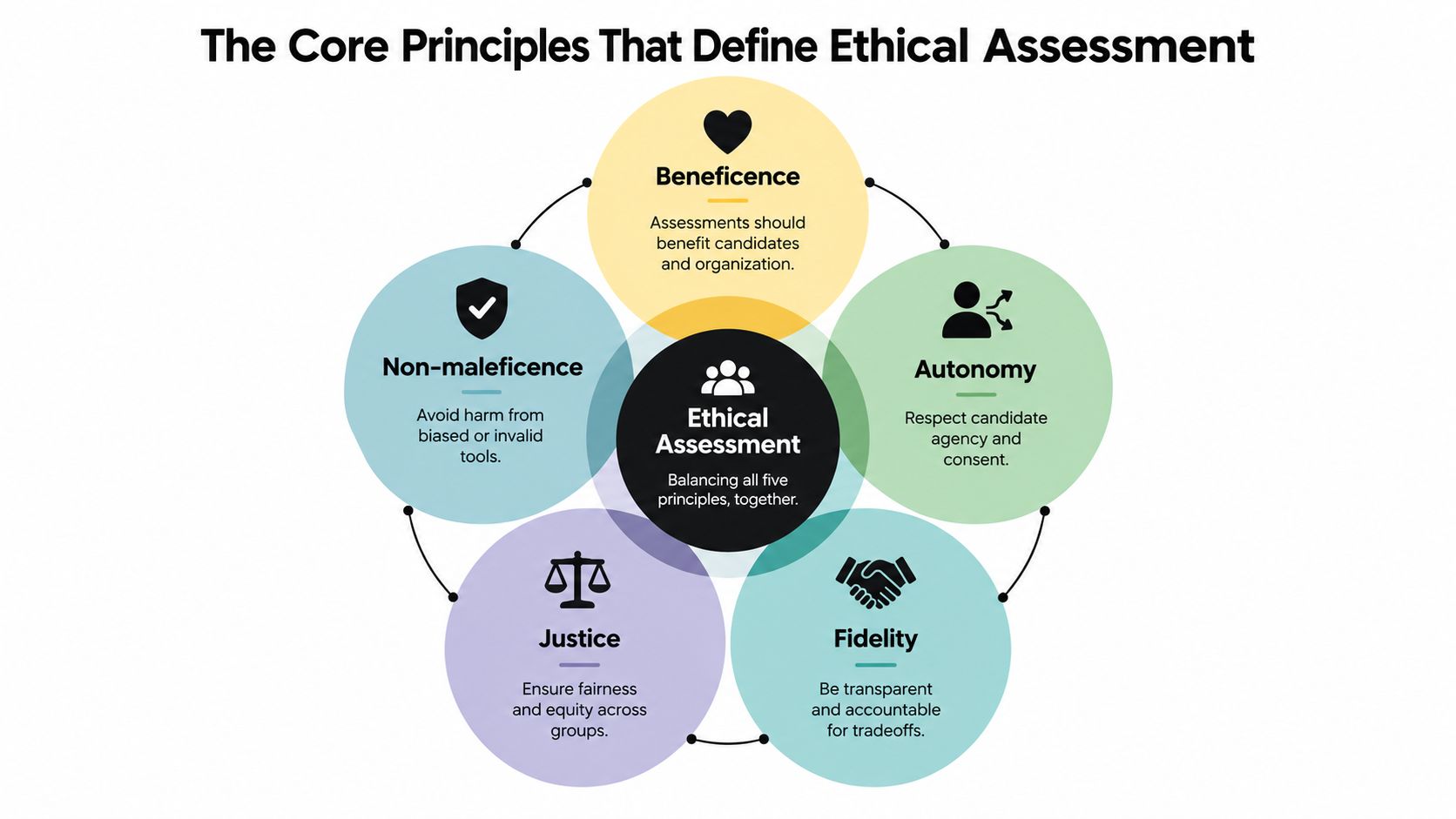
Ethical assessment works like medical ethics. A clinician can't justify harmful treatment by saying it was efficient, or ignore patient autonomy because the treatment has a strong success rate. The principles operate together because tradeoffs are real. Validity without transparency can deceive candidates. Fairness without validity can produce equal treatment of the wrong construct. Accountability without consent can make a controlled process ethically unacceptable.
Start with the construct
Validity asks whether the assessment supports the interpretation the organization wants to make. If a sales assessment claims to measure consultative selling, it shouldn't mainly reward vocabulary, familiarity with a particular cultural style, or comfort with timed online testing. Reliability asks whether results remain reasonably consistent across candidates, raters, and administrations. A tool that changes meaning from one recruiter or session to another can't support dependable decisions. [This practical guide to assessment validity and reliability](https://synopsix.ai/blog/assessment-validity-and-reliability) offers a useful foundation for separating measurement quality from business enthusiasm.
Apply justice and transparency together
Fairness requires evidence that irrelevant characteristics aren't creating advantages or disadvantages. Assessment bodies increasingly treat fairness as a multi-stage requirement spanning development, administration, scoring, interpretation, and use, with tools such as differential item functioning, or DIF, used to detect problematic items and score behavior ([assessment fairness research](https://www.tandfonline.com/doi/full/10.1080/08957347.2026.2691079)). Transparency means candidates understand what they're being measured on, how the result will be used, and whether an automated system contributes to the decision.
Consent and autonomy give candidates meaningful agency. A real process explains the assessment, requests informed participation, provides an alternative or accommodation route where appropriate, and explains how someone can withdraw or challenge a result. An unreadable vendor clause isn't consent.
Accountability, sometimes expressed through fidelity to commitments, assigns ownership. Someone must approve the use case, monitor outcomes, review exceptions, and authorize remediation. A highly predictive test still fails ethically if candidates were misled about its purpose or if nobody can answer a complaint.
These principles are the lenses through which bias becomes visible. Bias isn't only a bad outcome at the end. It can enter through the technical and managerial choices made throughout the pipeline.
How Bias Enters the Assessment Pipeline
Bias enters assessment through ordinary decisions that look harmless in isolation. A job analysis may describe an incumbent's habits instead of the actual requirements of the role. An item writer may use idioms that favor one linguistic background. A scoring model may optimize overall accuracy while masking unequal error rates. The result is construct-irrelevant variance, meaning factors unrelated to job performance influence the score and its interpretation ([fairness in testing guidance](https://www.enrollment.org/articles/fairness-in-testing)).
Treat every stage as a control surface
| Pipeline Stage | Bias Risk | Mitigation Control | |---|---|---| | Job analysis | The profile reflects current employees rather than job requirements | Validate competencies with multiple role experts and document exclusions | | Item design | Cultural, linguistic, disability, or accessibility features affect responses | Run red-team reviews, accessibility checks, and linguistic review | | Scoring algorithms | A model hides group differences behind aggregate accuracy | Test outcomes across relevant groups and inspect error patterns | | Adverse impact analysis | A threshold flags only obvious disparities | Use the four-fifths rule as a floor, not a ceiling, with DIF analysis | | Decisioning | Human overrides reproduce intuition or favoritism | Separate scores from judgment and log override patterns | | Post-hire outcomes | Early labels create self-fulfilling performance expectations | Compare later outcomes by assessment band and review rating practices |
Job analysis comes first because every later validation claim depends on it. Define the intended construct, identify what the job requires, and remove traits that merely resemble the profile of current incumbents. At item design, ask reviewers to challenge idioms, cultural assumptions, reading load, and unnecessary time pressure.
Scoring requires more than a headline accuracy figure. Audit disparate outcomes across protected groups, examine DIF at item level, and investigate whether a model's errors cluster around particular populations. A result can look stable overall while still creating a serious barrier for a subgroup.
Make human judgment inspectable
Human review doesn't automatically fix algorithmic bias. Recruiters may override scores inconsistently, and managers may use a score as an anchor even when they claim to apply judgment independently. Record the reason for every material override, then inspect patterns by recruiter, manager, role, and candidate group.
For a broader explanation of practical interventions, see this guide on [how to reduce hiring bias](https://synopsix.ai/blog/how-to-reduce-hiring-bias). Leaders should also distinguish an assessment problem from unlawful [discrimination](https://nicknorris.law/discrimination/) when investigating a complaint, while recognizing that ethical failures can become discrimination claims when protected groups experience unjustified disadvantage.
The operating recommendation is simple: name an owner for each stage, review the pipeline quarterly, and maintain documented exception handling. An annual audit is too slow for a tool whose role definitions, candidate populations, scoring models, and jurisdictions can change during the year.
Consent, Privacy, and Transparency in Practice
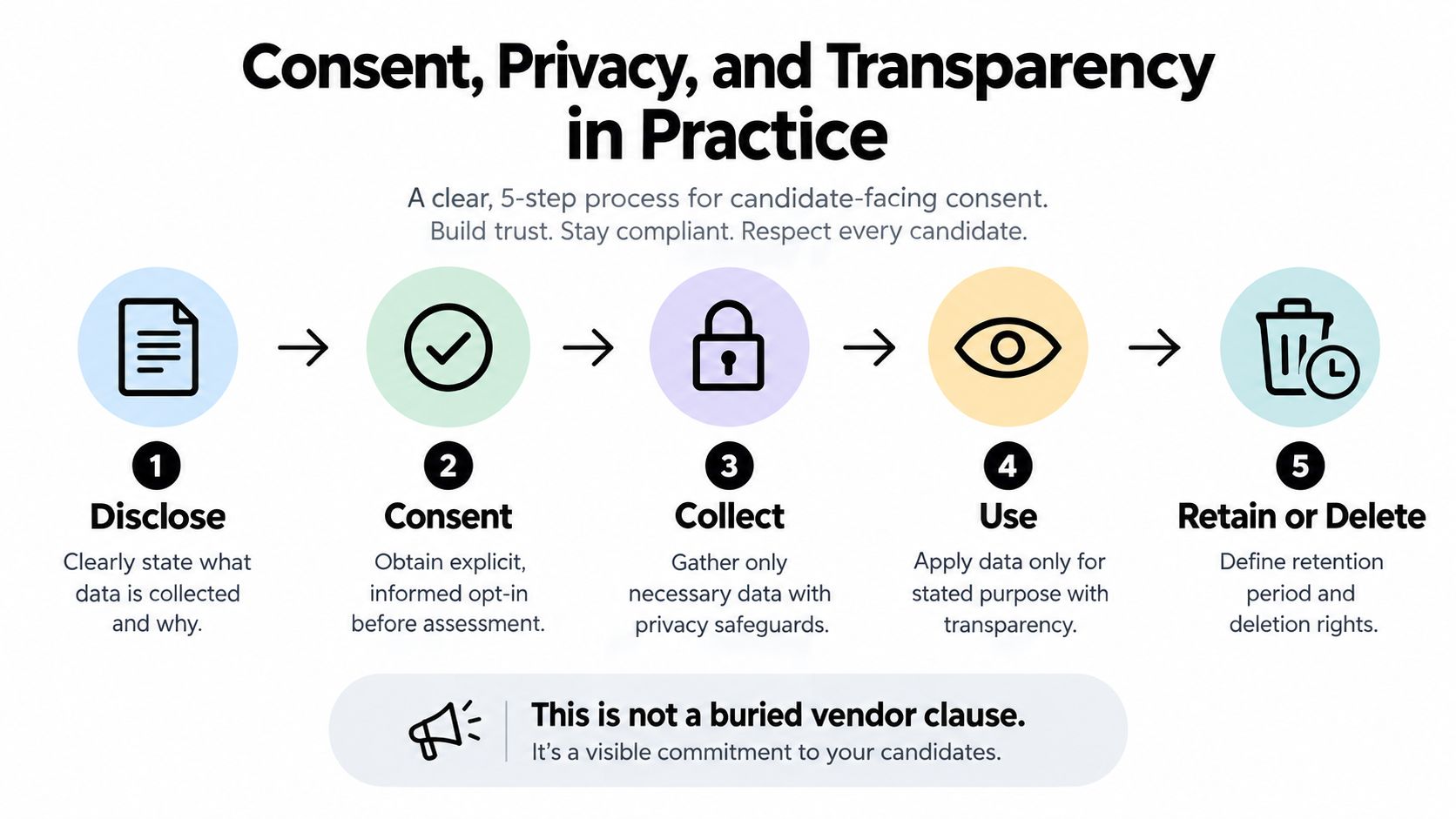
Consent should be a workflow, not a clause hidden inside a vendor contract. Before a candidate begins, the organization should explain what it collects, why each element is necessary, how long it will retain the data, who can access it, and how the candidate can withdraw or request an alternative.
Build the candidate flow deliberately
Use a short, plain-language notice before the assessment. It should identify the purpose, the categories of data, the decision the data may influence, the role of automated scoring, the retention approach, and the contact route for questions. Consent should be an explicit action, not a preselected box or a confusing choice that makes declining feel like abandoning the application.
Privacy by design follows the same logic as good assessment design. Collect only what the use case requires, restrict access by role, redact protected attributes from routine reports where possible, and tie retention schedules to the role and jurisdiction. The people who need to validate fairness may require controlled access to group data, while recruiters don't need unrestricted access to every sensitive field.
Turn transparency into operating materials
Transparency needs three deliverables:
Every access event should feed an audit trail. Log who viewed, exported, changed, or shared assessment information, and review unusual access patterns. Cross-border candidates require a clear transfer and storage decision, not an assumption that the vendor's global infrastructure is acceptable everywhere.
> Practical rule: If an HR business partner can't explain the scoring model in plain language, the organization isn't ready to use it in a high-stakes decision.
Common failure modes include vague consent, dark-pattern opt-ins, indefinite retention, uncontrolled report sharing, and models nobody inside HR can explain. Organizations comparing data governance approaches can also review [privacy practices for underwriters](https://figtrig.com/privacy.html) for an example of how a different risk-sensitive field frames information handling.
A short visual walkthrough can help teams train recruiters on the sequence:
<iframe width="100%" style="aspect-ratio: 16 / 9;" src="https://www.youtube.com/embed/O6-0CWcH7y4" frameborder="0" allow="autoplay; encrypted-media" allowfullscreen></iframe>
The standard should remain stable even when vendors change. Candidates deserve the same clarity whether the assessment is administered by a recruiter, an external platform, or an automated workflow.
Legal and Compliance Duties Across Regions
Compliance is tiered, not flat. A behavioral assessment may sit within employment selection rules, privacy obligations, automated decision requirements, accessibility duties, and local recordkeeping expectations at the same time. HR leaders shouldn't build separate minimum programs for every country. They should build one strong internal control, then map regional requirements onto it.
The EU AI Act, GDPR, the U.S. EEOC Uniform Guidelines on Employee Selection Procedures, the UK Equality Act, Singapore's PDPA, and emerging APAC AI guidance don't impose identical duties. Some focus on the risk classification of the tool, some on personal data and individual rights, and some on evidence that selection procedures are job-related and appropriately validated.
| Region / Framework | Scope of Regulated Tools | Required Impact Assessment | Adverse-Impact Testing | Recordkeeping & Candidate Rights | |---|---|---|---|---| | European Union, EU AI Act | Employment and worker-management AI can fall within high-risk requirements depending on the system and use | Risk management, data governance, and oversight obligations may apply to covered systems | Assess outcomes and risks as part of the control framework | Documentation, transparency, human oversight, and applicable rights requirements | | European Union, GDPR | Processing of candidate and employee personal data, including profiling | Data protection analysis may be required for risky processing | Fairness and necessity should inform processing decisions | Notice, access, objection, deletion or restriction rights where applicable | | United States, EEOC Uniform Guidelines | Employee selection procedures, including tests used to make employment decisions | Validation evidence should support the intended use | Adverse-impact analysis is a core safeguard | Maintain evidence supporting selection decisions and respond to challenges | | United Kingdom, Equality Act | Selection and employment practices that may disadvantage protected groups | Demonstrate objective justification where relevant | Monitor discriminatory effects and investigate concerns | Explain and document decisions, with rights shaped by the specific process | | Singapore, PDPA | Collection, use, disclosure, and protection of personal data | Assess privacy risks and safeguards appropriate to the use | Review whether data practices create unfair effects | Notice, purpose limitation, access, correction, and protection duties | | APAC emerging AI guidance | Guidance varies by country and may supplement existing employment and privacy rules | Often emphasizes governance, testing, and human oversight | Best practice is to test for group-level effects | Documentation and explainability expectations are expanding |
The table separates broad control expectations from legal conclusions. Legal duties depend on facts, jurisdiction, and system design. Best practice goes further by preserving validation evidence, documenting vendor accountability, and making scores explainable to decision-makers and candidates.
Build a single evidence file for each assessment. Store the use case, construct definition, validation materials, group analyses, model version, decision rules, notices, consent records, vendor commitments, and incident history. When a role profile or jurisdiction changes, reopen the file rather than relying on the original approval.
The strictest applicable regime should set the internal baseline. That approach costs more at launch, but it reduces fragmented controls, late redesigns, and the temptation to treat compliance as a local exception.
Ethics Across the Full Employee Lifecycle
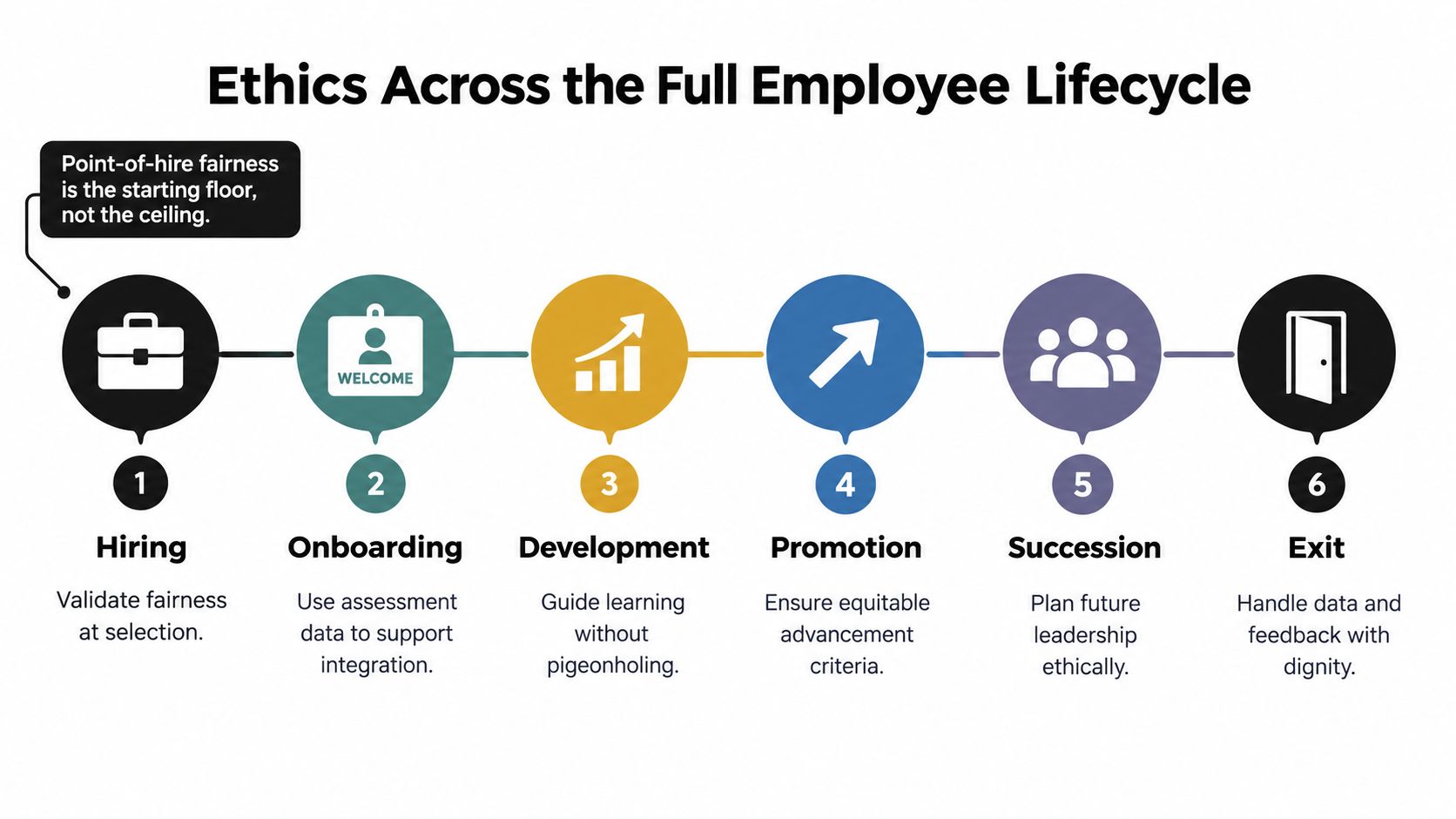
Point-of-hire fairness is the floor, not the ceiling. The same assessment data may later influence onboarding, development, promotion, succession, and exit, often without anyone revisiting whether the original consent or validation still covers the new decision.
Change the question at every stage
At hiring, ask whether the assessment predicts the role's intended outcomes. At onboarding, ask whether the result supports integration or labels a person before they've had an opportunity to demonstrate capability. Feedback and adjustment opportunities matter because a score should guide a conversation, not become an identity.
At development, check whether the same tool is administered and interpreted consistently across demographic groups. A development assessment can still create harm if managers use it to restrict access to stretch work or training.
At promotion, investigate whether historical scores are being overweighted because they're convenient. A hiring assessment may have been validated for selection, not advancement. Using it for promotion without fresh evidence turns an old signal into an unearned gate.
At succession, ask whether the assessment creates a self-fulfilling pipeline. If leaders repeatedly assign high-visibility work to people labeled as future leaders, later performance may reflect opportunity rather than the original assessment signal.
Re-consent before reuse
Reusing hiring data for later decisions is a common and fixable failure. A candidate may have agreed to an assessment for a specific role, but that doesn't automatically authorize indefinite use in promotion, termination, or succession decisions.
Use one operating rule:
> Any new use of assessment data triggers a documented review of validity, fairness, and consent.
That review should identify the new decision, confirm that the construct remains relevant, test downstream outcomes, and record who approved the change. Employees should receive a clear explanation when old assessment data enters a new decision process.
This lifecycle discipline connects ethics to the metrics leadership already watches. If assessment data influences retention, internal mobility, promotion rates, or succession readiness, those outcomes need monitoring by assessment source and decision stage. A fair hiring process can still produce an unfair career system if downstream controls are missing. Guidance on [assessment for employees](https://synopsix.ai/blog/assessment-for-employees) can help teams frame employee use separately from candidate selection.
Building an Assessment Ethics Program
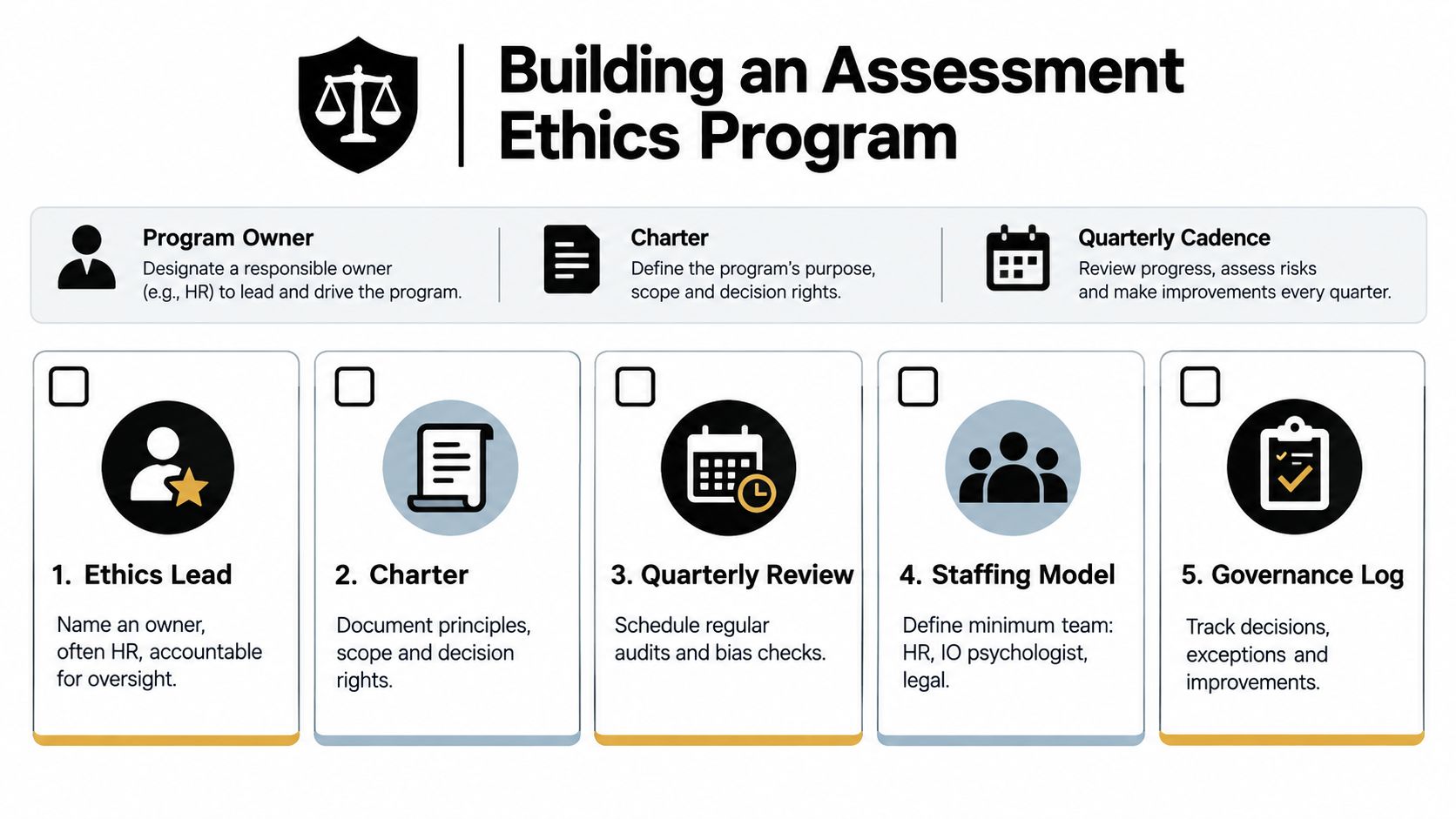
An assessment ethics program needs a name, a charter, and a calendar. Without those three things, responsibility disperses across HR, procurement, legal, analytics, and vendors until nobody owns the result.
Staff the control
The minimum model includes an ethics lead, often in HR compliance or people analytics, an assessment subject-matter expert, a legal partner, a DEI partner, and a rotating business sponsor. The business sponsor matters because ethical use depends on the role, the decision, and the consequences, not only on technical properties.
Maintain a documentation set that can answer an auditor, candidate, hiring manager, or board member:
Make review cadence non-negotiable
Run validation before launch, monitor after launch, conduct a formal fairness review annually, and trigger an additional review when the role profile, scoring model, vendor, candidate population, or jurisdiction changes. The quarterly review should produce decisions, not just dashboard circulation. Retire tools that no longer support their intended use, and document why.
Integrate ethics checkpoints into procurement. Gate every new assessment on documented review, then publish a one-page operating standard that tells HR business partners and hiring managers what the central program owns and what local users own. A standing program costs attention, but a crisis costs attention plus trust, legal work, replacement hiring, and executive time.
Questions Leaders Ask About Assessment Ethics
How should we govern AI-scored assessments?
Require model documentation, the intended construct, training and validation evidence, version history, known limitations, and a plain-language explanation of how the score contributes to the decision. Disclose algorithmic scoring to candidates, keep a human review step for adverse decisions, and log the human rationale rather than treating “the model said no” as an explanation.
What should candidates see?
Give candidates a competency-based narrative that explains relevant strengths, development areas, and the role connection. Don't send raw scores without interpretation. Where law or policy requires item-level feedback, provide it through a controlled process that protects test security and candidate privacy.
What belongs in vendor due diligence?
Ask for bias-audit evidence, data residency details, breach history, model update cadence, accessibility documentation, subcontractor information, and an exit clause covering candidate data. If a vendor refuses to explain its controls, that refusal is itself a procurement risk.
What happens when adverse impact surfaces?
Pause the affected decision rule, preserve the evidence, identify the stage where the disparity entered, and assess whether valid performance signal can be retained through a redesigned process. Communicate directly with affected candidates where the organization made a material decision, provide a review route, and document remediation. Don't discard a useful construct automatically, but don't keep a harmful threshold because replacing it is inconvenient.
Ethics in assessment becomes credible when candidates can see it in the process, recruiters can execute it, and leaders can audit it.
---
Synopsix helps HR teams turn validated behavioral assessments into comparable profiles, business-language reports, simulations, compatibility analysis, and development plans, with controls that support more explainable people decisions. Visit [Synopsix](https://synopsix.ai) to see how the platform can fit into a governed assessment workflow.