Executive Presence Assessment for Fairer Decisions
By Synopsix · October 29, 2026 · 15 min read
In a 2012 Center for Talent Innovation survey of 268 senior executives, respondents estimated that executive presence represented 26% of what it takes to be promoted into leadership, according to [Training magazine's account](https://trainingmag.com/executive-presence-what-it-is-what-it-isnt-and-why-it-matters/). That makes presence a consequential promotion input, but not an objective measure of leadership ability. A defensible executive presence assessment must turn stakeholder impressions into observable behaviors, then test whether those scores improve decisions.
What an Executive Presence Assessment Measures
An executive presence assessment is a structured judgment of how influential stakeholders experience a leader's behavior, especially when decisions are difficult. It isn't a personality type, a wardrobe review, or a test of who speaks most confidently.
The distinction matters because an audience can mistake familiarity for credibility. A leader who resembles current executives may feel reassuring without demonstrating better judgment.
Separate the dimensions before scoring
The Center for Talent Innovation survey emphasis was gravitas at 67%, communication at 28%, and appearance at 5%. These are shares of respondents naming an element most important, not validated weights for a hiring formula.
Executive presence emphasis and what to score
| Dimension | Respondents naming it most important | Behaviors to rate | How to use the score | |---|---:|---|---| | Gravitas | 67% | Composure, decisiveness, confidence under uncertainty, credibility, judgment | Heaviest starting emphasis; primary development target if low | | Communication | 28% | Concise framing, active listening, audience adaptation, assertiveness | Score spoken, written, and virtual delivery separately | | Appearance | 5% | Distracting presentation only, not style or polish | Derailment flag only; never a capability proxy |
Use that emphasis to decide what to investigate, not to hard-code a composite score. Local validation should determine how much each behavior contributes, while appearance remains outside the positive capability score.
For gravitas, look at what happens when a stakeholder challenges a recommendation. Does the leader explain the trade-off, acknowledge uncertainty, and commit to a defensible next action? Confidence without sound judgment shouldn't earn a strong rating.
Communication requires more than fluent speaking. A concise written decision note, an accurate summary of another person's objection, and respectful disagreement all provide evidence. Someone who dominates a presentation but leaves colleagues unclear about responsibilities has a communication gap.
Make credibility observable
Say a finance leader faces an unexpected budget shortfall. Rather than bluffing, they distinguish confirmed facts from assumptions, explain the options, and identify what would change their recommendation.
That behavior supports [leadership credibility](https://synopsix.ai/blog/leadership-credibility), even if the delivery is quiet. Conversely, polished reassurance without an explanation of the decision provides little evidence of readiness.
Appearance deserves particular restraint. Flag only a concrete, job-relevant distraction that obstructs the exchange, then investigate the context. Clothing preferences, physical characteristics, and resemblance to incumbent leaders aren't capability evidence.
> Scoring rule: Every mark needs a specific observed behavior. An impression without an example isn't a defensible rating.
A strong technical record doesn't cancel a genuine gravitas gap. But the assessor must identify the missing behavior, such as avoiding a necessary decision under pressure, rather than treating restrained delivery as a deficit.
Presence Apart from Leadership Quality
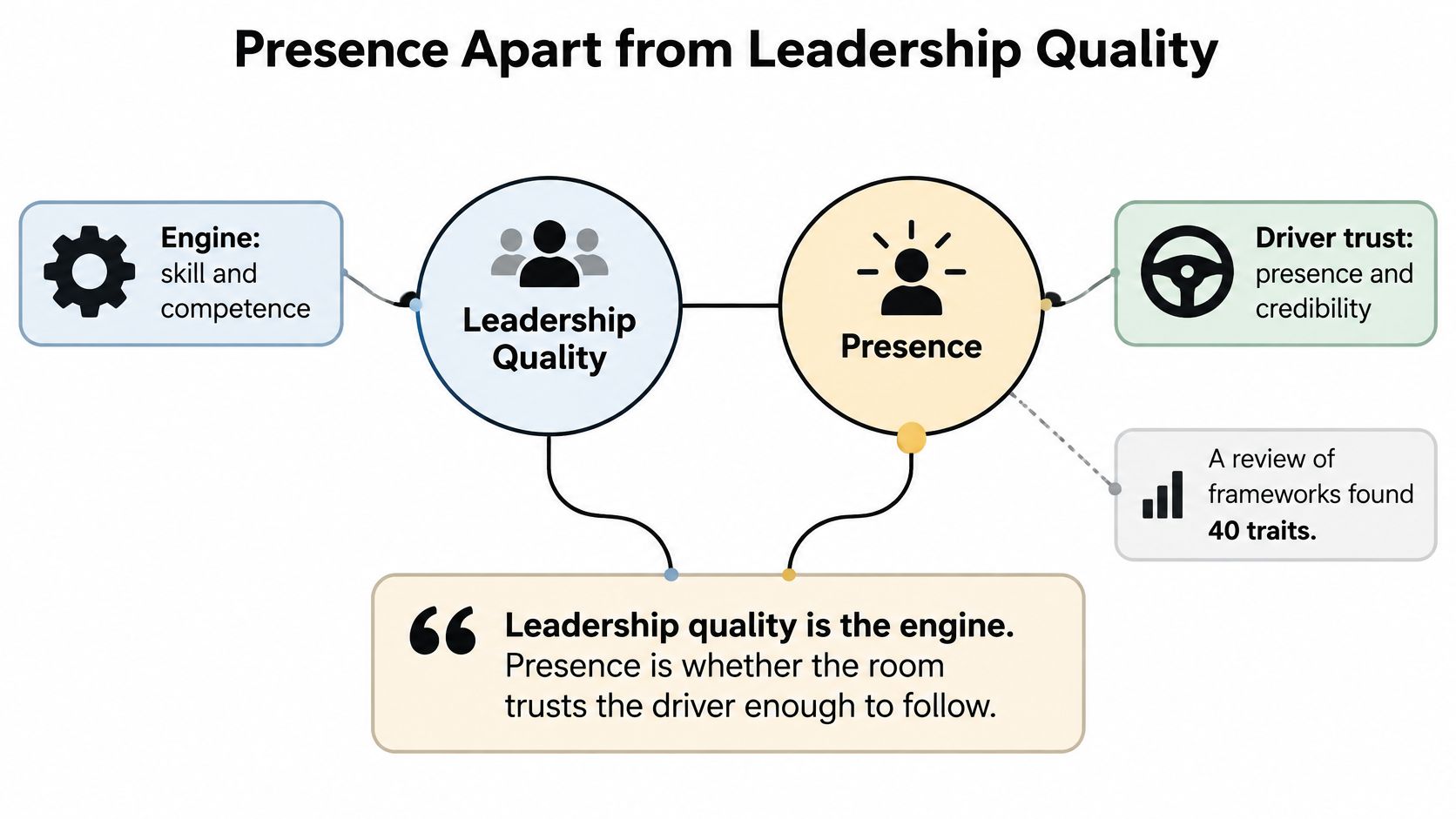
Leadership quality is the engine. Presence is whether the room trusts the driver enough to follow.
The distinction helps explain why a capable executive may struggle to mobilize stakeholders, while a persuasive executive may attract confidence their decisions don't justify. Assessors need to measure both without confusing them.
A [Deakin study based on interviews with 34 business professionals](https://dro.deakin.edu.au/articles/journal_contribution/Understanding_executive_presence_Perspectives_of_business_professionals/20910586) framed presence primarily as audience perception, identified four presence archetypes, and found that most executives described as having presence were men. Its characteristics spanned status, appearance, confidence, communication, integrity, expertise, and delivery of results.
That breadth creates a measurement problem. Integrity, expertise, communication, and results probably already appear in your leadership competency model. Adding another score with different branding can double-count the same strengths.
Test what the score adds
Confidence may be more distinctive than many other presence traits, but it still needs behavioral definition. An assessor should distinguish a leader who makes a recommendation despite uncertainty from someone who sounds certain.
Ask your people-analytics team to test these questions:
Incremental validity means the new assessment contributes useful information you didn't already have. Compare an outcome model using current leadership measures with a model that also includes presence behaviors. If the additional score contributes nothing reliable, don't introduce another selection hurdle.
Promotion alone is a risky validation target. If previous panels favored familiar presentation styles, predicting their decisions could reproduce that preference rather than establish leadership value.
Keep observation separate from interpretation
A useful report distinguishes what happened from what an audience inferred. For example, the observable behavior might be that a leader interrupted a stakeholder before the objection was complete; the resulting impression might be that dissent wasn't welcome.
Those aren't interchangeable statements. The behavior can be reviewed, while the impression explains its relational impact.
Report disagreement rather than hiding it inside an average. If peers experience decisiveness and direct reports experience exclusion, the organization needs to understand that difference before prescribing confidence coaching.
Behavioral, Simulation, and 360 Methods Compared
How the three assessment methods differ
| Method | What it captures | Best use | Main limit | Relative effort | |---|---|---|---|---| | Structured behavioral interview | Past behavior under pressure, with anchored probes | External hiring screen | Relies on self-report | Low; design for under an hour | | Simulation or case | Live composure, decisiveness, and framing | Finalist or promotion gate | Needs trained raters | Medium to high | | 360 multi-rater | Gap between intent and stakeholder impact | Internal promotion and succession | Slow and political if anonymity is weak | Medium; several raters |
These effort descriptions are planning assumptions, not benchmarked completion times. The right combination depends on the decision and the evidence you can obtain fairly.
For external hiring, use a structured interview plus a simulation. For internal promotion, add multi-rater feedback; for succession, use all three methods against a common behavioral scale.
Choose evidence that challenges the story
A structured behavioral interview is efficient because the assessor can probe an actual high-stakes episode. Ask what the candidate recommended, who disagreed, what they said next, and what changed afterward.
Follow-up questions matter more than a compelling opening story. Ask for the rejected option and the stakeholder who remained unconvinced. Otherwise, assessors may reward storytelling skill instead of the behavior they intended to assess.
A simulation provides a direct window into gravitas. Use a crisis briefing, an ambiguous stakeholder meeting, or board-style questions that require the candidate to balance incomplete information with a decision.
Keep the challenge job-relevant. Surprise trivia and deliberately hostile questioning introduce noise; a realistic conflict between commercial urgency and operational risk gives raters something useful to observe.
Compare intent with experienced impact
The [AIPMO leadership-presence review](https://www.aipmo.org/part-1-of-3-the-leadership-presence-series/) compiled 40 traits across published frameworks, with only four identified by at least four authors: confidence, decisiveness, superior communication skills, and appearance; 23 traits, or 58%, appeared in two or fewer sources. That lack of agreement makes explicit definitions essential.
The same review describes the Bates Executive Presence Index approach, which compares a leader's self-perception with ratings from their manager, peers, and direct reports. Someone may consider their communication clear and confident while colleagues experience it as abrupt or insufficiently inclusive.
> Self-assessment tells you what a leader believes they convey. Multi-rater evidence tells you how others experience it.
Require an evidence note from every assessor, regardless of method. Preserve anonymity in feedback reporting where appropriate, but don't allow anonymous impressions to become unchallengeable selection evidence.
Self-only tools, including popular 7C checklists, can serve as coaching mirrors. They aren't sufficient selection instruments: presence is relational, and a candidate can't establish stakeholder impact by rating themselves.
How to Design or Select the Assessment
Before piloting or purchasing, approve a governance plan: obtain consent for recorded simulations, set retention limits, restrict access, and specify how candidates can challenge inaccurate records. Plan adverse-impact checks by gender, ethnicity, and location on the first cohort, rather than waiting until the tool becomes established.
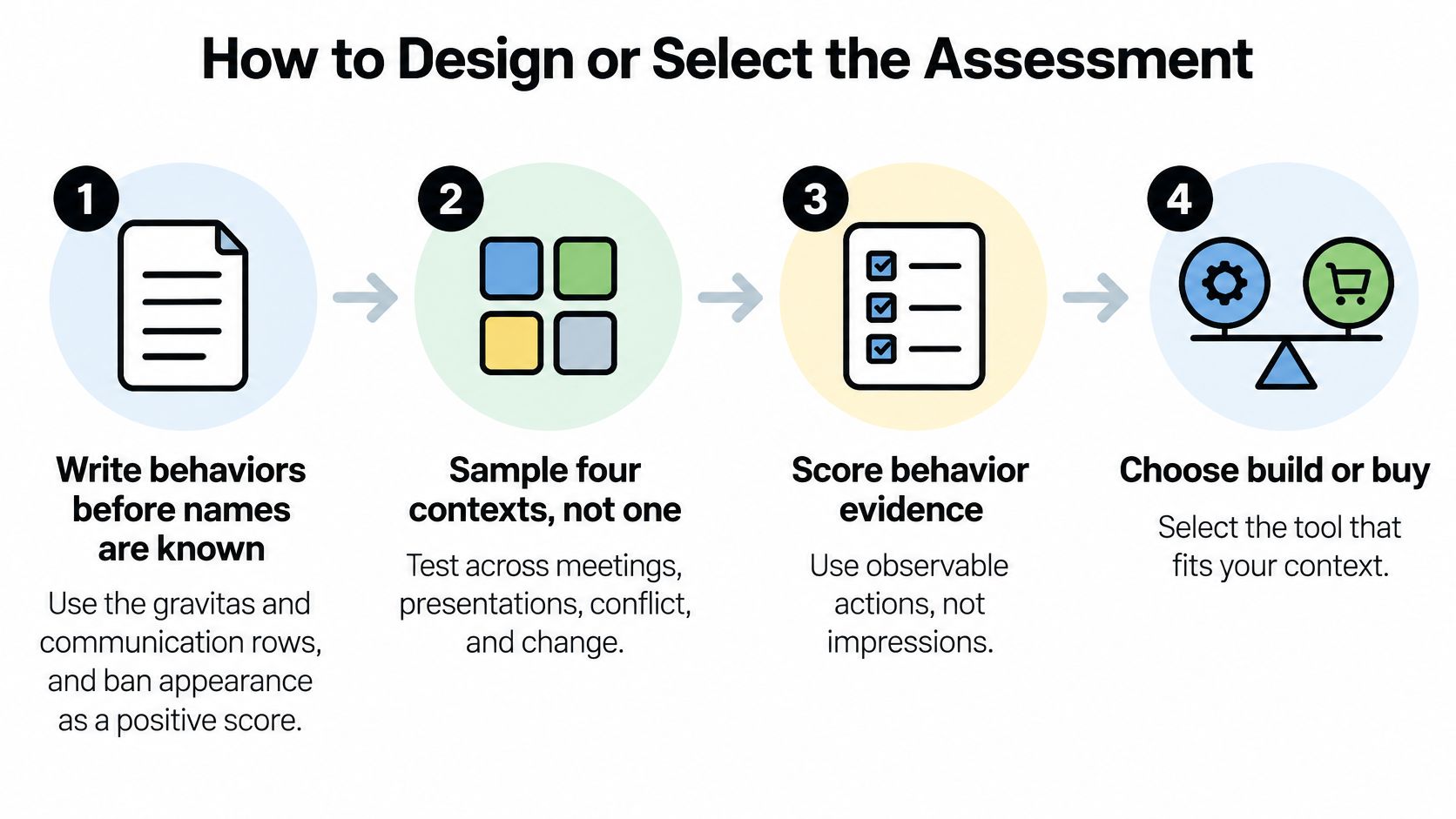
The design needs a consistent sequence, even when teams choose different tools.
Build a reviewable procedure
1. Write behaviors before names are known. Define the actions that demonstrate composure, judgment, listening, and framing for the role. Ban appearance as a positive score. For practical interview discipline, Underdog.io's guidance can help teams [ask consistent startup interview questions](https://underdog.io/blog/structured-interview-techniques), rather than improvising different tests for different candidates.
2. Sample four contexts, not one room. Include a live or recorded stakeholder exchange, asynchronous writing, virtual facilitation, and an outcome trail. The last should show how decisions translated into trust, execution, and team mobilization, not merely whether the executive attended visible meetings.
3. Use at least three raters across locations. Include someone outside the leader's home office and publish the scale beforehand. These are proposed operating rules, not universal psychometric thresholds. Train raters with shared examples before they assess candidates independently.
4. Attach evidence and flag disagreement. Require a note for every rating. Under this proposed protocol, a difference of two or more scale points triggers review. Keep the original ratings so calibration doesn't erase meaningful differences between audiences.
5. Check hybrid and cultural bias. Examine proximity, camera confidence, accent familiarity, and preferred communication style. [Harvard Business Impact's hybrid-work guidance](https://www.harvardbusiness.org/wp-content/uploads/2025/04/HBI_Perspective_Bridging-the-Distance.pdf) warns that transferring in-person collaboration practices to virtual channels often performs poorly. Accounts summarized in 2025 also found no empirical evidence that office presence improved productivity for certain knowledge-work groups; that limited finding isn't a claim about every role.
6. Pilot against the existing assessment. Use a historical promotion cohort for initial testing, then assess performance on a separate cohort when feasible. Keep the new measure only if it adds useful prediction beyond current leadership scores. Avoid adjusting weights until they merely reproduce past panel preferences.
7. Calibrate the explanation, not just the number. Record whether a weak rating reflects behavior, an unfamiliar organizational norm, or evaluator bias. If the panel can't distinguish them, gather another relevant sample instead of forcing agreement.
Set purchasing conditions
Require vendors to supply rater-level data with appropriate privacy controls, published reliability estimates, and evidence of predictive validity against relevant outcomes. Ask whether their validation population resembles your roles and operating contexts.
Use [ethics in assessment](https://synopsix.ai/blog/ethics-in-assessment) as a procurement criterion, not a closing checklist. Reject a single charisma index that can't explain its behaviors, audience differences, or limitations.
Score Bands and Risk Indicators
Presence score bands and the decision they support
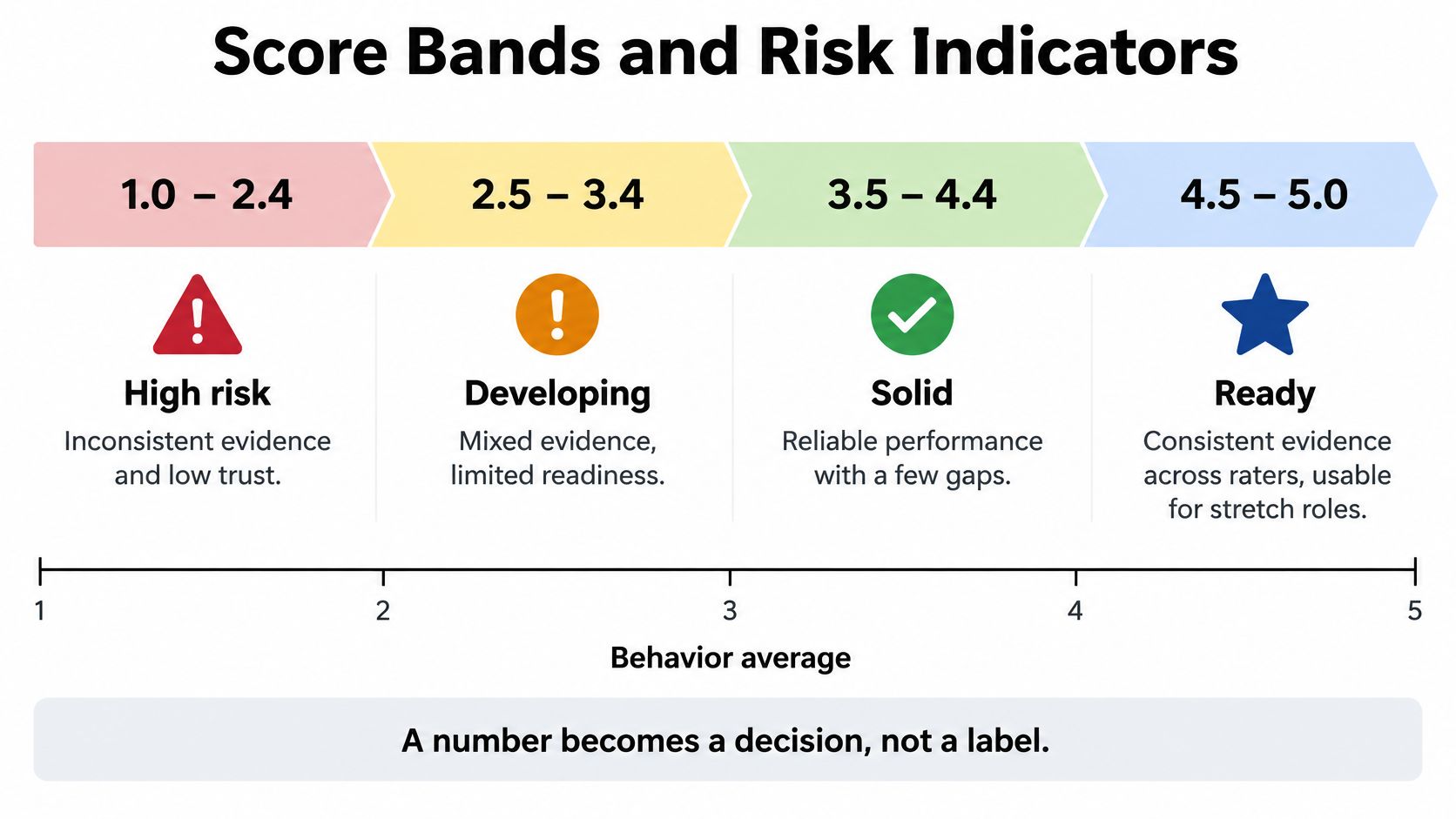
| Mean score | Reading | Decision | Development move | |---|---|---|---| | 4.5-5.0 | Ready | Consider a stretch role when evidence is consistent | Practise in a more demanding context | | 3.5-4.4 | Solid with one clear gap | Conditional yes | 90-day plan on the weakest dimension | | 2.5-3.4 | Mixed | Don't use as a sole gate; recalibrate | Identify behavior gap versus rater split | | 1.5-2.4 | Concern | Pause promotion and investigate | Target the dominant derailer | | 1.0-1.4 | Serious concern | Withhold readiness judgment pending review | Verify evidence and address harmful behavior |
These are illustrative policy bands, not validated cutoffs. They show how an organization could translate a behavior average into an action; local validation must establish whether the boundaries support fair decisions.
Use a behavior scale from 1 to 5, with written anchors for weak, adequate, and strong performance. For this example, round the reported mean to one decimal place before applying the table, and never average appearance flags into it.
Read the risk layer beside the mean
Averages can conceal important differences. Consider a leader whose manager sees calm confidence while colleagues experience an unwillingness to hear bad news.
Use these proposed review flags alongside the bands:
A channel difference alone doesn't prove bias. Review comparable tasks, technology conditions, and the assessor's explanation before reaching that conclusion.
Withhold unsupported decisions
Don't make a hire or promotion call from this score when evidence notes are missing, only the manager rated, or the assessment hasn't demonstrated added value beyond the existing leadership measure. Obtain the missing evidence or exclude the presence score from the decision.
> Decision safeguard: A precise-looking average doesn't repair weak evidence.
A useful [leadership assessment report](https://synopsix.ai/blog/leadership-assessment-report) should connect the readiness judgment to evidence and its limitations. Development plans should then name a dominant deficit, such as failing to frame a decision, rather than assign a generic goal to build presence.
Payoff Cases and Pitfalls to Avoid
Consider a hypothetical succession case. A regional general manager rates their communication at 4.6, while peers and direct reports average 3.1; colleagues understand the strategy but don't feel their objections receive a response.
The stalled rollout isn't explained by the overall average. The useful finding is the mismatch between the GM's intended clarity and colleagues' experience of being dismissed.
A review can make that contrast visible.

In this illustrative case, the GM practises summarizing objections before responding and ends strategy discussions with a clear decision frame. The organization reviews that behavior before promotion, rather than promoting first and prescribing vague confidence coaching.
Now consider hypothetical hybrid hiring. Finalists are equally strong technically, but a simulation and written stakeholder note reveal that a remote candidate can secure agreement without relying on physical visibility. The panel has a job-relevant reason to select that person instead of choosing the candidate who felt more familiar in the office.
Expect action, not a report
In 2024, 78% of executives surveyed said leadership assessments mostly or entirely resulted in development opportunities aligned with their assessment results, according to [Heidrick & Struggles](https://www.heidrick.com/en/insights/leadership-assessment/how-data-can-improve-every-aspect-of-executive-leadership-development-and-succession-planning). That finding concerns leadership assessments broadly, not executive-presence tools specifically.
The practical expectation is clear: assessment should change what someone does. A PDF without a development owner or decision consequence isn't enough.
Use the video as a discussion prompt, not as validation evidence.
<iframe width="100%" style="aspect-ratio: 16 / 9;" src="https://www.youtube.com/embed/WsZAx20Ui_A" frameborder="0" allow="autoplay; encrypted-media" allowfullscreen></iframe>
Test value without promising a return
Count mis-promotions and failed senior hires before and after rollout using consistent definitions. Estimate the cost of each failure, compare totals with assessor time and tool costs, and account for changes in role mix or hiring conditions.
Presence is what others experience when the stakes rise, not what the leader intended.
Start the Hiring and Development Workflow
Use this illustrative 30-day rollout to establish the workflow, not to claim completed predictive validation. Assign an HR owner and a people-analytics reviewer before opening the first case.
Assign the work by week
For regulated financial-advice roles, pair the behavioral workflow with [hiring compliance guidance from Advisor Momentum](https://advisormomentum.com/financial-advisor-hiring/). Behavioral assessment doesn't replace role-specific compliance review.
Evidence template for each presence rating
| Field | What to record | Example entry | |---|---|---| | Behavior | Observable action defined in advance | Expected anchor: named two fallback options within a minute in a board Q&A | | Context | Live, virtual, or asynchronous | Virtual board-style Q&A | | Rating | Score on the 1-5 behavior scale | 2 | | Evidence quote | Verbatim or close paraphrase | Close paraphrase: deferred the decision three times | | Disagreement | Yes if raters differ by 2 or more points | Yes: 2 from peer, 4 from manager | | Bias flag | Proximity, camera, accent, style, or none | Accent noted; rating based only on framing |
Synopsix is one option for teams seeking behavioral profiles and development guidance rather than building their own assessment infrastructure. Evaluate it against the same requirements: validation evidence, rater-level information, bias reporting, and a local pilot of vendor claims.
The immediate decision is whether presence stays a hallway opinion or becomes a scored, bias-checked input.
---
Synopsix offers behavioral assessments, role-focused intelligence reports, and development guidance to support hiring and talent decisions. Visit [Synopsix](https://synopsix.ai) to explore those tools and evaluate how they could support an evidence-based executive presence assessment workflow.