Executive Team Alignment: A Practical Playbook for Leaders
By Synopsix · August 18, 2026 · 14 min read
Most executive teams aren't teams. Only 31% of executives view the C-suite as their primary team, according to research discussed in [Harvard Business Review's analysis of executive teams](https://hbr.org/2025/10/is-your-executive-team-really-a-team). That gap matters because co-presence creates the appearance of alignment while functional loyalties continue to govern decisions.
Executive team alignment isn't agreement in a conference room. It's a shared operating identity, clear decision rights, coordinated strategic direction, and consistent behavior after the meeting ends. The evidence is too strong to treat alignment as a soft cultural preference. A study of 410 companies across eight industries found that highly aligned organizations grew revenue 58% faster and were 72% more profitable than less aligned peers, alongside stronger retention, customer satisfaction, leadership effectiveness, and employee engagement ([LSA Global](https://lsaglobal.com/executive-team-alignment-2/)).
The practical question isn't whether your leaders get along. It's whether they can make and support enterprise decisions as one leadership system when priorities collide, information is incomplete, and pressure rises.
Why Most Executive Teams Are Not Actually Aligned
Your executive team may meet every week and still fail the basic test of teamwork. A calendar full of leadership meetings proves only that senior people share a room. It doesn't prove they share an identity, a set of decision rules, or responsibility for the whole enterprise.
The problem appears below the surface. The CFO protects financial discipline, the chief commercial officer pushes growth, the COO prioritizes reliability, and the CHRO protects organizational capacity. Those perspectives should create productive tension. Instead, many C-suites let each leader return to their function with a private interpretation of what the company decided.
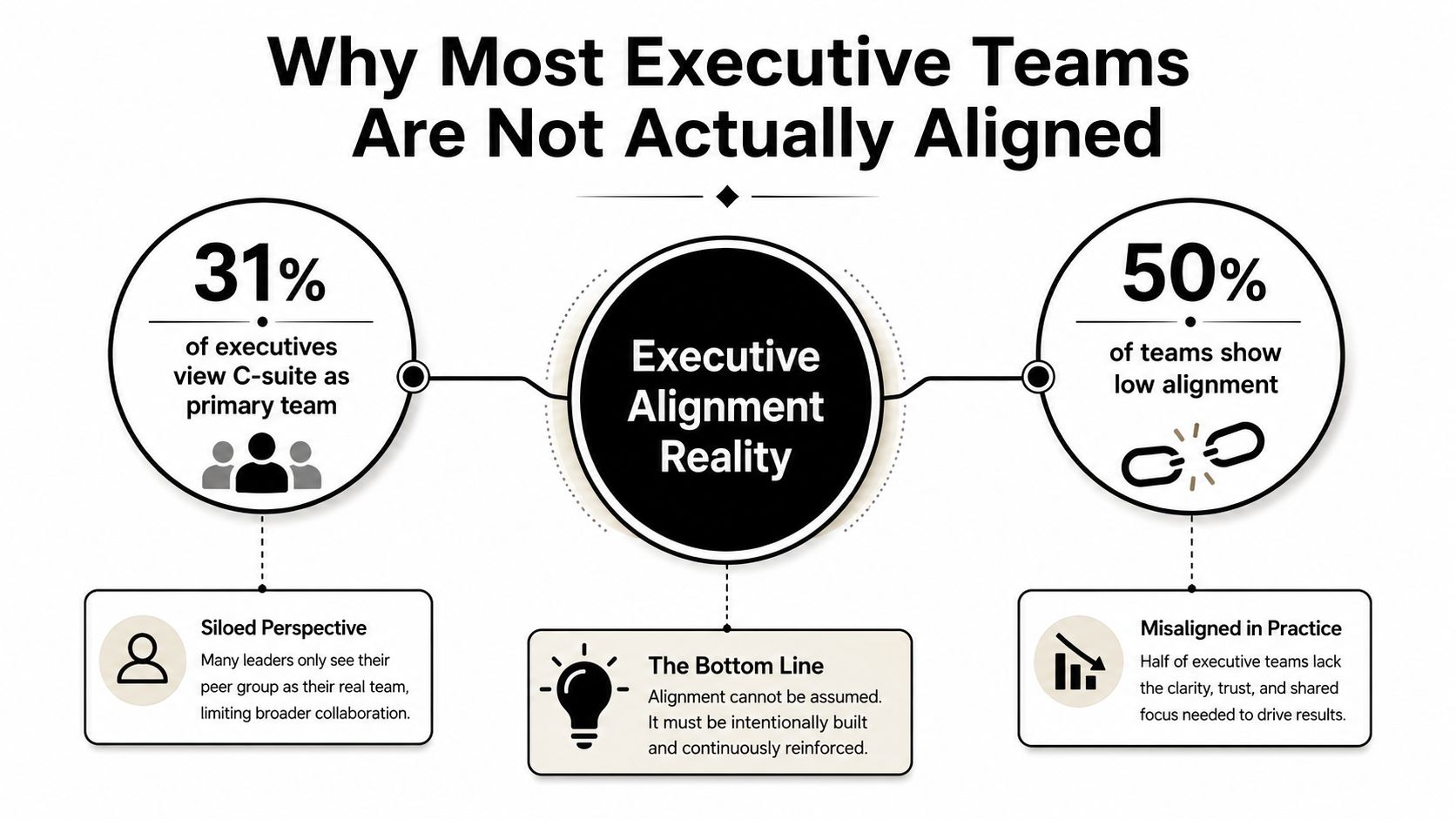
A large-scale study of more than 3,000 teams and nearly 130,000 employees found that about half of teams showed low internal alignment, while another partly overlapping half showed low alignment with management ([International Journal of Business and Management Research](https://ijbmer.org/uploads2023/BMER_6_455.pdf)). The finding exposes a common trap: leaders can feel coordinated because they understand their own priorities while their teams remain disconnected from the organization's direction.
Alignment has three tests
Use this working definition:
Alignment doesn't require unanimous enthusiasm. A strong team can disagree sharply, then commit to a decision and explain it consistently. Passive agreement is weaker than visible commitment.
> Practical rule: If leaders leave a meeting with different answers to “What did we decide, why did we decide it, and what happens next?”, the team isn't aligned.
CHROs and CEOs should diagnose this operating problem before commissioning another culture initiative. A useful companion is the [organizational alignment perspective from Synopsix](https://synopsix.ai/blog/organizational-alignment), which helps frame alignment as a connection between people, roles, and strategy. For coaches supporting this work, a [platform built for executive coaches](https://www.coachful.co/for-executive-coaches) can also provide structure around reflection and team development.
The Diagnostic Sequence for Alignment
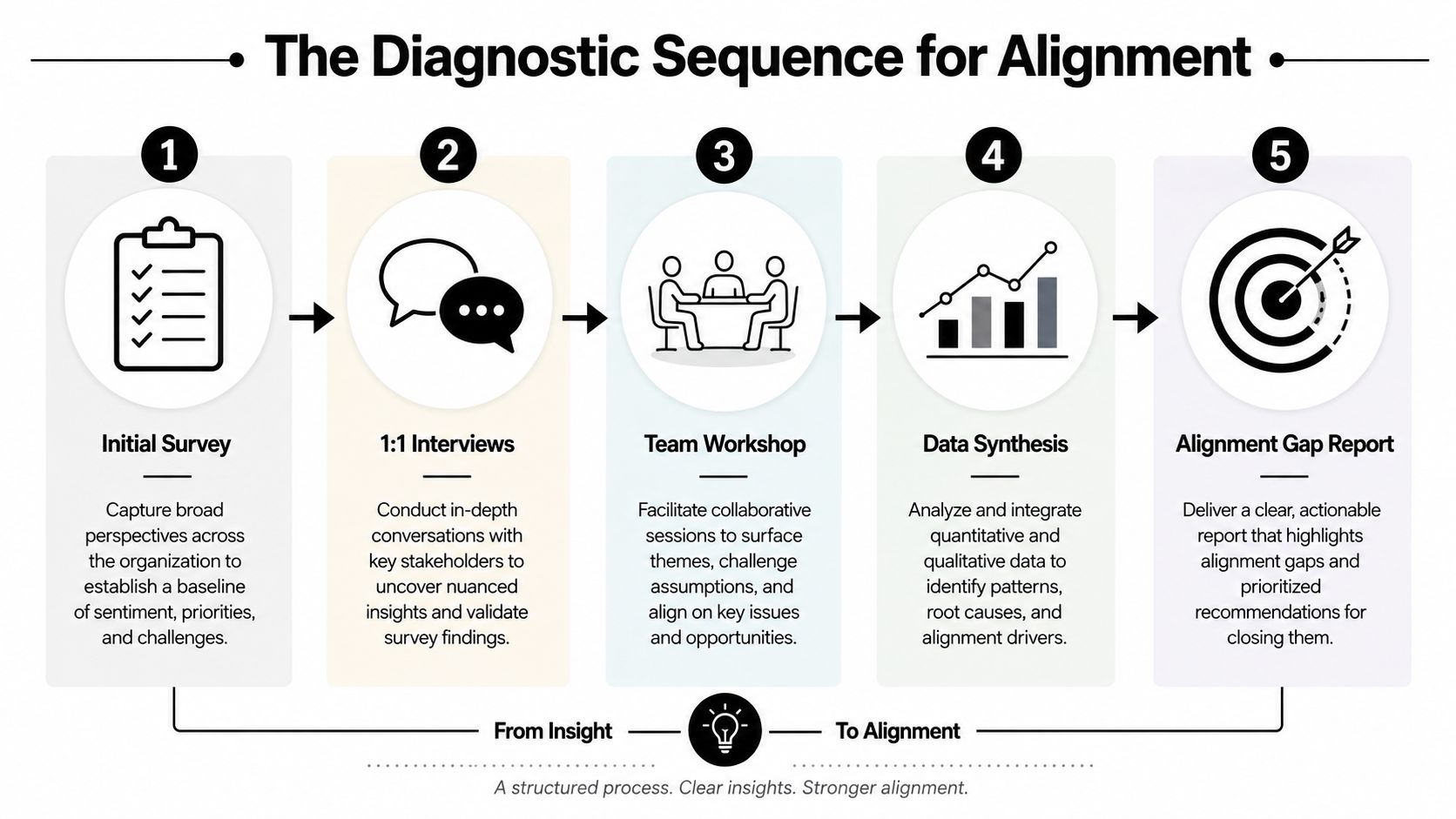
Don't begin with a personality workshop. Don't ask executives whether they feel aligned and accept the answer. Begin with observable behavior, then examine the patterns behind it, and only afterward map authority.
That order matters. Behavioral evidence shows what the team does. A psychometric baseline helps explain why those behaviors repeat. A decision-rights audit reveals where the organization concentrates power, which often differs from the formal organization chart.
Start with behavior
Observe several real leadership meetings, not a specially staged workshop. Record who introduces issues, who interrupts, who asks for evidence, who defers, who closes decisions, and what happens when a functional priority conflicts with an enterprise priority.
Then interview each executive individually. Ask where the team is aligned, where it performs alignment, and which decisions routinely reopen after closure. The discrepancies between interview answers are often more valuable than the answers themselves.
Add a psychometric baseline
Use validated behavioral and decision-style instruments to identify recurring tendencies. You're not looking for “good” or “bad” profiles. You're looking for combinations that create predictable friction, such as a high need for speed colliding with a high need for certainty.
Research on decision-style composition found that the distribution of decision styles within a team affects performance through the strategy the team uses (Journal of Management). That's why individual reports aren't enough. The team needs to understand how its patterns interact during actual decisions.
A structured [conflict risk assessment](https://synopsix.ai/blog/conflict-risk-assessment) can support this layer, provided the output becomes a conversation about operating choices rather than a label attached to an executive.
Map authority last
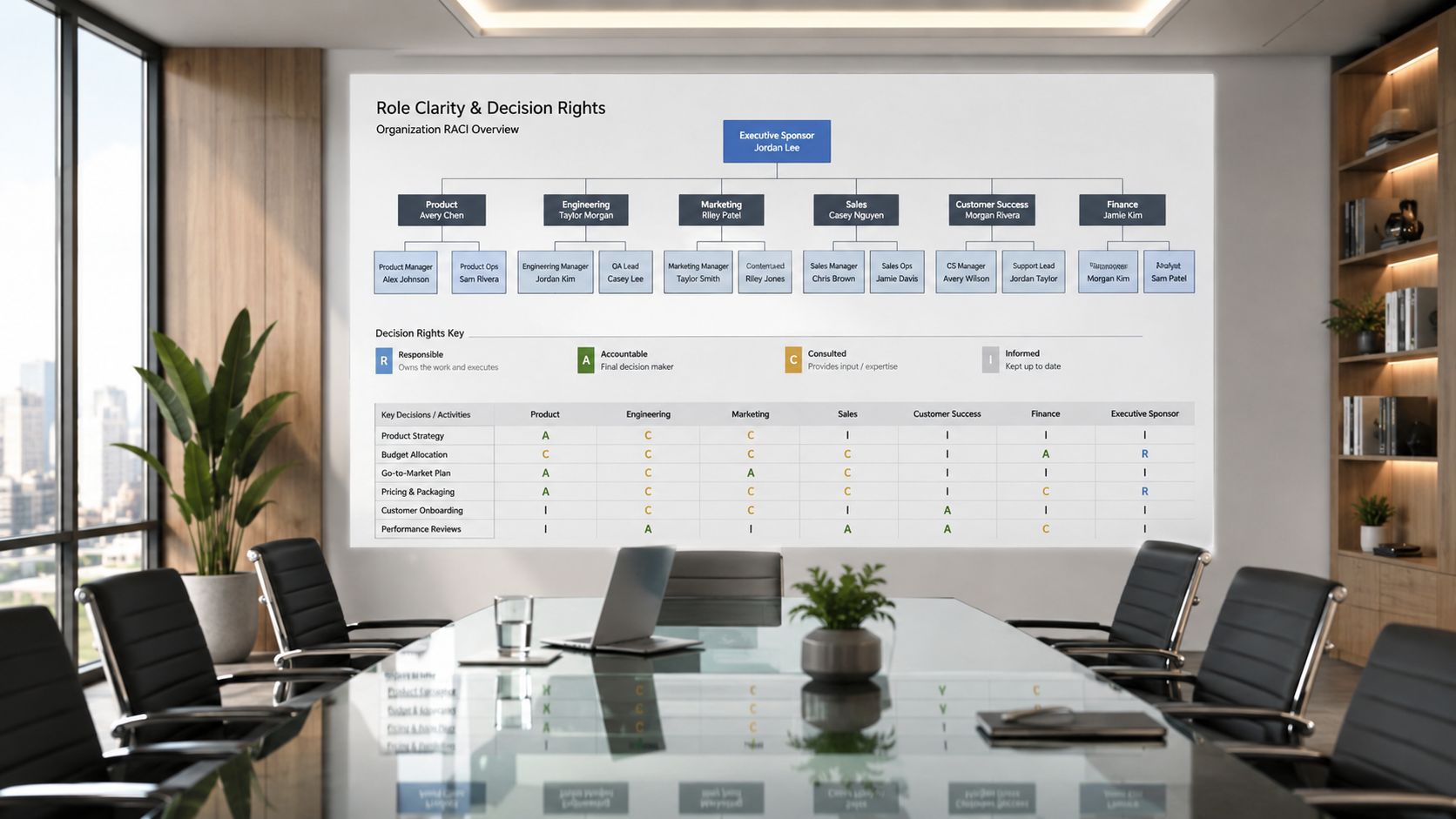
Create a decision-rights inventory covering the calls that matter most. For each decision, document who owns the recommendation, who has final authority, who must be consulted, who executes, and what escalation looks like.
The CHRO can turn these inputs into a one-page scorecard with three ratings: observed behavior, shared interpretation, and decision clarity. Run the sequence over two weeks. The point isn't statistical precision. It's a defensible picture of where the team's words and operating reality diverge.
Designing Role Clarity, Decision Rights, and Meeting Rhythms
Role clarity, decision rights, and meeting cadence form one operating system. Change one without changing the others and the team will compensate through escalation, side conversations, or executive overreach.
Start with a lightweight executive RACI. Keep the familiar categories, but use them sparingly. Assign one accountable executive for each material decision, identify the person responsible for execution, name only the essential contributors, and state who must be informed. If every leader is accountable, nobody is.
Build the meeting architecture around decisions
Separate meetings by the type of work they perform:
Don't let a weekly operating meeting become a dumping ground for strategic ambiguity. Put each issue in the forum where the team has the right information and authority to resolve it.
For every agenda item, specify whether the team will decide, escalate, or defer. Decide when the owner has enough information and the authority is clear. Escalate when the decision exceeds the owner's mandate or creates an enterprise-level trade-off. Defer only when a named person can close a defined information gap by a defined review point.
Make the rhythm reinforce the roles
A decision owner should present the issue, state the recommendation, name the trade-offs, and request a clear call. Other executives should challenge assumptions, not lobby after the meeting. The chair should close with the decision, owner, date, and communication requirement.
Use [this responsibility framework from Synopsix](https://synopsix.ai/blog/whose-responsibility-is-it) as a prompt for clarifying ownership, but adapt it to your governance model. The framework matters less than the discipline of publishing decisions and holding leaders to them.
Most offsites fail because they produce an attractive future-state narrative while leaving the weekly operating system untouched. Redesign the agenda, decision log, escalation rules, and accountability review before declaring the alignment work complete.
Facilitation Sequence for an Executive Offsite
A mid-market leadership team inherited a transformation mandate after several functions had already made competing commitments. The CEO wanted a vision session. The chief of staff insisted that the team first establish whether it could operate as a team at all.
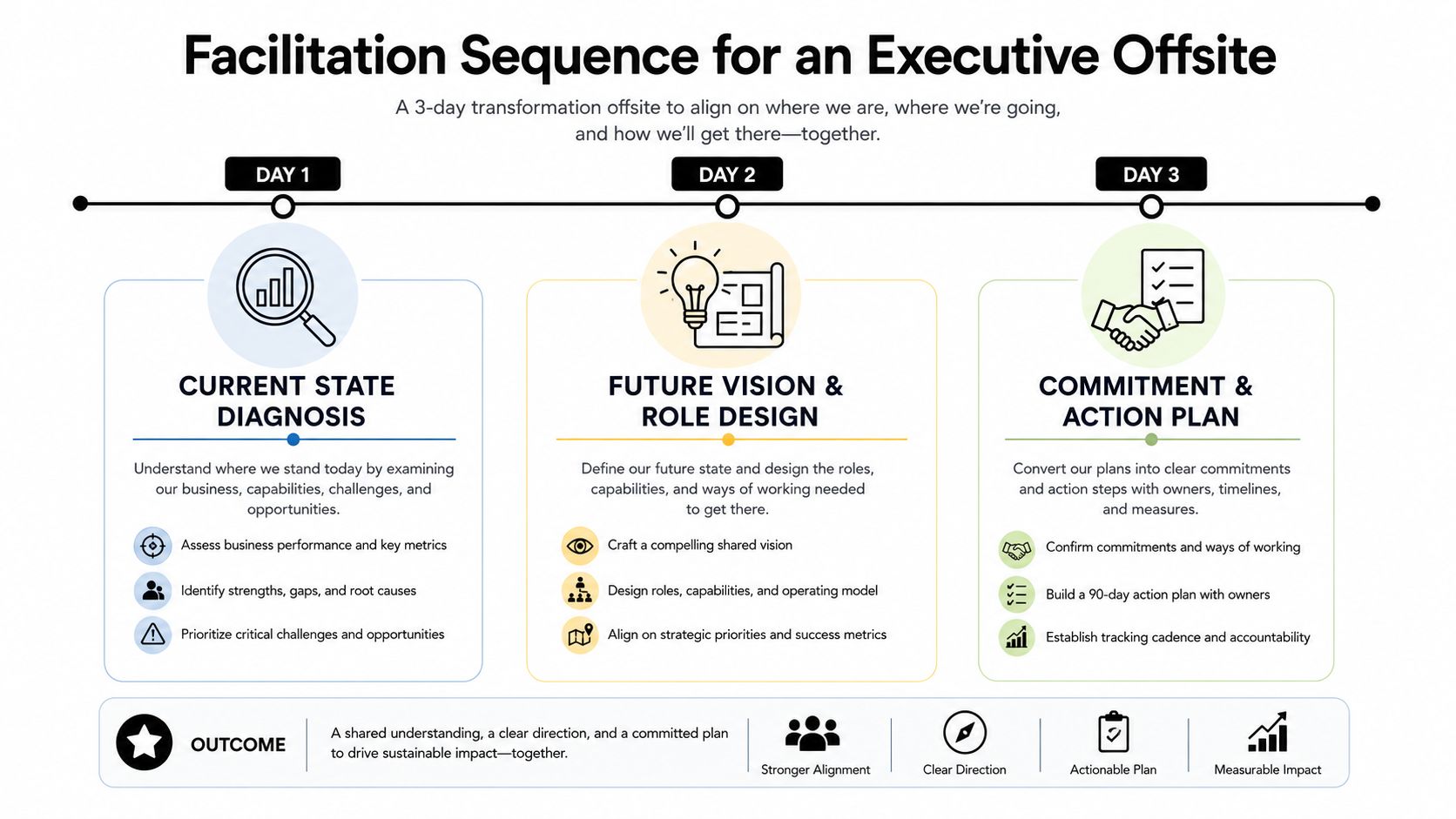
That choice changed the offsite. The facilitation sequence moved through three arcs: current state, shared direction, and operating commitment.
Day one should surface reality
The facilitator opened with individual answers to three questions: What must change? What is preventing it? What are we pretending is already aligned? Leaders placed their answers on a shared map, then grouped them into strategic, relational, and operating tensions.
The team reviewed meeting observations and interview themes before discussing solutions. That sequence prevented the most senior voice from defining the problem too early. The day ended with a short list of alignment gaps, including unclear ownership and incompatible assumptions about transformation priorities.
Day two should create direction and role design
The group translated the mandate into a small set of enterprise outcomes, then tested each outcome against functional incentives. Leaders had to state what their function would stop doing, what it would protect, and what support it needed from peers.
The facilitator then converted those choices into a draft decision-rights map and a leadership-team charter. Many offsites become vague at this stage. A charter should specify how the team will disagree, close decisions, communicate externally, and hold one another accountable.
A practical [guide to impactful offsites](https://madeiraremote.com/blog/team-offsite-ideas) can help with setting design and participation, but logistics won't repair a team that avoids the core issues. The agenda must protect time for difficult decisions.
Day three should produce commitments
The final day focused on operating changes. The team approved its meeting architecture, assigned owners to priority decisions, created a decision log, and scheduled follow-up reviews. Each executive made a public commitment tied to a behavior, not a sentiment. “I'll communicate better” is weak. “I'll stop reopening decisions in functional meetings unless new evidence meets the escalation rule” is actionable.
The CEO left with a unified message for the organization. The chief of staff left with artifacts that could survive the event. That's the standard. An offsite succeeds when the team's next ordinary week looks different.
Productive Dissent Versus Destructive Misalignment
Alignment without dissent produces polished mistakes. The objective isn't to eliminate disagreement. It's to distinguish disagreement that improves a decision from disagreement that prevents the organization from acting.
A worldwide board survey illustrates why this distinction matters. Twenty-one percent of C-suite members said talent management received too little attention, compared with 12% of boards, while 20% of executives said ESG received too little time, compared with 12% of boards ([Board Agenda](https://boardagenda.com/2024/03/21/c-suite-and-non-executive-directors-views-not-aligned/)). Those gaps don't automatically indicate dysfunction. They may reflect legitimate differences in perspective, accountability, or information.
Use the decision-quality test
Ask one question when disagreement appears: Does this challenge improve the decision, or does it create execution drag?
Productive dissent usually has a clear object. It tests assumptions, exposes second-order effects, identifies missing stakeholders, or proposes a stronger alternative. The executive making the challenge remains accountable to the enterprise outcome.
Destructive misalignment is less disciplined. It appears as repeated reopening, private lobbying, selective communication, or passive resistance after commitment. Leaders may claim agreement in the room while directing their functions differently afterward.
> The team doesn't need identical opinions. It needs a reliable way to convert disagreement into a decision.
Install dissent protocols
Give dissent a defined place in the process. Before a major decision closes, invite each executive to name the strongest argument against the recommendation and the evidence that would change their view. Then record the decision, the rationale, and the conditions that would justify revisiting it.
Separate challenge from commitment. During challenge, leaders should be candid and specific. After commitment, they should support the decision publicly and use the agreed escalation route if new information emerges.
When dissent repeatedly concerns the same role, priority, or authority boundary, stop treating it as a communication issue. It signals that the operating identity or decision architecture needs repair.
KPIs and a 90-Day Change Plan
Alignment becomes durable when the CEO and board can observe it in operating behavior. Don't reduce it to a single survey score. Track the signals that reveal whether leaders decide clearly, communicate consistently, and follow through across functions.
| KPI | What it measures | Cadence | Target signal | |---|---|---|---| | Decision velocity | Time from issue framing to a clear decision | Weekly | Material decisions close without avoidable delay | | Escalation frequency | Whether authority boundaries are working | Monthly | Escalations are purposeful, not routine | | Outcome clarity | Whether meetings produce owners and next actions | Weekly | Decisions leave with one owner and a recorded next step | | Cross-functional follow-through | Whether commitments survive functional handoffs | Monthly | Dependent teams act on shared commitments | | Psychological safety | Whether leaders can challenge assumptions | Monthly pulse | Executives raise risks before decisions harden | | Team cohesion | Whether leaders operate as one enterprise team | Quarterly review | Leaders describe shared priorities and responsibilities consistently |
These are management signals, not vanity metrics. Pair them with meeting observation and decision-log review so leaders can't improve the score while avoiding the underlying behavior.
Run the first 90 days in four moves
Weeks one and two, diagnose. Observe meetings, interview executives, establish the behavioral and psychometric baseline, and map contested decisions. Produce the one-page alignment scorecard.
Weeks three and four, design. Agree on the executive-team identity, clarify decision rights, rewrite the meeting architecture, and define escalation rules. Publish the draft operating model before the offsite.
Weeks five and six, facilitate. Use the offsite to resolve strategic tensions, approve role boundaries, and convert commitments into named actions. Don't end the event without a decision log and communication plan.
Weeks seven through twelve, reinforce. Review decisions, commitments, and recurring friction in the new meeting rhythm. The CEO should address violations quickly, while the chief of staff maintains the evidence base and updates the scorecard.
Common Pitfalls and How to Remediate Them
Executive teams usually don't fail because they lack intelligence. They fail because familiar habits protect functional comfort at the expense of enterprise performance.
Co-presence mistaken for collaboration
Diagnostic question: Do leaders make trade-offs together, or do they report from their functions?
Symptom: Meetings contain updates, but few enterprise decisions. Executives leave with separate priorities.
Remediation: Replace status reporting with decision briefs. Require each item to name the enterprise trade-off, decision owner, recommendation, and consequence of delay.
Offsite content optimized, operating rhythm ignored
Diagnostic question: What will change in next week's meeting?
Symptom: The team leaves with a compelling statement of intent, then returns to the same agenda, side channels, and unresolved decisions.
Remediation: Approve the new cadence and decision log before the offsite closes. Assign the chief of staff to inspect whether the team is using both.
Psychometrics treated as a verdict
Diagnostic question: Are profiles generating better conversations or defending fixed identities?
Symptom: Leaders explain behavior with labels and use assessments to excuse poor collaboration.
Remediation: Treat instruments as mirrors. Connect every pattern to a real decision, meeting behavior, or role requirement, then agree on a behavioral experiment.
One dominant voice sets direction
Diagnostic question: Can the team challenge the CEO or most powerful executive before commitment?
Symptom: Silence in the room, disagreement in private, and passive resistance afterward.
Remediation: Use structured dissent, written pre-reads, rotating challenge roles, and explicit invitations to opposing evidence. If the pattern persists, address power and governance directly.
Escalate to structural change when decisions repeatedly reopen, critical roles lack clear ownership, or leaders consistently act against collective commitments. Executive team alignment isn't a destination reached at an offsite. It's a system maintained through identity, decision rights, meeting discipline, and visible accountability.
---
Synopsix helps CHROs, CEOs, and executive coaches turn validated behavioral assessments into practical guidance for team design, leadership decisions, and development planning. Visit [Synopsix](https://synopsix.ai) to see how its people intelligence platform can help you diagnose alignment risks and connect the right people to the right roles.