High Potential Identification: A 2026 Predictive Framework
By Synopsix · June 26, 2026 · 19 min read
I have seen high-growth companies make the same expensive mistake over and over. They treat the strongest performer in the room as the safest bet for a bigger leadership role, then act surprised when that person struggles once the job requires judgment across functions, influence without authority, and calm decision-making under ambiguity.
That failure usually starts in the talent review itself. Managers reward results, visibility, and trust built in the current role, then label that mix "high potential." It is a weak prediction method. Past performance shows someone can win in the current context. High potential identification should test whether they can grow into a materially different context.
One of the clearest shifts we made was separating performance data from predictive behavioral data. We still cared about delivery. We stopped pretending delivery alone could answer succession questions. Platforms like Synopsix help make that distinction practical by combining evidence of aspiration, learning agility, and engagement with a sharper view of what future roles demand.
That only works if the organization has defined leadership well. A clear [leadership competency model](https://synopsix.ai/blog/leadership-competency-model) gives talent teams a consistent target, so HiPo decisions reflect future role fit instead of manager intuition.
The payoff is simple. Fewer failed promotions, stronger succession coverage, and a HiPo process leaders can defend with evidence instead of opinion.
Why Your Top Performers Might Not Be Your Future Leaders
Promotion failure is rarely a motivation problem. It is usually an assessment problem. Companies keep using current results as a proxy for future leadership capacity, then wonder why a star individual contributor or functional leader stalls in a broader role.
I have seen this pattern repeatedly in high-growth environments. The person was excellent at driving output, knew the business cold, and had strong credibility with their manager. None of that guaranteed they could lead across functions, make decisions with incomplete information, or scale judgment through other leaders.
That is the core mistake in high potential identification. Performance proves someone can win in the job they have. Potential asks whether they can grow into a job with different demands, trade-offs, and pressure.
Performance answers one question. Potential answers another.
Strong performance data still matters. It should influence pay, recognition, and trust. It should not carry the full weight of succession decisions.
The employees who outperform in a current role often do so because the role fits their strengths tightly. A top seller may rely on personal drive and deal control. A strong engineering manager may win through technical depth and rapid problem-solving. A reliable operator may keep execution steady through discipline and consistency. Those strengths are valuable, but they do not automatically predict enterprise leadership.
Future leadership requires a different signal set. Look for evidence of learning speed, range, judgment, self-awareness, and appetite for broader accountability. Those are predictive indicators. Past results alone are historical indicators.
This distinction becomes much easier to apply when the company has a clear definition of leadership. A [leadership competency model tied to future role requirements](https://synopsix.ai/blog/leadership-competency-model) gives talent reviews a standard that is bigger than manager preference.
> Practical rule: Reward performance in role. Assess potential against future role demands.
The business cost shows up fast
Mislabeling high performers as high potential creates expensive downstream errors, especially once the company starts scaling.
Three problems show up consistently:
Those mistakes hit hard. Promotion resets slow teams down. Regrettable attrition rises when strong talent sees nominations driven by visibility instead of evidence. Development spend gets spread across the wrong population.
What a better system does differently
The strongest HiPo programs separate two decisions that organizations often blend together. First, who is delivering today? Second, who is likely to handle materially bigger leadership scope tomorrow?
That separation is where predictive behavioral data matters. Tools like Synopsix help teams assess signals that performance ratings miss, including aspiration for broader responsibility, ability to adapt across new contexts, and engagement that is strong enough to sustain growth through harder roles. That does not replace manager judgment. It disciplines it.
The result is a cleaner process and better outcomes. Fewer promotions based on reputation. Better succession depth. More confidence that a nomination reflects future fit, not just past success.
The Aspiration Ability Engagement Blueprint
A workable HiPo model needs to be simple enough for leaders to use and rigorous enough to survive calibration. The cleanest framework I've found is Aspiration, Ability, and Engagement.
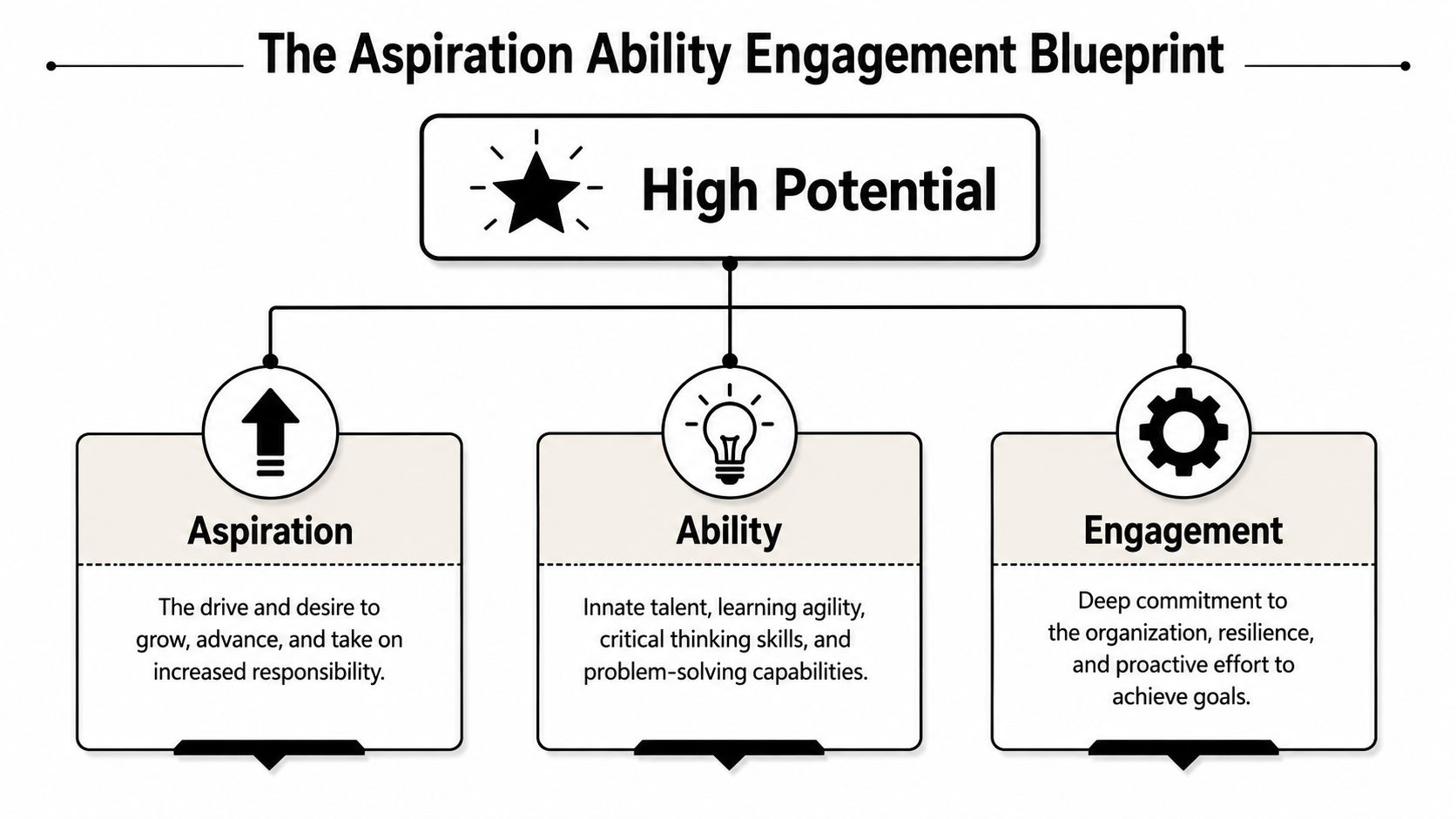
A [UC handout on identifying high-potential employees](https://www.ucop.edu/human-resources/management-development-program/2014/Donna%20Handout.pdf) states that a statistically sound methodology relies on assessing those three components simultaneously, and that without this structured triad, HiPo programs face a documented 50% failure rate.
Aspiration means more than ambition
Aspiration is the desire to take on broader responsibility. Not performative ambition. Not title collecting. Real willingness to own bigger problems, make harder calls, and absorb more accountability.
Look for people who actively seek stretch work, ask for broader context, and show energy when the role gets more complex. Be careful with employees who want advancement mainly for status or compensation. They may still be strong performers, but aspiration for leadership is different from preference for recognition.
Ability is future-facing capacity
Ability is where many organizations under-assess. This is the capacity to deal with complexity you haven't seen before. It includes learning agility, judgment, problem-solving, and the ability to adapt behavior when the environment changes.
Future roles don't just require more of the current job. They often require a different mode of operating. That's why ability has to be evaluated against a future state, not inferred from historical output alone.
Here's a useful framing. If someone is excellent when the playbook is known, but struggles when the problem is undefined, they may be high performing without being high potential for broader leadership.
A short explainer is worth watching if your team needs alignment on the concept before talent reviews begin.
<iframe width="100%" style="aspect-ratio: 16 / 9;" src="https://www.youtube.com/embed/pC5bYIpABt8" frameborder="0" allow="autoplay; encrypted-media" allowfullscreen></iframe>
Engagement keeps potential investable
Engagement is often treated as a soft factor. It isn't. A person can have aspiration and ability, but if they aren't meaningfully committed to the organization, the pipeline risk is obvious.
Engagement shows up in resilience, follow-through, and willingness to invest discretionary effort in the company's mission. It also shapes whether development investment is likely to pay back inside your business rather than somewhere else.
> High potential only becomes strategic when the person wants to grow with the organization, not just through it.
Define the time horizon before you assess
Potential without a time horizon is too vague to be useful. The [HiPo identification framework from Umbrex](https://umbrex.com/resources/frameworks/organization-frameworks/high-potential-hipo-identification-frameworks/) defines high potential around capacity and motivation for larger roles over 12 to 36 months, with 12 to 18 months for first-line leadership roles and 24 to 36 months for enterprise-level roles.
That's a practical discipline. It forces leaders to answer a concrete question. Potential for what role, and by when?
Use the blueprint this way:
Many talent reviews see immediate improvement. Once leaders stop using “high potential” as a compliment and start using it as a forecast, the conversation gets sharper.
How to Measure What Truly Matters
Most talent systems overweight lagging indicators. Ratings, promotions, tenure, and manager sentiment all matter, but they tell you what has already happened. High potential identification needs leading indicators.
That means looking at patterns of behavior that predict how someone is likely to operate when scope expands, pressure rises, and the job becomes less defined. In this context, scientifically validated assessments, structured simulations, and calibrated observations outperform informal judgment.
Stop asking reviews to do assessment work
Performance reviews are useful for compensation, feedback, and role accountability. They are weak tools for predicting future leadership capacity because they are anchored in the current job.
A modern assessment strategy separates those use cases. Reviews explain contribution. Predictive assessment estimates future fit.
That distinction becomes easier once leaders understand the basics of [people analytics in talent decisions](https://synopsix.ai/blog/what-is-people-analytics). The goal isn't to replace manager judgment. It's to stop treating judgment as a complete dataset.
The criteria worth measuring
The [Talogy criteria for high-potential talent](https://talogy.com/en/blog/6-criteria-to-identify-high-potential-talent-in-your-organization/) offers a practical lens. These six criteria are useful because leaders can observe them, discuss them, and assess them with more structure than vague labels like “executive presence.”
| Criterion | Definition | Observable Behaviors | |---|---|---| | Learning agility | Seeking challenges for self-enhancement | Takes on unfamiliar assignments, learns quickly from setbacks, applies lessons across contexts | | Adaptability | Adjusting behavior to fit situations | Changes approach across teams, responds well to ambiguity, shifts style when conditions change | | Pressure management | Maintaining productivity under stress | Stays composed in deadlines or conflict, prioritizes effectively, makes clear decisions under strain | | Results-driven focus | Pushing self and others to meet goals | Sets demanding standards, follows through, creates momentum without constant oversight | | Strategic thinking | Prioritizing long-term vision | Connects team work to broader business outcomes, anticipates second-order effects, thinks beyond immediate tasks | | Interpersonal connection | Earning trust and fostering collaboration | Builds credibility across functions, listens well, influences without formal authority |
Use multiple methods for one decision
No single instrument should determine HiPo status. Good systems combine methods that answer different questions.
The quality of the process depends less on having more data than on having data that serves a clear purpose. If a tool can't be mapped to role requirements, it shouldn't sit inside your HiPo process.
> The best assessment systems don't produce more information. They produce better decisions.
What predictive data adds
Predictive behavioral data is especially valuable when two employees have similar performance records. One may deliver through discipline and expertise in a stable environment. Another may show stronger range, faster learning, and better adaptation when conditions shift.
Traditional reviews often collapse those people into the same bucket. Predictive assessment doesn't.
That's why organizations using more advanced approaches often redesign calibration conversations around evidence categories instead of personality impressions. They ask: What suggests this person can scale? What suggests risk under greater complexity? What behavior would we expect to see in the target role that we haven't observed yet?
Those are better questions than “Who seems ready?”
Building a Fair and Defensible Identification Process
The hardest part of high potential identification isn't choosing criteria. It's building a process that leaders will use consistently, and that employees can trust.
Most systems become distorted at nomination time. A manager sees confidence and calls it leadership. Another sees similarity to their own style and calls it potential. Someone with quiet but scalable strengths gets missed because they don't fit the favored archetype.
The Talent Strategy Group reports that, on average, organizations identify 15% of their leaders as high potential and 21% as high performing, creating overlap but not equivalence. The same report notes that effective HiPo identification requires objective tools and structured calibration to reduce bias such as affinity bias in the process. That benchmark appears in the [2024 High Performer and High Potential Development Report](https://talentstrategygroup.com/2024-high-performer-and-high-potential-development-report/).
Where bias usually enters
Bias doesn't only show up as unfair intent. It usually enters through weak process design.
Common examples include:
These errors are predictable. That's useful because predictable errors can be designed around.
A defensible operating model
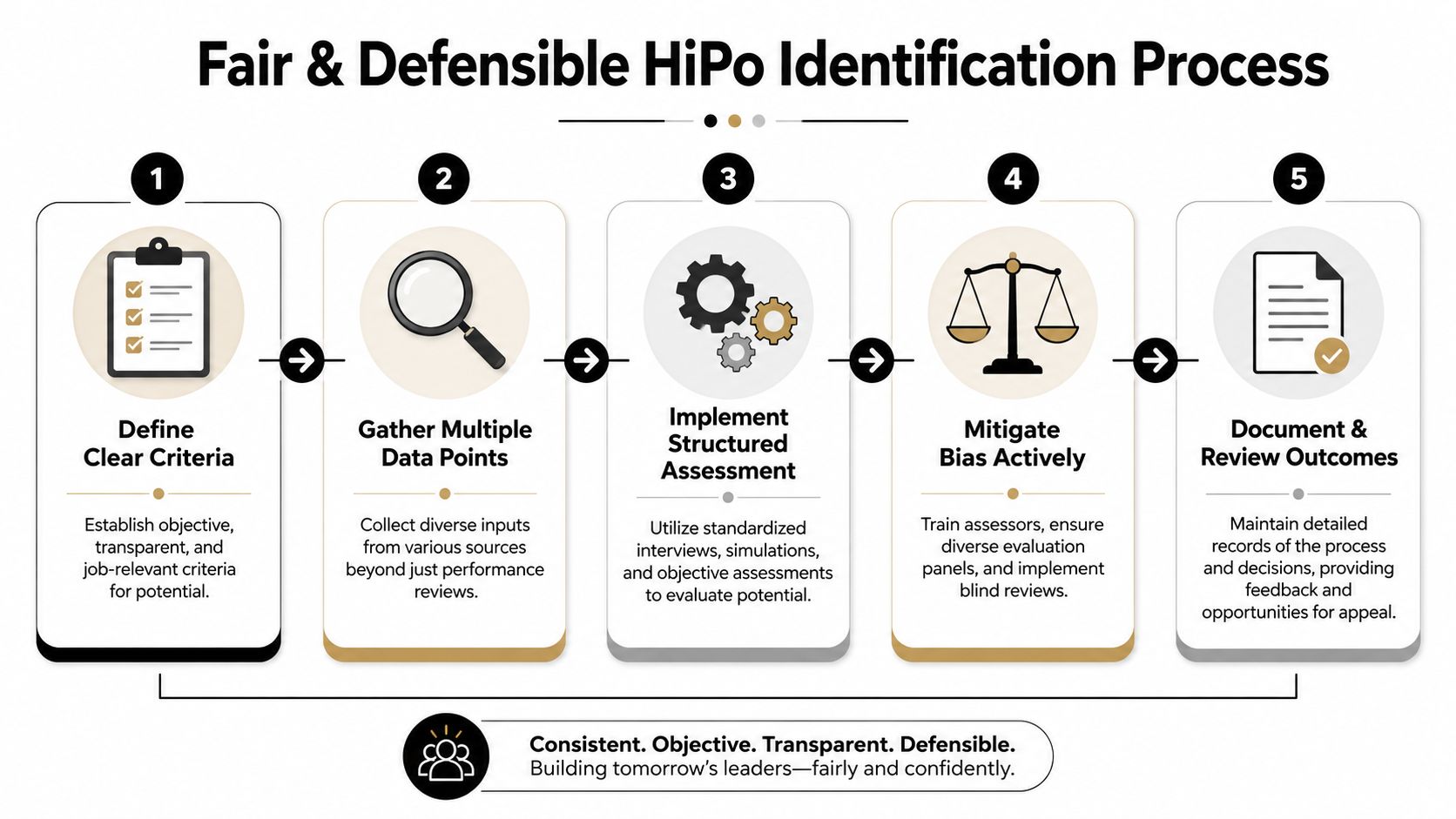
I prefer a five-step process because it gives enough structure without making the cycle unworkably heavy.
1. Define future-relevant criteria Tie potential to actual target roles and explicit behavioral requirements. “Leadership upside” is too vague to defend.
2. Collect distinct data sources Keep performance, behavioral assessment, career aspiration, and multi-rater feedback as separate inputs. Blending them too early hides signal.
3. Run structured talent calibration Bring leaders together with a common decision rubric. Force comparison against criteria, not against charisma or reputation.
4. Challenge assumptions in the room Ask where evidence is missing, where manager confidence exceeds the data, and whether the same standard is being applied across groups.
5. Document rationale and next actions A HiPo label without a written rationale creates inconsistency later. Record why the designation was made and what development action follows.
Calibration is where fairness becomes real
A talent review only becomes credible when leaders must defend their nominations in front of peers using shared evidence.
That changes the conversation. “She's a star” becomes “Her aspiration is clear, peers consistently trust her under pressure, and her simulation results suggest strong adaptation in ambiguous environments.” That's a different standard.
Use calibration meetings to do three things at once:
> If a nomination can't survive a structured calibration discussion, it probably shouldn't survive the process.
One more point matters here. Fairness isn't just a compliance issue. It improves forecast accuracy. The more your system reduces personal preference, the more likely it is to surface unconventional but scalable talent.
Spotting Future Leaders Before They Have a Track Record
The biggest blind spot in many HiPo programs is early-career talent. Organizations say they want future leaders, then build processes that require a long history of visible achievement before anyone can be considered.
That excludes exactly the people who may have the strongest long-term upside.

According to [Talogy's perspective on low-experience, high-potential talent](https://talogy.com/en/blog/high-potential-low-experience-how-to-identify-tomorrows-top-talent/), 85% of organizations mistakenly rely on tenure and past achievements, and 60% of new leadership hires fail due to a mismatch between their experience and the evolving nature of future roles. That's why ability and aspiration matter so much when history is thin.
Assess the how, not just the what
When someone lacks a long internal track record, you need better proxies. Focus less on resume density and more on how the person thinks, learns, and responds.
Useful signals include:
Well-designed assessment and simulation work earns its place. A candidate or early-career employee may not have led a large team yet, but you can still evaluate the traits that support future leadership.
For teams building location-flexible pipelines, skills-based hiring frameworks are also relevant here. This [guide for employers hiring in Latin America](https://www.latojobs.com/blog/what-is-skills-based-hiring) is useful because it shows how to evaluate capability without over-indexing on pedigree or conventional career signals.
Early signal doesn't mean early promotion
One of the worst mistakes is to identify emerging potential and then rush the person into a role they haven't earned. Early identification should change development, not erase readiness standards.
Use low-experience HiPo signals to shape:
If you're building your toolkit for this, a solid starting point is understanding where [personality tests for leadership](https://synopsix.ai/blog/personality-tests-for-leadership) fit well and where they need to be paired with other evidence. The test itself doesn't make the decision. The combination of evidence does.
The payoff is significant even when it isn't immediate. You widen the pipeline earlier, reduce dependence on incumbency, and stop overlooking people who haven't had the chance to build a traditional leadership resume yet.
Activating Your HiPo Pipeline and Measuring Impact
Identifying high-potential employees is only useful if it changes what the organization does next. A HiPo label with no action plan becomes prestige inventory. It creates internal politics, raises expectations, and does little for succession strength.
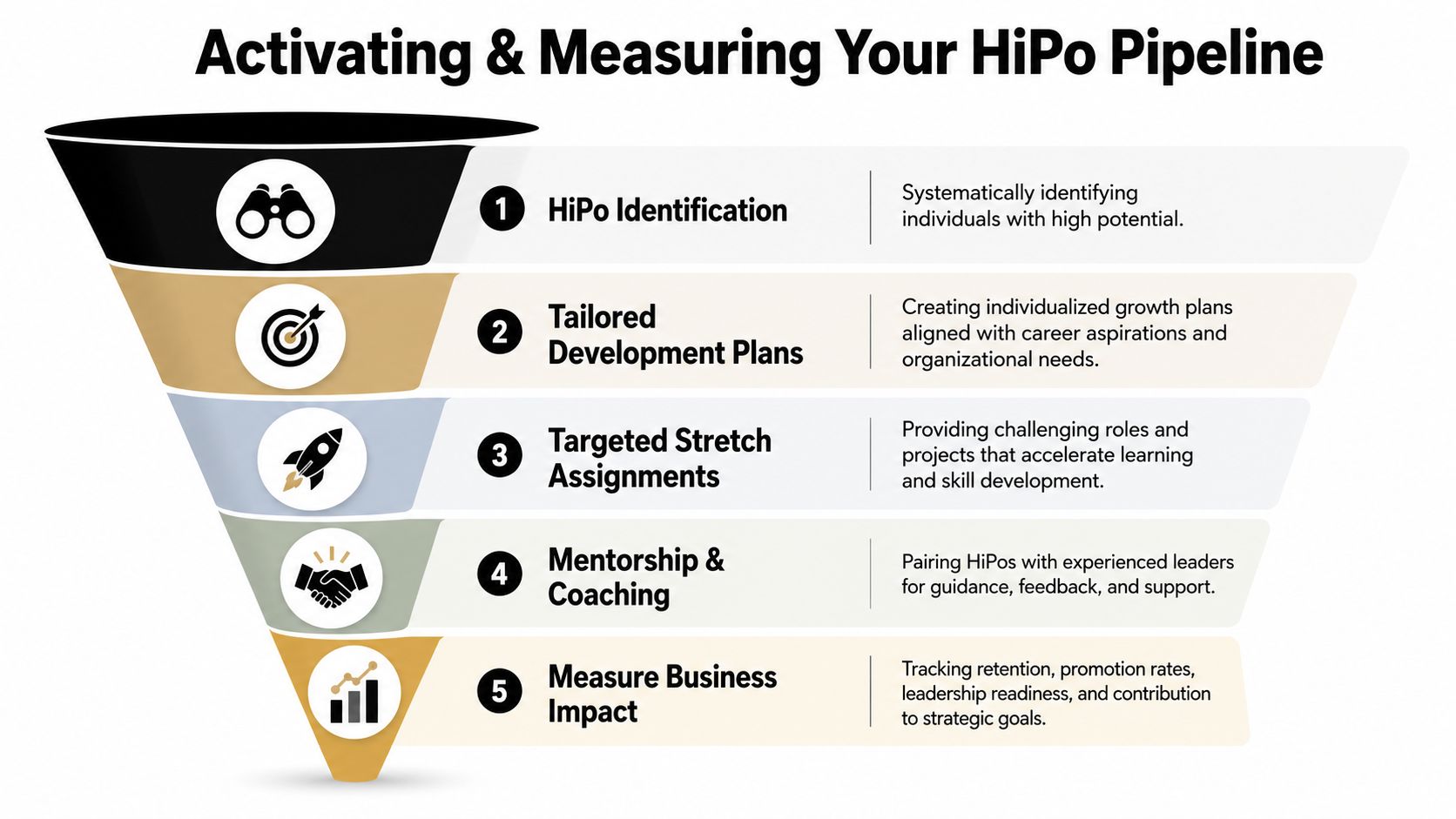
The companies that get value from high potential identification treat designation as the start of a managed development pathway.
Turn designation into action
Each identified employee should leave the process with a role-linked plan. Not generic leadership training. Not a broad “keep an eye on this person” note. A specific development strategy tied to the capability gaps between current behavior and future role demands.
A practical activation plan usually includes:
Measure movement, not just membership
Many organizations track who is in the HiPo pool. That's easy, but it doesn't tell you whether the pipeline is getting stronger.
The better approach is to track movement through the pipeline and compare outcomes over time. Focus on indicators such as readiness progression, quality of internal promotions, retention inside the HiPo cohort, and whether succession slates for critical roles become more credible.
You don't need a bloated dashboard. You need a small set of measures that answer three business questions:
| Business question | What to track qualitatively | |---|---| | Are we developing the right people? | Progress against role-specific development goals and observed behavior change | | Are HiPos becoming more ready? | Movement from emerging potential to near-ready status in talent reviews | | Is the pipeline helping the business? | Stronger succession coverage, better promotion quality, and lower disruption in key roles |
> A HiPo program proves its value when promotion decisions get cleaner and succession conversations get shorter.
What impact looks like in practice
The measurable impact usually shows up in a few operational ways. Executive teams spend less time debating subjective nominations. Managers get clearer about development priorities. Internal promotions become less risky because role-fit evidence is stronger before the move happens.
The broader effect is confidence. The organization starts to trust its pipeline because the process is repeatable, role-based, and visible. That trust matters when the business is scaling quickly and leadership gaps can slow execution.
If your current system stops at identification, you haven't built a pipeline. You've built a list.
Making Smarter People Decisions Your Competitive Advantage
Most companies still treat high potential identification as an HR program. The stronger view is that it's an operating capability.
Two-thirds of business leaders lack confidence in their succession planning outcomes due to an inability to distinguish high performance from high potential, according to [AIHR's analysis of identifying high-potential employees](https://www.aihr.com/blog/identifying-high-potential-employees/). That lack of confidence isn't abstract. It affects promotion quality, leadership continuity, and how fast the company can scale through change.
The strategic shift that matters
Organizations gain an advantage when they stop asking, “Who has earned recognition?” and start asking, “Who is most likely to succeed in a larger role within a defined horizon, and what evidence supports that forecast?”
That shift changes everything:
It also aligns well with broader hiring discipline. If your team is trying to improve decision quality beyond internal talent, this [guide for startup tech recruitment](https://linqin.ai/g/how-to-hire-tech-talent-without-budget-bleed) is a useful reminder that role clarity and evidence-based evaluation matter just as much in external hiring as they do in internal mobility.
What separates mature systems
Mature HiPo systems don't rely on executive intuition alone. They define future roles clearly, assess aspiration, ability, and engagement with rigor, use calibration to reduce bias, and develop people against real readiness gaps.
That combination provides significant influence. The organization gets better at predicting human behavior. Leaders make fewer avoidable mis-promotions. Emerging talent sees a fairer path. Succession planning stops feeling like a confidence game.
High potential identification is no longer just about naming the future. It's about building a more reliable way to choose it.
---
If you want a more practical way to turn behavioral assessment into actionable talent decisions, [Synopsix](https://synopsix.ai) helps teams assess people quickly, translate psychometric data into business language, and use that insight for hiring, team design, and leadership development. It's a strong fit for organizations that want sharper role-fit decisions and a more evidence-based HiPo pipeline.