Hiring Assessment Software for Smarter People Decisions
By Synopsix · October 24, 2026 · 15 min read
The leadership vacancy is still open. The finalists have credible résumés, the interview panel disagrees, and your revenue leader wants a decision. Someone suggests hiring assessment software to break the tie and move faster. Before approving another platform, you need to know whether it will add evidence or give the existing disagreement a numerical score.
Why Hiring Assessment Software Still Misses the Job
Consider a hypothetical hiring meeting for a sales leader. One interviewer values executive presence, another wants operational discipline, and a third worries about how the candidate handles challenge. Everyone has interviewed the same people, but they haven't evaluated the same job behaviors.
Adding an assessment at this point might help. But if the team hasn't agreed what successful performance requires, the software could become another competing opinion. A polished profile won't resolve whether the organization needs someone to rebuild sales processes, develop managers, or personally close difficult accounts.
The decision behind the delay
The immediate problem looks like speed. The underlying problem may be an undefined decision standard.
A CHRO should separate those problems before approving a purchase. Faster administration is valuable when recruiters are waiting on invitations, results, or approvals. It's less useful when leaders can't explain which evidence would change their minds.
The business consequences are recognizable without assigning them speculative dollar values:
> Practical rule: Don't buy a faster answer until the hiring team can state the question the assessment must answer.
What a defensible decision looks like
For the stalled sales-leadership hire, a useful assessment would connect its findings to explicit work demands. Does the person challenge weak forecasts constructively? Can they coach an experienced seller without taking over the account? Which concerns need direct observation?
That's a more demanding standard than producing a ranking. The output must be job-related, fair enough to defend, fast enough for recruiters, and clear enough for managers to act on without translating psychometrics.
My buying position is straightforward: evaluate the quality of the resulting decision, not the sophistication of the dashboard. Legal standards establish the foundation. Validation, subgroup analysis, realistic team scenarios, and operating controls determine whether the platform deserves a place in your workflow.
What Job-Related Assessment Software Must Prove
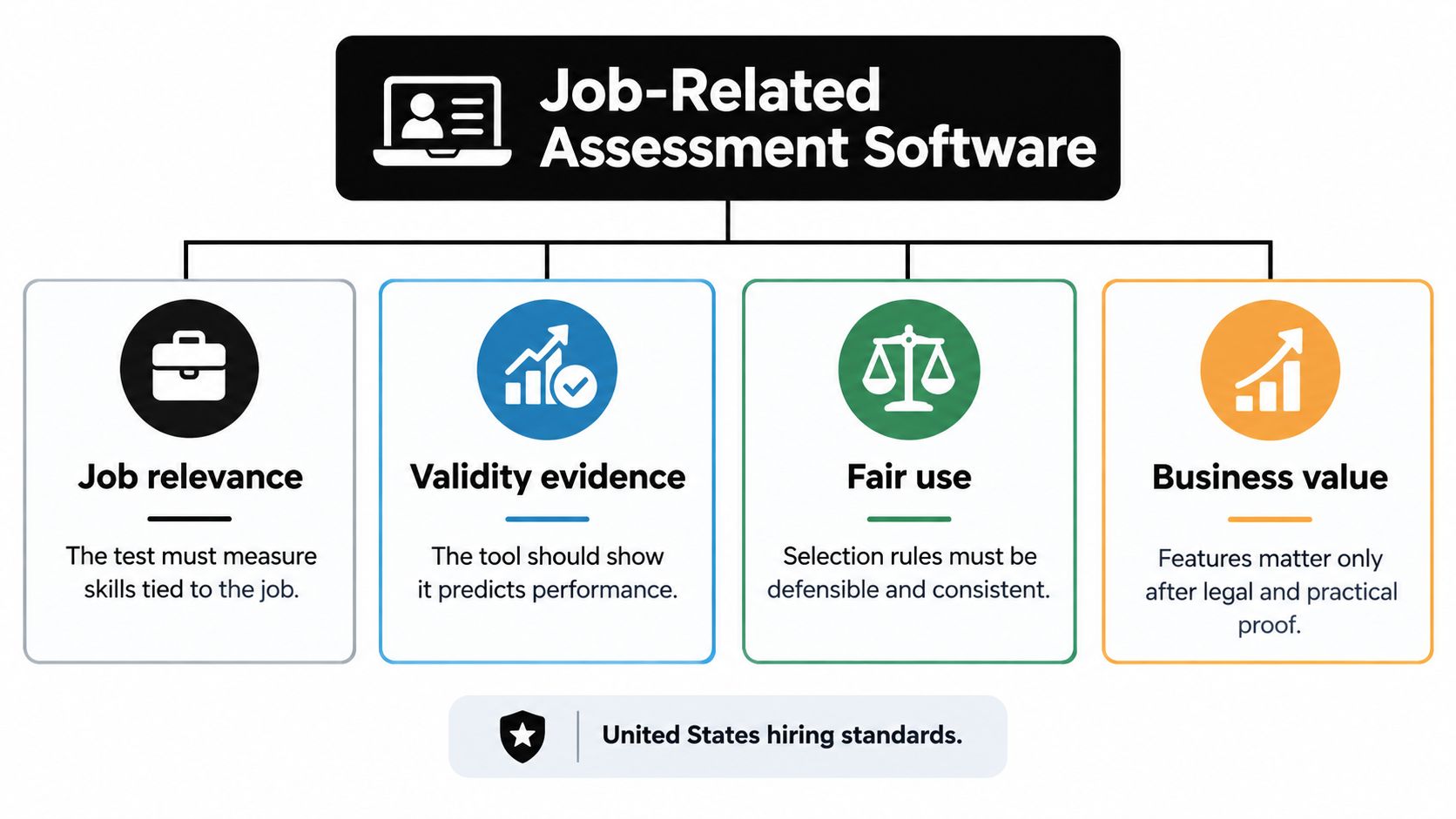
An assessment should earn its influence over a hiring decision. Start with the connection between what candidates do during the assessment and what employees must do at work.
In the United States, the legal foundation developed through Title VII of the Civil Rights Act of 1964, the Supreme Court's 1971 Griggs v. Duke Power decision, 1975 Albemarle Paper Co. v. Moody, and the 1978 Uniform Guidelines on Employee Selection Procedures. Together, these milestones establish the importance of nondiscriminatory use, job relevance, business necessity, and validation, including criterion-related, content, and construct approaches, as described in the [EEOC's guidance on employment tests and selection procedures](https://www.eeoc.gov/laws/guidance/employment-tests-and-selection-procedures).
Translate validation into business questions
Criterion-related validity asks whether assessment results relate to a meaningful performance outcome. For a leadership role, ask what the vendor used as evidence of performance and why that outcome represents successful leadership in your organization.
Content validity concerns whether the assessment represents important parts of the work. A realistic exercise can look convincing while omitting the judgment, constraints, or interpersonal demands that make the actual job difficult.
Construct validity concerns whether the procedure measures the underlying characteristic it claims to measure. A label such as adaptability isn't sufficient evidence by itself. Ask how the characteristic was defined, measured, and connected to relevant work.
Reliability is a separate question
A measure can produce consistent results without measuring something useful for your vacancy. Conversely, a relevant concept won't support a sound decision if the measurement is unstable. The distinction between [assessment validity and reliability](https://synopsix.ai/blog/assessment-validity-and-reliability) belongs in procurement discussions, not just technical documentation.
Ask vendors to connect their evidence to a specific role family:
Digital delivery and AI may improve speed and usability. They don't replace proof that an assessment is reliable, job-related, and administered without unlawful discrimination.
The purchasing implication is important: validation applies to an intended use, not merely to a product name. Don't treat a technical manual as blanket authorization for every role, location, or promotion decision.
How to Compare Hiring Assessment Platforms
Compare platforms against the decision you need to improve, rather than against the size of their assessment libraries. A broad catalog can be useful, but it doesn't establish that a particular test belongs in your selection process.
Use the same buying questions for a lightweight screening tool, a specialist assessment, and a people-intelligence platform. Score only what the vendor lets you inspect. An unsupported promise should remain an open question, not become a positive score.
What to Demand from Hiring Assessment Software
| Criterion | Question to ask | Evidence that holds up | |---|---|---| | Validity evidence | What supports this assessment for our role family? | Role-linked documentation, defined performance criteria, study limitations, and an explanation of applicability | | Time to complete | What does the candidate actually experience? | A complete assessment walkthrough, including instructions, preparation, accessibility, and review time | | Workflow integrations | Can recruiters use results without duplicate handling? | A demonstration in your existing workflow, including permissions, failed transfers, and support ownership | | AI analytics | What does the system recommend, and what remains a human decision? | Traceable inputs, stated uncertainty, reviewable recommendations, and explicit limits | | Business-language reporting | Can a manager identify the next action? | Sample reports that connect findings to job behaviors, risks, and interview follow-ups | | Cost against outcomes | What operational change would justify the purchase? | A full implementation scope and a buyer-owned plan for measuring decision time and hiring risk |
Inspect the report, not just the demonstration
Weak proof includes generic claims of scientific backing, a single accuracy headline, or an integration logo without a working demonstration. Stronger proof lets your team examine assumptions, test the workflow, and see what happens when information is incomplete.
As one concrete option, Synopsix describes a workflow built around assessments and comparable behavioral profiles, role-specific Intelligence Reports for leadership and sales, Predictive Simulations for friction and risk, and Human Interlink for team complementarity and tension. Its publisher materials describe reports with risk indicators, fit recommendations, and role-specific insights; treat its performance and accuracy claims as vendor claims that require validation against your own roles, rather than as independently established outcomes.
For a broader purchasing discussion, use this guide to [recruitment assessment tools](https://synopsix.ai/blog/recruitment-assessment-tools) alongside your actual hiring workflow. Keep the distinction between a capability and evidence of its value: a simulation is a capability; demonstrating that it improves a relevant decision is a separate task.
Don't assume a shorter candidate assessment creates a shorter hiring cycle. If managers need another meeting to decode the results, you may have moved the delay rather than removed it.
Fairness Without Losing Predictive Validity
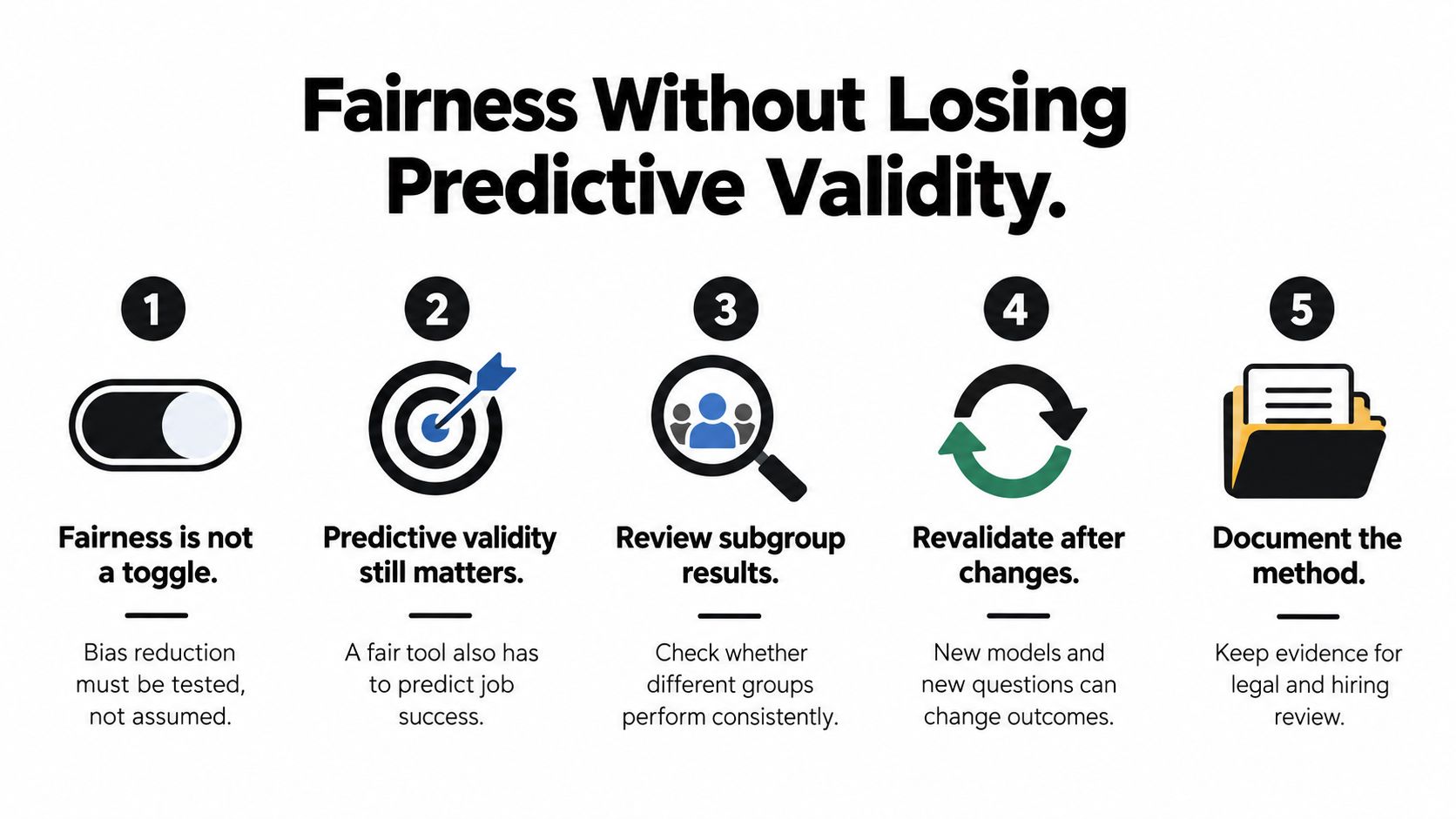
Bias mitigation isn't a setting you can accept on trust. Buyers need to know what changed, whose outcomes changed, and whether the resulting procedure still predicts relevant performance.
A Purdue review of roughly 20 scientifically sound personnel-selection studies reports that algorithms trained on historical hiring data generally reproduce existing subgroup differences, while mathematically reducing those differences can weaken prediction; it also discusses newer research suggesting additional skills could offer smaller subgroup gaps. The same [Purdue analysis of algorithmic bias in hiring](https://business.purdue.edu/daniels-insights/posts/2025/algorithmic-bias-in-hiring.php) describes a 2025 experiment using approximately 361,000 fictitious résumés, in which leading AI models favored female candidates and disadvantaged Black male candidates despite identical qualifications.
Ask which errors the model makes
An overall performance measure can't answer every purchasing question. Ask whether the system incorrectly rejects suitable candidates or advances unsuitable candidates, and how those errors differ across relevant subgroups.
Don't collapse subgroup differences, prediction errors, and adverse impact into a single fairness label. Your evaluation should examine each in relation to the decision the employer intends to make.
Require evidence at the deployment boundary
The practical purchasing test should include:
Where subgroup samples are insufficient, the vendor should say so. Treat missing evidence as uncertainty requiring a deployment restriction or further evaluation, not as proof that no difference exists.
> A fairness claim is incomplete unless the buyer can also inspect what the assessment predicts, for whom, and under which conditions.
For behavioral decision support, require explicit examples of where predictions hold and where they fail. A manager should understand what new evidence could justify departing from a recommendation.
My conclusion is that fairness and validity should be evaluated jointly, not negotiated by separate teams after procurement. People analytics, legal, and hiring leaders need to agree on acceptable uses and unresolved risks before the software influences candidate progression.
Hiring Assessment Software by Real Team Scenarios
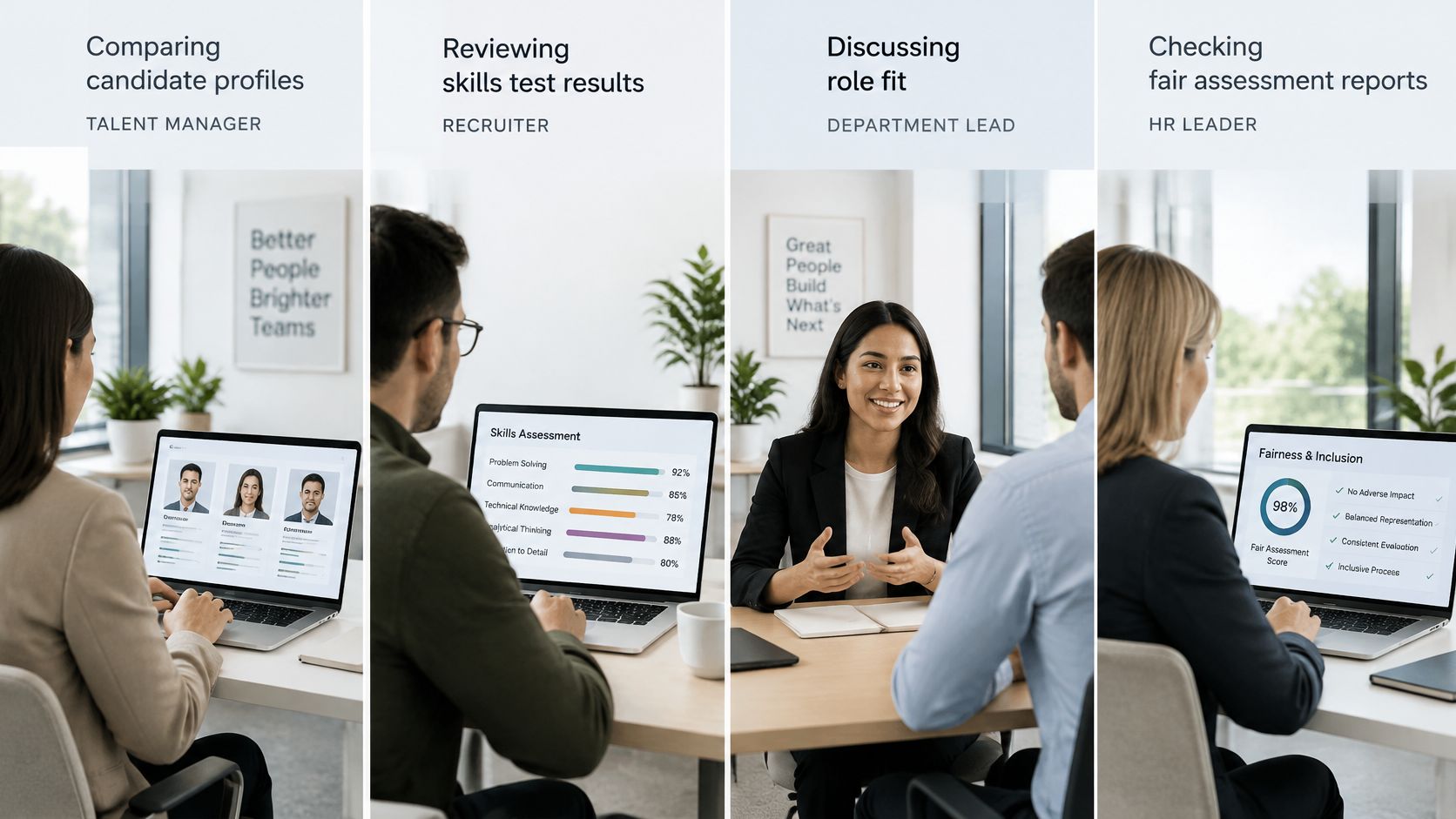
The appropriate assessment depth depends on the decision, not the seniority of the buyer. These hypothetical scenes illustrate how to match evidence to the work without treating a fuller profile as automatically better.
A talent team managing repeated hiring
A recruiting lead needs a consistent early screen for a recurring customer-facing role. A lightweight, job-related exercise may be sufficient if the immediate question is whether applicants can handle the essential task.
In the hiring meeting, a useful comparable profile would identify the observed skill, the scoring basis, and any uncertainty. The next action might be a structured interview focused on a weak or ambiguous response, not another broad assessment.
For the separate task of examining recruiting coordination, teams can review [Flowkon for recruiting teams](https://flowkon.io/for-recruiters) from Flowkon. Keep workflow coordination distinct from the evidence needed to assess candidates.
A manager choosing a sales or leadership finalist
A department head sees similar career histories but different approaches to challenge. Here, a behavioral profile should generate a testable question rather than settle the decision.
A plain-language risk signal might suggest investigating how the person responds when a forecast is challenged. The manager could then use a role-relevant simulation and compare the observed behavior with the assessment's hypothesis.
An organizational development lead designing a team
An organizational development lead is considering whether a new manager will complement an established leadership group. The output should describe possible working tensions without turning differences into fixed judgments about compatibility.
The practical next action could be a development plan covering decision rights, escalation, and feedback. If the issue is promotion readiness, the team should distinguish current performance from evidence of capability in the proposed role.
An executive-search or investment decision
An executive-search consultant or venture investor may want to pressure-test a senior appointment before committing. A fuller assessment could be appropriate when the decision involves substantial leadership responsibility and uncertainty about integration.
The report should identify which concerns deserve a simulation, reference discussion, or human interview. It shouldn't convert a behavioral inference into a categorical verdict about the person.
Choose the lightest assessment that supplies adequate job-related evidence. Escalate to simulations and team views when the unresolved decision warrants the additional candidate effort and interpretation.
Running AI Assessments Candidates Can Contest
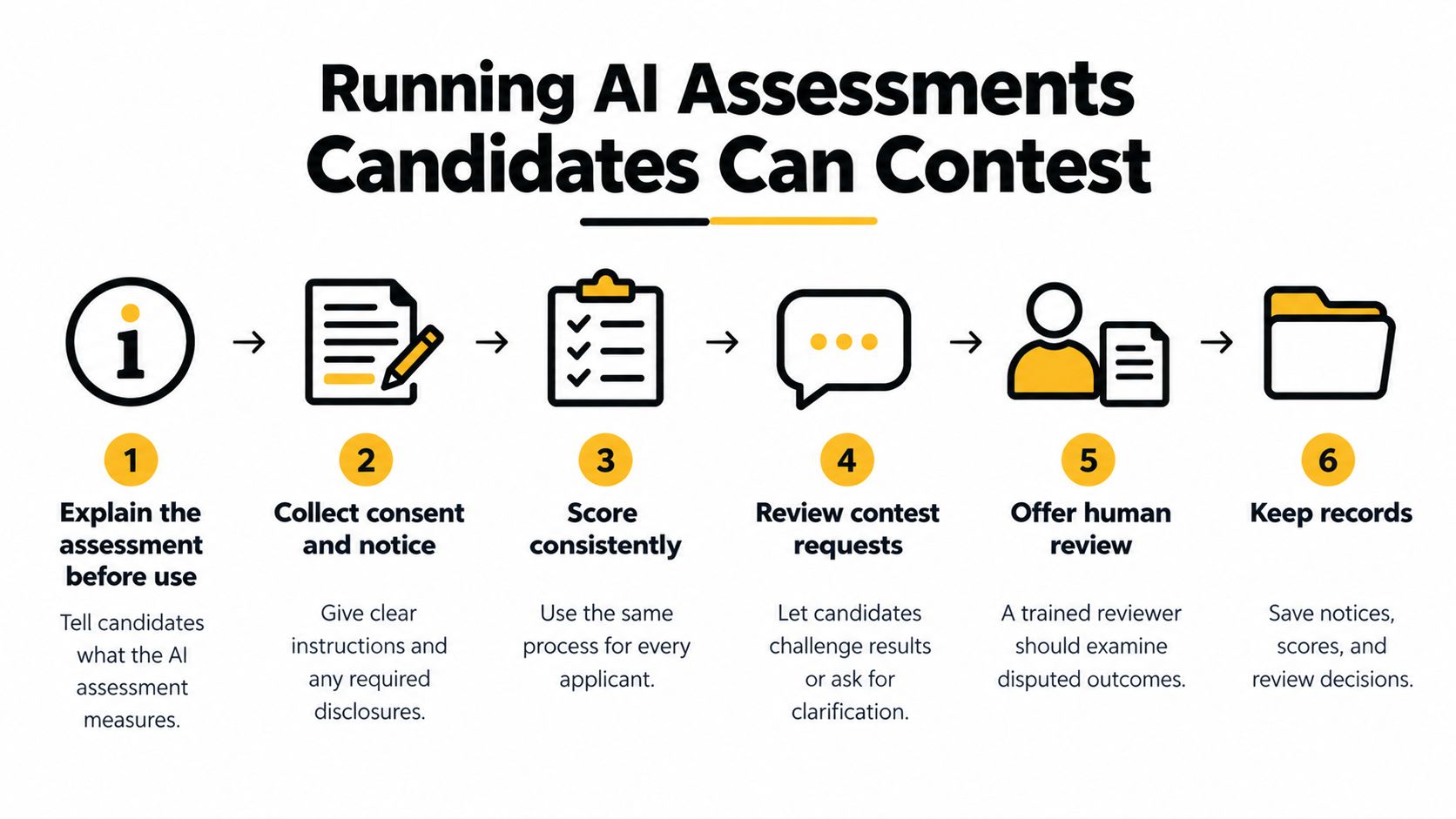
Candidate-centered assessment requires an operating process, not just a privacy statement. Applicants should understand the assessment's purpose and have a practical route to question an outcome.
The cited research material describes 2025 qualitative findings concerning opacity, demographic disparities, emotional dehumanization, and procedural injustice, particularly among marginalized groups, alongside a 2025 review of 49 peer-reviewed articles identifying standardization and productivity opportunities but persistent training-data bias. It also identifies California requirements effective October 1, 2025, covering fairness evaluation, pre-deployment testing, applicant notice, and human review, plus EU high-risk expectations around risk assessment, logging, traceability, transparency, accuracy, and documented oversight; use this [candidate-experience and AI-assessment research reference](https://garuda.kemdiktisaintek.go.id/citation/site/RIS/5187715) as background and have counsel confirm the applicable legal requirements.
Make disclosure operational
Before assessment, explain what candidates will do, what the tool measures, where AI supports evaluation, and how results influence progression. Don't substitute a vague statement about using technology for a meaningful explanation.
Legal notice and consent requirements vary by jurisdiction and use. Your operating baseline should be clear advance communication, with counsel identifying any additional obligations.
Give review an owner and a record
Build the following controls into the candidate journey:
A candidate who reports a technical interruption needs a different response from someone disputing the interpretation of their result. Route both requests to people with authority to act.
Use [ethics in assessment](https://synopsix.ai/blog/ethics-in-assessment) as a discussion point when assigning these responsibilities. The implementation test is whether a recruiter can explain the process, initiate a review, and retrieve the decision record without inventing a workaround.
Choosing a Platform and Taking the Next Step
Your organization may not need a deeper assessment platform. If the existing job sample is well validated and the underlying problem is inconsistent administration, a lighter workflow tool could be the more appropriate purchase.
A people-intelligence platform becomes more relevant when leaders need comparable behavioral evidence, role-specific business interpretation, and a way to investigate possible team friction before an appointment or promotion. That's a different decision problem from moving applicants through a queue.
Set purchase blockers before negotiating
Agree on the conditions that prevent approval. Missing job linkage, absent subgroup evidence, no meaningful human override, or reports managers can't use should stop the purchase until the supplier resolves the gap.
> Buying threshold: A convincing demonstration earns a pilot, not permission for unrestricted deployment.
Your pilot should test uncertainty rather than reproduce the vendor's preferred presentation. Give people analytics responsibility for the evaluation, involve recruiters in workflow testing, and ask hiring managers to interpret reports without coaching from the sales team.
Decide what the pilot can establish
A short operational pilot can reveal whether managers understand the reports and whether recruiters can run the process. It can't, by itself, establish long-term predictive validity.
Separate deployment readiness from evidence of future performance. Document what remains unresolved, what requires continued observation, and what would trigger suspension or restricted use.
The buying action is concrete: select the role, name the accountable owner, and schedule the evidence review before signing a broad rollout agreement.
---
Synopsix offers behavioral assessments and AI-supported guidance for hiring, team design, and talent development. Visit [Synopsix](https://synopsix.ai) to inspect how assessment findings become reports and actions, then request the validation and governance evidence needed for a time-boxed pilot in your chosen role family.