Hiring Assessment Test Guide: Types, Validity and Fairness
By Synopsix · November 4, 2026 · 16 min read
A 2025 survey found that 53% of participating employers used pre-employment assessments or selection tests, and job-specific skills assessments were the most common type. That adoption figure doesn't tell you whether a particular test predicts performance or treats candidates fairly. The key decision isn't which product to buy. It's whether the assessment measures work that matters, adds useful evidence, and gives candidates a comparable chance to show what they can do, according to [Survale's 2025 Candidate Experience Benchmark Research](https://survale.com/2025-candidate-experience-cande-benchmark-research-key-statistics/).
Hiring Assessment Test Types Compared
| Assessment type | What it measures | Mean validity (r) | Best used for | |---|---|---:|---| | Structured interview | Standardized questions and scoring tied to job criteria | 0.42 | Most roles where candidates must be compared on the same questions | | Job-knowledge test | Role-specific technical knowledge | 0.40 | Roles where knowledge is needed from day one | | Empirically keyed biodata | Past experience scored against real performance outcomes | 0.38 | High-volume roles with established performance data | | Situational judgment test | Choices in realistic work scenarios | 0.34 | Leadership, teamwork and customer-facing judgment | | Work-sample test | Performance on tasks resembling the job | 0.33 | Hands-on roles such as coding, trades or service tasks | | General cognitive-ability test | Reasoning and learning speed | 0.31 | Early-career screening and roles that require fast learning | | Skills test | Specific practical skills | Not reported | Roles with clearly defined software, language or technical skills | | Psychometric personality questionnaire | Traits and work preferences | Not reported | Behavioral profiling and team fit, interpreted with caution |
The first five figures, except for the situational judgment test, come from a recent synthesis of selection-method validity. They're correlations with job performance, not the percentage of hires who'll succeed or guarantees about an individual candidate. The situational judgment estimate comes from a meta-analysis; it reflects the method's average predictive relationship, not a universal result for every test or role. See the [selection-method synthesis](https://www.siop.org/tip-article/is-cognitive-ability-the-best-predictor-of-job-performance-new-research-says-its-time-to-think-again/) and the [meta-analysis of situational judgment tests](https://psycnet.apa.org/doi/10.1037/0021-9010.86.4.730).
Structured interviews ask every candidate the same job-linked questions and score responses against a fixed guide. Job-knowledge tests check the technical knowledge a person needs to use from day one. Empirically keyed biodata scores past background details against observed performance outcomes, so it's useful only when an employer has relevant, dependable performance data.
A situational judgment test presents a realistic work scenario and asks candidates to choose or rate possible responses. A work sample asks candidates to perform a task resembling the job, such as writing a customer response or completing a practical technical exercise. For a closer look at designing that kind of exercise, see this guide to [work-sample testing](https://synopsix.ai/blog/work-sample-testing).
General cognitive-ability tests measure reasoning and learning capacity. The comparison challenges the assumption that this category is automatically the strongest standalone predictor: in the cited synthesis, structured interviews and several job-specific methods had higher mean validity. The evidence cited here doesn't provide a mean validity coefficient for skills tests or personality questionnaires, so don't treat either as a measured substitute for the reported methods.
Start with the role's core tasks, not a vendor's catalog. Choose one or two assessment types that directly represent those tasks, then check whether they predict the outcomes you care about in the population where you'll use them.
Why Validity Matters More Than Test Labels
A test can look polished, sound relevant, and still fail the most important question: does its score predict or measure something needed for successful performance in this specific job? A familiar label such as “behavioral assessment” or “skills test” doesn't answer that. Validation does.
Three strategies help establish what a test measures and why it belongs in a hiring process. Criterion-related validity asks whether scores predict a defined outcome, such as work quality or supervisor ratings. Content validity asks whether the test tasks represent important parts of the actual job. Construct validity asks whether the test measures a defined attribute, such as a capability the role requires. The [federal selection-procedure regulation](https://www.ecfr.gov/current/title-29/subtitle-B/chapter-XIV/part-1607) sets out these approaches and the importance of standardized administration and scoring.
Consider a customer-service test whose questions sound like the work. It might ask how a candidate would respond to a frustrated customer, which gives it face validity: at first glance, the content seems relevant. But if the employer hasn't shown that the test tasks represent important job duties or that results connect to an outcome such as issue resolution, face validity alone doesn't establish that the test is a sound hiring measure.
Three checks before you rely on a score
1. Define the performance criterion first. Decide what success means before reviewing results. If you can't name the outcome the test should predict or the job tasks it should represent, you can't make a clear case for using it.
2. Validate the test for each role. Evidence from one job doesn't automatically establish that the same assessment is appropriate for a different occupation or hiring purpose. Keep the assessment connected to the position where you'll use it.
3. Check whether it still predicts after rollout. Standardize instructions and scoring, preserve the scoring protocol, and monitor results against performance outcomes after implementation. The regulation calls for documenting reliability and score distributions as part of a sound evaluation.
A practical guide to [assessment validity and reliability](https://synopsix.ai/blog/assessment-validity-and-reliability) can help teams frame the questions. The useful distinction is simple: an assessment's name describes its format; validity evidence supports its use.
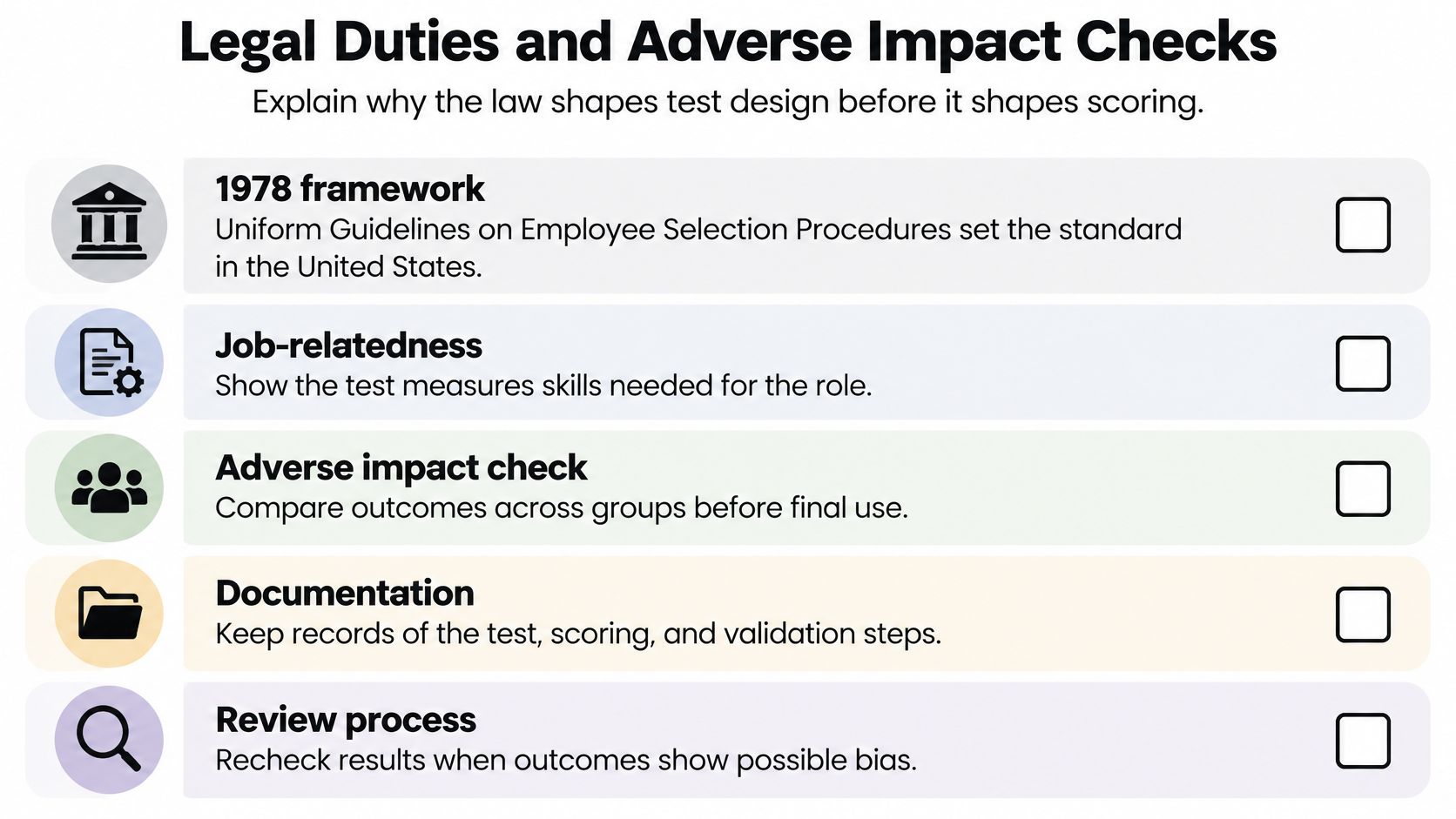
Legal Duties and Adverse Impact Checks
A hiring test can be job-related and still produce different selection rates across groups. The four-fifths rule is one initial screen: divide each group's selection rate by the rate of the group with the highest selection rate. A ratio below 80% signals a need to investigate; it is not, by itself, a legal finding. The federal selection-procedure regulation includes this comparison in the Uniform Guidelines.
The Equal Employment Opportunity Commission and other federal agencies established the Uniform Guidelines in 1978. Under Title VII, the framework addresses whether tests, interviews and other selection procedures are job-related and consistent with business necessity. The [EEOC's guidance on employment tests and selection procedures](https://www.eeoc.gov/laws/guidance/employment-tests-and-selection-procedures) explains that disproportionate exclusion of a racial, ethnic or sex group generally calls for appropriate validation evidence or consideration of ways to reduce adverse impact.
> The employer remains accountable. A vendor's technical manual can inform an employer's review, but it does not transfer responsibility for how the test is used.
A checklist to apply before launch
Compliance depends on how an assessment is selected, designed and used, not only on its final scores. Employers should connect its use to the specific position and purpose, and examine whether the process treats groups differently. A practical overview of [ethics in assessment](https://synopsix.ai/blog/ethics-in-assessment) can help teams consider fairness risks alongside their legal duties.
Choosing and Combining Assessments by Role
Choose assessments by the evidence a role requires, not by the test label. A work sample can show whether a candidate completes a job task; a structured interview can compare how candidates explain decisions against the same criteria. Use a second method when it addresses a distinct capability rather than measuring the same one again.
| Combination | What the pairing can add | When the pairing helps | |---|---|---| | General mental ability + work-sample test | Reasoning evidence alongside demonstrated task performance | Roles where both problem-solving and hands-on execution matter | | General mental ability + structured interview | Reasoning evidence alongside explanations of judgment and communication | Roles involving complex decisions and stakeholder communication | | General mental ability + integrity test | Reasoning evidence alongside information about work-related integrity | Roles involving trust, cash handling or security | | Structured interview + work-sample test | Explanations of decisions alongside demonstrated task performance | Roles where both execution and the judgment behind it matter |
The [U.S. Department of Labor assessment guidance](https://www.dol.gov/sites/dolgov/files/ETA/publications/99-testassess.pdf) supports choosing methods tied to the job and adding a predictor only when it contributes information beyond the first. A combination that works in one setting may not add useful evidence in another.
Start with tasks that distinguish strong from weak performance. If a work sample already measures a technical skill, a cognitive test covering the same skill may add little. If one method measures technical output and another assesses learning capacity, they may answer different questions. That additional contribution is the point of incremental validity.
Match the method to the question
A role-specific task shows whether a candidate can perform relevant work. A structured interview compares answers against consistent, job-linked criteria. A situational judgment test examines choices in realistic scenarios. Add a method only when it helps assess a capability the other methods do not cover.
A 2025 survey of 1,084 hiring decision-makers in the United States and the United Kingdom found that 76% used skills tests. The [2025 State of Skills-Based Hiring survey](https://www.testgorilla.com/skills-based-hiring/state-of-skills-based-hiring-2025/) reports that UK respondents rated role-specific skills tests effective more often than self-report tests, at 67% versus 57%; US respondents reported 61% versus 49%. These are respondents' effectiveness ratings, not measured validity coefficients. The survey also reports that 42% of job seekers said they had experienced hiring bias, compared with 31% the prior year.
A cognitive test is not automatically indefensible, and a skills test is not automatically fair. Assess whether each method relates to the job, fits the context in which it is used, and contributes evidence the other methods do not provide. Set the combination's decision rules before reviewing results so that impressions do not change how evidence is weighed.
How to Score and Record Assessment Results
A score becomes useful only when your team can explain how it was produced and how it affected the hiring decision. Lock rules before candidates take the assessment, apply them consistently, and preserve the decision record.
1. Lock the scoring rules. Set the weight for each method and the pass threshold before testing begins, so candidates face a consistent decision model. The common slip is to choose a cutoff after seeing this year's scores, which makes the rule responsive to the applicant pool rather than the job.
2. Score every response with the same rubric. Give raters written scoring anchors and have two raters independently assess a sample to check whether they apply those anchors consistently. Don't score from memory after several interviews; record judgments close to the assessment.
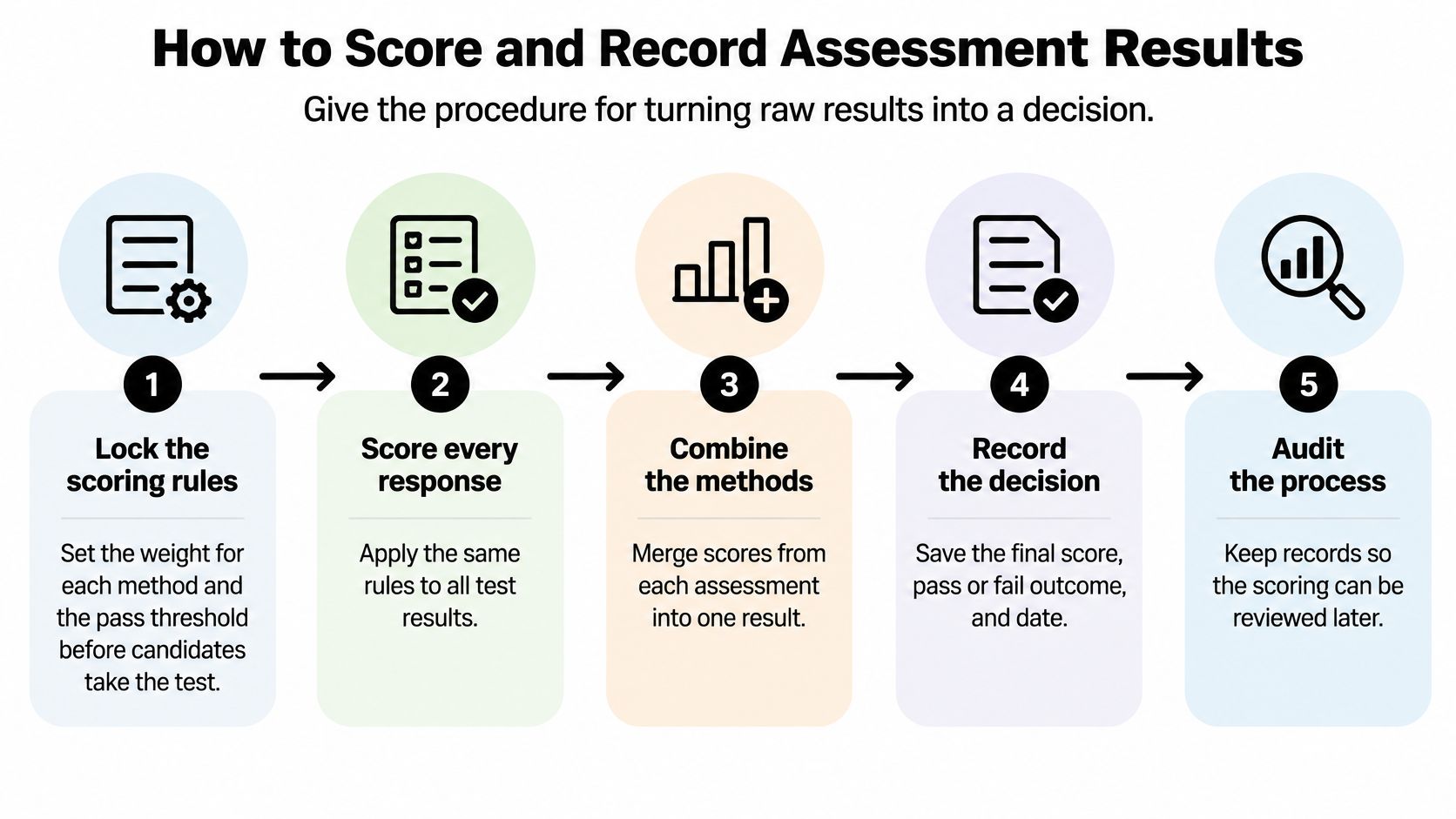
3. Set cut scores from validation evidence. Use evidence tied to the job and the outcomes you defined, not the average score of this year's applicants. A cutoff that shifts with the pool can make a stable performance standard impossible to interpret.
4. Combine methods and document exceptions. Apply the predefined weights, then record a written reason for any override. A frequent mistake is to dismiss a low test score because the candidate seemed strong in conversation, without explaining why the exception is justified.
5. Keep the decision in one candidate record. Choose an integration path, such as an API or webhook, and map each score to a named field in the applicant tracking system. Confirm that stage changes and override reasons sync to the same record, so reviewers don't have to reconcile scattered files.
6. Review the process against outcomes. At each review, compare assessment results and decision codes with hiring and performance outcomes. The common slip is to keep using a test without checking whether it still informs decisions or predicts the outcomes it was meant to support.
A sound process leaves documented rules, consistent scores, and a file that explains every decision. The numbers matter, but so does the audit trail showing how the team interpreted them.
Fair Access Through Practice and Accommodations
Fairness doesn't require making a valid test less demanding. It requires giving candidates a comparable chance to understand what they'll face, follow the instructions, and demonstrate the relevant skill.
A 2025 study of an operational selection process analyzed approximately 29,626 practice-test participants, 18,408 actual-test takers, and 5,078 people who completed both. Candidates who took the practice test scored higher on the actual assessment, estimated their likelihood of passing more accurately, and were more likely to apply. Racial and ethnic minority candidates had larger score gains than non-minority candidates, reducing subgroup score differences and adverse impact, according to the [study record in the APA PsycNet database](https://psycnet.apa.org/record/2025-79168-001).

That finding points to a practical fairness lever: equalize preparation opportunities without abandoning job-related assessment. Tell candidates the format and timing, offer accessible practice items, give everyone the same instructions, and provide reasonable accommodations when requested. Keep the practice material representative of the task, without giving away the scored questions.
Monitor subgroup scores and completion rates each cycle. If a gap appears, examine the instructions, format, access, and scoring process before attributing the difference to the candidate pool. Practice access isn't a universal remedy, and it doesn't replace validation or legal review.
> Did every candidate get a comparable chance to understand and prepare for your assessment?
Evaluating Vendors Against Validity and Compliance Criteria
A vendor comparison should test the evidence behind the product, not the persuasiveness of its demo. Use the same checklist for each provider and record what it can substantiate.
| Criterion | Strong answer | Red flag | |---|---|---| | Validity evidence | Shares studies for comparable jobs, names the performance criterion, and explains the sample and population. | Claims one test is validated for every role without showing supporting documentation. | | Job-analysis support | Helps connect the assessment to documented tasks and competencies for the position. | Starts with the product catalog and can't explain how the test maps to your work. | | Fairness reporting | Provides selection-rate and outcome information by group and explains how it identifies potential adverse impact. | Says the test is fair but won't share subgroup results or technical materials. | | Candidate experience | Gives clear instructions, accessible practice materials, accommodation options, and an explanation of time limits. | Can't explain how candidates request accommodations or what they'll encounter before starting. | | Operations and data | Explains score construction, ATS integration by API or webhook, data retention, consent, and exit terms. | Returns unexplained scores, can't describe how they were derived, or leaves data and contract terms unclear. |
Ask for the technical materials behind a validity claim, not just a summary slide. A vendor that refuses to share its technical manual or can't explain the criterion used for validation leaves your team unable to evaluate whether the assessment fits the role.
Candidate experience belongs in the same review as technical quality. Confusing instructions or inaccessible materials can affect who completes the process, while unclear scoring makes it hard for interviewers to interpret results consistently. Treat those as design and governance concerns, not cosmetic preferences.
Before committing, run a short pilot with current employees whose work you can evaluate. Check whether their results align with relevant job performance, whether the instructions work as intended, and whether the scores can be interpreted in the way the vendor claims. A pilot can expose a poor fit before candidates pay the cost in time and effort.
Launch Your First Validated Assessment
Start with one role and a decision your hiring team needs to improve. Selection and hiring analysis can also evaluate a candidate against the role, team, leader, and culture, identify integration risk, and propose questions for the final interview. Whatever tool you use, it shouldn't replace evidence tied to the work.
1. Write the job analysis. List the tasks that distinguish strong from weak performance. Keep the list specific enough to guide the choice of test and performance criterion.
2. Choose one or two methods. Use the comparison table to select assessment types that represent those tasks. Don't add another test unless it contributes distinct evidence.
3. Pilot the assessment. Use current employees and collect the performance measure you defined in advance. Check whether results correspond to the work, rather than assuming a plausible test is a useful one.
4. Review validity and selection rates. Examine how well the assessment relates to your chosen performance measure and compare selection rates by group. Keep the analysis and supporting materials in the validation file.
5. Set and lock the decision rules. Use the pilot evidence to set scoring weights and cut scores, then apply them consistently when candidates take the test.
6. Review after hiring. Compare results with hiring and performance outcomes after the first hiring cycle. Recheck whether the assessment predicts what you intended and whether the process gives candidates comparable access.
If you're helping applicants prepare for skills-first hiring, [HiredBySkill resources for skills-first job seekers](https://hiredbyskill.com/guides) offer a useful candidate-side perspective. For people-analytics platforms, ask for evidence tied to the specific role before you sign; a general claim of predictive power can't substitute for role-specific validation.
Decision rule: launch only when you have evidence that the assessment fits the specific role.
---
Synopsix helps HR teams turn behavioral assessments into role-specific guidance for hiring, team design, and talent development. If you're building a hiring process around validated evidence and clearer decisions, visit [Synopsix](https://synopsix.ai) to explore how its platform can support assessment through action.