8 Hiring Process Steps for 2026: From Role to Offer
By Synopsix · November 22, 2026 · 16 min read
Your team has interviewed a dozen candidates for an operations manager role. The recruiter has a shortlist, the panel has strong opinions, and everyone wants a decision. Then someone asks what the new hire must accomplish during their first months, and the answers don't match.
The department head wants tighter scheduling. Finance wants better cost control. The team wants a manager who can handle conflict. Nobody agreed on the benchmark before interviewing, so everyone has assessed a different job.
Most hiring breaks before the first interview even starts. The problem isn't necessarily the candidates or the interviewers. It's the missing blueprint, followed by handoffs that leave recruiters and managers filling in the gaps themselves.
A reliable process connects role definition, attraction, screening, assessment, interviews, practical testing, verification, and the offer. Each stage needs an input, produces evidence, and passes a specific deliverable forward. If the role definition is weak, the team can complete every later stage and still make an unsupported decision.
The following hiring process steps treat selection as a chain of dependencies, not a collection of meetings. The practical question at every stage is simple: what must the next person know to make a better decision?
1. Job Analysis and Role Definition
Define the work before defining the candidate. The hiring manager and recruiter should agree on why the role exists, which decisions it owns, and what successful performance looks like. Confirm budget, reporting relationships, and approval authority before anyone starts sourcing.
For an operations manager, replace broad requirements such as strong leadership with observable responsibilities: resolve scheduling conflicts, investigate service failures, and coach supervisors through performance issues. Then identify which capabilities someone needs on arrival and which your team can teach.
The benchmark should connect assessment criteria to important job behaviors. The [Uniform Guidelines on Employee Selection Procedures](https://www.ecfr.gov/current/title-29/part-1607/) distinguish criterion-related, content, and construct validity, and require validation evidence to relate to the jobs in question.
Build the scorecard before the posting
Speak with effective incumbents, their manager, and the people who depend on their work. Ask about difficult decisions, recurring mistakes, and the conditions under which otherwise capable employees struggle. Don't copy the personality or career history of a favored employee.
Use the role-analysis flow to keep the benchmark connected to the work.
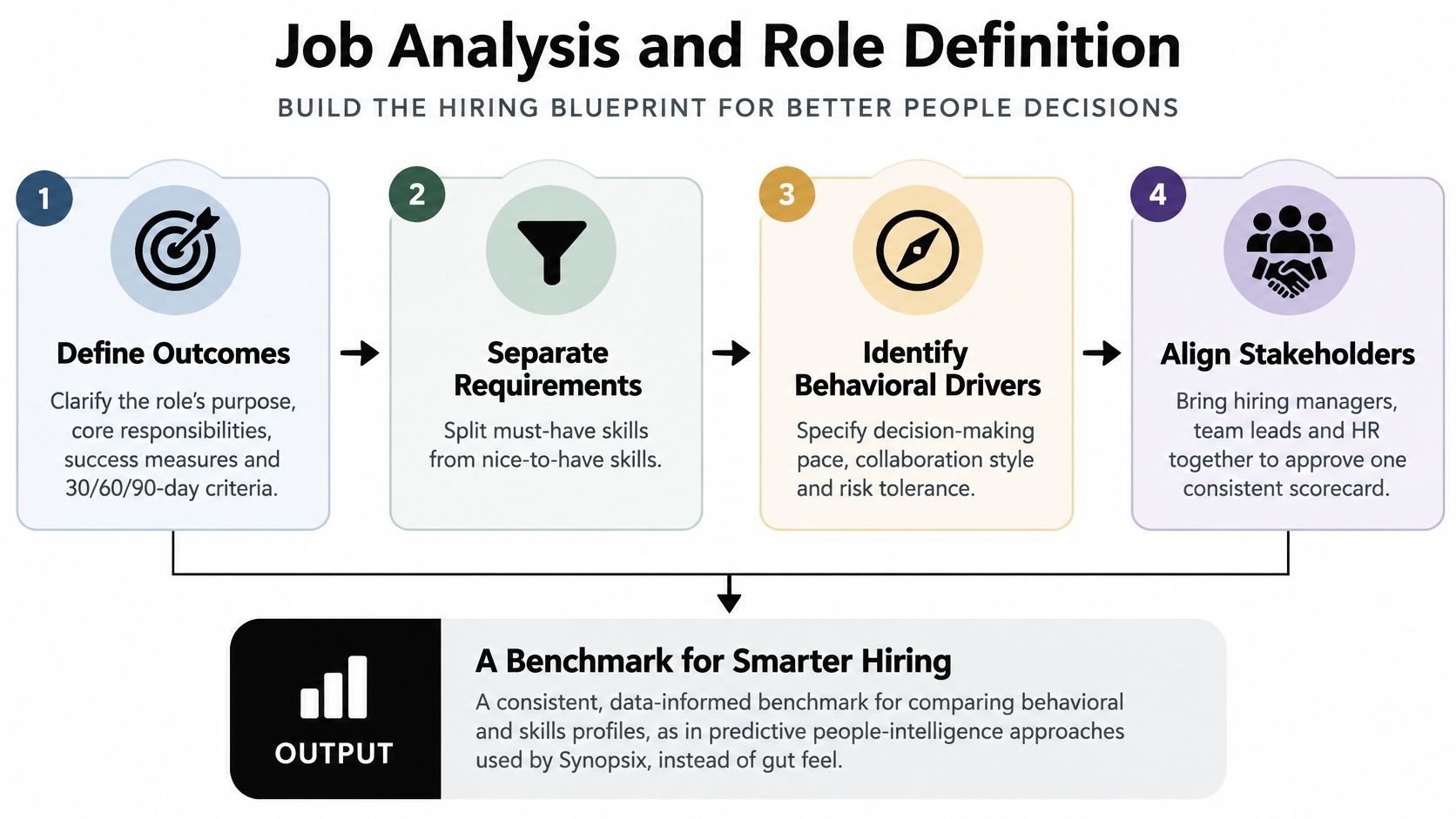
Handoff: Pass an approved role brief and evidence-based scorecard to the person writing the job description, with essential requirements clearly marked.
2. Job Description and Employer Positioning
A candidate shouldn't need a recruiter call to discover that a supposedly strategic role involves daily shift coverage. The job description must describe the job you're offering, including its less attractive constraints.
Translate the internal scorecard into a clear public proposition. State the role's purpose, expected outcomes, reporting line, work pattern, location requirements, and approved compensation information. Separate required qualifications from experience that would make onboarding easier.
The description should help candidates evaluate the opportunity before applying.

Make the trade-offs visible
For the operations manager vacancy, describe the actual mandate: stabilize scheduling, improve escalation handling, and support frontline supervisors. If the person must cover peak periods on-site, say so instead of relying on flexible working language that candidates could reasonably misunderstand.
Keep employer positioning specific. Explain the authority the manager will have, the support available, and the problems they can influence. Don't promise ownership if every decision requires executive approval.
> Practical rule: If a working condition could cause a finalist to reject the offer, disclose it before they invest time in interviews.
Use a bias-review checklist to challenge unnecessary credentials, age-coded language, and vague personality requirements. A tool can flag wording, but the hiring manager still needs to decide whether each requirement belongs.
Review the published version on mobile and test the application path. A clear description won't help if candidates encounter broken attachments or contradictory questions in the applicant tracking system.
Handoff: Give sourcing teams an approved posting, consistent employer messaging, and explicit answers about pay, flexibility, responsibilities, and required conditions.
3. Sourcing and Candidate Attraction
Sourcing quality starts with targeting, not message volume. Recruiters need to know which problems the hire must solve before searching LinkedIn Recruiter, Indeed, referral networks, or previous applicant records.
For an operations manager, search for relevant operating environments and responsibilities rather than matching job titles alone. Someone managing service delivery may have stronger scheduling and escalation experience than someone with the exact title in a very different business.
Build a channel mix that suits the role. Job boards can support broad discovery, direct outreach can reach people who aren't applying, and previous finalists can shorten the introduction. Referrals deserve consideration, but they shouldn't bypass the scorecard.
Use the approved role brief to keep outreach consistent across channels.

Personalize the reason for contact
Mention the candidate's relevant experience, the role's operating challenge, and a clear next action. Don't fabricate familiarity or send flattering claims that a recruiter hasn't checked.
LinkedIn's regional [Future of Recruiting report](https://business.linkedin.com/content/dam/lem/business/en/hire/resources/future-of-recruiting/future-of-recruiting-2025-au.pdf) reports that AI-generated messages produced a 44% higher acceptance rate than manually written outreach. That finding supports testing assisted drafting, not assuming every automated message will perform better.
Handoff: Pass a traceable candidate pipeline into screening, including source, relevant experience, expressed interest, and any confirmed constraints.
4. Resume and Application Screening
A resume is a set of claims to investigate, not a complete measure of capability. Screen for essential evidence without treating familiar employers, polished writing, or uninterrupted career paths as proof of competence.
Start with the approved requirements. Use an ATS to organize applications and apply legitimate knockouts, but don't turn every preference into an automatic rejection. A required professional license and a preferred industry background need different treatment.
For the operations manager role, a candidate might show scheduling responsibility without using your preferred terminology. A rigid keyword filter could reject them before anyone reads the relevant experience.
Separate rejection from uncertainty
Use a rubric that records evidence, missing information, and the reason for progression. Borderline applications should receive human review rather than being forced into an unsupported fail decision.
The [EEOC's guidance on the Uniform Guidelines](https://www.eeoc.gov/laws/guidance/questions-and-answers-clarify-and-provide-common-interpretation-uniform-guidelines) explains that a group's selection rate below 80% of the highest group's rate is generally regarded as evidence of adverse impact. Passing that guideline doesn't prove a process is unbiased, and smaller differences can still matter.
Don't let early screening become an improvised interview. Confirm baseline suitability and candidate expectations, then reserve deeper evaluation for the appropriate stage.
Handoff: Send assessment reviewers a qualified shortlist, criterion-level screening notes, and specific uncertainties that require further evidence.
5. Behavioral and Psychometric Assessment
An assessment should answer a defined hiring question. Cognitive ability, motivation, interpersonal tendencies, and work style aren't interchangeable constructs, and a compelling profile isn't automatically evidence of job performance.
For the operations manager vacancy, you might investigate how someone approaches competing priorities, difficult conversations, or procedural discipline. Define the relevant workplace behaviors before deciding which instrument belongs in the process.
The Principles for the Validation and Use of Personnel Selection Procedures state that validation begins with proposed uses, intended interpretations, and expected outcomes. Evidence supporting candidate comparison doesn't automatically support promotion, termination, or other employment decisions.
Turn profiles into questions, not verdicts
A behavioral result can generate a hypothesis for structured follow-up. If a profile suggests a preference for deliberation, investigate how the candidate makes urgent decisions rather than labeling them too slow for operations work.
Use a clear explanation of [what psychometrics measures](https://synopsix.ai/blog/what-is-psychometrics) to distinguish measured constructs from assumptions about character. Don't infer capability from an appealing label, or treat a candidate's similarity to the current team as a selection standard.
> Assessment results should identify what to examine next, not give interviewers permission to stop looking.
Explain what candidates will complete, why it's relevant, who will receive the results, and how the information will influence selection. Provide an accommodation route and retain human ownership of the decision.
Check the instrument's role relevance, scoring documentation, and validation evidence. Monitor completion patterns and group outcomes, and investigate discrepancies instead of assuming that standardized administration guarantees fairness.
Handoff: Pass comparable assessment results, interpretation limits, and job-related follow-up questions to interviewers without presenting a predetermined hiring verdict.
6. Structured Interviews
An unstructured conversation lets an interviewer follow whatever feels interesting. A structured interview directs attention toward the evidence needed to judge the role. Consistency comes from shared questions, scoring anchors, and disciplined evaluation.
The historical Schmidt and Hunter synthesis, summarized by [Cogn-IQ](https://www.cogn-iq.org/blog/what-predicts-job-performance/), reported predictive-validity coefficients of approximately 0.51 for structured interviews and 0.38 for unstructured interviews. These are correlations with later performance, not percentages of performance predicted.
For the operations manager, ask candidates to describe a serious scheduling failure: what happened, what they personally decided, how they communicated, and what changed afterward. Use the same core question and standardized probes for everyone.
Calibrate before meeting candidates
Define what weak, acceptable, and strong evidence looks like. A strong answer might show diagnosis, prioritization, stakeholder communication, and follow-through; confidence alone shouldn't earn a high score.
A comparison of [structured and unstructured interviews](https://synopsix.ai/blog/structured-vs-unstructured-interviews) can help hiring managers understand why conversational warmth isn't a substitute for comparable evidence. Leave room for candidate questions, but keep that discussion separate from scored evaluation.
Don't add another interview merely because the panel feels uncertain. Name the missing evidence first, then choose the smallest fair step that can resolve it.
Handoff: Give practical-test evaluators completed interview scorecards, evidence-backed concerns, and the specific capabilities still requiring demonstration.
7. Work Samples and Skills Testing
Ask finalists to demonstrate the work, not produce free work for your business. A realistic simulation can test whether a candidate applies the capabilities discussed during interviews.
Use the same preparation, materials, and assessment conditions for comparable candidates.

For an operations manager, provide a fictional staffing schedule, a service complaint, and an unexpected absence. Ask for a response plan and an explanation of priorities. Score decision quality, escalation judgment, and communication rather than presentation polish unless presentation is an essential requirement.
Good [work-sample testing](https://synopsix.ai/blog/work-sample-testing) starts with a bounded task and a disclosed rubric. Use synthetic or anonymized information, explain permitted tools, and specify whether AI assistance is allowed. If the job involves AI-supported work, testing responsible use may be more relevant than banning it.
Keep the exercise proportionate
Use the shortest task that produces useful evidence, and pay candidates for substantial assignments. Don't ask finalists to solve an active commercial problem or surrender reusable intellectual property as an audition.
The discussion of skills-based evaluation in [erecruit on government ICT recruitment](https://erecruit.io/blog/skills-based-hiring) provides a related context for practical assessment. The operational requirement remains the same: define the skill before designing the test.
Use this video as an additional discussion resource when planning the assessment experience.
<iframe width="100%" style="aspect-ratio: 16 / 9;" src="https://www.youtube.com/embed/KhCt0Rjejbw" frameborder="0" allow="autoplay; encrypted-media" allowfullscreen></iframe>
Score submissions without candidate identity where practical. Follow up on reasoning using consistent questions, especially when the finished output doesn't reveal how the candidate reached it.
Handoff: Pass scored work products, evaluator notes, and unresolved discrepancies into final verification and the offer decision.
8. Reference Checks, Background Verification, and Offer Decision
A reference who says the candidate was excellent hasn't necessarily answered your hiring question. Verification should confirm material claims and investigate role-relevant uncertainties, not collect general praise.
For the operations manager, ask a former manager how the candidate handled a missed deadline, challenged an unrealistic staffing request, or responded to a service failure. Request a concrete example and distinguish firsthand observation from opinion.
Check employment history, credentials, or other background information only where relevant and legally permitted. Obtain appropriate consent, follow applicable notice requirements, and give candidates an opportunity to address material discrepancies. Keep sensitive information restricted to authorized reviewers.
Make the decision against the original benchmark
Treat references and background screening as different evidence streams. A guide to [pre employment screening steps](https://www.digitalfootprintcheck.com/pre-employment-screening-process) can help distinguish activities, but your process must reflect the role and applicable jurisdiction.
Consolidate the evidence before discussing the preferred candidate:
> Don't let an enthusiastic reference erase a weak work sample. Resolve the contradiction or record why it doesn't change the decision.
Prepare approved compensation, benefits, start-date options, and negotiation boundaries before the offer conversation. Explain any remaining conditions clearly, and don't describe a conditional offer as final clearance.
Handoff: Send the chosen candidate a clear written offer, and pass the manager an onboarding brief covering success measures, support needs, and evidence to validate after joining.
How the eight hiring stages compare on ownership, output, and candidate effort
Read each row as a handoff. The output column is what the next stage receives as its benchmark, so a vague role profile at the top makes every later column less reliable.
| Stage | Main Owner | Main Output | Candidate Time Required | |---|---|---|---| | Job Analysis and Role Definition | Hiring manager, team leads, and HR | Role profile and hiring scorecard | No candidate time; internal planning | | Job Description and Employer Positioning | Hiring manager and recruiter | Public-facing job description | A few minutes of reading before applying | | Sourcing and Candidate Attraction | Recruiter and talent acquisition team | Qualified candidate pipeline | Typically 15–45 minutes to respond to outreach and apply | | Resume and Application Screening | Recruiter or hiring team | Shortlist of qualified applicants | Brief application and screening questions | | Behavioral and Psychometric Assessment | HR or talent assessment team | Comparable behavioral profiles | Typically 15–30 minutes | | Structured Interviews | Hiring team and interviewers | Rubric-based interview scores | Commonly 2–6 hours across all rounds | | Work Samples and Skills Testing | Hiring team or subject-matter reviewers | Scored work sample or skills assessment | Often 1–3 hours | | Reference Checks, Background Verification, and Offer Decision | HR, recruiter, and hiring manager | Verified candidate information and documented offer decision | Usually under 30 minutes for consent and reference details |
Two patterns stand out. Candidate effort climbs sharply after the screening stage, and ownership widens at the same point, from a single recruiter to a full hiring team. That is the deliberate trade: cheap filters early, expensive scrutiny only on finalists. If your process asks finalists for six hours of interviews before anyone has scored a work sample, the order is wrong.
The output column also tells you where to audit. When a hire fails, trace backward: the offer decision rests on reference checks, which rest on work samples, which rest on interview scores, which rest on the scorecard written in stage one. A weak job analysis rarely gets caught at stage one. It surfaces eight steps later, as an offer defended with gut feel instead of evidence.
Turning Eight Hiring Steps Into One Repeatable System
The eight hiring process steps work when recruiters and managers use the same benchmark throughout. Role analysis defines the outcomes, screening checks essential evidence, assessments and interviews examine relevant capabilities, and practical testing shows how a finalist applies them. The final recommendation should explain how those signals support the offer.
Start by auditing the weakest handoff, often the role definition or scorecard. Look at a recently closed vacancy and ask whether another reviewer could reconstruct the decision from the records. If the answer depends on remembering what someone meant during a meeting, the documentation isn't strong enough.
Fix ownership before adding automation
Assign a named owner, required deliverable, and expected response window to each transition. Track time spent waiting for review separately from time spent completing an assessment. A slow process may need faster approvals rather than another sourcing tool.
Automation deserves the same discipline. LinkedIn's [Future of Recruiting research](https://business.linkedin.com/hire/resources/future-of-recruiting) found that 37% of recruiting organizations globally were integrating or experimenting with generative AI. Use it where the task is repeatable, but retain human accountability for criteria, interpretation, accommodations, and selection.
Candidate trust requires more than a faster workflow. In [Criteria's candidate-experience findings](https://www.criteriacorp.com/blog/candidate-experience-report-findings), 31% of candidates reported negative feelings about organizations using AI in hiring in 2025. Explain the process plainly rather than assuming applicants understand what the technology does.
Validate the decision after the hire
An accepted offer doesn't establish that the selection process worked. Schedule onboarding, ramp-up, and established-performance reviews that compare the original evidence with actual job outcomes.
Assess retention, manager evaluations, work quality, and time to independent performance by comparable role and working conditions. Investigate whether a disappointing outcome reflects selection, inadequate onboarding, changed responsibilities, or insufficient resources before changing the hiring rubric.
Then revise criteria that don't help distinguish effective performance. Keep the benchmark job-related, preserve evidence at each handoff, and make the next hiring decision easier to explain than the last.
---
Synopsix turns behavioral assessments into practical guidance for hiring, team design, and talent development, helping you evaluate candidates against the role, team, leader, and culture. Visit [Synopsix](https://synopsix.ai) to explore how role-specific behavioral insights can support your scorecards, final interview questions, and hiring decisions.