How Many Interviews Is Too Many: A Practical Guide
By Synopsix · October 18, 2026 · 14 min read
Google's hiring analysis puts a striking number on interview returns: four interviews predicted the hiring outcome with 86% confidence, while each additional interview added about one percentage point. In the same analysis, decisions remained unchanged 94% of the time when candidates received four interviews instead of twelve, according to [HR Magazine's account of Google's hiring data](https://www.hrmagazine.co.uk/content/features/lengthy-recruitment-processes-could-be-pushing-candidates-away).
That's a useful benchmark, not a universal rule. The right question isn't how many people have spoken to a candidate. It's whether each conversation gathers distinct, job-relevant evidence that could change the decision.
The Four-Interview Benchmark and Why It Headlines Every Conversation
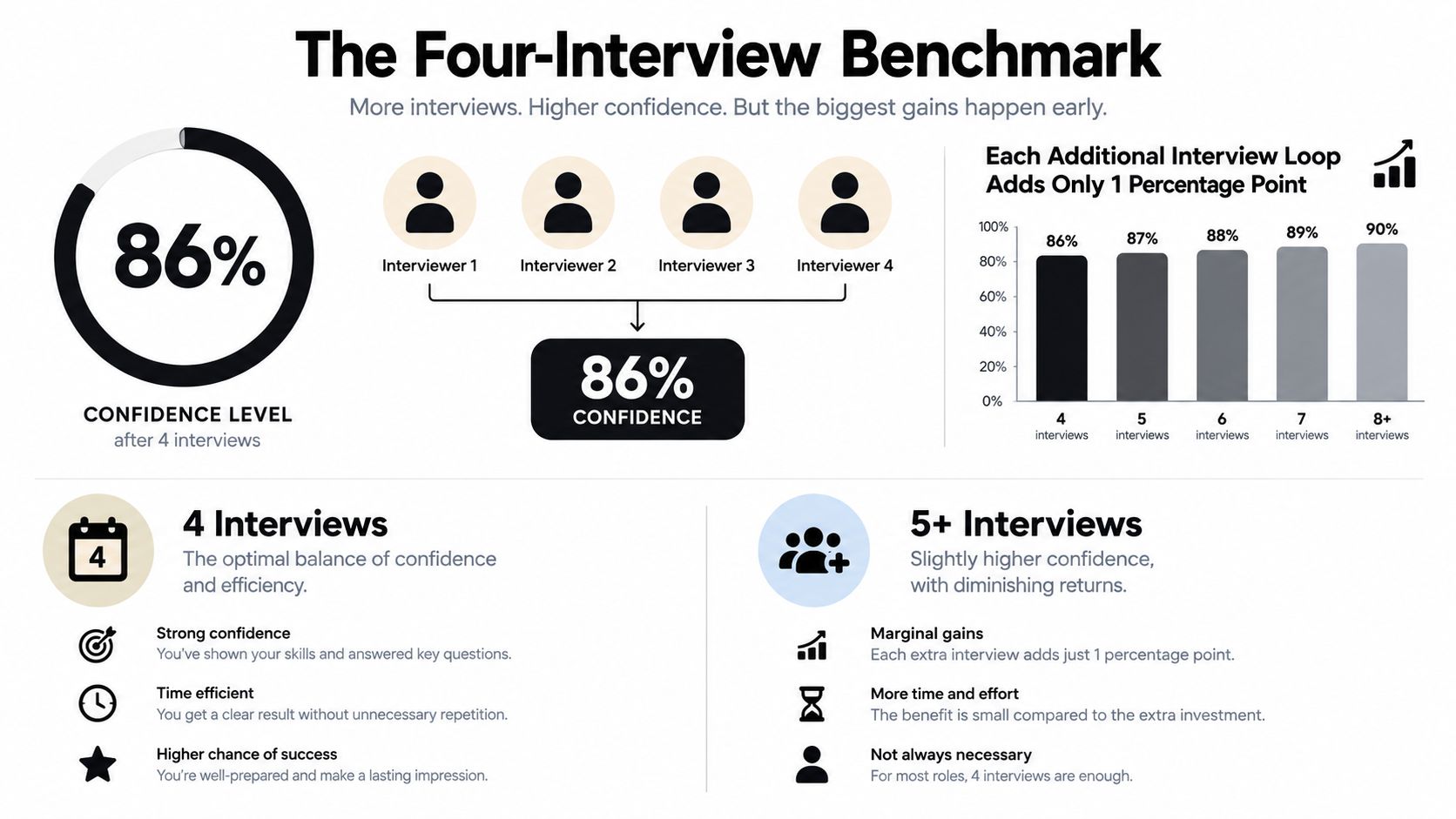
Google's four-interview finding attracts attention because it puts a limit on a common instinct: adding interviewers to make a decision feel safer. The benchmark is a useful starting point, not a target. The [historical Rule of Four discussion](https://sea.peoplemattersglobal.com/article/talent-acquisition/how-many-interviews-is-too-many-rethinking-the-hiring-process-45300) likewise raises the question of when additional assessments stop contributing meaningful evidence.
The number of stages should follow the evidence a role requires. A senior specialist search might need distinct assessments of technical judgment, collaboration, and decision-making under uncertainty. A narrower role may need fewer conversations when a structured interview or work sample already covers its requirements. The test is whether each stage resolves a genuine evidence gap.
A fourth conversation earns its place if it assesses a job-critical competency that earlier stages could not. For example, a senior analyst process might reserve a later interview for stakeholder negotiation if the earlier conversations assessed only analytical judgment and technical work. Without a distinct purpose, another meeting risks repeating impressions rather than improving the decision.
Measure evidence, not attendance
Interview volume alone says little about diligence. A full calendar can still leave a hiring team uncertain if interviewers lack shared criteria, collect overlapping evidence, or have unclear decision responsibilities.
> Practical rule: Before adding a stage, specify the new evidence it should produce and the decision that evidence could change.
The benchmark is most useful as a prompt to inspect each conversation. If an interviewer repeats earlier questions, scores the same competency, and has no defined role in the decision, the stage may add little. If the process still lacks evidence on a predefined requirement, a focused assessment may be warranted.
The stopping point comes when the team has credible evidence across the role's required competencies and no material uncertainty that another interview could resolve. That may take fewer or more than four conversations. A structured two-interview process can outperform a six-interview marathon when its stages gather distinct evidence, while extra rounds can increase the time and access burden for candidates without improving the decision.
Why Interview Architecture Beats Interview Count
A six-interview process can collect less useful evidence than two well-designed conversations. The difference is whether interviewers test distinct, job-related competencies and score responses against shared criteria. A meta-analytic summary reports average validity of 0.42 for structured interviews, with an 80% credibility interval from 0.18 to 0.66, compared with an estimated 0.19 for unstructured interviews ([Cambridge's review of selection predictors](https://www.cambridge.org/core/journals/industrial-and-organizational-psychology/article/revisiting-the-design-of-selection-systems-in-light-of-new-findings-regarding-the-validity-of-widely-used-predictors/A20984B138319E3D432E643978BF026D)). That range matters: a structured format does not guarantee accuracy. Job fit and consistent implementation still shape the quality of the evidence.
In an unstructured conversation, each interviewer may choose different questions and standards, making applicants harder to compare. Structured interviews give candidates consistent prompts and evaluators a shared basis for assessing answers. The gain comes from comparable evidence, not from adding another opinion.
Build the interview around evidence
Begin with job analysis. Identify the competencies the role requires, then assign each to an assessment stage. Use behavioral or situational questions that elicit specific evidence, and score answers against anchored descriptions of observable responses.
Interviewers should score independently before discussing candidates. This preserves differences in judgment for review, rather than letting the first or most senior voice set the group's conclusion. The [U.S. Office of Personnel Management's guidance on structured interviews](https://www.opm.gov/policy-data-oversight/assessment-and-selection/other-assessment-methods/structured-interviews/) discusses reliability, validity, and legal defensibility, and emphasizes consistent questions and scoring.
Structure does not require a mechanical exchange. Keep the criteria consistent while allowing candidates to explain how they approached a real problem.
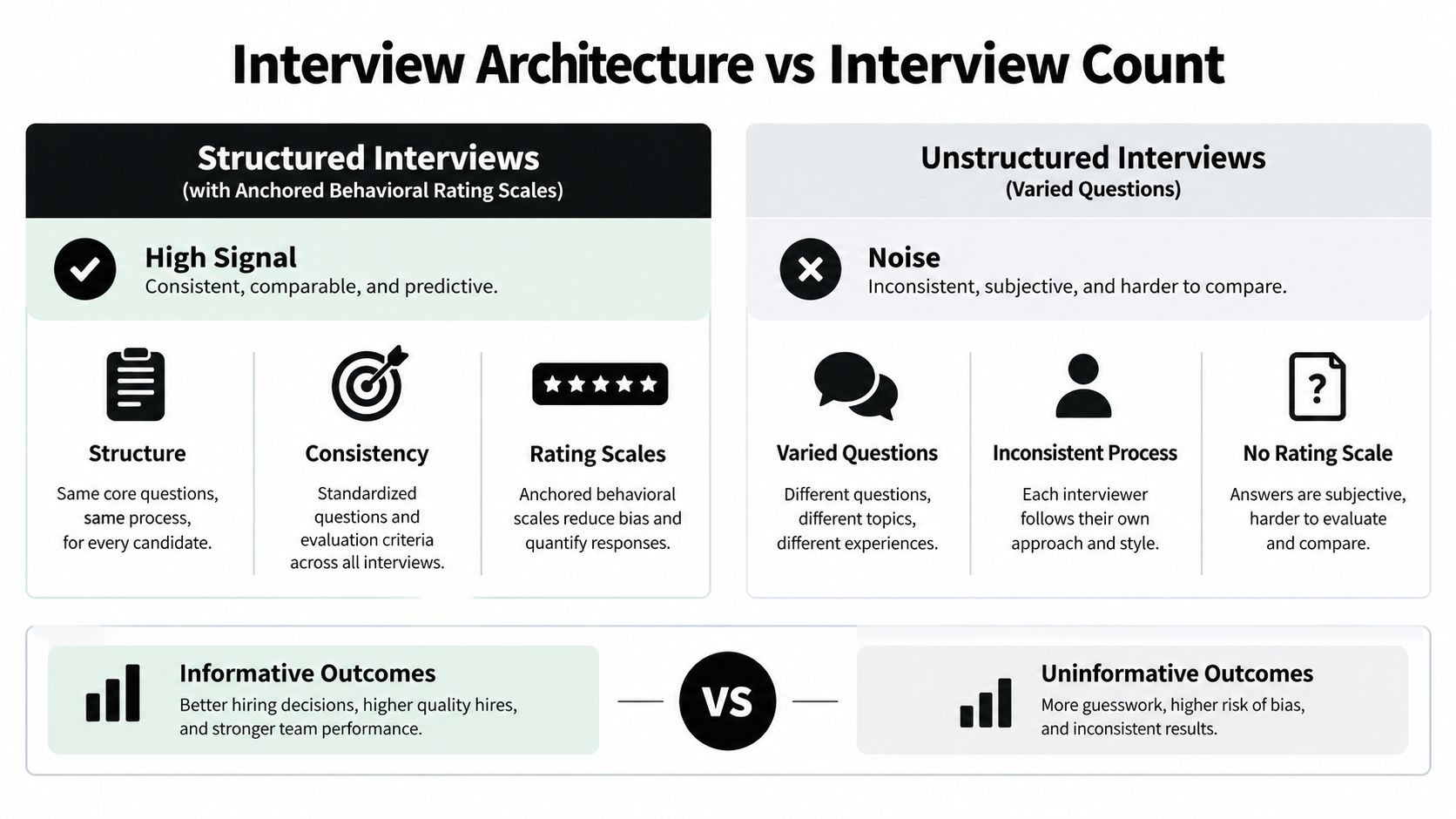
For HR leaders, the redesign question is which competencies remain untested, which stages overlap, and whether another format would assess a gap more directly. A rubric-scored interview can make judgments comparable; a loosely defined conversation may add another set of impressions without resolving disagreement. That distinction matters for equity and access: consistent questions and scoring create a common basis for evaluation, while each additional meeting asks candidates to spend more time in the process. The right architecture makes each stage accountable for evidence the hiring decision can use.
Candidate Experience, Time-to-Hire, and the Cost of Drift
66% of job seekers believed an offer should follow two interviews, while 81% expected the full application-to-offer process to take fewer than four weeks. Yet just 42% of hiring processes met that four-week expectation, according to [Robert Walters' interview-process report](https://www.robertwalters.com/content/dam/robert-walters/corporate/news-and-pr/files/whitepapers/robert-walters-whitepaper-optimising-the-interview-process-to-secure-the-best-candidates.pdf). The gap matters because interview volume is an evidence-collection decision, not a headcount target. A structured two-interview process can gather distinct, comparable evidence without the coordination burden of a six-interview marathon.
In the same report, 46% of hiring managers reported processes lasting one to two months. Robert Walters also cites Glassdoor data putting the average interview process at 20.5 days overall and 22.9 days in the United States. Its country figures show averages of 31.9 days in France, 28.8 in Germany, and 28.6 in the United Kingdom.
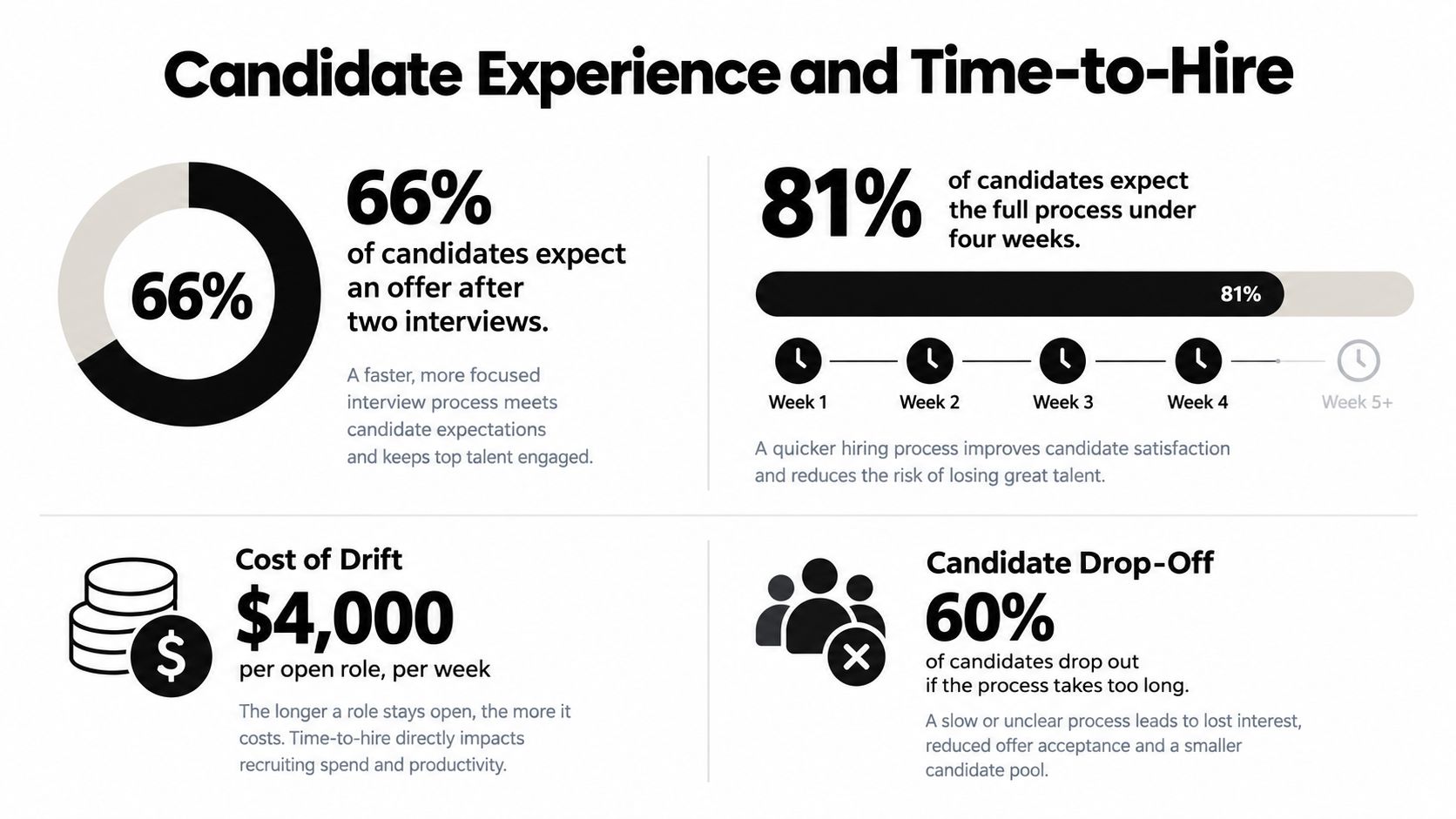
These figures do not establish that an extra interview causes a withdrawal. They do identify process length as a risk worth testing against a company's own funnel data. Every stage requires coordination, and delays between stages can turn a purposeful assessment into an uncertain wait. Candidates may be balancing other offers, work schedules, caregiving, or travel; late feedback can also cost hiring teams momentum.
Calculate the cost inside your own process
Estimate the effect with recruiting data rather than a generic claim about the cost of an open role. Compare the time between interview stages, withdrawals, offer declines, and outcomes by role family. Then locate the source of delay: the interviews, slow feedback, or difficulty finding shared availability.
A longer process can be justified when each stage adds distinct evidence. Drift starts when the next meeting has no clear assessment purpose, feedback remains incomplete, or scheduling extends the timeline without improving the hiring decision. Candidate expectations offer context, but the number of interviews should follow the evidence the role requires and what the organization's funnel results show.
The Hidden Equity Question Behind Every Extra Round
Interview burden isn't only a candidate-experience concern. It's also a measurement and access issue: who can complete each stage, who gets asked which questions, and whether interviewers evaluate comparable evidence.
Research summarized in a University of Nebraska review of selection evidence finds that structured interviews are more reliable and predictive than unstructured ones and generally produce smaller subgroup differences. That makes the usual “fewer is always fairer” argument too simple. A standardized additional interview can improve fairness when it tests a job-related competency that hasn't yet been assessed.
The reverse is also true. An unstructured conversation with another stakeholder can create more room for inconsistent questions, affinity bias, and subjective reactions. Extra appointments can also make the process harder to access for candidates managing disability-related needs, caregiving, hourly work, or cross-border scheduling.
Audit who advances and what the scores mean
Track completion and score patterns across stages for relevant demographic and access groups, using appropriate privacy and legal safeguards. If candidates from a group are more likely to withdraw at one stage, investigate the stage's format, timing, accessibility, and purpose before assuming the cause. If interview scores vary by group, examine whether questions and rating anchors are consistently applied and tied to the work.
For a practical overview of ways to reduce bias in hiring decisions, see [hireSDR.com's bias guide](https://hiresdrs.com/how-to-reduce-hiring-bias/). Teams looking to connect fairness practices with interview-process design can also consult [Synopsix's guide to reducing hiring bias](https://synopsix.ai/blog/how-to-reduce-hiring-bias).
> Another interview can improve fairness when it adds consistent, job-related evidence. Another discretionary conversation can just widen the opportunity for inconsistency.
The relevant question is not whether an additional round raises or lowers bias. It's whether that round standardizes evidence collection or gives decision-makers another unstructured opportunity to rely on intuition.
Mapping Interviews to Distinct Competencies in a Real Hiring Stack
A mid-market company hiring a senior individual contributor proposes four stages: a recruiter screen, a hiring-manager interview, a cross-functional panel, and a leadership round. Four interviews do not automatically mean a better decision. Their value depends on whether each stage collects distinct, job-related evidence.
The recruiter screen can establish role alignment and clarify relevant experience. The hiring manager can assess technical judgment and depth of work. A cross-functional interviewer can evaluate collaboration through a consistent, role-related scenario. The leadership conversation has a place only if it measures a separate requirement, such as influencing stakeholders or weighing tradeoffs that earlier stages do not assess.
| Interview Stage | Target Competency | Evidence Required | Stop Signal | |---|---|---|---| | Recruiter screen | Role alignment | Relevant experience and candidate expectations | The role criteria are already clear, and the screen repeats information without informing a decision | | Hiring-manager interview | Technical judgment | Structured examples of problem-solving and tradeoffs | The same evidence will be scored again in the panel | | Cross-functional panel | Collaboration | Responses to consistent, job-related scenarios | Panelists are gathering general impressions rather than separate evidence | | Leadership round | Stakeholder influence | Evidence of decision-making across functions | No distinct competency or decision responsibility is defined |
The table's stop-signal column operationalizes the structured-interview principle of consistent, job-linked scoring. It also exposes overlap: if the leadership round repeats collaboration questions and the hiring manager already assesses influence, the team can remove that round or replace it with a structured work sample aimed at a genuine evidence gap. In this example, three purposeful stages can cover the competencies without repeating the same assessment.
The interview design matters as much as the stage map. Teams can use [Synopsix's interview-question design guide](https://synopsix.ai/blog/interview-question-design) to turn role requirements into questions that produce comparable evidence. Clear prompts and scoring criteria make it easier to distinguish a candidate's demonstrated skill from an interviewer's general impression.
The leadership round survived the audit in this example only after the team added a written stakeholder-influence rubric. Without that rubric, the round would have been cut. This is the practical test of a hiring stack: each stage should contribute evidence that can change how the team evaluates a candidate, not add another opinion.
When Behavioral Assessments Replace Interviews Without Losing Signal
An additional interview isn't the only way to resolve uncertainty. A role-relevant assessment or simulation can produce evidence that a conversation may not, especially when the team needs to observe how a candidate approaches a realistic task.
A meta-analysis of 494 studies covering 13,521 people found that personality measures selected using explicit job analysis reached a corrected validity of .38, compared with .12 for exploratory studies without job analysis ([the meta-analysis on personality measures and job performance](https://onlinelibrary.wiley.com/doi/abs/10.1111/j.1744-6570.1991.tb00696.x)). The distinction is important: an assessment is more defensible when its constructs relate to the role's actual requirements, not when it offers a generic personality label.

Choose the assessment for the uncertainty
A structured work sample can test whether a candidate can perform a core task. A behavioral assessment can add comparable information about role-relevant tendencies. A simulation can show how someone handles a scenario that matters on the job. Each option should answer a specific question the current interview plan can't answer well.
That doesn't mean assessments should replace human judgment. Hiring teams still need to interpret results in context, check that the method is appropriate for the role, and apply consistent decision criteria. For regulated decisions or jobs where a competency requires human interaction to assess, a structured interview may remain essential.
The useful substitution is precise: replace a redundant conversation with an assessment that gives the team a different, relevant form of evidence. Don't add a test merely because it's available, and don't treat a behavioral profile as a final verdict. When the evidence is role-linked and interpreted responsibly, assessments can help a team avoid asking another interviewer to gather information the process could collect more directly.
Metrics CHROs Should Track to Know When the Process Has Too Many Rounds
Interview count alone won't show whether a hiring process works. CHROs need a view that connects process design to hiring outcomes, candidate access, and the consistency of decisions. Review the measures by role family and stage so that differences between job types don't disappear inside a single organization-wide average.
A practical dashboard can include:
Set review triggers from your baseline
A dashboard needs governance, not invented universal targets. Establish a baseline for each job family, then define review triggers based on meaningful changes in your own process. For example, if time-to-hire rises while offer acceptance falls, inspect stage delays and remove steps that produce no new evidence. If completion patterns shift for a particular group, examine scheduling and accessibility as well as interview criteria.
Use quality-of-hire measures carefully. A selection metric can look clean while missing long-term job performance, and a process change shouldn't be judged by speed alone. The point is to compare evidence gathered during hiring with what the role later requires, then refine questions, rubrics, and stages accordingly.
For a broader view of measures that connect recruiting activity to process performance, see [Synopsix's recruitment-efficiency metrics guide](https://synopsix.ai/blog/recruitment-efficiency-metrics). A useful review ends with an owner and an action: retain a stage because it contributes distinct evidence, redesign it because its scores are inconsistent, or remove it because it repeats what the team already knows.
A Decision Framework for Setting the Right Number of Interviews
There is no universal count that makes an interview process effective. A four-interview benchmark can trigger scrutiny, but the better test is whether each stage adds decision-relevant evidence. Treat interview volume as an evidence-collection question, not a headcount target.
Before adding a round, ask:
1. Which competency does it assess? Remove or redesign a stage that duplicates an existing assessment. 2. What evidence will it produce? Define the question, task, or observable behavior in advance. 3. Could the result change the decision? If no plausible answer would affect the hiring call, the meeting may add process without adding information. 4. Would another method produce better evidence? Use a structured work sample or simulation when it fits the role. 5. Can candidates access and complete it fairly? Check the format, timing, and job-related criteria for consistency.
Assign decision ownership as well. Stakeholders can review shared evidence without each requiring a separate candidate meeting. A hiring playbook should name who evaluates each competency and how reviewers resolve conflicting scores. That makes gaps visible before another round is scheduled.
Use the applicant-tracking workflow to record each stage's purpose, completed feedback, and candidate progress. A [software applicant tracking system guide](https://erecruit.io/blog/software-applicant-tracking-system) can help teams assess what their system should support. The defensible count is the smallest number of stages that gives reviewers anchored evidence for every predefined competency, with no unresolved signal gap. If a reviewer cannot identify what additional information another meeting would provide, the process needs redesign, not another interview.
Synopsix turns validated behavioral assessments into practical guidance for hiring, team design, and talent development, including comparable profiles, simulations, and compatibility analysis. For support in redesigning interviews around better evidence, visit [Synopsix](https://synopsix.ai) to explore its people-intelligence tools.