How to Assess Behavior for Smarter People Decisions
By Synopsix · August 27, 2026 · 17 min read
Most hiring teams say they assess behavior when they're really assessing presentation. A candidate can rehearse STAR answers, mirror the interviewer's energy, and sound collaborative without revealing how they respond to conflict, ambiguity, pressure, or accountability. The popular advice, “just ask behavioral questions and trust your instincts,” feels practical, but it often produces a polished conversation rather than a dependable prediction.
The better question is how to assess behavior without confusing temporary self-presentation with stable, work-relevant tendencies. That requires structure, multiple methods, job-specific criteria, and a translation layer that turns psychometric data into decisions managers can use. Structured interviews are a central part of that system, but they work because of consistent questions, probes, scoring, and trained assessors, not because the word “behavioral” appears in the interview guide. [Evidence on structured interviews](https://www.future-proof.app/research-structured-interviews/) shows validity estimates around 0.42 to 0.45, compared with about 0.20 for unstructured interviews, while some reviews report structured formats as roughly twice as predictive of later job performance.
Why Most Behavioral Assessments Miss the Mark
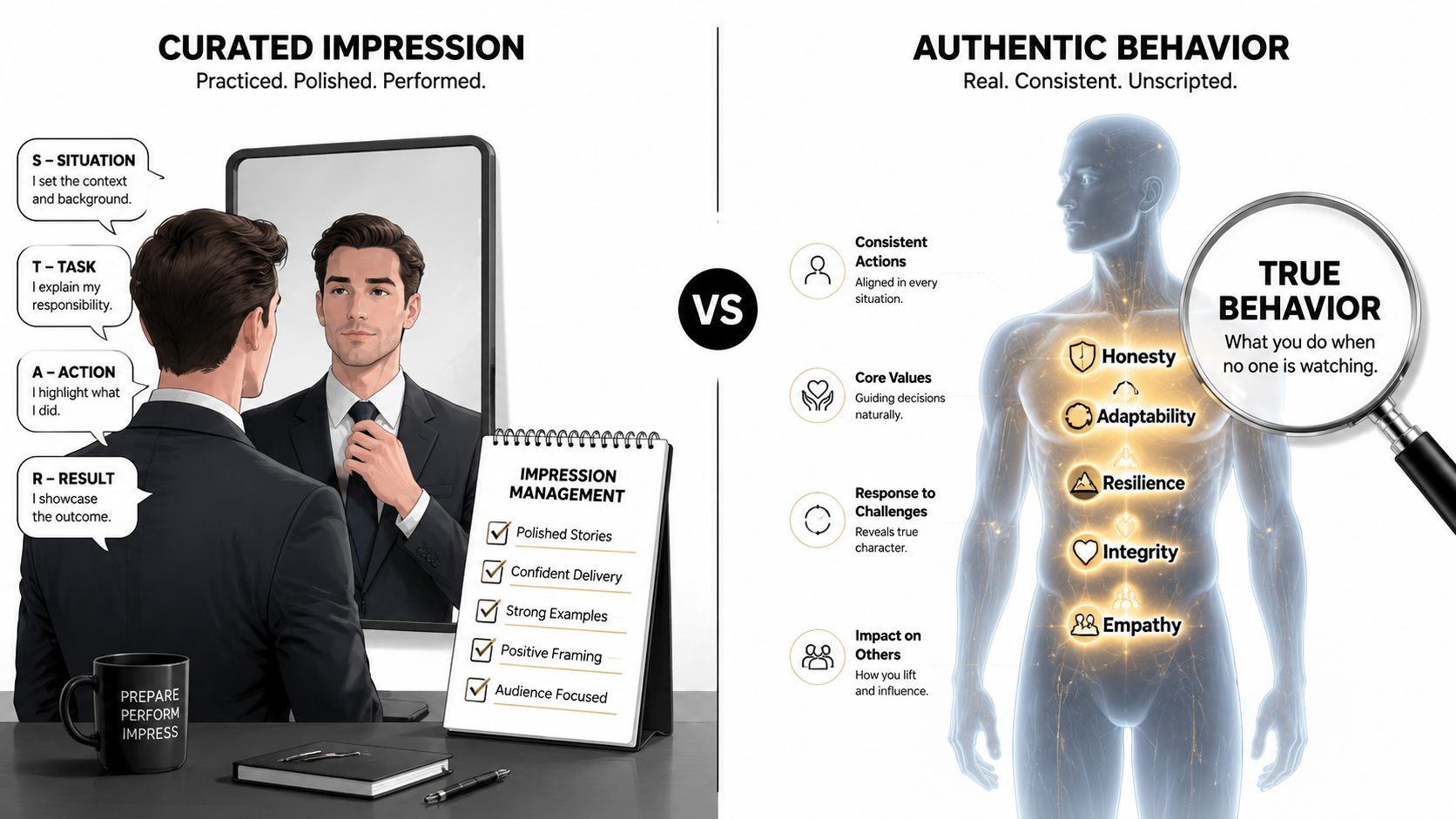
The usual behavioral assessment measures how convincingly someone performs in an interview, then treats that performance as evidence of how they will work. An unstructured conversation followed by an intuition-led debrief rewards confidence, fluency, and chemistry. It can feel insightful while producing a weak hiring signal.
Candidates can prepare for familiar prompts, select their strongest example, frame their contribution favorably, and describe a lesson learned without exposing the details that matter under pressure. Interviewers fill the gaps with assumptions. A polished answer becomes evidence of leadership, a warm interaction becomes evidence of collaboration, and shared background creates an unspoken sense of fit.
Past behavior remains useful when assessors ask anchored questions tied to defined competencies and apply the same scoring rules to every candidate. The failure occurs when teams treat interviewer memory and intuition as the measurement instrument. The interview then captures temporary self-presentation more reliably than stable, work-relevant tendencies.
What interview answers can and can't reveal
An answer shows how a candidate describes an event under controlled social conditions. It can reveal reflection, communication skill, and the ability to organize experience. It does not establish how consistently that person behaves when incentives conflict, time is short, or another person challenges their judgment.
Self-report and observed behavior are different signals. Recent HR evidence highlights that self-report studies often produce larger effects than behavioral outcome studies. That gap is a reason to treat a polished questionnaire or interview response as evidence requiring verification, not as a direct proxy for workplace performance. [The state of evidence in human resources](https://www.thehumancapitalhub.com/articles/the-state-of-evidence-in-human-resources-2025-what-the-research-tells-us-about-hiring-engagement-performance-and-leadership) also distinguishes performance appraisal from development conversations, because combining those purposes can weaken both.
Ask whether the candidate has demonstrated a relevant pattern, not whether they know the socially desirable answer.
> Practical rule: Treat an interview response as evidence to test, not as a verdict.
Why one data point creates noisy decisions
A single interview compresses complex behavior into a short, artificial interaction and gives the assessor room to improvise. One candidate may receive a probing follow-up about a failed project, while another gets an easier prompt about a success. One interviewer rewards concise answers, while another rewards enthusiasm.
The research on structured and multi-method assessment frames behavior assessment as a measurement problem. Historical behavior can come from a structured interview, task behavior from a simulation or work sample, and results from job-relevant criteria. Combining methods helps separate the target competency from confidence, likability, and impression management.
Reliable assessment looks for convergence across evidence. Does the candidate's account of conflict match how they handle disagreement in a simulation? Does a stated preference for careful execution align with the quality of a work sample? Do trained assessors identify the same behavior against the same criteria? Those comparisons turn psychometric and behavioral data into signals a hiring manager can act on, rather than leaving the decision to an attractive conversation.
Choosing Validated Assessment Methods That Actually Predict Performance
Start with the role, not the vendor dashboard. Define what successful performance requires, then choose methods that can observe those requirements under different conditions. No single assessment captures the full behavioral picture.
Match the method to the signal
A structured behavioral interview is useful for historical behavior. Ask every candidate the same core questions, use consistent probes, and score specific evidence against anchored criteria. Its predictive value depends on that structure. A landmark meta-analysis reported corrected validity of about 0.51 for structured interviews versus 0.38 for unstructured interviews. [The structured versus unstructured interview comparison](https://www.hiretruffle.com/blog/structured-vs-unstructured-interviews) explains why identical questions, scoring rules, and ordering matter.
Situational judgment tests show how candidates choose among realistic response options. They're efficient and can screen at scale, but they measure judgment in presented scenarios rather than behavior in a live work context.
Personality inventories, especially those grounded in the Big Five framework, can help identify stable tendencies relevant to a role. They shouldn't be treated as destiny or as a universal culture-fit test. A meta-analysis of personality measures found corrected mean validity of 0.29 with confirmatory strategies, compared with 0.12 for exploratory strategies, illustrating why organizations should pre-specify the connection between traits and job criteria. [The evidence on predictive validity in assessments](https://scovai.com/blog/predictive-validity-assessments/) provides that comparison.
Cognitive ability measures can add information about reasoning and learning, but they won't reveal every competency-specific behavior. Work samples and simulations create more direct evidence of task performance, although they require thoughtful design and can increase candidate effort.
Use a decision matrix
| Method | Predictive Validity | Candidate Burden | Best Use Case | Key Limitation | |---|---|---|---|---| | Structured behavioral interview | Strong when highly structured | Moderate | Historical behavior and reflection | Vulnerable to rehearsed self-presentation | | Situational judgment test | Useful for role-relevant judgment | Low to moderate | Early screening and scenario decisions | Responses may not match real conduct | | Big Five personality inventory | Depends on confirmed job links and use | Low | Stable tendencies relevant to role demands | Can be overinterpreted outside the job context | | Cognitive ability measure | Useful for reasoning and learning demands | Low to moderate | Roles with complex information processing | Doesn't capture interpersonal conduct | | Work sample or simulation | Direct evidence of task behavior | Moderate to high | Skills, prioritization, collaboration, and execution | Less efficient to create and administer |
Before selecting a provider, ask for criterion-related validity evidence, adverse impact analysis, test-retest reliability, scoring documentation, and the job criteria used for validation. A polished dashboard isn't evidence of prediction. For a practical review of measurement quality, use [assessment validity and reliability guidance](https://synopsix.ai/blog/assessment-validity-and-reliability).
A sensible stack often combines two or three complementary methods. The right combination depends on role complexity, hiring volume, candidate experience, and the consequences of a poor decision. Speed matters, but a fast process that produces unstable signals only moves the cost downstream.
Designing a Structured Behavioral Assessment Process
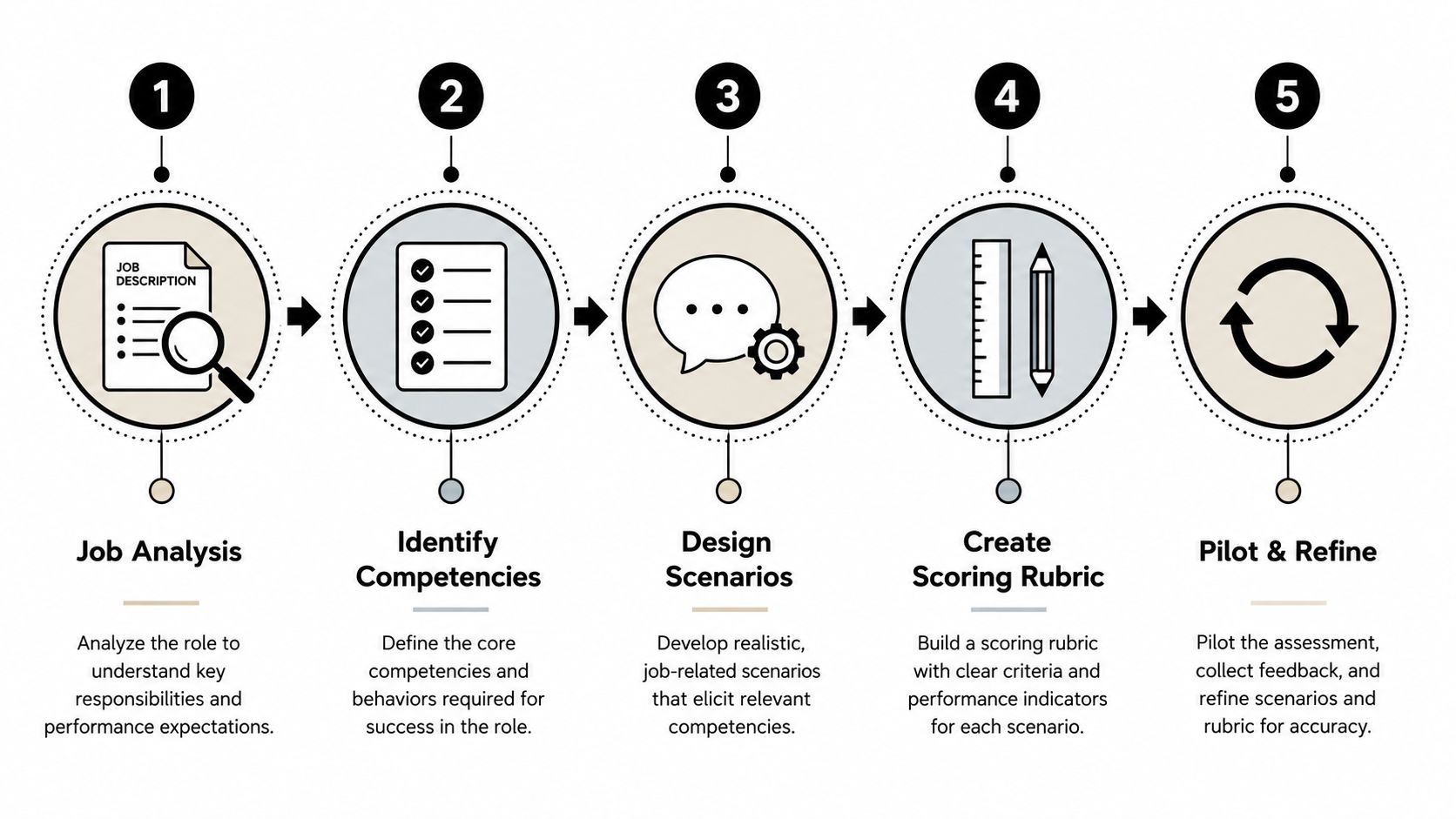
A structured process starts with the work, not the assessment platform. Identify the behaviors that separate effective performance from ineffective performance, then choose methods that can observe or test those behaviors. This distinction matters because stable, work-relevant tendencies can inform a hiring decision, while polished self-presentation may only show how well someone performs in an interview.
For a customer success manager, relevant competencies may include expectation setting, conflict handling, prioritization, and commercial judgment. For a senior engineer, they may include technical ownership, incident communication, trade-off reasoning, and cross-functional collaboration. Describe each competency through observable actions. Labels such as “culture fit” or “executive presence” are too vague to score consistently.
Build questions that force evidence
Behavioral questions should anchor candidates to a real event and require details about their actions, reasoning, and outcome. Useful prompts include:
Ask every candidate the same core questions. Standardize follow-up probes as well. Ask what the candidate personally did, which alternatives they considered, what happened afterward, and what they would change. Otherwise, the interview rewards storytelling and interviewer rapport instead of comparable evidence.
Link each question to a competency, and link each competency to a scoring guide. That chain keeps the assessment focused on job behavior rather than temporary self-presentation or narrative polish.
Make the rubric visible to assessors
A useful rubric defines evidence at each rating level. For conflict navigation, a low rating might show avoidance, premature escalation, or a description of the other person as the entire problem. A middle rating might show direct communication and a workable resolution. A high rating might include diagnosing interests, making trade-offs explicit, preserving the relationship, and following through after the decision.
Write anchors as observable actions, not personality judgments. “Strong communicator” gives assessors little to evaluate. “States the disagreement clearly, tests assumptions, proposes a specific next step, and checks whether the agreement holds” provides evidence they can compare.
Calibration makes the rubric practical. Have interviewers score sample responses independently, compare their reasoning, and resolve differences before assessing live candidates. The [structured interview research](https://www.future-proof.app/research-structured-interviews/) identifies inconsistent probes, interviewer improvisation, and excessive reliance on gut feel as sources of assessment variability. Calibration addresses each one without requiring a slower process at every stage.
Sequence the candidate journey
Use lighter methods earlier when hiring volume requires speed, then reserve deeper evaluation for finalists. A role-relevant questionnaire or brief judgment exercise can provide an initial signal. A structured interview or simulation can then test the competencies carrying the greatest business risk. The trade-off is straightforward: shorter screens improve throughput, while richer exercises demand more candidate and assessor time.
Document the question asked, the evidence provided, the rating assigned, and the rationale for any override. Keep observations separate from interpretations. “Candidate interrupted the customer in the simulation” is an observation. “Candidate lacks empathy” is an interpretation that requires stronger evidence.
The embedded walkthrough below can help interview teams visualize a repeatable process.
<iframe width="100%" style="aspect-ratio: 16 / 9;" src="https://www.youtube.com/embed/qATQ7maH6AI" frameborder="0" allow="autoplay; encrypted-media" allowfullscreen></iframe>
A reliable process lets assessors explain which job-relevant evidence supported the decision, not merely which score or impression they preferred.
Translating Psychometrics Into Actionable Business Signals
A psychometric score isn't a hiring recommendation. It becomes useful only after someone connects it to the work.
The translation starts with role demands. A high score on conscientiousness may support careful planning, but the business implication differs by context. In a compliance role, it may reinforce the need for procedural consistency. In a fast-moving product role, it may require a conversation about flexibility when priorities shift. The same trait can accelerate performance in one environment and create friction in another.
A low agreeableness signal doesn't automatically mean poor collaboration. It may indicate comfort with challenge, skepticism, or direct disagreement. Those tendencies can support strong individual contribution where independent judgment matters, while creating derailment risk in a matrixed leadership role if the person can't adapt their style or build trust.
Create a translation layer
A practical translation layer connects four elements:
1. Psychometric output, such as a trait score or situational judgment pattern. 2. Observable behavior, such as how the person handles competing priorities. 3. Business consequence, such as faster escalation, stronger quality control, or relationship strain. 4. Decision response, such as probe, simulate, coach, or proceed.
Avoid turning score ranges into universal labels. Use role-specific bands and explain what evidence would confirm or challenge the signal. A profile should flag accelerators and risks, not pretend to eliminate judgment.
| Psychometric Trait | Score Range | Business Signal | Role Fit Implication | |---|---|---|---| | Conscientiousness | Role-specific low, mid, or high band | Planning discipline, follow-through, and attention to detail | Valuable where reliability matters, but probe adaptability in volatile roles | | Agreeableness | Role-specific low, mid, or high band | Directness, cooperation, and approach to disagreement | May support challenge and independent judgment, while requiring collaboration evidence | | Emotional stability | Role-specific low, mid, or high band | Response to pressure, setbacks, and uncertainty | Relevant for high-pressure work, but confirm through realistic scenarios | | Openness | Role-specific low, mid, or high band | Curiosity, experimentation, and receptivity to new approaches | Useful in change-heavy work, with attention to execution discipline | | Situational judgment pattern | Consistent response pattern across job scenarios | Prioritization and decision quality under contextual pressure | Strongest when scenarios mirror real role trade-offs |
Percentile ranks should never stand alone. Hiring managers need a plain-language statement such as: “Likely accelerator in independent problem solving. Probe how this candidate builds alignment before making cross-functional decisions.” That sentence is more actionable than a dashboard full of trait terminology.
The [psychometric data analysis framework](https://synopsix.ai/blog/psychometric-data-analysis) is useful when teams need to connect assessment outputs with role criteria and decision rules. Seniority also changes the weighting. A frontline specialist may need dependable execution, while a senior leader may need the capacity to regulate personal preferences across competing stakeholders.
The final profile should compare candidates on decision-relevant dimensions, not rank them by who has the most attractive personality pattern. Treat every signal as a hypothesis to test through interviews, simulations, references, and observed work.
Integrating Assessments Into Your Hiring Workflow
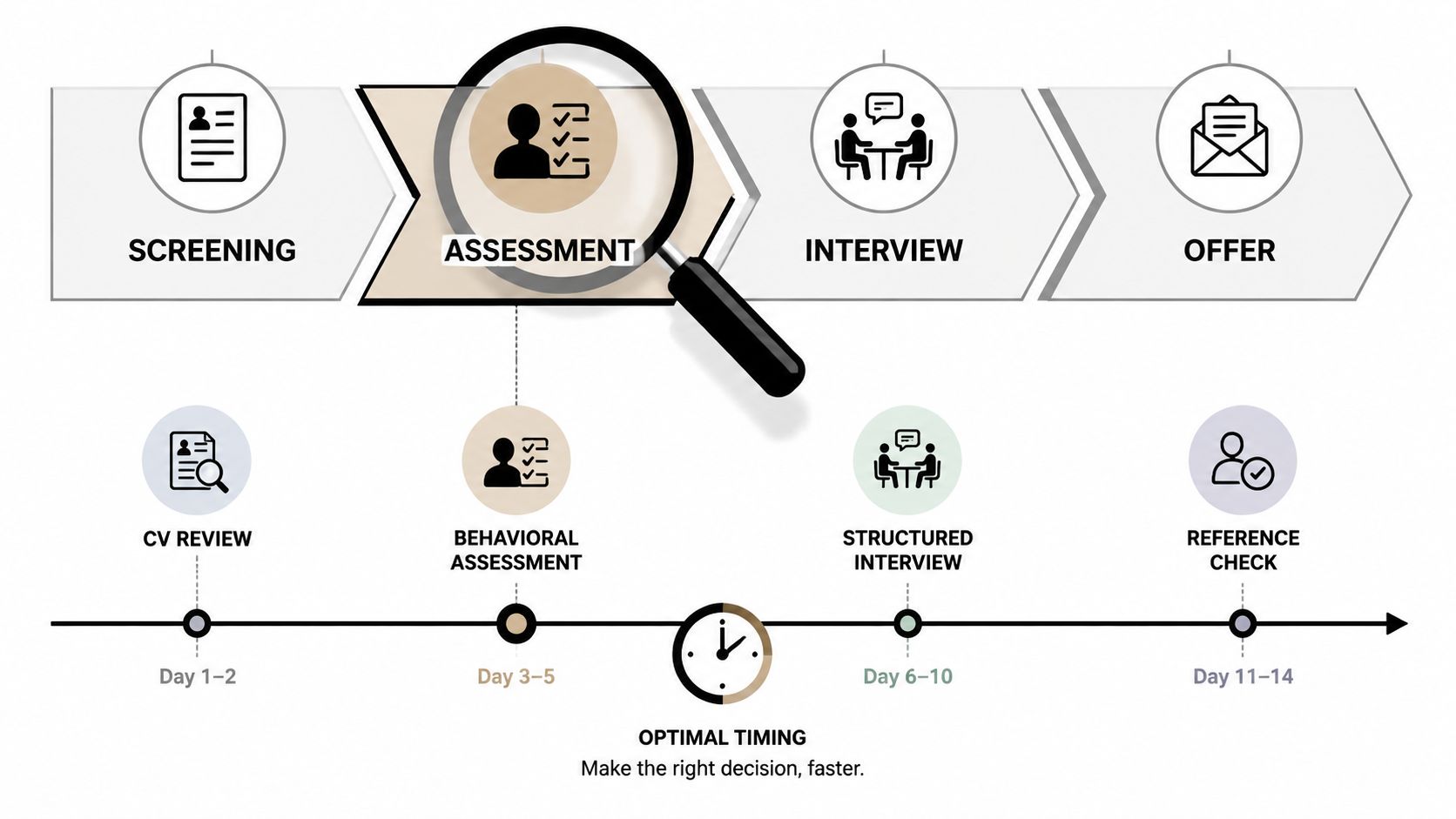
Assessment creates friction when recruiters add it after the process has already been designed. It works better when each stage has a clear purpose, owner, and handoff.
Assign one signal to each stage
Application and CV review should establish basic eligibility and experience relevance. Recruiters shouldn't infer deep behavioral traits from formatting, school names, or polished employment language.
Screening assessment can test a small set of role-relevant tendencies or judgment patterns. Keep the experience proportionate to the information it provides, and explain why candidates are completing it.
Structured interview should investigate historical behavior against the competencies identified in job analysis. Recruiters can own process consistency, while trained hiring managers or subject-matter assessors evaluate evidence.
Simulation or work sample should test the most consequential task behaviors. For a manager, that might involve prioritizing competing requests and giving difficult feedback. For a sales role, it might involve discovery, objection handling, and follow-up planning.
References and final review should test unresolved hypotheses rather than serve as a ceremonial final step. Ask references about the same behaviors the assessment measured, using specific examples rather than general praise.
Build the handoffs into the ATS
Store assessment results as structured fields, not as buried attachments. Give decision-makers a concise profile that includes the competency measured, the evidence source, the confidence level, and the recommended follow-up. Limit access to people who need the information for the decision.
When interview and assessment signals disagree, don't automatically average them. A strong interview with a weak simulation may indicate rehearsed self-presentation, unfamiliarity with the task, or an assessment design problem. The right response is a targeted follow-up, not an arbitrary override.
Teams reviewing their broader recruiting infrastructure can also use these [workforce planning tips for HR leaders](https://www.hubengage.com/employee-experience/mastering-talent-acquisition-to-build-and-retain-a-strong-workforce/) to connect assessment design with capacity, role planning, and retention priorities. For organizations building a broader evidence loop, [data-driven recruitment practices](https://synopsix.ai/blog/data-driven-recruitment) provide a useful operating model for connecting hiring decisions with later outcomes.
Track which assessments were completed, who made the decision, what evidence influenced the outcome, and how the hire performs against the original criteria. That feedback allows teams to refine weak questions, identify inflated signals, and improve the workflow without adding unnecessary stages.
Legal and Ethical Guardrails for Behavioral Assessment
Behavioral data can improve decisions, but it can also create legal and ethical exposure when organizations use it without validation, consent, or role relevance. A defensible program treats fairness as a design requirement, not a review completed after launch.
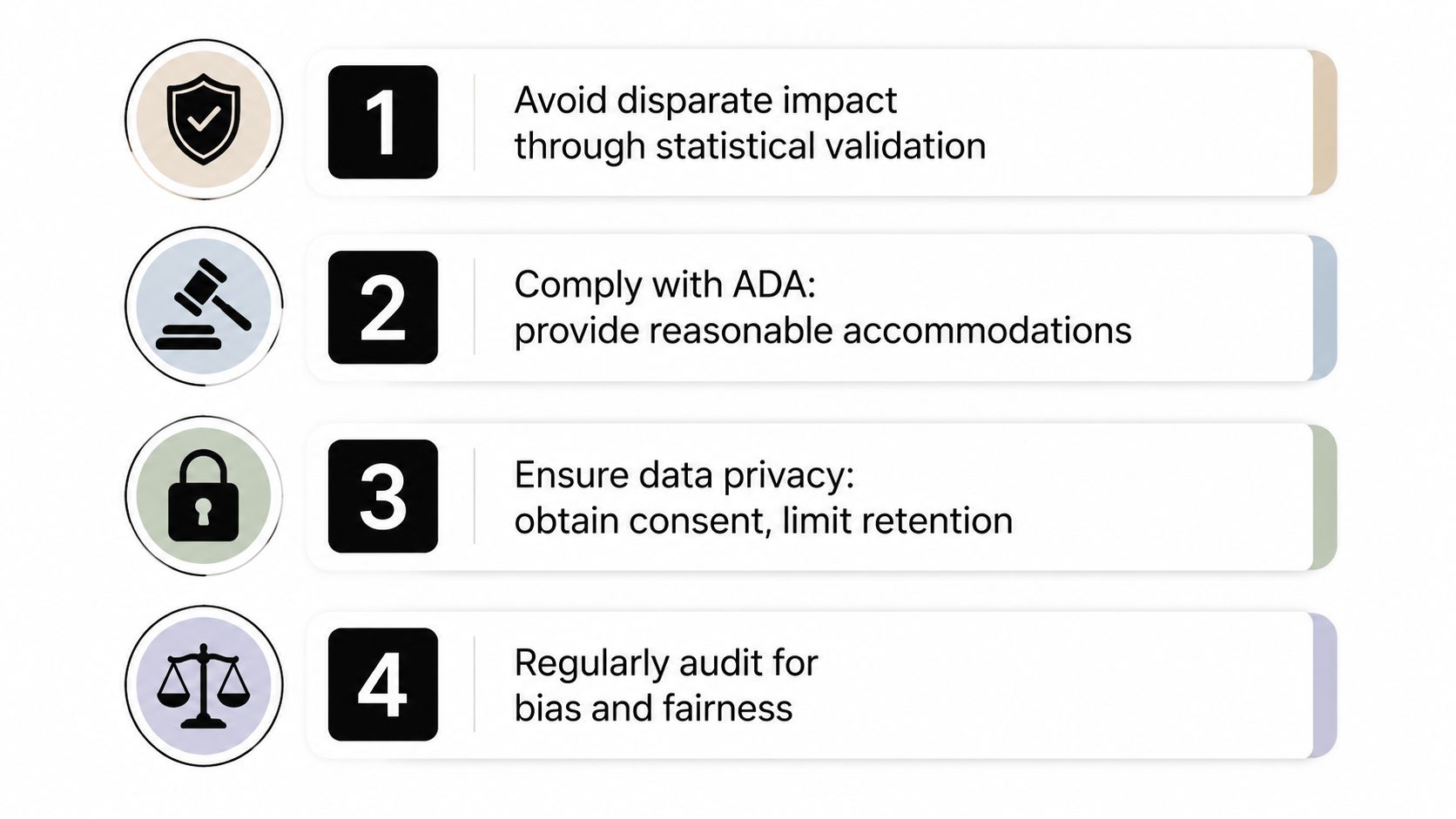
Start by validating the assessment against the job. Define the competency, document why it matters, and show how the method measures it. Conduct adverse impact analyses before and after deployment, review outcomes across relevant groups, and investigate unexpected disparities rather than explaining them away as “fit.”
Protect access and measurement integrity
Candidates with disabilities may need reasonable accommodations. Provide a practical path to request one, assess whether the accommodation changes the construct being measured, and document the decision. An accommodation should remove an irrelevant barrier, not change the job standard.
Privacy requires equal care. Tell candidates what data you collect, why you collect it, who can access it, how long you retain it, and how they can exercise applicable rights. Limit collection to information relevant to the assessment purpose, protect it with appropriate controls, and avoid reusing behavioral data for unrelated decisions without a legitimate basis.
Use caution with labels such as “dark triad” indicators. If a construct isn't clearly job-relevant, validated for the intended use, and handled with appropriate safeguards, it can stigmatize candidates and encourage managers to treat a score as a character judgment.
> Ethical boundary: Assessment data should focus human judgment on better questions. It shouldn't replace judgment or become a weapon for justifying a predetermined decision.
Keep an audit trail covering the job analysis, vendor evidence, scoring rules, accommodations, assessor training, adverse impact reviews, and override decisions. Human review matters, but “a person made the final call” doesn't make an invalid or discriminatory process defensible.
Turning Assessment Data Into Development and Team Decisions
Assessment becomes more valuable when it continues after the offer. A newly promoted manager with strong dominance and weaker empathy indicators might benefit from coaching on inquiry, listening, and the impact of direct communication. The profile doesn't diagnose the manager. It helps the coach choose observable behaviors to practice and revisit.
Team design offers another application. A project team full of fast risk-takers may need a colleague who naturally challenges assumptions and protects execution detail. A detail-heavy group may benefit from someone who creates momentum and tolerates ambiguity. The point isn't to assemble personality opposites. It's to make complementary strengths and predictable tension points visible before the project depends on them.
Leadership pipelines also improve when organizations compare assessment patterns with proven leadership competencies. In a calibration session, hiring managers might review internal mobility candidates and debate who has demonstrated strategic judgment, stakeholder influence, and learning agility. Instead of promoting the person who feels most ready, they can identify the evidence missing from the profile and assign a stretch project, coaching plan, or additional observation.
Use the data in talent reviews, succession conversations, team retrospectives, and development planning. [Synopsix](https://synopsix.ai) turns validated behavioral assessments into comparable profiles, role-oriented intelligence reports, predictive simulations, compatibility analysis, and development guidance so leaders can connect assessment data with practical action. Visit Synopsix to see how its people intelligence platform can help your team assess behavior, translate psychometrics into business signals, and make more consistent decisions from hiring through development.