How to Assess Cultural Fit Without the Bias
By Synopsix · September 25, 2026 · 17 min read
The popular advice is to “trust your experienced interviewers” when they assess cultural fit. That advice fails. Experienced interviewers often become more confident in a judgment they never defined, never documented, and never tested against job performance. Cultural fit isn't a sixth sense. It's a set of assumptions about values, work norms, team interactions, and the behaviors a role requires. If you don't translate those assumptions into evidence, your hiring funnel will reward charm, familiarity, and similarity.
The better question isn't whether a candidate feels like one of us. It's how to assess cultural fit without confusing shared personality with useful alignment. That requires an observable culture model, multiple assessment methods, calibrated scoring, team-level complementarity analysis, and decision rules that can survive legal review.
Why Gut Feel Fails at Cultural Fit
A senior candidate once charmed every culture interview. They answered the collaboration question perfectly, described themselves as transparent, and won unanimous approval. Within 90 days, the candidate had alienated two squads by hoarding context and rejecting the company's written communication norms. The interviews measured the candidate's ability to perform the language of the culture, not their evidence of practicing it under pressure.
That distinction is the heart of the problem. A polished candidate can repeat your values page. A reliable assessment asks what they did when collaboration slowed them down, when documentation exposed an error, or when a team decision challenged their preferred approach.
> The blunt diagnosis: Gut feel rewards recognizable behavior in an interview. Cultural fit requires evidence of behavior at work.
Research on person–organization fit reframed compatibility as more than skills. It connects a person's values with an organization's culture, while later work separates value congruence, which relates more closely to longer-term outcomes such as retention, from perceptual congruence, which relates more closely to day-to-day behavior and performance. A 2024 summary describes organizational fit as compatibility between workers and organizations and argues that hiring should evaluate both ability and fit, rather than treating either as a substitute for the other. The underlying research summary also shows why a universal checklist is inadequate. The relationship between individual and organizational values varies across cultural contexts.
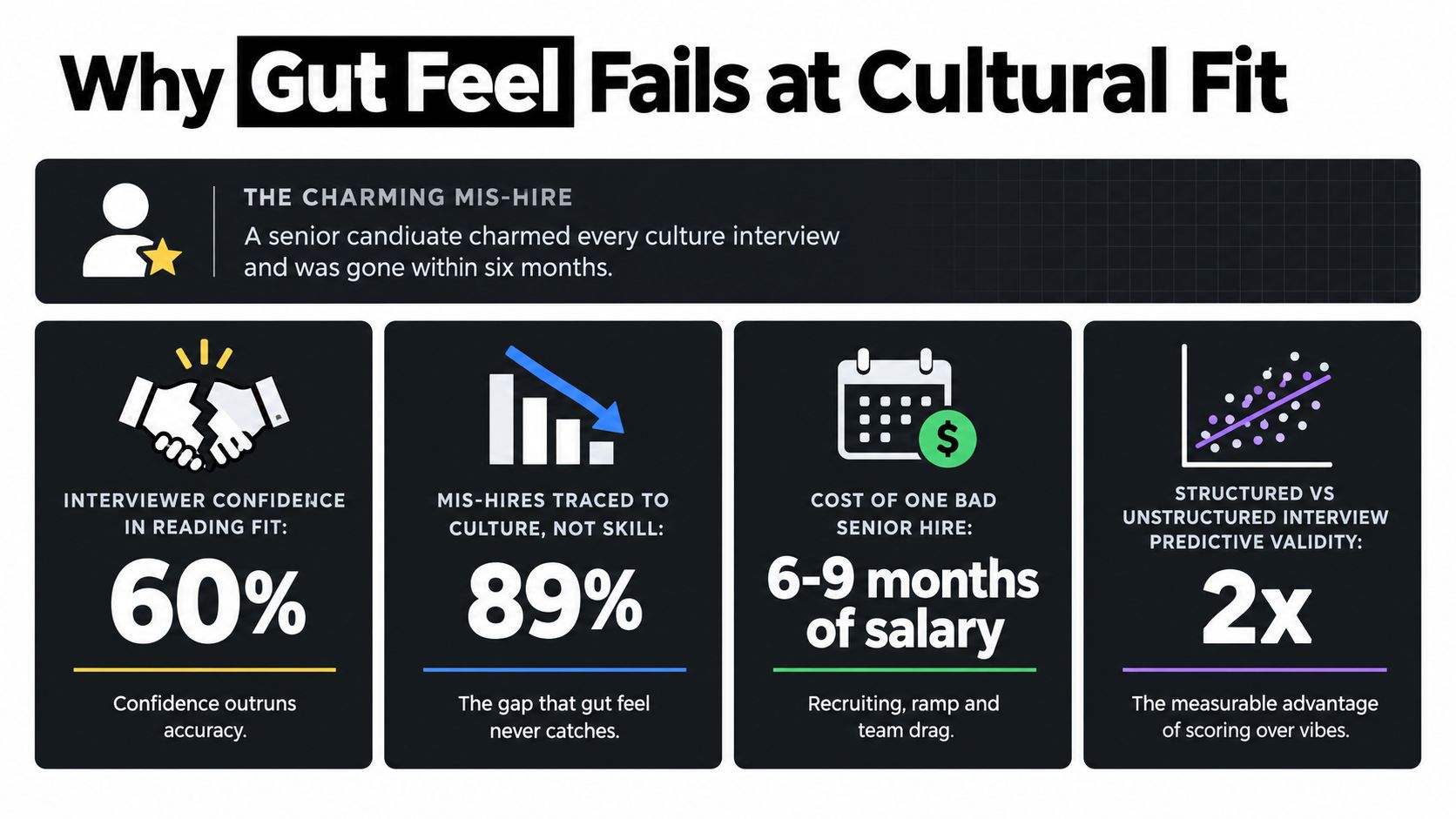
The second failure is the similarity-bias loop. Interviewers often interpret shared communication style, background, interests, or working preferences as evidence of alignment. The team then hires more people who resemble existing decision makers, which narrows the range of perspectives and makes the next similarity judgment feel even more natural.
The issue isn't that interviewers lack intuition. Their intuition is uncalibrated, undocumented, and difficult to defend. SHRM notes that no representative scientific study has established strong incremental validity for informal culture fit beyond values, abilities, personality, or organizational culture alone, and it highlights the unreliable way organizations often assess culture in subjective hiring. SHRM's discussion of culture fit and validity makes the operational recommendation clear: define criteria, structure interviews, and treat fit as evidence rather than chemistry.
Cultural fit becomes useful when leadership treats it as an organizational design variable. The relevant questions are how many aligned hires a team can absorb, which perspectives are missing, what behaviors a role demands, and how the new hire will change collaboration patterns. That is a design problem, not a vibe check.
Defining Your Target Culture in Observable Terms
Don't evaluate a candidate against a company value until you've converted that value into behavior. “Customer obsession,” “ownership,” and “collaboration” sound meaningful, but they produce inconsistent decisions unless hiring managers can point to actions that demonstrate them.
Take a customer success manager at a SaaS company moving from founder-led sales to a playbook-led team. “Customer obsession” shouldn't mean being endlessly available or agreeing to every request. It might mean responding to tickets within defined SLA windows, documenting root causes, looping in engineering proactively, declining feature requests with a clear rationale, and sharing churn learnings in team forums.
Build the behavior model before opening the funnel
Use three steps.
1. List the values that matter for the role. Keep the list tied to actual work, not branding language. A support role may require safety and escalation discipline. An engineering role may require written decision-making and constructive technical disagreement. A sales role may require commercial ownership and accurate expectation-setting.
2. Translate each value into four to six behavioral indicators. Each indicator should describe something a manager or colleague could observe. “Is collaborative” is not an indicator. “Shares decision context before requesting cross-functional execution” is.
3. Stress-test every indicator. Ask whether two reasonable employees could demonstrate the behavior in opposite ways. If one person documents extensively and another communicates verbally but reaches the same outcome, the indicator may be measuring preference rather than culture. Rewrite it around the job-relevant result.
Use this [guide to understanding organizational culture](https://synopsix.ai/blog/understanding-a-culture) to distinguish broad culture language from the specific work patterns your role needs. For teams that also want a practical example of how employee-generated content can support B2B growth, Ploot's [proven B2B lead gen with EGC](https://www.ploot.ai/en/casos-de-exito) offers useful context, but don't confuse marketing evidence with hiring evidence.
From values to observable behaviors
| Value | Observable Behavior | Evidence Candidate Must Show | |---|---|---| | Customer obsession | Responds within defined service expectations and explains trade-offs clearly | A specific example of balancing customer urgency, product limits, and follow-through | | Ownership | Documents root cause and communicates a recovery plan after an error | A past situation where the candidate took responsibility and changed the process | | Cross-functional collaboration | Loops in engineering before a recurring issue becomes a delivery risk | Evidence of sharing context early, not merely escalating after failure | | Commercial judgment | Declines unsuitable requests with a rationale and an alternative path | A decision where protecting trust required saying no | | Learning orientation | Shares churn or renewal lessons in team forums | A concrete example of turning customer evidence into changed team behavior |
Repeat this exercise for every role family. Culture shows up differently in engineering, support, sales, finance, and leadership. A company-wide statement can provide the boundary conditions, but the role profile and team context determine what alignment looks like in practice.
Choosing the Right Assessment Methods
No single method can assess cultural fit well enough on its own. Structured interviews capture past behavior, simulations expose choices under realistic constraints, psychometric assessments add scalable trait and values information, and peer panels reveal team signals that one interviewer won't see. Each method also has a predictable failure mode.
| Method | What It Measures | Best Stage | Key Limitation | |---|---|---|---| | Structured behavioral interview | Past actions, judgment, ownership, and reflection | Mid-funnel | Candidates can rehearse stories, and interviewers can still overvalue fluency | | Work-sample simulation | Collaboration, prioritization, communication, and trade-offs under realistic constraints | Finalist stage | It takes design and reviewer time, and a single exercise can overrepresent one scenario | | Psychometric and values assessment | Trait patterns, preferences, and stated values at scale | Pre-screen | Candidates can game transparent items, and results don't prove job behavior | | Peer or team feedback panel | Local compatibility, tension points, and working-style complementarity | Finalist stage | Group dynamics can create conformity and allow the loudest reviewer to dominate |
What each method actually contributes
Structured behavioral interviews work when every candidate receives the same job-relevant prompts and raters score evidence against the same anchors. Ask about a real conflict, a mistake, a difficult customer decision, or a time the candidate changed course after feedback. Don't ask, “Are you collaborative?” Candidates know the approved answer.
A practical question bank such as [behavioral assessment questions for hiring](https://synopsix.ai/blog/behavioral-assessment-questions) can help interviewers move from abstract values to evidence-seeking prompts. Interviewers should record the behavior, context, action, and result before discussing whether they liked the candidate.
Simulations are the best antidote to value performance. Give a candidate a realistic trade-off, such as a customer escalation that conflicts with a release commitment, and observe how they prioritize, share context, involve others, and explain a decision. The exercise should mirror the role's friction, not test theatrical confidence.
Psychometrics scale efficiently and can reveal patterns that interviews miss. They should inform hypotheses, not make the hiring decision. A broader comparison of [assessment tools for coaches](https://www.coachful.co/blog/best-coaching-assessment-tools) is useful when evaluating format and interpretation, but every tool still needs validation against your role model and local legal requirements.
Peer panels answer a different question: how might this person affect this team? They can surface whether a candidate's working style complements existing strengths or adds another blind spot. Keep the panel structured. Each reviewer should score independently before the group discusses the evidence.
Sequence the funnel deliberately
Use a psychometric or values assessment at pre-screen, a structured behavioral interview mid-funnel, then a simulation and peer panel at finalist stage. This sequence preserves speed early while reserving the most expensive evidence-gathering for candidates who have already met core ability requirements.
The research base supports combining methods rather than relying on intuition. Academic guidance recommends separating cognitive fit, behavioral fit, and value congruence, using multiple forms of evidence rather than a single interview impression. [The academic framework for measuring cultural fit](https://academic.oup.com/edited-volume/34264/chapter/290497861?guestAccessKey=) is especially useful for designing a method stack that measures both what candidates say and what they do.
Building a Scoring Rubric That Holds Up
A rubric earns its place only when it changes hiring decisions. Score five dimensions from 1 to 4, require observable evidence for every rating, and treat the weights as a starting design rather than a universal formula.
| Dimension | Weight | Anchor Level 1 | Anchor Level 3 | Anchor Level 4 | Candidate A Sales Score | Candidate B Engineering Score | |---|---:|---|---|---|---:|---:| | Values Alignment | 25% | Rejects or ignores core role behaviors | Shows relevant alignment with some gaps | Consistently demonstrates target values in specific examples | 4 | 2 | | Work Style Compatibility | 20% | Needs an environment the role cannot provide | Operates within team norms with support | Adapts productively and strengthens effective norms | 4 | 2 | | Communication Fit | 20% | Withholds context or communicates inconsistently | Communicates adequately in familiar situations | Shares context early, explains reasoning, and adjusts to the audience | 4 | 2 | | Collaboration Style | 20% | Creates avoidable friction or protects information | Works with others but needs defined coordination | Builds trust, handles disagreement, and improves execution | 3 | 3 | | Growth Trajectory | 15% | Deflects feedback and repeats known patterns | Learns when feedback is specific and supported | Seeks feedback, reflects accurately, and changes behavior | 4 | 3 |
Calibrate the anchors, not the personalities
A level 1 answer lacks a relevant example, contradicts the target behavior, or shows no ownership of the outcome. A level 3 answer provides a credible, role-relevant example with adequate reasoning, but leaves gaps in impact, reflection, or consistency. A level 4 answer gives specific evidence, explains trade-offs, acknowledges other perspectives, and shows the behavior transferred across situations.
Candidate A, a Sales hire, scores 3.7 after weighting the dimensions. Candidate B, an Engineering hire, scores 2.4. The total cannot override a hard floor: anyone scoring below 2.0 on Values Alignment should not advance. Technical capability does not offset a pattern of hoarding context, rejecting team norms, or refusing feedback. Those behaviors can create more organizational drag than the individual output justifies.
Use the rubric to design the organization you need, not to reward similarity to the current team. A candidate who complements existing strengths may be a better choice than one who matches them. Record both individual fit and team complementarity, then set thresholds before interviews begin so speed does not turn into gut judgment.
Hold calibration meetings with sample answers. Require raters to explain the evidence behind each score, track inter-rater reliability, and aim for above 0.7, a benchmark described in assessment guidance for checking consistent rubric use. [The Columbia and Berkeley research summary](https://business.columbia.edu/sites/default/files-efs/imce-uploads/Bernstein%20Center/Culture-Fit%20Employees_Wei%20Cai.pdf) adds an organizational lens: value congruence helps explain whether people stay, while perceptual congruence better predicts behavioral alignment and monthly bonus outcomes.
> Scoring rule: If a reviewer can't cite an observable behavior, the score is an opinion, not evidence.
Apply the rubric across structured interviews, simulations, and references. It does not replace those methods. It gives them a shared language, exposes trade-offs between rigor and speed, and creates a record explaining why a candidate advanced or declined. Review the rubric later against retention, performance, team health, and mobility outcomes, then revise dimensions that fail to predict those results.
Mitigating Bias and Legal Risk
Cultural fit programs create legal exposure when they let subjective preferences masquerade as job criteria. The most common risk scenarios include disparate impact claims when vague culture questions correlate with protected classes, failure-to-hire suits when protected candidates are rejected for an undefined fit concern, and negligent retention claims when a mis-hire contributes to a hostile environment.
For a 2026 hiring program, involve counsel in the relationship between your process and the EEOC, OFCCP, and relevant AI Bill of Rights principles. Don't wait until a complaint arrives. The legal question isn't whether your team intended to discriminate. It's whether your process used consistent, job-related criteria and preserved evidence of how decisions were made.
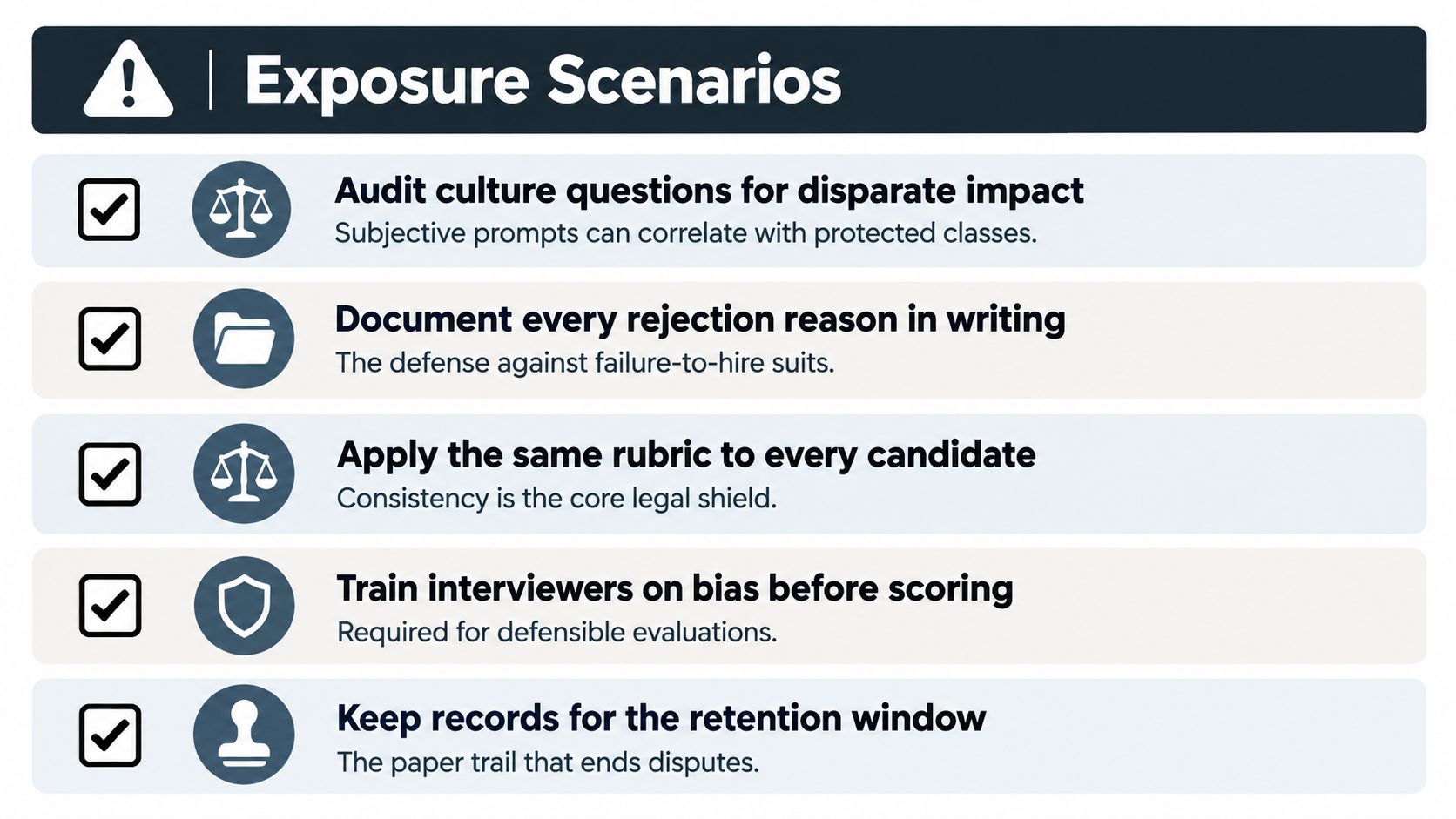
Five controls that neutralize common failure points
[This guide to reducing hiring bias](https://synopsix.ai/blog/how-to-reduce-hiring-bias) provides a useful companion for reviewing where subjective judgment enters the funnel.
Red flags that require immediate legal review
Escalate when interviewers use phrases such as “not our type,” “too aggressive,” “not polished,” or “wouldn't fit in.” Review any process where questions vary by candidate, scores appear after discussion rather than before it, demographic patterns go unaudited, or a manager can't explain a rejection without referring to personality. Also escalate automated assessments that lack accessibility, documentation, adverse-impact monitoring, or a clear human review path.
Turning Assessment Results into Action
A score in an applicant-tracking system has no value until it changes a decision or an operating routine. Set the consequences before interviews begin, then connect each result to hiring, onboarding, management, and development.
Use the rubric thresholds as explicit policy:
The supplied process visual uses a different operating band: a second structured panel between 2.5 and 3.4, followed by a decline below 2.5. If that version governs your process, publish it as the policy and apply it consistently across teams. Threshold inconsistency destroys trust in the scorecard.
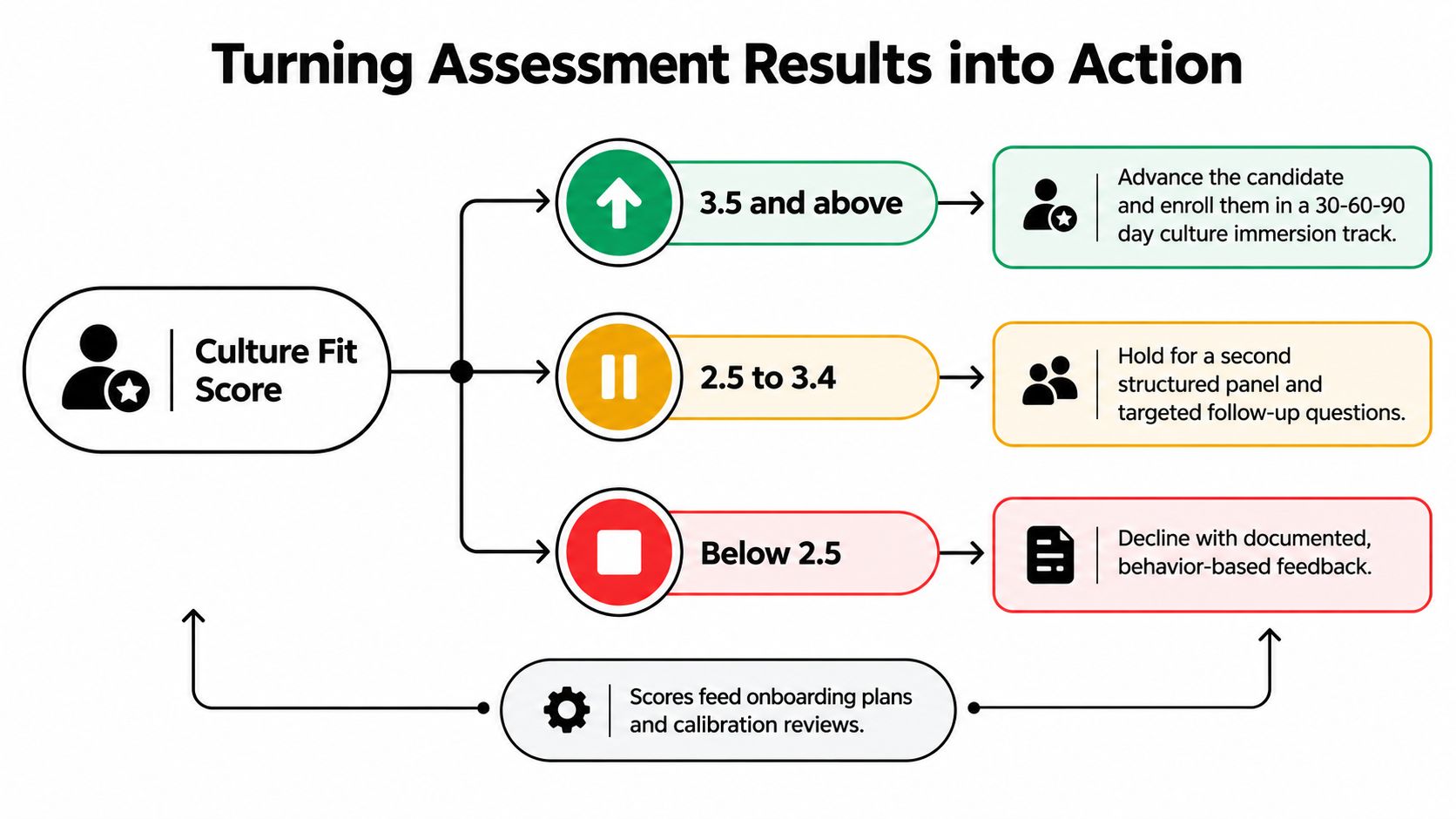
Convert scores into operating routines
An onboarding plan should name the behaviors requiring reinforcement, rather than repeat company values. A new hire with weaker written-context evidence might learn documentation norms in week one, complete a paired project during the first month, and have a manager review decision records during the first 60 days.
Use the same dimensions in one-on-one agendas and 90-day development plans. This links selection evidence to performance management without treating culture as a fixed personality label. Apply the rubric to internal mobility candidates, team transfers, and leadership promotions as well. The question is whether the person fits the new team's role context, not whether they are generally “good culture.”
Track outcomes that test the model
Track three KPIs:
1. 90-day new-hire NPS, segmented by team and hiring route, to measure whether new hires experience the working environment described during selection.
2. Six-month regrettable attrition rate, segmented by cultural-fit quartile, to test whether the assessment identifies durable alignment rather than interview performance.
3. Time-to-productivity benchmarks, defined for each role family, to assess whether stronger fit scores correspond with faster adoption of norms and effective execution.
The Columbia research adds an organizational design dimension. In one company study, existing employees' performance improved significantly when new hires in a particular office reached about 20% to 40% of staff. Before that threshold, the overall effect was positive but statistically insignificant. As noted earlier, placement, team composition, and retention affect the result.
Review hiring patterns at team level, not only candidate level. A strong individual score can still produce a poor outcome if the team lacks complementary working styles or receives too many people selected for the same narrow norm. Pair cultural-fit scores with team complementarity measures, then review retention, productivity, and employee experience by cohort. That turns culture from an interview impression into an organizational design variable that can be tested and defended.
Three Habits That Get Cultural Fit Right
First, treat culture as an artifact owned by leadership. Put the definition in writing, anchor it in behaviors, review it on a set cadence, and update it when strategy changes. If leaders can't explain which behaviors the business needs now, interviewers will fill the gap with personal preference.
Second, standardize ruthlessly. Use structured interview guides, calibrated scorecards, independent ratings, and recorded rationales for every hire. Standardization doesn't remove judgment. It forces judgment into a form that can be compared across candidates, reviewed in promotion discussions, examined during DEI audits, and defended in litigation.
Third, close the loop with data. Track 90-day new-hire performance, 12-month retention, and engagement scores by cultural-fit score. Publish the results internally, including weak findings. A rubric that never gets tested becomes bureaucracy with decimal points.
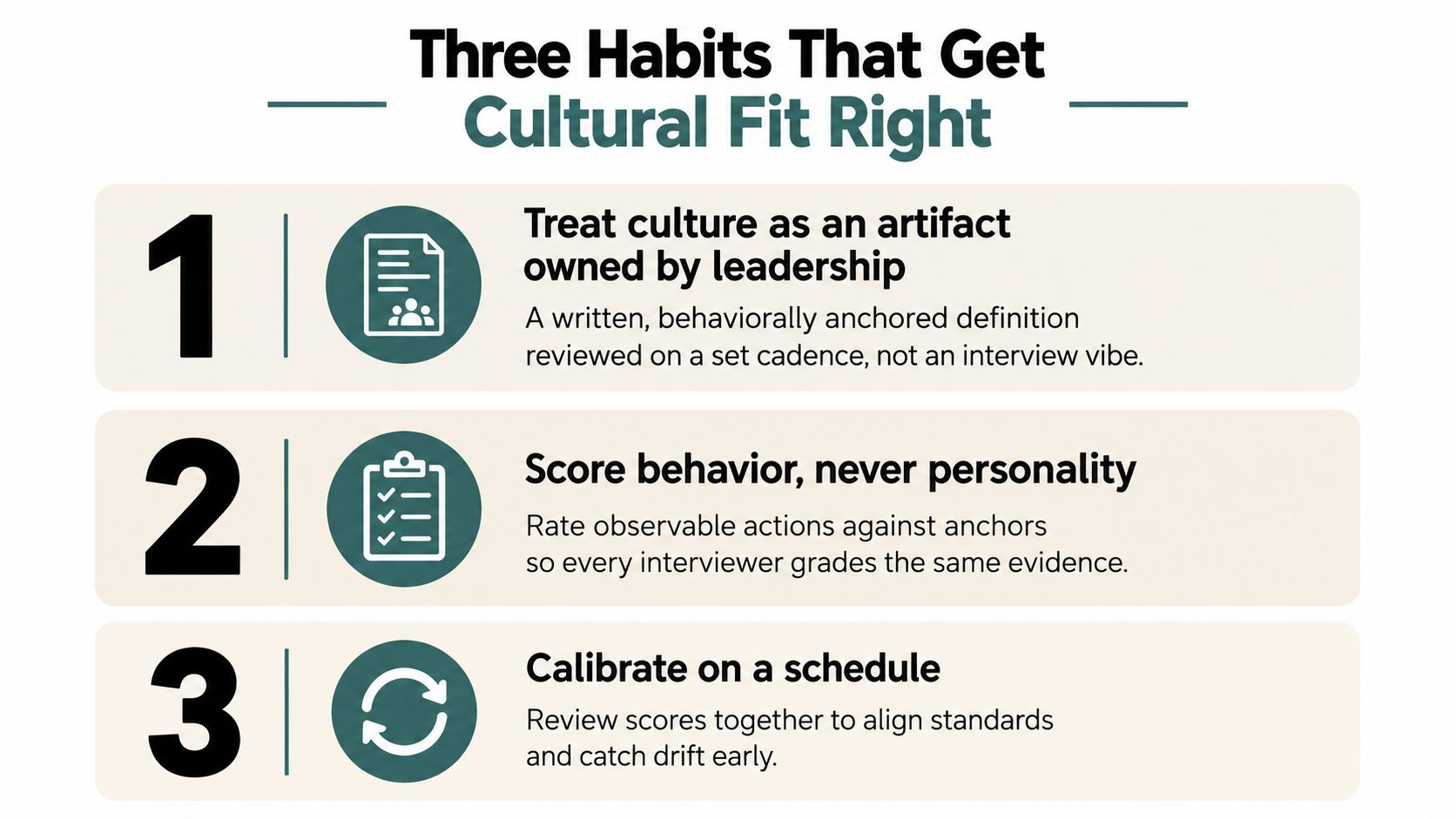
Teams that skip any of these habits repeat the same mis-hires at scale. No method is perfect, but a disciplined system beats intuition every quarter of the fiscal year.
---
Synopsix helps teams turn behavioral assessments into comparable profiles, role-specific fit recommendations, team complementarity analysis, and development plans. If you're rebuilding your cultural fit funnel, visit [Synopsix](https://synopsix.ai) to see how assessment results can become practical hiring and team-design decisions.