How to Assess Leadership Competencies: A Practical Guide
By Synopsix · August 5, 2026 · 15 min read
The promotion looked safe on paper. The manager had a strong track record, the team liked them, and the executive sponsor trusted their judgment. Six months later, the new role exposed gaps no one had measured, especially in delegation, decision-making under pressure, and how they developed other leaders.
That's the cost of relying on instinct instead of structure. When organizations assess leadership competencies well, they stop guessing who's ready and start comparing observable behavior against a shared standard. When they don't, they promote charisma, confuse current performance with future readiness, and end up repairing avoidable mis-hires, stalled succession plans, and fragile leadership pipelines.
Why Structured Leadership Assessment Matters

A lot of promotion decisions still happen the same way they did years ago. A high performer gets praised, a few senior leaders like the person's style, and someone says they've “got leadership presence.” Then the role changes, the scope expands, and the new leader finds out that being strong in the old job didn't automatically translate to the next one.
That failure usually isn't about talent. It's about misaligned assessment. The important shift in leadership evaluation has been moving from trait-based judgment to structured competency models, where organizations define leadership consistently and use multiple data points over time instead of a single subjective impression, a shift described in MIT Sloan Management Review's article on a data-driven approach to identifying future leaders ([MIT Sloan Management Review](https://sloanreview.mit.edu/article/a-data-driven-approach-to-identifying-future-leaders/)).
What changes when the process is structured
A structured model gives you something gut feel never can, a repeatable standard. It lets HR compare leaders across roles and regions, then audit why a decision was made instead of defending it after the fact. It also forces the conversation away from vague labels like “senior enough” and toward concrete behaviors such as how someone communicates, coaches, delegates, and decides.
> Practical rule: if you can't explain what success looks like in observable behavior, you're not assessing leadership. You're just reacting to personality.
The business value is straightforward. A competency-based process makes promotion decisions more repeatable, more comparable, and more auditable. That matters in organizations where one location promotes for technical excellence, another rewards charisma, and a third values harmony so much that nobody challenges weak leadership until teams start leaving.
The strongest organizations treat leadership assessment as a management system, not a one-off event. They define the role, measure the behaviors, and use the results to guide who gets promoted, who gets developed, and who needs a different seat before the mismatch turns expensive.
Building a Leadership Competency Framework
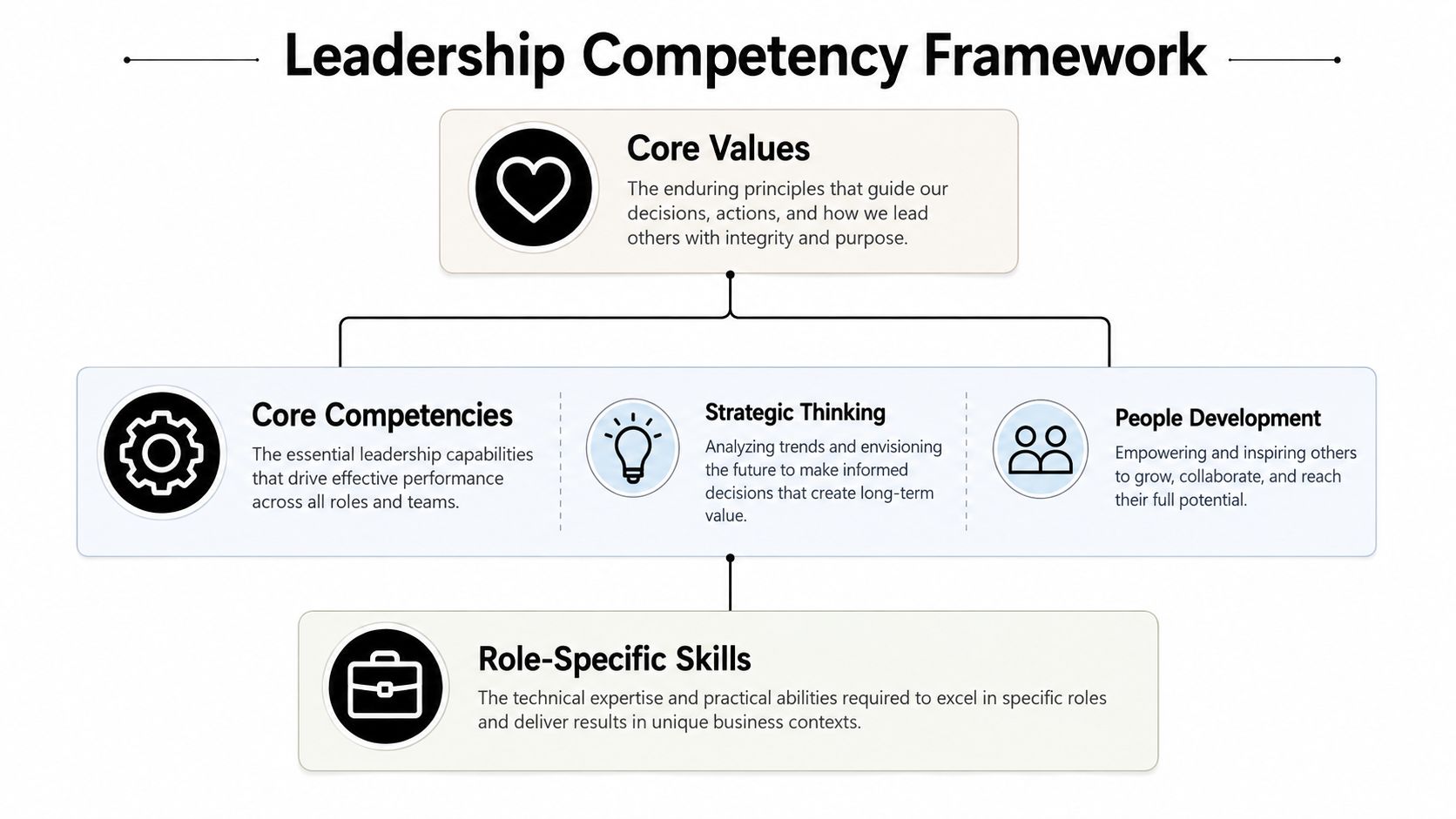
A competency framework should act as a shared language. If one manager treats leadership as driving results at any cost and another treats it as keeping everyone comfortable, the assessment process will drift no matter how polished the forms look. The framework has to define leadership in your organization, not in theory.
Start with the roles that matter most. In many companies, the core set includes communication, coaching, delegation, and decision-making, then expands into role-specific expectations as leaders move upward or into specialized functions. The point is to anchor the framework in observable behavior and scope, rather than personality labels or vague values statements.
Build from behaviors, not adjectives
Competencies work when they describe what people do. “Strategic” is too vague. “Sets priorities across competing demands and explains trade-offs clearly” gives assessors something they can observe and rate.
That also means the framework should collect concrete evidence per competency before anyone assigns a rating, then be reviewed and adjusted yearly so it keeps pace with strategy and structure, as recommended in the leadership competency framework template from Sprad ([Sprad leadership competency framework template](https://sprad.io/resources/leadership-competency-framework-template-levels-behaviors-assessment-matrix)).
Use a disciplined instrument design process
Assessment quality depends on the tool itself. One widely cited modern design standard for leadership Likert-scale assessments recommends generating 2 to 3 times more items than needed, using 5 to 7 response points, and pilot testing with at least 100 to 200 representative respondents before finalizing the tool.
Those numbers matter because leadership assessment is multi-dimensional. A single overall score is secondary to the underlying competency scores, and structured score mapping lets you compare dimensions like communication, coaching, delegation, and decision-making rather than flattening everything into one vague verdict. If the design does not let you see those differences, the framework is not mature enough for high-stakes use.
The same discipline applies to item writing. Keep the behavior window short and concrete, then tie each item to a competency you can defend. An assessment that asks people to rate whether someone “inspires others” without behavioral anchors will produce noise. An assessment that asks whether a leader has shown a pattern of clarifying priorities, coaching directly, and making timely decisions produces data you can use.
For teams building the underlying model, the article on [leadership competency model](https://synopsix.ai/blog/leadership-competency-model) offers a useful companion view of how frameworks are organized in practice.
Validate before you scale
Once the framework is drafted, test clarity and reliability before anyone uses it for promotion or succession. Pilot it, check whether assessors interpret the items the same way, and confirm that the model still reflects the business context you are hiring or promoting into. If the framework reads well but does not survive pilot feedback, it is not ready.
A framework that looks elegant in PowerPoint but breaks under pilot testing will do more damage than no framework at all.
Choosing Assessment Methods for Leadership Roles
A strong leadership assessment starts with the decision you need to make. Hiring, development, and succession all require different evidence, and the method should fit the risk, the timing, and the level of confidence you need before you act. Organizations often reuse one tool across every decision, then wonder why the results feel generic or difficult to trust.
Compare methods by the question you need answered
Behavioral interviews work well when you need concrete examples of how someone handled a real situation. Psychometric assessments are better when you want a structured view of traits, style, or decision patterns. Simulations come closest to a live test of leadership behavior, because they ask people to respond in role-specific scenarios before they hold the role.
The best choice is usually a mix, not a single method. Use behavior observations, stakeholder feedback, performance outcomes, and scenario exercises together so you can compare what people say, what others have seen, and how they respond under pressure. When those sources line up, confidence rises. When they conflict, you have a useful signal that deserves a closer look.
| Method | Best use | Strength | Watch-out | |---|---|---|---| | Behavioral interview | Hiring or promotion | Reveals how a person handled real situations | Can reward charisma if the interviewer isn't trained | | Psychometric assessment | Development or selection support | Surfaces behavior patterns and decision style | Shouldn't stand alone in a high-stakes decision | | Simulation | Hiring, succession, development | Shows how leaders behave in context | Takes more design effort than a simple questionnaire |
The interview format matters too. A well-designed interview scoring system keeps interviewers focused on the same evidence and makes their notes easier to compare across candidates. If you need a practical reference point, the [interview scoring system design](https://worksignal.com/blog/interview-scoring-system) guide is useful for turning interview notes into a clearer decision process.
Match the method to the risk
Low-risk development work can tolerate a lighter-touch method. A role with heavy people impact cannot. In those cases, a simulation or multi-method process is worth the extra work because the cost of a poor leadership call shows up in team performance, retention, and trust.
That is also why 360 feedback should usually sit alongside other inputs rather than carry the decision on its own. It captures current perceptions, which can be helpful, but perception is not the same as readiness for the next role. Synopsix's [360 assessment for leadership](https://synopsix.ai/blog/360-assessment-for-leadership) makes that limitation clear, and the point matters most in promotion and succession decisions.
> Decision rule: the higher the leadership risk, the more you should favor methods that show behavior going beyond what candidates say about themselves.
A procurement mindset helps here. Ask what each method measures, how much structure it adds, and whether it lets you compare people on the same standard. If a method does not improve decision quality, it is just extra activity.
Designing Scoring Systems That Predict Behavior
Scoring is where many leadership assessments break down. Teams build a thoughtful framework, run interviews or questionnaires, then let different managers interpret the same evidence in different ways. Once that happens, the process stops being a system and becomes a set of opinions.
A scoring model should make future behavior easier to predict, not just make past performance easy to summarize. That means the rubric has to preserve the differences between competencies, show where a leader is consistent, and surface where judgment is still uncertain. A score that looks clean on paper but hides those differences is convenient, not useful.
Use a scoring model that keeps the behavior visible
One proven structure uses 10 competencies with 4 items each, for 40 total items. Each competency is calculated as the average of its item ratings on a 1.0 to 5.0 scale, and the overall leadership index is the average of all competency scores, according to HireTruffle's scoring guidance ([assessing leadership skills questionnaire scoring](https://www.hiretruffle.com/assessments/assessing-leadership-skills-questionnaire-scoring)).
That structure works because it preserves the shape of the data. If a leader scores well on coaching but weakly on delegation, you can see the gap. If someone is uneven across dimensions, that shows up too. A single composite score can still help with executive summaries, but it should never hide the underlying pattern.
Score behavior, not intent
Leadership should be assessed from observed behavior in the last 60 to 90 days, rather than stated intent. Intentions are easy to say and harder to trust. Recent behavior is harder to fake and more useful for both selection and development. The same source also notes that these scores are often followed by a 60 to 90 day development cycle focused on the lowest-gap, highest-impact competencies ([assessing leadership skills questionnaire scoring](https://www.hiretruffle.com/assessments/assessing-leadership-skills-questionnaire-scoring)).
For validation, one common benchmark is Cronbach's alpha above 0.70, with pilot samples of 100 to 200 respondents to test clarity and reliability before rollout ([assessing leadership skills questionnaire scoring](https://www.hiretruffle.com/assessments/assessing-leadership-skills-questionnaire-scoring)). If the pilot cannot show that the items hang together reliably, the final score should not be treated as more precise than it is.
Know what your score can and can't do
A good score tells you where the behavior is strong, where it is thin, and where the assessment is uncertain. It does not tell you whether a leader will succeed in a new culture, new mandate, or more complex role unless the scoring model was built and validated for that context. I treat scoring as a decision aid, not a verdict.
If your team is refining interview rubrics alongside structured assessments, the article on [interview scoring system design](https://worksignal.com/blog/interview-scoring-system) is a useful companion for keeping scorer judgment aligned. For a closer look at how to read mixed evidence without overreacting to any single result, [assessment interpretation guidance](https://synopsix.ai/blog/assessment-interpretation) can help your team keep the findings grounded in actual decision use.
Interpreting Results and Managing Assessment Risks
A score only matters if you interpret it correctly. That sounds obvious, but a lot of organizations still make succession calls from one snapshot, one manager's view, or one self-assessment that flatters the leader more than the evidence deserves.
Separate current performance from future potential
Future-role assessment gets tricky. A leader can be highly effective in one environment and struggle in another because mandate, seniority, and context change the job. The Center for Creative Leadership notes that the same leader can succeed or fail depending on those variables, so a single current-state score can mislead succession decisions ([Center for Creative Leadership](https://www.ccl.org/articles/leading-effectively-articles/leadership-gap-what-you-still-need/)).
That's why demonstrated capability and growth potential need to be separated. Current performance tells you what the leader is doing now. Future potential tells you whether the person can handle a different scope, a different pace, or a different set of trade-offs. If you collapse those into one number, you lose the nuance that makes succession planning defensible.
Build bias checks into the process
Bias mitigation can't be an afterthought. Recent healthcare and public-sector competency frameworks put more weight on inclusive leadership, equity, belonging, and psychological safety, which reflects a broader shift toward measuring whether leaders create fair outcomes, not just whether they look decisive on the surface (ACHE inclusive leadership competencies PDF).
That same source also reinforces a common mistake to avoid, over-reliance on self-assessments and single-source ratings. Those inputs can be useful as one data point, but they're weak on their own because they're easy to distort with blind spots, social desirability, or political context.
> Practical rule: if only one rater or one instrument is driving the outcome, the process isn't defensible enough for high-stakes leadership decisions.
Calibrate before you decide
Score calibration is where fairness gets operational. Bring assessors together, review concrete examples, and test whether they're applying the same standard to similar evidence. Then check whether the assessment is producing different outcomes for different groups in ways that need explanation or correction. Inclusion-related competencies only matter if they're connected to measurable leadership behavior and, eventually, business outcomes.
Synopsix's [assessment interpretation](https://synopsix.ai/blog/assessment-interpretation) resource is helpful if you need a practical lens for translating results into readable signals without flattening nuance.
Integrating Assessments Into Hiring and Development Workflows
Assessment systems work when they change decisions. If the data sits in a report and never reaches hiring, performance, or succession conversations, the process becomes theater.
Treat the framework as a common operating language
The cleanest implementation I've seen is when the competency model becomes the shared language across leadership roles. Hiring uses it to screen for fit. Performance management uses it to rate behavior. Succession planning uses it to compare readiness across levels. The point isn't to make every process identical. The point is to stop using different definitions of leadership in different parts of the business.
Promotion decisions should be anchored in behaviors and scope, not in personal impressions. A manager should be able to point to concrete evidence per competency before assigning a rating, then explain why the evidence supports the decision. That's how you move from favoritism or instinct to consistency.
Put a review cycle around the system
A framework shouldn't fossilize. Review and adjust it yearly so it stays aligned with strategy and organizational structure, then recalculate what matters if the business shifts. When your organization changes how it sells, operates, or expands, leadership expectations shift with it.
For practical workflow integration, use three checkpoints.
Connect the system to everyday HR work
This is also where tooling matters. Some teams use structured assessment platforms, some build the process in their own HR stack, and some combine assessments with simulation or feedback tools. Synopsix is one option in that category, since it profiles people, maps skills and motivators, and turns behavioral data into decision support for hiring and leadership use cases. It belongs in the same conversation as the rest of your workflow, not as a replacement for human judgment.
The main test is simple. If the assessment data doesn't change who you hire, how you develop, or how you promote, the process isn't integrated enough.
Your Leadership Assessment Action Checklist
Start with the decision you need to make, then build the assessment around it. For hiring, promotion, or succession, define the competencies that matter in your organization and write them as specific behavioral descriptors instead of vague trait labels. Tie each competency to role scope, and collect concrete evidence before any rating is assigned.
Choose methods for the kind of prediction you need. Use behavioral interviews to surface past examples, psychometrics to add structured insight into patterns, and simulations when you need to see how someone behaves in a role-specific situation. High-risk leadership calls deserve multiple sources, because a single method is easy to misread.
Build scoring so the behavior stays visible. Use item-level scoring, review competency-level patterns, and pilot the tool before anyone relies on it for a promotion or succession decision. If reliability is weak, pause and fix the process instead of pretending the numbers are ready.
Interpret results with discipline. Separate current performance from future potential, check for bias in both the process and the outcomes, and avoid making a high-stakes call from self-assessments or single-source ratings alone. If the same score leads to different outcomes for different groups, stop, recalibrate, and retest the assessment mix.
Keep the system under review. When the business shifts, leadership expectations shift with it, so revisit the framework and the scoring rules rather than letting them drift. The point is not to measure how someone behaved in the past. It is to predict how they are likely to lead in the next role, under the next level of pressure.