How to Build an AI Team That Actually Ships Results
By Synopsix · September 30, 2026 · 18 min read
Employer demand for AI skills rose from about 0.5% of all job postings in 2010 to 1.7% in 2024, with nearly 628,000 postings requiring at least one AI skill in 2024, according to the [Atlanta Fed's analysis of AI skill demand](https://www.atlantafed.org/research-and-data/publications/workforce-currents/2025/05/21/01-by-degrees-measuring-employer-demand-for-ai-skills-by-educational-requirements). That shift changes the question. Building an AI team isn't mainly about finding a handful of brilliant researchers. It's about designing a workforce that can translate business problems into reliable systems, deploy them, and help people use them safely.
The strongest teams combine technical depth with product judgment, domain knowledge, operational discipline, and behavioral fit. They define ownership before they post jobs, validate collaboration patterns before making offers, and measure whether people can recover from failure, not just produce impressive demonstrations. Here's how to build an AI team that ships real results.
Why Most AI Teams Stall Before They Ship
Bain reports that AI-related job postings have grown 21% annually since 2019, while compensation has increased 11% annually over the same period. Its analysis also says 44% of executives identify a lack of in-house AI expertise as a barrier to implementing generative AI, and projects that U.S. demand could exceed 1.3 million AI roles over the next two years while supply may remain below 645,000, leaving as many as 700,000 workers needing reskilling. Review the [Bain analysis of the widening AI talent gap](https://www.bain.com/about/media-center/press-releases/20252/widening-talent-gap-threatens-executives-ai-ambitions--bain--company/) for the underlying figures and projection.
Those numbers explain the hiring pressure. They do not justify building a team around one famous researcher. In enterprise settings, that choice creates a costly bottleneck. The senior hire becomes the translator between executives, engineers, legal teams, operations, and customers. Decisions wait for that person, while adoption and business outcomes remain unowned.
Three predictable stall patterns
The lone-expert dependency starts when a company treats a senior hire as a substitute for team design. An expert may be excellent, but one person cannot provide product context, data access, production support, stakeholder alignment, and change management at the same time.
The science-project trap starts with an impressive model and no deployment owner. The team optimizes accuracy in isolation, then finds that the workflow cannot accept the output, the data arrives too late, or nobody has authority to change the process.
The collaboration blind spot appears when hiring managers test coding ability but ignore ambiguity, disagreement, documentation, and reactions to an imperfect first release. Technical interviews show what a candidate can solve alone. They do not reliably show how that person will behave inside a cross-functional team.
> Practical rule: Hire for the full delivery system, not for its most glamorous component.
The Atlanta Fed also found that AI skill demand expanded in occupations requiring at least an associate degree. The implication is direct: an AI workforce needs more than research scientists. It needs engineers who integrate systems, analysts who understand business decisions, operators who support adoption, and managers who distribute responsibility across functions.
Build a team that can take one use case from framing to governed production. Set a first production pilot within 90 days as a delivery challenge, not as a promise of model performance. Assess team composition, collaboration habits, and behavioral fit alongside technical skill. Use structured interviews and psychometric validation before offers, then document decision rights and dependencies through an [organizational alignment framework](https://synopsix.ai/blog/organizational-alignment).
Interim leadership can help while permanent capability develops. Resources on [how to hire fractional executives for results](https://capstacker.io/blog/team-building-for-leaders/) can clarify temporary operating roles, but temporary leadership must not become a substitute for long-term ownership.
Define the Mission Before You Define the Roles
Don't begin with a job description. Begin with a business problem that a senior executive is willing to own.
Write the mission in operational language. “Build a large language model” isn't a mission. “Reduce manual claims triage,” “improve the consistency of underwriting decisions,” or “help service teams resolve complex cases” gives the team something measurable to investigate. The wording should identify the user, the workflow, the decision being improved, and the business owner accountable for adoption.
Use a three-stage mission workshop
First, state the desired business change. Define what must become faster, safer, more consistent, or easier to manage. Avoid inserting a preferred technology before the team understands the problem. A model is a means, not the outcome.
Second, pressure-test the use case. Ask whether the organization has usable data, a clear process, a sponsor with decision authority, and a realistic way to evaluate results. A promising idea without data access is not a ready AI initiative. A technically feasible idea without workflow ownership is not a deployable initiative.
Third, derive the role map. The mission should determine the capabilities you need. Most enterprise teams require some combination of four tracks:
A mid-sized insurer might start with claims automation rather than a customer chatbot because its claims records are cleaner, the workflow is already documented, and the business sponsor can define what a useful triage recommendation looks like. That choice creates a different team. The insurer may need a claims-domain lead, a product manager, a data engineer, an applied scientist, and an integration engineer. It may need fewer conversational AI specialists than a chatbot-first strategy would suggest.
Let the mission reject attractive roles
A FAANG-style ladder is not a workforce plan. If the mission is a regulated decision workflow, domain fluency and governance may matter more than another research-oriented role. If the mission is a shared data and inference platform, platform reliability and data engineering deserve more weight than surface-level product polish.
Write down the business owner, technical owner, deployment owner, risk owner, and adoption owner before sourcing begins. If one person holds all five responsibilities, the design is probably too thin. A clear [mission statement framework](https://synopsix.ai/blog/value-of-a-mission-statement) can help leaders turn an ambitious AI agenda into a decision-making document that guides hiring.
Map the Skills Matrix Across Four Capability Clusters
A skills matrix should prevent two common errors. The first is hiring people who are impressive in one discipline but unable to operate across the delivery chain. The second is treating every AI role as if it requires the same profile.
Score candidates against four capability clusters, then change the weighting according to the mission. A platform-heavy build should weight data engineering more heavily. A regulated use case should place greater emphasis on domain fluency, documentation, and judgment under constraints. A product-led automation initiative may need more weight on problem framing and workflow integration.
A practical scoring model
Use a 1-to-5 score for each cluster. A score of 1 means the candidate offers little evidence. A score of 3 means they can perform the work with normal support. A score of 5 means they have repeatedly handled complex situations and can raise the capability of others.
| Capability Cluster | Weight Mission-Dependent | Sample Skills | Observable Signals | Psychometric Traits | |---|---|---|---|---| | Technical | High for model-led work | Python, statistics, MLOps, model evaluation | Can explain an evaluation choice, diagnose an error pattern, or describe a model rollback they led | Learning agility, conscientiousness | | Data engineering | High for platform-led work | Pipelines, governance, lineage, feature stores | Can trace data quality issues, negotiate access constraints, and explain lineage to a nontechnical owner | Persistence, ownership | | Product and domain | High in regulated or workflow-heavy work | Problem framing, experiment literacy, regulatory fluency | Can reject a technically attractive use case and define a decision that users can act on | Judgment, openness to feedback | | Operations and collaboration | High for enterprise deployment | Stakeholder communication, delivery discipline, ambiguity tolerance | Can describe a disagreement resolved with a business owner and a controlled imperfect release | Team cohesion preference, emotional stability |
The observable signal matters more than the label. Don't ask whether someone is “strategic.” Ask them to explain a time they changed scope after discovering that the data or workflow couldn't support the original plan. Don't ask whether they collaborate. Ask how they handled a data access dispute with a business owner who had a legitimate confidentiality concern.
Put behavior on the same scorecard
Coding scores are useful, but they shouldn't be the only predictive input. Learning agility, conscientiousness, and a preference for team cohesion affect whether someone documents limits, accepts review, escalates risk, and keeps learning after the first deployment. Those traits should sit beside technical evidence in the matrix, not appear as an informal impression at the end of the process.
Predictive validity means showing that an assessment score forecasts later job performance. The process requires collecting applicant scores, hiring through existing methods, and comparing those scores with actual performance later. As explained in this [overview of predictive validity in selection decisions](https://txwes.pressbooks.pub/iopsychologytxwes/chapter/5-2-selection-decisions/), meaningful validation can take months or years, so establish the measurement plan before hiring rather than retrofitting it after a poor appointment.
For teams that need a structured way to connect behavioral profiles with role and team requirements, [skills inventory management](https://synopsix.ai/blog/skills-inventory-management) is one useful lens. The principle is simple. Assess the individual, assess the work, then examine the interaction between the two.
Sourcing, Interviewing, and Behavioral Validation
Treat hiring as a funnel with hard gates, not a sequence of enthusiastic conversations. The matrix tells you where to look, the interview tests whether candidates can perform, and behavioral validation shows how they'll operate when the work becomes ambiguous or politically difficult.
Start sourcing by capability. Technical candidates may be found through GitHub, Kaggle, OpenML, and conference communities, but repositories and papers aren't enough. Look for evidence of testing, deployment, maintenance, incident response, and communication with users. Product and operations candidates may come from people who have shipped machine learning inside regulated industries, managed workflow change, or translated complex systems for nontechnical stakeholders.
Five gates for a disciplined funnel
1. Targeted sourcing: Search for evidence tied to the role's capability clusters rather than collecting prestigious credentials. 2. Skills matrix screen: Score every candidate against the role's weighted matrix and reject candidates who fall below the agreed threshold. 3. Structured technical interview: Give candidates a realistic problem, not trivia. Ask them to identify missing information, define an evaluation approach, and explain what they would ship first. 4. Behavioral validation: Probe ambiguity tolerance, stakeholder disagreement, ownership, documentation, and willingness to release a controlled imperfect version. 5. Final reference gate: Verify prior delivery with concrete examples, including what the candidate owned, what went wrong, and what changed afterward.
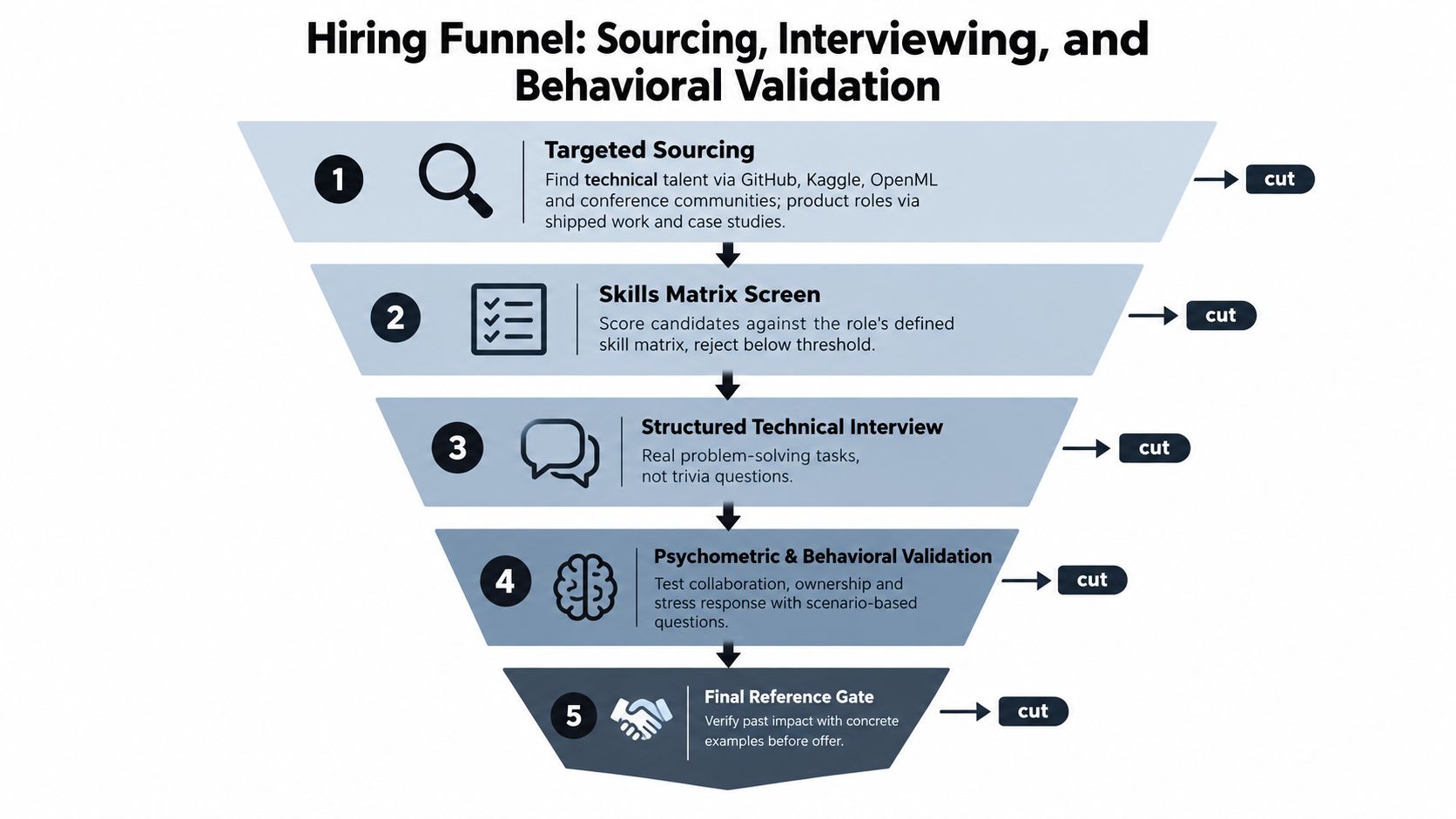
Use a 45-minute case study with realistic business data or a carefully constructed equivalent. A candidate should diagnose a failing model, identify whether the problem is data, evaluation, integration, or user behavior, and recommend the next controlled test. The best answer isn't always the most advanced model. It's the answer that makes trade-offs explicit.
Add behavioral evidence without creating theatre
Use structured STAR prompts. Ask about a time the candidate disagreed with a stakeholder, shipped a limited first version, discovered a serious model limitation, or had to change direction after new evidence. Score the answer against observable behaviors. Don't reward confidence when the candidate can't explain uncertainty.
A psychometric assessment can add a consistent behavioral signal, provided you use a validated instrument and interpret it against the role. The Predictive Index says its Behavioral Assessment takes six minutes and measures four behavioral drives through an untimed, free-choice stimulus-response format. Its hiring workflow sets a behavioral target for the role, ranks candidate fit, and can combine the behavioral assessment with cognitive testing and AI-generated interview questions, as described in its [assessment materials](https://www.predictiveindex.com/learn/support/our-assessments/) and [hiring workflow](https://www.predictiveindex.com/software/hiring/).
Run interviews in a concentrated sequence, debrief on the same afternoon, and require two approvers before an offer. If you need to compare internal teams with external delivery partners, an [enterprise BPO strategy guide](https://anybpo.com/offshoring-vs-nearshoring) can help frame the sourcing trade-offs. References should focus on shipped outcomes and working behavior, not just title, institution, or technical vocabulary.
Build, Blend, or Buy the Capability You Need
Stop debating build versus buy as if one answer should govern the entire AI program. Decide at the capability level.
Hire full-time when the work is strategic, recurring, competitively sensitive, or intimately linked to proprietary data and decisions. Blend when the organization needs specialist depth but doesn't yet have enough recurring demand to justify a large permanent group. Buy when the capability is commodity, temporary, or useful mainly for a bounded prototype.
Use five decision criteria
Score each capability against strategic differentiation, regulatory exposure, in-house learning curve, time-to-value, and total cost over 24 months. If two or more criteria point clearly toward one mode, use that mode. If the signals conflict, blend. The blended option is often the most practical because it preserves internal ownership while buying access to scarce expertise.
| Criterion | Build Full-Time Hire | Blend | Transition to Build | Buy Vendor Only | |---|---|---|---|---| | Strategic differentiation | Keep core model, workflow, and decision logic inside | Keep product and architecture inside, supplement specialist execution | Move repeatable knowledge to internal owners | Use for generic capability | | Regulatory exposure | Retain accountability and controls internally | Vendor supports delivery, internal leaders own approval | Transfer documented controls and review routines | Accept only when exposure is limited | | In-house learning curve | Invest when capability will recur | Pair internal staff with specialists | Use vendor work as a learning vehicle | Avoid building knowledge that won't be reused | | Time-to-value | Slower at the start, stronger long-term control | Faster access with shared responsibility | Stage the handover against capability milestones | Fastest for bounded work | | Total cost over 24 months | Favors recurring, differentiated work | Favors uncertain demand or specialist peaks | Reduces long-term dependency | Favors transient or commoditized needs |
A small internal team paired with a vendor for MLOps, evaluation, or domain data labeling can work well. The internal product owner must still define the problem, approve the evaluation method, control access to sensitive data, and retain the operational runbook. Otherwise, the organization is renting capability without learning how to manage it.
Set the exit condition before the contract starts
Every blended engagement needs a transition plan. Name the internal owner, require documentation in the organization's systems, include shadowing in the delivery plan, and define which decisions must move inside the company. Review the decision quarterly as data access, market supply, and internal skills change.
The most damaging outsourcing mistake is handing away the learning loop. If the vendor frames the problem, selects the evaluation criteria, operates the system, and explains the failures, the internal team can't later own the capability. Buy execution if necessary. Don't buy helplessness.
Onboarding, KPIs, and Risk Management After Day One
A strong hire can still fail if onboarding drops them into a maze of undocumented systems and competing sponsors. The first month should connect the person to the business context, the existing technical reality, and a visible result.
Use three rituals immediately:
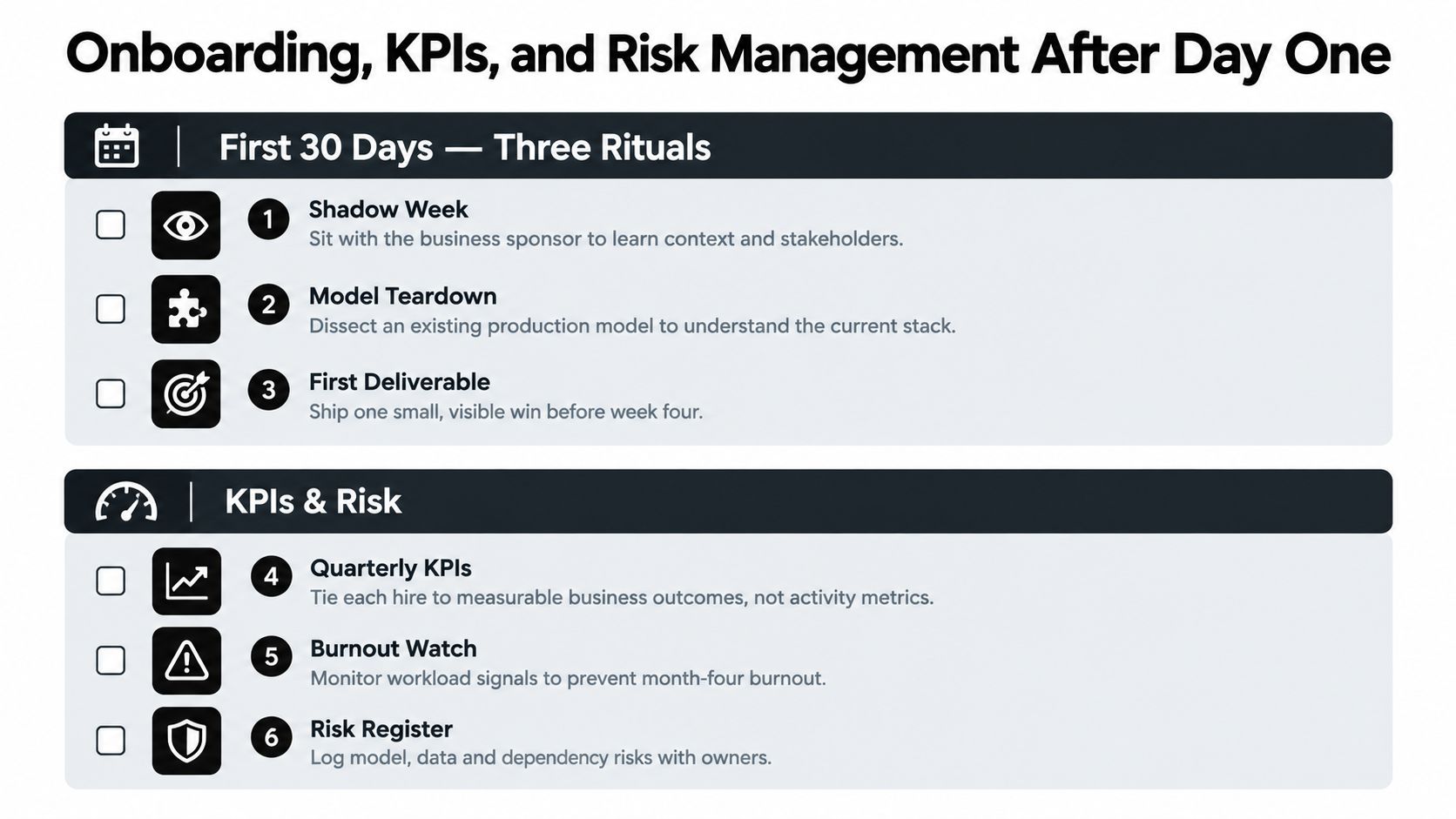
Have the new team member write a 90-day thesis covering the problem, assumptions, risks, first pilot, and decisions the organization must make. The CHRO and CIO should review it with the business sponsor. This forces alignment while the team's assumptions are still cheap to change.
Measure delivery and coordination
Track delivery metrics such as models in production, time to first value, and inference cost per use case. Pair them with learning metrics, including documentation coverage, growth of the evaluation suite, and stakeholder trust scores from recurring surveys. Output alone can hide a broken process. A team may produce fast results while creating unmanageable operational debt.
Research on human-AI teaming recommends measuring process conditions as well as output, including goal alignment, division of labor, workload balance, and error-recovery rate. The [human-AI teaming methodology](https://pmc.ncbi.nlm.nih.gov/articles/PMC12983458/) is especially useful because it organizes the work around formulation, coordination, maintenance, and training.
Run a quarterly model review covering data drift, fairness, regulatory exposure, vendor dependencies, and unresolved incidents. Maintain a risk register with named owners. Define rollback authority before a failure occurs, and make sure the person with authority can act without waiting for a committee.
> A pilot earns scale by proving repeatable operation, not by producing an impressive demo.
Use a scale gate before expanding scope. Require two successful production deployments and one measurable business outcome before approving a broader rollout. Develop the team as deliberately as you deploy the system. Managers should train people to evaluate outputs, use AI safely, and escalate to humans when the evidence is weak.
Your 90-Day AI Team Launch Plan and Quick Answers
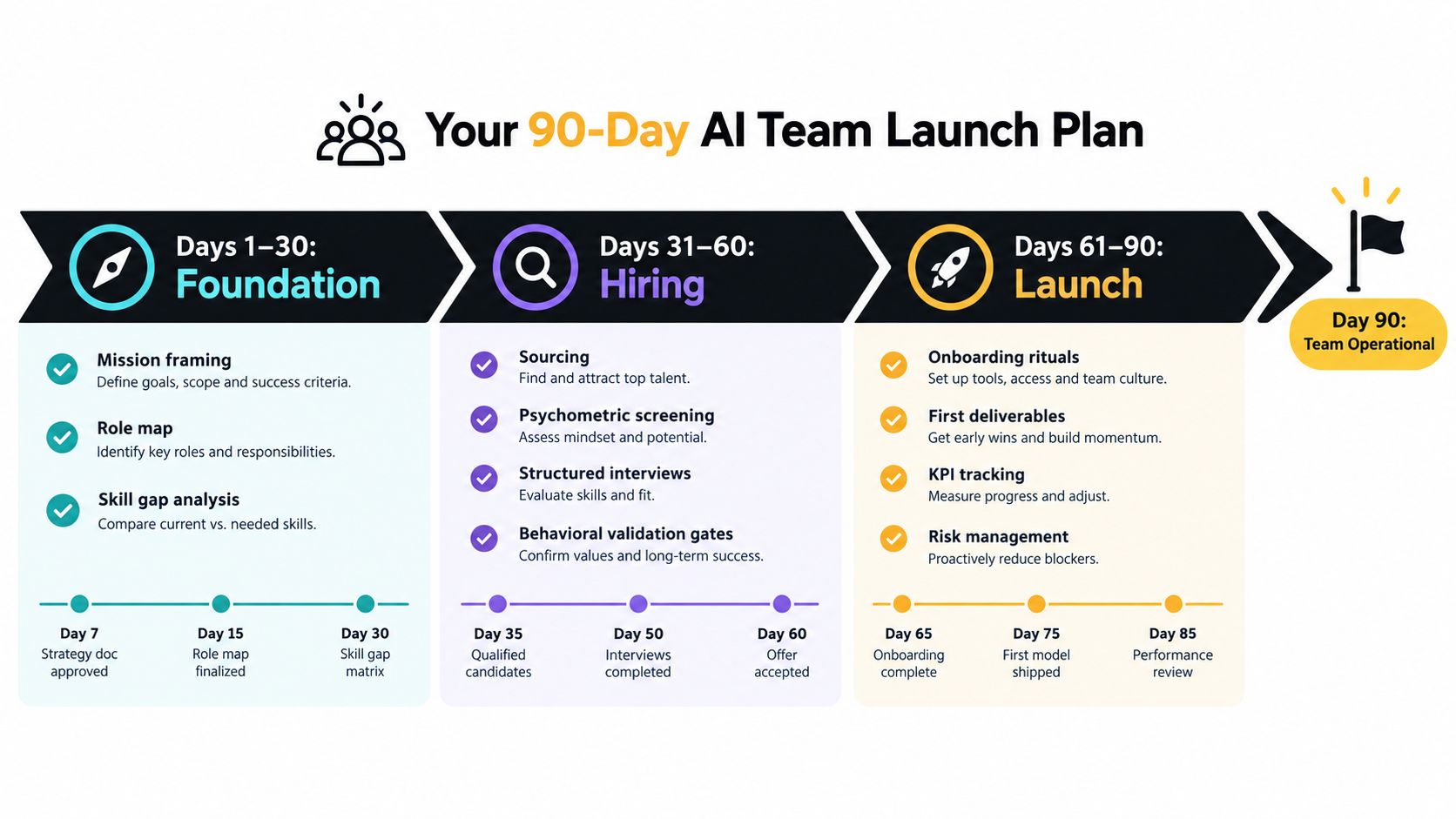
A practical launch plan has three sprints. Each sprint should end with a decision, not merely a completed activity.
Days 1 to 30, foundation. Secure the executive sponsor, write the business mission, select the first use case, map the role tracks, and score the current workforce against the capability matrix. Confirm data access, risk ownership, budget, and the process that will absorb the AI output.
Days 31 to 60, hiring. Source against the matrix, run the hard-gate screen, conduct structured technical interviews, complete behavioral and psychometric validation, and hold calibrated panel debriefs. Decide which gaps require full-time hiring, internal mobility, upskilling, or a specialist partner.
Days 61 to 90, launch. Finalize offers, run the onboarding bootcamp, complete the model teardown, assign the first deliverable, and launch a governed pilot. The team should have a named business owner, technical owner, risk owner, rollback authority, KPI set, and review calendar before the pilot reaches users.
Pre-launch checklist
<iframe width="100%" style="aspect-ratio: 16 / 9;" src="https://www.youtube.com/embed/b9RmpdMeapw" frameborder="0" allow="autoplay; encrypted-media" allowfullscreen></iframe>
Quick answers for CHROs
How can we compete on compensation without matching FAANG packages? Don't compete only on cash. Offer meaningful ownership, a credible mission, access to decision-makers, strong technical standards, and the chance to shape an operating model rather than inherit a narrow backlog. Be transparent about constraints. Senior candidates will often reject ambiguity disguised as autonomy.
When should we prioritize internal mobility? Move internal people when they understand the domain, have delivery credibility, and can learn the missing technical skills with support. Internal mobility is especially valuable for product, operations, risk, and domain roles. Hire externally when the organization lacks a critical technical capability or needs someone who has already operated the relevant production system.
What should we do when a pilot fails? Separate model failure from team failure and framing failure. Preserve the evaluation record, identify whether the data, workflow, adoption, or model caused the result, and stop scope expansion until the team can explain the failure. A failed pilot with disciplined learning is healthier than a successful demo that nobody can govern.
How should we measure ROI in the first two quarters? Use one business outcome tied to the workflow, then pair it with operational evidence such as usage quality, exception handling, trust, and cost. Don't claim value from activity alone. If users don't adopt the system or operators can't recover from errors, the model's technical performance hasn't created business value.
---
Synopsix helps organizations assess behavioral fit, compare people against roles and teams, and surface collaboration risks before hiring or restructuring an AI group. Visit [Synopsix](https://synopsix.ai) to turn psychometric evidence into clearer hiring, team design, and talent development decisions.