How to Do a Job Analysis: Steps for Hiring Criteria
By Synopsix · November 14, 2026 · 17 min read
Your posting has been live for eight days. There are 120 applications, the hiring manager wants to see "three or four people" by Friday, and the job description on the page is last year's file with two lines changed. Nobody has written down what the work involves, so the interviews will be scored on how confident each candidate sounded.
A job analysis fixes that, but not in the way most templates describe. It isn't a longer job description and it isn't a form you fill in for compliance. It's the evidence file behind every requirement you put in front of a candidate: what the work is, how often it happens, what it takes to do it well, and which hiring measure tests for it.
Treat it that way and three things change. The posting gets shorter and sharper. Interview questions start pointing at real tasks. And when someone asks why you require a licence, a test or a work sample, you can open a document and show the task, the rating and the validation step that put it there. That's how to do a job analysis that survives the question.
Why Job Analysis Starts With the Work Itself
An operations coordinator leaves five months after being hired. The posting never mentioned reconciling vendor invoices with delivery notes, covering the weekend handover when the night lead is off, or chasing refunds for damaged freight. Those tasks shape the actual job. A profile built from the title alone can miss them.
Job analysis is the structured study of a role's actual work and requirements. It gives each hiring criterion a traceable basis: an observed task, a rating of its demands, and a way to check the requirement during selection. Without that record, a profile can drift into a wish list shaped by the last person in the role or a manager's preferences.
The practice has a long history. The U.S. Department of Labor's Dictionary of Occupational Titles grew out of the public employment-service system established under the Wagner-Peyser Act. The [first DOT edition](https://www.dol.gov/agencies/oalj/PUBLIC/DOT/REFERENCES/DOTINTRO) appeared in 1939 with approximately 17,500 occupational definitions, organized by title and classification code. Analysts documented jobs through observation and worker interviews. Later editions changed how occupations were classified and documented as work changed.
The same principle applies to a hiring decision today. If you require a licence, a test or a work sample, the analysis should show which task calls for it and how the measure checks that requirement. For work assigned to an external provider, [what buyers should check before outsourcing](https://anybpo.com/what-is-a-bpo-call-center) can help frame the handoff; the job analysis still needs to identify the tasks and standards that apply to the role.

The result is an auditable decision record, not just a revised job description. It connects the work to the requirements and the hiring checks, so the team can explain why each criterion belongs in the process.
The Six Stages of a Job Analysis at a Glance
Copy this table into the project document before anyone writes a question. It gives the team a shared map and a clear answer to "what comes next."
| Stage | Main Input | Output | |---|---|---| | 1. Define the job | Hiring manager, HR and org chart | Scope and intended hiring decision | | 2. Collect data | Incumbents, supervisors, SMEs and observation | Raw evidence from several sources | | 3. Write task statements | Collected activities | Observable task and behavior list | | 4. Rate each task | Task list and structured rating form | Importance, frequency, difficulty and error-consequence scores | | 5. Identify KSAOs | Rated tasks | Knowledge, skill, ability and other characteristic list | | 6. Map to measures | KSAO list and planned assessments | Traceability matrix linking criteria to job evidence |
What Each Stage Has to Produce
Stage one sets the boundary. Name the job, the work setting and the decision the analysis will support, whether that's an external hire, a promotion panel or a restructure. Pull the hiring manager, an HR partner and the current org chart into the room, because a scope that drifts between a coordinator and a manager produces ratings nobody can use.
Stage two is evidence collection. Incumbents, supervisors, subject-matter experts, direct observation, interviews and existing work records all count. One source is an anecdote. Three sources that agree are a finding.
Stage three converts activity into statement. "Handles scheduling" is an activity. "Rebuilds the shift roster every Thursday after confirming agency cover" is a task you can observe and rate.
Stage four produces the scores. Importance, frequency, difficulty and consequence of error, each on a structured form. This is the stage that turns a narrative description into a decision record.
Stage five derives the requirements. From the highest-rated tasks, list the knowledge, skills, abilities and other characteristics a person needs. Requirements follow tasks, never the reverse.
Stage six maps each measure to the work. Every interview question, test and work sample gets a line pointing back to a rated behavior or KSAO.
The stages run in order, but they loop. A rating round that shows wide disagreement sends you back to stage three for a sharper task statement. A KSAO list with nothing behind it sends you back to stage four. The [Uniform Guidelines](https://www.uniformguidelines.com/uniguideprint.html) require the analysis to address important work behaviors, their relative importance, associated tasks and resulting work products, and to document the method itself. Documentation is the deliverable, not the afterthought.
> What good looks like: independent ratings first, group discussion second, and a written record of both.
Decide which stage your team is in right now, then name the document that stage must produce before anyone moves on. That single sentence closes more stalled analyses than any template.
How to Collect Data From Several Sources
A warehouse supervisor posting says “manages inventory.” Observation shows that much of the week goes to shift scheduling and damaged-stock claims, while a system handles inventory accuracy and the supervisor audits it. A job analysis based only on the posting could screen for the wrong expertise. Collecting evidence from several sources helps turn each requirement into an auditable record: the work it reflects, the evidence behind it and the check that will assess it.
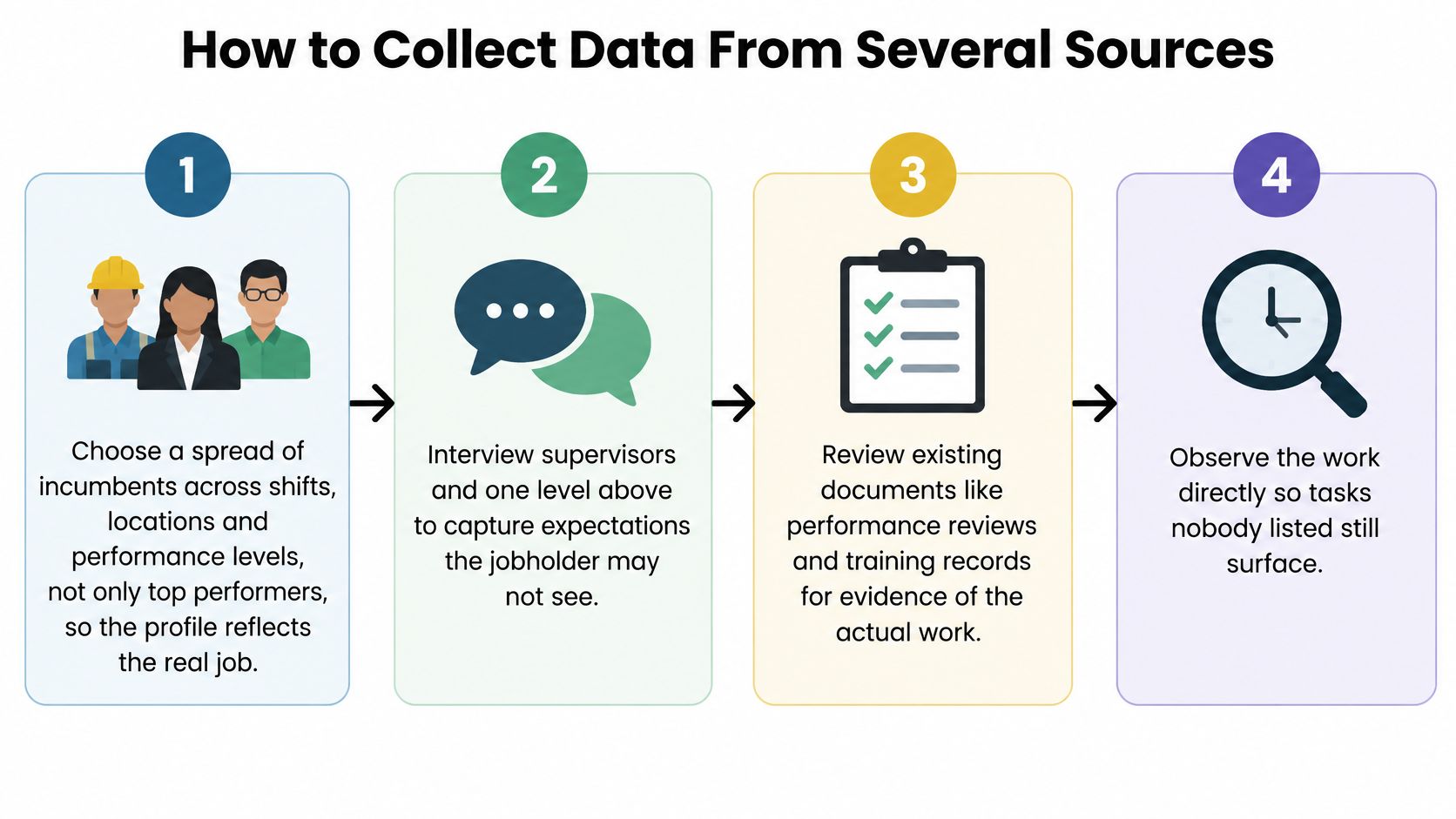
1. Choose a spread of incumbents. Include different shifts, locations and performance levels. A sample made up only of top performers can describe expert practice rather than the work expected of a new hire, setting criteria too high for the actual role.
2. Interview supervisors and one level above, separately. Compare their accounts after each interview. Differences between a supervisor's expectations and a director's expectations may point to work that is performed inconsistently. Record the disagreement rather than forcing it into a single account.
3. Observe the work in its real setting. Follow a full work cycle and record actions before assigning labels. Include improvised fixes, informal checks and spreadsheets that compensate for gaps in a system. If an observed activity does not belong in the role, note why it is excluded.
4. Review the paper trail. Examine the current posting, team KPIs, process documents, training materials and incident logs. These records show which tasks the organization has already formalized or tracked. Incident logs can also highlight tasks where errors have serious consequences.
5. Write each task as a verb plus an object. “Reconcile daily cash drawers against point-of-sale totals” describes observable work; “cash handling” does not. A specific statement gives raters something concrete to assess and trainers a behavior to teach.
6. Merge duplicates and benchmark the list. Combine overlapping statements, then compare the result with a similar occupation. ONET publishes occupational task and work-activity data that can help identify work your initial list may have missed.
Keep the evidence linked to the task statement. A short record can identify the source, the observation or interview that supports the task, any conflicting accounts and the later validation check. For methods to keep raw material traceable through analysis, see [PlotStudio AI on collection-to-analysis workflows](https://www.plotstudio.ai/articles/research-tools-for-data-collection).
Across sources, look for gaps as well as agreement: a supervisor may describe how work should run, an incumbent how it runs in practice, and an observer what happens between the two. In the warehouse example, comparing the posting with observed work changed four of the nine requirements. The analysis became more defensible because each requirement could be traced to evidence from the job rather than copied from the original description.
<iframe width="100%" style="aspect-ratio: 16 / 9;" src="https://www.youtube.com/embed/R2LlW6OLAxA" frameborder="0" allow="autoplay; encrypted-media" allowfullscreen></iframe>
How to Rate Tasks and Define KSAOs
Ratings are where subjectivity either gets captured or gets hidden. Capture it. Send a structured form to each subject-matter expert, have them score independently, and only then hold the group discussion. The loudest voice in a room shouldn't set the weight on a task.
| Dimension | Question It Answers | Scale Anchor (1 to 5) | |---|---|---| | Importance | How much do the results depend on this task? | 1 = minor effect, 5 = critical to results | | Frequency | How often is the task performed? | 1 = yearly, 5 = several times a day | | Difficulty | How long does proficiency take to reach? | 1 = learned in days, 5 = years of practice | | Consequence of error | What happens if it goes wrong? | 1 = trivial fix, 5 = safety, legal or financial harm |
Where Two Dimensions Change the Priority
Take a customer service role where one task is approving refunds above a set limit. Frequency scores a 1 or 2 because it happens a few times a month. Consequence scores a 5 because a wrong approval creates a financial loss and, in some accounts, a compliance breach. Read only frequency and you'd cut it from the interview. Read consequence and it becomes a scenario question with a scoring rubric.
Multiply nothing. A high score on any single dimension earns the task a place in the requirement set. Frequency tells you how much of the job the task consumes; consequence tells you what a mis-hire costs.
From Rated Tasks to KSAOs
Knowledge is what the person must know, such as the routing rules that govern service windows. Skills are what they must do well, such as keying orders accurately at speed. Abilities are the underlying capacities, like holding a priority order steady when four alerts arrive at once. Other characteristics cover licences, physical demands and shift tolerance.
A dispatcher profile makes the split concrete: routing-rule knowledge, fast order entry as a skill, prioritization under conflicting alerts as an ability, and willingness to work rotating nights as an other characteristic. Four different things, four different measures, and only one of them can be tested with a multiple-choice quiz. This list is also the input to [competency mapping](https://synopsix.ai/blog/what-is-competency-mapping), where role-level and individual competencies get organized into a framework you can hire and develop against.
If you're rating analytical roles, look at how the market writes [business analyst roles](https://jobglance.app/jobs/roles/business-analyst/) before you draft statements, so your vocabulary matches what candidates and recruiters use.
Calculating Inter-Rater Agreement
List every task with each rater's 1-to-5 score. Count the share of tasks where all raters land within one point of each other, then report that percentage as your agreement rate. ONET analyst procedures treat roughly .80 as a useful rule of thumb for reliability in comparable occupational rating work, with the caveat that the right threshold depends on the occupation sample and the rating design.
Compute agreement on the first round and resolve every task where raters differ by more than one point. Those tasks are usually worded badly, not understood differently, and rewriting the statement often closes the gap without another meeting.
Turning Findings Into Fair, Validated Hiring Criteria
By step six you have rated tasks and a KSAO inventory. The remaining work is mapping, and it's where analyses often fall apart: the report is thorough, the posting still asks for the same five things as last year, and nobody can say which interview question tests which requirement.
The fix is a traceability matrix. Rows are the criteria that survived rating. Columns hold the job evidence (task IDs from the rated list), the measure you plan to use, the scoring rule and the weight it carries. A row with no task ID isn't a criterion, it's a preference, and preferences don't belong in a hiring bar.
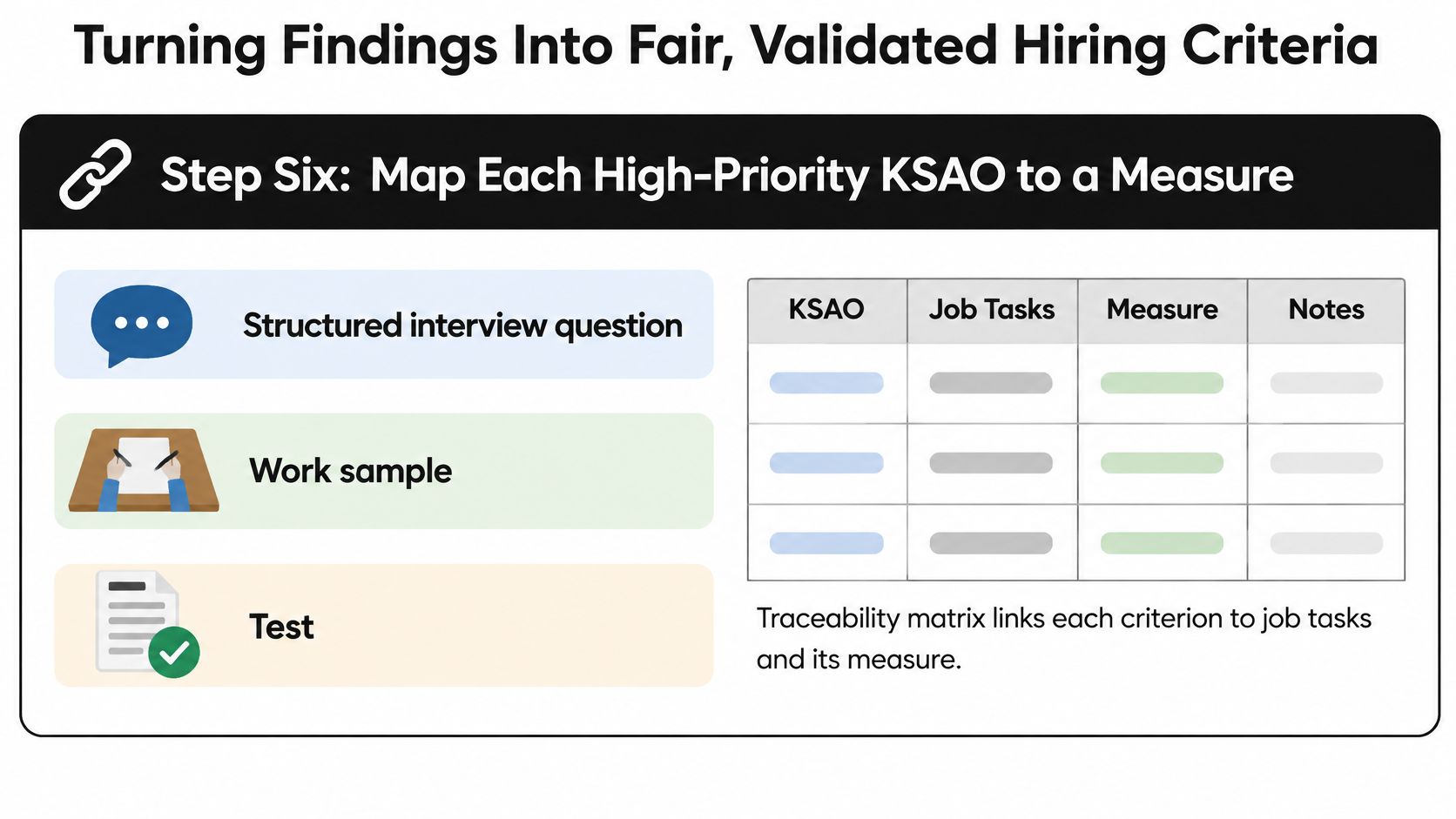
Then classify every requirement. Essential means a high-rated task fails without it on day one. Trainable means onboarding can close the gap. Degree or licence means a specific task legally or practically requires it. The fourth category is the one nobody wants to name: the requirement no task supports at all.
| Requirement Type | Evidence Needed | Hiring Use | |---|---|---| | Essential KSAO | Rated high on importance or error consequence | Screen in and assess directly | | Trainable KSAO | Low consequence and learnable in onboarding | Record as development, do not screen out | | Degree or licence | Tied to a specific task that requires it | Require only where the task needs it | | Personality preference | No link to a task outcome | Leave off the requirement list |
What Validation Actually Requires
Define the outcome before you define the test. Error rate, sales production, safety incidents, quality and turnover are all defensible target criteria, provided you can show how the measure represents critical work behavior or a required KSAO. The [EEOC's guidance on employment tests and selection procedures](https://www.eeoc.gov/laws/guidance/employment-tests-and-selection-procedures) is explicit that employers remain responsible for ensuring a procedure is valid for the positions and purposes it's used in, even when a vendor supplies the validity documentation. Buying a validated instrument doesn't outsource the accountability.
The [EEOC's answers clarifying the Uniform Guidelines](https://www.eeoc.gov/laws/guidance/questions-and-answers-clarify-and-provide-common-interpretation-uniform-guidelines) require employers to keep adverse-impact information for each job and, where adverse impact exists, evidence that the procedure is valid. That requirement collides with how skills-first hiring is going. A 2025 SHRM study found 86% of HR professionals and 91% of supervisors reported implementation hurdles, including inadequate tools for skills assessment and continued reliance on educational requirements.
Knock-out questions deserve their own audit. Our Screen product uses knock-out questions on your own job board to filter applicants, which is fast and unforgiving: a single auto-reject can remove every candidate who lacks a credential you never tied to a task. Each knock-out has to trace to an essential requirement, or it comes off the form.
Run three questions against every criterion before it reaches a posting: does it link to at least one rated task, does it predict a named outcome, and is it classified correctly as essential, trainable, licence or removed? Any criterion that fails gets deleted rather than softened.
Once the criteria hold, build the questions from them directly, using a repeatable approach to [interview question design](https://synopsix.ai/blog/interview-question-design) rather than improvising prompts in the room.
Changing Roles and Validation Risks to Watch
A customer service role still required a four-year degree, although its core tasks were product knowledge, accurate order corrections and calm de-escalation. The credential had been carried over from an older version of the job. Because it did not demonstrate ability to perform those tasks, it risked screening out capable applicants without improving the hiring decision.

That is a legacy requirement. For each credential, ask which rated task would be affected if the candidate lacked it. If no task depends on it, remove it or identify the actual skill the role requires.
One Analysis or Three
Roles change with location, technology and operating model, so one profile may not describe every version of the work. Gather evidence from each arrangement. Mark which outcomes depend on physical proximity or synchronous collaboration, then distinguish enduring requirements from workflow conventions introduced during a reorganization.
A change-exposure rating can help. For each task, assess how likely its tools, processes, customer expectations or decision rights are to change within the planning horizon. Tasks with equal importance can have very different expected lifespans.
> A job profile records work at a point in time. Include a date for reviewing it, so it does not remain in use after the role changes.
Pressure to find suitable candidates and align skills with work makes accurate, current criteria important. A profile based on outdated tasks can narrow the candidate pool without improving performance.
Measurement drift creates another risk. Unstructured impressions can turn vague traits into hiring criteria, while proxy signals such as school, postcode or career gaps can stand in for evidence of capability. Tie each score to a behavior on the rated task list. That link is central to [understanding predictive validity](https://synopsix.ai/blog/what-is-predictive-validity): a measure should support a relevant prediction about work.
Set a review date when tools, workflow, reporting lines or location change materially. Revisit the task ratings and criteria against the new work, and update the record so each requirement still has a clear basis and validation step.
Confirm the Analysis Before You Post the Role
Four checks stand between a finished analysis and a live posting. Run them in order.
1. Every requirement traces and is classified. Each line on the posting links to at least one rated task and carries one of four labels: essential, trainable, degree or licence, removed. A line with no label is unfinished work. 2. The rating round reached agreement. You have a reported agreement rate, and every task where raters split by more than a point was rewritten or discussed. Consensus without a number doesn't count. 3. The sample was varied. Incumbents across shifts, locations and performance levels contributed, plus at least one supervisor and one direct observation. 4. The document records the method. Dates, raters, rating forms, the benchmark list and the version of the profile all sit in one file that a reviewer can follow without you in the room.
Post the role only when all four pass. When one fails, send the requirement back to the task list for re-rating instead of editing the posting directly. Editing the output to fix an input is how profiles drift away from the work.
One distinction keeps this practical: knock-out questions belong on the application form, not in the interview guide, because they decide who reaches a conversation. Keep them there only where they map to an essential requirement, and review the drop-off rate after the first fifty applicants.
The first action is small. Choose one live role this week, run the six stages end to end with a single hiring manager, and keep every artifact. That pilot will show you where your organization stalls, whether it's stage two collection or stage six mapping, before you scale the workflow across twenty roles.
---
When you reach the point where the rated profile exists and the question becomes whether a specific candidate fits it, [Synopsix](https://synopsix.ai) turns behavioral assessment into role-specific intelligence: candidates assessed in under 30 minutes, comparable profiles, and fit recommendations written in business language rather than psychometric jargon. Our assessments read each person against the demands of the role you just analyzed, not against a generic template, so the evidence chain from task to hiring decision stays intact. Run one role through the analysis, then see what the profile looks like when it's applied to real candidates.