How to Manage Different Personalities at Work
By Synopsix · November 13, 2026 · 13 min read
The most popular advice on how to manage different personalities is to identify everyone's type and adapt your communication. That's a useful tactic, but a poor starting diagnosis. Before deciding that someone is too blunt, too cautious or too sensitive, establish whether the problem is an unclear working agreement, a performance gap or unacceptable conduct.
Start with how the team works, then examine individual preferences. You'll make fairer decisions when you can name the behavior, explain its impact and identify the standard everyone should meet.
Tell a Personality Clash From a Performance Problem
Different personalities alone rarely explain a workplace dispute. A [meta-analysis of deep-level diversity](https://onlinelibrary.wiley.com/doi/epdf/10.1111/joms.12670), covering 94 studies and 24,425 teams, linked differences in values, attitudes and personality-related characteristics with more conflict and fewer positive team processes. Its practical implication is to examine how people coordinate, not which traits they have.
Managers usually encounter friction as a recurring clash, declining delivery quality or a complaint about tone. None identifies the cause on its own. In [ACAS research in Great Britain](https://www.acas.org.uk/research-and-commentary/workplace-conflict/prevalence-of-conflict-at-work/report), conflict involving managers and direct reports most commonly concerned capability and performance, at 94%, followed by personal disagreements, at 80%.
Diagnostic signals, likely causes and first moves
Use these as starting hypotheses, not verdicts.
| Signal | Likely cause | First move | |---|---|---| | Repeated interruptions in meetings | Differing pace and turn-taking habits | Agree a turn-taking norm at the next meeting | | Missed handoffs and rework | Unclear decision rights or owners | Write down who decides what and by when | | Quality or speed below standard | Capability or performance gap | Document the standard, then hold a private fact-based conversation | | Intimidation, bullying or discrimination | Conduct problem with protected-characteristic risk | Escalate through the formal HR procedure; do not coach it as personality |
The distinction changes your response. An employee who prefers written discussion may need a different meeting format. An employee who repeatedly submits incomplete work needs a clear quality standard, appropriate support and a performance conversation.
Allegations of harassment, discrimination or intimidation require the formal procedure promptly. Don't force an informal reconciliation or assume that every conduct complaint involves a protected characteristic. Establish the facts through a fair process.
> Diagnostic test: Write down the behavior, its work impact and how often it happens. If you can't describe it without a personality label, you don't yet have usable evidence.
This week, choose an active friction and place it against the table. Decide whether your first response should address style, performance or conduct, while remaining open to evidence that changes that diagnosis.
Map Working Styles Across Your Team
Build a one-page team map before commissioning another individual assessment. Capture how people make decisions, manage deadlines, receive feedback and respond to disagreement. The useful question isn't who's outgoing, but where colleagues have incompatible expectations about doing the work.
The [Oxford Academic review of personality and team performance](https://academic.oup.com/edited-volume/61768/chapter-abstract/553547350?redirectedFrom=fulltext) reports the following corrected correlations across analyses involving 106 to 527 teams.
Team-level personality signals and performance
| Team-level measure | Corrected correlation with team performance | How to read it | |---|---|---| | Average agreeableness | ρ = 0.24 | Supports cooperative delivery across the team | | Average conscientiousness | ρ = 0.20 | Supports reliability and follow-through | | Variability in agreeableness | ρ = −0.12 | Wide spread signals inconsistent cooperation norms | | Variability in conscientiousness | ρ = −0.24 | Wide spread signals uneven follow-through to address early |
These are associations, not staffing instructions. They don't justify hiring agreeable people exclusively or treating conscientiousness scores as a substitute for observing work.
Build a map people can correct
Use neutral language such as agreeableness and conscientiousness when discussing assessed traits. For an accessible workshop conversation, Corporate Challenge Events' resource on [how bird personality types improve collaboration](https://www.corporatechallenge.com.au/dope-bird-personality-test/) offers an approachable vocabulary. Keep those categories as discussion prompts, not evidence of capability.
Say finance colleagues have very different conscientiousness scores. Don't conclude that one cares more. Examine their deliverables and agree a shared checklist covering reconciliations, supporting documents and approval status.
Your output should be a map updated after each major project, with an agreed working standard for every consequential gap. Keep assessment detail private where possible; the team needs the agreement, not everyone's full profile.
Check Your Own Style First
A director closes debates quickly because they value momentum. Reserved analysts stop challenging plans because they can't finish explaining the risks before the decision is made. Calling them passive would miss the manager's contribution.
The practical fix is to request written objections before committing, distinguish genuine deadlines from self-imposed urgency and explain what evidence could change the decision. The director doesn't need to abandon decisiveness. They need to stop making speed the price of participation.
Examine your opening moves
Review recent meetings where the tone became tense. Write down what you did at the start: interrupted an explanation, supplied the answer, challenged a detail or asked for dissent after announcing your preference.
Then compare your default with the task. Fast decisions suit some operational problems. Extended consultation may suit a consequential change, but it can also frustrate employees who need an owner and a deadline. Written detail helps preparation, yet excessive documentation can turn a reversible decision into an approval exercise.
> Your preferred way of working isn't the neutral baseline against which everyone else should be judged.
Don't collect feedback and immediately explain why your behavior was justified. Summarize what you heard, choose an adjustment and tell people what they should notice next time.
The useful check isn't whether colleagues describe you as flexible. It's whether they can challenge your reasoning without first translating everything into your preferred style.
Adapt How You Communicate to Each Style
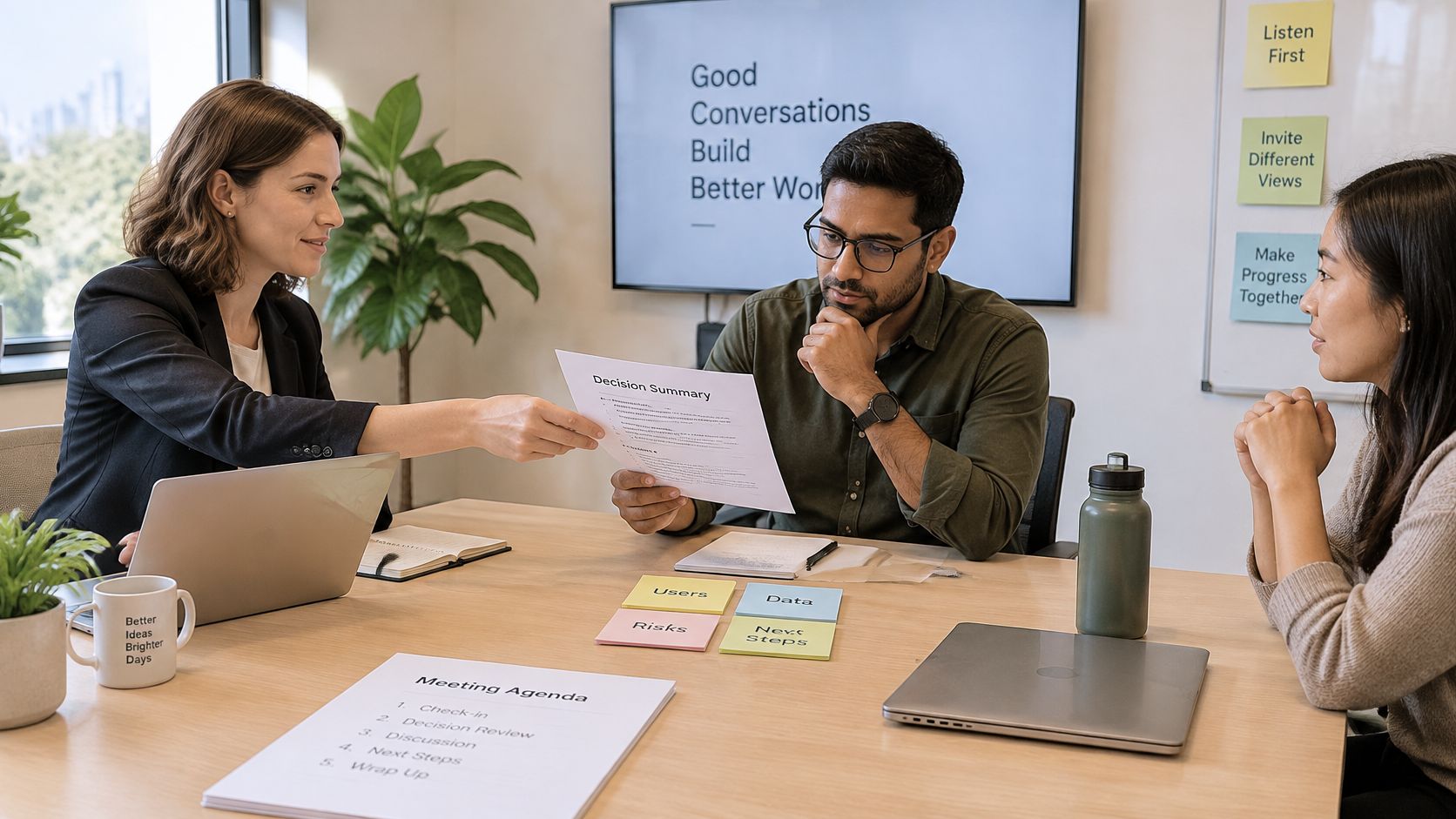
For detail-oriented colleagues, send written decision summaries with supporting sources and unresolved questions before the meeting. Separate what's settled from what still needs discussion so preparation doesn't become an invitation to reopen everything.
For colleagues who avoid conflict, offer private processing time and invite written views before a group decision. Don't interpret a quiet meeting contribution as consent. For highly assertive colleagues, frame requests around risk and deadline, specifying what must happen quickly and what cannot be skipped.
A written decision summary gives the team something concrete to examine together.
Turn adjustments into trainable skills
Use a repeatable practice cycle rather than relying on the manager to translate every exchange.
1. Identify triggers through confidential self-assessment, appropriately handled 360-degree feedback and incident reviews. 2. Train observable skills, including emotion recognition, perspective-taking, impulse control and constructive feedback. 3. Rehearse difficult conversations. Role-play the actual handoff or disagreement, including the response that usually causes trouble. 4. Apply the skills to a live conflict, with clear boundaries and manager support. 5. Review behavioral change after approximately four weeks and again after three months, using the intervention schedule described in the [systematic review of workplace emotional-competence training](https://pmc.ncbi.nlm.nih.gov/articles/PMC11616120/pdf/40359_2024_Article_2198.pdf), which found a moderate controlled training effect of 0.47 and substantial between-study heterogeneity of I² = 68%.
That variation matters. Don't promise a universal result from the same workshop. Check whether employees practice the skills, whether managers reinforce them and whether workload or authority problems prevent their use.
Treat a profile as a starting hypothesis, not a fixed identity. Ask whether the adjustment helps rather than announcing what someone's type requires. The practical test for [communication for impact](https://synopsix.ai/blog/communication-for-impact) is whether the recipient can act accurately.
This week, replace a verbal kickoff with a written summary for a detail-oriented teammate. Ask what became clearer and what still needs discussion.
Resolve Conflicts and Make Disagreement Safe
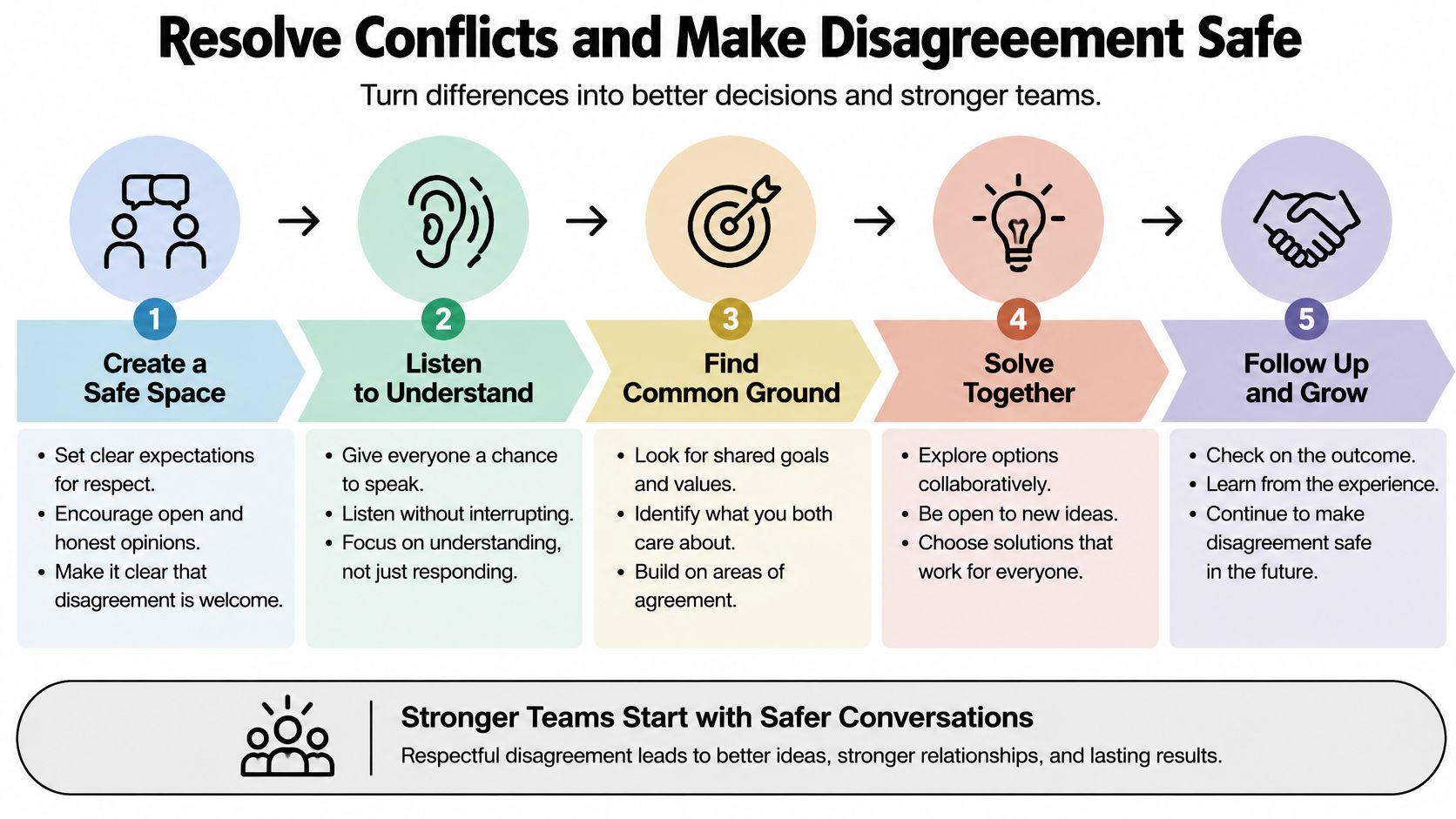
When a clash persists, stop asking people to work it out. Give them a process with clear boundaries, balanced participation and an outcome you can review.
Use the visual as a conversation aid alongside the intervention protocol.
Run a structured intervention
1. Classify the dispute. Is it about the task, the process or the relationship? A product manager and engineer arguing about release speed may need a release-risk threshold and a decision owner, not rapport coaching. 2. Meet participants separately. Ask what happened, what it changed for their work and what they need next. Request examples without accepting claims about the other person's motives as facts. 3. Mediate an explicit agreement. Establish the shared goal, required evidence, decision rights, acceptable response times and escalation route. Use timed turns or a speaking rotation, then document an action with a named owner. 4. Review compliance and outcomes within two to four weeks. The [study of managerial interventions in employee disputes](https://www.academia.edu/27388544/An_investigation_of_managerial_interventions_in_employee_disputes) supports this intervention approach and found that managers with lower mediation confidence were more likely to overlook disputes.
If you lack mediation skills, get support rather than letting the dispute continue. Moving people apart may reduce contact without fixing the disputed handoff or authority boundary.
Make participation practically safe
Feeling permitted to speak doesn't mean knowing how to disagree. In a [2025 survey of 1,519 employees reported by Everything DiSC](https://www.everythingdisc.com/blogs/why-constructive-conflict-Is-key-to-thriving-workplaces/), 72% felt psychologically safe addressing conflict, yet 88% reported difficulty engaging in workplace conflict, and 77% were more likely to raise difficult topics with coworkers they felt close to.
Protect the conversation accordingly. An outspoken employee can challenge a proposal firmly, but directness doesn't excuse intimidation. Give remote participants a guaranteed turn or invite their comments in a shared document before discussion begins.
For another discussion resource, use this video alongside the team's written agreement.
<iframe width="100%" style="aspect-ratio: 16 / 9;" src="https://www.youtube.com/embed/jUF9sY4HvxY" frameborder="0" allow="autoplay; encrypted-media" allowfullscreen></iframe>
Send a written recap within a day and schedule a check-in after a week. These are practical operating choices, not guarantees of resolution. Acknowledge changed behavior explicitly rather than contacting people only when something goes wrong.
Track time to resolution, repeat incidents and missed handoffs, alongside delivery quality. Use [team conflict resolution strategies](https://synopsix.ai/blog/team-conflict-resolution-strategies) to choose an intervention that fits the dispute, not to force every disagreement into mediation.
> The test is whether the quietest person would disagree with you again next week.
Match Roles to Strengths and Test the Fit
Job requirements should determine which personality measures matter. A [meta-analysis of personality measures and job performance](https://onlinelibrary.wiley.com/doi/abs/10.1111/j.1744-6570.1991.tb00696.x) found corrected mean validity of 0.12 in exploratory studies, 0.29 in confirmatory studies and 0.38 when measures were selected through job analysis; trait-level estimates ranged from 0.16 for extraversion to 0.33 for agreeableness.
Those differences don't establish a universal best trait. They support selecting relevant constructs deliberately instead of fitting every role to a generic profile.
Assess the work before the person
1. Define the role's essential behaviors. For a customer operations lead, include handling escalations, prioritizing queues, checking detail, making timely decisions and coaching colleagues. 2. Map evidence against those behaviors. Separate demonstrated ability from self-description. Note where evidence is missing rather than filling the gap with an assessment score. 3. Ask structured past-behavior questions. Use consistent prompts and follow-ups. The [study of structured behavioral interviews](https://psycnet.apa.org/doi/10.1037/0021-9010.77.5.571) associated judgment accuracy with the amount of relevant behavioral information interviewers obtained. 4. Add a job-related scenario. Ask candidates to manage a customer escalation with incomplete information. A [systematic review of situational judgment tests](https://pubmed.ncbi.nlm.nih.gov/32353895/) found additional explained variance beyond knowledge and cognitive-ability tests was often approximately 5% to 10% where reported. 5. Check team complementarity. Don't fill every position with people who respond to pressure by accelerating.
Assessment reports are most useful when discussed against specific role requirements.

A fast-moving, assertive operations lead might complement a meticulous analyst. That pairing works only if the lead respects the analyst's review authority and both understand when a risk must delay action.
Profiles should inform questions, not determine decisions. Before appointing someone, write the observable behaviors that would demonstrate a good fit at the end of their first quarter, and assign someone to check them.
Confirm Your Next Step With a Two-Week Team Audit
Put these checkpoints in the calendar, with a named owner and a short written record.
If you need comparable behavioral profiles before a hire, promotion or reorganization, Synopsix is a people-intelligence platform built for that work. Its free assessment shows your traits, leadership style and professional fit. By default, only you can see your data unless you explicitly authorize sharing, for example with a manager, recruiter or coach.
By day 14, answer this: Which working norm, if written down, would prevent your next conflict?
---
Synopsix offers role-specific behavioral assessments and team simulations to help you examine complementarity and potential friction before making people decisions. Visit [Synopsix](https://synopsix.ai) to explore your profile, then use it to sharpen the questions you ask about a real role or team challenge.