How to Write Intelligence Reports People Actually Use
By Synopsix · October 19, 2026 · 13 min read
You sent the report on Friday. It's Monday, the hiring panel meets in twenty minutes, and nobody can tell you what it recommended. They skimmed the charts, argued about a score, and fell back on gut feel. That's not an analysis problem. It's a report problem, and knowing how to write an intelligence report that forces a decision is a different skill from collecting good data.
What a Modern Business Intelligence Report Actually Is
A CHRO gets a long document before a promotion decision. She scans page one, looks for the recommendation, doesn't find it, and closes the file. I've watched that happen across the table. The analyst did weeks of work. The reader gave it seconds because the report asked her to do the analyst's job.

A modern business intelligence report is a decision product, not a data dump. It names one decision, states a judgment, shows the evidence behind that judgment, and tells a named owner what to do next. If a reader can finish it and still ask what you'd recommend, you've written an archive, not a report.
Report Versus Analysis
Analysis is the thinking. A report is that thinking made usable by someone who wasn't in the room. Teams confuse the two and ship notebooks, score exports, and assessment printouts as if volume equals rigor. It doesn't. Readers need behavioral observations separated from your interpretation, and interpretation separated from business implication, a distinction that sits at the core of [people analytics in HR practice](https://synopsix.ai/blog/people-analytics-in-hr).
People intelligence reports are a specific subtype. They translate behavioral assessment data into a role-specific call on hiring, promotion, team design, or development. The same discipline applies in adjacent fields, which is why a [guide to sales intelligence for go-to-market](https://fetchin.io/blog/b-2-b-sales-intelligence-tools) is useful reading on turning external signals into action rather than lists.
> A report that describes a person without recommending a decision has not finished its job.
Three styles consistently fail. The data dump buries the call under charts. The personality essay sounds insightful and commits to nothing. The score sheet hands over numbers and forces the manager to invent the meaning. The style that survives a Monday inbox leads with the decision, supports it briefly, and makes the next step unmissable.
The Four-Stage Workflow Behind Every Strong Report
Strong reports don't start at the keyboard. They start with a workflow that treats writing as analysis, not decoration.
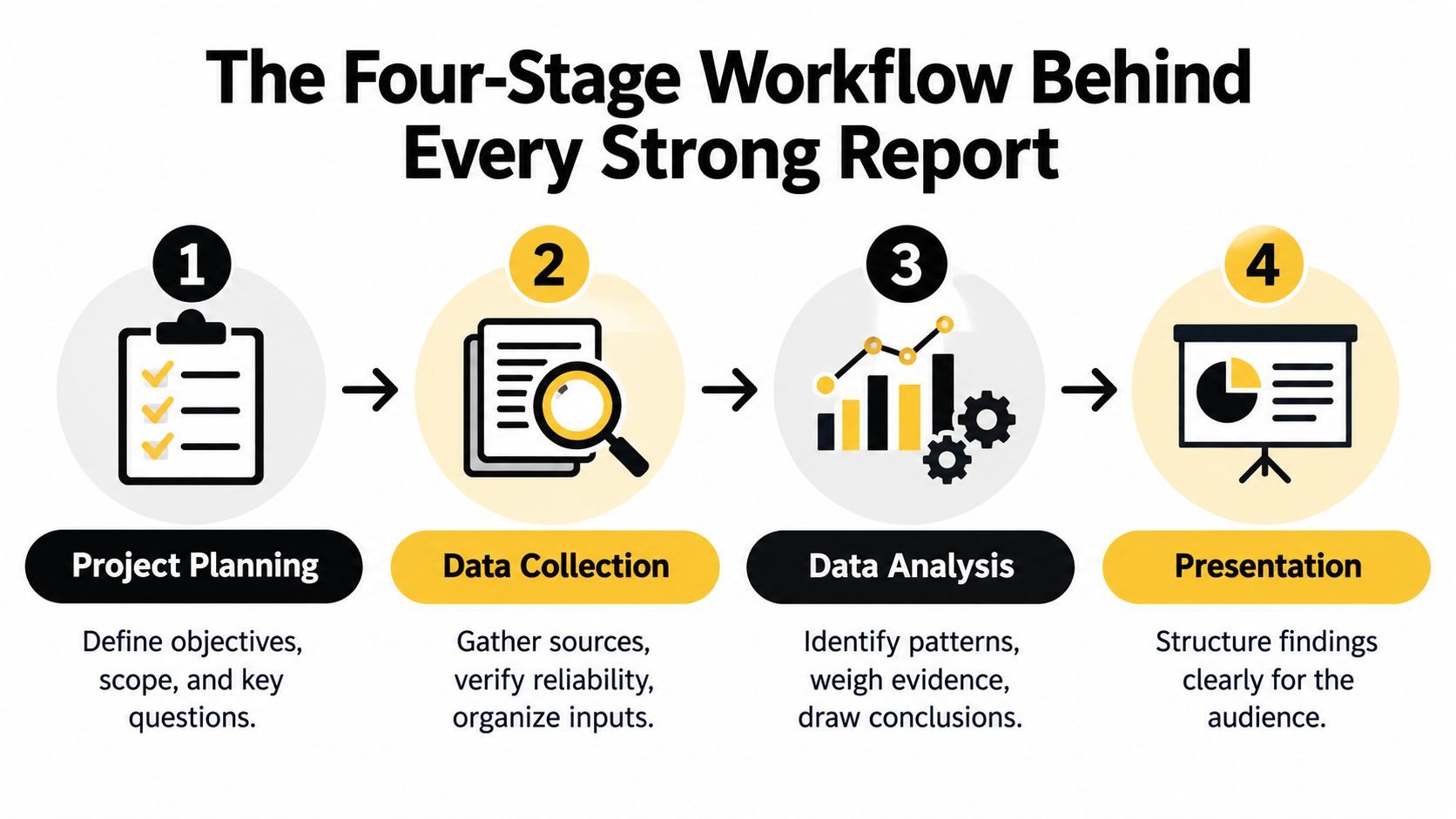
A CIA review of intelligence research divides the work into four basic operations, project planning, data collection, data analysis, and presentation, with presentation defined as the writing of the report itself. You can read that framing in the [CIA review of intelligence research operations](https://www.cia.gov/resources/csi/static/Intelligence-Research-Suggested-Approaches.pdf). That sequencing matters because an accurate judgment still fails if readers can't find the conclusion, evidence, uncertainty, or recommended action.
The Four Questions That Gate Each Stage
Don't move to the next stage until you can answer its question in one sentence.
1. Project planning: Who decides what, by when? Define the decision problem, the audience, and the threshold for action before you touch data. 2. Data collection: What did we measure? Gather relevant evidence, note what's missing, and record where each signal came from. 3. Data analysis: What pattern emerged, and what else could explain it? Test the pattern instead of narrating it. 4. Presentation: How will the reader act? State the most important finding early, separate measured traits from inference, and translate both into role-specific actions.
Most weak people reports collapse stages two and four. Someone runs an assessment and forwards the profile. There's no planning, so the report answers no specific question. There's no real presentation stage, so the hiring manager gets traits without a recommendation on ramp, coaching, or fit.
Use the same progression for hiring, leadership development, or team design. Question, evidence, judgment, action. When every analyst follows that order, readers can compare reports side by side instead of learning a new format each time. Paste those four gate questions into your SOP. When a report feels decorative, you'll know exactly which stage you skipped.
The Section-by-Section Blueprint of a People Intelligence Report
Copy this structure into a template and stop reinventing the document. Seven blocks, in this order, will carry almost any people decision.
Anatomy of a People Intelligence Report
| Block | Purpose | Typical Length | |---|---|---| | Decision Question | Name the exact call and deadline | 1 to 2 sentences | | Bottom Line Up Front | State the recommendation first | 2 to 3 sentences | | Evidence and Behavioral Signals | Show measured traits and observations | Short bullets | | Risk Indicators | Flag specific, role-relevant risks | Short bullets | | Role Fit Recommendation | Connect evidence to this role, not people in general | 1 paragraph | | Confidence and Limitations | State confidence, gaps, and assumptions | 2 to 4 sentences | | Recommended Next Actions | Assign owners, actions, and timing | Numbered list |
Decision Question goes first because it disciplines everything after it. Write, should we hire this candidate for enterprise sales, or redirect to mid-market? Not, candidate overview. Bottom Line Up Front answers that question immediately. If readers stop there, they should still act correctly.
Evidence comes next, and it must stay clean. List behavioral signals you measured, not adjectives you prefer. Disciplined [assessment interpretation for business decisions](https://synopsix.ai/blog/assessment-interpretation) matters, because a trait label without behavioral evidence invites every reader to project a different meaning onto it. Risk indicators then name what could go wrong in this role, such as slow ramp in unstructured territories or friction with a highly directive manager.
Formal investigations use a similar discipline of separating findings from conclusions, and [Paradigm International's SMB investigation template](https://paradigmie.com/post/workplace-investigation-report-template) is a practical reference for how structured sections keep sensitive reports defensible. Borrow that separation even when your topic is talent, not misconduct.
Synopsix packages these blocks into Intelligence Reports for leadership and sales roles, translating assessment output into business language with fit recommendations and risk indicators. Treat that as one production example of the blueprint, not a substitute for applying it to your own context.
What Good Blocks Sound Like
> Bottom Line Up Front: Recommend hire for mid-market sales, not enterprise. Evidence supports strong relationship building and follow-through, with a risk indicator around long, ambiguous deal cycles that enterprise would expose immediately.
That's usable. Compare it with, the candidate is personable and results-oriented. The second version commits to nothing and protects no one. Keep each block short, label it plainly, and cut any sentence that doesn't help the reader decide, challenge, or act.
Writing With Structured Analysis Instead of Gut Stories
A clean template won't save a judgment you can't defend. Panels don't challenge formatting. They challenge reasoning, and gut stories collapse under the first serious question.
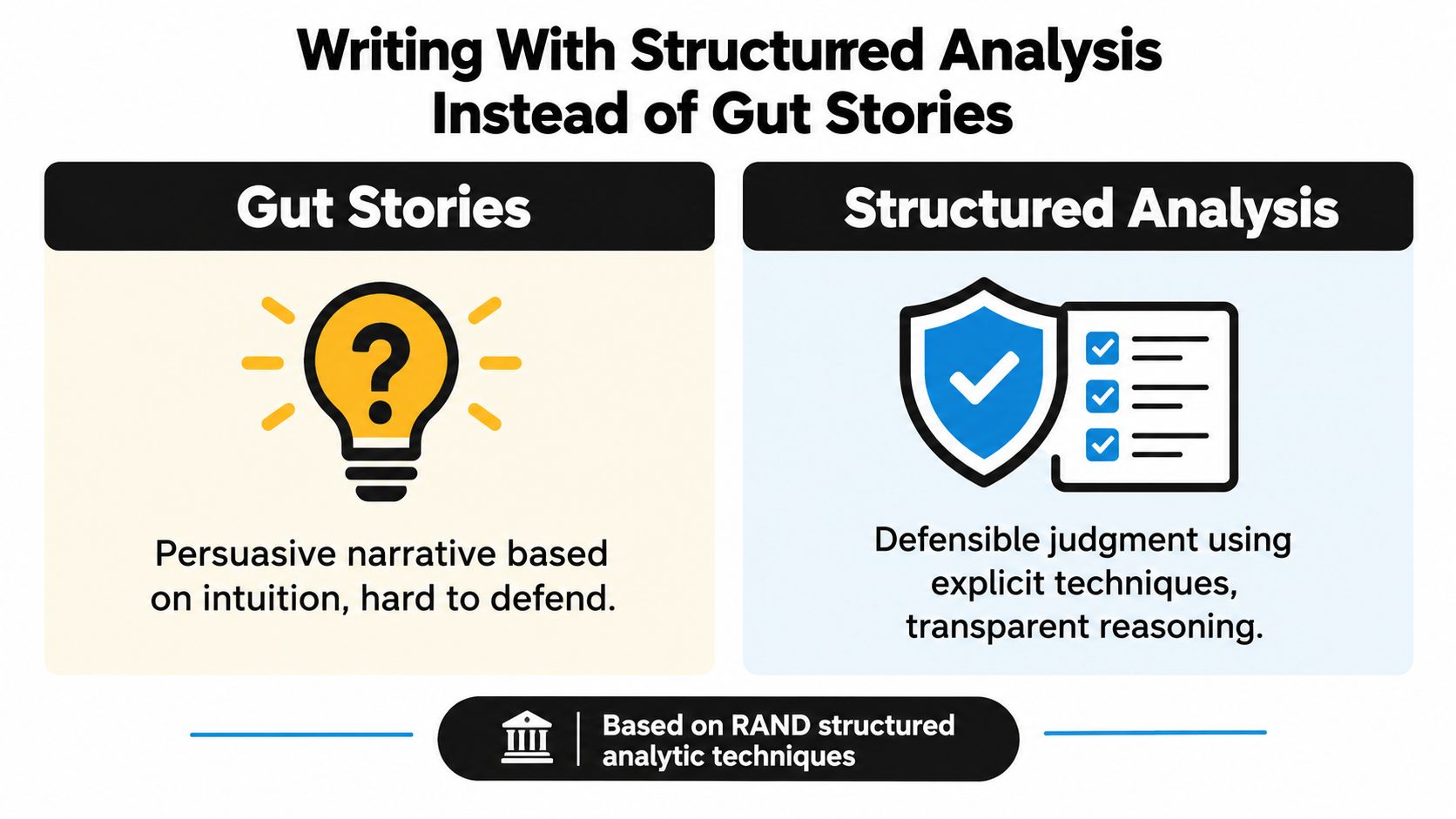
RAND describes structured analytic techniques as methods that organize thinking, make the process conscious and transparent, and reduce errors from cognitive biases that intuitive analysis leaves unchallenged. The [RAND review of structured analytic techniques](https://www.rand.org/content/dam/rand/pubs/research_reports/RR1400/RR1408/RAND_RR1408.pdf) reflects a broader shift from persuasive narrative toward auditable judgment that another reader can reconstruct.
Three Families to Use in People Reports
In practice, that means testing a fit call against plausible alternatives. Is this a genuine role mismatch, a development gap coaching can close, or insufficient evidence? Those three explanations lead to three different decisions. Naming them is the work, and it's the same discipline behind sound [behavioral data analysis in talent decisions](https://synopsix.ai/blog/behavioral-data-analysis).
Weak Versus Defensible Writing
Weak: She's a natural leader and should be promoted. Her scores are strong and the team respects her.
Stronger: Recommend promotion with structured support in the first quarter. This judgment assumes she'll inherit a stable team. The main alternative explanation is that recent results reflect team strength more than her delegation, so watch handover quality and escalation patterns. If escalations rise while delivery slips, revisit the call.
> A strong report doesn't only state what's likely. It shows how the conclusion was tested and what evidence could prove it wrong.
Add four elements to every judgment: explicit assumptions, competing explanations, indicators that would change the assessment, and a confidence statement. Do that and your report survives challenge. Skip it and you're asking readers to trust your tone.
How the Same Report Changes for Each Role and Audience
The template stays fixed. The emphasis changes, because a CHRO, a sales VP, and a hiring panel aren't making the same decision.
The team below is working from the same underlying assessment data, but each reader needs a different cut of it placed first.

Three Decisions and Three Different Reports
The sales hire. The VP needs ramp risk on page one. Lead with territory fit, deal-cycle tolerance, and manager compatibility. Move developmental strengths lower. Recommend a specific segment, onboarding focus, and an early indicator to monitor, such as pipeline creation habits or follow-up discipline. Cut generic personality commentary. It won't change the offer decision.
The leadership promotion. The CHRO needs mis-promotion risk and pipeline consequences, not a celebration of past performance. Lead with readiness for the next level, derailment indicators under pressure, and what support would change the odds. State what happens if you wait, because delay is also a decision. The coach who later works with this leader needs the detailed evidence, but the promotion panel needs the call and its conditions first.
The team design call. Nobody here is hiring or promoting one person. Lead with complementarity and tension points across the group. Show where working styles reinforce delivery and where they'll collide on pace, detail, or decision ownership. Recommend pairings, meeting norms, or role boundaries. Individual profiles belong in an appendix, not in the opening.
The briefing below shows why audience altitude matters when the same evidence has to serve different decision makers.
<iframe width="100%" style="aspect-ratio: 16 / 9;" src="https://www.youtube.com/embed/_gvqw_JVF60" frameborder="0" allow="autoplay; encrypted-media" allowfullscreen></iframe>
Don't write three reports from scratch. Write one analysis, then choose the right cut. Same evidence, different decision question, risk emphasis, and next action. That's the craft most writers miss when they send one document to everybody.
Communicating Uncertainty and Risk Indicators Without Misleading Anyone
Polished prose creates false certainty. So does a clean numerical score. Your job is to tell readers how much weight a judgment can bear, and most reports fail exactly here.
Separate Three Things Readers Conflate
These aren't interchangeable. A candidate can look like a strong fit while your confidence stays moderate because corroboration is thin, data comes from a single source, or the role rarely tests the behavior you're judging. Guidance from the University of Minnesota recommends stating both likelihood and confidence and explaining what creates uncertainty, as set out in its [guidance on likelihood and confidence in security analysis](https://manifold.open.umn.edu/read/security-analysis-ch-1-introducing-security-analysis-ua1/section/1be77d8d-bbee-40e1-b956-8e529b396098). WADA guidance adds a useful corroboration rule, calling an assessment confirmed only when at least two independent sources support it.
Write the reason, not just the label. Don't write, moderate confidence. Write, moderate confidence because the judgment rests on one assessment and one interview, with no work sample yet. That sentence tells the reader what to collect next. Capturing source notes accurately matters here, and the [AIDictation guide for research accuracy](https://aidictation.com/blog/research-documentation) offers practical habits for keeping documentation clean enough to audit later.
A Confidence Rubric You Can Drop Into Any Report
Pair every confidence statement with key assumptions, information gaps, and a trigger for revising the judgment. Then make risk indicators specific. Don't write, flight risk. Write what behavior, in which condition, monitored by whom, would signal rising flight, ramp, derailment, or team-fit risk. Generic warnings alarm readers. Specific indicators let them intervene early and change the recommended action before the cost lands.
Your Pre-Flight Checklist and Common Pitfalls to Avoid
Run this check before you send anything. If you can't tick an item, fix the report, don't explain it away in the meeting.
Quick Answers to Recurring Questions
How long should it be? Long enough to support the call, short enough that the decision summary fits on page one. Put detail behind it in layers. How often should you refresh it? When new evidence arrives or a named indicator triggers, not on a ritual schedule. Who signs off? The analyst owns the judgment, the decision maker owns the call. Report versus profile? A profile describes a person. A report recommends a decision about that person in a role.
Common pitfalls are predictable. Burying the conclusion, mixing likelihood with confidence, recommending actions without owners, and sending the same cut to every audience. Avoid those four and your next report will already outperform most of what lands in an executive inbox.
---
If you're turning behavioral assessments into hiring, promotion, and team design decisions, [Synopsix](https://synopsix.ai) generates concise people intelligence reports in business language, with role-specific fit recommendations and risk indicators your managers can act on the same day. Visit the platform to see how assessment evidence becomes a clear decision, not another document nobody reads.