Top 10 HR Analytics Tools for 2026: A CHRO's Guide
By Synopsix · July 4, 2026 · 20 min read
The global HR analytics market is projected to grow from [USD 5.866 billion in 2025 to USD 22.61 billion by 2035, at a 14.44% CAGR](https://www.marketresearchfuture.com/reports/hr-analytics-market-24179). That trajectory matters because it signals a shift in how boards and CHROs now view people data. HR analytics is no longer a reporting layer. It's becoming operating infrastructure for workforce decisions.
Yet many HR teams still make retention, hiring, and promotion calls with lagging dashboards, spreadsheet exports, and managerial instinct. The category then splits. Some hr analytics tools are built to centralize and visualize workforce data. Others help leaders forecast what may happen next. A smaller, newer set aims at the missing layer: explaining behavioral risk well enough to change outcomes before attrition, conflict, or a poor hire becomes expensive.
That distinction is a key buying issue for 2026. A polished dashboard isn't the same as decision support. If your team can spot turnover risk but can't explain why a team is breaking down or how a manager should intervene, you're still operating reactively. For leaders trying to justify budget, redesign teams, or connect talent choices to business outcomes, [L&D investment returns](https://www.medial.com/post/roi-from-training) and people analytics now belong in the same executive conversation.
1. Synopsix
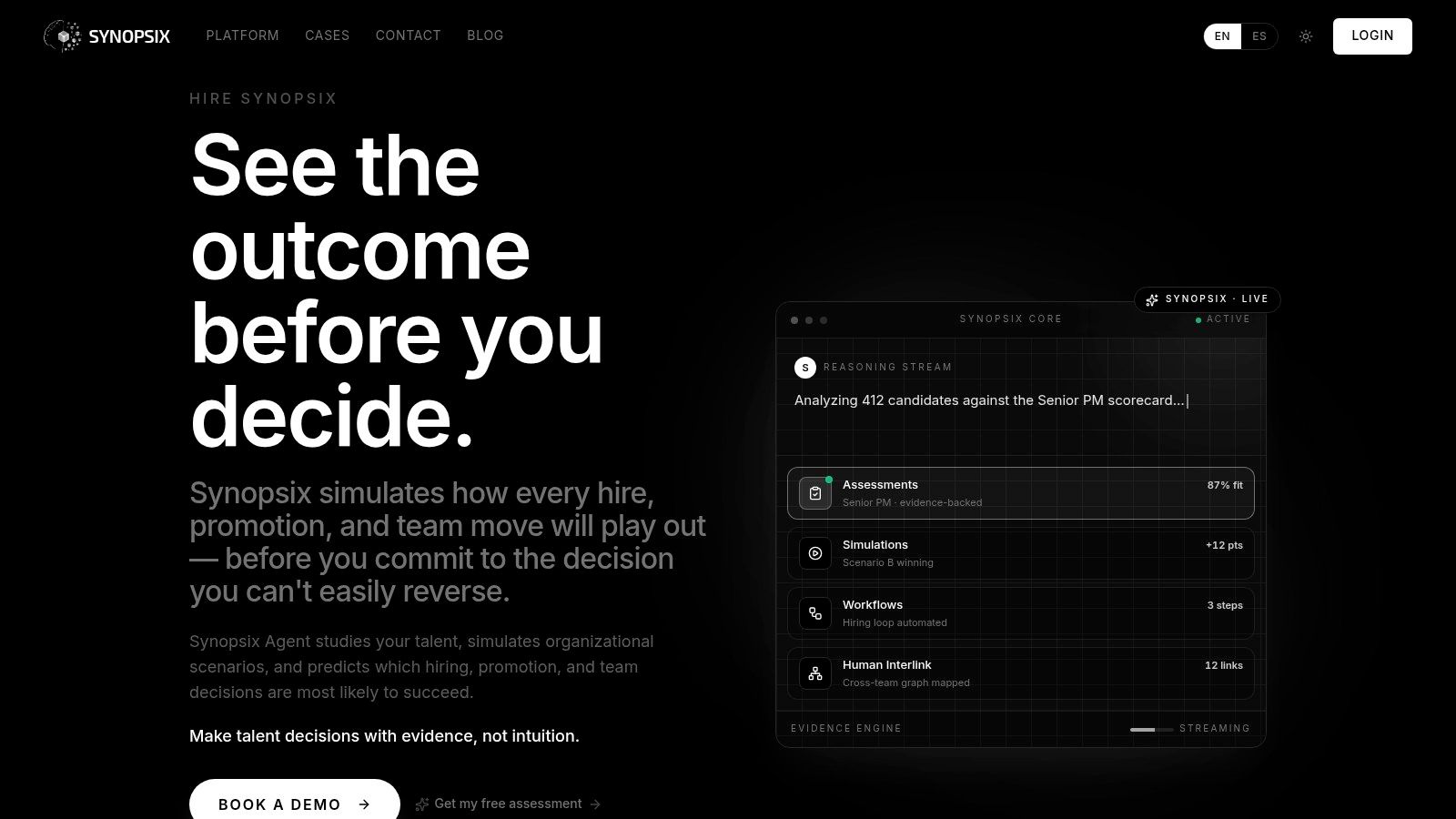
Few HR analytics platforms are designed around a harder question than reporting: what should a leader do differently with this person, team, or hiring decision? Synopsix is notable because it focuses on behavioral intelligence as a decision layer, rather than treating analytics as a dashboarding exercise. For CHROs, that creates a different evaluation standard. The platform should be judged less on how many workforce metrics it surfaces and more on whether it improves decisions in hiring, team design, succession, and development.
The product uses scientifically validated behavioral assessments and translates them into business-facing outputs. Instead of leaving psychometric data in specialist language, it organizes results into workflows that a hiring leader, executive, or HR business partner can apply directly. Its model is straightforward: assess, create comparable profiles, convert those profiles into practical signals, then use simulations and fit analysis to test likely outcomes before making a people decision. A useful companion resource is Synopsix's explanation of [predictive analytics in HR and where prediction alone falls short](https://synopsix.ai/blog/predictive-analytics-in-hr).
That distinction matters. Traditional HR analytics tools are usually strongest at identifying patterns in attrition, headcount, span of control, compensation, or DEI representation. They are less effective at explaining interpersonal friction, manager fit, or the behavioral drivers that influence whether a new hire succeeds. For CHROs comparing platforms, this is the dividing line between retrospective analytics and intervention-oriented intelligence.
One peer-reviewed review of people analytics adoption found that organizations see value in analytics, yet many HR decisions still depend heavily on managerial judgment and intuition because interpretation remains a bottleneck, especially in retention-related contexts ([PMC review](https://pmc.ncbi.nlm.nih.gov/articles/PMC8096159/)). Synopsix is built around that bottleneck.
Its product design reflects that priority:
This approach gives Synopsix a clear place in the market. It is not a replacement for broad workforce reporting, governance, or enterprise benchmarking. It addresses a narrower and often neglected problem: converting behavioral data into specific actions that managers can apply.
Vendor-reported outcomes cited in the materials for this article include faster hiring decisions, fewer mis-hires, more than 50,000 profiles generated, and high assessment accuracy. Those figures should be validated during procurement, especially if the platform is being considered for enterprise-wide deployment. Even so, the product direction is clear. Synopsix is built for organizations that want explanation and intervention support, not only trend visibility.
The trade-offs are also clear. Public pricing is not listed, so evaluation starts with a sales process. Assessment-led systems also depend on disciplined implementation, sound interpretation, and use alongside interviews, manager judgment, and organizational context. For CHROs, the practical conclusion is straightforward: Synopsix is strongest when the goal is to improve decision quality at the person and team level, not merely to centralize workforce reporting.
2. Visier People
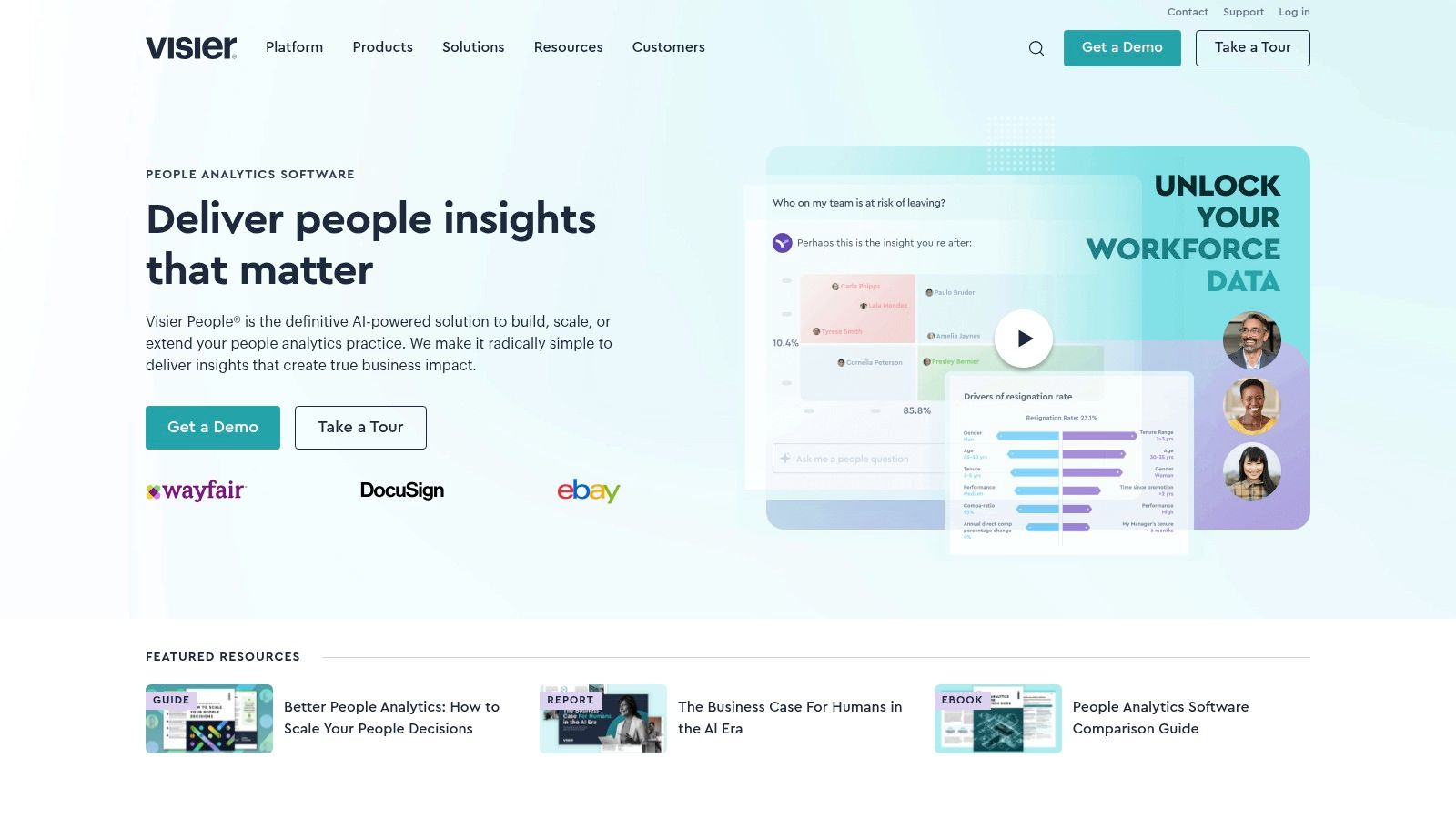
[Visier People](https://www.visier.com/products/visier-people/) is one of the clearest choices for large enterprises that need a dedicated people analytics layer rather than a general BI tool. Its core strength is prebuilt HR content. That matters because many analytics projects fail when teams spend too much time constructing definitions, cleaning data, and rebuilding standard workforce metrics from scratch.
Visier's value is less about flashy visualization and more about operational maturity. It unifies HR and business data, supports governed access, and gives leaders prebuilt analyses across hiring, retention, compensation, DEI, and workforce composition. For CHROs, that shortens the distance between a workforce question and a usable answer.
For leaders evaluating predictive use cases, Synopsix's view on [predictive analytics in HR](https://synopsix.ai/blog/predictive-analytics-in-hr) is a useful companion framework because it clarifies where prediction alone is useful and where explanation is required.
Where Visier is strongest
Visier is a strong fit when the central challenge is enterprise-scale consistency. The platform is built for organizations that want:
> Visier is usually the right choice when the problem is fragmentation across systems, not ambiguity inside human behavior.
The trade-off is implementation effort. Enterprise data mapping, governance design, and cross-system normalization take time. Pricing is also quote-based and usually makes more sense at scale than in smaller environments.
3. ChartHop
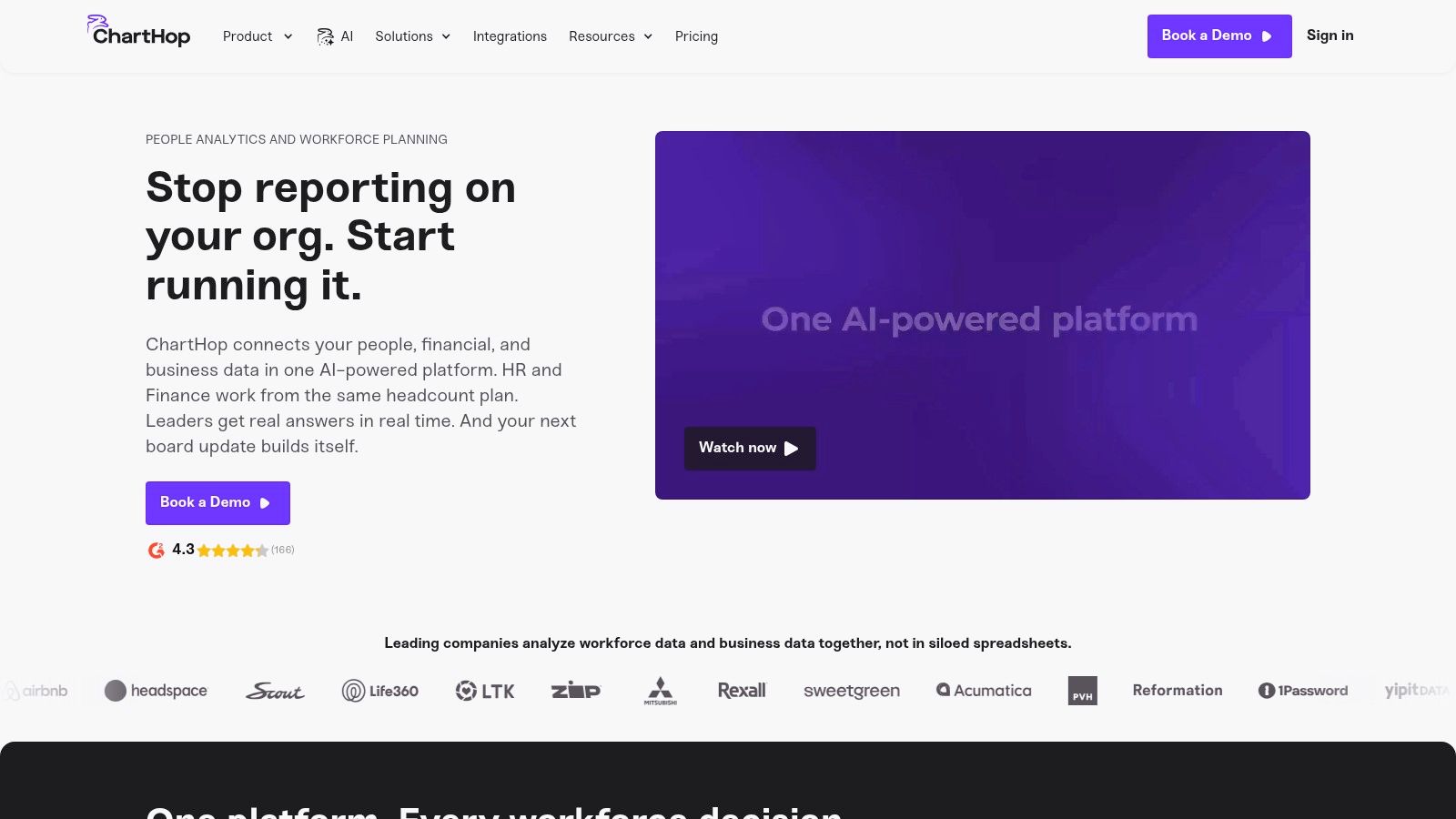
[ChartHop](https://www.charthop.com/) approaches hr analytics tools from a structure-first angle. Instead of treating the org chart as a static reference, it uses the org model as the interface for planning, analytics, and reporting. That sounds simple, but it changes who uses the system. Managers and business leaders tend to engage more readily with an org-based view than with a dense analytics environment.
This is why ChartHop works well in organizations where workforce planning is the actual use case. Headcount, spans and layers, compensation visibility, and scenario modeling all become easier to discuss when the organizational structure is the frame.
Its value aligns closely with the kind of questions raised in [strategic workforce planning](https://synopsix.ai/blog/strategic-workforce-planning), especially when HR needs to model future roles rather than merely report current ones.
Best use case
ChartHop is particularly effective when HR needs to bridge planning and adoption. A platform can have strong analytics and still fail if line leaders won't use it. ChartHop's org-centric interface helps avoid that.
Its key strengths include:
The constraints are straightforward. Public pricing is limited, and more advanced functionality tends to require sales engagement. It also isn't designed as a deep behavioral intelligence platform. If your challenge is predicting interpersonal friction, promotion risk, or role fit at the individual level, you'll need another layer.
4. Crunchr
[Crunchr](https://www.crunchr.com/) is one of the better options for HR teams that want guided analytics without committing to a fully custom analytics build. It focuses on data consolidation, harmonization, prebuilt metrics, and self-service dashboards that HR leaders can explore without a heavy analyst dependency.
That positioning matters because tool selection isn't usually the biggest blocker. Capability is. One verified industry analysis argues that the under-discussed bottleneck is organizational readiness, noting that [80% of HR data remains siloed across systems and 60% of analytics initiatives stall because staff capability is too low to use integrated data well](https://wowledge.com/blog/advancing-hr-analytics-by-overcoming-common-challenges). Crunchr's emphasis on guided analyses and drag-and-drop use directly addresses that failure pattern.
Why Crunchr often wins the short list
Crunchr is less intimidating than many enterprise analytics platforms. It's built to make early wins visible, especially for HR teams that need a cleaner path from messy data to executive storytelling.
For CHROs, that means faster operational traction. For analytics leaders, it means fewer stalled requests and fewer bespoke reporting cycles.
The trade-off is that Crunchr still sits mainly in the consolidation-and-interpretation category. It helps teams understand what's happening. It's less differentiated when the need is individualized behavioral prediction or intervention design.
5. Orgvue
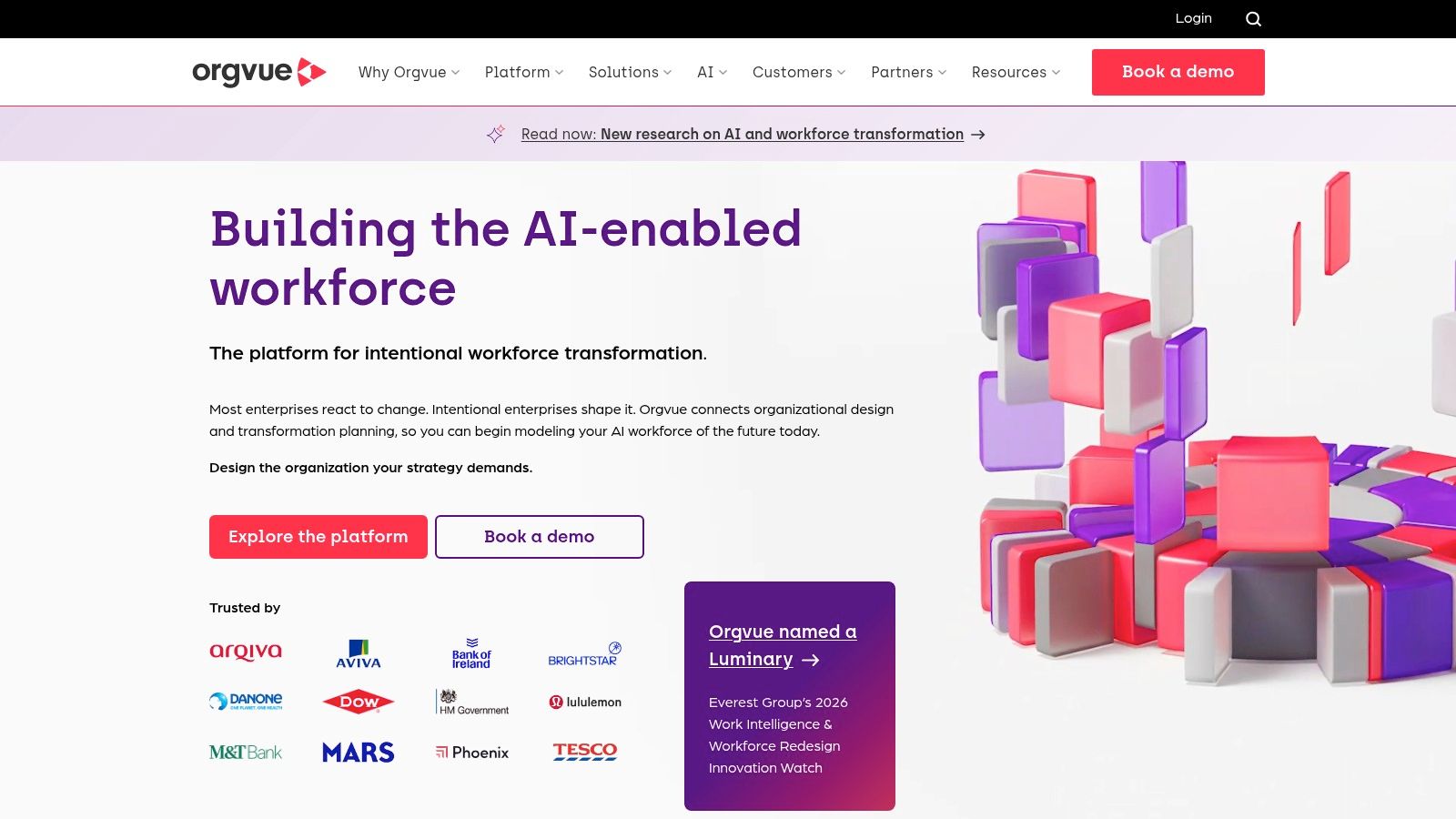
[Orgvue](https://www.orgvue.com/) is the specialist option on this list for organizational design and transformation. Where some hr analytics tools optimize reporting and others improve manager visibility, Orgvue is built for workforce restructuring, operating model redesign, and scenario comparison across roles, cost, skills, and structure.
That makes it especially valuable during mergers, span-of-control redesigns, function reshaping, or large workforce planning exercises. The product is less about ongoing engagement analytics and more about executive decision support during change.
What Orgvue does better than generalist platforms
Orgvue is strongest when leadership wants to answer “what happens if we redesign the organization this way?” rather than “what did turnover look like last quarter?” It connects disparate data into a modeling environment where structure and workforce economics can be assessed together.
Its strongest capabilities are:
> If your primary stakeholder is the transformation office, not the HRBP community, Orgvue will often be more relevant than a broad people analytics suite.
The limitation is focus. Orgvue isn't trying to be an employee experience platform, a survey engine, or a universal people analytics warehouse. Buyers should choose it when org design is the strategic problem, not merely because it has analytics features.
6. Workday People Analytics + Prism Analytics
[Workday Prism Analytics and related analytics capabilities](https://www.workday.com/en-us/products/analytics-reporting/data-hub.html) make the most sense for organizations already standardized on Workday HCM. That may sound obvious, but it's a critical procurement filter. In the analytics category, native fit often matters more than theoretical feature breadth.
Workday's proposition is practical. Use augmented analytics to surface workforce themes and root drivers, then use Prism as the data hub to combine Workday information with external sources. For CHROs who need stronger alignment between workforce and finance decisions, that integration path can be more important than another layer of standalone dashboards.
Where it creates value
Workday's main advantage is reduced friction for existing customers. A lot of analytics initiatives lose momentum during integration and model maintenance. Workday avoids some of that burden when the core HCM system is already in place.
The most useful strengths are:
This isn't the ideal choice for organizations outside the Workday ecosystem. As a standalone analytics investment, its appeal drops. But for Workday customers trying to connect talent and financial decisions more tightly, it can be a pragmatic and lower-friction move.
7. SAP SuccessFactors People Analytics
[SAP SuccessFactors](https://www.sap.com/products/hcm.html) is strongest when HR analytics needs to sit inside a broader SAP enterprise environment. The appeal isn't just HR reporting. It's HR-finance convergence. If your organization already runs finance, planning, and workforce data in SAP-adjacent systems, the analytics story becomes much more compelling.
The market is moving toward broader business impact analysis rather than isolated HR metrics. One verified industry source notes that by 2025, the convergence of HR analytics with broader business metrics is expected to sharpen how organizations quantify the ROI of human capital investments, while visualization tools like Power BI and Tableau have already changed how leaders interpret complex workforce data through interactive dashboards. That same source also notes that Excel remains the most accessible entry point for many HR teams, while more advanced organizations are adding R and Python for deeper modeling, which shows how wide the maturity gap still is across the category: [SkillPanel's HR analytics tools overview](https://skillpanel.com/blog/hr-analytics-tools/).
Best fit
SuccessFactors People Analytics is best suited to enterprises that want curated dashboards inside the SAP stack, along with a path toward strategic planning and cost linkage.
Its core strengths include:
The trade-off is complexity. For non-SAP environments, implementation and skills requirements increase quickly. Advanced use often depends on SAP Analytics Cloud expertise, so the buyer has to assess internal capability accurately.
8. UKG People Analytics
[UKG Analytics](https://www.ukg.com/products/features/analytics) is a strong operational choice for organizations where workforce management data matters as much as core HR data. That's a meaningful distinction. Many analytics platforms are strongest in corporate environments. UKG tends to be more compelling when scheduling, time, attendance, and front-line labor dynamics shape business performance.
This is why UKG often resonates in healthcare, retail, hospitality, logistics, and other labor-intensive settings. It can connect workforce operations to people decisions in a way some white-collar-centric platforms don't.
Why UKG is different
UKG's advantage is lineage. Because the platform grew out of workforce management as well as HCM, the analytics layer can reflect operational signals that are often early indicators of pressure, disengagement, or scheduling imbalance.
Its notable capabilities include:
The product is most valuable for organizations already invested in UKG. Outside that installed base, the case gets weaker. Public pricing also isn't listed, and analytics functionality is often bundled into wider commercial arrangements.
9. ADP DataCloud
[ADP DataCloud](https://www.adp.com/what-we-offer/products/adp-datacloud.aspx) is built for a specific kind of buyer. If payroll and core HR already run through ADP, and the organization wants guided analytics with strong U.S. benchmark context, DataCloud is one of the more efficient add-on choices.
The platform emphasizes preconfigured KPIs, dashboards, labor insights, and benchmark comparisons. That tends to appeal to HR leaders who want quick visibility into turnover, headcount, compensation, and labor cost patterns without standing up a new analytics ecosystem.
Where DataCloud is most useful
ADP DataCloud isn't trying to be the deepest custom analytics environment. It's trying to be easy to activate and easy to consume for organizations already living in the ADP stack.
Its strongest points are:
The main limitation is ecosystem dependence. If you aren't already using ADP broadly, the strategic case is weaker. And if your CHRO wants cross-platform behavioral guidance, team-fit modeling, or deep custom data science, DataCloud won't replace a more specialized layer.
10. Culture Amp
[Culture Amp](https://www.cultureamp.com/platform/plans-and-pricing) belongs on this list because not every HR analytics decision starts with data warehousing. Many start with manager behavior, engagement risk, and employee experience signals. Culture Amp is strongest when those are the primary questions.
It combines engagement, performance, lifecycle feedback, and manager-ready insights in one environment. For HRBPs and people managers, that makes it easier to connect sentiment with performance and team outcomes without needing a more technical analytics stack.
Best for employee experience-driven analytics
Culture Amp is particularly effective when the organization wants analytics to drive local action, not just executive reporting. Managers can explore patterns, drill into drivers, and use connected employee experience modules to address issues in context.
Its strengths include:
> A dashboard used by managers every month is usually more valuable than a richer one used only by the analytics team.
The limitation is scope. Culture Amp isn't a full enterprise warehouse for deep multi-system modeling. It's best when employee experience and manager action are central, not when the organization needs one consolidated analytics backbone for every HR and finance source.
Top 10 HR Analytics Tools Comparison
| Product | Core features | UX & Quality | Value / Pricing | Target audience | Unique selling points | |---|---|---:|---|---|---| | Synopsix 🏆 | Behavioral assessments; Intelligence Reports; Predictive Simulations; Human Interlink | ★4.8, 98% accuracy claim; fast, business-language reports | 💰 Quote-based, ROI: faster hires, fewer mis-hires | 👥 CHROs, TA teams, hiring managers, coaches | ✨ AI-backed psychometrics → clear business signals; simulation-led team fit | | Visier People | Prebuilt HR metrics & questions; large benchmarks; AI assistant | ★4.5, enterprise-grade analytics & governance | 💰 Quote-based, enterprise pricing | 👥 Large enterprises, HR leaders, analysts | ✨ Massive benchmark dataset; deep HR content | | ChartHop | Living org charts; headcount planning; role-based dashboards | ★4.3, intuitive org UI, manager-friendly | 💰 Tiered / quote for advanced plans | 👥 Fast-growing companies, HR & line managers | ✨ Visual org model + scenario planning for adoption | | Crunchr | Data consolidation & harmonization; AI-guided insights; self-serve dashboards | ★4.2, easy, quick time-to-value | 💰 Quote-based, scalable tiers | 👥 HR teams seeking rapid insights & storytelling | ✨ Guided analyses & drag‑drop dashboards for non-experts | | Orgvue | Org design; fast scenario modeling; roles/skills analytics | ★4.4, executive-ready visualizations | 💰 Quote-based, modular licensing | 👥 Organizations in transformation / M&A | ✨ Best-in-class what-if org/design modeling | | Workday People Analytics + Prism | Augmented analytics; Prism data hub; role-based reports | ★4.0, native Workday experience | 💰 Add-on to Workday subscription | 👥 Workday customers, HR & finance leaders | ✨ Native Workday integration + HR↔Finance blending | | SAP SuccessFactors People Analytics | Prebuilt HR dashboards; S/4HANA finance linkage; scenario planning | ★4.0, enterprise-grade, SAP-aligned | 💰 Add-on to SuccessFactors / SAP stack | 👥 Large SAP ecosystem enterprises | ✨ Tight SAP data model & HR‑Finance convergence | | UKG People Analytics | Real-time dashboards; predictive analytics; benchmarking | ★4.1, strong frontline/workforce signals | 💰 Bundled or add-on with UKG suites | 👥 UKG customers, hourly/frontline-heavy orgs | ✨ Workforce mgmt signals enrich analytics for hourly ops | | ADP DataCloud | Turnkey KPIs; U.S. benchmark dataset; storyboards | ★4.2, rapid TTV for ADP payroll users | 💰 Add-on to ADP subscription | 👥 U.S. companies using ADP payroll/HCM | ✨ One of the largest U.S. payroll benchmarks for comp & turnover | | Culture Amp | Engagement, performance & lifecycle analytics; EX modules | ★4.3, manager-ready, action-focused insights | 💰 Public tiered pricing | 👥 Orgs focused on employee experience & managers | ✨ Survey-driven EX + linked performance insights |
The Future of HR Is Predictive, Not Just Retrospective
One market forecast estimates the HR analytics category at USD 5.2 billion in 2024, rising to USD 12.4 billion by 2033. For CHROs, the more important signal is not category size. It is the change in what boards and CEOs expect from HR technology.
Senior leaders now expect HR to do more than report hiring efficiency, attrition, or engagement scores. They want earlier warning on workforce risk, clearer links between talent decisions and business outcomes, and evidence for which interventions are likely to work. That shift changes how hr analytics tools should be evaluated. A dashboard that summarizes the past has value, but it does not answer the full decision problem.
A better CHRO-focused framework has three tests. First, can the platform unify and clean fragmented people data across HRIS, payroll, performance, and survey systems? Second, can it surface patterns that matter commercially, such as manager-related turnover, internal mobility bottlenecks, or capacity risks after reorgs? Third, can it convert those findings into guidance that leaders will use in hiring, promotion, team design, and retention decisions?
The third test is where many tools still fall short.
Traditional analytics platforms are strongest at visibility, benchmarking, and trend analysis. That matters for governance and workforce planning. Newer behavioral intelligence platforms address a different gap. They aim to explain likely causes of people outcomes and support earlier intervention, especially when the question is not only who is at risk, but why that risk is forming and what action fits the context.
That distinction also affects trust. In a discussion of prediction and decision-making, [Gerd Gigerenzer argues that transparent, theory-grounded reasoning can outperform opaque complexity in real-world settings](https://www.youtube.com/watch?v=nfQHG1ExjAo). HR leaders should apply the same standard to analytics software. If a manager cannot understand the rationale behind a risk signal, adoption usually weakens and action quality declines.
Across this list, the tools serve different strategic priorities. Visier, Crunchr, ADP DataCloud, and the major HCM-native suites are well suited to centralized reporting and operating cadence. Orgvue and ChartHop are strong choices for organizations focused on org design, headcount planning, and structural scenarios. Culture Amp is useful when employee experience data needs to connect to manager action. Synopsix is differentiated by its focus on behavioral interpretation and decision guidance, which is relevant for CHROs trying to close the gap between prediction and prevention.
The market is shifting toward systems that support earlier, more precise decisions.
If your team needs more than benchmark dashboards and historical reporting, compare vendors against one standard: how reliably they help leaders make better people decisions before performance, retention, or team effectiveness deteriorates. [Discover Bridge Global's insights](https://www.bridge-global.com/blog/predictive-analytics-for-business/) for a broader view of predictive analytics in business, then assess whether each platform on your shortlist improves actionability, explainability, and decision speed.
If your organization wants behavior-based guidance for hiring, promotion, and team design, Synopsix is worth close evaluation. Its value is not just measurement. It is the ability to translate behavioral signals into specific management decisions that senior leaders can defend.