Human Resource Management Salary with Masters Degree
By Synopsix · July 23, 2026 · 13 min read
A master's degree in human resources isn't just a credential upgrade, it's tied to a real pay jump. Franklin University reports that labor-market analytics firm EMSI found average advertised salary for HR professionals with a bachelor's degree at $64,000, while the average for HR professionals with a master's degree was $80,300, a gap of $16,300 or about 25.5% higher pay for the graduate-degree group [Franklin University](https://www.franklin.edu/blog/masters-in-human-resources-salary). For talent leaders, that changes how you think about retention, succession planning, and internal mobility. For candidates, it changes how you evaluate whether graduate school is a cost, a signal, or a direct route into higher-paying HR work.
A human resource management salary with masters degree follows a pattern that's more nuanced than a simple across-the-board premium. The biggest gains show up where education helps people move into management, specialized functions, and higher-responsibility roles. That's why the right salary question isn't only “What do HR master's graduates earn?” It's “Which roles, regions, and industries turn that degree into measurable upside?”
Use the benchmark data in this article as a decision tool, not as a flat promise. If you're comparing programs, a compensation benchmark can sharpen your expectations. If you're hiring, it can help you set fairer bands. If you're mapping your own path, it can show where graduate study pays off, and where experience, specialization, and negotiation do the heavy lifting. For a broader compensation framing, see the related [compensation salary survey](https://synopsix.ai/blog/compensation-salary-survey).
Introduction to HR Salary Premium
The strongest reason the master's-degree conversation matters is simple, pay is meaningfully higher for the graduate group. Franklin University's summary of EMSI labor-market data shows $64,000 for HR professionals with a bachelor's degree versus $80,300 for those with a master's degree, a difference of $16,300 and roughly 25.5% [Franklin University](https://www.franklin.edu/blog/masters-in-human-resources-salary). That isn't a cosmetic bump. It's enough to change whether a program looks like an academic milestone or a career investment.
That premium matters for different people in different ways. Hiring managers and CHROs need to know whether a graduate credential really predicts higher-value work, or just a stronger résumé. HR aspirants need to know whether the degree helps them move into better-paid roles fast enough to justify the time and tuition. Talent leaders also need to understand that salary data shapes expectations, because employees compare their pay to what the market says someone like them should earn.
> Practical rule: treat a master's in HR as a lever for role access, not just a credential. The pay increase is strongest when the degree gets paired with a move into more complex work.
The bigger story is that salary gains in HR don't move in a straight line. They depend on where someone lands in the function, how much responsibility they carry, and whether their work sits close to business strategy. That's why the rest of this analysis breaks the data into national benchmarks, regional variation, sector differences, and ROI logic. If you're trying to decide whether graduate school makes sense, or whether to pay more for a candidate with an advanced degree, the useful answer lives in those details.
Understanding Salary Premium for Masters Holders
A master's degree changes HR pay most clearly when it changes the kind of work someone can do. The U.S. Bureau of Labor Statistics reports a median annual wage of $72,910 for human resources specialists in May 2024, with employment projected to grow 6% from 2024 to 2034 [BLS](https://www.bls.gov/ooh/business-and-financial/human-resources-specialists.htm). In the same labor-market picture, HR professionals with more education and experience can reach $140,030 per year, with top executives earning up to $493,000 [BLS](https://www.bls.gov/ooh/business-and-financial/human-resources-specialists.htm). That gap tells you where the degree matters most, at the transition from generalist or specialist work into higher-responsibility management and executive tracks.
Why the premium isn't uniform
The graduate premium is not a single number that applies everywhere. It's concentrated in jobs where employers value strategic judgment, analytics, compensation design, labor relations, or people leadership. Marshall University's BLS-based framing makes that clear by contrasting the specialist median with a higher earnings figure tied to more education and several years of experience [Marshall University](https://www.marshall.edu/blog/masters-in-human-resources-worth-it/). In other words, the master's degree doesn't pay because it exists. It pays because it helps people qualify for work that sits closer to organizational decision-making.
That's also why the wage growth pattern matters. Franklin University reports that over the past three years, the advertised wage for HR professionals with a master's degree rose 7.3%, compared with 5.3% for those with a bachelor's degree [Franklin University](https://www.franklin.edu/blog/masters-in-human-resources-salary). The difference isn't huge in isolation, but it signals a better growth trajectory for the graduate group. Employers appear to pay more aggressively for credentials tied to harder-to-fill, more strategic work.
What the spread means in practice
The median specialist wage and the higher-experience figure cited in Marshall University's article create a large earnings spread of $67,120 [Marshall University](https://www.marshall.edu/blog/masters-in-human-resources-worth-it/). That spread is a key signal to watch. It shows that the return on a master's degree in HR is often front-loaded through mobility, not a small raise on the same job.
If your goal is better pay, the most useful question isn't whether the degree is “worth it” in the abstract. It's whether the program helps you cross into roles where compensation is structurally higher. That's the part most salary pages miss, and it's why your benchmark should be role progression, not just degree status.
Regional and Role-Based Salary Benchmarks
Geography changes the value of an HR master's degree fast. National averages are useful, but they can hide the pay differences that show up once you cross state lines or move into specialized management functions. One BLS-based summary cited by National University shows California HR manager pay at $154,430 versus a national $126,230, while compensation and benefits managers in California earned $149,670 [National University](https://www.nu.edu/blog/what-can-you-do-with-a-master-of-human-resources/). That's a clear reminder that location can lift compensation even when the job title stays similar.
Regional Salary Benchmarks for HR Roles
| Region | HR Manager Salary | Compensation Manager Salary | |---|---:|---:| | National | $126,230 | Not specified in the cited data | | California | $154,430 | $149,670 |
The table shows the core point. An HR master's holder targeting a manager role in a high-cost, high-demand market can often clear a much stronger salary base than someone in a lower-cost region. The degree helps, but local labor conditions still decide how much of a premium lands in the offer.
That regional variation becomes even more important for specialized functions. National University also cites role-specific figures that put HR manager at about $91,000, chief learning officer at $160,500, and compensation and benefits manager at $111,500 [National University](https://www.nu.edu/blog/what-can-you-do-with-a-master-of-human-resources/). Those numbers show why specialty matters. A master's degree doesn't produce one salary outcome. It opens different doors, and those doors don't all lead to the same pay band.
A practical way to use this is to compare your current market against the role you want, not just the degree you hold. If your compensation target is in a stronger regional market, it can make sense to build your search around relocation, remote reach, or employer type. If you're already in a costlier market, you may need to prove deeper specialization to avoid getting lumped into a generic HR band.
For teams doing market reviews, a good compensation process should also [negotiate better PEO terms](https://www.peometrics.com/employee-benefits-benchmarking/) by separating national averages from local benchmarks. That keeps benefit and salary decisions closer to the actual market reality instead of a blended figure that doesn't fit any one role well.
Industry and Sector Salary Variance
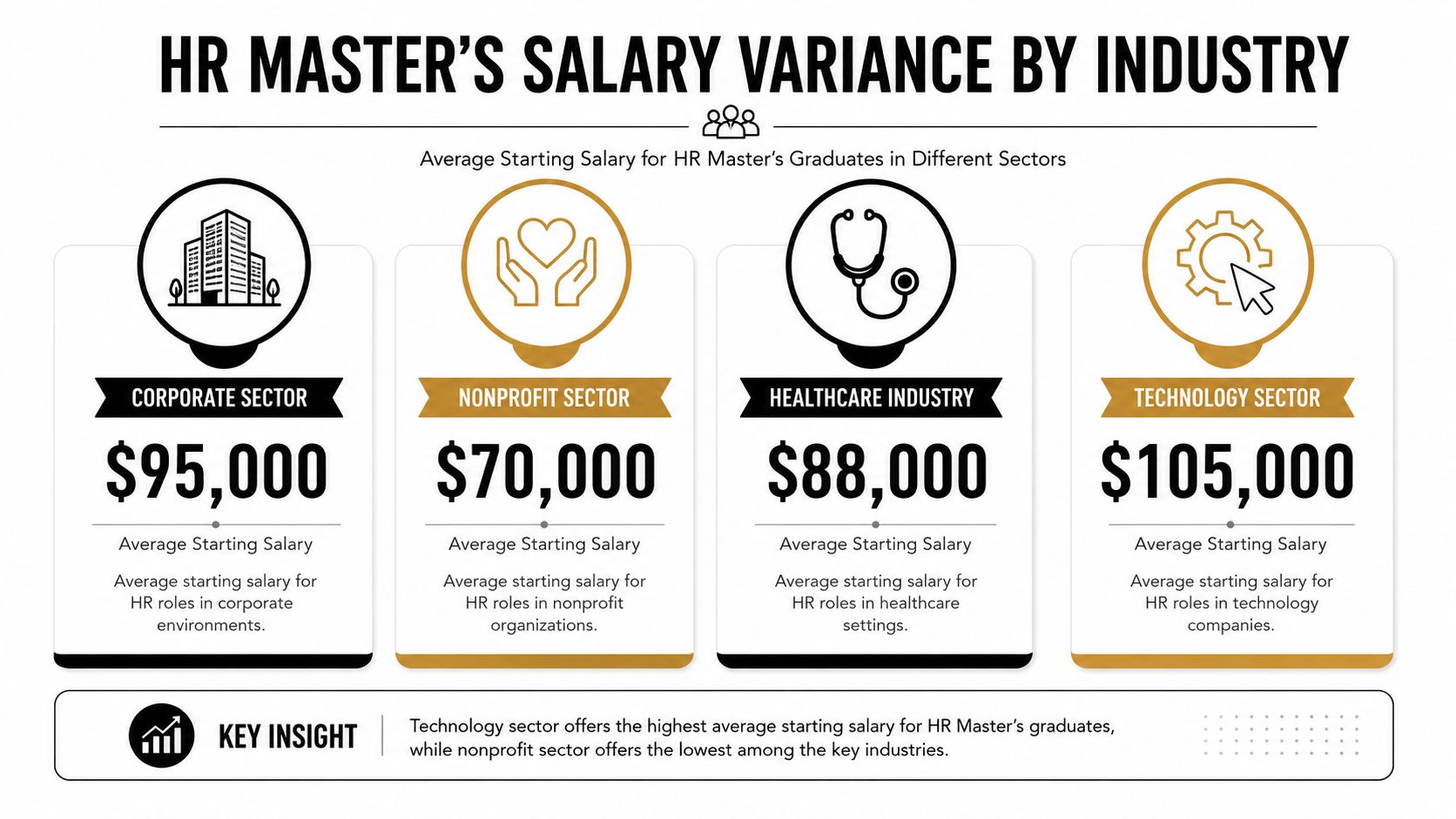
Industry choice can matter as much as geography, sometimes more. MBA.com reports that graduates of HR management master's programs earn an average of $73,000, with some reaching up to $114,000 depending on organization size and seniority [MBA.com](https://www.mba.com/business-school-and-careers/salary-and-roi/what-business-masters-degrees-have-highest-salaries/amp). That range makes one thing obvious. The same degree can lead to very different pay outcomes depending on whether the employer is a mid-sized organization or a larger, more complex enterprise.
Why some sectors pay more
The highest-pay sectors tend to be the ones where HR is under heavier pressure from compliance, analytics, scale, or scarcity of talent. Healthcare organizations need precise policy execution and workforce coordination. Technology firms often need fast hiring, retention planning, and compensation fluency. Corporate environments can pay more when HR is close to leadership and workforce planning.
That's why the best niche isn't always the best-known one. A graduate who wants to maximize return should look for roles where HR is tied to business risk or revenue protection. Compensation design, labor relations, analytics, and talent strategy all tend to sit nearer to the budget and the executive team, so pay tends to rise with responsibility.
A useful lens is to compare sector, not just title. Two HR managers can do similarly complex work, but one may sit in a narrow nonprofit budget and the other in a multi-site, high-growth company with more room for pay escalation. That's not a matter of prestige, it's a matter of organizational economics.
For compensation leaders, that also means salary benchmarking should connect directly to workforce design. A [pay equity audit](https://synopsix.ai/blog/pay-equity-audit) helps separate legitimate role differences from pay gaps that come from inconsistent structures or informal negotiation. That's especially important in sectors where the demand for HR expertise is high, but salary bands haven't kept pace with market conditions.
Factors Driving Salary Growth and ROI
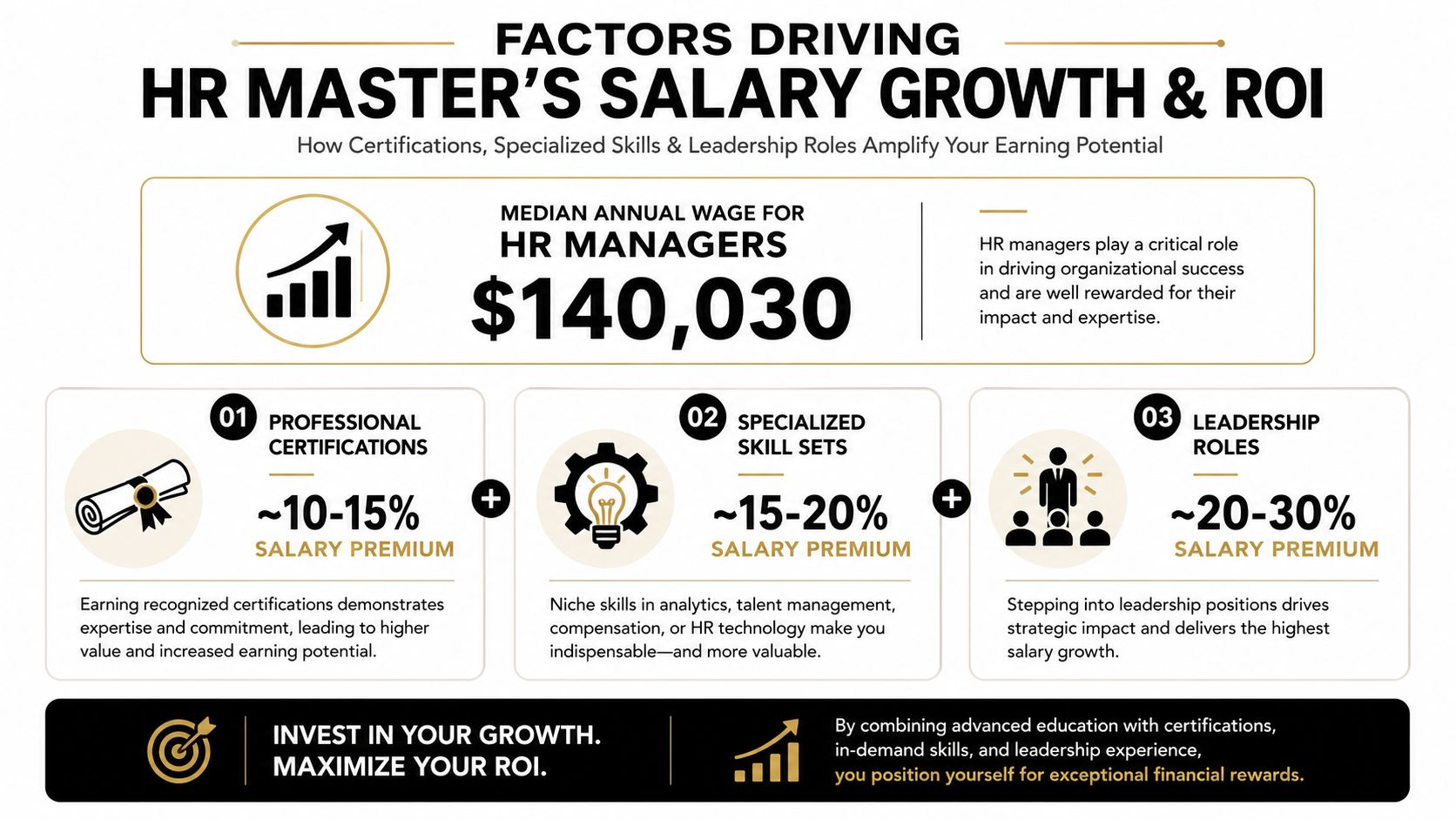
The master's-degree premium in HR gets bigger when it's paired with the right role, the right skills, and the right moment in a career. The BLS reports a median annual wage of $140,030 for human resources managers in May 2024 [BLS](https://www.bls.gov/ooh/management/human-resources-managers.htm). That number matters because it shows where the ROI usually starts to become visible, in management rather than in the specialist tier.
What actually lifts pay
Advanced education matters most when it lines up with three things.
> Rule of thumb: the degree's ROI rises fastest when it shortens the path from HR support work to budget-linked decision-making.
That's why the return on graduate study is uneven. A master's program can build value, but the payback depends on whether the student uses it to enter a better-paying lane. Someone who stays in the same scope of work may see only a modest shift. Someone who steps into manager-level work can move into a very different pay structure.
A five-year ROI lens helps here. The degree investment only makes sense when the added pay from promotion, specialization, or location change outweighs the cost and time commitment. Because the verified data doesn't provide tuition totals, the safest conclusion is qualitative. Graduate study has the strongest return when it leads to faster movement into manager tracks, specialized niches, or leadership pipelines where compensation is materially higher.
That also means employers should think carefully about where they assign advanced-degree holders. If the role doesn't use the person's strategy, analytics, or leadership training, the pay premium may feel disconnected from performance. If the role does use it, the business gets better decision quality and the employee gets a clearer path to advancement.
For a deeper look at how pay structures connect to broader rewards strategy, the [total rewards HR](https://synopsix.ai/blog/total-rewards-hr) perspective is useful because it keeps salary from being treated as the only lever. Benefits, growth paths, and role design all shape perceived value.
Salary Negotiation and Career Path Strategies
An HR master's degree can improve pay, but it won't negotiate for you. The strongest offers usually go to candidates who bring market data, a clear business case, and evidence that they can handle more complex work. That matters because Marshall University cites a $72,910 median annual wage for HR specialists in May 2024 and $140,030 for HR professionals with advanced experience, creating a potential earnings spread of $67,120 [Marshall University](https://www.marshall.edu/blog/masters-in-human-resources-worth-it/).
How to negotiate with better leverage
Start with the market, not your current salary. Document the role, location, and scope you're targeting, then compare it against the salary signals above. If your work includes analytics, compensation, labor relations, or team leadership, say that directly. Employers pay more when they can see why the job sits above a generic HR coordinator or specialist band.
Your interview presentation also matters. A polished digital presence helps hiring teams trust the story you're telling, especially for leadership roles. If your profile still looks like an early-career résumé, use the [guide to optimizing your LinkedIn photo](https://www.aiheadshots.ai/blog/linkedin-photo-tips) to tighten the first impression before you go to market.
> Negotiation move: ask for the role scope you want, not only the pay you want. Higher salary usually follows higher responsibility.
A simple progression path looks like this. HR specialist builds operating fluency. HR manager adds supervision and budget accountability. HR director brings policy, multi-team oversight, and strategy. CHRO sits at the executive table and ties workforce decisions to business outcomes. The ladder is familiar, but the pay changes sharply once the role stops being mainly administrative.
Video can help a candidate think through that shift in a practical way.
<iframe width="100%" style="aspect-ratio: 16 / 9;" src="https://www.youtube.com/embed/SjvS20YqUJ4" frameborder="0" allow="autoplay; encrypted-media" allowfullscreen></iframe>
The smartest five-year plan usually includes one of three moves. You either move into management, you specialize in a higher-value function, or you position yourself for a better-paying geography or employer type. The degree gives you options. The negotiation strategy decides whether you capture them.
Conclusion and Strategic Takeaways
The salary case for an HR master's degree is real, but it isn't uniform. Franklin University's labor-market data show a 25.5% premium for master's holders, and the strongest returns appear when the degree supports movement into management, specialized functions, or high-demand regions [Franklin University](https://www.franklin.edu/blog/masters-in-human-resources-salary). That's the central takeaway for anyone evaluating human resource management salary with masters degree outcomes.
The smart move is to stop asking whether the degree is “worth it” in the abstract. Ask which role, industry, and location turn it into an advantage. The data point to a simple conclusion. Graduate study pays best when it changes your market position, not just your credentials.
For HR leaders, that means building career paths that reward advanced skill. For candidates, it means choosing programs and roles with a clear route into higher-value work. Use the benchmarks, compare the niches, and negotiate from the role you're aiming for, not the one you already have.
---
If you're planning your next promotion, building an HR career ladder, or mapping graduate-degree ROI for your team, use Synopsix to turn people data into clearer role fit, development plans, and talent decisions.