Inclusive Recruitment: Your 2026 Playbook
By Synopsix · June 21, 2026 · 17 min read
Most inclusive recruitment advice asks a narrow question: how do you reduce bias while choosing a candidate?
That matters, but it's incomplete. The harder question is this: how do you build a hiring system that is fair on the way in, predictive in selection, and stable after the hire?
That's where organizations often get stuck. They clean up job ads, add structured interviews, maybe run a workshop on unconscious bias, and then wonder why their funnel still leaks talent or why a promising hire lands in a team that never really absorbs them. Inclusive recruitment isn't a communications exercise. It's a design problem, a data problem, and eventually a team dynamics problem.
Candidate expectations have shifted too. A recruitment roundup citing Glassdoor reported that 76% of job seekers say diversity is an important factor when considering job opportunities, and a ResumeGenius survey found that 36% of candidates aged 18 to 44 consider a company's DEI policies essential when deciding whether to apply ([recruitment statistics roundup](https://www.wecreateproblems.com/blog/recruitment-statistics)). That tells you something simple. Inclusion affects whether people enter your funnel at all.
Ground Your Strategy in Goals and Data
Most hiring teams start with intent. Few start with a diagnostic.
If you want inclusive recruitment to work, begin by treating your current funnel as a system you need to understand, not a culture issue you need to sloganize. The fastest way to waste time is to launch five new initiatives before you know where candidates from underrepresented groups are dropping out.
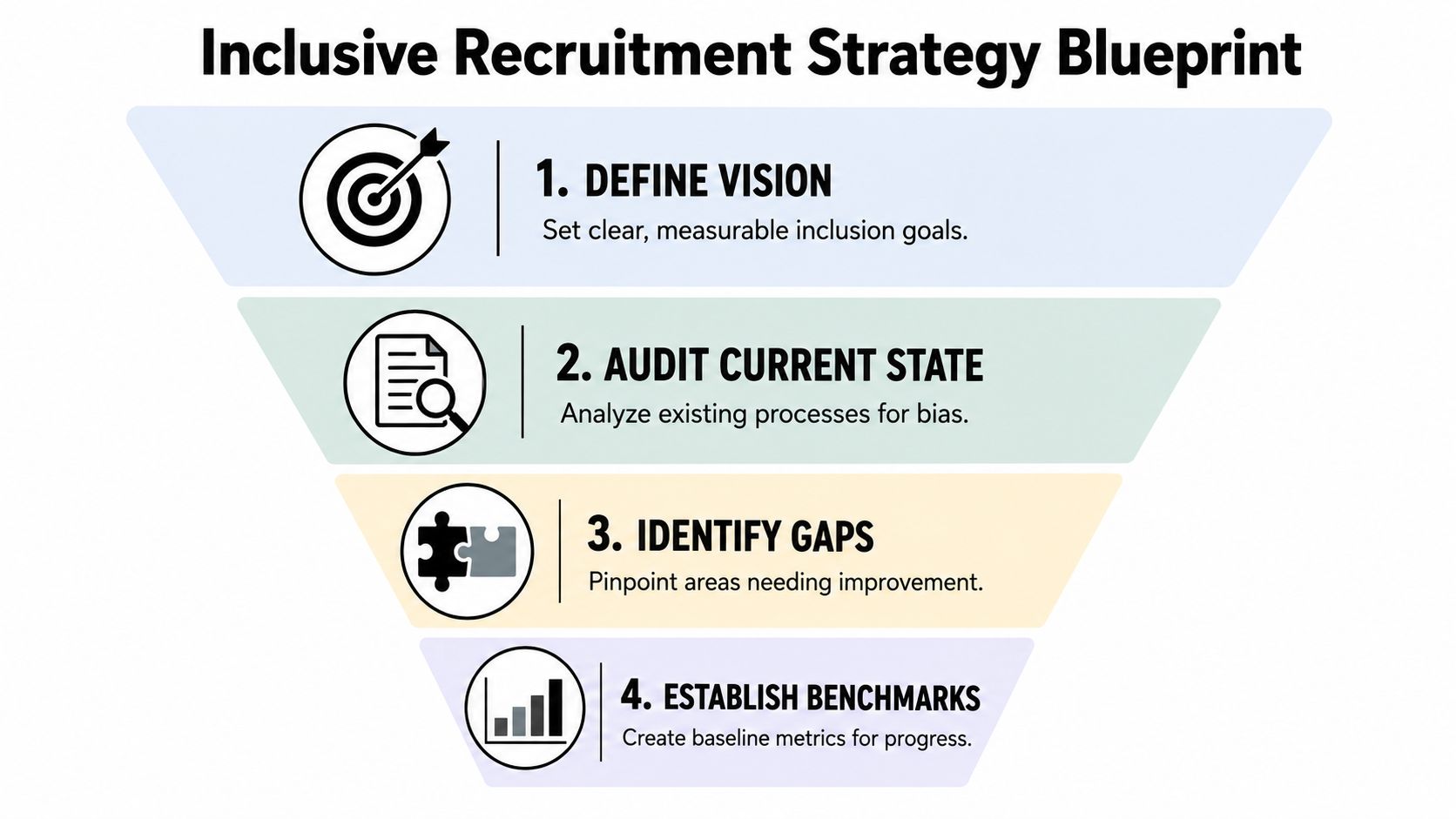
Audit the funnel before you redesign it
I'd start with one role family, not the whole company. Engineering, sales, operations, or leadership hiring. Pick the area where hiring volume is meaningful and where representation matters commercially.
Then map the funnel in plain terms:
CIPD recommends setting separate diversity conversion targets for each funnel stage, including application, sift, interview, offer, and hire, and notes that only 28% of UK employers train all interviewers on objective interview practice ([CIPD guidance on inclusive employers](https://www.cipd.org/en/knowledge/guides/inclusive-employers/)). That's useful because it forces discipline. If representation falls sharply at one stage, you know where to investigate instead of blaming the whole process.
What data actually helps
Too much messy data and too little usable data are often collected. Keep the first audit tight.
Use a checklist like this:
> Practical rule: If your data can't tell you where people are excluded, it can't help you build an inclusive process.
This is also where data hygiene matters more than most TA leaders admit. If demographic fields are optional but hidden, if source data is inconsistent, or if interviewers free-type whatever they want into scorecards, your dashboard will mislead you. A practical reference point is this [guide for SaaS data quality](https://helpwithmetrics.com/blog/data-quality-metrics/), because the same discipline applies in talent systems. Define fields, standardize entries, and decide what “complete” means before you try to compare outcomes.
Turn values into operating targets
A statement like “we want more inclusive hiring” is too vague to manage. A better operating target sounds like this: improve progression for an underrepresented group at the screening stage, widen qualified sourcing channels for a specific role family, or reduce application friction in roles with weak completion rates.
That's where people analytics becomes useful. If you need a clean frame for what to measure and how to structure the evidence, this explainer on [people analytics in practice](https://synopsix.ai/blog/what-is-people-analytics) is a good starting point.
The goal isn't to prove your process is broken. The goal is to find points of influence. Inclusive recruitment improves when you can point to one stage, one decision pattern, and one operational fix at a time.
Redesign Your Job Posts and Sourcing Channels
Job ads still filter out strong candidates long before an interviewer gets involved. Most of the damage happens in plain sight. Inflated requirements, vague “culture” language, and missing pay information signal to people who belongs and who doesn't.
SHRM's 2025 Talent Trends data shows that 46% of organizations were already including pay ranges in job postings, and HR professionals reported streamlining application processes (49%) and sharing pay ranges upfront (48%) as effective recruiting tactics ([SHRM recruiting strategies](https://www.shrm.org/topics-tools/research/2025-talent-trends/recruiting-strategies)).

Write for capability, not pedigree
A lot of exclusion hides inside “must-have” lists. Teams ask for the perfect prior title, the exact industry, a narrow education path, and a stack of years that often has little to do with actual success on the job.
A better job post focuses on outcomes and core competencies.
| Weak version | Better version | |---|---| | “Must have elite communication skills and executive presence” | “Must be able to present recommendations clearly to senior stakeholders and respond to challenge with evidence” | | “Needs startup DNA and a high-energy mindset” | “Must be comfortable working in changing priorities and making decisions with incomplete information” | | “Only candidates with direct SaaS experience will be considered” | “Experience in recurring revenue, complex buying cycles, or comparable commercial environments is valuable” |
That shift matters. “Pedigree” language narrows the pool. Capability language opens it without lowering standards.
Fix the signals candidates use to self-select
Candidates read more than the requirements list. They read what the company values enough to make explicit.
Improve the post by tightening these areas:
Many teams also benefit from reviewing the structure underneath the post, not just the wording. If your leveling, scope, and competency expectations are fuzzy, your hiring criteria will be too. This piece on [job architecture design](https://synopsix.ai/blog/job-architecture-design) is useful for aligning role definition with more consistent hiring decisions.
A short walkthrough can help teams spot the common mistakes in real job ads:
<iframe width="100%" style="aspect-ratio: 16 / 9;" src="https://www.youtube.com/embed/xfQlpgDNzEY" frameborder="0" allow="autoplay; encrypted-media" allowfullscreen></iframe>
Source outside your default network
Inclusive recruitment fails early when sourcing depends on the same recruiters, the same referrals, and the same platforms used the same way every quarter.
What tends to work better:
> Don't confuse visibility with access. A role posted everywhere can still be written so narrowly that the same people apply.
The best sourcing strategy usually isn't louder. It's broader, clearer, and less dependent on old pattern matching.
Engineer a Fair and Predictive Selection Engine
The interview is where many inclusive recruitment efforts collapse. Teams clean up the top of the funnel, then hand final decisions to unstructured interviews, “chemistry,” and confidence theater. That doesn't just reintroduce bias. It often destroys predictive quality.
If you want better outcomes, build a selection engine that does two things at once. It needs to reduce subjectivity and increase job relevance.
Replace gut feel with evidence architecture
A fair process doesn't mean a softer one. It means every candidate is measured against the same job-relevant criteria, with the same prompts, the same scoring logic, and the same decision standards.
That usually requires a few essential requirements:
This sounds basic, but execution is where companies fail. A scorecard with sloppy competencies is just a prettier version of bias. “Culture fit,” “polish,” and “executive presence” remain some of the most common ways teams launder preference into process.
Be careful with assessments
Assessment tools can improve fairness. They can also make things worse when teams buy generic personality products and assume “scientific” means valid for hiring.
That's the assessment paradox. Companies adopt tools to reduce bias, then choose instruments that were never validated for the hiring decisions they're making.
The provided research in your brief highlights that 68% of standard personality assessments used in hiring show adverse impact against minority candidates, while only 12% of HR leaders have access to AI-powered, validated behavioral profiles that can predict performance without bias. Whether or not a vendor presents itself as modern, that's the key distinction. Can the tool show job relevance, defensibility, and fair use across candidate groups?
What a stronger assessment standard looks like
If you use behavioral data in hiring, ask tougher questions than most vendors expect.
| Weak practice | Better practice | |---|---| | Using a broad personality quiz as a pass-fail gate | Using role-relevant behavioral insights as one input alongside structured evidence | | Treating “fit” as similarity to the current team | Defining the working behaviors the role actually requires | | Assuming an assessment is fair because it's popular | Asking how it was validated and how adverse impact is monitored | | Giving managers raw psychometric jargon | Translating results into practical hiring signals and decision risks |
A useful companion process is making sure your compliance checks happen in the right place and for the right reason. Teams often mix background screening, right-to-work verification, and suitability judgments into one fuzzy step. If you need a grounded overview, this guide to [understanding pre-employment checks](https://www.digitalfootprintcheck.com/pre-employment-screening-process) helps separate administrative screening from actual hiring evaluation.
Use behavioral data to improve judgment, not replace it
The best use of behavioral science in inclusive recruitment isn't to automate decisions. It's to improve the quality of human judgment.
That means:
A hiring process gets stronger when interview questions are informed by evidence and when scorecards capture the answer in business language. If your team is still treating psychometrics as either mystical truth or complete nonsense, they're missing the middle ground where these tools are useful. This overview of [psychometric testing in recruitment](https://synopsix.ai/blog/psychometric-testing-in-recruitment) is a solid reference for that distinction.
> The real benchmark isn't whether a tool feels sophisticated. It's whether it improves consistency, job relevance, and fairness at the same time.
Inclusive recruitment gets more credible when the selection engine is both stricter and smarter.
Train Hiring Managers on Bias and Data
Most bias training doesn't fail because bias isn't real. It fails because awareness alone doesn't change hiring behavior.
Managers need operating habits, not just vocabulary. They need to know how to use the process, what good evidence looks like, when they're drifting into preference, and how to disagree in a debrief without turning the room into a political exercise.
Train on moments that change outcomes
Skip generic workshops disconnected from live hiring. Train managers on the moments where decisions bend:
A practical support resource for leaders who need a broader people-management foundation is this [guide for HR leaders on training](https://www.weunite.ai/blog/manager-sensitivity-training). The useful part isn't moral framing. It's helping managers build repeatable behaviors in high-stakes conversations.
Run debriefs like evidence reviews
A bad debrief sounds like this: “I liked them.” “I'm not sure they'd fit.” “They didn't feel senior enough.” None of that is usable.
A stronger debrief has a simple sequence:
1. Start with the role criteria. Re-anchor the room on what the job requires. 2. Read scores before opinions. Look at where ratings diverge. 3. Ask for evidence, not conclusions. “What did the candidate say or do that led to that score?” 4. Separate capability from style. Quiet is not weak. Polished is not competent. 5. Document the decision logic. If you can't explain the choice clearly later, the process wasn't disciplined enough.
> Debrief rule: Ban “gut feel” unless the speaker can translate it into a specific risk tied to the job.
Calibrate managers over time
One training session won't fix inconsistent interviewing. Calibration needs repetition.
Review completed scorecards. Compare managers who score too harshly or too loosely. Spot recurring vague language. Listen for code words that hide bias behind professional-sounding terms. Then coach on the pattern.
The point isn't to force every manager into identical judgments. It's to make their judgments comparable, evidence-based, and less vulnerable to bias.
Set KPIs and Build Your Improvement Dashboard
Inclusive recruitment becomes durable when it moves from one-off intervention to operating rhythm. That's what the dashboard is for. It tells you whether the fixes you made are changing the system or just changing the conversation.
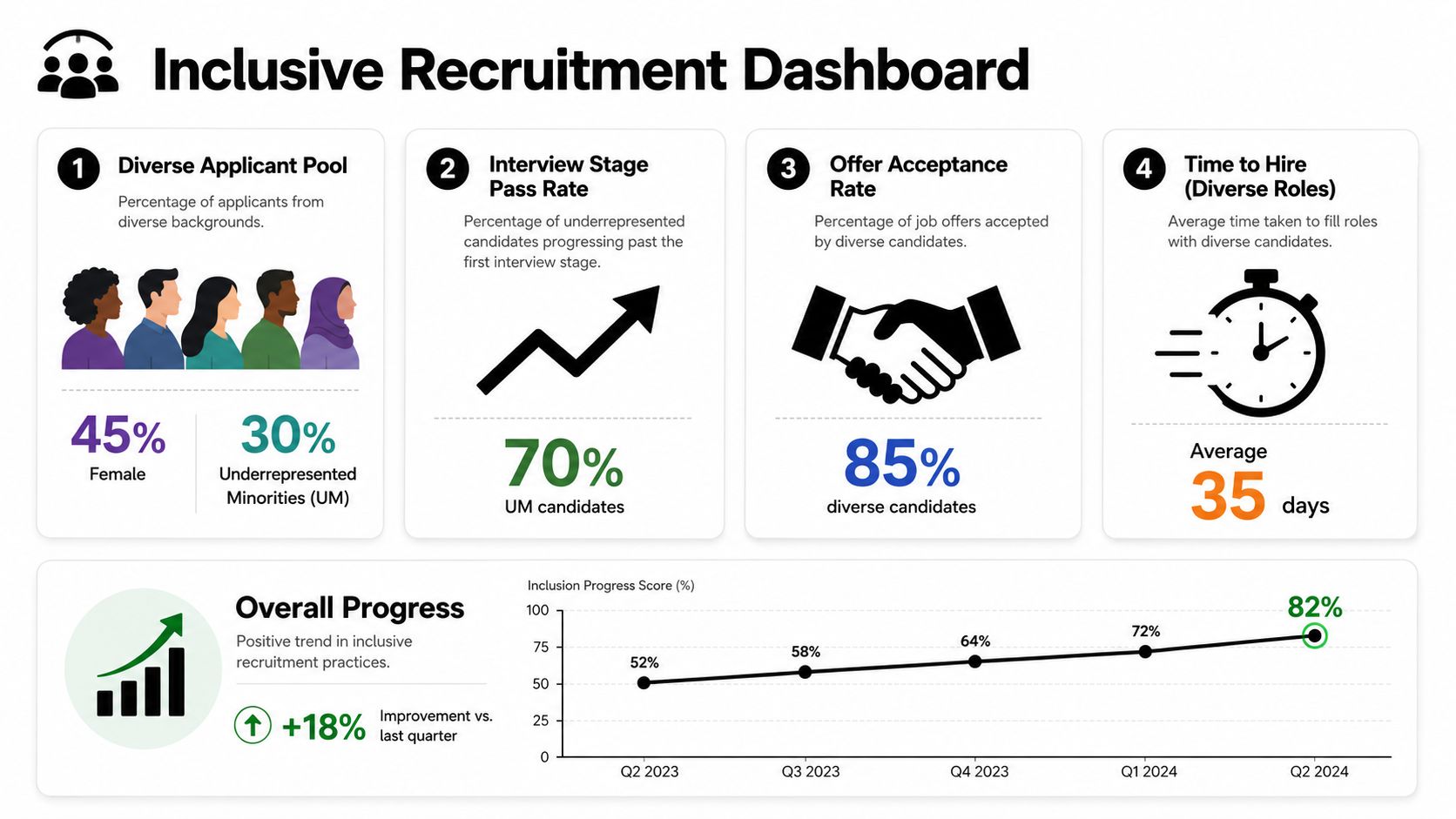
Build the dashboard around decisions
A dashboard should help someone act. If a metric doesn't trigger a question, a change, or a review, it's probably dashboard decoration.
The most useful dashboard structure mirrors the funnel audit from the start of the process. CIPD recommends setting separate diversity conversion targets for each stage of the funnel, and it also notes that only 28% of UK employers train all interviewers on objective interview practice. That gap matters because outcome data without execution data leaves you guessing why results changed.
Track the funnel in layers:
Watch for patterns, not vanity numbers
A single headline metric can hide a lot. You can hit broad applicant diversity and still lose people in screening. You can improve interview progression and still make offers inconsistently. You can even make good hires and create a bad candidate experience that weakens the next cycle.
That's why I prefer a simple review table:
| Dashboard question | What it usually reveals | |---|---| | Where does representation drop most sharply? | Process design or evaluation bias at a specific stage | | Which sources widen the pool but don't convert? | Messaging mismatch or weak screening logic | | Where do interview ratings vary most by panel? | Manager inconsistency and calibration issues | | Which roles generate the most candidate friction? | Poor job design, unclear expectations, or accessibility problems |
> A healthy dashboard doesn't just prove progress. It exposes where your process still behaves unfairly.
Review monthly, redesign quarterly
Don't rebuild the hiring process every time a metric twitches. But don't wait for annual reviews either.
A good rhythm is monthly operational review and quarterly redesign. Monthly review catches execution issues early. Quarterly redesign lets you revisit scorecards, role definitions, sourcing mixes, and interview training based on actual evidence.
That's where inclusive recruitment becomes a management discipline instead of a campaign. The dashboard closes the loop between what you intended, what managers did, and what candidates experienced.
Look Beyond the Hire to Team Integration
This is the part many inclusive recruitment strategies ignore. Getting a diverse candidate through the funnel is not the finish line. It's the start of a different risk.
A team can make a fair hire and still fail that person through poor integration, unmanaged working-style tension, or a manager who only knows how to lead people who operate like they do. If you don't account for that, your hiring process can look inclusive on paper and still produce churn, underperformance, or quiet exclusion.
A 2025 Harvard Business Review Organizational Science study found that 54% of diverse teams fail within 18 months due to unmanaged behavioral tension, not lack of diversity. That's the uncomfortable truth most hiring guides skip. Diversity doesn't break teams. Poor team design and weak integration do.
Stop treating team fit as similarity
The old “fit” model asks whether a candidate feels familiar. That's exactly the wrong standard for inclusive recruitment.
The better question is whether the team can absorb and benefit from different working styles without creating unnecessary friction. Those aren't the same thing. Similarity feels easy in interviews, but it often produces blind spots after hiring. Complementarity is harder to assess, but it's far more useful.
Look at integration through a few practical lenses:
Build inclusion into the first months, not just the offer
A lot of post-hire friction is predictable. Teams just don't inspect it early enough.
Use onboarding and manager planning to make the invisible visible:
> Hiring diversely without integrating deliberately is just moving risk from selection into retention.
The next frontier of inclusive recruitment isn't only reducing bias at the point of selection. It's improving the odds that diverse hires join teams where they can contribute fully, challenge constructively, and stay.
---
If you're trying to make hiring fairer and more predictive at the same time, [Synopsix](https://synopsix.ai) is built for that problem. It helps teams turn validated behavioral assessment data into practical hiring guidance, clearer fit signals, and better decisions about how people will work together after the offer is signed.